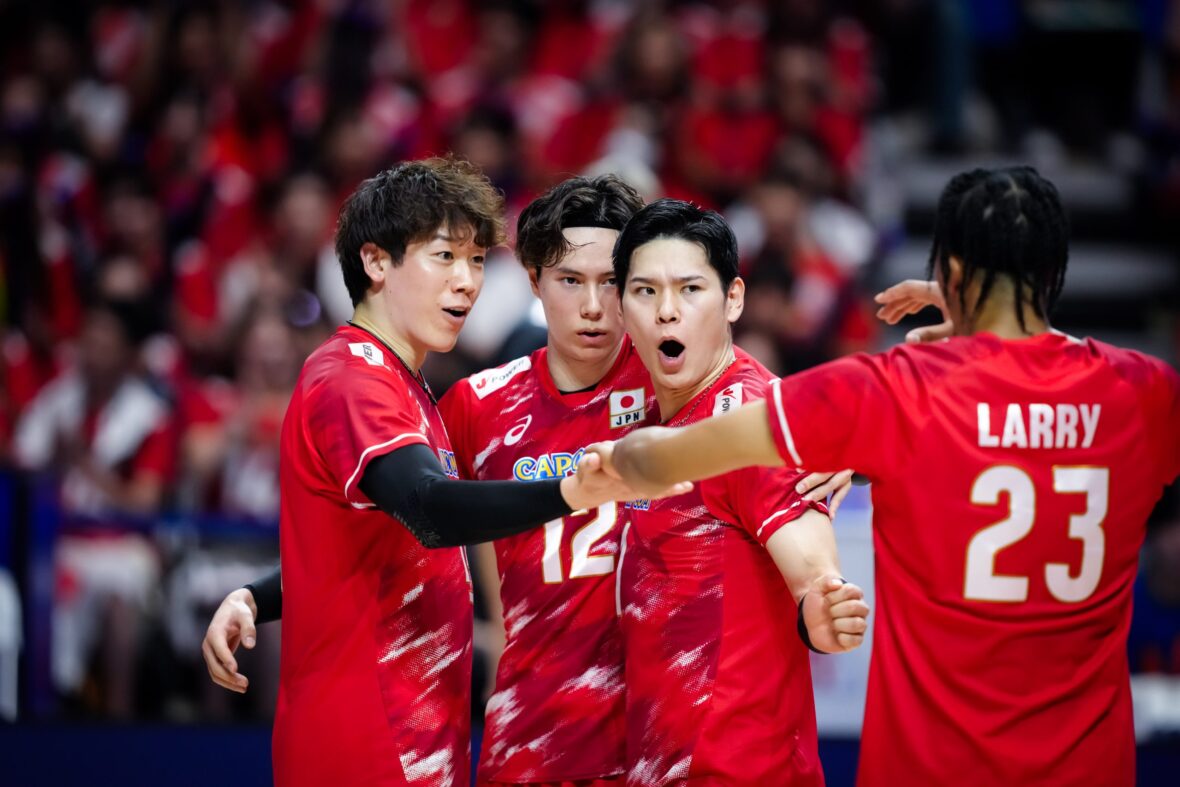
Japan’s men’s volleyball team has made the kind of start its fans were hoping for at the 2026 AVC Men’s Volleyball Continental Championship.
Playing on home soil in Fukuoka, Japan swept through the preliminary round with three wins in three matches, beating Oman, Bahrain and Australia to finish first in Pool A. The team now moves into the quarterfinals, where the stakes become much higher: one loss can end Japan’s championship run.
And there is much more on the line than an Asian title.
The 2026 AVC Men’s Championship is part of the qualification pathway for both the Los Angeles 2028 Olympics and the 2027 FIVB Men’s Volleyball World Cup. The Asian champion earns an Olympic berth, while the three medalists qualify for the 2027 World Cup. (Volleyball World)
For fans following Yuji Nishida, Ran Takahashi, Yuki Ishikawa, Kento Miyaura and the rest of Japan’s national team, here is an updated look at Japan’s AVC 2026 schedule, roster, results, next match and what happens from here.
Content
Japan Men’s Volleyball AVC 2026: Latest Update
As of September 9, Japan has completed the preliminary round with a perfect 3-0 record.
Japan’s results:
| Date | Match | Result |
|---|---|---|
| September 4 | Japan vs Oman | Japan won 3-1 |
| September 6 | Japan vs Bahrain | Japan won 3-0 |
| September 8 | Japan vs Australia | Japan won 3-0 |
| September 10-11 | Quarterfinal | Opponent/time to be confirmed |
| September 12 | Semifinals | If Japan advances |
| September 13 | Final/third-place match | If Japan advances |
Japan finished first in Pool A after its straight-set victory over Australia on September 8. The hosts ended pool play undefeated with only one set lost across three matches.
That means Japan is officially through to the knockout stage.
However, there is one important detail for fans searching for Japan’s next opponent: the quarterfinal pairings are determined by the overall ranking of the eight teams that advance from the preliminary round, not simply by a fixed Pool A-vs-Pool B bracket.
The remaining preliminary matches have to be completed before the final seedings and quarterfinal matchups are confirmed. The JVA says the eight qualified teams will be ranked from No. 1 to No. 8 based on preliminary-round performance before the knockout bracket is formed. (Japan Volleyball Association)
So, as of this update, Japan knows it is in the quarterfinals, but its exact opponent and match time are still awaiting confirmation.
Japan’s Next Match at AVC 2026
Japan’s next match will be in the quarterfinals.
The quarterfinals are scheduled across September 10 and 11 at Kitakyushu City General Gymnasium. The available match times are 3:30 p.m. and 7:30 p.m. Japan time on both days.
For fans in the Philippines, Japan is one hour ahead, so those times correspond to:
- 2:30 p.m. Philippine time
- 6:30 p.m. Philippine time
Japan’s specific quarterfinal slot and opponent will be determined once the preliminary-round standings are finalized.
That makes September 9 an important day even though Japan itself does not play. The remaining results will influence the overall seeding and determine Japan’s path through the knockout bracket.
Japan vs Australia Result: Japan Wins Pool A
Japan closed the preliminary round in convincing fashion on September 8, sweeping Australia:
Japan 3-0 Australia
25-20, 25-13, 25-21
This was arguably Japan’s most important pool-stage match because Australia entered the contest undefeated as well. The winner would finish first in Pool A.
Japan responded with one of its best performances of the tournament.
Yuji Nishida led all scorers with 16 points while attacking at an 82% success rate. Ran Takahashi added 13 points and was especially dangerous from the service line, producing five aces. (Volleyball World)
Japan controlled the second set in particular, winning 25-13, before closing out Australia in three.
The victory gave Japan a 3-0 pool-stage record and first place in Pool A.
It also continued a very encouraging trend: Japan became stronger as the preliminary round progressed.
Japan vs Bahrain Result
Japan’s second match came against Bahrain on September 6.
Japan 3-0 Bahrain
25-15, 25-15, 25-23
Japan was rarely troubled in the opening two sets before Bahrain made the third much more competitive.
Once again, Ran Takahashi was right at the center of Japan’s offense.
Takahashi finished with a match-high 19 points, including three service aces and one block. He converted 71% of his attacks. Captain Yuki Ishikawa contributed 12 points, including three blocks.
The result moved Japan to 2-0 and essentially put the hosts on the doorstep of the quarterfinals.
Japan vs Oman Result
Japan opened its AVC campaign against Oman on September 4.
Japan 3-1 Oman
25-18, 25-13, 20-25, 25-9
It wasn’t quite the straight-set victory many expected.
Japan dominated the first two sets but lost the third 20-25. Oman’s resistance briefly made the match interesting before Japan responded emphatically by taking the fourth set 25-9.
Ran Takahashi and Yuki Ishikawa were Japan’s leading scorers with 19 points each.
Both players also recorded five aces, while Yuji Nishida contributed another 14 points. (Volleyball World)
If there was a positive takeaway from dropping the third set, it was Japan’s response. Instead of allowing Oman back into the match, Japan immediately took control again.
And that third set remains the only set Japan has lost so far at AVC 2026.
Japan’s AVC 2026 Preliminary-Round Record
Japan’s Pool A performance can be summarized simply:
- Matches played: 3
- Wins: 3
- Losses: 0
- Sets won: 9
- Sets lost: 1
- Pool finish: 1st
- Status: Qualified for quarterfinals
Japan defeated every other Pool A team:
Oman → Bahrain → Australia.
The improvement between the first and third matches has been noticeable as well. Oman managed to take a set, while Bahrain and Australia were both swept.
Japan Men’s Volleyball AVC 2026 Roster
Japan brought a strong 14-man squad to Fukuoka.
The official tournament roster includes many of the players volleyball fans already know from the VNL and other major international competitions. (Japan Volleyball Association)
| No. | Player | Position |
|---|---|---|
| 1 | Yuji Nishida | Opposite |
| 2 | Taishi Onodera | Middle Blocker |
| 3 | Hideomi Fukatsu | Setter |
| 4 | Kento Miyaura | Opposite |
| 5 | Tatsunori Otsuka | Outside Hitter |
| 6 | Akihiro Yamauchi | Middle Blocker |
| 9 | Yudai Kawahigashi | Setter |
| 11 | Shoma Tomita | Outside Hitter |
| 12 | Ran Takahashi | Outside Hitter |
| 13 | Tomohiro Ogawa | Libero |
| 14 | Yuki Ishikawa | Outside Hitter |
| 17 | Keigo Nishimoto | Middle Blocker |
| 20 | Tomohiro Yamamoto | Libero |
| 23 | Larry Evbade-Dan | Middle Blocker |
Japan’s head coach for the tournament is Laurent Tillie. (Japan Volleyball Association)
It is a roster with considerable flexibility.
Japan has Nishida and Miyaura at opposite, one of the strongest one-two options at that position in Asian volleyball. On the outside, Ishikawa, Takahashi, Otsuka and Tomita give Japan several attacking and receiving combinations.
The middle-blocker group includes Onodera, Yamauchi, Nishimoto and Evbade-Dan, while Fukatsu and Kawahigashi handle the setting duties.
Ran Takahashi Has Been One of Japan’s Standout Players
One of the biggest stories of Japan’s tournament so far has been Ran Takahashi.
His first two matches were particularly impressive.
Against Oman:
19 points
5 aces
Against Bahrain:
19 points
3 aces
1 block
71% attacking success
Against Australia:
13 points
5 aces
70% attacking success
The serving numbers immediately stand out.
Takahashi’s ability to put opponents under pressure from the service line has given Japan another way to score beyond its traditionally quick and efficient attack.
He also gives Japan tremendous value in reception and defense, which becomes increasingly important against stronger opponents in the knockout stage.
Yuji Nishida Is Heating Up
Yuji Nishida is another player to watch closely as Japan enters the quarterfinals.
Nishida started with 14 points against Oman before producing an especially efficient performance against Australia.
He scored 16 points against the Australians and converted an impressive 82% of his attacking attempts. (Volleyball World)
That is exactly the type of Nishida performance Japan will want in the knockout rounds.
When Nishida is scoring efficiently from the opposite position, defenses cannot simply concentrate on Ishikawa and Takahashi.
And Japan still has Kento Miyaura available as another elite option at opposite.
What About Kento Miyaura?
Miyaura’s presence is one of the reasons this Japanese roster is so deep.
Japan does not necessarily need to rely exclusively on Nishida at opposite. Miyaura brings a different attacking option and gives the coaching staff more flexibility depending on the matchup, rotation and condition of the players.
He is one of 14 players officially selected for this tournament and remains an important weapon as Japan moves into the more demanding knockout stage. (Japan Volleyball Association)
This becomes particularly valuable if Japan has to play several high-pressure matches in a short period.
A quarterfinal, semifinal and final could all come within a span of only a few days.
Yuki Ishikawa Remains Japan’s Captain
Yuki Ishikawa continues to serve as the leader of the team.
He opened the tournament with 19 points against Oman and then scored 12 against Bahrain, including three blocks. (Volleyball World)
Even when he isn’t Japan’s top scorer, Ishikawa’s role goes well beyond point production.
His reception, attacking range, experience and leadership become particularly important in close sets — exactly the kind of situations Japan is likely to encounter as the competition moves deeper into the knockout phase.
How the AVC 2026 Format Works
There are 12 teams competing in Fukuoka.
They were divided into three pools of four teams:
Pool A
Japan
Australia
Bahrain
Oman
Pool B
Iran
China
India
New Zealand
Pool C
Qatar
Korea
Chinese Taipei
Thailand
The top two teams from each pool advance automatically to the quarterfinals.
That’s six teams.
The two best third-place teams across the three pools also qualify, giving the tournament eight quarterfinalists.
Here’s where the format becomes especially important for Japan.
The teams aren’t simply paired according to which pool they came from. Instead, the eight quarterfinalists are ranked from No. 1 through No. 8 using their preliminary-round results.
Those rankings then determine the quarterfinal matchups.
That is why Japan’s next opponent was not immediately known after defeating Australia.
AVC 2026 Final-Round Schedule
The tournament runs until September 13.
According to the official JVA schedule: (Japan Volleyball Association)
| Round | Date |
|---|---|
| Quarterfinals | September 10-11 |
| Semifinals | September 12 |
| Third-place match | September 13 |
| Final | September 13 |
The semifinals are scheduled for 3:30 p.m. and 7:30 p.m. Japan time on September 12.
The bronze-medal match is scheduled for 3:30 p.m. on September 13, followed by the championship match at 7:30 p.m.
For Philippine viewers, subtract one hour.
That puts the final at approximately 6:30 p.m. Philippine time.
Why Winning AVC 2026 Matters So Much
Usually, winning an Asian Championship would already be enough motivation.
This year, however, the reward is much bigger.
The winner of the AVC Men’s Championship earns Asia’s first direct men’s volleyball qualification berth for the Los Angeles 2028 Olympic Games. (Volleyball World)
That means Japan could secure its Olympic place almost two years before LA 2028 begins.
There is another incentive.
The top three teams — gold, silver and bronze medalists — qualify for the 2027 FIVB Men’s Volleyball World Cup. (Volleyball World)
So the tournament has two qualification targets:
Win the tournament
→ Qualify for LA 2028
Finish in the top three
→ Qualify for the 2027 World Cup
That dramatically raises the stakes once the quarterfinals begin.
Who Could Challenge Japan?
Japan may be one of the strongest teams in the field, but the knockout rounds are unlikely to be straightforward.
Iran remains one of Asia’s major powers, while teams such as Korea, China, Australia, Qatar, Thailand and Chinese Taipei can become dangerous in a single elimination match.
The key difference now is that Japan no longer has room for an off-night.
Pool play allows teams to recover from one poor performance.
The quarterfinals do not.
Win, and Japan moves closer to the Asian title and an Olympic ticket.
Lose, and that path ends.
Where to Watch Japan at AVC 2026
Volleyball World says the entire AVC Men’s Volleyball Asian Championship is being streamed live and on demand through VBTV. (Volleyball World)
Fans should check the official Volleyball World and Japan Volleyball Association schedules close to match day because quarterfinal pairings and times can change as the bracket is finalized.
For Filipino fans in particular, remember that Japan time is one hour ahead of Philippine time.
So:
7:30 p.m. Japan → 6:30 p.m. Philippines
3:30 p.m. Japan → 2:30 p.m. Philippines
What’s Next for Japan?
For now, Japan has accomplished its first objective.
Three games.
Three victories.
First place in Pool A.
But the tournament effectively starts again in the quarterfinals.
Japan’s stars have also arrived in good form. Ran Takahashi has been serving extremely well, Yuji Nishida delivered a highly efficient performance against Australia, and captain Yuki Ishikawa has already produced several strong all-around matches.
And behind them is a deep roster that includes Kento Miyaura, Tatsunori Otsuka, Taishi Onodera, Tomohiro Yamamoto and other experienced national-team players.
The next question is simple:
Who will Japan face in the quarterfinals?
That answer will be confirmed once the preliminary round is completed and the eight qualified teams are seeded.
Japan AVC 2026 Schedule and Results at a Glance
| Date | Match | Result/Status |
|---|---|---|
| Sept. 4 | Japan vs Oman | W 3-1 |
| Sept. 6 | Japan vs Bahrain | W 3-0 |
| Sept. 8 | Japan vs Australia | W 3-0 |
| Sept. 10-11 | Quarterfinal | TBD |
| Sept. 12 | Semifinal | If qualified |
| Sept. 13 | Final/bronze match | If qualified |

Final Thoughts
Japan couldn’t have asked for much more from the preliminary round of the 2026 AVC Men’s Volleyball Championship.
The hosts went undefeated, finished first in their group and appear to be building momentum at exactly the right time.
Ran Takahashi has been one of the tournament’s most productive players. Yuji Nishida is finding his rhythm. Yuki Ishikawa continues to provide leadership and scoring. And Japan still has players such as Kento Miyaura ready to make an impact as the matches become more difficult.
But the comfortable part of the tournament is now over.
From the quarterfinals onward, every match carries championship, World Cup and Olympic implications.
Japan’s next opponent is still to be finalized as of September 9, but one thing is already certain: the road to Los Angeles 2028 is about to become much more intense.