Some festivals are named after a product.
Others take their names from a patron saint.
Kialegnon Festival is different.
Its name reaches back to what Magsaysay, Davao del Sur was called before it became Magsaysay.
Kialeg.
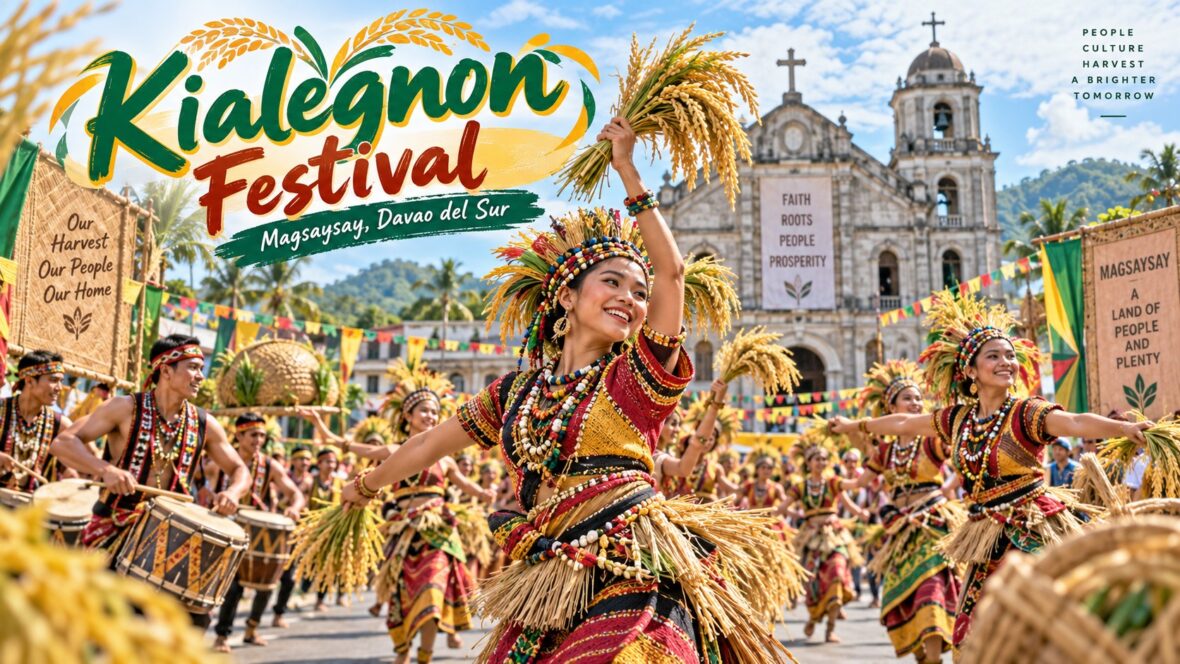
Every September, this agricultural municipality celebrates its harvest, indigenous heritage, local culture and community identity through the Kialegnon Festival. Over the years, the celebration has included street dancing, tribal presentations, beauty and cultural searches, school performances, traditional games, agricultural activities, livestock competitions and a grand parade.
At first glance, it looks like another colorful Mindanao harvest festival.
But the story goes much deeper.
Kialeg was the old name of the community that eventually became Magsaysay. Local history connects that name with a native chieftain remembered for bravery. The Municipality of Magsaysay says the town was commonly known as Kialeg in the early 1950s and that the name came from a local chieftain who was killed in a duel with another chieftain named Guinang.
That old name never completely disappeared.
Residents are still referred to as Kialegnons.
And every September, the festival brings that older identity back into the center of town.
At the same time, Kialegnon is very much a harvest celebration.
Magsaysay is widely recognized locally as the Rice Granary of Davao del Sur, and farming remains central to the municipality’s economy. The LGU says its wide rice fields are among its greatest resources and that agriculture provides livelihood for a large portion of local families.
So Kialegnon Festival really tells two stories at the same time.
It looks backward toward the people and culture that came before modern Magsaysay.
And it looks toward the fields surrounding the town and says:
This is what sustains us today.
Content
Kialegnon Festival at a Glance
| Details | Information |
|---|---|
| Festival | Kialegnon Festival |
| Location | Magsaysay, Davao del Sur |
| Region | Davao Region / Region XI |
| Main festival date | September 28 |
| Traditional festival period | Usually during the final week of September |
| Festival type | Cultural, indigenous and harvest thanksgiving |
| Main themes | Harvest, culture, indigenous heritage and community identity |
| Old name of Magsaysay | Kialeg |
| Name associated with | Datu Kialeg |
| Major agricultural product | Rice |
| Other products | Corn, rubber, Cardava banana, cacao, coffee, copra and mango |
| Famous identity | Rice Granary of Davao del Sur |
| Major attractions through the years | Street dancing, grand parade, Hiyas sa Kialeg, tribal events and traditional games |
| Municipality formally created | June 17, 1967 |
The Provincial Government of Davao del Sur currently lists Kialegnon Festival as Magsaysay’s official festival and gives September 28 as the principal date.
What Is Kialegnon Festival?
Kialegnon Festival is Magsaysay’s annual cultural and harvest thanksgiving celebration.
It recognizes the municipality’s agricultural abundance while also putting considerable attention on local indigenous heritage.
Older festival coverage describes it as a celebration of the harvest and of the cultural traditions of Magsaysay’s communities. During the fifth Kialegnon Festival in 2012, the local mayor explained that organizers deliberately placed the celebration in September because it coincided with harvest season.
That explains why so many traditional festival activities revolve around rural life.
Carabaos.
Horses.
Farm games.
Rice.
Agricultural displays.
Physical contests.
Street dancing.
And cultural performances.
But the harvest is only one side of Kialegnon.
The festival name itself points back to the community’s indigenous and historical roots.
That makes it different from a festival built purely around agricultural products.
What Does “Kialegnon” Mean?
The easiest way to understand the name is:
Kialeg + non.
Kialeg was the old name of the community.
“Kialegnon” refers to a person from Kialeg or someone belonging to the community.
Even today, the Magsaysay municipal government uses Kialegnon when referring to local residents.
The festival therefore has a very direct meaning.
It is essentially the festival of the people of Kialeg.
The name survived even after Kialeg was officially renamed Magsaysay in 1959.
Republic Act No. 2106 formally changed Barrio Kialeg in the Municipality of Bansalan to Barrio Magsaysay on April 3, 1959.
But laws can change a place name much faster than they change community memory.
Kialeg remained part of the local identity.
And decades later, that old name became the title of the festival.
The Story of Datu Kialeg
The name Kialeg is traditionally connected with a native chieftain.
The Municipality of Magsaysay says Kialeg was named after a chieftain known for bravery who was later killed in a duel with another local chieftain named Guinang.
The municipality’s forest land-use plan gives a little more context.
It describes Magsaysay as an ancestral homeland of B’laan and Bagobo communities and says that local tradition remembers a duel between Datu Kialeg and Datu Guinang. After Datu Kialeg’s death, tribal residents named the place Kialeg in his honor.
Another local festival account describes Datu Kialeg as a legendary B’laan leader remembered for defending his community.
Like many old community stories, the exact details have been passed down through local historical tradition rather than through one single contemporary written account.
So the safest way to understand Datu Kialeg is as a central figure in Magsaysay’s local origin story.
What matters culturally is what he represents.
Bravery.
Leadership.
Protection of the community.
And an indigenous past that predates the town’s modern name.
Why the Old Name Matters
Think about how unusual this is.
The municipality is officially called Magsaysay.
It has been called Magsaysay for decades.
Yet the biggest cultural festival is called Kialegnon.
That tells you how powerful old names can be.
A place name isn’t just something written on a road sign.
It can contain a memory.
A story.
A family identity.
A connection with people who were there before today’s municipal boundaries existed.
By using the name Kialegnon, the festival brings that older identity into the present every September.
Indigenous Heritage of Magsaysay
Magsaysay’s cultural story cannot be told only through settlers and agriculture.
The municipal government identifies the area as historically connected with B’laan and Bagobo peoples. Its cultural profile describes the municipality as part of the traditional homeland of these communities.
Migration later changed the population.
Cebuano and Ilocano settlers moved into the area.
Farming expanded.
Communities developed in different parts of the municipality.
But indigenous groups remained part of Magsaysay’s cultural landscape.
This is one reason Kialegnon Festival has repeatedly featured indigenous events and cultural presentations.
The festival isn’t simply borrowing tribal-looking designs because they are colorful.
The indigenous story is part of the history behind the town itself.
Kialegnon as an Indigenous Peoples’ Celebration
Some local documentation even describes Kialegnon Festival as part of Magsaysay’s Indigenous Peoples’ Week.
Research on B’laan communities in the municipality has cited Kialegnon as an annual venue for showcasing indigenous traditions and strengthening recognition of local tribal culture.
This gives the festival another purpose.
It isn’t only about entertaining crowds.
It can create space for indigenous communities to present traditions to younger generations and to residents who may have little direct exposure to them.
That matters because cultural knowledge can disappear surprisingly quickly.
Language.
Stories.
Rituals.
Songs.
Traditional skills.
Once younger generations stop learning them, rebuilding that knowledge becomes difficult.
Festivals can’t solve that problem alone.
But they can make traditions visible.
A Note About “Tribal-Inspired” Festival Costumes
This distinction is important when watching Kialegnon.
A school street-dancing costume inspired by B’laan or Bagobo colors is not automatically an authentic ceremonial garment.
Festival choreography is theater.
Real indigenous culture belongs to living communities.
There is a difference between:
a choreographer interpreting tribal imagery,
and
B’laan or Bagobo participants representing their own traditions.
Visitors and photographers should keep that distinction in mind.
The most respectful way to experience cultural presentations is to understand them as more than decoration.
The Search for Hiyas sa Kialeg
One of the festival’s most distinctive events through the years has been the Search for Hiyas sa Kialeg.
This isn’t simply a standard municipal beauty pageant.
In the 2016 edition, the competition featured 18 candidates representing tribal barangays, with organizers identifying B’laan, Bagobo and Igorot communities among the indigenous groups represented.
Candidates participated in cultural and talent activities before the coronation.
That gives Hiyas sa Kialeg a stronger heritage component than a typical evening gown competition.
The event gives young women an opportunity to represent communities and cultural identities while participating in one of the festival’s biggest stage programs.
Why September Is Harvest Season in Kialeg
Now we get to the agricultural side of the festival.
When the fifth Kialegnon Festival was held in 2012, the mayor directly explained why September was chosen.
Harvest.
He said the municipality intentionally celebrated during the month because September was harvest time in Magsaysay.
This makes Kialegnon a real harvest-season festival rather than an event that simply added farm decorations later.
The fields determine the timing.
And in a municipality whose economy remains strongly tied to agriculture, harvest affects almost everyone.
Magsaysay: Rice Granary of Davao del Sur
Rice is especially important.
The Municipality of Magsaysay itself calls the town the Rice Granary of Davao del Sur and describes agriculture as one of its proudest assets.
Galing Pook has also documented the scale of local dependence on farming, noting that a large share of the municipal workforce relies on agriculture and that rice production has been a major livelihood.
This helps explain why Kialegnon looks and feels the way it does.
A rice-producing town celebrates differently from an urban commercial city.
Fields matter.
Weather matters.
Irrigation matters.
Farm animals matter.
Harvest timing matters.
And when the crop is good, thanksgiving has a practical meaning.
Rice Isn’t the Only Crop
Rice gets the most attention, but Magsaysay grows much more.
The Provincial Government of Davao del Sur lists the municipality’s major products as:
rice,
corn,
rubber,
Cardava banana,
cacao,
coffee,
copra,
and mango.
That is a diverse agricultural base.
So the phrase “harvest festival” should be understood broadly.
Kialegnon isn’t celebrating one crop.
It celebrates an agricultural municipality.
MagRice and Organic Farming
Magsaysay has also developed a more modern agricultural identity around organic rice.
The Philippine Information Agency has highlighted MagRice, a Magsaysay-grown organic rice product available in brown, red and black varieties. The municipality began promoting diversified organic farming in the early 2000s and partnered with farming organizations to train growers in organic production.
This is a useful reminder that harvest festivals aren’t only about nostalgia.
Agriculture changes.
Farmers adopt new methods.
Consumers develop new preferences.
Local governments invest in sustainability.
So while Kialegnon may celebrate traditional rural life, the farms surrounding the festival are also evolving.
Indak-Indak sa Kadalanan
Street dancing has traditionally been one of Kialegnon Festival’s biggest crowd attractions.
Older festival programs identify the event as Indak-Indak sa Kadalanan.
School and community performers take over Magsaysay’s streets in colorful costumes while percussion and music drive the choreography.
The themes can combine:
agriculture,
harvest,
local history,
indigenous culture,
community pride,
and thanksgiving.
During the fifth festival, Indak-Indak sa Kadalanan was listed alongside traditional rural competitions and the grand parade.
Street dancing gives Kialegnon its most visually dramatic side.
But the best performances make more sense once you know the history behind the name.
What Does Kialegnon Street Dancing Look Like?
There is no single permanent Kialegnon costume.
Themes change from year to year.
Expect festival interpretations using:
earth colors,
red,
yellow,
green,
woven-looking patterns,
beads,
feather-like decorations,
rice stalks,
farm props,
baskets,
large headdresses,
and indigenous-inspired visual motifs.
One contingent may focus on farmers.
Another might portray Datu Kialeg.
Another may emphasize B’laan heritage.
Another could tell the story of the harvest.
This flexibility keeps the festival visually interesting.
But again, festival costumes should not automatically be treated as documentary representations of indigenous clothing.
They are artistic interpretations.
The Grand Parade
Historically, Kialegnon has built toward September 28 with a grand parade.
In 2012, the weeklong festival culminated on that date with a major parade through the municipality.
The parade creates space for more than dancers.
Schools.
Government offices.
Community organizations.
Musicians.
Barangays.
Cultural groups.
Festival candidates.
All can become part of the procession.
In a smaller municipality, this can feel very different from a giant city parade.
The spectators may personally know the performers.
Parents are watching children.
Teachers are watching students.
Barangays cheer for their own representatives.
It feels local.
Kialegnon Beat
Secondary-school students have also been featured through events such as Kialegnon Beat.
During the 2016 festival, organizers scheduled Kialegnon Beat following an elementary-school band competition on September 28.
These school-based competitions are an important part of how festival culture survives.
Today’s student drummer becomes tomorrow’s trainer.
Today’s dancer becomes a choreographer.
Today’s young singer eventually helps organize another festival.
The celebration teaches the next generation how to stage the celebration.
Tingog sa Kialeg
Music also has its own place.
The 2016 program included Tingog sa Kialeg, an inter-high-school singing competition held before the Hiyas sa Kialeg coronation activities.
The name means something like the Voice of Kialeg.
Again, notice how the old community name keeps returning.
Kialegnon.
Hiyas sa Kialeg.
Tingog sa Kialeg.
The festival repeatedly reminds residents that Magsaysay had another identity before it became Magsaysay.
The Traditional Rural Games of Kialegnon
This is one of the things I like most about the festival.
Kialegnon has historically included games that actually make sense in a farming municipality.
Not generic carnival activities.
Rural competitions.
Lumba sa Karabao
Carabao racing.
The carabao is one of the most recognizable symbols of Philippine farming.
During Kialegnon, it becomes part of the festival competition.
Karabao Makeover
Yes.
Decorating carabaos has also appeared in festival programs.
It’s playful, but it also gives farmers and their animals a place in the celebration.
Lumba sa Kabayo
Horse racing has likewise been part of past festivities.
Pig Catching
Exactly what it sounds like.
Simple.
Chaotic.
Probably more difficult than spectators expect.
Bamboo Pole Climbing
Another traditional challenge requiring strength, balance and determination.
These activities appeared in accounts of the festival’s earlier editions.
They give Kialegnon a personality that is hard to recreate in an urban festival.
The Kialegnon Megathon
Festival organizers have also experimented with endurance and community challenges.
Past programs featured a Kialegnon Megathon combining activities such as running, walking, cycling-style events, traditional racing and a carabao-balsa component.
The exact events can change.
But the overall spirit fits Kialegnon.
Strength.
Endurance.
Community participation.
And activities connected with rural life.
Why Carabaos Belong in the Festival
A carabao isn’t just a cute festival prop.
For generations of Filipino farmers, it represented work.
Plowing.
Transport.
Farm labor.
And resilience.
Modern machinery has changed agriculture, but the carabao remains deeply symbolic.
So when Kialegnon holds carabao-related activities, it is bringing rural livelihood into the center of the festival.
That makes much more cultural sense than simply putting another decorative float on the road.
When Did Kialegnon Festival Begin?
The exact founding ordinance is not easily available online, but festival numbering gives us a strong timeline.
Magsaysay celebrated its fifth Kialegnon Festival in 2012.
The ninth edition was held in 2016.
If those editions were held annually without interruption, the modern Kialegnon Festival would trace back to approximately:
2008
The 2012 local report also said the mayor at the time had started the festival.
So Kialegnon is not an ancient festival performed unchanged for centuries.
It is a modern cultural celebration built around much older elements:
indigenous history,
the name Kialeg,
agriculture,
harvest,
and local identity.
That distinction is important.
The festival is modern.
The stories it tells are older.
A Short History of Magsaysay
Today’s Magsaysay used to be part of Bansalan.
The community was widely known as Kialeg.
In 1959, Republic Act No. 2106 officially changed the name of Barrio Kialeg to Barrio Magsaysay in honor of President Ramon Magsaysay, who had died in a plane crash in 1957.
Then came the complicated process of becoming a municipality.
President Diosdado Macapagal issued Executive Order No. 103 on September 28, 1964 creating the Municipality of Magsaysay from barrios formerly belonging to Bansalan.
That first municipal creation was later invalidated following a Supreme Court ruling affecting municipalities created by executive order.
The movement to establish Magsaysay continued.
The present municipality was ultimately created by law, and the Provincial Government of Davao del Sur recognizes:
June 17, 1967
as Magsaysay’s official date of creation.
That is why Magsaysay has two major civic dates worth distinguishing.
June 17 relates to Araw ng Magsaysay.
September 28 is associated with Kialegnon Festival.
Kialegnon Festival vs. Araw ng Magsaysay
These are not the same celebration.
Araw ng Magsaysay
Celebrated around June 17.
It marks the municipality’s creation.
Kialegnon Festival
Celebrated in September.
It focuses on harvest, culture, indigenous heritage and the Kialegnon identity.
Interestingly, September 28 was also the date of Executive Order No. 103 in 1964, the earlier attempt to create Magsaysay municipality.
However, the better-documented reason for celebrating Kialegnon in September is harvest season. Festival organizers themselves have said that September was chosen because it is the town’s harvest period.
Environmental and Community Programs During Kialegnon
Kialegnon has also become a convenient annual venue for recognizing barangays and community programs.
Magsaysay’s ecological solid-waste plan says the municipality has used the festival to award barangays performing well in waste segregation and Gulayan sa Barangay activities.
This is a good example of how modern festivals evolve.
They are not only cultural performances.
Local governments use them to:
recognize communities,
promote environmental programs,
reward farmers,
highlight local products,
and encourage public participation.
The festival becomes the biggest stage in town.
So the municipality uses it.
What Makes Kialegnon Different?
Davao del Sur has several festivals.
So why does Kialegnon stand out?
I think there are four reasons.
1. The festival uses the town’s old name
That gives it a built-in historical identity.
2. The indigenous story is central
Datu Kialeg, B’laan and Bagobo heritage all connect directly with the origins of the place.
3. Harvest isn’t just a theme
Magsaysay is a major farming municipality and rice-producing area.
4. The traditional events reflect actual rural life
Carabaos.
Horses.
Farm contests.
Agriculture.
These things make sense here.
Kialegnon isn’t trying to become a copy of a major urban festival.
It works best when it stays recognizably Magsaysay.
When Is Kialegnon Festival Celebrated?
The most important date is:
September 28
The Provincial Government of Davao del Sur officially lists Kialegnon Festival on September 28.
Older festival schedules show activities taking place during the days leading toward the 28th.
Some references list September 23–28 as the broader festival period.
The exact duration has changed depending on the edition.
For example:
the 2012 celebration was described as weeklong,
while the 2016 festival ran as a three-day main celebration from September 26 to 28.
So the safest rule is:
September 28 is the key date.
Check the official program for the days before it.
Visiting Kialegnon Festival
If you’re traveling specifically for Kialegnon, don’t wait until the afternoon of September 28 before arriving.
Come earlier.
If the year’s schedule follows the historical pattern, competitions and community events may already be underway before the culmination.
Arriving early also lets you explore Magsaysay before festival traffic affects movement around the poblacion.
Watch More Than the Street Dancing
Street dancing will probably produce your favorite photographs.
But don’t make it the only event you watch.
If available during your visit, I’d also prioritize:
an indigenous cultural presentation,
an agricultural activity,
Hiyas sa Kialeg,
and at least one traditional rural competition.
Those events explain Kialegnon much better than street dancing alone.
Respect Indigenous Communities
Magsaysay’s B’laan and Bagobo heritage isn’t a tourist costume.
If you attend an indigenous cultural activity, remember that you are seeing parts of a living tradition.
Ask before photographing people in more personal or ceremonial situations.
Don’t interrupt rituals to get a better angle.
And don’t assume every cultural object exists only for festival entertainment.
Prepare for September Weather
Bring both sun and rain protection.
Mindanao weather can change quickly.
You may begin the morning under intense sunlight and finish the afternoon dealing with rain.
Comfortable shoes are essential.
Bring water.
And protect your phone or camera.
Festival performers may keep dancing through bad weather.
Your electronics won’t appreciate the same challenge.
Getting to Magsaysay, Davao del Sur
Magsaysay is a landlocked municipality in Davao del Sur.
It sits west of Bansalan and near the boundary with North Cotabato, with road connections linking it to neighboring municipalities. The provincial government identifies Magsaysay as a daughter municipality of Bansalan.
For travelers arriving from outside Mindanao, Davao City is a major air gateway before continuing overland into Davao del Sur.
Depending on where you’re coming from, routes through Digos, Bansalan or nearby areas may form part of the journey.
Check current bus and van routes before traveling because terminal arrangements and schedules can change.
Magsaysay Beyond Kialegnon
Festival visitors who stay longer will find that Magsaysay is also developing a strong agro-tourism and nature-adventure identity.
The municipal government promotes the town as an agro-tourism destination and highlights caves, cliffs, waterfalls and rainforest areas.
That gives you a completely different Magsaysay after festival day.
One day:
drums, dancers and crowds.
The next:
rivers, rock formations and forest.
Mapunggis Rainforest
One of the municipality’s standout nature areas is Mapunggis Rainforest.
The LGU describes a river hike through rainforest terrain with numerous cascading falls and endemic plants and wildlife.
This is more adventure tourism than casual sightseeing.
Check current accessibility and local guide arrangements before attempting the route.
Malawanit Limestone Cliff and Blasan Falls
Barangay Malawanit is another adventure destination promoted by the municipality.
The area includes limestone cliffs and cascading waterfalls, with activities such as hiking, rappelling and rock climbing promoted for experienced adventure visitors.
Again, this isn’t the kind of place where you should simply arrive alone with sandals and hope for the best.
Coordinate locally.
Stafungsol Cave
Magsaysay also promotes Stafungsol Cave in Barangay Malawanit.
The LGU says regional environment officials have assessed the cave and described its formations as having significant tourism potential.
Cave conditions and management rules can change, so verify access before traveling.
Datal Lanao and Other Natural Areas
The municipality’s tourism inventory also includes lakes, springs, waterfalls, caves and upland viewpoints in several barangays.
That landscape fits the festival’s rural identity.
Magsaysay isn’t an urban town surrounded by decorative farms.
Agriculture and nature genuinely dominate much of the municipality.
What to Eat During Kialegnon
Start with rice.
That sounds obvious, but this is the Rice Granary of Davao del Sur.
If you encounter MagRice products, they are particularly worth trying because they represent Magsaysay’s push into organic farming and value-added agriculture.
The locally produced organic rice includes brown, black and red varieties.
Festival trade areas can also be good places to look for:
cacao products,
coffee,
bananas,
mangoes,
local vegetables,
and processed agricultural goods.
The most useful souvenirs from a harvest festival are often edible.
Kialegnon Festival Frequently Asked Questions
Where is Kialegnon Festival celebrated?
Kialegnon Festival is celebrated in Magsaysay, Davao del Sur.
When is Kialegnon Festival?
The principal festival date is September 28.
The broader celebration may begin several days earlier depending on the year’s program.
What does Kialegnon mean?
Kialegnon refers to a resident or person associated with Kialeg, the old name of the community now known as Magsaysay.
Who was Datu Kialeg?
Local history remembers Kialeg as a brave indigenous chieftain. Municipal records say the old settlement was named after him following his death in a duel with another chieftain named Guinang.
Why was Kialeg renamed Magsaysay?
Republic Act No. 2106 changed Barrio Kialeg to Barrio Magsaysay in 1959 in honor of President Ramon Magsaysay.
Is Kialegnon a harvest festival?
Yes.
It is an annual thanksgiving celebration associated with the municipality’s September harvest season. Historical festival organizers specifically identified the harvest as one reason for holding Kialegnon in September.
Why is rice important to Kialegnon Festival?
Magsaysay is known as the Rice Granary of Davao del Sur and rice farming remains one of the municipality’s major livelihoods.
What are the main Kialegnon Festival activities?
Programs have varied through the years but have included street dancing, a grand parade, Hiyas sa Kialeg, school band competitions, singing contests, indigenous cultural activities, carabao racing, horse racing, farm games and community events.
What is Hiyas sa Kialeg?
It is one of the festival’s major cultural pageants, historically featuring young women representing tribal barangays and indigenous communities.
Are B’laan communities part of Kialegnon Festival?
Yes.
B’laan heritage is strongly connected with the story of Kialeg and Magsaysay, and indigenous cultural recognition has been one of the festival’s important themes.
Is Kialegnon Festival the same as Araw ng Magsaysay?
No.
Araw ng Magsaysay commemorates the municipality’s official creation on June 17.
Kialegnon Festival is the September cultural and harvest celebration.
When did Kialegnon Festival begin?
Available festival numbering strongly suggests the modern festival began around 2008.
Magsaysay celebrated its fifth edition in 2012 and ninth edition in 2016.
Because I have not found an official founding ordinance naming the exact inaugural date, around 2008 is the safer way to state it.
Kialegnon Festival 2026
This article is designed to remain useful from year to year, but travelers planning specifically for 2026 should keep one confirmed date in mind:
September 28, 2026
The Provincial Government of Davao del Sur continues to list September 28 as the official Kialegnon Festival date for Magsaysay.
Older festival patterns often place activities during the final several days before September 28, sometimes beginning around September 23 or later.
As of September 12, 2026, however, I have not found a reliable complete official public timetable covering every Kialegnon Festival 2026 activity, including street dancing, Hiyas sa Kialeg, cultural presentations, agricultural competitions and evening events.
That means the date is established, but the full schedule should still be checked against the latest announcements from the Municipality of Magsaysay and Davao del Sur tourism offices before traveling.
If the festival follows its traditional structure, the final days leading to September 28 are the period to watch.
Final Thoughts
Kialegnon Festival is much easier to appreciate once you stop thinking of it as simply a harvest celebration.
Yes, the harvest matters.
Magsaysay is a rice-producing municipality.
Farmers are central to the local economy.
September is tied to the agricultural calendar.
Rice fields help explain the festival.
But the word Kialegnon takes the celebration somewhere deeper.
Before Magsaysay, there was Kialeg.
Before municipal offices and modern highways, there were indigenous communities.
Local memory tells of Datu Kialeg.
B’laan and Bagobo heritage remain part of the story.
Then settlers arrived.
Farming expanded.
The community grew.
Kialeg became Magsaysay.
And yet the old name survived.
Every September, it comes back through Hiyas sa Kialeg.
Tingog sa Kialeg.
Kialegnon Festival.
That is what makes the celebration interesting.
It is a harvest festival, but the harvest is not the only thing being preserved.
The festival also harvests memory.
The old name.
The old stories.
The traditions of the people who were here first.
The work of farmers who continue producing food.
And the pride of residents who still call themselves Kialegnon.
So if you visit Magsaysay during the final week of September, enjoy the drums.
Watch the street dancing.
See the agricultural events.
Try the local rice.
Explore the surrounding countryside.
But remember the word written across the festival banner.
Kialegnon.
Because that one name carries almost the entire history of the celebration.