Every first Sunday of July, something special happens along the Bocaue River in Bulacan.
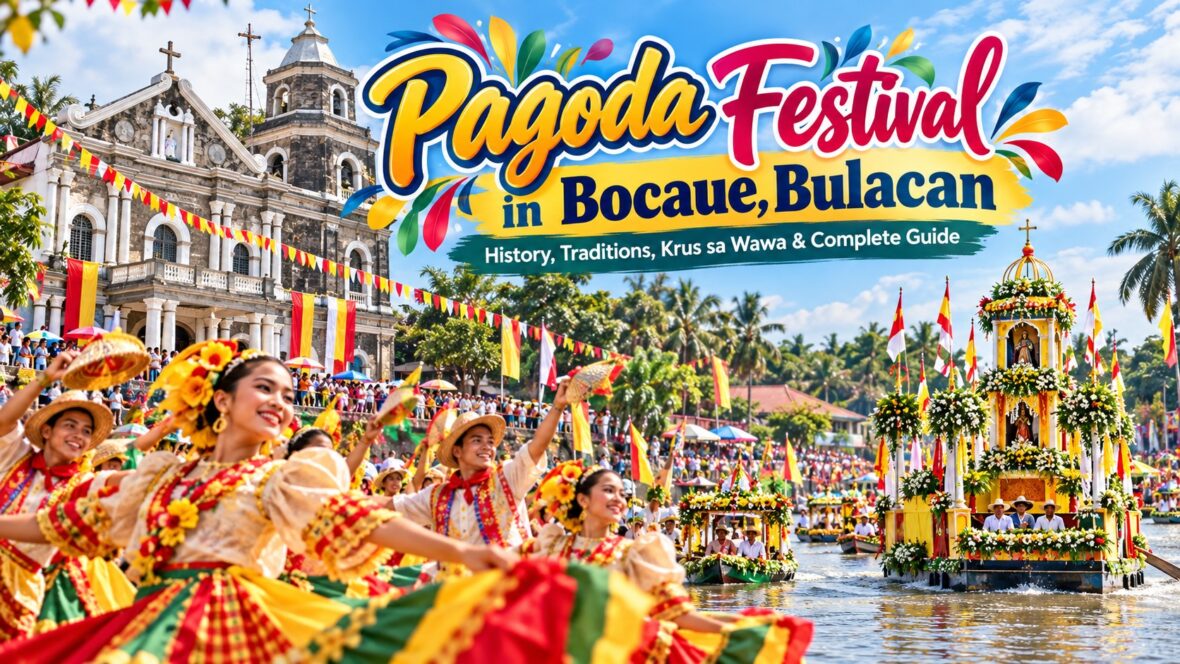
A beautifully decorated floating structure slowly makes its way across the river, accompanied by smaller boats filled with devotees. Prayers are offered, religious songs are sung, and crowds gather along the riverbanks to witness one of Bulacan’s most recognizable religious traditions.
This is the Pagoda Festival of Bocaue, also known as Pagoda sa Wawa, the Bocaue River Festival, or the Feast of the Holy Cross of Wawa.
For visitors, the sight of the enormous pagoda floating along the river is already impressive. But for the people of Bocaue, the festival means much more than a colorful river procession.
It is a celebration of faith, history, survival, community and a devotion that has been passed from one generation to another.
Here’s everything you need to know about the Pagoda Festival in Bocaue, Bulacan.
Content
What is the Pagoda Festival?
The Pagoda Festival is an annual religious celebration held in Bocaue, Bulacan in honor of the Mahal na Poon ng Krus sa Wawa, commonly called the Holy Cross of Wawa or Krus sa Wawa.
The celebration is traditionally held on the first Sunday of July.
Its biggest attraction is a fluvial procession along the Bocaue River.
During the procession, a decorated floating structure known as the pagoda travels along the river while smaller boats accompany it. The Holy Cross of Wawa is at the center of the religious celebration.
The Provincial Government of Bulacan describes the pagoda as a brightly decorated structure riding on a large banca as it glides through the Bocaue River.
But while the pagoda is the most photographed part of the festival, everything begins with the town’s devotion to the Krus sa Wawa.
Where is the Pagoda Festival celebrated?
The Pagoda Festival is celebrated in the municipality of Bocaue in the province of Bulacan.
Bocaue is located north of Metro Manila and is probably more widely known to many Filipinos for its fireworks and firecracker industry.
But culturally, one of the town’s strongest identities is its relationship with the Bocaue River and the story of the Holy Cross of Wawa.
The main religious center of the celebration is the St. Martin of Tours Parish Church, which is also the Diocesan Shrine of Mahal na Poon ng Krus sa Wawa.
The river, however, becomes another important place of worship during festival season.
That is what makes the Pagoda Festival different from many other Philippine fiestas.
Instead of having its most recognizable procession entirely on the streets, much of the celebration takes place on the water.
The Story of the Holy Cross of Wawa
To understand the Pagoda Festival, you first have to know the story of the Krus sa Wawa.
According to the traditional story told in Bocaue, a large wooden cross was discovered floating along the Wawa section of the Bocaue River during a typhoon in the 19th century.
Local tradition commonly dates the event to around 1850.
The story says that a woman was struggling in the river and was in danger of drowning.
She saw the wooden cross floating nearby and tried to reach it.
Eventually, she was able to hold on to the cross and safely reach the riverbank.
People interpreted her survival as miraculous.
Over time, devotion to the cross grew among the people of Bocaue.
The Holy Cross of Wawa eventually became one of the most important religious symbols in the town, and the annual river procession developed around the story.
Whether you’re visiting as a devotee or simply as a traveler interested in Philippine culture, knowing this story changes the way you see the festival.
The pagoda isn’t simply a decorative boat.
Its journey along the river recreates the connection between the Krus sa Wawa and the river where the town’s devotion began.
Why is it called Pagoda Festival?
If you’re hearing about the celebration for the first time, the name can be slightly confusing.
The word “pagoda” usually makes people think of the tiered temples found in countries such as China, Japan and other parts of Asia.
In Bocaue, however, “pagoda” refers to the elaborate floating structure used during the river procession.
The decorated barge serves almost like a moving shrine.
The Holy Cross becomes the religious centerpiece while devotees and members of the community participate in the procession along the Bocaue River.
Smaller boats usually travel around or alongside the pagoda, creating one of the most beautiful scenes of the festival.
This fluvial parade is what turned the Pagoda Festival into one of Bulacan’s most distinctive celebrations.
When is the Pagoda Festival?
The Pagoda Festival is traditionally celebrated every first Sunday of July.
However, the festival should not be thought of as just a one-day event.
Religious activities can begin before the main feast day.
These may include novena Masses, prayers, processions and other devotional activities.
Civic and cultural events can also be organized by the local government and community depending on the year’s program.
Because the exact schedule of activities can change every year, travelers planning to attend should check announcements from the Municipality of Bocaue, local tourism authorities or the parish before traveling.
The Fluvial Procession
The highlight of the Pagoda Festival is undoubtedly the fluvial procession.
This is the moment when Bocaue River becomes the center of the celebration.
A large, elaborately decorated pagoda carries the revered religious symbol while boats filled with devotees accompany it.
From the riverbanks, spectators watch as the procession moves slowly across the water.
There is something uniquely Filipino about seeing religion, community and the natural landscape come together this way.
We are used to seeing processions pass through roads in front of churches and town plazas.
In Bocaue, the river itself becomes the procession route.
The Tourism Promotions Board describes the main attraction of the festival as the fluvial parade of the decorated pagoda together with colorful smaller boats.
For photographers and travelers, this is naturally the most visually striking part of the fiesta.
For devotees, however, it remains first and foremost an act of faith.
What is Ligiran?
One of the traditions associated with the festival is sometimes called ligiran or libiran.
It refers to boats navigating around or accompanying the pagoda during the river celebration.
You may see numerous smaller boats surrounding the main vessel as the procession continues through the Bocaue River.
The sight gives the pagoda an even stronger presence because it appears at the center of an entire river filled with devotees.
Research documenting the festival describes the main pagoda being joined by smaller supporting boats during the fluvial procession.
It is one of those scenes that immediately tells you you’re witnessing something deeply connected to river life.
Novenas, Masses and Prayer
The Pagoda Festival may be colorful, but religion remains at its heart.
Before and during the feast, devotees participate in Masses and prayer activities dedicated to the Holy Cross of Wawa.
A nine-day novena has traditionally formed part of the celebration.
During previous observances, devotees have also boarded the pagoda after novena activities, praying and singing religious songs while traveling along the river.
This is worth remembering if you’re attending primarily as a tourist.
The festival is not just a cultural performance.
For many families in Bocaue, this is an important religious occasion.
Being respectful during prayers, Masses and the procession is one of the best ways visitors can appreciate the celebration properly.
The 1993 Bocaue Pagoda Tragedy
You cannot tell the complete story of the Pagoda Festival without remembering one of the most painful moments in Bocaue’s history.
On July 2, 1993, a pagoda carrying hundreds of people sank in the Bocaue River during the festivities.
More than 200 people died, although historical reports differ regarding the exact number of fatalities.
It remains one of the worst festival-related disasters in Philippine history.
The tragedy deeply affected Bocaue.
For years afterward, the joyful tradition of the pagoda was naturally connected with memories of those who died.
Among the names remembered from the disaster is Sajid Bulig, a young boy who reportedly saved several children before losing his own life. He became remembered locally as a hero.
The tragedy also changed the way future river celebrations were organized.
Safety became an essential part of the festival.
Modern observances have incorporated greater attention to the structure of the pagoda, capacity controls and disaster preparedness.
A scholarly study of the Pagoda sa Wawa Festival has examined how religious tradition and disaster-risk management now work together in organizing the celebration.
Today, remembering the victims has itself become part of the festival’s story.
Prayers have been offered near the area associated with the tragedy as devotees continue the tradition while honoring those who were lost.
Why the Festival Continued
After such a devastating tragedy, some might wonder why Bocaue continued holding the pagoda tradition at all.
The answer probably tells us something about the importance of the festival to the community.
The Pagoda Festival is not simply an annual tourism event that can easily be replaced.
It is connected to the town’s religious identity and generations of devotion to the Holy Cross of Wawa.
Eventually, the pagoda returned to the river with greater safety precautions.
For many people in Bocaue, continuing the tradition became both an expression of faith and a way of showing that the community could remember its painful history without abandoning something deeply rooted in its culture.
That combination of celebration and remembrance makes the Pagoda Festival particularly meaningful.
A Festival Built Around the River
Another reason the Pagoda Festival stands out is its relationship with the Bocaue River.
Rivers have always played an important role in Philippine communities.
Before modern highways and transportation networks, rivers served as transportation routes, fishing areas, commercial centers and gathering places.
In Bocaue, the river is also woven into the town’s religious story.
The Krus sa Wawa was discovered there according to local tradition.
The miraculous rescue happened there.
The pagoda sails there.
And generations of Bocaue residents continue returning to the river every July.
In this sense, the Bocaue River isn’t just the location of the festival.
It is part of the festival’s identity.
What to Expect During Pagoda Festival
If you’re visiting Bocaue during fiesta season, expect the town to become much busier than usual.
The atmosphere can include religious ceremonies, crowded streets, food stalls, entertainment and community events in addition to the main river procession.
The exact program changes depending on the year, but visitors can generally look forward to a combination of:
- Holy Masses and religious services
- Novena prayers
- Processions honoring the Krus sa Wawa
- The Pagoda sa Wawa fluvial procession
- Smaller boats accompanying the main pagoda
- Cultural and civic activities
- Local food and fiesta gatherings
- Entertainment programs
- Fireworks or other nighttime festivities in some editions
Modern versions of the celebration have also included activities such as street dancing, civic parades and concerts alongside the traditional religious observances.
Still, schedules vary every year.
If you’re traveling specifically to see the pagoda, make sure you verify the time of the fluvial procession before leaving home.
Basaan Tradition
Another tradition visitors may encounter during the celebration is basaan or playful water splashing.
In some previous editions, people celebrated after the river activities by splashing one another with water.
The practice adds another festive element to an event already strongly associated with the river.
If basaan activities are being held when you visit, protect your phone, camera, wallet and other electronics with waterproof bags.
And like other water festivals in the Philippines, it’s always better to join with a sense of fun while still respecting people who may not want to participate.
Visiting St. Martin of Tours Parish Church
While the pagoda receives most of the attention, visitors should also consider visiting St. Martin of Tours Parish Church.
The church is closely connected with devotion to the Mahal na Poon ng Krus sa Wawa.
It is located in Bocaue’s poblacion and serves as an important center of the religious activities surrounding the fiesta.
The parish is formally associated with the Roman Catholic Diocese of Malolos and is recognized as the Diocesan Shrine of Mahal na Poon ng Krus sa Wawa.
Visiting the church before or after watching the river procession gives you a much better understanding of the religious side of the celebration.
How to Get to Bocaue, Bulacan
Bocaue is relatively accessible from Metro Manila, which makes the Pagoda Festival possible as a day trip.
By Private Car
From Metro Manila, travelers can usually take the North Luzon Expressway or NLEX toward Bulacan.
Exit toward Bocaue and continue toward the town center.
Travel time depends heavily on your starting point and traffic.
Fiesta days can also mean heavier traffic once you enter Bocaue, so leaving early is highly recommended.
By Public Transportation
Buses and other public transportation traveling toward Bulacan can bring passengers to or near Bocaue.
From major transportation areas, local jeepneys, tricycles or other transport can then be used to reach the town proper.
Routes and terminals can change, so check the latest transportation arrangements before your trip.
Travel Tips for Pagoda Festival
If you want to experience the festival comfortably, a little planning makes a big difference.
Arrive early
The best viewing areas near the river can become crowded, especially close to the main procession.
Getting there early gives you more time to explore Bocaue and find a good location.
Expect crowds
This is both a religious event and an important local fiesta.
Be prepared for crowded streets, traffic and transportation delays.
Protect your belongings
Whenever you’re visiting a crowded festival, keep phones, wallets and cameras secure.
A waterproof pouch is especially useful because of the river setting and possible water-splashing activities.
Wear comfortable clothes
Light clothing and comfortable footwear are ideal.
July is part of the rainy season in the Philippines, so bringing an umbrella, raincoat or waterproof bag is also a good idea.
Bring drinking water
Festival days can involve a lot of walking and waiting.
Stay hydrated, particularly if you’re spending several hours outdoors.
Follow safety instructions
This is especially important around the river.
Stay within designated viewing areas and follow instructions from local authorities, organizers and emergency personnel.
Never board vessels or enter restricted areas without authorization.
Respect the religious celebration
Remember that the Pagoda Festival isn’t only an attraction.
Many of the people around you are participating because of religious devotion.
Avoid interrupting prayers, blocking religious processions or treating sacred objects merely as photo props.
Best Places to Watch the Pagoda
Viewing arrangements can change depending on river conditions and security plans.
Generally, areas along the Bocaue River where the procession passes attract the largest crowds.
Some people also position themselves near bridges or riverside areas that provide a wider view of the pagoda.
However, don’t assume that every riverbank or bridge is automatically open to spectators.
Crowd-control measures may be implemented, particularly during the main procession.
Follow official announcements regarding designated viewing areas.
Photography Tips
The Pagoda Festival is one of those celebrations where having a camera with you is absolutely worth it.
For wide photos, try capturing the pagoda together with the river, surrounding bancas and crowds along the banks.
Those wider scenes tell the story better than simply zooming into the floating structure.
If you’re photographing from the riverbank, a moderate zoom lens can also be useful because you may not be able to approach the pagoda closely.
And because the Philippines can get very bright even during rainy months, watch your highlights when photographing white religious decorations and reflective water.
Most importantly, don’t sacrifice safety just to get the perfect shot.
What Makes Pagoda Festival Unique?
The Philippines has hundreds of fiestas.
Many feature street dancing.
Others have enormous processions, colorful costumes, parades, food festivals or religious images carried through town.
Pagoda Festival has something different.
Its main stage is the river.
The relationship between the Holy Cross, the Bocaue River, the floating pagoda and generations of devotees gives the celebration an identity that is difficult to copy elsewhere.
It is visually spectacular, yes.
But behind that spectacle is a surprisingly deep story involving a miraculous rescue, centuries of religious devotion, tragedy, remembrance and resilience.
And that is probably why Pagoda sa Wawa continues to remain one of Bulacan’s most recognizable traditions.
Pagoda Festival 2026
The Pagoda Festival remains an annual celebration, so visitors should always check the schedule for the specific year they plan to attend.
For 2026, the first Sunday of July fell on July 5.
Thousands of devotees gathered in Bocaue on Sunday, July 5, 2026 for the annual Feast of the Mahal na Krus sa Wawa, with the pagoda once again sailing along the Bocaue River.
The 2026 pagoda featured a bamboo-inspired bahay kubo design that emphasized simplicity, faith, unity and resilience. The design was particularly meaningful because the name Bocaue itself has historical connections with the word bukawe, a type of bamboo.
For future editions, the main feast traditionally remains on the first Sunday of July, but individual events, Mass schedules and river activities should always be confirmed closer to the celebration.
Frequently Asked Questions About Pagoda Festival
Where is Pagoda Festival celebrated?
Pagoda Festival is celebrated in Bocaue, Bulacan, particularly around the Bocaue River and St. Martin of Tours Parish Church.
When is Pagoda Festival celebrated?
The Feast of the Holy Cross of Wawa is traditionally celebrated on the first Sunday of July.
What is Pagoda Festival famous for?
The festival is famous for its Pagoda sa Wawa, an elaborately decorated floating structure used during a religious procession along the Bocaue River.
Who is honored during Pagoda Festival?
The celebration honors the Mahal na Poon ng Krus sa Wawa or Holy Cross of Wawa.
Why is the Holy Cross of Wawa important?
According to Bocaue tradition, a wooden cross floating along the river helped save a woman who was drowning. The event came to be regarded as miraculous and inspired the devotion surrounding the Krus sa Wawa.
What happened during the 1993 Pagoda tragedy?
A heavily loaded pagoda sank in the Bocaue River on July 2, 1993, killing more than 200 people. The disaster became one of the darkest moments in Bocaue’s history and led to much greater emphasis on safety during later celebrations.
Is Pagoda Festival a religious festival?
Yes. Although cultural programs and entertainment have become part of the festivities, its foundation remains Catholic devotion to the Holy Cross of Wawa.
Can tourists attend Pagoda Festival?
Yes. Visitors are welcome to experience the celebration, but they should remember that many activities are religious ceremonies and should be observed respectfully.

Final Thoughts
There are festivals you remember because of their costumes.
There are others you remember because of the food, the dancing or the enormous crowds.
Pagoda Festival is different.
What stays with you is the sight of an entire community turning toward the river.
The Bocaue River becomes a place of celebration, prayer and remembrance as the pagoda slowly moves across the water surrounded by boats and devotees.
Behind that beautiful scene is a story that stretches back generations—the story of a cross found in the river, a woman who survived, a devotion that grew around it, a tragedy that permanently changed the community, and a tradition that Bocaue continues to carry forward.
That is why Pagoda Festival is more than just another colorful Philippine fiesta.
For the people of Bocaue, it is part of who they are.