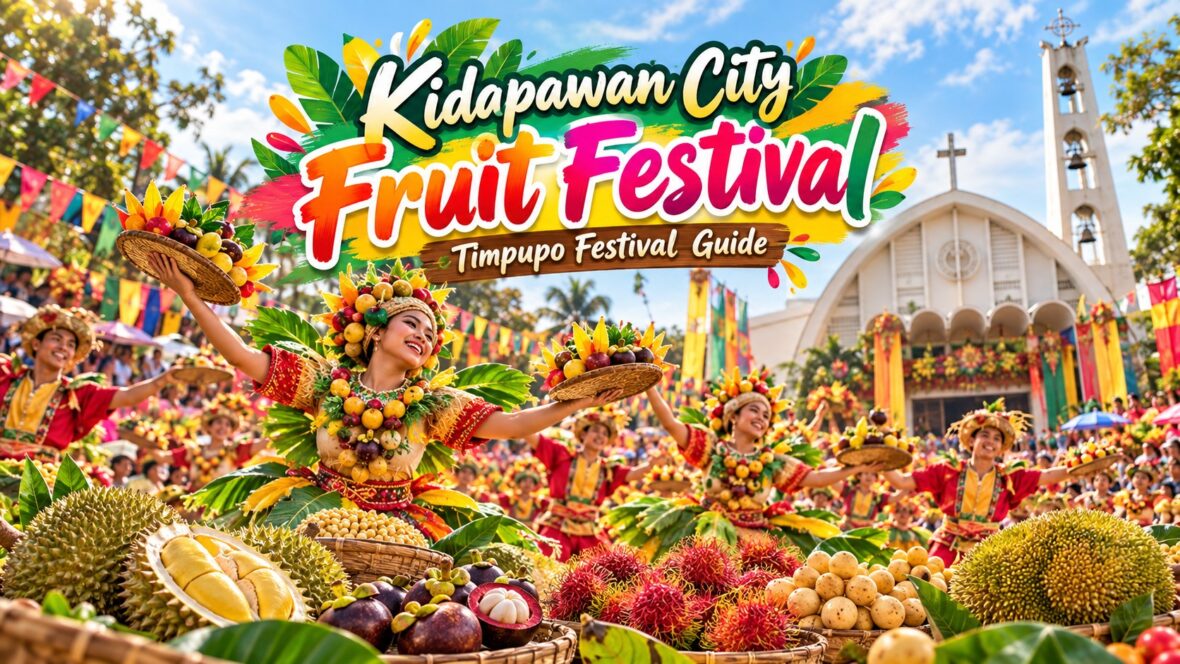
There are festivals in the Philippines built around history, religion, flowers, food, and local traditions. Then there is Kidapawan City’s Timpupo Festival—a celebration where the stars of the show are literally piled on tables by the thousands of kilos: durian, mangosteen, rambutan, lanzones, marang, and other tropical fruits.
If you love fruits, this is one Philippine festival that deserves a place on your travel list.
Timpupo Festival, often referred to simply as the Kidapawan City Fruit Festival, is the city’s annual thanksgiving celebration for its agricultural harvest. Held during the fruit season in August, the festival brings together local farmers, Indigenous communities, schools, businesses, government offices, and visitors in a celebration that is both colorful and surprisingly delicious.
And yes, one of its biggest attractions is exactly what it sounds like: long tables filled with locally grown fruits that people can enjoy during the famous Fruit Eat-All-You-Can.
But Timpupo is more than a giant fruit buffet.
It is also a celebration of Kidapawan’s farmers, Indigenous heritage, local culture, agricultural economy, and identity as one of Mindanao’s important fruit-producing areas.
Content
What Is the Timpupo Festival?
Timpupo Festival is the annual harvest and fruit festival of Kidapawan City in the province of Cotabato.
The City Government of Kidapawan describes Timpupo as a celebration of the city’s tribal life and culture as well as its abundant harvest of tropical fruits. The word “timpupo” is used among Manobo communities and Mindanao Bisaya speakers in connection with harvest, particularly the harvesting of fruits. Kidapawan City
That makes the festival’s concept fairly straightforward.
It is essentially Kidapawan saying:
Look at what our land and our farmers have produced. Let us celebrate it together.
The festival is usually held in August, when many of the fruits associated with Kidapawan and surrounding areas are in season. The celebration is also connected with the founding anniversary of Kidapawan, commemorated on August 18. Philippine Information Agency
Depending on the year, festivities may run for several days or even more than a week, although the exact program changes.
Why Is Kidapawan Famous for Fruits?
You really cannot talk about Timpupo without talking about Kidapawan’s agricultural identity.
Located at the foot of Mount Apo, Kidapawan enjoys environmental conditions that allow a wide variety of tropical crops and fruits to grow in and around the area.
The city has long promoted itself as the “City of Fruits and Highland Springs,” and fruit production remains an important part of the local economy.
Among the fruits commonly associated with Kidapawan are:
- Durian
- Mangosteen
- Rambutan
- Lanzones
- Marang
- Banana
- Dragon fruit
- Other seasonal tropical fruits
Some of those are already familiar to most Filipinos. Others—especially marang—can be a completely new experience if you are visiting from Luzon or other parts of the country.
Agricultural data cited during the 2023 Timpupo celebration showed just how significant fruit production can be in the city. Mangosteen was among Kidapawan’s largest fruit crops, followed by durian, rambutan, marang, lanzones, and dragon fruit. Manila Bulletin
So this is not a festival that simply chose fruits as a theme because they look colorful.
Fruit farming is genuinely part of Kidapawan’s identity.
History of the Timpupo Festival
Timpupo is relatively young compared with some of the Philippines’ centuries-old religious fiestas.
The festival was first celebrated in the early 2000s, with several historical accounts placing its beginning in 2001. The name “Timpupo Festival” was formally adopted by the city council several years later, around 2005. Philippine Primer
The festival developed as a way of showcasing Kidapawan’s harvest while giving local farmers another platform to market their produce.
Its history has not always been uninterrupted.
Fruit production is heavily affected by weather, diseases, drought, and changing growing conditions. Earlier editions of Timpupo had to adjust when harvests were insufficient, showing just how closely the festival is connected to what actually happens on local farms.
Over the years, however, Timpupo grew beyond a simple agricultural fair.
Cultural presentations, Indigenous rituals, street activities, concerts, trade fairs, competitions, fruit floats, food events, environmental programs, and community gatherings eventually became part of the celebration.
Today, Timpupo serves several purposes at once.
It is a harvest festival.
It is a tourism event.
It is a celebration of Indigenous and local culture.
It supports farmers.
And it is tied closely to Kidapawan’s foundation anniversary.
Fruit Eat-All-You-Can: The Biggest Timpupo Attraction
This is probably the activity that made Timpupo famous outside Kidapawan.
During selected festival days, huge quantities of fruits are placed on tables for people to enjoy.
Imagine rows and rows of:
Durian.
Mangosteen.
Rambutan.
Lanzones.
Marang.
And whatever else happens to be abundant during that year’s harvest.
Earlier versions of the event charged visitors a small entrance fee. More recent editions have also featured fruits provided free to the public during the culmination celebration.
And this is not a small buffet hidden inside a function hall.
Some editions have literally taken over stretches of Kidapawan’s streets.
During the 2024 festival, for example, the Fruit Eat-All-You-Can sa Dalan stretched approximately 1.5 kilometers through part of the city. SunStar Publishing Inc.
In 2023, around 12 tons of fruits were prepared for thousands of participants during the culmination of the festival. Philippine News Agency
That gives you an idea of the scale.
You do not just attend Timpupo and look at fruits.
You eat them.
Lots of them.
Durian Is One of the Stars
Of course, no fruit celebration in this part of Mindanao would feel complete without durian.
Durian is probably the fruit visitors are most curious about.
Some people love it immediately.
Others need several tries.
And some will smell it from several meters away and decide that watching other people eat it is good enough.
But if you have never tried fresh Mindanao durian before, Timpupo is a pretty good opportunity.
Fresh fruit during harvest season is a very different experience from eating something that has traveled hundreds of kilometers before reaching a supermarket.
The festival can also introduce visitors to different locally grown varieties depending on what farmers have available that season.
Do Not Ignore the Mangosteen
Durian gets most of the attention, but Kidapawan’s mangosteen deserves some love too.
Mangosteen has that thick purple shell hiding soft white segments inside. The flavor is sweet with a little acidity, making it easy to understand why people can eat one after another without noticing how many shells have piled up beside them.
In fact, mangosteen has historically been one of Kidapawan’s most important fruit crops in terms of production. Manila Bulletin
So when you visit Timpupo, don’t spend all your time chasing durian.
Try the other fruits too.
Marang: A Mindanao Fruit You Should Try
Another fruit you will likely encounter is marang.
If you are coming from Metro Manila or other areas where marang is less common, this should be high on your list.
It is related to jackfruit and breadfruit, but its flavor and texture are quite different.
Once the fruit is opened, you will find soft, creamy segments surrounding the seeds.
It has a strong aroma—but generally not the same infamous reputation as durian.
Marang is best eaten when fresh, which makes a festival held near the places where it is grown an ideal opportunity to try it.
Rambutan and Lanzones
These two are more familiar to many Filipinos, but eating them during peak fruit season still hits differently.
Rambutan is instantly recognizable because of its red or yellow hairy-looking shell.
Lanzones, meanwhile, comes in clusters of small round fruits with translucent flesh inside.
During Timpupo, you may see enormous amounts of both.
That’s part of the fun.
The festival lets visitors experience not just one signature fruit but the sheer variety of produce coming from farms around Kidapawan.
The Fruit Float Parade
If there is one Timpupo activity that photographs beautifully, it is the fruit float parade.
Floats are decorated using fruits, vegetables, plants, agricultural materials, flowers, and designs inspired by local culture.
You might see giant arrangements built around durian.
Or rambutan.
Or baskets overflowing with different fruits.
Some floats practically look like moving fruit gardens.
The parade has become one of the festival’s signature attractions, with barangays, schools, organizations, businesses, and other participants producing increasingly elaborate creations.
The culmination celebrations in recent years have paired the fruit float parade with the massive Fruit Eat-All-You-Can event. SunStar Publishing Inc.
And visually, it makes perfect sense.
If Timpupo is supposed to showcase the abundance of Kidapawan, nothing communicates that better than an entire vehicle covered in fruits.
Street Dancing and Cultural Performances
Like many Philippine festivals, Timpupo also comes alive through music and dancing.
Street performances and school presentations have formed part of different editions of the festival.
One activity associated with earlier celebrations is Kiay-Kiay sa Dalan, which brought students from Kidapawan schools into the streets for performances showcasing their creativity and talent. Kidapawan City
Festival programs change from year to year, so there is no guarantee that exactly the same competition or street-dancing format will appear every time.
But cultural performances remain an important part of Timpupo.
Costumes often take inspiration from agriculture, tropical fruits, nature, and the cultures of Mindanao.
Indigenous Culture Is an Important Part of Timpupo
This part of the festival deserves attention because Timpupo is not simply an agricultural tourism event.
Kidapawan and the surrounding areas have deep Indigenous roots, particularly among Obo Manuvu/Manobo communities.
Traditional rituals have been incorporated into the festival as expressions of thanksgiving, protection, peace, unity, and respect for the land.
During the 2026 celebration, for example, Indigenous leaders performed the Somaya Pokiyaab, a thanksgiving and blessing ritual asking for continued guidance, protection, unity, and abundant harvests. Kidapawan City
The presence of these traditions adds another layer to Timpupo.
Agriculture is not viewed simply as an industry.
Harvest is also connected to land, community, heritage, and thanksgiving.
Tribal Day and Cultural Activities
Different editions of Timpupo have featured activities dedicated specifically to Indigenous communities and local heritage.
These have included Tribal Day celebrations, cultural exhibits, traditional ceremonies, food demonstrations, Indigenous weddings, arts activities, and other programs.
In 2019, for example, Indigenous couples participated in a traditional mass wedding during the Timpupo and foundation anniversary celebrations, with the activity intended partly to recognize and preserve tribal traditions. Philippine News Agency
These events show that the festival has gradually become a space where Kidapawan can celebrate several aspects of its identity at once.
Agro-Trade Fairs
Another important part of Timpupo is the agricultural trade fair.
And for me, events like this are often worth visiting even without the big parade.
This is where you can discover products made by farmers, cooperatives, small businesses, food producers, and local entrepreneurs.
Depending on the year, you may find:
Fresh fruits
Vegetables
Seedlings
Processed fruit products
Durian candies
Jams and preserves
Local delicacies
Handicrafts
Agricultural products
Food stalls
Pasalubong
You can eat at the festival and at the same time bring something home.
More importantly, buying directly from local producers means your money can go more directly into the local economy.
Supporting Kidapawan Farmers
This is perhaps the most meaningful part of Timpupo.
Behind every beautifully arranged fruit display is a farmer.
Growing fruit isn’t easy.
Farmers deal with pests, unpredictable rainfall, drought, production costs, fluctuating prices, and traders who may offer very low farmgate prices when supply is high.
During recent Timpupo celebrations, the Kidapawan City Government has purchased large quantities of fruits from local growers specifically for festival activities.
For the 2024 celebration, the local government said it allocated around ₱1.7 million to purchase fruits from farmers. The city has also operated a buy-back system intended to help farmers receive fairer prices while allowing local organizations to distribute and sell produce. SunStar Publishing Inc.
That changes the meaning of the giant fruit tables.
They are not simply there to entertain tourists.
They can also represent real income for farming families.
Fruit Stalls and Pasalubong Centers
Timpupo can also help farmers beyond a single festival day.
In previous editions, the city has provided stalls where growers could display and sell their fruits without paying rental fees.
The goal is to give producers better access to consumers rather than relying entirely on middlemen.
During the 2023 celebration, local officials said farmers were given dedicated fruit stalls and opportunities to sell produce directly during the festival. Manila Bulletin
So if you’re visiting, consider buying a few kilos of fruit outside the free-eating event too.
You’re getting good fruit.
The farmer gets a customer.
Everybody wins.
Other Activities You May See
Because the Timpupo program changes every year, visitors should always check the official schedule before traveling.
Past celebrations have included activities such as agricultural fairs, fruit-carving contests, cultural exhibitions, food festivals, bazaars, concerts, sports competitions, environmental activities, visual arts workshops, pageants, traditional food demonstrations, pyro-musical shows, and community programs. SunStar Publishing Inc.
Not everything happens every year.
And that is actually one reason a timeless guide like this matters.
The individual events may change, but the heart of Timpupo remains the same: fruit, farming, culture, thanksgiving, and community.
Timpupo Festival and Kidapawan Foundation Anniversary
Another thing visitors should understand is that Timpupo is closely connected with Kidapawan’s foundation anniversary.
August 18 commemorates the establishment of Kidapawan as a municipality in 1947.
Kidapawan would later become a component city through Republic Act No. 8500, with cityhood taking effect in 1998. Philippine News Agency
That explains why the biggest festival activities frequently happen on or around August 18.
The occasion celebrates both the city’s agricultural abundance and its history as a community.
Timpupo Festival vs. Kalivungan Festival
This can be confusing for travelers searching festivals in Kidapawan.
Timpupo Festival is the festival of Kidapawan City.
Kalivungan Festival, meanwhile, is associated with the Province of Cotabato and its provincial foundation celebration.
Because the Cotabato Provincial Capitol is also located in Kidapawan, Kalivungan activities can take place in the city as well. Manila Bulletin
So you may see two different August festivals connected with Kidapawan.
They are not the same celebration.
If your goal is the giant fruit feast and Kidapawan’s harvest festival, you want Timpupo.
When Is the Timpupo Festival?
Timpupo Festival is generally celebrated in August.
The biggest activities usually take place around August 18, Kidapawan’s foundation anniversary.
However, do not assume that the festival runs on exactly the same dates or for the same number of days every year.
Some editions have lasted more than a week.
Others have been shorter.
The exact schedule depends on the city government and that year’s program.
If you’re planning a trip specifically for the Fruit Eat-All-You-Can, check the official Kidapawan City announcements before booking your transportation.
That is the activity you really don’t want to arrive one day late for.
What Is the Best Day to Visit?
If you only have one day, the culmination or foundation anniversary day around August 18 is usually the safest choice.
That is when major events such as the fruit feast and fruit float parade have traditionally been scheduled.
If you have more time, staying for two or three days allows you to experience more of the festival.
You can visit fruit stalls.
Check the trade fair.
Watch cultural activities.
Explore Kidapawan.
Then attend the big culmination.
Personally, that sounds much better than arriving in the morning, eating five kilos of mangosteen, and immediately getting back on a bus.
Although I suppose that is also an option.
How to Get to Kidapawan City
Kidapawan is located in Cotabato Province in Mindanao.
There are no regular commercial passenger flights directly into Kidapawan, so visitors coming from Manila, Cebu, or other distant cities normally fly to a nearby major airport and continue by land.
Davao City is one of the most practical gateways.
From Davao, buses and vans travel toward Kidapawan and other destinations along the Davao-Cotabato corridor.
Other possible gateways include areas around Cotabato City and General Santos, depending on your itinerary and available transportation.
If you are planning specifically for Timpupo, give yourself some extra travel time.
Festival traffic can make the city noticeably busier than usual.
Where to Stay During Timpupo
Kidapawan has hotels, inns, pension houses, and other accommodations within and around the city center.
For a festival trip, staying relatively close to the downtown area is convenient because many major activities traditionally take place around central Kidapawan and along major roads.
Book early if you’re visiting for the culmination.
Timpupo attracts visitors from neighboring municipalities and provinces, so accommodations can become busier around the festival period.
What Else Can You Do in Kidapawan?
Timpupo may be the reason you visit, but the city is worth exploring beyond the fruit tables.
Kidapawan sits near Mount Apo and promotes itself not only as the City of Fruits but also as a destination for nature and adventure.
The area is associated with mountain trails, springs, waterfalls, farms, and agricultural tourism.
Farm visits are particularly fitting during Timpupo.
You’ve just eaten durian, rambutan, mangosteen, and marang.
Why not see where some of these crops actually grow?
It creates a much better connection between the festival and the farmers behind it.
Tips for Visiting Timpupo Festival
First, arrive early for major events.
Thousands of people can show up for the fruit-eating activities, particularly during the culmination.
Second, wear comfortable clothes.
August in Mindanao can be hot and humid, and many festival activities happen outdoors.
Third, bring water.
Eating fruit does not mean you can forget to hydrate.
Fourth, don’t waste food.
This should be obvious, but during an eat-all-you-can event, it is tempting to grab everything in sight.
Take what you can actually finish.
You can always get more.
Fifth, bring tissues or wet wipes.
Especially if you’re eating marang or durian.
You’ll understand.
Sixth, carry some cash.
Small fruit vendors, food stalls, and local producers may still prefer cash payments.
And finally, buy something from the farmers.
The free fruit feast is wonderful, but purchasing local produce is another way to support the people who make Timpupo possible.
Why Timpupo Festival Is Worth Experiencing
There are much bigger Philippine festivals.
There are festivals with larger parades.
There are festivals with more elaborate street-dancing competitions.
But Timpupo has something incredibly genuine about it.
Its biggest attraction comes directly from the land.
The durian on the table came from somebody’s farm.
So did the rambutan beside it.
The mangosteen.
The marang.
The lanzones.
Suddenly, an agricultural statistic becomes something you can touch, smell, peel, and eat.
And at the same time, you begin understanding why Kidapawan proudly calls itself the City of Fruits.
Timpupo transforms the harvest into a community celebration.
Farmers earn.
Visitors eat.
Local businesses gain customers.
Young people see their agricultural heritage celebrated.
Indigenous traditions are given space.
And an entire city gathers to give thanks.
That’s what makes the festival interesting.
It isn’t just about fruit.
It’s about everything behind the fruit.
Timpupo Festival 2026 Schedule
For reference, the main Timpupo Festival celebration in 2026 was held on August 17 and 18.
The city shortened the core festival to two days that year as part of local government austerity measures.
August 17 featured traditional rituals and thanksgiving activities led by Obo Manuvu community members, including the Somaya Pokiyaab ceremony.
The major Fruit Eat-All-You-Can sa Kadalanan followed on August 18 as part of Kidapawan’s foundation anniversary celebration. Kidapawan City
The scale was still impressive: city officials later reported that around 30 tons of assorted fruits were served free to festivalgoers during the August 18 event. Kidapawan City
Future editions may follow a completely different schedule, so always check Kidapawan City’s official announcements for the latest dates and program.
Final Thoughts
If there is one festival that perfectly explains Kidapawan’s nickname as the City of Fruits, it is Timpupo Festival.
Come for the durian.
Stay for the mangosteen.
Try the marang.
Watch the fruit floats.
Learn something about the Indigenous cultures of the area.
Visit the agricultural stalls.
Talk to local growers.
And somewhere between your third rambutan and another piece of durian, you’ll probably realize that Timpupo is much more than an eat-all-you-can fruit festival.
It is Kidapawan celebrating its land, its farmers, its culture, and the harvest that brings all of them together.
And really, there aren’t many better ways to celebrate abundance than sharing it with everyone.