When we talk about Cebu festivals, Sinulog is naturally the first name that comes to mind. But travel beyond Cebu City and you’ll discover that many towns have their own celebrations—festivals shaped by farming, livelihood, religion, local food and everyday community life.
One interesting example is the Sinanggiyaw Festival of Dumanjug in southwestern Cebu.
Sinanggiyaw was created as a celebration of Dumanjug’s agricultural heritage. Through colorful costumes, energetic street dancing and choreographed performances, the festival told a simple but meaningful story: people plant, people harvest, and when the harvest is good, the community gives thanks.
It was closely connected with Dumanjug’s annual fiesta in honor of St. Francis of Assisi, whose feast falls on October 4.
There is also an interesting part of Sinanggiyaw’s story that travelers should know. While many older festival guides still list Sinanggiyaw as Dumanjug’s October festival, the municipality eventually introduced another celebration called the Bisnok Festival. An academic study on Cebu’s corn-farming communities notes that Sinanggiyaw began in 2001 and was replaced by Bisnok in 2012.
So Sinanggiyaw today is best understood as an important chapter in Dumanjug’s festival history—a celebration that helped showcase the town’s agricultural identity before that cultural storytelling evolved into Bisnok.
Content
What is the Sinanggiyaw Festival?
Sinanggiyaw Festival was a harvest and cultural festival celebrated in Dumanjug, Cebu.
At its heart was thanksgiving.
Instead of simply presenting a parade with dancers wearing colorful costumes, Sinanggiyaw incorporated the life of local farmers into its choreography.
Festival performances revolved around three important stages:
Planting.
Harvesting.
Thanksgiving.
These three themes turned ordinary agricultural activities into dance.
You could imagine performers portraying farmers preparing the soil, planting crops and tending the fields before finally celebrating a successful harvest. The final part of the performance represented gratitude—for the land, the harvest and the blessings received by the community.
That agricultural storytelling was what gave Sinanggiyaw its identity.
Older descriptions of the festival consistently identify street dancing and field presentations as its main attractions, with performances centered on planting, harvesting and thanksgiving.
What Does Sinanggiyaw Mean?
Even the festival’s name tells you what the celebration is about.
Sinanggiyaw combines Cebuano words connected with harvest and dance.
“Sayaw,” of course, means dance.
“Sinanggi” is commonly described in festival materials as referring to a harvest or abundance of harvested agricultural products. A study on corn production in Cebu gives it a more specific agricultural meaning, describing “sinanggi” as harvested corn.
Put the ideas together and you get Sinanggiyaw—a celebration in which the harvest becomes a dance.
And that is probably the easiest way to understand the festival.
It wasn’t merely dancing for entertainment. The movement itself represented the work being done in the fields.
Where is Sinanggiyaw Festival Celebrated?
Sinanggiyaw is associated with the municipality of Dumanjug in southwestern Cebu.
Dumanjug faces the Tañon Strait and is located roughly 70 kilometers southwest of Cebu City. It sits between Barili to the north and Ronda to the south.
The municipality may not receive the same tourist crowds as Cebu City, Moalboal or Oslob, but that’s also part of its charm.
This side of Cebu gives visitors a different view of the province—one defined more by provincial towns, farms, coastal communities and local traditions.
Sinanggiyaw reflected that environment perfectly.
Instead of trying to imitate a major urban festival, it celebrated something already deeply connected with Dumanjug: agriculture.
The Agricultural Roots of Sinanggiyaw
To fully appreciate Sinanggiyaw Festival, you have to understand the role agriculture has played in Cebuano communities.
Corn, in particular, has long been important in rural Cebu.
A scholarly study examining subsistence-oriented corn production in Dumanjug and Bogo noted the significance of corn not only as an agricultural product but also as part of Cebuano food culture. Rural Cebuano households have traditionally consumed corn as a staple, and corn could be dried, stored and milled as needed.
That agricultural connection eventually found its way into local festivals.
Dumanjug had Sinanggiyaw.
Bogo developed the Pintos Festival, another Cebu celebration closely associated with corn.
But while Pintos highlighted a corn-based delicacy, Sinanggiyaw focused more on the actual agricultural cycle—particularly planting and harvesting.
It is a great example of how festivals can preserve something that might otherwise seem ordinary.
Working in a field isn’t usually considered a tourist attraction.
But give those movements music, choreography, colorful costumes and a story, and suddenly everyday farm life becomes cultural heritage.
Planting, Harvesting and Thanksgiving
The three stages represented in Sinanggiyaw tell almost the entire story of the festival.
Planting
Everything begins with planting.
Festival choreography could represent farmers preparing the land and putting crops into the soil.
This part reminds spectators that food doesn’t simply appear in markets and supermarkets. Before a harvest can happen, somebody has to prepare the fields and do the work.
Harvesting
The second stage represents the reward for that labor.
Harvesting is where the word Sinanggiyaw becomes especially meaningful.
Dancers recreate movements associated with gathering crops while the presentation becomes livelier, symbolizing abundance and prosperity.
Thanksgiving
Finally comes thanksgiving.
After months of work, a successful harvest becomes something worth celebrating.
And this is where the agricultural and religious sides of Sinanggiyaw naturally meet.
The community isn’t simply celebrating how much food was produced. The harvest becomes a reason to be thankful for another year of blessings.
Sinanggiyaw and St. Francis of Assisi
Like many traditional Philippine festivals, Sinanggiyaw wasn’t completely separate from the town fiesta.
Dumanjug’s patron saint is St. Francis of Assisi, whose feast is observed on October 4.
The town’s San Francisco de Asis Parish has deep historical roots. Dumanjug was once connected ecclesiastically to Barili before becoming a parish in 1854.
Sinanggiyaw was traditionally associated with the October fiesta period, combining civic festivities with the religious celebration honoring the town’s patron saint.
This combination is common throughout the Philippines.
There is often a religious side—Masses, prayers, processions and devotion to a patron saint.
Then there is the cultural side—street dancing, competitions, concerts, food, fairs and other community activities.
Together, they transform a town fiesta into something much bigger.
Street Dancing at Sinanggiyaw Festival
For visitors, street dancing would naturally have been one of the most exciting parts of Sinanggiyaw.
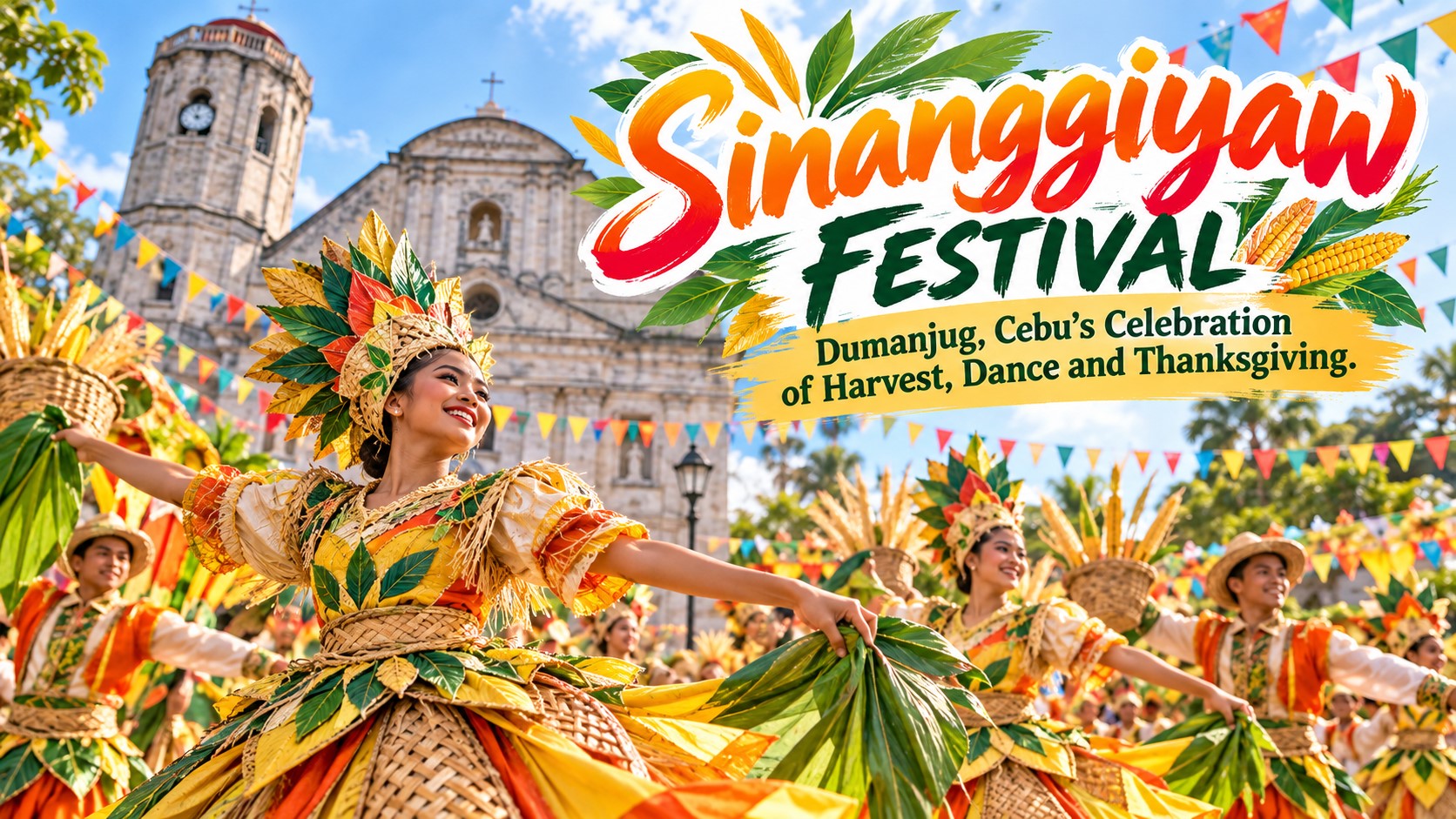
Imagine groups of performers moving through the streets wearing costumes inspired by farming, crops and rural life.
Drums provide the rhythm.
Large groups perform synchronized routines.
Props and decorations help transform agricultural scenes into something theatrical.
Older accounts of Sinanggiyaw describe the use of street dancing and field presentations to tell the story of the harvest. One historical description also notes the use of indigenous materials for costumes, accessories, props and sets, with drums and bamboo contributing to the musical atmosphere.
The result was more than a parade.
It was essentially a moving agricultural story.
The Costumes and Festival Colors
One thing Philippine festivals do particularly well is color.
Sinanggiyaw was no exception.
Festival presentations highlighted agricultural products and imagery, while costumes helped reinforce the connection between dancers and the land.
Older descriptions mention products such as corn, rice, coconut, camote and banana being represented during festival activities.
You’ll notice something interesting about many provincial festivals in the Philippines.
The costumes aren’t random.
Look closely and you’ll often see clues about the community.
A fishing town may use costumes inspired by the sea.
A flower festival uses floral decorations.
A farming community incorporates crops, leaves, baskets and agricultural tools.
Sinanggiyaw used the same idea.
Agriculture became visual art.
Field Presentations and Festival Showdowns
After street dancing, contingents traditionally performed larger choreographed routines in a presentation area.
This is where dancers could tell a more complete story.
Street dancing has to keep moving.
A field presentation allows performers to build scenes.
Groups can arrange themselves into formations, introduce larger props and portray different stages of the farming cycle.
Planting can transition into growing crops.
The growing season can transition into harvest.
Harvest can become celebration.
And celebration can end with thanksgiving.
This storytelling format is one reason festivals like Sinanggiyaw are interesting even if you’re unfamiliar with the town.
You don’t necessarily need to understand every lyric or Cebuano word.
Much of the story is communicated through movement.
A Festival About Farmers
Perhaps the most meaningful part of Sinanggiyaw was the people it represented.
Farmers rarely become the centerpiece of major celebrations.
Yet their work affects practically everyone.
Sinanggiyaw placed farming right in the middle of the town fiesta.
The fields became inspiration.
The harvest became the theme.
Farmers’ movements became choreography.
Agricultural products became festival decorations.
And thanksgiving for the harvest became the story connecting everything together.
That’s what made Sinanggiyaw more than another street-dancing competition.
It was a celebration of livelihood.
The History of Sinanggiyaw Festival
There are conflicting claims online about exactly how old Sinanggiyaw is, so it’s worth separating Dumanjug’s much older town fiesta tradition from the Sinanggiyaw festival itself.
Dumanjug’s religious fiesta and devotion to St. Francis of Assisi go back much further.
Sinanggiyaw, however, appears to be a modern cultural festival.
A published academic study on corn production in Cebu states that Sinanggiyaw began in 2001 and was organized to coincide with Dumanjug’s fiesta. The same research says that it was later replaced by the Bisnok Festival in 2012.
This distinction matters because some older tourism pages continue to list Sinanggiyaw as if it were still the town’s current festival.
Those sources are useful for understanding what Sinanggiyaw was like, but travelers planning an actual trip to Dumanjug should check the municipality’s latest fiesta program.
From Sinanggiyaw to Bisnok Festival
Dumanjug’s festival identity eventually changed.
In 2012, Sinanggiyaw was replaced by Bisnok Festival.
“Bisnok” comes from “Bisayang Manok,” referring to the native chicken for which Dumanjug has become known.
The concept changed from agricultural harvest to something more specifically connected with a recognizable local product and food tradition.
Even the dance movements changed.
Bisnok performances imitate movements associated with native chickens as well as the preparation of grilled native chicken.
The Department of Tourism’s Central Visayas travel portal describes dance movements inspired by chicken behavior, including scratching and courting, together with movements connected with preparing inasal nga manok.
It’s actually an interesting evolution.
Sinanggiyaw told Dumanjug’s story through farming.
Bisnok tells another side of the same town through food, agriculture and the native chicken.
Different concept.
Same goal: celebrating Dumanjugano identity.
Is Sinanggiyaw Festival Still Celebrated?
This is probably the most important question for anyone finding old Sinanggiyaw Festival guides online.
Sinanggiyaw remains part of Dumanjug’s festival history, but the current major cultural festival held around the town fiesta is Bisnok Festival.
That doesn’t make Sinanggiyaw irrelevant.
Quite the opposite.
It represents an earlier chapter in the development of Dumanjug’s cultural celebrations and shows how communities continuously reshape festivals to better represent local identity.
Travelers researching Sinanggiyaw should therefore think of it as Dumanjug’s former harvest festival rather than automatically assuming that a Sinanggiyaw street-dancing competition takes place every October today.
When Was Sinanggiyaw Festival Traditionally Celebrated?
Sinanggiyaw was associated with October 4, coinciding with the feast of St. Francis of Assisi.
Many festival references continue to list:
Festival: Sinanggiyaw Festival
Place: Dumanjug, Cebu
Traditional date: October 4
Patron saint: St. Francis of Assisi
Main theme: Planting, harvesting and thanksgiving
Main activities: Street dancing and field presentations
For present-day travel planning, however, visitors should look for announcements under Dumanjug Fiesta and Bisnok Festival rather than relying entirely on older Sinanggiyaw schedules.
Dumanjug Fiesta and Bisnok Festival 2026
For context, Dumanjug’s 2026 celebration used the Bisnok Festival.
The Department of Tourism’s Central Visayas portal listed the 2026 Bisnok celebration for October 3 to 4, while the main street-dancing and ritual showdown took place on October 3 as part of the town’s fiesta honoring St. Francis of Assisi.
Eight contingents participated in the 2026 Ritual Showdown, showing that festival culture continues to be very much alive in Dumanjug—even though the identity has evolved from Sinanggiyaw to Bisnok.
Why Sinanggiyaw Festival Still Matters
Festivals change.
Names change.
Themes change.
Sometimes one celebration disappears and another takes its place.
But that doesn’t erase the cultural meaning of the festival that came before it.
Sinanggiyaw preserved the story of Dumanjug’s agricultural communities through dance.
It celebrated the farmer.
It celebrated the land.
It celebrated the harvest.
And perhaps most importantly, it celebrated the simple Filipino tradition of giving thanks after receiving another year’s blessings.
For travelers interested in Philippine culture, that’s what makes small-town festivals fascinating.
Behind all the drums, costumes and street dancing is usually a story about how people live.
Sinanggiyaw’s story was about planting something into the ground, patiently waiting for it to grow, harvesting the results of months of labor—and then gathering together as a community to say thank you.
That is a story that goes far beyond one festival.
It’s a story familiar to farming communities throughout the Philippines.
Final Thoughts
Sinanggiyaw Festival may no longer be Dumanjug’s primary festival today, but it remains an important part of the municipality’s cultural story.
Born from the words associated with harvest and dance, Sinanggiyaw transformed Dumanjug’s farming traditions into colorful performances centered on planting, harvesting and thanksgiving.
For years, dancers carried that story through the streets during the October fiesta honoring St. Francis of Assisi.
Eventually, Dumanjug introduced the Bisnok Festival, giving the town a new cultural symbol centered on Bisayang Manok.
But Sinanggiyaw shouldn’t simply be forgotten.
It reminds us that festivals aren’t frozen in time.
They evolve together with the communities that created them.
And whether the celebration is called Sinanggiyaw or Bisnok, the message behind Dumanjug’s festival tradition remains familiar: celebrate the community, honor local livelihood, preserve culture and give thanks for the blessings that sustain the town.