There are festivals in the Philippines built around saints, harvests, flowers, historical events, and local delicacies. Then there is the Agal-Agal Festival of Tawi-Tawi—a celebration centered on something that has shaped everyday life across the islands for generations: seaweed.
At first, a festival dedicated to seaweed might sound unusual. But once you understand Tawi-Tawi, it makes perfect sense.
Surrounded by some of the richest waters in the southern Philippines, many communities in Tawi-Tawi have long depended on the sea for food and livelihood. Fishing, boat-building, trading, and especially seaweed farming are closely tied to life in the province.
“Agal-agal” is the local term for seaweed in the Sulu Archipelago. The festival takes this humble marine crop and turns it into a colorful celebration of livelihood, tradition, music, dance, and the diverse cultures of Tawi-Tawi.
And while the street dancing is often what first catches the attention of visitors, Agal-Agal Festival is really about something deeper: the relationship between the people of Tawi-Tawi and the sea that surrounds them.
Content
What is the Agal-Agal Festival?
Agal-Agal Festival is an annual cultural and livelihood festival celebrated in Tawi-Tawi, usually in September.
It honors the province’s seaweed industry while showcasing the traditions of the different communities that call Tawi-Tawi home, including the Sama, Sama Dilaut, Jama Mapun and Tausug.
The festival is closely connected with Kamahardikaan sin Tawi-Tawi, the celebration of Tawi-Tawi’s founding as a separate province. Tawi-Tawi was officially created through Presidential Decree No. 302 on September 27, 1973, after several municipalities were separated from the Province of Sulu.
This is why the final days of September are especially significant in the province.
Over time, Kamahardikaan has developed into a much broader cultural celebration containing several activities and festivals. Agal-Agal is among its most recognizable components, along with events celebrating traditional boats, food, indigenous performances and other aspects of Tawi-Tawi heritage. Academic research published in 2026 describes Agal-Agal or the Seaweed Festival as one of the sub-festivals within the larger Kamahardikaan celebration.
Why Is It Called Agal-Agal?
The name comes directly from the local word for seaweed.
Throughout the islands of Tawi-Tawi and the wider Sulu Archipelago, seaweed farming has become much more than an agricultural activity. For many coastal families, it is part of their everyday routine.
Farmers prepare lines in shallow coastal waters, attach seaweed seedlings, maintain the farms, harvest the mature seaweed and eventually dry the crop before selling it.
So when performers recreate seaweed farming during Agal-Agal Festival, they are not simply creating choreography for tourists.
They are portraying an actual way of life.
Festival presentations have traditionally incorporated scenes showing seaweed cultivation, fishing and other activities connected with the sea.
Why Seaweed Matters So Much in Tawi-Tawi
To understand Agal-Agal Festival, you really have to understand the importance of seaweed to the local economy.
Tawi-Tawi has historically been one of the biggest seaweed-producing areas in the Philippines.
The Philippine Seaweed Industry Roadmap reported that Tawi-Tawi produced about 375,617 metric tons of seaweed in 2020, accounting for roughly 26 percent of national production that year.
The industry remains important today.
The Department of Agriculture and Bureau of Fisheries and Aquatic Resources reported in 2024 that Tawi-Tawi had approximately 62,000 hectares of existing seaweed farms, with another 20,000 hectares identified as potential farming areas.
That gives some perspective.
Agal-Agal isn’t celebrating a random local product chosen simply because it makes an interesting festival theme. Seaweed represents thousands of families, coastal communities, farmers, traders and businesses.
It is part of Tawi-Tawi’s economic identity.
History of the Agal-Agal Festival
Modern accounts of the festival trace the organized Agal-Agal celebration to around 2001, when it was developed as a way of recognizing the seaweed industry while promoting cultural unity and tourism in Tawi-Tawi.
The idea was simple but powerful.
Instead of focusing only on the provincial anniversary, organizers could use the celebration to showcase what makes Tawi-Tawi distinctive.
That meant highlighting the province’s marine environment, indigenous traditions, traditional clothing, dances, music and the livelihood of ordinary people living along its coastlines.
The festival eventually grew into one of the most visible components of Kamahardikaan sin Tawi-Tawi.
One interesting thing about Agal-Agal is that the major celebration has not always been confined to a single permanent venue.
Bongao, the provincial capital, frequently serves as a major center of activities, but events and major performances have also been staged in other municipalities. Languyan, for example, hosted prominent Agal-Agal celebrations in 2017.
This provincial character is important because the festival represents Tawi-Tawi as a whole rather than just one town.
The Street Dancing Competition
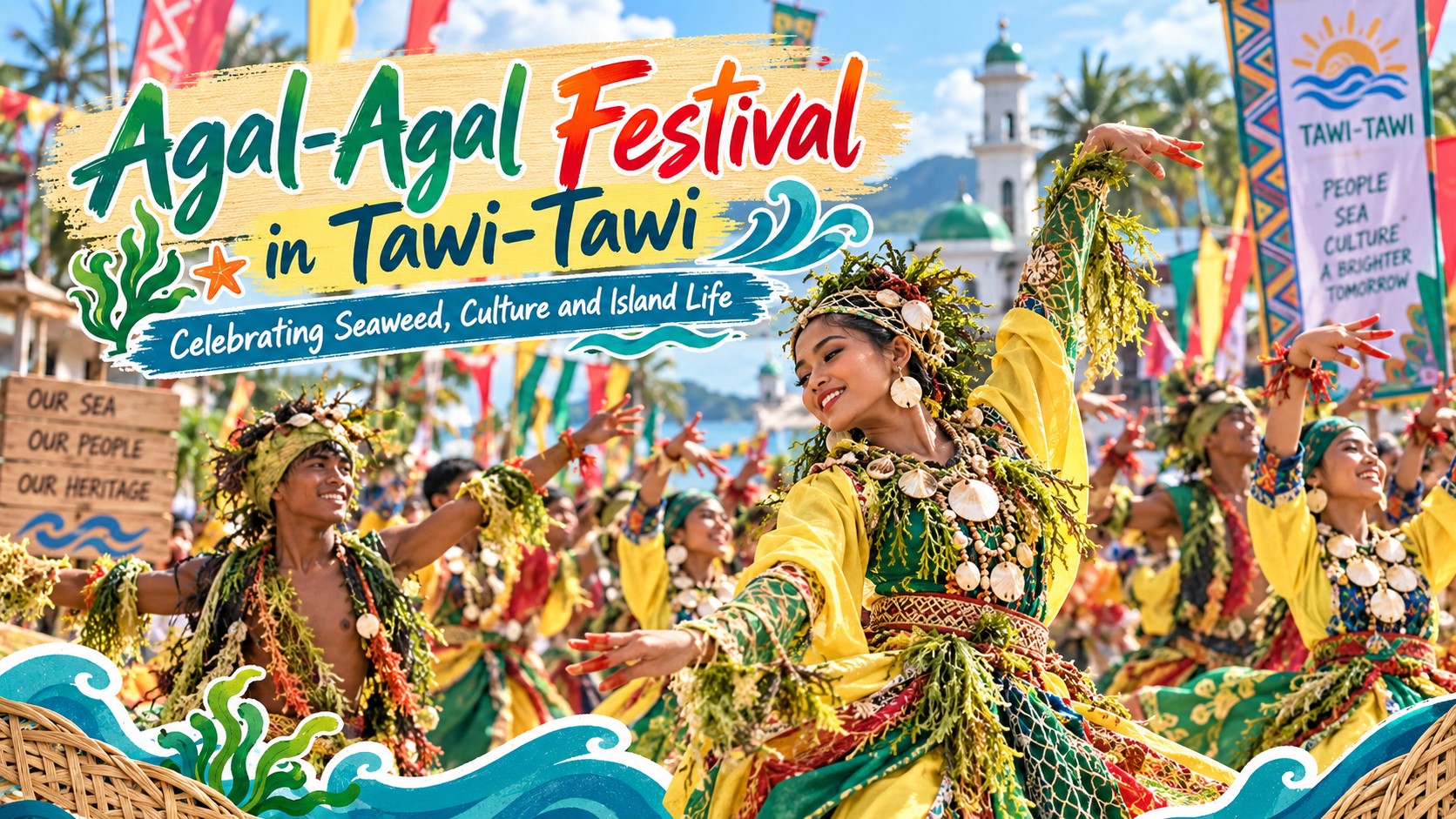
For many visitors, the biggest attraction is the street dancing.
Municipal delegations perform elaborate routines using movements, costumes, music and props inspired by Tawi-Tawi’s environment and cultural traditions.
But don’t expect the performances to look exactly like the typical Philippine street festival.
Traditional dance forms remain an important part of Agal-Agal.
Graceful arm and hand movements, controlled body movements and expressive fingers are characteristic of several dance traditions associated with the Sulu Archipelago.
The spectacle becomes especially striking when dozens of dancers perform these movements together.
A parade can suddenly look like waves moving down the street—which seems appropriate for a festival so closely tied to the sea.
Igal and Pangalay
Among the most important cultural elements seen during Agal-Agal are igal and pangalay.
These dance traditions are strongly associated with the peoples of the Sulu Archipelago.
Rather than relying on fast jumping and heavy movements, many performances emphasize flowing arms, precise hand gestures, graceful posture and controlled movements.
Long ornamental fingernails or janggay may also be used in some performances, extending the visual lines created by the hands and fingers.
Academic research into Sama igal describes movements inspired by natural elements such as wind, lightning and waves. These movements can carry cultural and spiritual meanings beyond what spectators see on the surface.
During Kamahardikaan celebrations, igal has become an important marker of Tawi-Tawi identity, performed by schools and community groups in parades, competitions and cultural presentations.
That makes Agal-Agal Festival interesting because you’re not simply watching entertainment.
You’re seeing cultural traditions being adapted for a large public celebration.
Igal Ma Lan
One of the names visitors may encounter during the festival is Igal Ma Lan, particularly in connection with the major street-dancing competition.
Municipal contingents interpret Tawi-Tawi life through choreography, music and costumes.
Seaweed farming is naturally one of the dominant themes.
A performance might depict fishermen heading out to sea, farmers tending their seaweed lines, harvesting the crop and communities celebrating the bounty of the ocean.
Other performances incorporate courtship, marine life, traditional occupations or stories associated with the islands.
In recent editions, Igal Ma Lan has continued to be one of the centerpiece competitions of Agal-Agal. The Municipality of Languyan, for example, was reported as champion of the Igal Ma Lan and showdown competition during the 2025 festival.
Traditional Music of the Festival
The music is just as important as the dancing.
Traditional ensembles may use instruments including the kulintangan, agung and gandang.
The kulintangan consists of a set of small gongs arranged horizontally and played melodically, while larger hanging gongs and drums provide rhythm.
Instead of simply playing recorded festival music through giant speakers, efforts have been made over the years to keep indigenous musicians and live traditional instruments part of Agal-Agal performances.
Festival guidelines introduced in the 2010s emphasized authentic indigenous dance movements, traditional costume patterns and the live playing of instruments such as kulintangan, agung and gandang.
The result gives Agal-Agal a very different sound from many other Philippine festivals.
Colorful Costumes Inspired by the Sea
Then there are the costumes.
This is where Agal-Agal can become incredibly creative.
Traditional patterns and clothing may be combined with designs inspired by seaweed, shells, fish and other elements of marine life.
Some past performers have even incorporated dried seaweed, rattan, shells and other locally available materials into their costumes and accessories.
Bright reds, yellows, greens, gold and other vivid colors frequently dominate the streets.
And yet, underneath all the festival creativity is an effort to maintain a connection with traditional Tawi-Tawi clothing.
That balance has become increasingly important.
Preserving Culture While Creating a Festival
Agal-Agal also has an interesting story when it comes to cultural preservation.
Like many festivals around the Philippines, earlier versions of Agal-Agal incorporated the familiar competitive street-dancing format used by celebrations such as Sinulog and Ati-Atihan.
That raised questions about whether indigenous dances were being changed too much simply to create bigger, louder and more visually dramatic performances.
Cultural advocates argued that traditional Sama and Sulu Archipelago dances developed in very different settings—including houses, porches, boats and smaller ceremonial spaces—and could lose some of their character when transformed into mass street dancing.
Organizers responded.
By 2014, competition guidelines were revised to place greater emphasis on authentic indigenous movements, traditional music, proper costumes and locally inspired materials.
That evolution is one of the most fascinating aspects of Agal-Agal Festival.
The celebration isn’t simply preserving culture inside a museum.
It is showing the continuing conversation between tradition and modern festival culture.
Other Traditional Dances You May See
Agal-Agal performances can incorporate several dance forms and movements from Tawi-Tawi and the surrounding Sulu cultural region.
Past festivals have featured traditions including tawti, kuntaw, silat and different pangalay or igal variations.
Some are connected with martial traditions.
Others imitate animals, fishing activities, courtship or everyday life.
The tawti, for example, has appeared in performances portraying fishing and the catching of catfish.
These details make the festival more meaningful when you know what you’re watching.
What might initially look like an elaborate dance routine may actually be telling a very specific story about coastal life.
The Municipal Delegations
Another thing that makes Agal-Agal exciting is the participation of communities from around Tawi-Tawi.
Delegations representing municipalities prepare their own interpretations of the festival theme.
That gives the event a friendly competitive atmosphere.
Every contingent wants memorable costumes, strong musicians, impressive choreography and a performance capable of winning the grand competition.
But there is also a sense that everyone is presenting different pieces of the same provincial identity.
Tawi-Tawi consists of island communities separated by water, so bringing representatives together for the provincial celebration carries special meaning.
More Than Street Dancing
Although street dancing gets much of the attention online, Kamahardikaan and Agal-Agal festivities can include a much wider program.
Depending on the year, visitors may encounter cultural presentations, parades, trade fairs, sports events, community activities, exhibitions, beauty pageants and maritime celebrations.
Trade and tourism activities also provide opportunities to showcase seaweed products, local handicrafts and food.
Because the official program changes from year to year, visitors shouldn’t assume that every activity will happen during every edition.
Think of Agal-Agal as part of a larger provincial celebration rather than one isolated parade.
The Connection With the Lepa Festival
Another maritime tradition sometimes incorporated into the wider Kamahardikaan celebration is the Lepa Festival.
The lepa is a traditional wooden boat closely associated with the Sama Dilaut.
For communities whose history and culture are deeply connected with the sea, boats are much more than transportation.
They represent mobility, livelihood, craftsmanship and identity.
That’s why celebrations involving decorated traditional boats fit naturally alongside Agal-Agal.
Seaweed farms, fishing boats, maritime communities and traditional dances all tell different parts of the same story: Tawi-Tawi is a province shaped by water.
A Celebration of Tawi-Tawi’s Cultural Diversity
One of the best things about Agal-Agal Festival is that it doesn’t try to reduce Tawi-Tawi to one cultural tradition.
The province is home to different communities, including the Sama, Sama Dilaut, Jama Mapun and Tausug.
Their languages, traditions and histories aren’t identical.
Yet Agal-Agal provides a shared space where these cultural influences can be presented together.
That is why the festival can feel like both a livelihood festival and a cultural festival at the same time.
Seaweed gives the celebration its name.
But Tawi-Tawi itself is really the subject.
When Is the Agal-Agal Festival Celebrated?
Agal-Agal Festival is generally celebrated in September as part of the activities surrounding Kamahardikaan sin Tawi-Tawi.
The most important date to remember is September 27.
That is the anniversary of the issuance of Presidential Decree No. 302 creating the Province of Tawi-Tawi in 1973.
Some historical festival programs have placed major Agal-Agal activities on September 25 or other dates during the final week of September, while the provincial anniversary itself falls on September 27.
So if you’re planning to visit specifically for the festival, don’t rely on a permanent date for the street-dancing competition.
Check the current year’s official program.
Where Is Agal-Agal Festival Held?
Bongao is the capital and main gateway to Tawi-Tawi, and many provincial activities take place there.
However, major Agal-Agal celebrations have also been hosted by other municipalities.
This means travelers should verify the official venue before making arrangements.
Previous celebrations in Languyan demonstrate that the festival can move beyond Bongao and involve different parts of the province.
What to Expect If You Visit
If you happen to experience Agal-Agal Festival in person, expect something quite different from the huge commercial festivals of Cebu, Iloilo or Bacolod.
The setting itself changes the experience.
You’re in an island province at the southwestern edge of the Philippines, surrounded by communities whose lives remain closely connected with the sea.
The sound of gongs and drums, performers making graceful hand movements, seaweed-inspired costumes and delegations representing different islands create an atmosphere that feels distinctly Tawi-Tawi.
For photographers, the festival is especially interesting because of its costumes and movement.
For cultural travelers, however, the smaller details are even more rewarding.
Watch the musicians.
Look at the hand gestures.
Notice the traditional fabrics.
Pay attention to the props and what they represent.
You’ll appreciate the festival much more once you realize that almost every visual element is telling a story.
Visiting Tawi-Tawi During the Festival
Most travelers enter the province through Bongao, which serves as its commercial and transportation hub.
Because Tawi-Tawi consists of numerous islands, getting from one destination to another often involves boats.
Visitors who are attending the festival can also use Bongao as a base for discovering other attractions in the province.
One of the most famous is Bud Bongao, the mountain overlooking the provincial capital and surrounding waters.
Island-hopping is another major attraction, although sea conditions should always be considered, particularly around the wetter months.
September can experience changing weather and rougher seas, so travelers planning boat trips should keep some flexibility in their itinerary.
Respecting Local Culture
Tawi-Tawi is predominantly Muslim, so visitors should travel with cultural sensitivity.
Modest clothing is appropriate, particularly when visiting communities, government events and religious sites.
Ask permission before photographing people up close.
And if you’re watching traditional performances, remember that what you are seeing isn’t merely something staged for visitors.
Many of the dances, musical traditions and costumes have cultural meaning.
Being curious is welcome.
Being respectful matters even more.
Food and Local Products
Festival season is also a good opportunity to explore Tawi-Tawi’s food culture.
Local delicacies reflect the province’s connections with the wider Sulu region, Mindanao and neighboring Southeast Asia.
You’ll find rice-based sweets, coconut desserts, seafood and other dishes closely associated with Sama and Tausug communities.
Seaweed products naturally appear as well.
Trade fairs organized during provincial festivities can also feature locally produced food, crafts and livelihood products, giving visitors another way of seeing what communities produce beyond the festival stage.
Why Agal-Agal Festival Is Special
The Philippines has hundreds of festivals, and after you’ve seen enough street-dancing competitions, some can admittedly begin to look similar.
Agal-Agal stands out because its strongest identity doesn’t come from the size of the parade.
It comes from the place.
Take away Tawi-Tawi’s seaweed farms, traditional boats, coastal communities, Sama dances and indigenous music, and Agal-Agal wouldn’t exist in the same way.
It belongs specifically to this group of islands.
The festival turns something ordinary—a crop growing quietly beneath the sea—into a symbol of community pride.
Seaweed provides income.
The sea provides food.
Traditional dances preserve memory.
Music connects generations.
And for several days each September, all of those things come together in one celebration.
Agal-Agal Festival 2026
For travelers looking specifically at the 2026 celebration, September 27, 2026 remains the anniversary date of Tawi-Tawi’s founding.
However, the Agal-Agal street-dancing competition and other Kamahardikaan activities do not necessarily fall on exactly the same date each year. Recent festival information also notes that schedules and venues can change, so travelers should wait for or verify the official program from the Provincial Government or Provincial Tourism Office of Tawi-Tawi before booking a trip around a particular event.
In other words, think of late September as the main festival period rather than assuming everything happens only on September 27.
Final Thoughts
Agal-Agal Festival is one of those celebrations that makes much more sense once you know the story behind it.
From the outside, you see colorful costumes, graceful dancers and lively traditional music.
But underneath all of that is the story of an island province whose people have depended on the sea for generations.
Seaweed farming may not sound glamorous, yet in Tawi-Tawi it represents livelihood, resilience and community.
And that is exactly what makes Agal-Agal Festival worth remembering.
It is a celebration of the farmers who work in the sea, the musicians keeping traditional sounds alive, the dancers carrying centuries-old movements into a modern festival, and the many communities scattered across the islands of Tawi-Tawi.
More than anything, Agal-Agal Festival is Tawi-Tawi telling its own story—through the sea, through dance and through culture.