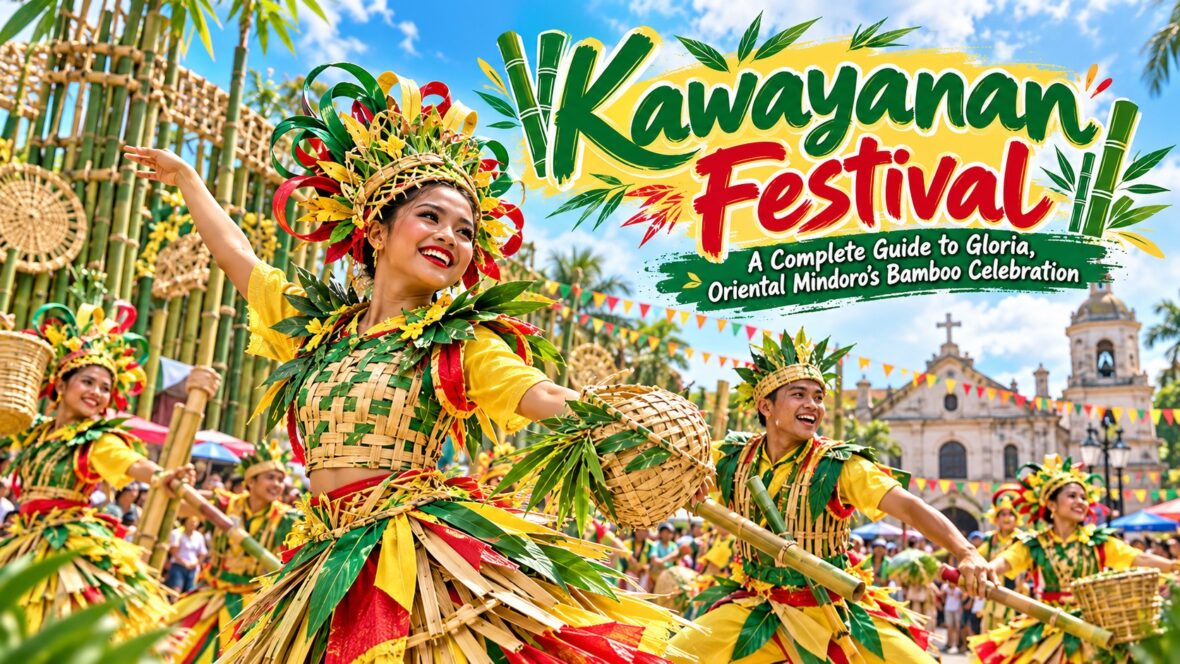
There are plenty of Philippine festivals inspired by things that grow from the land.
We have festivals for flowers.
Rice.
Coconut.
Fruits.
And in Gloria, Oriental Mindoro, one of the most useful plants you can possibly find becomes the star of the celebration.
Bamboo.
Every October, the municipality of Gloria celebrates the Kawayanan Festival, a colorful cultural celebration that highlights the abundance, importance and many uses of bamboo in the community.
“Kawayan,” of course, is the Filipino word for bamboo.
And during the festival, you’ll see it almost everywhere.
In costumes.
In handicrafts.
In furniture.
In decorations.
In musical and cultural presentations.
And sometimes even in the movements and concepts used by street dancers.
But Kawayanan Festival is more than a celebration of one plant.
It also coincides with the founding anniversary of Gloria, making the festival a celebration of the town itself—its history, agriculture, creativity, local products and community pride.
If you’re looking for a lesser-known festival in Oriental Mindoro that combines street dancing with agriculture and traditional craftsmanship, Kawayanan Festival is definitely one worth discovering.
Here’s a complete guide.
Content
What Is Kawayanan Festival?
Kawayanan Festival is an annual cultural festival celebrated in the Municipality of Gloria, Oriental Mindoro.
The festival focuses on bamboo and its importance in the everyday lives and livelihoods of local residents.
According to the official Oriental Mindoro tourism portal, Gloria is known not only for rice and coconut production but also for areas where different varieties of bamboo grow. Kawayanan Festival was developed around that local resource, highlighting the versatility of bamboo and the many ways people use it.
The festival traditionally features activities such as:
- Street dancing
- Bamboo product showcases
- Bamboo craft demonstrations
- Agricultural fairs
- Cultural presentations
Those activities make Kawayanan one of those festivals where the theme isn’t simply decorative.
The festival actually connects to a real local industry and resource.
Where Is Kawayanan Festival Celebrated?
Kawayanan Festival is celebrated in:
Gloria, Oriental Mindoro
The main festival venue is commonly associated with the Gloria Municipal Grounds.
Gloria is one of the municipalities of Oriental Mindoro and sits along the main highway running through the eastern side of Mindoro Island.
The town is agricultural, with rice, coconut and other crops contributing to the local economy.
And bamboo has become one of the resources closely associated with Gloria.
That’s why the festival feels very much connected to the place where it is celebrated.
What Does “Kawayanan” Mean?
The festival name comes from the Filipino word:
Kawayan = bamboo
“Kawayanan” can refer to a place where bamboo grows abundantly—a bamboo grove or an area filled with bamboo.
And that’s essentially the idea behind the festival.
Gloria has long been associated with abundant bamboo resources, so the municipality turned that identity into a cultural celebration.
Simple name.
Very clear meaning.
And once you see festival performers surrounded by bamboo-inspired costumes, props and decorations, the connection becomes even more obvious.
Why Bamboo?
Bamboo is one of those materials that Filipinos have been using for generations without necessarily thinking about how versatile it is.
You can build with it.
You can turn it into furniture.
You can create baskets and containers.
You can make decorations.
You can use it for fences.
Traditional homes have used bamboo.
Farmers use bamboo.
Craftspeople use bamboo.
And some traditional musical instruments are made from bamboo too.
In Gloria, local sources specifically identify bamboo as a material used for furniture, handicrafts and various novelty products.
That’s what makes the Kawayanan Festival theme interesting.
Bamboo isn’t something chosen randomly because it looks nice in festival costumes.
It is connected to everyday life.
Kawayanan Festival and Gloria’s Agricultural Identity
Gloria isn’t known only for bamboo.
Agriculture remains an important part of the municipality.
Rice and coconut are among the products historically associated with the town, while fruits and other crops are also grown in the area.
So when Kawayanan Festival includes an agricultural fair, it fits naturally into the celebration.
The festival becomes an opportunity to showcase more than bamboo.
It can highlight the products coming from local farms and communities throughout Gloria.
In that sense, Kawayanan is also a celebration of the land.
The festival says:
This is what we grow.
This is what we make.
And this is what makes our community different.
Kawayanan Festival and Gloria’s Founding Anniversary
One of the most important things to understand about Kawayanan Festival is that it is closely tied to Gloria’s founding anniversary.
Gloria was created as a municipality through Executive Order No. 117 issued by President Diosdado Macapagal on October 1, 1964.
That date explains why October 1 is so important in Gloria.
The festival and the municipality’s anniversary come together in one celebration.
So while bamboo is the visual and cultural symbol of Kawayanan Festival, the occasion is also about Gloria itself.
Its history.
Its barangays.
Its people.
Its farmers.
Its craftsmen.
And the identity the town has developed through the years.
A Quick History of Gloria, Oriental Mindoro
Before becoming a municipality, the area that would eventually become Gloria formed part of Pinamalayan.
According to Oriental Mindoro’s tourism history, settlers from Marinduque began establishing communities in the area during the early 20th century.
One of the communities that developed was Barrio Maligaya.
Residents from several barrios later pushed for the creation of a separate municipality.
That effort led President Diosdado Macapagal to issue Executive Order No. 117 on October 1, 1964, creating the Municipality of Gloria.
The municipality’s legal history became more complicated afterward, but Gloria eventually became firmly established as an independent municipality.
October 1 nevertheless remained the date associated with its founding celebration.
And today, Kawayanan Festival has become part of how Gloria marks that occasion.
When Did Kawayanan Festival Begin?
Compared with centuries-old fiestas, Kawayanan Festival is relatively young.
By 2023, Gloria was already celebrating its 20th Kawayanan Festival, according to the Philippine Information Agency.
That tells you something important about the festival.
It may not have hundreds of years of history behind it, but it has already become an established part of Gloria’s local identity.
Festivals don’t necessarily have to be ancient to become meaningful.
Traditions can grow.
And after years of students practicing dances, families attending activities and local craftsmen displaying products, a relatively new festival can become something an entire generation grows up with.
Kawayanan Festival Street Dancing
For many visitors, street dancing is probably the most visually exciting part of Kawayanan Festival.
Groups of performers take to the streets wearing colorful costumes that often incorporate bamboo or designs inspired by it.
Past documentation of the festival specifically mentions participants wearing costumes made with or inspired by bamboo materials.
And because bamboo has such a distinctive appearance, it gives costume designers plenty of ideas to work with.
Think:
Natural brown and green tones.
Bamboo strips.
Woven patterns.
Leaves.
Traditional textiles.
Large headpieces.
Farm-inspired accessories.
And then mix all of that with the bright colors Filipino street festivals are known for.
The result is a celebration that can look traditional and modern at the same time.
Street Dancing as Storytelling
The best street dancing isn’t simply about performers moving to loud music.
It tells a story.
In Kawayanan Festival, dance performances can represent the connection between the people of Gloria and bamboo.
You may see choreography inspired by planting.
Harvesting.
Cutting.
Crafting.
Building.
Farming.
Or community life.
Bamboo props can become part of the choreography itself.
And when dozens of dancers move together carrying bamboo-inspired decorations or wearing woven costumes, the festival theme becomes instantly recognizable.
Even if you arrived without knowing the name of the celebration, you would probably figure out pretty quickly that bamboo is important here.
Bamboo Product Showcase
One of the most practical parts of Kawayanan Festival is the bamboo product showcase.
This is where visitors can see how local creativity transforms a simple bamboo pole into something completely different.
Products may include:
- Furniture
- Home decorations
- Handicrafts
- Souvenirs
- Woven products
- Household items
- Novelty pieces
Oriental Mindoro tourism materials specifically identify bamboo products as one of the festival’s major attractions.
And honestly, this is one of the festival activities I find most interesting.
Street dancing gives you entertainment.
The product exhibits show you why bamboo actually matters to the community.
Bamboo Craft Demonstrations
Festival visitors may also encounter bamboo craft demonstrations.
These activities allow local craftsmen to show how bamboo is cut, shaped, woven and turned into useful objects.
It’s one thing to see a finished bamboo chair.
It’s another thing to watch someone create it.
Traditional skills like these can easily be overlooked because we’re surrounded by mass-produced products.
A festival gives craftsmen a public platform.
Students get to see the process.
Visitors learn something.
And local makers get recognition for their skills.
That makes the celebration more than entertainment.
It becomes a way of preserving knowledge.
The Agricultural Fair
Agriculture is another major component of Kawayanan Festival.
The official provincial tourism listing identifies an agricultural fair among the festival highlights.
That makes sense when you consider Gloria’s agricultural character.
A local agricultural fair can give farmers and producers opportunities to showcase:
- Rice
- Coconut products
- Fruits
- Vegetables
- Plants
- Processed food
- Local delicacies
- Farm products
It also helps connect visitors with the people actually producing food in the municipality.
Sometimes we visit festivals and spend all our time photographing dancers.
But agricultural fairs often tell you just as much about a town.
Maybe even more.
Cultural Presentations
Kawayanan Festival also includes cultural presentations.
These activities can feature music, dances and performances highlighting Gloria’s culture and local identity.
The exact program naturally changes from year to year.
Some years may have competitions.
Others may have concerts.
There may be school presentations or barangay performances.
But the general idea remains the same.
Festival week becomes an opportunity for the community to perform.
And in many Philippine towns, schools play a huge role in keeping festival traditions alive.
Students rehearse for weeks.
Teachers prepare costumes.
Parents help.
Barangays organize.
Then suddenly the entire community is involved.
Students and the Festival
Students have traditionally been major participants in Kawayanan Festival street dancing.
The Philippine Statistics Authority’s Oriental Mindoro provincial publication describes the festival as featuring street dancing performances largely involving students from different educational levels, wearing costumes incorporating bamboo materials.
That’s significant.
It means the festival isn’t simply something younger residents watch.
They participate.
And when young people actually dance the routines, wear the costumes and learn the meaning behind the festival, the tradition becomes much easier to pass on.
Why Bamboo Is a Great Festival Symbol
The more you think about it, the more appropriate bamboo becomes as a symbol.
Bamboo can look simple.
But it’s incredibly useful.
It bends.
It grows.
It can be transformed.
And Filipinos have found countless ways to use it.
So in a festival setting, bamboo can represent more than a local resource.
It can symbolize creativity.
Adaptability.
Resourcefulness.
And community.
Those are qualities that fit the story of many Philippine towns.
Kawayanan Festival and Local Livelihood
A festival becomes more meaningful when it supports actual livelihoods.
Kawayanan does that by giving bamboo craftsmen and local producers visibility.
People visiting a trade fair might discover locally made furniture.
Someone might buy handicrafts.
A visitor may bring home a bamboo souvenir.
Those transactions may seem small individually.
But festivals can create opportunities for microbusinesses and community-based producers.
That’s another reason festivals matter economically.
Tourism isn’t only about hotels and big attractions.
Sometimes it starts with someone buying a handmade product from a local craftsman.
Bamboo and Eco-Tourism in Gloria
The town’s bamboo identity has also become part of Gloria’s tourism positioning.
The official Oriental Mindoro tourism portal currently lists a bamboo plantation among Gloria’s farm and agri-tourism attractions.
That means the bamboo story doesn’t necessarily end when Kawayanan Festival finishes.
Visitors can continue exploring Gloria’s agricultural landscape and other natural attractions.
The town also has beaches, fish sanctuaries, resorts and waterfalls listed by provincial tourism authorities.
So if you’re traveling for the festival, it can easily become part of a longer Oriental Mindoro trip.
What Makes Kawayanan Festival Different?
The Philippines has hundreds of festivals.
So what makes Kawayanan worth noticing?
For me, it’s the clarity of the theme.
Bamboo is everywhere in Filipino life.
But we rarely stop and celebrate it.
Gloria does.
And instead of treating bamboo simply as decoration, the festival shows its connection to:
Agriculture.
Craftsmanship.
Livelihood.
History.
Art.
And local identity.
That’s what makes the celebration work.
Kawayanan Festival Is Also About Gloria
It would be easy to describe Kawayanan as simply “the bamboo festival.”
But that would miss half of the story.
October 1 is also Gloria’s anniversary.
So the festival becomes a celebration of the municipality itself.
Younger generations learn local history.
Barangays come together.
Local products get promoted.
Performers showcase their talents.
Farmers and craftsmen receive attention.
And people who have moved away may come home to celebrate.
That’s when a festival becomes more than an event.
It becomes part of the town calendar.
When Is Kawayanan Festival Celebrated?
Kawayanan Festival is traditionally celebrated every:
October 1
in Gloria, Oriental Mindoro.
The date coincides with Gloria’s founding anniversary.
Oriental Mindoro’s official tourism portal lists October 1 as the annual celebration date.
However, festival activities may begin before October 1.
In some years, Gloria has organized longer programs surrounding the anniversary, with events spread over several days or weeks.
So October 1 is the key date.
But if you’re planning to attend, always check the year’s full festival calendar.
Where Are the Main Festival Activities Held?
The official tourism portal identifies the:
Gloria Municipal Grounds
as the main venue associated with Kawayanan Festival.
Street dancing naturally takes place along designated roads and public spaces before performances or competitions move toward central festival venues.
Routes can change from year to year.
If you want to photograph the street dancing, check the official route before choosing where to wait.
How to Get to Gloria, Oriental Mindoro
If you’re coming from Metro Manila, one common route to Oriental Mindoro is through Batangas.
Travelers can head to Batangas Port and take a ferry to Calapan.
From Calapan, buses and vans travel south through Oriental Mindoro toward towns including Pinamalayan, Gloria, Bansud and Roxas.
Gloria sits along the main highway running through this section of the province.
If you’re traveling specifically for Kawayanan Festival, allow extra time because festival activities can affect traffic around the town center.
Coming From Roxas, Oriental Mindoro
Travelers arriving through Roxas Port can also head north toward Gloria.
Local transport guides commonly indicate buses and vans operating along the Roxas-Calapan corridor, with Gloria along the route.
That makes the municipality accessible from either the northern or southern side of Oriental Mindoro.
Things to Do in Gloria After the Festival
If you’re already making the trip, don’t immediately leave after the street dancing.
Gloria has several places that can be explored as part of a longer visit.
The official Oriental Mindoro tourism portal currently lists attractions including:
- Bamboo Plantation
- Agsalin Fish Sanctuary
- Sta. Theresa Fish Sanctuary
- Walang Langit Waterfalls
- M. Adriatico Pottery
- Local resorts and farm stays
That makes Kawayanan Festival a good excuse to discover a part of Oriental Mindoro many travelers simply pass through.
Tips for Attending Kawayanan Festival
If you’re planning to visit, here are a few practical tips.
Arrive early
Street dancing events can attract crowds.
You’ll have a better chance of finding a good viewing spot if you arrive before the performances begin.
Check the official schedule
Don’t assume all activities happen on October 1.
Some events may take place before or after the main festival day.
Wear comfortable shoes
You’ll probably be walking.
A lot.
Bring sun protection
October can still be hot.
Bring sunscreen, a hat or an umbrella.
Prepare for rain too
It’s the Philippines.
The umbrella has two jobs.
Support local sellers
Look for bamboo handicrafts, food products and locally made souvenirs.
That’s one of the best ways to make your festival visit actually benefit the community.
Respect the performers
Students and cultural groups may have spent weeks or months preparing their routines.
Give them room to perform.
Ask before taking close-up portraits
Festival photography is fun, but basic courtesy still matters.
Kawayanan Festival for Photographers
If you love photographing festivals, Kawayanan gives you plenty of subjects.
You have:
- Street dancers
- Bamboo costumes
- Craft demonstrations
- Agricultural displays
- Musical performances
- Colorful decorations
- Crowds
- Local products
For street dancing, try positioning yourself where dancers have enough room to perform rather than standing where the parade is moving quickly.
Wide shots are great for showing the crowd and festival atmosphere.
Closer photos can highlight the details of bamboo costumes and handmade accessories.
And don’t forget the craftsmen.
Sometimes the quietest photos tell the best story.
Is Kawayanan Festival Worth Visiting?
If you’re already traveling around Oriental Mindoro in late September or early October, yes.
Kawayanan offers something very different from the province’s beaches and waterfalls.
It’s an opportunity to experience the community itself.
You’ll see how people celebrate.
What they produce.
What they value.
And what they want visitors to remember about Gloria.
It is especially worth considering if you’re interested in:
- Philippine festivals
- Street photography
- Local crafts
- Bamboo products
- Agriculture
- Community tourism
- Lesser-known destinations
- Oriental Mindoro culture
Are There Other Kawayanan Festivals in the Philippines?
Yes.
This is worth mentioning because searching “Kawayanan Festival” online can sometimes produce results from different places.
Other Philippine communities have also used the Kawayanan name for celebrations connected to bamboo.
For example, tourism references document a Kawayanan Festival in Zamboanga del Sur, while historical government proclamations also refer to a Kawayanan Festival in M’lang, Cotabato.
This guide specifically refers to:
Kawayanan Festival of Gloria, Oriental Mindoro
The one traditionally celebrated on October 1 alongside Gloria’s founding anniversary.
Frequently Asked Questions About Kawayanan Festival
What is Kawayanan Festival?
Kawayanan Festival is an annual bamboo-themed cultural festival held in Gloria, Oriental Mindoro.
It highlights the abundance and many uses of bamboo while also celebrating local agriculture, culture and community.
What does “Kawayanan” mean?
The name comes from “kawayan,” the Filipino word for bamboo.
Kawayanan generally refers to a place where bamboo grows abundantly.
Where is Kawayanan Festival celebrated?
It is celebrated in Gloria, Oriental Mindoro.
When is Kawayanan Festival?
The main festival date is traditionally October 1.
Why is October 1 important in Gloria?
President Diosdado Macapagal issued Executive Order No. 117 creating the Municipality of Gloria on October 1, 1964.
The Kawayanan Festival is therefore celebrated alongside the municipality’s founding anniversary.
What is Gloria known for?
Gloria is an agricultural municipality associated with rice, coconut and bamboo, among other products.
What happens during Kawayanan Festival?
Common festival highlights include street dancing, bamboo craft demonstrations, bamboo product showcases, agricultural fairs and cultural presentations.
Where are the main activities held?
The Gloria Municipal Grounds is identified by Oriental Mindoro tourism authorities as the primary festival venue.
Do dancers use bamboo costumes?
Bamboo materials and bamboo-inspired designs are traditionally incorporated into costumes and festival presentations.
Kawayanan Festival 2026 Schedule
For travelers planning to attend in 2026, the official Oriental Mindoro tourism portal currently lists the next Kawayanan Festival celebration on:
Thursday, October 1, 2026
Location:
Gloria, Oriental Mindoro
Venue:
Gloria Municipal Grounds
The portal highlights bamboo product showcases, street dancing, bamboo craft demonstrations, an agricultural fair and cultural presentations as the festival’s signature activities.
A detailed hour-by-hour 2026 program may still be announced separately by the municipality, so visitors should check Gloria’s official tourism or local government channels before traveling.

Final Thoughts
What I like about Kawayanan Festival is how ordinary its inspiration initially seems.
Bamboo.
We see it beside roads.
Behind houses.
On farms.
In fences.
In furniture.
Sometimes we barely notice it.
But then you go to Gloria during Kawayanan Festival and suddenly bamboo becomes something completely different.
It becomes a costume.
A dance prop.
A livelihood.
A work of art.
A piece of furniture.
A cultural symbol.
And a reason for an entire town to celebrate.
That is what local festivals do so well.
They take something people see every day and remind us that it has a story.
For Gloria, Oriental Mindoro, that story is written in kawayan.
And every October 1, the town brings that story to the streets.


