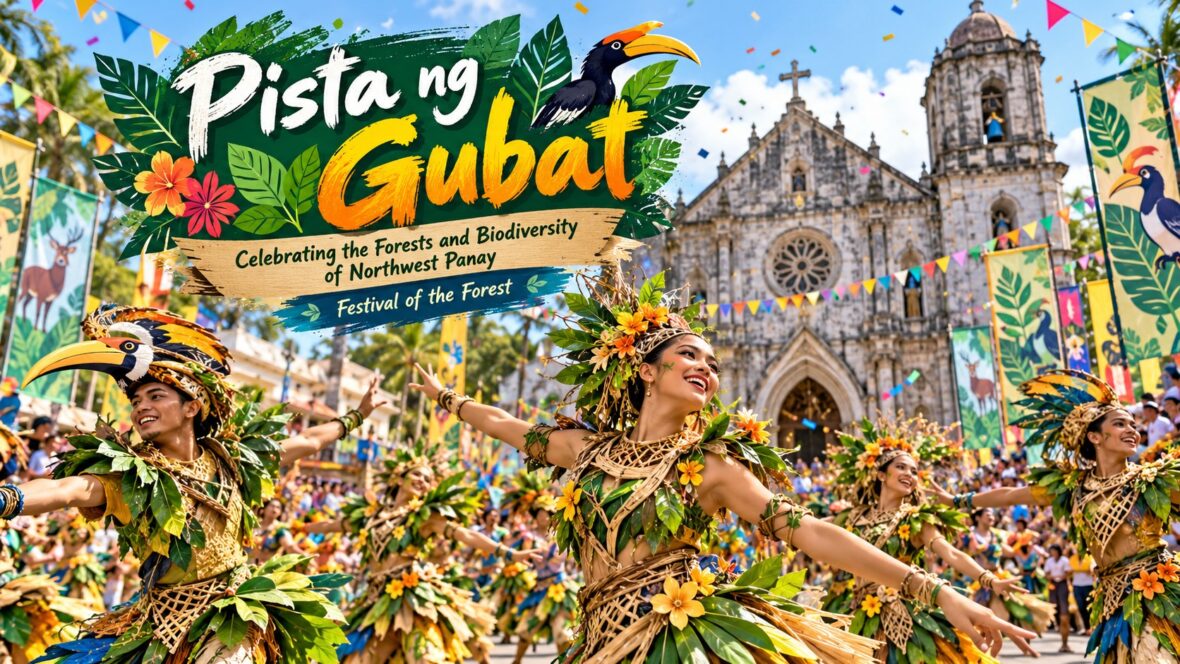
When we hear the word “festival” in the Philippines, we usually imagine colorful costumes, street dancing, marching bands, food fairs and a town plaza packed with people.
Pista ng Gubat is a little different.
Yes, it is still a celebration.
But instead of honoring a particular crop, historical event or patron saint, the star of this festival is something much bigger:
the forest itself.
Pista ng Gubat—literally “Festival of the Forest” or “Feast of the Forest”—is an environmental celebration associated with the Northwest Panay Peninsula Natural Park, one of the most important remaining forest areas in Western Visayas.
The festival brings together communities from Antique and Aklan, government agencies, students, conservation organizations and environmental advocates with one common message:
The forests of Northwest Panay are worth protecting.
And once you learn what actually lives inside these forests, you begin to understand why.
The Northwest Panay Peninsula is home to rare wildlife found nowhere else in the world, including threatened hornbills, Visayan warty pigs and the critically endangered Negros bleeding-heart.
So Pista ng Gubat isn’t simply another date on the Philippine festival calendar.
It is a celebration with a purpose.
Here’s a closer look at Pista ng Gubat, its history, meaning, environmental importance and what visitors can expect from this unique conservation festival.
Content
Pista ng Gubat Quick Guide
| Information | Details |
|---|---|
| Festival | Pista ng Gubat |
| Meaning | Festival or Feast of the Forest |
| Main Focus | Forest protection, biodiversity and environmental conservation |
| Area Celebrated | Northwest Panay Peninsula |
| Provinces | Antique and Aklan |
| Protected Area | Northwest Panay Peninsula Natural Park |
| Municipalities Connected to the Park | Pandan, Libertad, Buruanga, Malay and Nabas |
| Traditional Festival Listing | October 1, Pandan, Antique |
| Modern Schedule | Varies by year and host community |
| Common Activities | Biodiversity education, environmental exhibits, conservation talks, tree planting and community activities |
| Organizer in Recent Editions | Northwest Panay Peninsula Natural Park Protected Area Management Board |
Unlike many Philippine fiestas, Pista ng Gubat does not necessarily have one permanently fixed venue or date in its modern form.
And that’s something worth explaining.
Where Is Pista ng Gubat Celebrated?
Many older Philippine tourism and festival calendars identify Pista ng Gubat with Pandan, Antique and list October 1 as its traditional date.
These listings describe the festival as an annual celebration of Northwest Panay’s biodiversity intended to encourage environmental awareness and conservation.
But Pista ng Gubat is better understood today as a celebration connected with the entire Northwest Panay Peninsula rather than simply one town.
The Northwest Panay Peninsula Natural Park covers portions of five municipalities:
- Pandan, Antique
- Libertad, Antique
- Buruanga, Aklan
- Malay, Aklan
- Nabas, Aklan
This isn’t just an informal grouping.
Presidential Proclamation No. 186 officially declared the mountain ranges covering those five municipalities as the Northwest Panay Peninsula Natural Park in 2002. The protected area covers approximately 12,009 hectares.
And because the forest crosses municipal and provincial boundaries, protecting it requires cooperation beyond a single town.
That same idea is reflected in Pista ng Gubat.
What Does “Pista ng Gubat” Mean?
The name is very straightforward.
“Pista” means festival or feast.
“Gubat” means forest.
So Pista ng Gubat literally means:
Festival of the Forest.
But the deeper meaning goes beyond simply celebrating trees.
The festival is about recognizing everything the forest provides:
clean water,
habitat for wildlife,
protection against erosion,
resources for surrounding communities,
biodiversity,
and an ecosystem that connects mountains, rivers and coastal areas.
In other words, Pista ng Gubat treats the forest not as empty land waiting to be developed but as a living system worth protecting.
The Northwest Panay Peninsula Natural Park
To understand the festival, you really need to understand the forest behind it.
The Northwest Panay Peninsula Natural Park stretches across northern Antique and western Aklan.
It was formally declared a protected area on April 18, 2002 through Presidential Proclamation No. 186.
The park covers roughly 12,009 hectares and includes lowland forest ecosystems that serve as important watersheds.
Water collected in these forested mountains feeds springs and river systems used by communities in the area. Government biodiversity documents also identify the park as an important habitat for a remarkable collection of Western Visayan wildlife.
And that is where Pista ng Gubat becomes much more meaningful.
You’re not celebrating just any forest.
You’re celebrating one of the remaining homes of some of the country’s rarest animals.
Wildlife of Northwest Panay
Imagine walking through a forest and knowing that somewhere among the trees could be animals found only in this part of the world.
That’s the reality of Northwest Panay.
Government biodiversity assessments list species found in or associated with the protected area including:
- Visayan warty pig
- Visayan spotted deer
- Negros bleeding-heart
- Visayan hornbill
- Rufous-headed or Walden’s hornbill
- Blue-naped parrot
- Visayan leopard cat
- Panay monitor
- Little golden-mantled flying fox
Several of these species face serious threats from habitat loss, hunting and other human pressures.
That makes conservation in Northwest Panay important not just for Antique and Aklan but for Philippine biodiversity as a whole.
The Negros Bleeding-Heart
One animal has received particular attention during recent Pista ng Gubat celebrations.
The Negros bleeding-heart, locally known as the Badlitan, is a ground-dwelling forest pigeon with a striking reddish patch on its chest.
Despite its name, the bird is associated not only with Negros but also with Panay.
And it is critically endangered.
During the 2026 Pista ng Gubat, the Haribon Foundation created an exhibit focusing on the Badlitan and the importance of protecting its remaining habitat in the Northwest Panay Peninsula Natural Park.
That is exactly the kind of activity that makes Pista ng Gubat different from an ordinary fiesta.
Someone might attend because they’re curious about the festival.
Then they discover an endangered bird they had never heard of.
Suddenly conservation becomes personal.
Hornbills of Northwest Panay
Hornbills are another important part of the forest ecosystem.
The Northwest Panay Peninsula provides habitat for threatened hornbill species including the Visayan hornbill and the critically endangered Rufous-headed or Walden’s hornbill.
Research on the Visayan hornbill describes Northwest Panay as one of the most important remaining low-elevation forest landscapes within the species’ range.
Hornbills are especially interesting because forests need animals like them.
Birds can help disperse seeds throughout the forest after feeding on fruits.
So protecting wildlife doesn’t simply mean saving individual animals.
Those animals themselves help maintain the forest.
Everything is connected.
How Did Pista ng Gubat Begin?
Records indicate that the modern Northwest Panay Pista ng Gubat developed alongside conservation efforts in the peninsula during the early 2000s.
The municipality of Libertad’s planning records describe Pista ng Gubat as a major environmental festival created to raise awareness about environmental protection and conservation following the declaration of the Northwest Panay Peninsula Natural Park.
A 2006 report described that year’s celebration in Buruanga as the fifth Pista ng Gubat.
That report identified the event as an annual gathering of communities within the Northwest Panay Peninsula intended to emphasize the importance of the area’s forest ecosystem.
So rather than beginning as a traditional religious fiesta centuries ago, Pista ng Gubat grew out of modern conservation efforts.
And I think that makes its story interesting in a completely different way.
A Festival Shared by Several Towns
One of the most unusual things about Pista ng Gubat is that it isn’t necessarily owned by just one municipality.
The forest doesn’t stop at a municipal boundary.
Neither does wildlife.
A hornbill can fly from one side of the protected area to another without knowing that it has crossed from Antique into Aklan.
That reality encouraged cooperation among the municipalities surrounding Northwest Panay.
Historical records describe the Northwest Panay Biodiversity Management Council as involving the provincial governments of Antique and Aklan together with the municipalities of Pandan, Libertad, Buruanga, Malay and Nabas.
Recent editions are organized through the Northwest Panay Peninsula Natural Park Protected Area Management Board.
This shared structure explains why the festival has appeared in different communities over the years.
For example:
Buruanga hosted the fifth Pista ng Gubat in 2006.
Pandan hosted activities connected with the 2024 celebration.
Libertad hosted the 2026 edition.
So when researching Pista ng Gubat, don’t be surprised if you encounter different locations.
That’s part of the festival’s character.
Is Pista ng Gubat Really Held on October 1?
This is where things can become confusing online.
Many older Philippine festival directories list:
Pista ng Gubat
October 1
Pandan, Antique
And historically, that’s how the festival became commonly categorized in tourism calendars.
However, recent editions show that the modern NPPNP Pista ng Gubat does not always follow that October 1 schedule.
The 2024 biodiversity activities, for example, included a program in Pandan on June 22.
The 2026 celebration was held in Libertad on June 21.
So for travelers, the safest approach is this:
Don’t rely only on old festival calendars.
Check announcements from the Northwest Panay Peninsula Natural Park, its Protected Area Management Board, DENR, participating LGUs or conservation organizations before planning your trip.
The location and schedule can change.
Why June Makes Sense
Recent editions taking place in June aren’t random.
June is observed as Philippine Environment Month, making it a natural period for environmental education, tree-growing activities and biodiversity campaigns.
That fits perfectly with the purpose of Pista ng Gubat.
Instead of simply becoming another tourism event, the celebration remains tied to environmental awareness.
And honestly, that is probably how it should be.
Biodiversity Talks
Education is one of the most important elements of Pista ng Gubat.
During the 2024 celebration, a biodiversity talk was held in Barangay Tingib, Pandan.
Speakers discussed the natural heritage of Northwest Panay, biodiversity conservation and the need to protect the natural park.
Events like these might not look as spectacular as a street dancing competition.
But their impact can last much longer.
A student who attends a conservation talk may later become a forest ranger.
A farmer might learn why protecting a watershed also protects agriculture.
A resident may understand why hunting a rare bird can damage an ecosystem.
Environmental protection often starts with understanding.
Environmental Exhibits
Another activity associated with recent Pista ng Gubat celebrations is environmental exhibits.
Organizations use the festival as an opportunity to introduce visitors to rare plants and animals.
The Haribon Foundation’s Badlitan exhibit in 2026 is a good example.
Instead of simply showing photos of an endangered bird, conservation organizations can explain:
where it lives,
why it is endangered,
what threatens it,
and what ordinary people can do to help.
That makes Pista ng Gubat a kind of outdoor environmental classroom.
Tree Planting and Forest Restoration
Tree planting has also been associated with Pista ng Gubat activities over the years.
Historical conservation records show seedlings being prepared and distributed for tree-growing activities connected with the festival.
One conservation report, for example, documented hundreds of native seedlings provided for a Pista ng Gubat tree-planting activity in Malay.
Tree planting sounds simple.
Dig a hole.
Put in a seedling.
Cover it with soil.
Take a photo.
But real forest restoration is more complicated than that.
The right species need to be planted.
Seedlings need to survive.
Sites need to be monitored.
And existing forests need to be protected at the same time.
That’s why conservation festivals are most meaningful when tree planting is accompanied by long-term stewardship.
Forest Rangers and Community Conservation
Another important part of protecting Northwest Panay is the work of forest rangers.
Conservation doesn’t happen only during festivals.
Every day, people have to patrol protected areas, monitor wildlife, report illegal activities and work with communities living near the forest.
Historical conservation programs in Northwest Panay have included ranger-based habitat protection, wildlife monitoring and community livelihood initiatives designed to reduce pressure on forest resources.
Pista ng Gubat gives the public an opportunity to understand that work.
Because protecting a forest is much easier to support once you meet the people actually doing it.
The Forest as a Source of Water
One reason forests matter so much to communities is water.
Healthy forests absorb rainfall.
They help regulate water flow.
They reduce erosion.
They protect watersheds.
Government biodiversity reports describe Northwest Panay as an important watershed whose forests channel rainfall into rivers and springs used by communities in Panay.
This connection is important because conservation can sometimes sound abstract.
People hear words like biodiversity and ecosystem.
But water is easy to understand.
No forest can mean less reliable water.
Less reliable water affects households.
It affects farming.
It affects businesses.
It affects tourism.
Suddenly protecting trees becomes everybody’s concern.
Forests and Boracay
Here’s another interesting connection.
The Northwest Panay Peninsula sits close to one of the country’s biggest tourism destinations:
Boracay.
Watersheds in the Northwest Panay area help support communities around Malay and nearby areas.
So the forested mountains tourists may never see can still influence places they visit along the coast.
That’s another reminder that tourism and environmental protection cannot really be separated.
A beautiful beach destination depends on healthy ecosystems beyond the beach itself.
Ridge to Reef
Recent Pista ng Gubat themes have emphasized the idea of protecting ecosystems “from ridge to reef.”
I like this phrase because it explains conservation very simply.
What happens on a mountain can eventually affect the sea.
Rain falls in the forest.
Water flows downhill.
It reaches streams and rivers.
Rivers eventually reach coastal areas.
If upland forests are damaged, soil and pollution can travel downstream.
So forest conservation can also become coastal conservation.
Everything is connected.
Threats Facing Northwest Panay
Pista ng Gubat is a celebration, but it also exists because the forest faces real pressures.
Government biodiversity documents have identified threats including:
- timber poaching
- agricultural land conversion
- kaingin
- wildlife hunting
- collection of forest products
- development pressure
That doesn’t mean local communities should simply be blamed.
The relationship between people and forests is complicated.
Families need livelihoods.
Communities need roads.
Farmers need land.
People need housing and resources.
That is why conservation efforts increasingly focus on finding ways for communities to benefit economically without destroying the ecosystems they depend on.
Sustainable Livelihoods
Conservation works better when people living beside protected areas are partners rather than outsiders.
Organizations working in Northwest Panay have supported livelihood programs intended to reduce dependence on destructive extraction of forest resources.
These have included agroforestry, sustainable agriculture and community livelihood initiatives.
And that is another important message behind Pista ng Gubat.
Protecting forests doesn’t have to mean ignoring people.
Good conservation protects both biodiversity and communities.
Indigenous Communities and Northwest Panay
The Northwest Panay protected area is also connected with Indigenous communities.
The legal framework establishing and managing the protected area specifically recognizes the rights of Indigenous Peoples, including Ati communities associated with the region.
That matters because Indigenous knowledge can play an important role in understanding forests, plants, wildlife and sustainable resource use.
Environmental celebrations become stronger when the voices of communities with long-standing connections to the land are included.
What Happens During Pista ng Gubat?
Unlike festivals with a fixed program every year, activities during Pista ng Gubat can change depending on the host community and organizers.
Based on past and recent editions, activities may include:
- Biodiversity talks
- Environmental exhibits
- Wildlife education
- Tree planting
- Conservation campaigns
- Youth activities
- School participation
- Environmental competitions
- Community gatherings
- Forest awareness programs
- Presentations from conservation organizations
- Information booths
- Sustainable livelihood exhibits
- Recognition of environmental partners
Some editions may include more celebratory cultural elements, while others are heavily focused on environmental education.
So don’t expect Pista ng Gubat to look exactly the same every year.
A Different Kind of Philippine Festival
That’s actually what makes Pista ng Gubat stand out.
There may not always be giant floats.
There may not be thousands of dancers.
There may not be a famous celebrity concert at the end.
Instead, you might find students looking at photographs of endangered birds.
Forest rangers talking about their work.
Researchers discussing wildlife.
Communities planting native trees.
And children learning that the forest behind their hometown contains animals found nowhere else on Earth.
That’s still a festival.
Just a different kind.
Why Students Are Important to Pista ng Gubat
Young people are especially important in conservation festivals.
Why?
Because the forest they inherit depends on decisions being made today.
Schools regularly participate in environmental awareness activities connected with Pista ng Gubat.
The 2026 celebration itself was held at Libertad National Vocational School, bringing environmental education directly into a school setting.
Imagine being a student there.
You might have grown up seeing forested mountains in the distance.
Then one day you learn that inside those mountains lives one of the rarest birds in the Philippines.
You begin looking at the same landscape differently.
That’s the power of environmental education.
Ecotourism Potential
Pista ng Gubat also highlights the possibilities of responsible ecotourism.
Northwest Panay has forests, rivers, waterfalls, caves and wildlife.
Those natural assets can attract travelers interested in hiking, birdwatching, conservation and outdoor experiences.
But ecotourism needs to be managed carefully.
If tourism damages wildlife habitat, then it defeats the purpose.
The goal should be tourism that helps people appreciate nature while creating incentives to protect it.
Pista ng Gubat can help create that awareness.
Birdwatching and Wildlife Tourism
Birdwatchers can travel incredible distances just to see one rare species.
And Northwest Panay has exactly the kind of wildlife that can attract serious bird enthusiasts.
The Visayan hornbill.
The Rufous-headed hornbill.
The Negros bleeding-heart.
These aren’t birds you casually see everywhere in the Philippines.
Responsible wildlife tourism therefore has potential to create economic opportunities while strengthening the argument for keeping forests intact.
A living bird in a protected forest can continue attracting visitors for generations.
Why Pista ng Gubat Matters
At its core, the festival sends a very simple message:
People protect what they understand and value.
If residents see a forest only as timber, then cutting it down might seem logical.
If they understand that the same forest supplies water, protects wildlife, supports agriculture and can create sustainable tourism opportunities, the calculation changes.
That is why awareness matters.
And that is why Pista ng Gubat exists.
Tips If You Want to Attend Pista ng Gubat
Because the festival’s schedule and location can change, planning ahead is especially important.
Here are some practical tips:
- Check the latest official schedule before traveling.
- Confirm which municipality is hosting the celebration.
- Follow announcements from NPPNP, DENR and participating LGUs.
- Wear comfortable outdoor clothing.
- Bring sun and rain protection.
- Carry drinking water.
- Use reusable containers whenever possible.
- Avoid leaving trash behind.
- Follow protected-area regulations.
- Never collect plants or wildlife.
- Do not feed wild animals.
- Respect forest rangers and local guides.
- Support local community products.
- Participate in conservation activities when available.
And perhaps most importantly:
Practice the message of the festival while you’re there.
An environmental festival filled with single-use garbage would be missing the point.
Pista ng Gubat vs. Pista Y Ang Cagueban
Here’s another important clarification.
Pista ng Gubat in Northwest Panay should not be confused with Pista Y Ang Cagueban in Puerto Princesa, Palawan.
They have similar meanings and both focus on forests and environmental protection.
But they are different events.
Pista Y Ang Cagueban is Puerto Princesa’s long-running mass tree-planting celebration and environmental program.
Pista ng Gubat discussed in this guide is associated with the Northwest Panay Peninsula Natural Park in Antique and Aklan.
So if you’re researching online and see Puerto Princesa appearing in search results, you’re probably looking at a different forest festival.
Pista ng Gubat 2026
Although this guide is meant to remain timeless, the 2026 celebration gives us a good example of what modern Pista ng Gubat looks like.
Pista ng Gubat 2026 was held on June 21 at Libertad National Vocational School in Libertad, Antique.
The celebration was organized by the Northwest Panay Peninsula Natural Park Protected Area Management Board and brought together government agencies, schools, communities and conservation partners.
The theme was:
“NPPNP Together in NATURE: Nurturing Action, Together for Unified Resilient Ecosystem from Ridge to Reef.”
One of the featured conservation activities was Haribon Foundation’s exhibit about the critically endangered Negros bleeding-heart or Badlitan.
For future celebrations, visitors should check official announcements rather than assuming the festival will return to the same June date or Libertad venue.
Frequently Asked Questions
What is Pista ng Gubat?
Pista ng Gubat is an annual environmental celebration associated with the Northwest Panay Peninsula Natural Park. It promotes forest protection, biodiversity conservation and environmental awareness.
What does Pista ng Gubat mean?
“Pista ng Gubat” means “Festival of the Forest” or “Feast of the Forest.”
Where is Pista ng Gubat celebrated?
The festival is associated with the Northwest Panay Peninsula, particularly the municipalities surrounding the protected area in Antique and Aklan.
The park covers parts of Pandan, Libertad, Buruanga, Malay and Nabas.
Is Pista ng Gubat held in Pandan, Antique?
Pandan is historically associated with the festival, and older tourism calendars commonly identify it as an October 1 festival in Pandan.
However, modern Pista ng Gubat activities involve the wider Northwest Panay protected area and may be hosted by different municipalities.
When is Pista ng Gubat celebrated?
There is no single date that should be assumed for every modern edition.
Older festival calendars commonly list October 1, while recent NPPNP celebrations have taken place in June.
Always check the current year’s official schedule.
What does Pista ng Gubat celebrate?
It celebrates the forests and biodiversity of Northwest Panay while promoting environmental awareness, wildlife protection and sustainable management of natural resources.
What is Northwest Panay Peninsula Natural Park?
It is a protected natural park covering approximately 12,009 hectares across portions of Antique and Aklan.
It was officially declared a protected area through Presidential Proclamation No. 186 in 2002.
What animals live in Northwest Panay?
Wildlife associated with the park includes the Visayan warty pig, Visayan spotted deer, Negros bleeding-heart, Visayan hornbill, Rufous-headed hornbill and other threatened species.
Is Pista ng Gubat a religious fiesta?
No. Its main purpose is environmental and conservation-focused rather than being centered on a Catholic patron saint.
Is Pista ng Gubat the same as Puerto Princesa’s Pista Y Ang Cagueban?
No. They are separate environmental celebrations held in different parts of the Philippines.

A Festival Where the Forest Takes Center Stage
The more I learned about Pista ng Gubat, the more I appreciated how different it is from many Philippine festivals.
There is no agricultural product that needs to become the star.
No giant festival queen needs to represent the celebration.
No centuries-old patronal story is required.
Because the forest itself already gives the festival everything it needs.
Trees that protect watersheds.
Hornbills flying between branches.
Rare animals hiding under the forest canopy.
Rivers flowing toward communities below.
And people from different municipalities coming together because they all depend on the same ecosystem.
That’s the bigger message of Pista ng Gubat.
Political boundaries may divide Pandan from Libertad or Antique from Aklan.
Nature doesn’t recognize those boundaries.
The same forest connects them all.
And protecting that forest requires the same thing the festival celebrates every year:
people working together.
So if you ever get the chance to experience Pista ng Gubat, don’t expect only the usual fiesta atmosphere.
Listen to the conservation talks.
Look closely at the wildlife exhibits.
Learn the names of the animals.
Talk to the people protecting the forest.
And when you see the green mountains of Northwest Panay afterward, you might look at them a little differently.
Not simply as scenery.
But as something alive—and something worth protecting.