There are festivals you recognize because of a particular saint, flower, fruit or costume.
Karansa Festival is a little different.
Its identity begins with something much simpler: the happiness of people dancing after a long day of work.
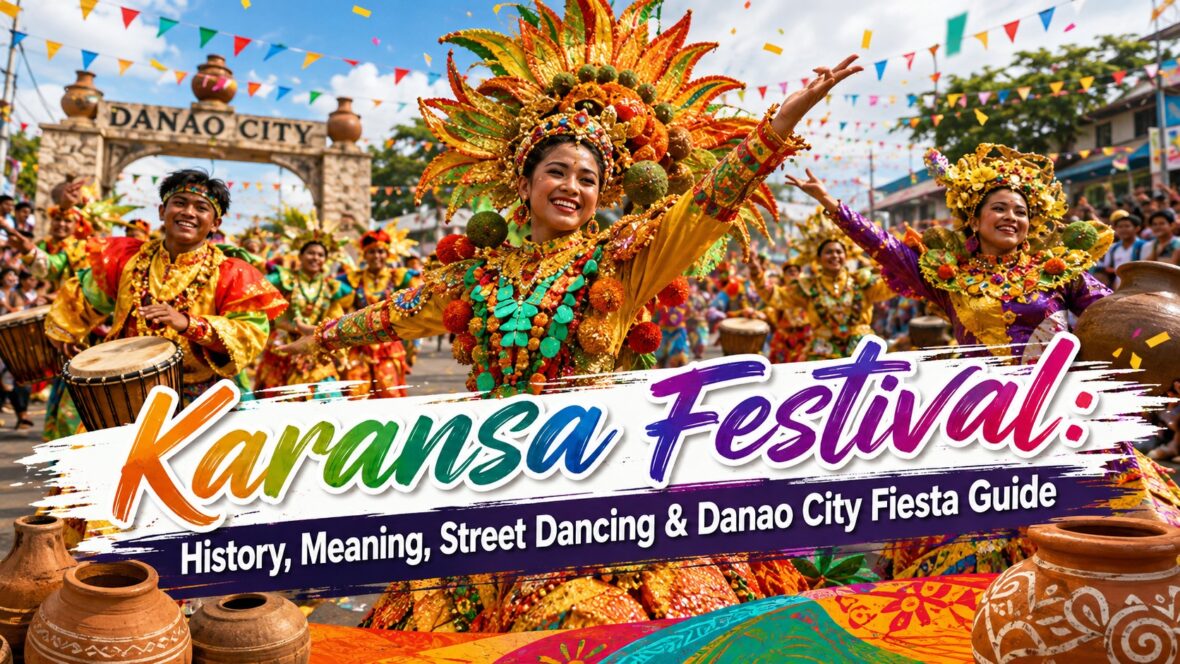
Every September, Danao City in Cebu fills its streets with drums, elaborate costumes and groups of dancers performing movements known as kiay, kurug, karag and karahay. The performances eventually build toward a ritual showdown where contingents compete through choreography, music, props and storytelling.
But underneath all that spectacle is an older Danawanon idea.
Karansa is about merrymaking.
It is about celebrating after work, gathering with neighbors, dancing because you feel happy and giving thanks for the blessings you’ve received.
One of the most popular origin stories connects the tradition with the potters of Barangay Suba, who would gather after finishing their work, drink tuba or coconut wine and dance together. Local historical accounts add an important nuance: similar communal dancing was also practiced elsewhere in Danao, so Karansa eventually came to represent something broader than one livelihood or barangay.
Today, that simple community tradition has grown into Danao City’s biggest annual cultural festival and one of Cebu’s major September celebrations.
And despite all the changes through the years, one thing has remained consistent:
Karansa is supposed to feel joyful.
Content
Karansa Festival at a Glance
| Details | Information |
|---|---|
| Festival | Karansa Festival |
| Location | Danao City, Cebu |
| Usual date | Third Sunday of September |
| Festival type | Cultural and religious |
| Patron saint | Sto. Tomas de Villanueva / St. Thomas of Villanova |
| Main attractions | Street Dancing, Ritual Showdown and Festival Queen |
| Signature movements | Kiay, Kurug, Karag and Karahay |
| Cultural association | Merrymaking, thanksgiving and Danao’s pottery tradition |
| Modern festival roots | Around 1980 |
| Main venue in recent editions | Ramon M. Durano Sr. Sports Complex and streets of Danao |
Danao City’s own government describes Karansa as an annual celebration of the city’s cultural heritage and devotion to Sto. Tomas de Villanueva, traditionally staged every third Sunday of September.
What Is Karansa Festival?
Karansa Festival is Danao City’s annual celebration of culture, faith, community and thanksgiving.
At first glance, it looks like a traditional Philippine street-dancing festival.
You have huge contingents.
You have colorful costumes.
You have drummers.
There are props, festival queens, choreographed formations and a grand competition.
But what makes Karansa different is the movement itself.
Performers are expected to incorporate four basic Karansa dance steps into their routines: kiay, kurug, karag and karahay.
During the 2024 festival, for example, Danao City reported that ten contingents representing clustered barangays and local schools performed these four signature movements during the Street Dancing Competition before proceeding to the Ritual Showdown.
That means Karansa isn’t simply a festival where organizers choose a theme and let groups perform any dance they want.
There is a recognizable dance vocabulary connecting modern performances with the tradition from which the festival gets its name.
What Does “Karansa” Mean?
Karansa is associated with expressing happiness through dancing and merrymaking.
A local Danao historical account describes it as a dance expressing joy, particularly the kind of informal celebration people enjoyed after completing a hard day’s work.
The image is easy to picture.
The day’s work is finished.
People gather in the evening.
Someone brings tuba.
Conversations turn into laughter.
Music begins.
Then somebody starts dancing.
Eventually, everyone joins in.
That feeling—not a perfectly rehearsed performance—is at the heart of Karansa.
It is dancing because you’re happy.
And in many ways, the modern festival has simply enlarged that idea.
What once might have happened among neighbors after work is now performed by large contingents in front of thousands of spectators.
“Tara na, magkaransa na ta!”
One phrase often associated with the festival roughly carries the invitation:
“Come on, let’s dance!”
It captures Karansa better than a complicated definition ever could.
You’re not being asked to watch quietly.
You’re being invited to celebrate.
The Connection Between Karansa and Danao’s Potters
The most widely repeated origin story connects Karansa with Barangay Suba.
Suba became known for pottery-making, one of Danao’s traditional livelihoods.
According to local cultural accounts, potters would gather after completing their work, relax with coconut wine and dance as an expression of happiness and thanksgiving. The word Karansa became closely associated with this form of merrymaking.
That’s why pots and pottery-related imagery sometimes appear in festival presentations.
A choreographer may use a clay pot as a prop.
Another contingent may tell a story about workers making pottery.
Costumes may use earthy colors or shapes inspired by traditional products.
But there is a useful historical clarification here.
One Danao local history argues that the practice of gathering, singing, drinking and dancing after work was not exclusive to Suba’s potters. Similar community merrymaking occurred in other parts of Danao as well.
So I wouldn’t describe Karansa solely as a “pottery festival.”
Pottery is an important part of its story.
But Karansa has grown into something larger: a celebration of Danawanon happiness and community life.
The Four Basic Karansa Dance Steps
If you’re watching Karansa for the first time, pay attention to the dancers rather than only the costumes.
You’ll begin noticing repeated types of movement.
The four signature steps are:
Kiay, Kurug, Karag and Karahay.
Danao City’s official account of the 2024 festival specifically identifies these four movements as the foundation of the street-dancing performances.
Local historical descriptions characterize the overall Karansa style through swaying, shaking and playful juddering movements performed to the distinctive Karansa beat.
What makes the competition interesting is that every contingent has access to the same basic dance vocabulary.
The challenge is what they do with it.
One group may create a traditional-looking routine.
Another may incorporate a story about pottery.
Another might interpret agriculture, industry, resilience or a recent achievement of the city.
The basic Karansa remains recognizable, but the presentation changes.
That’s where the creativity comes in.
History of Karansa Festival
The community traditions behind Karansa are older than the organized festival.
The modern festival itself is generally traced to around 1980.
A local historical chronicle of Danao states that Karansa Festival began that year during the administration of Mayor Ramon “Boy” Durano Jr. It describes the festival as a street-dancing and showdown competition held during the September fiesta season.
There is another piece of evidence supporting that timeline.
Danao celebrated the 45th Karansa Festival in 2025.
That places the beginning of the organized celebration around 1980.
Before Karansa, There Was Moro-Moro
Karansa didn’t appear in a cultural vacuum.
Before street dancing became Danao’s main festival attraction, the city’s fiesta was known for theatrical performances of Moro-moro.
Moro-moro was a form of folk theater depicting conflicts between Christian and Muslim characters. Danao historical accounts trace local performances back to around the 1940s and associate their popularity particularly with playwright and director Vicente “Inting” Camoro.
When that tradition began fading, Karansa emerged as a new form of public cultural celebration.
The timing is also interesting.
Cebu’s Sinulog was developing into its modern organized festival format around the same period, and Danao’s historical accounts acknowledge Sinulog as one influence on the formation of Karansa.
But Danao didn’t simply make a smaller Sinulog.
It built a festival around a local dance tradition.
That decision is probably one reason Karansa still feels recognizably Danawanon decades later.
Karansa and Sto. Tomas de Villanueva
Karansa also cannot be separated from Danao City’s patron saint, Sto. Tomas de Villanueva, or St. Thomas of Villanova.
The cultural festival takes place during Danao’s September fiesta season and functions as an offering of thanksgiving to the patron saint.
Danao City officially describes Karansa as a celebration of both cultural heritage and devotion to Sto. Tomas de Villanueva.
That religious connection changes how you should understand the performances.
Yes, contingents want to win.
There are prizes.
There are judges.
There is a Festival Queen competition.
But the ritual presentations also contain an element of thanksgiving.
The performers aren’t just celebrating Danao.
They are presenting their dance within a fiesta honoring the city’s patron.
The Religious Celebration and the Cultural Festival
The biggest street-dancing day is traditionally held on the third Sunday of September.
The broader religious observance can extend beyond that Sunday.
The 2025 celebration illustrates the distinction clearly. The 45th Karansa Festival was staged on Sunday, September 21, with a fiesta Mass followed by street dancing, the grand showdown and Festival Queen competition. Additional religious observances connected with Sto. Tomas de Villanueva continued on September 22.
So if you’re planning a future trip, don’t assume the words “Karansa Festival” and “Danao City Fiesta” always refer to one single event at one exact hour.
Think of Karansa as the major cultural centerpiece of a wider fiesta season.
What Happens During Karansa Festival?
Karansa’s exact program changes from year to year, but the main cultural attractions have become fairly consistent.
Street Dancing Competition
This is where you’ll first see the festival at full energy.
Large contingents move through Danao’s streets accompanied by drums and festival music.
The dancers perform their Karansa steps while maintaining formations, interacting with props and presenting their chosen themes.
The streets themselves become part of the competition.
Unlike a stage performance where everything happens in one controlled space, street dancers have to maintain energy while moving along a route.
They have spectators on both sides.
The weather can change.
Props have to travel.
Musicians have to keep pace.
And everyone still needs to look synchronized.
Danao’s 2024 festival went ahead despite rain, with ten contingents dancing through the streets before moving to the main showdown venue.
That’s Philippine festival culture for you.
Sometimes the rain just becomes part of the performance.
The Ritual Showdown
After street dancing comes the more theatrical part of the competition.
Recent editions have staged the Ritual Showdown at the Ramon M. Durano Sr. Sports Complex in Barangay Sabang.
This is where contingents can tell their complete story.
Large props appear.
Dancers create wider formations.
The Festival Queen becomes more visible.
A routine may start with ordinary community life, move through a challenge or struggle and end in thanksgiving.
Others may focus heavily on Danao’s past and present.
In 2024, for example, the winning contingent incorporated Danao City’s recent development and competitiveness achievements into its performance while still presenting the cultural and religious elements expected of Karansa.
That shows how flexible the festival can be.
Karansa isn’t frozen in history.
It can talk about the Danao of today.
Karansa Festival Queen
The Festival Queen is another major part of Karansa.
She’s not simply someone wearing an elaborate gown beside the dancers.
The Festival Queen participates in the cultural presentation and becomes one of the visual focal points of her contingent.
That requires more than looking good.
She has to dance.
She has to maintain energy through the performance.
She needs to interact with the choreography.
And because the competition is connected with the fiesta, she frequently carries imagery or gestures related to the contingent’s devotional presentation.
The Karansa Festival Queen competition continues to be staged alongside the street dancing and ritual showdown in recent editions.
Costumes of Karansa Festival
If there’s one thing Karansa definitely isn’t, it’s visually quiet.
Expect color.
Lots of it.
Bright pink, orange, yellow, blue, green, gold and purple frequently appear in festival costumes.
Large headdresses are common.
Beads, sequins, fabric panels, metallic decorations and elaborate accessories are used to make performers visible even from across a crowded street.


And because dance is central to Karansa, the costumes have to move well.
Fabric swings as dancers perform the kiay.
Headpieces create additional movement when groups turn simultaneously.
Props become part of larger formations.
It’s one thing to see an individual costume up close.
It’s another to see fifty or a hundred people wearing coordinated versions of it while dancing to the same beat.
That’s where festival costume design really works.
Drums, Shouts and the Sound of Karansa
Photographs capture the colors.
They don’t capture the noise.
Karansa is driven by rhythm.
Drums accompany the dancers, giving the basic movements their pace and helping hundreds of performers stay coordinated.
Traditional descriptions of Karansa also mention occasional loud shouts as part of its playful character.
That fits the festival perfectly.
Karansa isn’t supposed to feel restrained.
Remember where the tradition supposedly came from.
People had finished working.
They were relaxing.
They were drinking tuba.
They were laughing and dancing.
The modern festival takes that spontaneity and turns it into choreography without completely removing the sense of fun.
Why Karansa Matters to Danao City
September is an important tourism period for Danao.
The city government itself identifies Karansa Festival as Danao’s biggest annual fiesta and notes that visitors and returning Danawanons contribute to a significant increase in people coming to the city during the celebration.
But its importance goes beyond tourism.
Karansa gives Danao a cultural identity that belongs specifically to the city.
That’s not easy.
Cebu already has one of the Philippines’ most internationally recognizable festivals in Sinulog.
Smaller Cebu cities and municipalities could easily disappear under that shadow.
Karansa avoids that by telling a different story.
It doesn’t try to become Sinulog.
It talks about potters.
It talks about workers.
It uses its own dance movements.
It honors its own patron saint.
And the festival gives younger Danawanons a reason to learn those stories and perform them in front of their community.
Karansa vs. Sinulog: What’s the Difference?
Because both festivals are in Cebu and both involve street dancing, visitors naturally compare them.
But the experience is quite different.
Sinulog is enormous. Its devotion centers on the Santo Niño, and it draws participants and spectators from across Cebu, the Philippines and overseas.
Karansa is more local in scale and identity.
It honors Sto. Tomas de Villanueva.
Its choreography revolves around the Karansa steps.
Its cultural story is connected to Danao and particularly to the merrymaking traditions popularly associated with local workers and potters.
So if you’ve already experienced Sinulog, I wouldn’t think of Karansa as a substitute.
Think of it as another side of Cebu.
Sinulog tells you something about Cebuano identity at a much larger scale.
Karansa tells you about Danao.
When Is Karansa Festival Celebrated?
The easiest rule to remember is:
Karansa Festival is traditionally celebrated on the third Sunday of September.
That schedule is confirmed by Danao City itself.
Because the third Sunday falls on a different calendar date each year, Karansa doesn’t have one permanent numerical date.
That’s why you may see September 15 one year, September 21 another year and September 20 in another.
The broader Danao fiesta celebration can extend beyond the main festival Sunday.
If street dancing is your priority, always check which date falls on the third Sunday.
Visiting Karansa Festival for the First Time
Karansa is a relatively practical Cebu festival to visit because Danao is reachable overland from Metro Cebu.
But don’t wait until the street dancing has already started before arriving.
Festival traffic changes everything.
Roads may close.
Public transportation may be rerouted.
People begin claiming good viewing positions well before the first contingent reaches them.
If possible, arrive in Danao the day before.
You’ll have time to check the route, visit the church and see some of the pre-festival atmosphere without rushing.
What Should You Bring?
Comfortable shoes matter more than fashionable ones.
You’ll probably walk much farther than expected.
September can bring both intense sun and rain, sometimes on the same festival day, so prepare for both. Bring water, sun protection and something waterproof for your phone or camera.
Carry some cash as well.
Digital payments are increasingly common in the Philippines, but festival food stalls and small vendors may still prefer cash.
And don’t forget patience.
Thousands of other people are trying to move around the same streets you are.
How to Get to Danao City
Danao City sits north of Cebu City along Cebu’s eastern side and forms part of the wider Metro Cebu area.
Travelers coming from Cebu City can reach Danao by northbound public transportation or private vehicle.
Because routes, terminals and transport operators can change, check the current arrangement before your trip rather than relying on a several-year-old timetable.
Allow additional travel time during festival weekend.
A journey that feels easy on an ordinary Sunday can become much slower once Karansa crowds and road closures begin affecting traffic.
Danao Beyond Karansa
If you’ve traveled all the way to Danao for the festival, give yourself time to see the city outside the parade route.
Start with the Sto. Tomas de Villanueva church, particularly if you want to understand the religious side of the fiesta.
Danao’s coastal setting is also part of everyday city life, while its upland areas offer a very different environment from the busy poblacion.
And then there is the local heritage behind Karansa itself.
Knowing that pottery once played an important role in communities such as Barangay Suba makes the festival’s repeated clay-pot imagery much easier to understand.
You stop seeing the props as random decorations.
They become part of the story.
Karansa Festival Frequently Asked Questions
Where is Karansa Festival celebrated?
Karansa Festival is celebrated in Danao City, Cebu, Philippines.
When is Karansa Festival?
The main festival is traditionally held every third Sunday of September.
What does Karansa mean?
Karansa refers to an expression of joy and merrymaking through dancing. Local tradition strongly associates it with workers gathering to celebrate after finishing a day’s work.
Why is Karansa associated with pottery?
One of the best-known origin stories comes from Barangay Suba, whose potters traditionally gathered after work, drank coconut wine and danced in celebration.
What are the four Karansa dance steps?
They are Kiay, Kurug, Karag and Karahay. Danao City’s government identifies these as the four signature movements performed during the festival.
Who is the patron saint of Danao City?
Karansa is celebrated in honor of Sto. Tomas de Villanueva, or St. Thomas of Villanova.
Is Karansa a religious festival?
It is both cultural and religious.
Karansa showcases Danao’s dance and community heritage while being celebrated as part of the city’s fiesta honoring Sto. Tomas de Villanueva.
What are the major Karansa Festival events?
Street dancing, the Ritual Showdown and the Karansa Festival Queen competition are among the festival’s recurring highlights.
When did Karansa Festival start?
Local Danao historical accounts trace the organized festival to 1980. Danao’s 2025 celebration was officially described as the 45th Karansa Festival, which is consistent with that timeline.
Is Karansa Festival worth visiting?
Yes, particularly if you’re interested in experiencing a Cebu festival outside the much larger Sinulog celebration.
Karansa has a strong local identity, recognizable dance movements and a cultural story specifically tied to Danao.
Karansa Festival 2026
This guide is designed to remain useful long after 2026, but if you’re planning to attend this year’s celebration, the most important date is:
Sunday, September 20, 2026
September 20 is the third Sunday of the month, matching Danao City’s established schedule for the main Karansa Festival. Current Cebu event listings place the wider 2026 fiesta period around September 20–22.
Preparations are also clearly underway. A late-August procurement notice for the 2026 festival refers to meals for ten barangay contingents participating in Karansa, indicating that preparations for the competing groups are active.
For visitors, I would prioritize September 20 if the goal is specifically to see the major cultural festivities and street dancing.
The full sequence of individual event times, road closures and venues can still be adjusted, so check the final announcements from the Danao City Government shortly before traveling.

Final Thoughts
What I like most about Karansa Festival is how ordinary its story is.
It doesn’t begin with royalty.
It doesn’t begin with a famous battle.
It begins with people finishing their work.
They gathered.
They talked.
They drank.
They laughed.
And eventually, they danced.
Over time, that simple expression of happiness grew into something an entire city could claim as its own.
Today there are enormous headdresses, competitive choreography, Festival Queens, drums, prizes and thousands of spectators.
But underneath all of that, the basic idea hasn’t really changed.
Karansa is still about joy.
It is about celebrating work accomplished, blessings received and another year together as a community.
So when you’re standing along a Danao street in September and the drums begin approaching, watch for the kiay, kurug, karag and karahay.
Look at the pottery imagery.
Remember Sto. Tomas de Villanueva.
But most of all, watch the faces of the dancers.
Because after all the history and choreography are explained, Karansa is still supposed to look like people having a very good reason to dance.