You usually hear the Bakood Festival before you really see it.
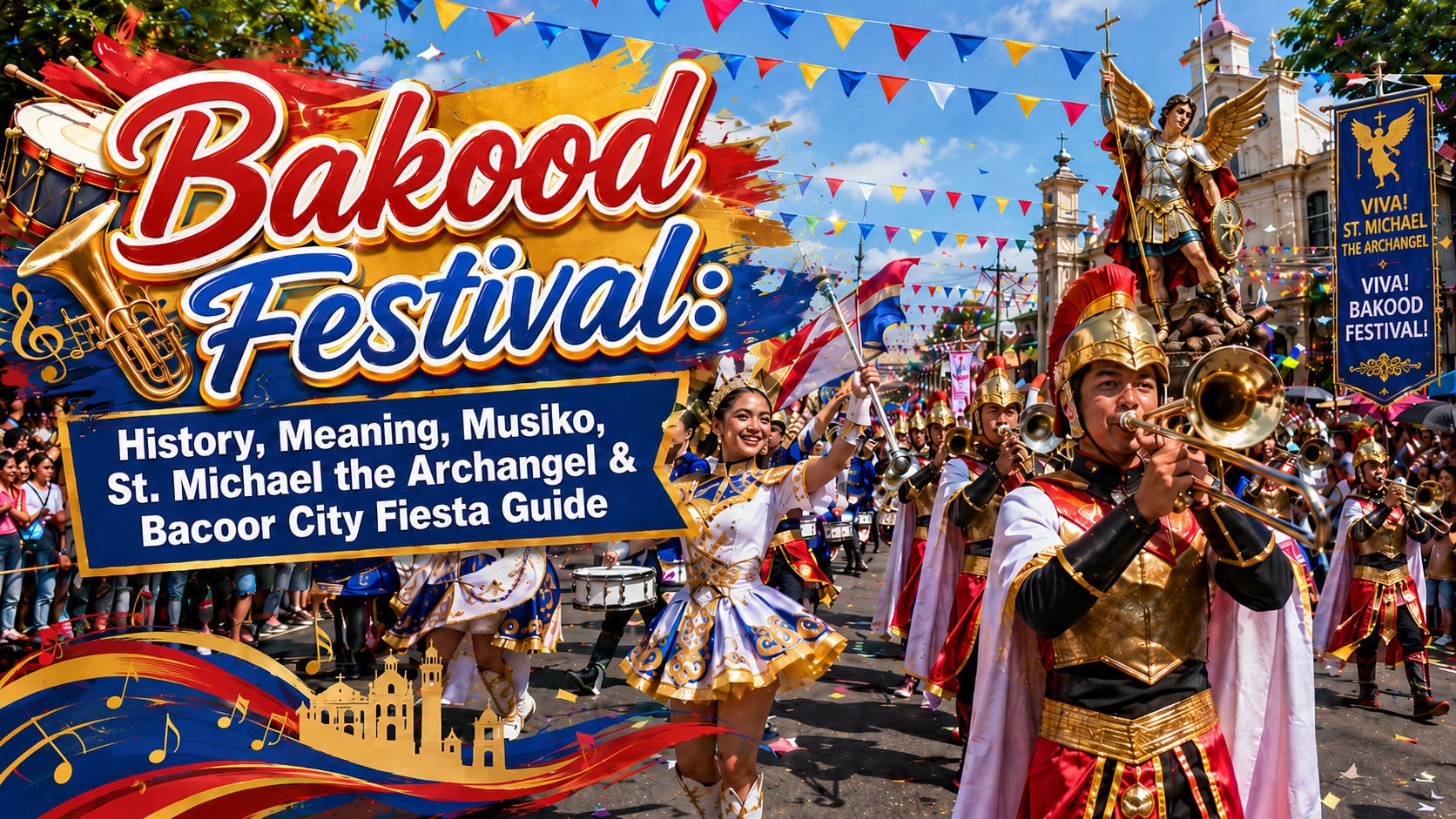
A drumline starts somewhere down the road. Brass instruments answer a few seconds later. Then the sound gets louder until an entire marching band comes into view—musicians in polished uniforms, majorettes spinning batons, color guards lifting enormous flags and drum majors leading everyone forward with almost military precision.
Then another band arrives.
And another.
This is one of the things that makes Bakood Festival different from many other celebrations in the Philippines.
Bacoor City certainly has the usual ingredients of a Filipino fiesta: religious activities, community programs, concerts, food, civic events and a patron saint deeply connected with local life.
But Bakood has another identity that is almost impossible to ignore.
Music.
More specifically, marching-band music.
Bacoor’s musical tradition has grown so strongly that the city was officially proclaimed the Marching Band Capital of the Philippines in 2020. Its signature event, Musiko, has become one of the biggest attractions of the annual Bakood Festival and brings together marching bands, drumlines, color guards, majorettes and musicians from Bacoor and beyond.
Yet there is more to Bakood than the bands.
The festival also tells the story of one of Cavite’s oldest communities—a city tied to the Philippine Revolution, devotion to St. Michael the Archangel and centuries of history at the gateway between Metro Manila and Cavite.
Content
Bakood Festival at a Glance
| Details | Information |
|---|---|
| Festival | Bakood Festival |
| Location | Bacoor City, Cavite |
| Region | CALABARZON / Region IV-A |
| Usual festival period | September |
| Traditional culmination | Last Sunday of September |
| Patron saint | St. Michael the Archangel |
| Patronal feast | September 29 |
| Main themes | History, faith, music, culture and Bacooreño identity |
| Signature event | Musiko |
| Famous for | Marching bands and marching arts |
| Modern Bakood Festival initiated | 2007 |
| Bacoor founded | 1671 |
| National distinction | Marching Band Capital of the Philippines |
The Bacoor City Government describes Bakood as an annual celebration honoring St. Michael the Archangel while promoting tourism, trade, camaraderie and appreciation of the city’s cultural heritage. The traditional festival period lasts about a week and culminates around the last Sunday of September.
What Is the Bakood Festival?
Bakood Festival is Bacoor City’s major annual cultural celebration.
It brings together several different sides of the city.
There is Bacoor the historic community.
There is Bacoor the center of marching-band culture.
There is Bacoor the Catholic community honoring St. Michael the Archangel.
And there is modern Bacoor—a rapidly developing city that has become one of the busiest gateways between Metro Manila and Cavite.
The festival tries to put all of those identities into one celebration.
That is why the annual program can feel incredibly varied.
One day might center on music.
Another may involve community services or trade activities.
There can be competitions, arts programs, sports, religious events, concerts and large civic gatherings.
And then, once Musiko begins, the streets can become a giant moving music venue.
This isn’t a festival built around only one performance.
It’s a celebration of Bacoor itself.
Why Is It Called Bakood?
This is one of the most interesting parts of the festival because the origin of the name isn’t as simple as some travel articles make it sound.
Historical records have used several spellings for Bacoor over the centuries.
The city government’s historical account notes old forms including Vacol, Bacor, Bacood and Bakod. It also says bakod—the Tagalog word for a fence—and Bacood were both traditional names associated with the area. Interestingly, an 1874 Spanish-Tagalog manual translated “Bacood” as tierra alta, or “high ground.”
So you may encounter several explanations of the city’s name.
Some associate it with bakod, meaning a fence or enclosed area.
Others connect Bacood with elevated land.
What we can say with confidence is that “Bakood” deliberately recalls one of Bacoor’s old names.
The festival is therefore using the city’s historical identity rather than a completely new word invented for tourism.
And I think that’s the best way to understand it.
Bakood is Bacoor looking backward at where its name came from while celebrating what the city has become.
How Old Is Bacoor?
Very old by the standards of many modern Philippine cities.
The Bacoor City Government traces the town’s formal founding to 1671.
According to its historical account, members of the local principalia petitioned for Bacoor to become separate from Cavite El Viejo, which is present-day Kawit. The separation took place during the Spanish colonial period, although settlements in the area existed long before that formal town foundation.
That history explains why Bakood Festival is often celebrated together with Bacoor’s founding anniversary.
In 2025, for example, the city marked its 354th founding anniversary during Bakood Festival.
For Bacooreños, then, the celebration isn’t simply about having a fiesta at the end of September.
It is also an annual reminder that Bacoor has been a community for more than three centuries.
How Did the Modern Bakood Festival Begin?
Religious fiestas and community celebrations in Bacoor are much older than the current festival format.
The modern Bakood Festival, however, is relatively recent.
Bacoor’s official historical account says the festival was initiated in 2007 as part of a broader effort by the city government to research and promote Bacoor’s products, tourism, history and culture.
That distinction matters.
Bakood Festival didn’t create Bacoor’s traditions.
It organized many of them under a more visible citywide celebration.
Over time, cultural activities became larger.
Musical events became more ambitious.
Marching bands increasingly became one of the festival’s defining attractions.
Eventually, the city’s music tradition became so prominent that Bakood developed a very different personality from many other September fiestas around the Philippines.
St. Michael the Archangel and Bakood Festival
Underneath the civic celebration is a strong religious tradition.
St. Michael the Archangel is Bacoor’s patron saint.
The city’s official festival description specifically identifies Bakood as an annual celebration held in his honor.
His feast falls on September 29.
That helps explain why Bakood festivities traditionally reach their climax in the final part of September.
Recent celebrations continue to emphasize the religious dimension. In 2024, Bacoor held a Thanksgiving Mass during Bakood Festival and the feast celebration honoring St. Michael.
In 2025, the city even brought together three historic images of St. Michael associated with different Christian churches in Bacoor for a special procession and Mass at the Bacoor Government Center.
So even though marching bands may dominate photographs of Bakood, religion remains an important part of the celebration.
For many residents, this is still a fiesta rooted in faith and thanksgiving.
Why St. Michael Is Important to Bacoor’s History
The connection with St. Michael goes beyond the modern fiesta.
Bacoor’s official history records that during the revolutionary period the town was given the name “Gargano,” a reference to Monte Gargano in Italy, home to an ancient sanctuary associated with St. Michael the Archangel.
That tells you something about how deeply devotion to St. Michael had already become connected with local identity.
He wasn’t simply added to the festival later.
The patron saint had long been part of Bacoor’s religious and historical story.
The Festival of a Marching Band City
Now we get to the part of Bakood that probably makes the most noise.
Bacoor has an unusually strong marching-band tradition.
Bands have long participated in religious fiestas, processions, school events, civic ceremonies and other important occasions.
The city government describes Bacoor as the birthplace or home of some of the country’s oldest active marching bands, alongside numerous community bands and school-based drum-and-lyre corps.
This isn’t simply a hobby practiced by a few people.
For many families, music is passed from one generation to another.
A child might begin in a school drum-and-lyre group.
Later, that child may join a larger band.
Older musicians become trainers.
Former performers return as conductors or supporters.
Parents who once marched may eventually watch their own children carry instruments through the same streets.
That is how a musical tradition becomes part of a city’s identity.
Bacoor: Marching Band Capital of the Philippines
Bacoor’s musical reputation eventually received official national recognition.
Proclamation No. 939, signed on April 6, 2020, declared Bacoor the Marching Band Capital of the Philippines.
The proclamation recognized the city’s contribution to Philippine marching-band culture and encouraged continued preservation and promotion of the tradition. It also acknowledged the wider historical role marching bands have played in Filipino fiestas, civic events and even episodes connected with the Philippine Revolution.
That title isn’t simply something written on a tourism poster.
When you experience Musiko during Bakood Festival, you understand why Bacoor claims it.
Musiko: The Heartbeat of Bakood Festival
If there is one Bakood event I’d recommend prioritizing, it would be Musiko.
This is the festival’s grand marching-arts celebration.
The Bacoor City Government describes Musiko as a major Bakood Festival event that showcases the city’s musical heritage while encouraging marching-band education and helping preserve the tradition.
And Musiko has become much more sophisticated than a simple parade.
Depending on the year, competitions can include marching field shows, street parades, drumline battles, color guard performances, drum and lyre groups, baton twirling and awards for individual performers and sections.
For the 2024 edition, for example, the city scheduled a Color Guard Battle, Drumline Battle, Marching Field Show and Marching Street Parade as part of Musiko.
In 2025, eleven bands competed in the Marching Field Show alone, with awards for conductor, majorette, color guard, wind section, percussion, visual effects and uniforms.
That gives you an idea of how serious the competition has become.
The Marching Street Parade
For casual visitors, this may be the easiest part of Musiko to enjoy.
Bands move through a designated Bacoor road while playing and marching in formation.
First comes the drum major.
Then musicians appear in rows.
Brass instruments catch the sunlight.
Drummers maintain the beat.
Color guards add movement.
Majorettes spin batons.
And spectators line the road several people deep.
But don’t let the festive atmosphere make you underestimate what the musicians are doing.
Walking in formation while playing music is difficult.
You have to control breathing.
You have to listen to the musicians around you.
You must keep the correct distance from the person ahead.
And all of that happens while walking through an actual city street filled with noise and spectators.
One person going too fast can break the line.
One section falling behind can affect the sound.
The best bands somehow make the entire thing look effortless.
The Marching Field Show
The field show is different.
Instead of simply moving down a road, bands perform inside a defined space where they can create elaborate formations.
Lines become circles.
Circles become diagonals.
Musicians move backward, sideways and across one another while continuing to play.
Color guards wave huge flags through the formation.
Percussion drives the rhythm.
The band might create a recognizable shape for only a few seconds before everything changes again.
This is where marching becomes almost like choreography.
The strongest routines aren’t simply technically clean.
They tell a story.
Music, movement and visual effects all work together.
Drumline Battles
If you enjoy percussion, the drumline competition may become your favorite part of Musiko.
Without the full band covering the sound, every beat becomes obvious.
Snare drums create sharp patterns.
Bass drums provide depth.
Cymbals add dramatic accents.
Performers may move while playing, spin their sticks or challenge other sections with increasingly complicated rhythmic sequences.
The audience reacts immediately.
You don’t need formal musical training to know when thirty percussionists hit exactly the same beat.
You feel it.
Sometimes literally.
Color Guards
Color guards provide much of Musiko’s visual movement.
Large flags sweep across the performance space while members dance between band formations.
More advanced routines can include equipment such as rifles or sabres used specifically for marching-arts performance.
When everything goes right, dozens of performers release or turn their equipment at the exact same moment.
It can be beautiful.
It can also go very wrong if someone’s timing is off.
That is what makes the precision impressive.
Majorettes and Drum Majors
They are often the people spectators remember.
Majorettes combine dance, baton twirling and showmanship.
Drum majors lead the band and communicate commands through gestures and movement.
The position comes with a lot of responsibility.
A drum major isn’t simply standing in front because the uniform looks impressive.
The entire band is watching.
One raised arm, turn or movement can signal what dozens of musicians are supposed to do next.
During Bakood, these performers help turn a normal band into a full visual production.
Bakood Festival Costumes and Uniforms
One reason Bakood photographs so well is that every band brings its own identity.
Some uniforms look military-inspired.
Others use bright contemporary colors.
Tall hats, feathers, polished boots, metallic accents and decorative braiding are common.
Majorettes may wear completely different costumes from the musicians.
Color guards use outfits designed for movement.
Then another band appears in an entirely different color palette.
During a large Musiko parade, Bacoor’s streets can change color every few minutes.
And all of this happens in Philippine September weather.
That alone deserves respect.
Marchers can be wearing heavy uniforms under intense sun one moment and dealing with rain the next.
More Than Marching Bands
Musiko may be Bakood’s most famous attraction, but the festival isn’t only about music.
Past editions have included arts programs, job and livelihood activities, health services, sports, community events, religious celebrations and activities involving different sectors of Bacoor society.
For example, the city’s 2023 Arts in the City program showcased singing, dancing, poetry, musical performance, artworks, handicrafts and livelihood products from local creators.
The 2017 festival included cultural presentations, sports activities and a fishing competition, while organizers emphasized community interaction and appreciation of Bacoor’s heritage.
That variety is part of the point.
Bakood Festival isn’t only meant to entertain visitors.
It gives local organizations, schools, artists, musicians and communities a chance to participate.
Bacoor’s Revolutionary History
Another reason Bakood feels different from a purely entertainment-driven festival is Bacoor’s enormous place in Philippine history.
The city was involved in the Philippine Revolution and served as an important center of revolutionary activity.
Bacoor’s official historical account remembers fighting around the Zapote River, the role of local revolutionary forces and the town’s connections with Emilio Aguinaldo’s government.
The city government continues to promote sites connected with this past, including Zapote Bridge and other heritage locations.
That history gives Bakood Festival another layer.
You’re watching a modern city celebrate music and culture in streets belonging to a place that witnessed some of the country’s most dramatic political and military changes.
The Battle of Zapote Bridge
One historical site worth understanding before visiting Bakood is Zapote Bridge.
The area became the scene of an important battle between Filipino revolutionaries and Spanish forces in February 1897.
Bacoor’s historical materials remember General Edilberto Evangelista among the revolutionary figures associated with the fighting.
Today, thousands of commuters pass through the Zapote area without necessarily thinking about what happened there more than a century ago.
Festival season gives the city an opportunity to put that history back into the conversation.
When Is Bakood Festival Celebrated?
Bakood Festival takes place in September.
The City Government of Bacoor traditionally describes it as a roughly weeklong celebration ending on the last Sunday of September.
That makes the final part of September the most important period for visitors.
St. Michael the Archangel’s feast falls on September 29, and Bacoor’s founding-anniversary celebrations have also traditionally taken place around this date.
However, modern Bakood Festival activities can begin earlier and stretch over a wider part of the month.
So don’t simply assume everything happens on September 29.
Musiko may fall on the preceding weekend.
Community activities may begin weeks earlier.
Religious programs can have their own schedule.
Always check that year’s official calendar.
What Does Bakood Festival Feel Like?
Imagine arriving several hours before Musiko.
You can already tell something is happening.
Buses carrying performers are parked around the city.
Young musicians stand under whatever shade they can find.
Someone is polishing an instrument.
Another band is quietly practicing one difficult section.
A majorette checks her costume.
Drummers tap rhythms on practice pads.
Then spectators begin gathering.
Families arrive with children.
Street vendors prepare drinks and snacks.
Photographers start looking for positions.
Eventually, a drumbeat comes from somewhere beyond the crowd.
Everyone looks toward the road.
The sound gets closer.
Then the first band appears.
For the next several hours, the music barely stops.
That is Bakood at its best.
Visiting Bakood Festival for the First Time
Bacoor is easier to reach than many provincial festival destinations because it sits immediately south of Metro Manila.
That doesn’t necessarily mean festival travel is easy.
In fact, Bacoor traffic combined with festival road closures can create exactly the opposite situation.
If Musiko is your priority, arrive much earlier than you think you need to.
Don’t wait until the announced start time.
By then, good viewing positions may already be occupied and some roads may be restricted.
Comfortable shoes are essential.
So are drinking water and sun protection.
And September weather means you should prepare for rain even when the morning looks clear.
Watching Musiko With Children
Musiko can be a great family event.
Children usually love the drums, flags, majorettes and colorful uniforms.
But marching bands can also be extremely loud at close range.
If you’re bringing young children or anyone sensitive to noise, ear protection is worth considering.
Avoid standing immediately beside the loudest percussion sections.
Keep children behind crowd barriers.
And don’t try to stay through every single band if they’re getting tired.
Seeing a few excellent performances is better than turning the entire day into an endurance test.
Festival Photography Tips
Bakood gives photographers a lot to work with.
Instead of photographing only whole bands, look for details.
A drummer waiting for the signal.
A majorette catching a baton.
The reflection of a crowd in a brass instrument.
A conductor concentrating before the performance begins.
Rows of musicians turning at exactly the same moment.
Color guards lifting their flags against the sky.
And don’t forget the spectators.
Sometimes the reaction of a child watching a huge band pass is more memorable than another perfectly centered parade photograph.
Food to Try in Bacoor
Festival trips should always include food.
And Bacoor has one particularly famous local tradition:
Digman halo-halo.
Barangay Digman has long been associated with versions of the classic Filipino iced dessert, and the Bacoor City Government continues to list Digman halo-halo among the city’s notable attractions.
After several hours standing beside a hot parade route, halo-halo suddenly makes a lot of sense.
Bacoor’s coastal character also explains the importance of seafood in local food culture. The city government highlights tahong, or mussels, and seafood dishes among local culinary attractions.
Places to Visit During Bakood Festival
Bakood gives you a reason to stay in Bacoor longer than the parade itself.
St. Michael the Archangel Church belongs on the list if you want to understand the religious side of the festival.
Zapote Bridge connects directly with Bacoor’s revolutionary history.
Bahay na Tisa is another heritage site associated with the city’s past.
And Barangay Digman is an obvious stop if halo-halo is part of your plan.
The festival becomes more interesting when you see these places.
Bakood stops feeling like a collection of unrelated events and begins to feel like a celebration built from several parts of Bacoor’s identity.
Why Bakood Festival Matters
Bacoor today is changing incredibly quickly.
Subdivisions continue expanding.
Commercial centers have multiplied.
New residents arrive from Metro Manila and other provinces.
Road networks connect the city more closely with surrounding areas.
Urban growth can be good for a city.
But rapid development also creates a problem.
How do you preserve a local identity when the city is becoming larger, busier and more metropolitan every year?
Bakood Festival is one answer.
The festival tells new residents that Bacoor existed long before today’s subdivisions and malls.
It reminds young Bacooreños about St. Michael.
It introduces them to the city’s revolutionary past.
And through Musiko, it gives them a living cultural tradition they can actually participate in.
You don’t preserve marching-band culture by putting an old trumpet in a glass display case.
You preserve it by teaching another child how to play.
Bakood Festival Frequently Asked Questions
Where is Bakood Festival celebrated?
Bakood Festival is celebrated in Bacoor City, Cavite, immediately south of Metro Manila.
When is Bakood Festival?
The celebration takes place in September and traditionally culminates around the last Sunday of the month. Activities may begin earlier, and St. Michael the Archangel’s feast is observed on September 29.
What is Bakood Festival famous for?
The festival is particularly famous for Musiko, Bacoor’s major marching-band and marching-arts celebration.
Why is Bacoor called the Marching Band Capital of the Philippines?
The national government formally gave Bacoor that title through Proclamation No. 939 in 2020, recognizing the city’s long musical tradition and contribution to Philippine marching-band culture.
What is Musiko?
Musiko is the Bakood Festival’s major marching-arts event. Depending on the year, it can feature street parades, field-show competitions, drumlines, color guards, majorettes and other marching-band categories.
Who is the patron saint of Bacoor?
St. Michael the Archangel is the patron saint honored during Bakood Festival.
When is the feast of St. Michael the Archangel?
The feast is celebrated on September 29.
What does Bakood mean?
Bakood recalls older forms of Bacoor’s name. Bacoor’s official historical account records Bakod and Bacood among traditional names and notes that an 1874 Spanish-Tagalog source translated Bacood as “high ground.”
When did Bakood Festival begin?
Bacoor’s official historical account credits the modern festival’s initiation to 2007 as part of an effort to promote the city’s tourism, products, culture and history.
When was Bacoor founded?
The city government traces Bacoor’s formal establishment to 1671.
Is Bakood Festival religious?
It has religious, cultural and civic elements.
The celebration honors St. Michael the Archangel but also includes Bacoor’s founding anniversary, musical heritage, history, community programs and tourism activities.
Bakood Festival 2026
This guide is intended to remain useful year after year, but there are already a few details worth knowing for the 2026 celebration.
Because Bacoor traces its founding to 1671, 2026 marks the city’s 355th founding year.
The city’s established festival pattern places the main Bakood period in late September, traditionally culminating on the last Sunday of the month. In 2026, that falls on September 27. St. Michael the Archangel’s feast follows on September 29.
At least one official 2026 Bakood activity has already been confirmed. Bacoor announced a city Mass Baptism scheduled for September 16, 2026 at San Martin de Porres Parish Church in Panapaan 4, specifically identifying it as part of Bakood Festival 2026.
As of September 4, however, a complete official 2026 festival timetable covering Musiko, concerts, parade routes and all other major activities was not yet surfaced in the official city announcements reviewed for this guide. Anyone traveling specifically for Musiko should wait for the final schedule from the Bacoor City Government and its tourism and cultural offices before locking in plans.
Final Thoughts
Bakood Festival makes sense only when you understand Bacoor.
This is a city that has been around since the Spanish colonial period.
It has revolutionary history.
It has generations of devotion to St. Michael the Archangel.
And somehow, through decades of fiestas, schools, community bands and musicians teaching younger musicians, Bacoor also developed one of the strongest marching-band cultures in the Philippines.
Put all of those things together and you get Bakood.
Yes, the festival can be loud.
Musiko can fill the streets with drums, brass instruments, flags and thousands of spectators.
The uniforms are colorful.
The competitions are exciting.
And if you enjoy marching bands, there may be few better places in the country to be during the final part of September.
But the most interesting part isn’t simply how loudly Bacoor can celebrate.
It’s what the city is celebrating.
History.
Faith.
Music.
Community.
And a local identity that has managed to survive even as Bacoor becomes more urban every year.
So if you attend Bakood Festival, don’t just watch one band and leave.
Listen to the music.
Visit St. Michael.
Learn what happened around Zapote.
Have a halo-halo in Digman.
And pay attention to the young musicians carrying instruments through the streets.
Because in Bacoor, the sound of Bakood isn’t only festival entertainment.
It’s a tradition being handed to the next generation.