If you regularly drive along Commonwealth Avenue in Quezon City, you’ve probably noticed how much attention motorists are giving to traffic rules these days. Motorcycles are staying in designated lanes, private vehicles are becoming more careful when changing lanes, and drivers are paying closer attention to traffic signs.
One of the biggest reasons is the return of the No Contact Apprehension Policy, or NCAP.
Commonwealth Avenue is among the major roads in Metro Manila covered by the Metropolitan Manila Development Authority’s (MMDA) camera-based traffic enforcement system.
And with the expanded implementation of NCAP in October 2026, motorists have even more questions.
Where exactly are the NCAP cameras along Commonwealth Avenue? What is the speed limit? Can motorcycles use regular car lanes? How much are the fines? And most importantly, how can you check whether your vehicle has already been recorded committing a violation?
Whether you’re driving from Fairview to Quezon Memorial Circle, heading toward Batasan Hills, or simply passing through Commonwealth Avenue on your daily commute, understanding these rules can help you avoid unnecessary traffic fines.
Here’s a comprehensive guide to NCAP on Commonwealth Avenue, including its latest implementation status, camera coverage, traffic regulations, violation checking, payment procedures, and appeals.
Content
Is NCAP Active on Commonwealth Avenue in 2026?
Yes. As of October 18, 2026, Commonwealth Avenue remains among the major Metro Manila roads covered by the MMDA’s No Contact Apprehension Policy.
The MMDA resumed NCAP enforcement on May 26, 2025, following the Supreme Court’s decision to partially lift the temporary restraining order that had prevented the agency from operating its camera-based traffic enforcement system.
Initially, the resumption covered major circumferential and radial roads under MMDA jurisdiction.
Commonwealth Avenue, which forms part of Radial Road 7 (R-7), was among the roads included.
Another important development happened in 2026.
On July 9, the Supreme Court publicly announced its decision dismissing petitions challenging the previous NCAP ordinances of several Metro Manila local governments.
The decision, promulgated on June 3, 2026, also lifted the remaining restraining order affecting those local government systems.
Following the ruling, several cities announced plans to resume their respective NCAP operations beginning October 5.
Quezon City was among them.
However, there is an important distinction.
Commonwealth Avenue is already part of MMDA’s NCAP enforcement coverage, while Quezon City’s separate camera-based enforcement program is being implemented and tested at selected city intersections.
Motorists should not confuse the two systems because the authority issuing the violation determines where you should check, pay, or contest a ticket.
Latest NCAP Commonwealth Avenue Updates
The implementation of NCAP has undergone several important changes over the past few years.
Here’s a look at the developments affecting motorists along Commonwealth Avenue.
August 2022: Supreme Court Suspends Local NCAP Programs
The Supreme Court issued a temporary restraining order against NCAP ordinances in several Metro Manila cities.
The order followed legal challenges questioning the system’s constitutionality, particularly regarding due process, vehicle-owner responsibility, and the issuance of penalties without physical apprehension.
The suspension affected the implementation of the challenged programs.
May 26, 2025: MMDA Resumes NCAP
The MMDA restarted camera-based traffic enforcement along major roads following the partial lifting of the Supreme Court restraining order.
Commonwealth Avenue was among the covered thoroughfares.
During the initial days of implementation, the MMDA reported improvements in traffic discipline, particularly among motorcycle riders using designated lanes.
The agency also reported changes in vehicle travel speeds and road crash figures following the resumption.
June 2025: Motorcycle Lane Adjustments
The MMDA clarified that motorcycles with engine displacements of 400cc and above were no longer required to remain in motorcycle-exclusive lanes.
However, lane splitting remained prohibited.
The agency also discussed proposals to reconfigure portions of Commonwealth Avenue’s bicycle and motorcycle lanes to improve traffic flow.
Those discussions should not be confused with a confirmed, corridor-wide change to all existing lane markings.
July 2026: Supreme Court Lifts Remaining NCAP Restraints
The Supreme Court dismissed the consolidated petitions involving NCAP ordinances and lifted the remaining restraining order.
The Court cited the adoption of the Metro Manila Traffic Code of 2023, which introduced a more uniform framework for traffic enforcement, penalties, adjudication, and data protection.
Importantly, the Court clarified that dismissing the petitions did not amount to declaring all previously challenged NCAP provisions constitutional.
October 2026: Expanded NCAP Implementation
Quezon City announced the return of its local NCAP program beginning October 5, 2026.
However, reports from October 8 indicated that the city’s own cameras were still undergoing testing, with installation progressing intersection by intersection.
The city government emphasized that road markings and traffic signs must be properly installed before camera enforcement begins at individual intersections.
Meanwhile, MMDA NCAP enforcement continues on major thoroughfares such as Commonwealth Avenue.
The MMDA has also coordinated with local governments to avoid overlapping camera coverage and duplicate citations.
Where Are the NCAP Cameras Along Commonwealth Avenue?
This is probably one of the biggest questions among drivers.
Unfortunately, there isn’t a publicly verified, comprehensive list showing the exact location of every operating MMDA NCAP camera along Commonwealth Avenue.
In June 2025, the MMDA specifically warned motorists about a viral list claiming to identify camera locations throughout Metro Manila.
The agency clarified that it had not officially released such a list.
So, if you encounter a social media post claiming that NCAP cameras are installed at specific electric posts, pedestrian crossings, or intersections, don’t immediately assume that information is accurate.
What Is the Confirmed Coverage?
What we do know is that Commonwealth Avenue is among the major roads under MMDA NCAP coverage.
For motorists unfamiliar with the area, Commonwealth Avenue is a major highway connecting the Quezon Memorial Circle area with the northeastern sections of Quezon City toward Fairview.
Some of the notable locations along or connected to this corridor include:
- Quezon Memorial Circle and Elliptical Road
- University Avenue and the University of the Philippines area
- Tandang Sora Avenue
- Luzon Avenue
- Batasan Hills and the Batasang Pambansa area
- Ever Gotesco Commonwealth
- Don Antonio and Holy Spirit
- Litex Road
- Doña Carmen Avenue
- Fairview and its surrounding road connections
These are major landmarks and traffic areas along the Commonwealth corridor.
However, this is not an official list of active NCAP camera sites.
The inclusion of these locations does not mean that every intersection or road segment has a functioning camera issuing NCAP citations.
The safest approach is to follow traffic regulations throughout Commonwealth Avenue rather than attempting to identify only the locations with cameras.
Are There NCAP Cameras at Every Intersection?
Not necessarily.
NCAP coverage of a major road does not automatically mean that every intersection has an active enforcement camera.
Camera installations depend on the equipment, operating arrangements, and traffic enforcement requirements of the responsible agency.
Some CCTV cameras are used primarily for traffic monitoring or public safety rather than issuing traffic citations.
Motorists should also distinguish between MMDA cameras and cameras operated by the Quezon City government.
What Traffic Violations Can NCAP Detect on Commonwealth Avenue?
The No Contact Apprehension Policy uses surveillance cameras, digital technology, and recorded images or videos to identify possible traffic offenses.
Instead of physically stopping a motorist, the system captures the alleged violation and allows authorized personnel to review the recorded evidence.
Here are some of the traffic violations that motorists should be particularly careful about along Commonwealth Avenue.
1. Disregarding Traffic Signs
Ignoring official traffic signs is among the common offenses recorded under NCAP enforcement.
Examples include disregarding no-entry signs, prohibited-turn signs, lane restrictions, and other regulatory instructions.
Even if the road appears clear, motorists should not ignore traffic signs simply because there is no traffic enforcer nearby.
2. Motorcycle Lane Violations
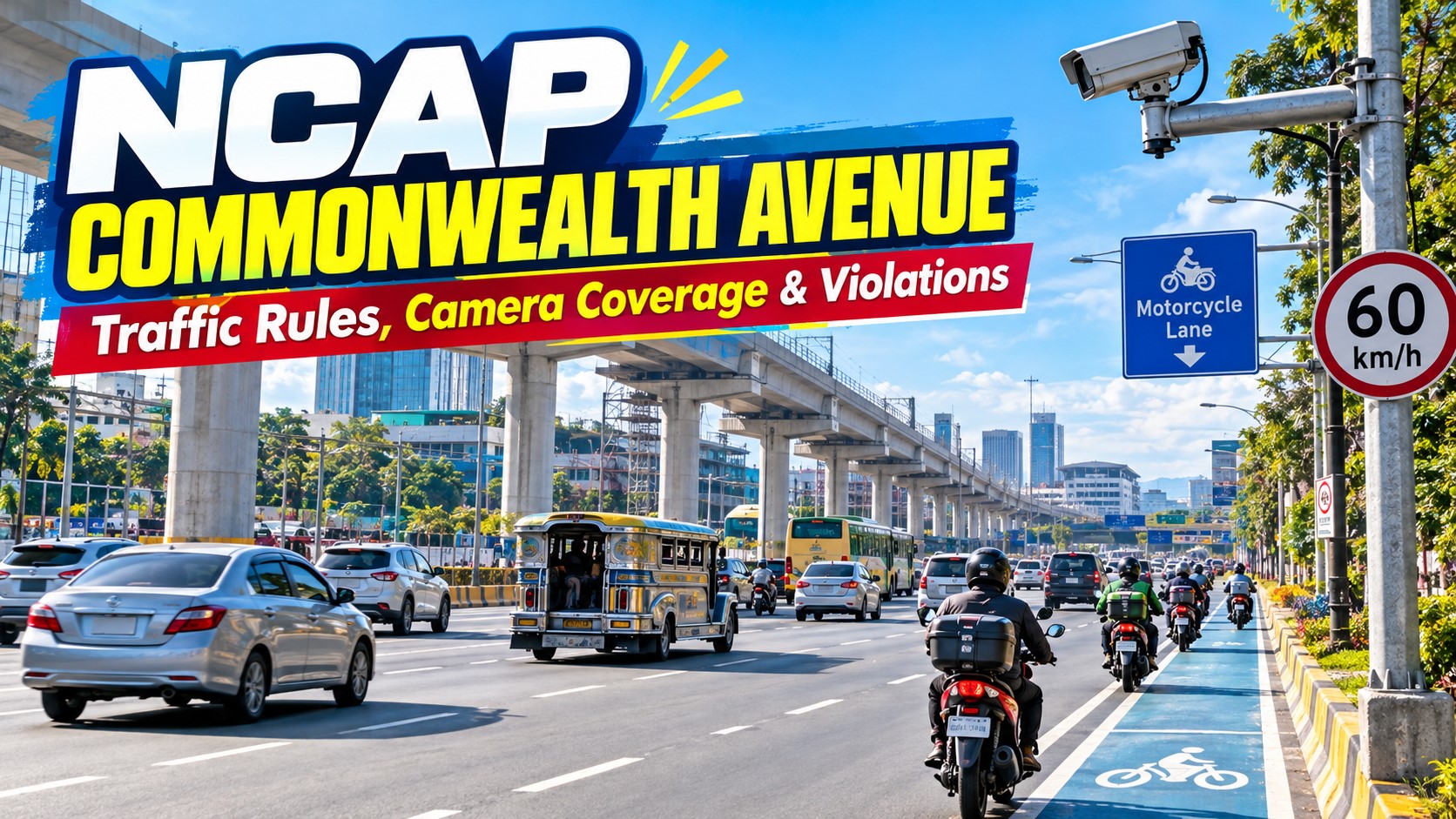
Commonwealth Avenue has designated motorcycle lanes intended to organize motorcycle traffic and reduce conflicts with other vehicles.
Motorcycle riders who are required to use these lanes should follow the applicable restrictions.
Similarly, private cars and other vehicles should avoid entering motorcycle-exclusive lanes without a permitted reason.
Lane restrictions can be enforced through camera footage when the violation is properly documented.
3. Public Utility Vehicle Lane Violations
Certain lanes along Commonwealth Avenue are reserved for public utility vehicles.
Private motorists should avoid using these lanes as shortcuts through traffic.
Drivers of buses and jeepneys must also follow their designated lane restrictions.
4. Overspeeding
Commonwealth Avenue has a published maximum speed limit of 60 kilometers per hour.
Drivers exceeding applicable speed limits risk being penalized through authorized traffic enforcement.
Whether a specific speeding violation can be captured through NCAP depends on the equipment and legally sufficient evidence available to the issuing authority.
5. Beating the Red Light
Motorists must stop when traffic signals require them to do so.
Running a red light is a serious traffic offense because it creates a risk of collisions with crossing vehicles and pedestrians.
6. Illegal U-Turns
U-turn slots along Commonwealth Avenue may change because of construction, road improvements, or traffic management adjustments.
Drivers should only make U-turns at authorized locations.
Using an unauthorized opening or disregarding a no-U-turn sign can result in a traffic violation.
7. Illegal Lane Changes
Abruptly changing lanes, disregarding lane markings, and entering restricted lanes can create dangerous situations.
Drivers should use their signal lights and change lanes only when permitted and safe.
Not every lane change is illegal, but violating specific lane restrictions or making an unsafe maneuver can result in apprehension.
8. Illegal Parking and Obstruction
Stopping or parking in prohibited areas along Commonwealth Avenue can obstruct traffic and endanger road users.
Motorists should avoid parking along lanes reserved for moving vehicles or in areas covered by no-parking restrictions.
9. Disregarding Pedestrian Crossings
Drivers should observe traffic signals and pedestrian right-of-way rules at designated crossings.
Pedestrians are especially vulnerable along wide roads such as Commonwealth Avenue, making proper observance of crossing regulations important.
10. Number Coding Violations
Metro Manila’s Unified Vehicular Volume Reduction Program, commonly known as number coding, may also apply to covered vehicles traveling along Commonwealth Avenue.
Motorists should check their plate number’s assigned restriction day and the current MMDA operating hours.
However, number coding rules are separate from NCAP itself. NCAP is simply one method authorities may use to detect or document violations of applicable traffic regulations.
What Is the Speed Limit on Commonwealth Avenue?
The published maximum speed limit along Commonwealth Avenue is 60 kilometers per hour.
This limit is established under MMDA Regulation No. 11-001, which also covers designated lanes for buses, jeepneys, and motorcycles.
It applies to vehicles traveling along the avenue, subject to any more restrictive lawful controls applicable to specific areas.
For example, road construction zones, temporary diversions, and particular traffic conditions may require motorists to travel at significantly lower speeds.
Why Does Commonwealth Avenue Have a 60 KPH Limit?
Commonwealth Avenue is among Metro Manila’s busiest and widest thoroughfares.
Despite its wide lanes, the highway carries a combination of private cars, buses, jeepneys, motorcycles, and other vehicles.
The corridor also has numerous access roads, pedestrian crossings, intersections, and transport stops.
Speed regulation is intended to reduce the risk and severity of road crashes.
In April 2025, Commonwealth Avenue’s 60-kph speed limit again became a subject of public discussion following a fatal road crash.
The incident renewed calls for stricter enforcement of existing traffic safety regulations.
For motorists, the important thing to remember is that a wide, relatively open road does not mean there is no speed restriction.
Commonwealth Avenue Motorcycle Lane Rules
Motorcycle lane regulations are particularly important along Commonwealth Avenue because of the large number of riders using the highway every day.
The MMDA’s lane designation system has included separate spaces for bicycles, public utility vehicles, motorcycles, and other motor vehicles.
Which Lane Should Motorcycles Use?
Under the established Commonwealth Avenue lane arrangement, the lanes from the sidewalk inward have been designated as follows:
- Bicycle lane
- Public utility vehicle lane
- Motorcycle lane
- Other lanes for general motor vehicle traffic
The motorcycle lane arrangement was introduced along the section between Elliptical Road and Doña Carmen Avenue.
However, the actual road configuration may differ at intersections, construction areas, and segments where lane markings or facilities have been modified.
Motorists should follow the currently installed lane markings and official directional signs.
Are Big Bikes Exempt From the Motorcycle Lane?
Yes. In June 2025, the MMDA announced that motorcycles with engine displacements of 400cc and above were no longer required to use motorcycle-exclusive lanes.
This means qualifying large-displacement motorcycles can use regular vehicle lanes, subject to the applicable traffic rules.
However, this exemption does not mean they can freely weave between vehicles.
The MMDA specifically maintained its prohibition against lane splitting for these motorcycles.
Can Motorcycle Riders Leave the Motorcycle Lane to Turn?
The established lane rules recognize that riders need to leave their designated lanes when making authorized turns or entering and exiting side roads.
However, these maneuvers should be performed at permitted transition points while following traffic signs, lane markings, and applicable signaling requirements.
Motorists should not treat turning movements as permission to cross solid lane markings at any location.
Are Motorcycles Allowed in the Bicycle Lane?
Motorcycles should not use a designated bicycle lane unless a particular segment has been officially reconfigured and opened for that use.
Although the MMDA discussed possible changes to the Commonwealth Avenue bicycle lane in 2025, a proposal alone does not authorize riders to use a protected cycling facility.
Follow the actual signs, barriers, and markings on the road.
Commonwealth Avenue Bus and PUV Lane Rules
Commonwealth Avenue also has designated lanes for public utility vehicles.
The purpose of these lanes is to organize bus and jeepney movements and reduce conflicts with other road users.
Under MMDA Regulation No. 11-001, the original lane reservation covered the two rightmost lanes, with one allocated to buses and the other to jeepneys and motorcycles.
Subsequent road configurations have included an expanded lane designation system separating bicycles, PUVs, and motorcycles.
The practical rule is simple: drivers should follow the latest posted lane signs and markings applicable to the specific road segment.
Private motorists should not enter a lane clearly reserved for buses or other public utility vehicles merely to avoid heavy traffic.
Drivers preparing to turn right should also observe the authorized transition markings and use their turn signals.
The regulation requires adequate advance signaling and provides for merging approximately 100 meters before an intersection where there are no designated yellow broken transition lines.
Where broken yellow markings are provided, drivers should use the permitted transition area.
Can You Get an NCAP Violation Without Being Stopped?
Yes.
This is the defining feature of the No Contact Apprehension Policy.
Under traditional enforcement, a traffic officer may stop your vehicle and issue a citation.
Under NCAP, an alleged violation can be recorded by a camera even when no officer physically approaches your vehicle.
Here’s how the process generally works:
- A traffic enforcement camera records a possible violation.
- The recorded images or footage are reviewed by authorized personnel.
- The vehicle’s plate number and registration information are used to identify the registered owner.
- A Notice of Violation is prepared when an offense is established under the applicable procedures.
- The registered vehicle owner is notified and given information about the alleged offense, fine, and available options for contesting the citation.
This means you might complete your journey along Commonwealth Avenue without realizing that a violation has been recorded.
That’s why checking your vehicle’s official NCAP records can be useful, particularly if you’ve received a notification.
How to Check NCAP Violations on Commonwealth Avenue
If you want to find out whether your vehicle has an MMDA-issued NCAP violation, you can use the agency’s official May Huli Ka website.
The service allows vehicle owners to check recorded violations using identifying information from their vehicle registration.
Step 1: Visit the MMDA May Huli Ka Website
Open your browser and visit:
mayhulika.mmda.gov.ph
This is the MMDA’s official online NCAP verification portal.
Step 2: Prepare Your Vehicle Details
You will generally need:
- Vehicle plate number
- Motor Vehicle (MV) File Number
The MV File Number is printed on your vehicle’s Certificate of Registration.
The portal also provides a plate-number-and-ticket-number search option for motorists who have already received a citation.
Step 3: Enter the Information
Type the required details into the corresponding fields.
Double-check the plate number and registration information before submitting your search.
Step 4: Check the Results
Select the option to check your traffic violation records.
If a valid MMDA NCAP record is found, the system will allow you to review available information and access the corresponding procedures.
The portal has been upgraded to provide motorists with access to evidence, payments, and online contestation.
Step 5: Review the Alleged Violation
If your vehicle has a record, check the following information:
- Date and time of the alleged violation
- Location of the incident
- Type of traffic offense
- Available photographic or video evidence
- Applicable fine
- Status of the notice
Make sure the vehicle in the record is actually yours.
If something appears incorrect, you may consider using the official contest procedure.
Important Update: Expanded Search Options
In August 2026, the MMDA introduced additional search functionality on May Huli Ka.
Motorists can now use either their plate number together with a ticket number, or their plate number together with the MV File Number.
This makes it possible to check available NCAP records even if you have not received a specific ticket number.
How to Check NCAP Through the eGovPH App
Another convenient option is the eGovPH Super App.
In July 2026, the MMDA and the Department of Information and Communications Technology integrated NCAP services into the government application.
Here’s how to access the service.
- Open the official eGovPH app on your phone.
- Sign in or create an account if required.
- Look for the MMDA service.
- Select the available NCAP violation checking feature.
- Enter the required vehicle information.
- Review any available violations and corresponding transaction details.
The integration is intended to make it easier for motorists to check records, monitor payment status, and access other traffic-related services.
For MMDA-issued violations along Commonwealth Avenue, this is another official checking option.
If your citation was issued separately by the Quezon City government, verify the case through the city’s designated enforcement system instead.
How Much Is the NCAP Fine on Commonwealth Avenue?
There isn’t one fixed penalty for every NCAP violation.
The amount depends on the offense, the governing traffic regulation, and the applicable fine schedule.
For example, previous MMDA enforcement guidelines for Commonwealth Avenue’s dedicated-lane arrangement identified the following penalties:
| Violation category | Previously published penalty |
|---|---|
| Motorcycle lane violation | ₱500 |
| Private vehicle lane violation | ₱500 |
| PUV lane violation | ₱1,200 |
These amounts come from the earlier Commonwealth Avenue lane enforcement scheme.
However, they should not be treated as a complete or definitive schedule for all NCAP citations issued in 2026.
The Metro Manila Traffic Code of 2023 introduced standardized penalties and procedures, and the amount in an actual Notice of Violation must be verified using the current regulations.
Other offenses, such as disregarding traffic signs, speeding, beating red lights, or reckless driving, may carry different penalties.
Before paying, always confirm the exact offense and amount indicated in the official notice.
How to Pay an NCAP Violation
If your Commonwealth Avenue violation was issued by the MMDA, you can begin the payment process through the official May Huli Ka portal.
Online Payment
First, search for your vehicle’s violation record.
Once a valid record is found, the portal provides available payment options.
The MMDA lists several digital payment channels, including:
- GCash
- Maya
- Bayad App
- iCash
- Landbank LinkBizPortal
Follow the official payment instructions displayed for your citation.
Make sure you save your transaction confirmation and official receipt.
Over-the-Counter Payment
The MMDA also provides physical payment options at designated offices, including its head office in Pasig City and its Robinsons Galleria satellite office.
Before visiting, verify the current payment counter schedules and requirements.
Will Unpaid NCAP Violations Affect LTO Registration?
Unresolved MMDA NCAP violations may be flagged in LTO records and can affect a vehicle owner’s ability to renew registration.
This makes it important to resolve legitimate outstanding citations or pursue the available appeal process when appropriate.
However, motorists should not assume that every text message claiming an LTO registration problem is authentic.
Always check through official government systems.
How to Appeal an NCAP Violation
What if you receive a Notice of Violation but believe the citation was incorrect?
Fortunately, the NCAP framework includes an adjudication process.
For MMDA-issued violations, motorists can file a contest with the Traffic Adjudication Division.
The MMDA states that a contest should be filed within ten working days from receipt of the Notice of Violation.
Common Reasons for Contesting a Violation
There are several circumstances in which a motorist might have grounds to question a citation.
For example:
- Your vehicle was incorrectly identified.
- The plate number in the evidence does not match your vehicle.
- The vehicle had already been sold.
- Your vehicle was stolen or used without authorization.
- The road markings were unclear or inconsistent with the alleged violation.
- A traffic officer directed you to take a movement that would otherwise have been prohibited.
- An emergency affected the circumstances of the alleged offense.
Of course, these situations do not automatically guarantee that an appeal will be successful.
Each case must be evaluated based on the applicable regulations and available evidence.
How to File a Contest
Motorists can access the MMDA’s online E-Contest feature through May Huli Ka, subject to the portal’s verification requirements.
The general process involves reviewing the recorded violation, submitting the required information, and uploading supporting documents.
You may also inquire with the MMDA Traffic Adjudication Division about in-person procedures.
Keep a copy of your Notice of Violation, vehicle registration, and supporting documents.
For disputes involving road markings or temporary traffic arrangements, photographs, dashcam footage, and other reliable records may be useful.
MMDA NCAP vs. Quezon City NCAP: What’s the Difference?
Because Commonwealth Avenue is located in Quezon City, some motorists assume that every NCAP citation along the highway is issued by the Quezon City government.
That isn’t necessarily true.
The MMDA and Quezon City operate under distinct traffic enforcement responsibilities.
MMDA NCAP
The MMDA covers major circumferential and radial roads within its jurisdiction.
Commonwealth Avenue is among these roads.
MMDA-issued notices can be checked through May Huli Ka and the agency’s eGovPH services.
Quezon City NCAP
Quezon City’s local NCAP program applies to designated roads and intersections under its own enforcement arrangements.
The city announced its reimplementation beginning October 5, 2026.
In early October, city officials said cameras were being installed and tested progressively, with attention given to visible lane markings and traffic signs.
The MMDA and Quezon City have also coordinated their camera coverage to avoid duplicate apprehensions for the same offense.
For motorists, the most important thing is to identify which agency actually issued the violation.
That determines the correct checking portal, payment procedure, and appeals office.
Are NCAP Cameras Operating 24 Hours on Commonwealth Avenue?
MMDA NCAP operates as a 24-hour traffic enforcement system.
That means motorists should not assume that traffic cameras stop being used for enforcement at night, early in the morning, or during weekends.
However, continuous program operations do not establish that every camera along Commonwealth Avenue is functioning or recording citations around the clock.
Camera capabilities, particular site coverage, and the availability of evidence may differ.
Traffic rules also have their own schedules.
For example, speed limits and red-light restrictions are different from time-limited traffic measures such as number coding.
A motorist should not assume that all restrictions apply only during the same hours.
What If You Receive an NCAP Text Message?
Be careful.
The MMDA has issued several warnings about fraudulent text messages claiming that motorists have unpaid NCAP fines.
These messages often attempt to direct recipients to fake websites where personal information or payment details may be stolen.
According to MMDA advisories, legitimate NCAP text notifications use the sender ID MMDA_NCAP.
The agency also emphasizes that legitimate notifications do not contain payment links or ask motorists to reply with personal information.
If you receive a suspicious message:
- Do not click any payment link included in the text.
- Do not provide bank account details, passwords, or one-time PINs.
- Open the official May Huli Ka website independently.
- Verify whether your vehicle actually has a recorded violation.
- Contact the MMDA if you need assistance.
The MMDA hotline is 136.
One more thing worth remembering: an SMS claiming that your fine will immediately increase because of interest or daily late-payment charges is a warning sign. The MMDA has clarified that its NCAP fines do not accumulate interest or late-payment penalties in the manner commonly claimed by scammers.
Practical Driving Tips Along Commonwealth Avenue
Commonwealth Avenue can be challenging, particularly for drivers who are unfamiliar with the highway.
The road is wide, traffic volumes can be heavy, and motorists often need to prepare early for turns, U-turn slots, and designated lanes.
Here are some practical tips.
Pay Attention to Lane Markings
Do not assume that every lane is open to every type of vehicle.
Check the applicable lane signs before entering a section reserved for motorcycles, buses, or jeepneys.
Maintain a Safe Speed
Observe the 60-kph maximum speed limit, and slow down further when traffic conditions require it.
Prepare Early for Turns
If you need to turn right, turn left, or make a U-turn, position your vehicle early and follow the designated transition markings.
Avoid suddenly cutting across several lanes.
Avoid Using PUV Lanes as Shortcuts
Even when traffic is heavy, entering a restricted lane to overtake other vehicles can result in a violation.
Watch for Road Construction
MRT-7-related works and other road projects have affected traffic arrangements along parts of Commonwealth Avenue.
Always follow the latest temporary signs, barriers, and instructions from authorized traffic personnel.
Be Careful Near Pedestrian Crossings
Commonwealth Avenue has many areas where people need to cross or access public transportation.
Slow down near pedestrian facilities and follow traffic signals.
Don’t Rely on Social Media Camera Lists
Because the MMDA has disavowed circulating lists of purported NCAP camera locations, it is better to follow official traffic rules throughout the corridor.
Frequently Asked Questions About NCAP Commonwealth Avenue
1. Is NCAP currently active on Commonwealth Avenue?
Yes. Commonwealth Avenue remains part of MMDA NCAP enforcement coverage as of October 18, 2026. The agency resumed operations along covered major roads on May 26, 2025.
2. Where are the NCAP cameras on Commonwealth Avenue?
The MMDA has confirmed that Commonwealth Avenue is a covered major road, but it has not published a verified comprehensive list identifying every active NCAP camera location along the highway.
3. What is the speed limit on Commonwealth Avenue?
The published maximum speed limit is 60 kilometers per hour under MMDA Regulation No. 11-001. Motorists must also comply with any applicable lower limits and temporary traffic restrictions.
4. Can motorcycles use regular car lanes?
The MMDA announced an exemption for motorcycles with engine displacements of 400cc and above in June 2025. Qualifying motorcycles may use regular vehicle lanes, but lane splitting remains prohibited. Other motorcycle riders should observe the designated motorcycle lane rules.
5. Are NCAP cameras operational at night?
The MMDA implements NCAP as a 24-hour enforcement program. However, the agency has not publicly established that every individual camera along Commonwealth Avenue operates continuously.
6. How do I check my NCAP violation?
For an MMDA-issued citation, visit mayhulika.mmda.gov.ph and search using your plate number and MV File Number, or the available ticket-number option. You may also use the MMDA service in the eGovPH app.
7. Can I get a ticket without a traffic enforcer stopping me?
Yes. NCAP allows traffic violations to be documented through cameras without requiring a physical roadside apprehension.
8. How much is the NCAP fine for a motorcycle lane violation?
Earlier Commonwealth Avenue motorcycle lane enforcement guidelines specified a ₱500 penalty. However, motorists should verify the current applicable fine under the Metro Manila Traffic Code of 2023 and the specific violation notice.
9. Can I appeal an NCAP violation?
Yes. For MMDA-issued citations, motorists can file a contest with the Traffic Adjudication Division within ten working days from receipt of the Notice of Violation. Online contestation is available through the agency’s May Huli Ka services.
10. Will an unpaid NCAP violation affect my vehicle registration?
Unresolved violations may be flagged in LTO records and can prevent vehicle registration renewal until the issue is properly resolved.
11. Is Commonwealth Avenue under MMDA or Quezon City NCAP?
Commonwealth Avenue is among the major roads covered by MMDA NCAP. Quezon City also operates a separate local NCAP system at designated locations. The issuing authority should be identified from the official Notice of Violation.
12. Are all CCTV cameras on Commonwealth Avenue used for NCAP?
No. Some cameras may be used for traffic monitoring, security, or other public safety purposes. A visible CCTV camera does not automatically mean it is an active NCAP enforcement device.
Final Thoughts
Commonwealth Avenue is one of the most important roads connecting different parts of Quezon City, and thousands of motorists rely on it every day.
With the return and expansion of NCAP, there’s now greater attention on traffic discipline, particularly when it comes to motorcycle lanes, public utility vehicle lanes, speed limits, and prohibited driving maneuvers.
But here’s something worth remembering: the purpose of traffic regulations shouldn’t simply be to issue more tickets. The bigger goal should always be to make roads safer and more organized for everyone.
With a highway as busy as Commonwealth Avenue, that means having clear lane markings, properly maintained roads, understandable traffic signs, and fair enforcement procedures.
For motorists, the best thing to do is to familiarize yourself with the rules before driving along the highway.
Keep your speed within the legal limit, stay in the correct lane, use your signals properly, and be extra careful when approaching intersections or U-turn slots.
And if you ever receive an NCAP notification, don’t immediately panic or pay through an unfamiliar website.
Verify the violation through the official MMDA May Huli Ka system, review the available evidence, and follow the prescribed payment or appeal procedure.
With the right information and responsible driving habits, navigating Commonwealth Avenue can be a lot less stressful.
Latest update: As of October 18, 2026, Commonwealth Avenue remains under MMDA NCAP coverage. The published speed limit is 60 kph, lane restrictions continue to apply, and motorists can check MMDA-issued violations through May Huli Ka or the eGovPH app. Exact active camera locations have not been comprehensively disclosed by the MMDA.