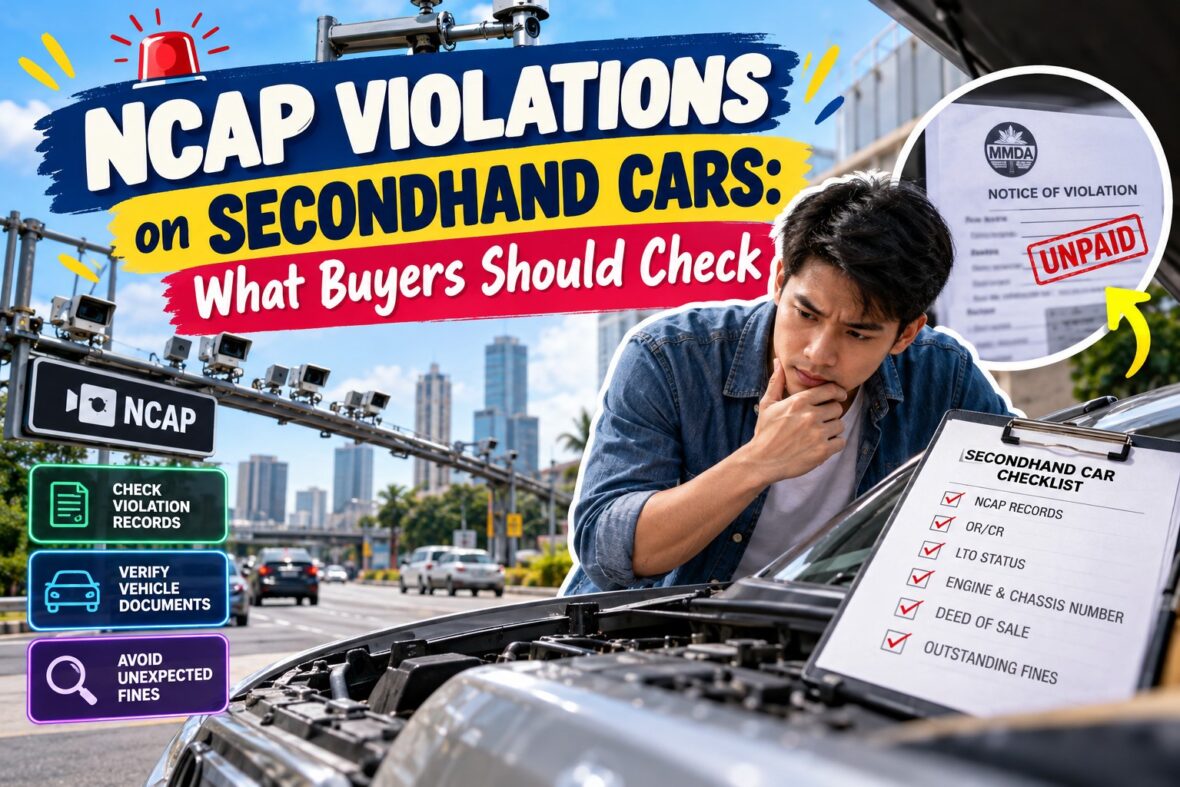
Buying a secondhand car in the Philippines can be a practical way to save money, especially when you’re looking for a reliable vehicle without paying the price of a brand-new one.
But before you hand over your payment and drive away with your newly purchased car, there’s something you shouldn’t overlook.
The vehicle’s traffic violation history.
With the No Contact Apprehension Policy (NCAP) operating on major Metro Manila roads and in participating cities, a secondhand car could have an outstanding traffic violation that the previous owner hasn’t settled.
And here’s where things can become complicated.
What if you discover an unpaid NCAP ticket after buying the car? What if the violation happened before you became the owner? Will you be required to pay the fine? And can an outstanding violation affect your vehicle’s registration or transfer of ownership with the Land Transportation Office (LTO)?
These are important questions, especially now that NCAP enforcement has expanded across parts of Metro Manila.
The good news is that there are ways to check a vehicle’s violation records before completing your purchase.
However, not all violations are recorded in one database, and buying a vehicle with a clean-looking OR/CR doesn’t automatically mean it has no outstanding traffic-related problems.
If you’re buying a used car, here’s a comprehensive guide to checking NCAP violations, understanding who may be responsible for old tickets, and protecting yourself from unexpected expenses.
Content
Can a Secondhand Car Have an Existing NCAP Violation?
Yes. A secondhand car can have an outstanding NCAP violation even if the buyer wasn’t the person driving when the violation occurred.
NCAP uses cameras and other digital equipment to detect traffic violations without requiring an enforcer to physically stop the driver.
The system generally identifies the vehicle through its license plate number and registration details.
This is important because the notice of violation is commonly issued to the vehicle’s registered owner, using the information available in the LTO database.
Let’s say someone owns a car and commits a traffic violation along EDSA.
The violation is recorded by an NCAP camera, but the owner decides to sell the vehicle before settling the ticket.
A few weeks later, the buyer receives the car and starts processing the transfer of ownership.
The unpaid violation may still appear in the vehicle’s records.
Even though the buyer wasn’t responsible for the original incident, the unresolved ticket could create complications that need to be addressed.
This is why checking a secondhand vehicle’s traffic records is just as important as inspecting its engine, transmission, and registration documents.
Why NCAP Violations Matter When Buying a Used Car
NCAP became an especially important consideration for vehicle buyers following the program’s resumption and expansion in Metro Manila.
The Supreme Court partially lifted the suspension affecting MMDA’s NCAP operations in May 2025.
In July 2026, the Court also dismissed consolidated petitions challenging several Metro Manila local government NCAP ordinances.
Beginning October 5, 2026, Manila, Quezon City, Parañaque, Muntinlupa, and San Juan resumed their respective NCAP operations.
Valenzuela postponed its planned October 5 resumption because of ongoing road construction.
Meanwhile, MMDA continues to implement its own NCAP system on roads under its traffic enforcement jurisdiction.
This means motorists can encounter NCAP enforcement from different authorities.
And for secondhand vehicle buyers, that creates an additional responsibility during the purchasing process.
A car’s plate number may have been recorded by MMDA or a city government before the sale.
If the owner hasn’t resolved the violation, the record may become a problem for the buyer later.
Possible Problems Caused by Unpaid NCAP Violations
An unresolved violation can lead to several situations:
- The previous registered owner may receive a Notice of Violation even after selling the vehicle.
- The buyer may discover an outstanding ticket during a vehicle background check.
- An unresolved citation may result in an LTO alarm or hold, subject to the issuing authority’s rules and applicable due process.
- The car’s registration renewal may be affected if a valid alarm has been entered into the LTO system.
- The buyer may need to coordinate with the previous owner before the case can be resolved.
- A disputed violation may require additional documents or an administrative protest.
Not every unpaid NCAP ticket automatically blocks all LTO transactions.
The consequences depend on the issuing authority, the case status, applicable procedures, and whether an enforceable alarm or restriction has been recorded.
How to Check NCAP Violations Before Buying a Secondhand Car
Before purchasing a vehicle, take time to verify whether it has outstanding NCAP records.
The process is relatively straightforward for MMDA-issued violations, although additional checks may be necessary for city-issued tickets.
Step 1: Ask the Seller for the Vehicle’s OR/CR
Start by requesting the car’s Official Receipt and Certificate of Registration, commonly called the OR/CR.
These documents contain essential information about the vehicle, including:
- Registered owner’s name
- Plate number
- Motor Vehicle File Number
- Make and model
- Engine number
- Chassis number
- Registration details
The Motor Vehicle File Number, or MV file number, is particularly useful when checking MMDA NCAP records.
Compare the information in the documents with the actual vehicle.
Make sure the plate number matches and that the engine and chassis numbers agree with the official registration records.
If the seller refuses to show the OR/CR or claims that you can verify everything after making a down payment, consider that a warning sign.
Step 2: Visit MMDA’s May Huli Ka Portal
The Metropolitan Manila Development Authority operates an official online NCAP platform called May Huli Ka.
You can access the website by entering the official address:
mayhulika.mmda.gov.ph
In August 2026, MMDA introduced an additional vehicle-search option that allows motorists to check the NCAP violation records available for a vehicle.
Users can search using either the plate number and ticket number or the plate number and MV file number.
For someone buying a secondhand car, the plate number and MV file number combination is particularly useful.
That’s because you may not know whether the vehicle has any existing ticket numbers.
Step 3: Enter the Plate Number and MV File Number
Follow the instructions on the official May Huli Ka website.
Enter the vehicle’s plate number and the corresponding MV file number from its Certificate of Registration.
Make sure the details are accurate.
Even a small error could result in an unsuccessful search.
If you’re purchasing the car from another person, it’s best to complete this check together with the seller.
This allows both parties to review the available records and clarify any violations before the transaction is finalized.
Step 4: Review the NCAP Results
After entering the required details, review the results displayed by the portal.
Depending on the vehicle’s records, the system may indicate whether a violation has been recorded.
If a ticket appears, check the available information carefully.
Important details include the violation date, time, location, type of offense, ticket number, fine amount, and payment or contest status.
The date is particularly important because it can help establish whether the incident happened before or after the sale.
Step 5: Save the Results
If the search reveals no violation, keep a dated screenshot of the result.
If outstanding tickets appear, save the information and discuss it with the seller before paying for the car.
Remember, however, that a “No Record Found” result is not a guarantee that the vehicle has never committed a traffic violation.
It only indicates that no matching record was returned by the particular system using the information provided at that time.
Other agencies may maintain separate records, and recently recorded violations may not yet be visible.
Check NCAP Violations Through the eGovPH App
Another option is the eGovPH mobile application.
In July 2026, MMDA and the Department of Information and Communications Technology introduced NCAP services through the eGovPH app.
The integration allows motorists to access relevant traffic services, including checking violation records and monitoring payment status.
Here’s the general process:
- Open the official eGovPH application.
- Sign in using your registered account.
- Look for the MMDA NCAP service.
- Follow the vehicle verification instructions.
- Review the available violation and payment information.
The exact screens may change as the application is updated.
For secondhand vehicle buyers, it’s a convenient additional verification channel.
However, keep in mind that the MMDA service should not automatically be treated as a comprehensive record of every traffic citation issued by every local government.
Check City-Issued NCAP Violations Separately
Here’s one of the most important things buyers should know.
Not all NCAP violations come from MMDA.
Several Metro Manila city governments operate their own NCAP programs and online portals.
This means that checking May Huli Ka alone may not be sufficient when buying a secondhand vehicle.
For example, a car may have traveled through Quezon City, Manila, and Parañaque before being offered for sale.
Depending on where the alleged violation occurred and which authority issued the citation, the records may be managed by different systems.
NCAP Authorities Worth Checking
| Authority | What buyers should verify |
|---|---|
| MMDA | MMDA-issued NCAP violations through May Huli Ka |
| Quezon City | City-issued NCAP records |
| Manila | City-issued NCAP records |
| Parañaque | City-issued NCAP records |
| Muntinlupa | City-issued NCAP records |
| San Juan | City-issued NCAP records |
| Valenzuela | Existing records and any updates to its postponed NCAP implementation |
Use the official city government NCAP website or contact the appropriate traffic management office.
Some portals may require the plate number, MV file number, or Notice of Violation number.
If you don’t have the ticket number, ask whether the issuing office can verify the vehicle’s record using its registration information.
Also remember that traffic violations are not limited to NCAP.
A secondhand car may have other unresolved citations issued through physical apprehension or different local traffic enforcement systems.
For a more complete background check, review the vehicle’s LTO record as well.
Does an NCAP Violation Transfer to the New Owner?
This is one of the biggest concerns when purchasing a secondhand vehicle.
The answer depends on when the violation occurred, who owned or possessed the vehicle at that time, and the regulations of the issuing authority.
An NCAP ticket doesn’t automatically become the buyer’s personal responsibility simply because the car was purchased afterward.
However, there is an important difference between responsibility for the original violation and the practical consequences of an unresolved record attached to the vehicle.
Scenario 1: The Violation Happened Before the Sale
Let’s say the following happened:
October 3 – The previous owner committed a traffic violation.
October 10 – You purchased the car.
October 15 – You discovered the unpaid NCAP ticket.
In this situation, the violation occurred before you acquired the vehicle.
You have a strong factual basis for arguing that you weren’t responsible for the original offense.
The ticket should be reviewed based on the vehicle’s ownership and possession history, the applicable NCAP rules, and available evidence.
The best approach is to ask the seller to resolve the outstanding case or cooperate in contesting or correcting the record.
Don’t immediately pay the fine without first establishing the facts.
Scenario 2: The Violation Happened After the Sale
Now, imagine a different situation.
October 3 – You purchased the car.
October 10 – The car was recorded committing a traffic violation.
October 15 – The previous owner received an NCAP notice because the registration hadn’t been transferred.
In this case, the violation occurred after the vehicle was sold.
Although the Notice of Violation may have been addressed to the previous registered owner, that doesn’t automatically establish that the previous owner committed the offense.
The parties should provide the relevant documents to the issuing authority so the facts can be reviewed.
Depending on the applicable NCAP ordinance and evidence, the previous owner may be able to contest the notice and establish that the vehicle had already been sold.
Scenario 3: The Car Has Changed Owners Several Times
Things become more complicated when the vehicle has been sold repeatedly without properly updating its registration.
For example, the car may have passed from Owner A to Owner B, then to Owner C, before finally being sold to you.
If the registration still identifies Owner A, an NCAP notice may be addressed to someone who sold the vehicle years ago.
Resolving the case may require tracing the chain of ownership and obtaining supporting documents.
This is why vehicles sold through an open deed of sale or with incomplete ownership records deserve particularly careful inspection.
What If the Previous Owner Receives an NCAP Ticket After Selling the Car?
This situation has already occurred in the Philippines.
In August 2026, a motorist publicly shared that he received an MMDA NCAP notice involving a Toyota sedan he had sold approximately 22 years earlier.
The alleged violation was recorded in May 2026 along EDSA.
Despite the passage of time, the notice was still sent to the former owner because the vehicle apparently remained registered under his name.
The incident illustrates an important point.
Selling a vehicle does not necessarily update the LTO ownership record automatically.
If the transfer is not properly processed, the previous owner’s name may continue to appear in government databases.
Can the Previous Owner Contest the Ticket?
Yes, depending on the applicable rules and supporting evidence.
For example, San Juan City’s official NCAP frequently asked questions specifically address this situation.
The city explains that a previous registered owner who receives a notice for a vehicle already sold may contact the NCAP office or traffic adjudication board and submit a notarized Deed of Sale as evidence.
This provides a way to establish that the vehicle had been sold before the violation.
However, other issuing authorities may have different documentary requirements and procedures.
The seller should contact the office that issued the ticket rather than assuming that the same process applies everywhere.
Can Unpaid NCAP Violations Affect LTO Registration?
Yes, an unresolved NCAP violation may affect vehicle registration if it results in a valid alarm or restriction in the LTO system.
For example, San Juan City’s NCAP rules state that if a violation remains unsettled and no protest is filed within the prescribed period, the vehicle’s plate number may be placed on an alarm list.
The city explains that payment of the outstanding violation may then be required before renewing the vehicle’s LTO registration.
This is especially important for secondhand car buyers.
Even when the alleged offense happened before the purchase, a vehicle-related alarm may create an administrative problem that the buyer needs to resolve.
However, not every unpaid ticket automatically results in an immediate registration block.
The issuing agency must follow the applicable notice, contest, and due process requirements.
This is why buyers should verify the actual status of the citation rather than assuming that any listed ticket automatically prevents renewal.
How to Check for LTO Alarms Before Buying a Used Car
Aside from NCAP records, buyers should also examine the vehicle’s status with the LTO.
An LTO-related problem can involve more than an unpaid traffic ticket.
A vehicle may have issues related to its registration, recorded ownership, or other legal and administrative restrictions.
Start by reviewing the original OR/CR and comparing the details with the vehicle itself.
Ask the seller to assist with a record verification at the appropriate LTO office.
Verify whether the registration is current, whether any official alarm or restriction exists, and whether the vehicle is eligible for the intended transfer.
You should also check whether the vehicle has an outstanding mortgage or encumbrance.
If the car was previously financed, request evidence that the mortgage has been properly released and that the documentation is acceptable to the LTO.
Don’t Forget the PNP-HPG Clearance
A PNP-Highway Patrol Group Motor Vehicle Clearance is also part of the established ownership-transfer requirements.
This process helps verify the vehicle’s identity and check relevant motor vehicle records.
It is separate from an NCAP violation search.
Obtaining an HPG clearance does not automatically mean every MMDA or city-issued traffic ticket has been settled.
For a reliable secondhand-car background check, treat NCAP verification, LTO verification, and HPG clearance as separate steps.
What Documents Should You Check Before Buying a Secondhand Car?
Before completing the purchase, ask the seller to provide the necessary documents for verification.
1. Original Certificate of Registration
The Certificate of Registration identifies the vehicle and its recorded owner.
Check the name, plate number, engine number, chassis number, and other registration details.
2. Latest Official Receipt
The latest LTO Official Receipt helps establish the vehicle’s recorded registration transaction.
Review its information together with the Certificate of Registration.
A recent receipt does not guarantee that every traffic record is clear.
3. Notarized Deed of Sale
The Deed of Sale documents the transfer between the seller and buyer.
It should contain accurate information about the parties, vehicle, and transaction.
Don’t sign blank documents or agree to inaccurate dates.
4. Valid Identification Documents
Confirm that the seller’s identity matches the records and that the person has the legal authority to sell the vehicle.
If the seller is acting for someone else, request the necessary authorization.
5. PNP-HPG Clearance
Verify the required HPG clearance process for the intended transfer.
6. Proof of Mortgage Release, If Applicable
If the vehicle was mortgaged, ask for the proper cancellation or release documents.
7. NCAP Verification Results
Check MMDA records and relevant city-issued violation systems.
Keep dated screenshots or official confirmations.
8. Official Receipts for Settled Violations
If the seller previously paid an NCAP ticket, request the payment confirmation and verify whether the issuing authority has marked the record settled.
Why You Should Avoid Buying a Car Through an Open Deed of Sale
An open deed of sale generally refers to a transaction document in which information about one of the parties, often the buyer, has been left incomplete.
Some vehicle buyers and resellers use this arrangement to avoid processing multiple ownership transfers.
However, it creates important risks.
If the car changes hands several times without proper registration, it can become difficult to establish who was responsible for a particular traffic violation.
Notices may continue going to the original registered owner.
The actual buyer may also encounter difficulties completing the required LTO paperwork.
Imagine purchasing a vehicle from a reseller whose name doesn’t appear anywhere in the existing ownership documents.
If you later discover an unpaid NCAP violation, you may need to locate the original registered owner to obtain information or supporting documents.
That can become a complicated and time-consuming process.
For this reason, it’s generally safer to purchase a vehicle through a properly documented transaction with a clear chain of ownership.
How Soon Should You Transfer Ownership After Buying the Car?
If you’re buying a secondhand car, don’t delay processing the transfer of ownership with the LTO.
Under Section 8 of Republic Act No. 10883, also known as the New Anti-Carnapping Act of 2016, the sale or transfer of a motor vehicle must be registered with the LTO within 20 working days from purchase or acquisition.
However, buyers should be aware of a related regulatory development.
In August 2024, LTO issued Administrative Order No. VDM-2024-046 establishing more detailed requirements for reporting vehicle sales and transferring ownership.
The agency subsequently suspended implementation of that administrative order in October 2024 to review its provisions and allow additional consultation.
The suspension of that particular administrative order should not be interpreted as permission to leave a vehicle registered under the previous owner indefinitely.
The underlying statutory registration requirements remain important.
Before processing the transfer, check the latest LTO instructions and any applicable updated regulations.
Why Updating Ownership Matters
Transferring the vehicle properly helps ensure that government records identify the correct owner.
This is particularly important for NCAP because notices are generally addressed using the registered owner’s information.
It also helps prevent confusion if the vehicle is involved in a traffic incident or other investigation.
The LTO has repeatedly reminded motorists that outdated ownership information can expose previous registered owners to inquiries and other legal complications involving vehicles they no longer possess.
What to Do If You Already Bought a Car With an Old NCAP Violation
Let’s say you have already completed the purchase.
Everything appeared fine during the transaction.
But after checking the vehicle’s records, you discovered an unpaid NCAP ticket from the previous owner.
What should you do?
Step 1: Confirm the Actual Violation
Verify the ticket through the official MMDA or city government portal.
Check its date, time, location, issuing authority, and payment status.
Make sure the information actually belongs to the vehicle you purchased.
Step 2: Compare the Violation Date With the Sale Date
Review your Deed of Sale and other transaction documents.
Determine whether the incident occurred before or after you acquired the car.
If the violation predates the transaction, that is important evidence supporting your position.
Step 3: Contact the Seller
Explain the situation and provide the official violation details.
Ask the seller to resolve the outstanding ticket or assist with the appropriate protest or correction procedure.
Keep records of your communications.
Step 4: Contact the Issuing Authority
If the seller is unresponsive, contact the agency that issued the citation.
Ask what documents are necessary to establish the sale date and determine the proper handling of the old violation.
Depending on the circumstances, the authority may require the OR/CR, Deed of Sale, identification documents, a copy of the notice, or other supporting evidence.
Step 5: Determine Whether the Violation Should Be Contested
If the violation was incorrectly attributed to you or there is an issue with the vehicle record, ask about the formal contest or adjudication procedure.
Don’t assume that a simple explanation over the phone automatically cancels a violation.
The issuing authority may require a written request or supporting documents.
Step 6: Resolve Any LTO Record Issues
If the outstanding violation has resulted in an LTO alarm, request instructions on having the record corrected or cleared.
After the case has been settled or dismissed, verify that the status has actually been updated.
Keep the official payment receipt, adjudication decision, or clearance document.
Can the Buyer Refuse to Pay an Old NCAP Fine?
If the violation occurred before the sale, the buyer has a reasonable basis for disputing personal responsibility for an offense committed by the previous owner or driver.
However, the proper handling depends on the specific case and the applicable NCAP rules.
The buyer may need to demonstrate that the vehicle had not yet been acquired when the violation occurred.
A notarized Deed of Sale, delivery records, and other transaction documents can help establish the timeline.
The buyer should not be required to simply accept the seller’s unpaid ticket as a normal cost of purchasing the car without examining the facts.
At the same time, refusing to pay doesn’t automatically remove a valid alarm or pending citation from the vehicle’s record.
The issue may still need to be formally resolved with the issuing authority.
What If the Seller Refuses to Cooperate?
If the seller refuses to settle an old violation, review the terms of your sale agreement.
A contract stating that the seller is responsible for traffic violations incurred before the sale may provide additional protection between the parties.
However, such an agreement does not automatically override the enforcement procedures of MMDA, a city government, or the LTO.
If the amount is significant or the unresolved record prevents a necessary transaction, consider seeking legal advice concerning your options.
How to Protect Yourself Before Paying for a Secondhand Car
The best way to avoid NCAP-related problems is to address them before releasing the full purchase price.
Here’s a practical checklist.
| What to check | Why it matters |
|---|---|
| Plate number and MV file number | Required for MMDA vehicle-record searches |
| MMDA NCAP records | Identifies available MMDA-issued tickets |
| City-issued NCAP records | Checks violations from separate LGU systems |
| LTO registration status | Helps identify alarms or registration problems |
| OR/CR details | Verifies recorded ownership and vehicle identity |
| Engine and chassis numbers | Confirms consistency with registration records |
| PNP-HPG clearance | Supports identity and ownership verification |
| Deed of Sale | Establishes transaction details and dates |
| Existing mortgage | Helps determine whether ownership can be transferred properly |
| Seller’s identification | Verifies the identity and authority of the seller |
You can also ask for a written declaration from the seller confirming whether any outstanding traffic violations are known.
For additional protection, consider including a provision in the sale agreement stating that the seller will resolve verified traffic violations incurred before the transaction.
This is especially useful when purchasing from a private seller or buy-and-sell dealer.
What Should Be Included in the Deed of Sale?
When preparing the Deed of Sale, the parties should accurately identify the vehicle and the transaction.
For NCAP-related protection, it’s useful to establish the actual date and, where appropriate, time when possession of the car was transferred.
The agreement may also contain provisions addressing traffic violations.
For example, the seller may agree to be responsible for unresolved citations arising before the agreed turnover date, while the buyer assumes responsibility for their own violations afterward.
This helps avoid disagreements if a notice arrives several weeks later.
It’s also useful to require both parties to cooperate if a government agency requests documents concerning a violation.
However, these provisions govern the agreement between buyer and seller.
They do not guarantee that an enforcement agency will automatically assign responsibility according to the contract.
The final treatment of a citation remains subject to the applicable law, ordinance, and adjudication process.
Beware of Fake NCAP Payment Links
As NCAP enforcement expands, motorists should also be careful about fraudulent text messages and payment websites.
The MMDA has warned the public about scammers impersonating its NCAP notification system.
According to official advisories, MMDA’s legitimate NCAP SMS sender ID is MMDA_NCAP.
Genuine MMDA NCAP text alerts do not include payment links, reply options, or instructions to provide sensitive information through suspicious websites.
This is especially relevant when buying a secondhand car.
A dishonest person could send you a fake violation notice and claim that you need to settle a ticket before completing the purchase.
Always verify the alleged violation using an official government portal.
Never send money to a personal bank account or e-wallet simply because someone claims that an NCAP fine must be paid.
If a violation is genuine, follow the payment instructions issued through the appropriate government channel.
Frequently Asked Questions About NCAP and Secondhand Cars
Can I check NCAP violations before buying a secondhand car?
Yes. You can check MMDA-issued records through the official May Huli Ka portal using the plate number and MV file number. You should also check relevant city NCAP portals and verify the vehicle’s registration status with the LTO.
Does NCAP follow the driver or the plate number?
NCAP generally identifies a vehicle through camera evidence and registration information.
Notices are commonly issued to the registered owner, but questions about actual responsibility may be addressed through the relevant contest or adjudication process.
Who pays an NCAP violation committed before the car was sold?
Responsibility depends on the facts and applicable rules. If the violation occurred before the sale, the buyer can use the transaction documents to establish that they did not yet own or possess the vehicle.
Ideally, the seller should resolve verified outstanding tickets before the sale is completed.
Can I transfer ownership if the car has an unpaid NCAP ticket?
It depends on whether the violation has resulted in a valid alarm or administrative restriction in the LTO system.
An unresolved ticket may create problems with certain LTO transactions, but not every citation automatically prevents transfer.
Verify the actual status with the LTO and issuing authority.
Will the previous owner receive NCAP tickets after selling the vehicle?
Possibly, if the LTO registration still identifies the previous owner.
This is why completing the ownership transfer is important.
Can a notarized Deed of Sale remove an NCAP violation?
A notarized Deed of Sale can serve as evidence establishing when a vehicle was sold.
However, it does not automatically delete the citation.
The issuing authority must review the evidence and apply the appropriate procedure.
Can I check NCAP using only the plate number?
Some government platforms may provide certain verification options, but MMDA’s May Huli Ka system uses the plate number together with another identifier, such as the MV file number or ticket number.
Check the requirements of the relevant portal.
What if the NCAP portal says “No Record Found”?
It means no matching record was returned by that particular system based on the information entered.
It does not conclusively establish that the car has no outstanding traffic violations anywhere.
Check other relevant authorities and the LTO as needed.
Do NCAP tickets expire when a car is sold?
Selling the car does not automatically cancel an outstanding citation.
Its status must be determined according to the issuing authority’s rules and any applicable legal requirements.
How can I check whether an old NCAP violation has already been paid?
Use the official portal of the issuing authority or request payment verification from its traffic office.
Ask the seller for the official payment receipt and confirm that the ticket has been marked settled.
Can I buy a secondhand car with existing NCAP violations?
A vehicle with an outstanding violation may still be offered for sale.
However, purchasing it without resolving or properly documenting the issue can expose you to administrative inconvenience and possible additional expenses.
For your protection, it’s generally better to have the matter resolved before completing the transaction.
How many days do I have to contest an NCAP violation?
The deadline depends on the issuing authority and applicable rules.
For example, San Juan City’s official NCAP guidance provides ten working days from receipt of the Notice of Violation to file a protest.
Do not assume that every NCAP authority follows exactly the same period.
Always check the deadline stated in the official notice.
Final Thoughts
Buying a secondhand car should be an exciting experience.
You’re getting a vehicle that fits your needs while potentially saving a substantial amount compared with buying brand-new.
But before you make that purchase, remember that there’s more to check than the car’s physical condition.
Its traffic violation history matters, too.
With NCAP operating through MMDA and several Metro Manila city governments, a used car may have outstanding traffic citations that aren’t immediately obvious during a typical vehicle inspection.
And if the previous owner hasn’t settled those tickets or completed the appropriate ownership records, the buyer could encounter unexpected complications.
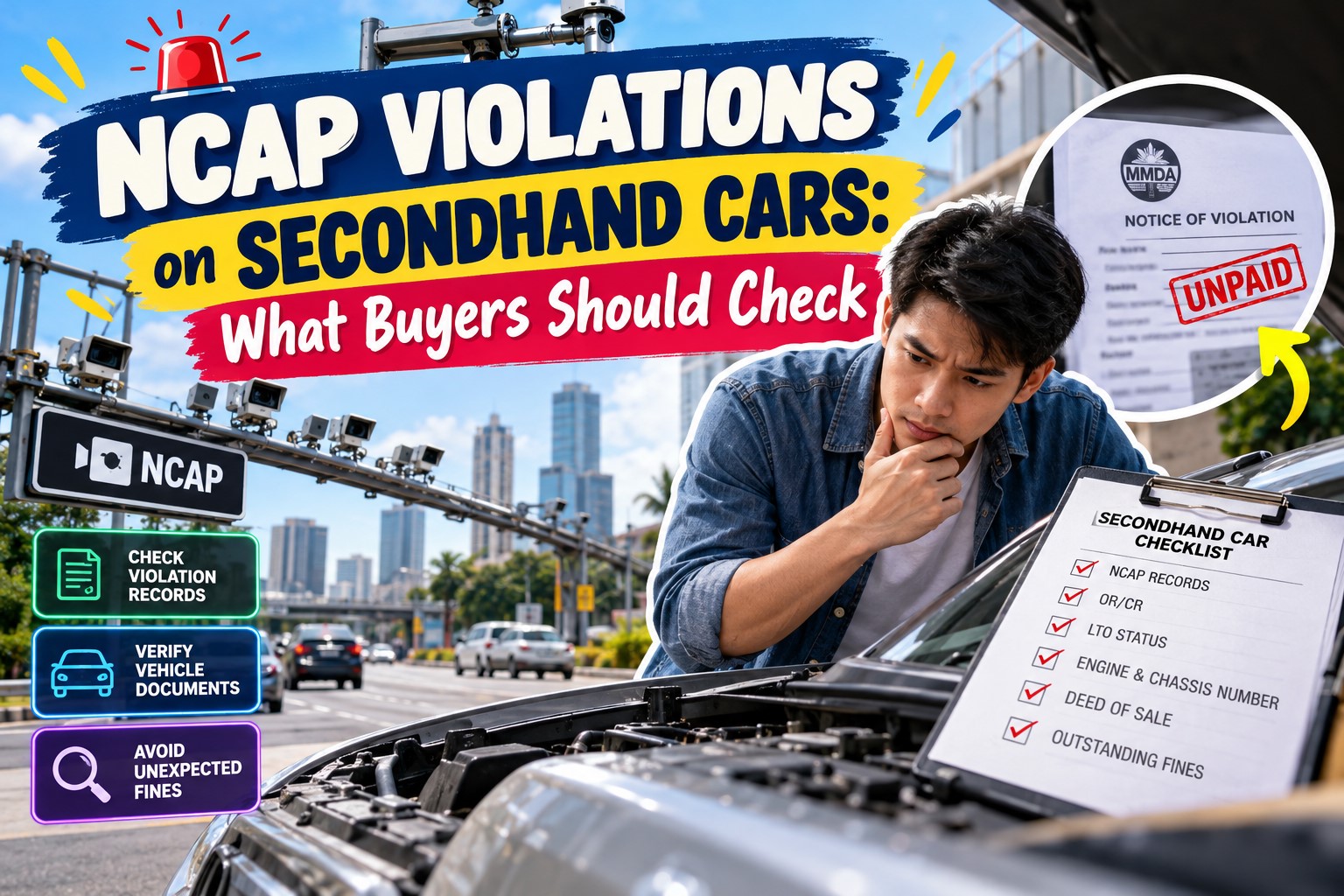
That’s why I recommend checking the vehicle’s NCAP records, reviewing the original OR/CR, confirming its LTO status, and preparing a properly documented Deed of Sale before handing over the full payment.
Just as importantly, understand that the registered owner and the person who actually committed the violation may not always be the same person.
If an old citation appears, establish the timeline and coordinate with the issuing authority rather than assuming that the latest buyer must automatically pay.
A little extra effort before purchasing can save you from headaches later.
Because when you buy a secondhand car, what you really want is a reliable vehicle you can confidently use — not a collection of unpaid traffic tickets left behind by someone else.
This guide reflects NCAP and LTO information available as of October 19, 2026. Specific violation records, payment obligations, ownership-transfer requirements, and contest procedures should always be verified through the appropriate government agencies.