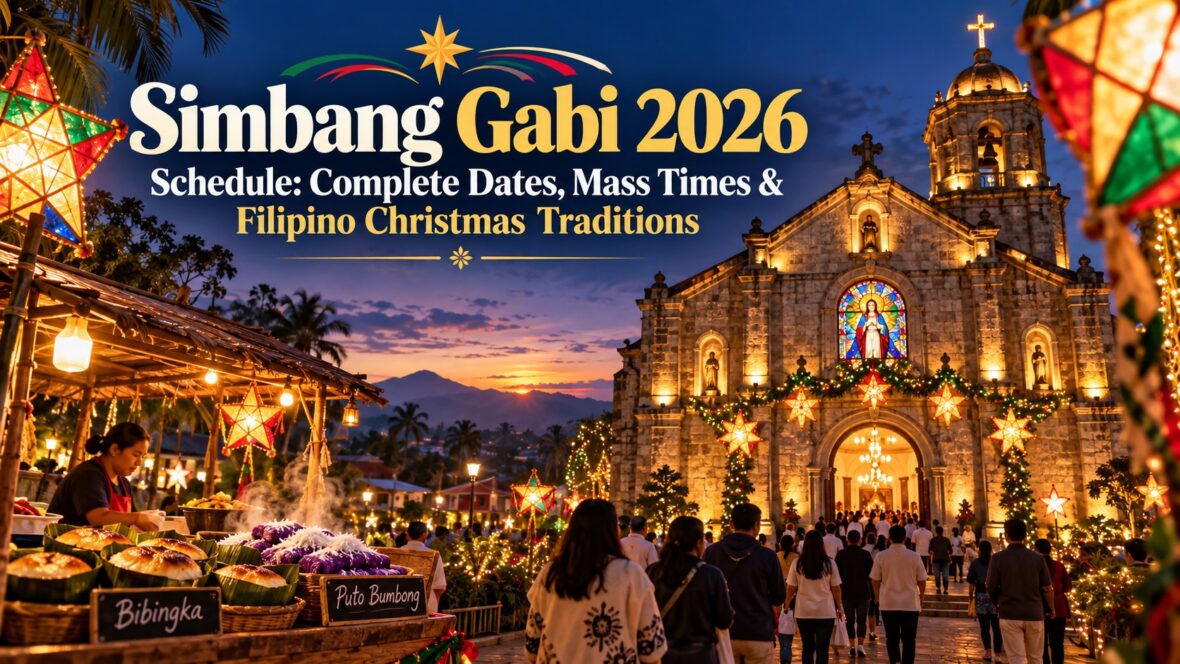
There are many things that make Christmas in the Philippines special. We have colorful parols hanging outside our homes, Christmas lights illuminating the streets, familiar holiday songs playing almost everywhere, and families preparing for their much-awaited reunions.
But there’s one tradition that truly captures the Filipino spirit of Christmas: Simbang Gabi.
For many Filipinos, Christmas wouldn’t feel complete without waking up before sunrise, heading to church while the streets are still quiet, and attending Mass with family and friends. And of course, there’s always the excitement of buying freshly cooked bibingka or puto bumbong afterward.
It’s a tradition that has been passed down through generations, bringing together faith, family, and community.
If you’re planning to complete the nine Simbang Gabi Masses this Christmas season, you might already be wondering when they will begin in 2026.
The good news is that the dates follow the same traditional calendar every year.
In this guide, we’ll cover the complete Simbang Gabi 2026 dates, the schedule for dawn and evening Masses, the meaning behind this beloved Filipino Christmas tradition, and everything else you need to know before attending.
Content
When Is Simbang Gabi 2026?
Simbang Gabi 2026 will officially begin on Wednesday, December 16, 2026, and continue until Thursday, December 24, 2026.
The traditional celebration consists of nine consecutive dawn Masses held in Catholic churches throughout the Philippines.
However, many parishes also offer evening Simbang Gabi Masses for people who cannot attend early in the morning.
These evening celebrations begin one day earlier, on Tuesday, December 15, 2026, and conclude on Wednesday, December 23, 2026.
Here’s a quick overview of the schedule.
| Simbang Gabi 2026 | Schedule |
|---|---|
| First Evening Mass | December 15, Tuesday |
| First Dawn Mass | December 16, Wednesday |
| Last Evening Mass | December 23, Wednesday |
| Last Dawn Mass | December 24, Thursday |
| Christmas Eve | December 24, Thursday |
| Christmas Day | December 25, Friday |
| Total Simbang Gabi Masses | 9 |
These dates follow the traditional Simbang Gabi calendar. Individual churches determine their own Mass times, which may vary depending on the parish and diocese.
Complete Simbang Gabi 2026 Dates and Schedule
If you’re planning to complete all nine Masses, it helps to have the entire schedule ready.
Below is the complete Simbang Gabi 2026 calendar, including the corresponding dates for evening and dawn Masses.
| Day | Evening Simbang Gabi | Dawn Simbang Gabi |
|---|---|---|
| 1 | December 15, Tuesday | December 16, Wednesday |
| 2 | December 16, Wednesday | December 17, Thursday |
| 3 | December 17, Thursday | December 18, Friday |
| 4 | December 18, Friday | December 19, Saturday |
| 5 | December 19, Saturday | December 20, Sunday |
| 6 | December 20, Sunday | December 21, Monday |
| 7 | December 21, Monday | December 22, Tuesday |
| 8 | December 22, Tuesday | December 23, Wednesday |
| 9 | December 23, Wednesday | December 24, Thursday |
Remember that evening Simbang Gabi Masses are celebrated on the night before their corresponding dawn Masses.
For example, the first evening celebration takes place on December 15, while the first traditional dawn Mass is on December 16.
You don’t need to attend both the evening and dawn celebration for the same Simbang Gabi day to complete the nine-day devotion.
Also, December 20, 2026, falls on the Fourth Sunday of Advent. Because Sunday liturgical celebrations have particular rules, follow your parish’s guidance on the appropriate Simbang Gabi Masses, especially when alternating between evening and dawn schedules.
What Time Is Simbang Gabi in 2026?
The exact time of Simbang Gabi depends on the church.
Unlike the dates, which are traditionally fixed, individual parishes announce their own schedules.
Dawn Simbang Gabi Schedule
Traditional Simbang Gabi Masses usually take place before sunrise.
Common starting times include:
- 4:00 AM
- 4:30 AM
- 5:00 AM
- 5:30 AM
- 6:00 AM
Some parishes schedule their Masses earlier or later, depending on local church guidelines.
The early morning schedule is one of the defining characteristics of Simbang Gabi.
Imagine leaving your house while it’s still dark, walking toward a brightly illuminated church, and seeing other families making the same journey.
For many Filipinos, those simple moments are part of what makes the Christmas season memorable.
Evening Simbang Gabi Schedule
Evening Simbang Gabi is especially convenient for employees, students, commuters, and families who may have difficulty waking up early.
Common evening schedules include:
- 6:00 PM
- 6:30 PM
- 7:00 PM
- 7:30 PM
- 8:00 PM
- 9:00 PM
These are typical times rather than confirmed 2026 schedules.
For reference, the Archdiocese of Manila allowed evening Aguinaldo Masses to start as early as 6:00 PM under its 2025 guidelines. Specific times and requirements for 2026 will depend on the applicable diocesan and parish announcements.
Are the Official Simbang Gabi 2026 Church Schedules Available?
As of October 19, 2026, the complete 2026 Christmas Mass schedules of churches across the Philippines have not yet been published.
Many churches release their schedules closer to December.
If you’re planning to attend a particular parish, the best places to check are its official Facebook page, website, parish office, or church announcement board.
Be careful when looking at schedules circulating online. Some may contain Mass times from previous years.
What Is Simbang Gabi?
Simbang Gabi is a traditional Filipino Catholic celebration consisting of nine Masses leading up to Christmas.
It is also known as Misa de Gallo or Misa de Aguinaldo.
The phrase Simbang Gabi literally means “night Mass” or “night worship” in Filipino.
Interestingly, despite the name, the traditional celebrations actually take place very early in the morning, often before sunrise.
The term Misa de Gallo comes from Spanish and translates to “Mass of the Rooster,” referring to the early hour associated with the crowing of roosters.
Meanwhile, Misa de Aguinaldo refers to the tradition of offering these Masses as part of the faithful’s spiritual preparation for Christmas.
The devotion honors the Blessed Virgin Mary as Catholics prepare to celebrate the birth of Jesus Christ.
Although Simbang Gabi has become closely associated with Filipino Christmas festivities, its central purpose remains religious.
It is a time for prayer, reflection, thanksgiving, and preparation for Christmas.
The History of Simbang Gabi in the Philippines
Simbang Gabi has a long history dating back to the Spanish colonial period.
The tradition is commonly traced to the 17th century, when Catholic missionaries began celebrating Masses before sunrise to accommodate the schedules of farmers and laborers.
During that time, many Filipinos worked in agricultural communities.
Farmers usually began their work early in the morning to avoid the intense heat of the afternoon.
Attending an ordinary daytime Mass could be difficult because of their work responsibilities.
To make religious participation more accessible, missionaries held Masses in the early morning hours.
This allowed people to attend church before beginning their daily activities.
Over the centuries, the practice became deeply rooted in Filipino Catholic life.
What started partly as an accommodation for working communities evolved into one of the country’s most recognizable Christmas traditions.
Eventually, evening Simbang Gabi celebrations also became common, particularly in urban communities where work and commuting schedules made early morning attendance difficult.
Today, Simbang Gabi continues in cities, towns, provinces, and Filipino Catholic communities around the world.
Even after hundreds of years, the tradition remains remarkably familiar.
Families still wake up early, churches still fill with worshippers, and food vendors still prepare their traditional Christmas delicacies outside church grounds.
Why Do Filipinos Celebrate Simbang Gabi for Nine Days?
The nine-day duration is significant because Simbang Gabi is a novena of Masses.
In Catholic tradition, a novena is a period of prayer observed over nine days or on nine occasions.
For Simbang Gabi, the nine Masses represent a continuing spiritual preparation for Christmas.
The devotion encourages Catholics to dedicate time to God during a season that can easily become dominated by shopping, parties, and other holiday activities.
Attending Simbang Gabi is also an opportunity to reflect on the meaning of Christmas beyond gifts and celebrations.
Many Filipinos use this time to pray for their families, express gratitude for the blessings they have received, and seek guidance for the coming year.
Others offer their prayers for loved ones who are sick, relatives working abroad, or personal challenges they hope to overcome.
Whatever their individual intentions, Simbang Gabi provides a meaningful opportunity to strengthen their faith.
Simbang Gabi Traditions in the Philippines
One reason Simbang Gabi remains so special is that it combines religious devotion with distinctly Filipino Christmas customs.
Here are some of the traditions commonly associated with the celebration.
1. Attending Mass Before Sunrise
Perhaps the most recognizable Simbang Gabi tradition is waking up early for church.
For many families, preparing for the dawn Mass becomes a yearly ritual.
Parents wake up their children, everyone gets ready while it’s still dark, and the family makes its way to church.
Some people walk because their parish is nearby, while others travel by tricycle, jeepney, or car.
The early morning setting creates a different atmosphere from an ordinary Sunday Mass.
The streets are quieter, the weather is often cooler, and church surroundings are illuminated by Christmas decorations.
For many, this is one of the most peaceful experiences of the holiday season.
2. Eating Bibingka After Mass
You can’t talk about Simbang Gabi without mentioning bibingka.
This popular Filipino rice cake is traditionally cooked using charcoal heat, often with banana leaves lining the baking container.
Bibingka is commonly topped with salted egg, cheese, butter or margarine, and grated coconut.
Some vendors offer additional toppings, while others stick to traditional recipes.
What makes bibingka especially memorable during Simbang Gabi is the experience of eating it fresh from the stall.
After attending Mass, families and friends gather outside the church to enjoy warm bibingka before heading home.
The smell of freshly baked rice cakes is practically part of the Christmas atmosphere.
3. Buying Puto Bumbong
Another popular Simbang Gabi delicacy is puto bumbong.
This purple-colored rice cake is traditionally prepared by steaming glutinous rice in bamboo tubes.
Once cooked, it is usually served on banana leaves with butter or margarine, grated coconut, and sugar. Some versions also include cheese or muscovado sugar.
Puto bumbong is particularly associated with the Christmas season.
Although it may be available at other times of the year, many Filipinos look forward to eating it during Simbang Gabi.
And really, there’s something special about enjoying a warm serving of puto bumbong on a cool December morning.
4. Decorating Churches With Parols and Christmas Lights
Churches throughout the Philippines often feature beautiful Christmas decorations during Simbang Gabi.
Among the most iconic decorations is the parol, the traditional Filipino Christmas lantern.
Parols come in different shapes, sizes, and materials, although the five-pointed star remains the most recognizable design.
These lanterns are inspired by the Star of Bethlehem, which is associated with the Nativity story.
During Simbang Gabi, parols and Christmas lights help create a welcoming atmosphere around churches and public spaces.
Some churches also display elaborate Nativity scenes, commonly called belen.
These decorations contribute to the festive setting while reminding worshippers of the religious meaning of Christmas.
5. Completing the Nine Masses With Family and Friends
For some Filipinos, attending all nine Simbang Gabi Masses is a personal commitment.
For others, it becomes a family tradition.
Parents may bring their children every year, while groups of friends make plans to attend Mass together.
Couples may also observe Simbang Gabi as part of their annual Christmas activities.
Completing nine consecutive Masses requires time and discipline, especially for people balancing school, work, and household responsibilities.
But beyond completing the schedule, many value the opportunity to spend meaningful time with the people they love.
6. Making a Christmas Wish
One of the most popular beliefs associated with Simbang Gabi is that completing all nine Masses will make a wish come true.
You may have heard someone say that if you successfully attend all nine Masses, God will grant your special wish.
This belief has become a familiar part of Filipino Christmas culture.
However, it’s important to understand that this is a folk belief rather than an official teaching of the Catholic Church.
Completing the nine Masses does not guarantee that a particular wish will be granted.
Catholic leaders have emphasized that the purpose of Simbang Gabi is spiritual preparation for Christmas, not obtaining a guaranteed reward for attendance.
Of course, there’s nothing wrong with bringing personal prayer intentions to Mass.
The important thing is to remember that Simbang Gabi is primarily about faith, prayer, gratitude, and preparing to celebrate the birth of Christ.
Simbang Gabi vs. Misa de Gallo: What’s the Difference?
The terms Simbang Gabi and Misa de Gallo are often used interchangeably in the Philippines.
However, there are some distinctions in their traditional meanings.
Simbang Gabi generally refers to the entire nine-day series of Masses leading up to Christmas.
Misa de Gallo, literally “Mass of the Rooster,” is commonly used to describe the early morning Masses associated with the tradition.
In some contexts, Misa de Gallo is also associated specifically with Christmas Eve or the Christmas midnight celebration.
Misa de Aguinaldo is another traditional name used for the nine Masses offered in preparation for Christmas.
In everyday Filipino conversations, however, all these terms are closely connected with the Christmas Mass tradition.
What matters most is understanding the particular schedule and celebration being announced by your local church.
Can You Attend Evening Simbang Gabi Instead of Dawn Mass?
Yes. Evening Simbang Gabi celebrations are a recognized pastoral accommodation in many Filipino Catholic communities.
This is particularly helpful for people who work early in the morning, have night shifts, commute long distances, or cannot attend the traditional dawn schedule.
For instance, if your working hours make a 4:00 AM Mass difficult, attending an evening celebration may be a more practical option.
You may also choose to attend dawn Masses on some days and evening Masses on others, following the way your parish organizes the nine-day devotion.
Just remember that the evening Mass generally corresponds to the following morning’s celebration.
Attending both the evening and morning celebration for the same novena day does not automatically count as two different days of Simbang Gabi.
If you are switching between schedules, confirm the sequence with your parish so that you can properly follow the nine-day observance.
Is Completing All Nine Simbang Gabi Masses Required?
No. Completing all nine Simbang Gabi Masses is not a requirement imposed on every Catholic.
It is a voluntary devotional tradition.
Many people make a personal commitment to attend all nine because they find the experience spiritually meaningful.
However, missing one or more Masses does not mean that a person has failed as a Catholic.
If you become sick, have an important responsibility, or cannot attend because of circumstances beyond your control, you can still continue participating in the remaining celebrations.
The purpose of Simbang Gabi is not simply to maintain a perfect attendance record.
It is to prepare spiritually for Christmas.
Also, remember that Simbang Gabi participation and the ordinary Catholic obligation to attend Sunday Mass are distinct matters. The applicable Sunday Mass obligation still needs to be considered, particularly when following evening schedules.
Does Simbang Gabi End on December 24 or December 25?
Traditional dawn Simbang Gabi ends on December 24.
For 2026, the ninth and final dawn Mass will fall on Thursday, December 24, which is Christmas Eve.
However, this does not mean that all church celebrations conclude that morning.
Catholic churches also celebrate Christmas Eve Masses on December 24, which may take place in the evening or around midnight.
These Christmas celebrations are distinct from the traditional nine-day Advent novena.
Christmas Day Masses are then celebrated on December 25.
So, if you’re planning your church visits, remember the difference:
- December 24 morning: Ninth and final traditional dawn Simbang Gabi Mass.
- December 24 evening or late night: Christmas Eve or Christmas Vigil Masses.
- December 25: Christmas Day Masses.
The exact Christmas Eve and Christmas Day schedules depend on the parish.
Where Can You Attend Simbang Gabi in the Philippines?
Simbang Gabi is celebrated in Catholic churches throughout the country.
You can attend at your local parish, a cathedral, a national shrine, or another church offering the traditional novena Masses.
In Metro Manila, churches that have regularly hosted Simbang Gabi include the Manila Cathedral in Intramuros, Quiapo Church in Manila, Baclaran Church in Parañaque, and other major parish churches and shrines.
Outside Metro Manila, the tradition is widely observed in provinces such as Cavite, Laguna, Bulacan, Pampanga, Batangas, Cebu, Iloilo, Negros Occidental, and many other parts of the Philippines.
You don’t necessarily have to travel to a famous church to participate.
Your neighborhood parish may offer both morning and evening schedules, making attendance much more convenient.
Also, some chapels, schools, workplaces, and other institutions may organize Simbang Gabi celebrations, subject to the necessary church permissions and local guidelines.
For 2026, always verify the official schedule with the specific church before visiting.
Can You Attend Simbang Gabi Online?
Some Catholic parishes and religious organizations livestream Simbang Gabi through their official Facebook pages or YouTube channels.
This can be particularly helpful for Filipinos living overseas, senior citizens, people who are sick, and those who cannot physically travel to church.
Online broadcasts can provide an opportunity to listen to the readings, hear the homily, and join in prayer from home.
However, watching Mass online is not ordinarily the same as physically participating in Mass for purposes of a Mass attendance obligation.
Catholics who are unable to attend because of illness or other serious circumstances may participate in prayer through the broadcast, while following the guidance of their parish or diocese.
If you want to join online in 2026, check whether your chosen church will provide an official livestream.
Practical Tips for Attending Simbang Gabi 2026
Planning to complete the nine Masses this year? Here are some useful tips.
Check the Schedule Before December 15
If you prefer evening Masses, remember that the celebration begins on December 15 rather than December 16.
This is an easy detail to overlook.
Check your parish’s announcements ahead of time and save the schedule on your phone.
Arrive Early
Popular churches can become crowded during Simbang Gabi, particularly during the first and final days.
Arriving approximately 15 to 30 minutes early may help you find a seat and avoid rushing before the Mass begins.
Prepare for Early Morning Weather
December mornings can be cooler than usual in many parts of the Philippines.
Bring a light jacket or sweater, particularly if you’re attending Mass in elevated areas or open-air church grounds.
Consider Your Transportation
If you’re commuting to church, check whether public transportation will be available at your chosen time.
Jeepneys, tricycles, and other transport options may operate on limited schedules very early in the morning.
If you’re driving, allow extra time for parking.
Respect Church Rules and Traditions
Remember that Simbang Gabi is a religious celebration.
Dress appropriately, silence your phone, and follow parish guidelines regarding photography and other activities.
If you’re visiting a church primarily to experience the Filipino Christmas atmosphere, make sure your activities do not disturb worshippers.
Make Time for Reflection
Christmas can become extremely busy with shopping, work deadlines, reunions, and celebrations.
Simbang Gabi provides an opportunity to slow down and focus on things that truly matter.
You don’t have to rush out immediately after Mass.
Take a little time to pray, reflect, and appreciate the experience.
And yes, if there’s a bibingka or puto bumbong stall outside the church, enjoying a traditional Christmas breakfast afterward can be a wonderful way to complete your morning.
Frequently Asked Questions About Simbang Gabi 2026
When is the first Simbang Gabi in 2026?
The first traditional dawn Simbang Gabi will be held on Wednesday, December 16, 2026. Evening Simbang Gabi celebrations begin on Tuesday, December 15, 2026.
When is the last Simbang Gabi in 2026?
The final dawn Simbang Gabi Mass takes place on Thursday, December 24, 2026. The final evening Simbang Gabi celebration is traditionally held on Wednesday, December 23, 2026.
How many days is Simbang Gabi?
Simbang Gabi consists of nine consecutive Masses held in preparation for Christmas.
What time does Simbang Gabi usually start?
Traditional dawn Masses commonly begin between 4:00 AM and 6:00 AM, although some churches have different schedules. Evening Masses may begin around 6:00 PM to 9:00 PM or at other times announced by the parish.
Is Simbang Gabi celebrated on Sunday?
Yes. Simbang Gabi continues through Sundays that fall within the nine-day period.
In 2026, December 20 falls on a Sunday and is also the Fourth Sunday of Advent. Individual parishes follow the applicable liturgical guidelines for their Sunday celebrations.
Is December 15 included in Simbang Gabi?
Yes, for churches offering evening Simbang Gabi. December 15, 2026, marks the first evening celebration, corresponding to the first dawn Mass on December 16.
Can I complete Simbang Gabi by attending only evening Masses?
Yes, provided you attend the appropriate nine Simbang Gabi celebrations offered by your parish from December 15 to 23.
Do I need to attend the same church for all nine days?
No. You may attend Simbang Gabi at different Catholic churches.
Just make sure that the Masses you attend correspond to the appropriate days of the devotion.
What happens if I miss one Simbang Gabi Mass?
You may continue attending the remaining Masses. Completing all nine is a personal devotional commitment, not a compulsory religious requirement.
Does completing Simbang Gabi make your wish come true?
The belief that completing nine Masses grants a wish is a popular Filipino tradition, not an official Catholic teaching. The main purpose of Simbang Gabi is spiritual preparation for Christmas.
Is Simbang Gabi only celebrated in the Philippines?
No. Filipino Catholic communities in other countries also celebrate Simbang Gabi, including communities in the United States and other places with significant Filipino populations.
The schedules may differ from those followed in the Philippines.
Is Simbang Gabi the same as Christmas Eve Mass?
No. Simbang Gabi is the nine-day devotion before Christmas. Christmas Eve Mass celebrates the Nativity of Jesus Christ and is part of the Christmas liturgical celebration.

Final Thoughts
Simbang Gabi is one of those Filipino Christmas traditions that never seems to lose its meaning.
Whether you’re attending Mass with your parents, bringing your children for the first time, meeting friends at your neighborhood church, or continuing a tradition you started years ago, there’s something special about these nine days before Christmas.
It’s not simply about waking up early or completing nine consecutive Masses.
It’s about faith, gratitude, family, and making time for reflection during one of the busiest seasons of the year.
And for many of us, those early morning memories—walking through quiet streets, seeing beautifully decorated churches, and enjoying warm bibingka or puto bumbong afterward—are just as meaningful as the Christmas celebrations themselves.
For 2026, remember the important dates: evening Simbang Gabi begins on December 15, while the traditional dawn Masses run from December 16 to December 24.
Check your local church’s official Mass schedule as December approaches, especially if you’re planning to attend all nine celebrations.
Whether you complete the entire novena or attend whenever you can, I hope this year’s Simbang Gabi brings you and your loved ones a meaningful and peaceful Christmas season.
Maligayang Pasko!