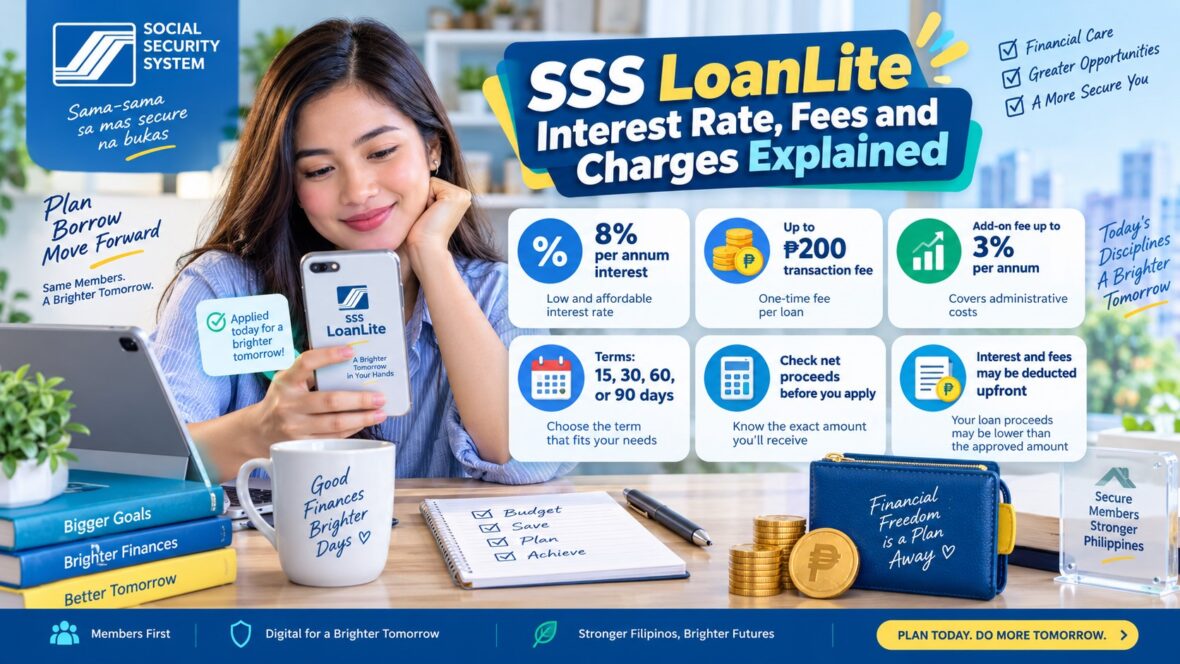
One of the first things most people want to know about SSS LoanLite is simple: How much does it actually cost?
You may see that SSS LoanLite has an interest rate of 8% per year, which sounds fairly straightforward. But the interest rate is only one part of the story. There can also be a transaction fee and an add-on fee charged by the participating financial institution. And because these charges are generally deducted before the money reaches your account, the amount you receive can be lower than the loan amount shown on your approval screen.
The good news is that SSS has placed limits on the fees participating financial institutions can charge.
So before accepting an SSS LoanLite offer, it helps to understand the difference between your approved loan amount, interest, fees, net proceeds, and the amount you eventually need to repay.
In this guide, I’ll break everything down in plain language, including actual sample computations.
Content
What Is the Current SSS LoanLite Interest Rate?
As of September 2026, the SSS LoanLite interest rate is 8% per annum, or approximately 0.67% per month.
Under SSS Circular No. 2026-005, the LoanLite rate follows the prevailing interest rate for an initial SSS Salary Loan. The current initial Salary Loan rate is also 8% per annum.
But there’s an important detail here.
You aren’t automatically charged 8% of your entire loan just because the advertised rate is 8% per year.
LoanLite is a very short-term loan, with repayment periods of only 15, 30, 60, or 90 days. SSS therefore calculates the interest according to the actual loan period.
That’s why the actual interest charge can be much smaller than 8% of your principal.
How SSS LoanLite Interest Is Computed
According to SSS Circular No. 2026-005, the basic computation uses the monthly rate of approximately 0.67% and the number of days from the loan date until the end of the loan term.
In simplified form:
Loan amount × 0.67% × number of loan days ÷ 30
Let’s use some examples.
For a ₱10,000 LoanLite borrowed for approximately 30 days:
₱10,000 × 0.67% × 30 ÷ 30
Estimated interest: ₱67
For approximately 60 days:
₱10,000 × 0.67% × 60 ÷ 30
Estimated interest: ₱134
And for approximately 90 days:
₱10,000 × 0.67% × 90 ÷ 30
Estimated interest: ₱201
These examples illustrate the interest component only. They don’t yet include the participating bank’s transaction fee or possible add-on fee.
SSS’s Official ₱20,000 Example
SSS actually provides its own LoanLite example in Circular No. 2026-005.
In the example:
Loan amount: ₱20,000
Loan date: April 10, 2026
Loan term: 15 days
End of loan term: April 25, 2026
Monthly interest rate: 0.67%
The computation is:
₱20,000 × 0.67% × 15 ÷ 30 = ₱67
So the interest for the 15-day loan is only ₱67.
SSS also states that this ₱67 is deducted from the loan proceeds.
And that brings us to one of the most important things to understand about LoanLite.
The Interest Is Deducted Upfront
With some loans, you receive the entire principal and then pay interest on top of it over time.
SSS LoanLite works differently.
The LoanLite interest is deducted upfront from your loan proceeds.
Suppose you borrow ₱20,000 and the calculated interest is ₱67.
Before considering any other fees, you would receive:
₱20,000 approved loan
Minus ₱67 interest
= ₱19,933
However, ₱19,933 may still not be the amount deposited into your account because the participating financial institution can deduct additional permitted fees.
This distinction between the principal amount and net proceeds is extremely important.
What Are the SSS LoanLite Fees?
Under the official LoanLite guidelines, participating financial institutions may impose two additional types of charges:
| Charge | Maximum allowed under SSS rules |
|---|---|
| Interest | Currently 8% per annum, about 0.67% monthly |
| Transaction fee | Up to ₱200 per loan transaction |
| Add-on fee | Not more than 3% per annum of the loan amount |
| Other LoanLite-related PFI fees | Not allowed |
The transaction fee and add-on fee are fees for the services provided by the participating financial institution, or PFI. They are deducted from the loan proceeds.
Let’s look at each one separately.
1. LoanLite Transaction Fee
A participating financial institution may charge a transaction fee of up to ₱200 for each LoanLite transaction.
The keyword here is “up to.”
It doesn’t mean every SSS LoanLite borrower will automatically be charged exactly ₱200.
₱200 is the maximum amount permitted under the LoanLite guidelines. A participating institution can charge less.
For example, if your LoanLite principal is ₱10,000 and your PFI charges the maximum transaction fee:
Loan amount: ₱10,000
Transaction fee: ₱200
That ₱200 would normally be deducted from your proceeds rather than collected separately after disbursement.
2. LoanLite Add-On Fee
There is also an add-on fee.
Under SSS Circular No. 2026-005, the participating financial institution may charge an add-on fee of no more than 3% per annum of the loan amount.
Once again, this is a ceiling.
It does not mean every LoanLite borrower will necessarily be charged the maximum 3%.
The exact charge can depend on the participating financial institution offering your LoanLite loan.
And there’s another important point.
The circular describes the maximum as “3% per annum.” Because LoanLite terms are only 15 to 90 days, readers shouldn’t simply assume that a 3% annual ceiling means 3% of the entire principal will automatically be deducted from every short-term loan.
The SSS circular doesn’t provide the same detailed worked example for the add-on fee that it provides for interest.
For that reason, the amount that matters most is the actual add-on fee displayed in your LoanLite disclosure statement before you accept the loan.
Why Your ₱20,000 Loan May Not Give You ₱20,000 in Cash
This is probably the biggest misconception borrowers should avoid.
If the app says:
“You are eligible for ₱20,000”
that doesn’t necessarily mean ₱20,000 will arrive in your bank or e-wallet.
Your net proceeds are calculated after applicable deductions.
The loan record transmitted by the participating institution is required to include information such as the principal amount, interest, transaction fee, add-on fee, amount net of interest, and final net loan proceeds.
So conceptually, it works like this:
Approved principal
₱20,000
Minus interest
For SSS’s 15-day example:
₱67
Minus transaction fee
Up to:
₱200
Minus applicable add-on fee
Amount depends on the PFI and loan terms, subject to the SSS maximum.
Equals
Your actual net loan proceeds.
That’s the amount that reaches your account.
Sample ₱20,000 LoanLite Computation
Let’s use the same 15-day example provided by SSS.
Principal: ₱20,000
Interest:
₱67
If the participating institution charged the maximum ₱200 transaction fee:
₱20,000
− ₱67 interest
− ₱200 transaction fee
= ₱19,733
You would then still subtract any applicable PFI add-on fee.
So your net proceeds would be less than ₱19,733 if an add-on fee applies.
This is why the number you really want to look for in the app isn’t just “Loan Amount.”
Look for:
Net Loan Proceeds.
Approximate LoanLite Interest by Term
Here’s another way to understand how the 0.67% monthly interest affects different loan amounts.
These figures illustrate the SSS interest calculation and don’t include transaction or add-on fees.
| Loan Amount | 15 Days | 30 Days | 60 Days | 90 Days |
|---|---|---|---|---|
| ₱1,000 | ₱3.35 | ₱6.70 | ₱13.40 | ₱20.10 |
| ₱5,000 | ₱16.75 | ₱33.50 | ₱67.00 | ₱100.50 |
| ₱10,000 | ₱33.50 | ₱67.00 | ₱134.00 | ₱201.00 |
| ₱15,000 | ₱50.25 | ₱100.50 | ₱201.00 | ₱301.50 |
| ₱20,000 | ₱67.00 | ₱134.00 | ₱268.00 | ₱402.00 |
These are simplified illustrations using 0.67% per month. Your actual application disclosure is the figure you should rely on because the calculation is tied to the applicable loan dates and terms.
Isn’t ₱200 a Lot on a Small Loan?
This is worth thinking about, especially if you’re borrowing a very small amount.
Imagine borrowing only ₱1,000.
If a PFI charged the maximum ₱200 transaction fee, that fee alone would represent a significant portion of the principal.
That’s why comparing only the advertised 8% annual interest rate doesn’t tell you the whole cost of a small short-term loan.
Fixed charges have a much bigger impact on smaller loans.
For example, a ₱200 fee on:
₱1,000 = 20% of the principal
₱5,000 = 4%
₱10,000 = 2%
₱20,000 = 1%
This doesn’t mean your bank will necessarily charge the full ₱200. SSS permits a transaction fee of up to ₱200.
But it does show why it’s important to check all fees before accepting a small LoanLite offer.
What Is an Effective Interest Rate or EIR?
This is another term you may encounter when reviewing your LoanLite disclosure.
The nominal interest rate tells you the stated rate—in this case, currently 8% per annum.
But the effective interest rate, or EIR, is designed to provide a fuller picture of the cost of borrowing after considering the loan structure and applicable charges.
This matters with LoanLite because some charges are deducted upfront.
For example, suppose your principal is ₱10,000 but you receive less than ₱10,000 after deductions.
You’re still dealing with an obligation based on the loan terms even though the amount of usable cash deposited in your account is lower than the headline principal.
Under SSS Circular No. 2026-005, the participating institution must provide essential loan information in accordance with the Truth in Lending Act. The disclosure includes information such as the principal amount, itemized deductions, repayment schedule, due date, and EIR.
So don’t judge a LoanLite offer purely from the words “8% per annum.”
Check the entire disclosure.
What Should You Check Before Accepting LoanLite?
When your LoanLite offer appears in the participating bank’s app, don’t immediately tap Confirm.
Look for the following information:
- Principal loan amount
- Interest charge
- Transaction fee
- Add-on fee
- Net loan proceeds
- Repayment amount
- Repayment schedule
- Due date
- Effective interest rate or EIR
- Late-payment consequences
SSS requires essential information and itemized deductions to be disclosed to the borrower before final loan approval.
Take a screenshot or keep a copy of the disclosure statement if the app allows you to do so.
Does LoanLite Have Hidden Fees?
Under the SSS rules, a PFI isn’t supposed to simply keep adding miscellaneous LoanLite charges.
Circular No. 2026-005 specifically provides that no other fees related to the loan should be charged by the participating financial institution beyond those permitted under the program.
The permitted PFI charges are essentially:
the transaction fee of up to ₱200 and the add-on fee capped at 3% per annum.
That transparency is one of the reasons reviewing the disclosure statement is so important.
If you see a charge you don’t understand, check what it is before accepting the loan.
What Happens If You Pay LoanLite Late?
This is where LoanLite can become much more expensive.
Because the program is meant for very short-term borrowing, SSS expects the loan to be settled by the end of the agreed term.
If you still have an unpaid principal balance after the LoanLite term ends, the account becomes past due or in default.
Under Circular No. 2026-005, a past-due LoanLite currently follows the applicable Salary Loan rates for continuing interest and penalties:
Continuing interest: 10% per annum
Penalty: 1% per month
These are imposed on the outstanding principal until the obligation is fully settled. SSS loan privileges are also automatically suspended until the past-due LoanLite account is fully paid.
That’s a very good reason not to treat LoanLite like money you can simply repay whenever you’re ready.
Example of a Late LoanLite Account
SSS provides another useful illustration in its official circular.
In the example, a borrower reaches the end of the loan term with an outstanding principal balance of ₱8,000.
For one month:
Continuing interest:
₱8,000 × 10% × 1/12 = ₱66.67
Penalty:
₱8,000 × 1% = ₱80
So after the first month, the total obligation becomes:
₱8,146.67
After another month:
Another ₱66.67 continuing interest
Plus another ₱80 penalty
Total:
₱8,293.34
That means a balance that started at ₱8,000 had already grown by ₱293.34 after two months in the SSS illustration.
And that’s before considering the wider consequences of having a defaulted SSS loan.
Your SSS Loan Privileges Can Be Suspended
Missing your LoanLite due date doesn’t just create additional charges.
SSS states that the member’s loan privileges will automatically be suspended while the LoanLite account remains past due.
That could affect your ability to obtain another SSS loan.
So if you’re thinking:
“I’ll just pay it several months later.”
that decision could cost more than the continuing interest and penalty.
It can affect your ability to access future SSS borrowing facilities.
What Happens During the First 60 Days After Default?
Under the official guidelines, the PFI continues collection efforts for the next 60 days after the LoanLite term.
During this period, outstanding principal, continuing interest, and penalties may continue to be collected through the participating financial institution’s auto-debit facility whenever funds enter the member’s disclosed bank or e-wallet account.
Payments collected during this period are applied in this order:
penalties first,
then continuing interest,
then principal.
That can make it harder to reduce the actual principal once a loan becomes seriously past due.
What Happens After the 60-Day Collection Period?
The LoanLite guidelines also allow a participating financial institution to offer refinancing for certain defaulted accounts.
If a PFI refinances the obligation, the refinanced loan can have its own rates, fees, and repayment terms, which the borrower must agree to.
If the defaulted LoanLite isn’t refinanced by the PFI, the account may eventually be turned over and reported back to SSS.
The circular states that the obligation can then be recorded as a new Salary Loan-type account and handled according to existing SSS collection and recovery policies.
In short, ignoring a LoanLite balance isn’t a good strategy.
Can You Pay SSS LoanLite Early?
Yes.
SSS allows borrowers to make partial or full advance payments at any point within the loan term.
However, there’s a catch.
If you fully pay the loan before the term ends, the circular states that there is no rebate of the interest or transaction fee.
For example, suppose you chose a 90-day term but suddenly had enough money to repay everything after 20 days.
You can pay it off.
But don’t automatically expect the interest that was already deducted upfront to be refunded simply because you settled earlier.
This is another reason to choose your loan term carefully when you apply.
Is the Transaction Fee Refundable If You Pay Early?
Under the LoanLite guidelines, no rebate of the transaction fee is provided when a borrower fully pays the obligation before the loan term ends.
So the transaction fee should be viewed as a cost of taking the loan rather than something you recover if you repay early.
Can the LoanLite Interest Rate Change?
Yes.
LoanLite does not permanently lock itself to 8% forever.
The program guidelines say that its interest rate follows the prevailing rate for an initial Salary Loan under the SSS Salary Loan Program.
Right now, that rate is 8% per annum. But SSS states that Salary Loan rates may be adjusted in response to market conditions, with adjustments applying to new or renewed loans after the change takes effect.
So if you’re reading this article in the future, it’s always worth checking the official SSS website or your LoanLite disclosure before applying.
Is LoanLite Really Cheaper Than Online Lending Apps?
LoanLite was designed partly as a safer and more affordable alternative to high-cost informal lending. SSS describes it as short-term financial assistance offered through regulated participating financial institutions.
But whether LoanLite is cheaper than a particular loan app depends on the complete cost of both products.
Don’t compare:
“LoanLite is 8%.”
against:
“Another app charges 5%.”
Those percentages might be calculated in completely different ways.
Instead, compare actual pesos.
For example:
How much are you borrowing?
How much cash will actually be deposited?
How much will you have to repay?
When is payment due?
What happens if you’re late?
That comparison is far more useful than looking at one advertised percentage.
SSS LoanLite vs. SSS Salary Loan Interest
This is another common source of confusion.
The current starting interest rate may be the same—8% per annum—but the structure of the two products is very different.
LoanLite is a short-term microloan ranging from ₱1,000 to ₱20,000 with available terms of 15, 30, 60, or 90 days. Its interest is deducted upfront.
A regular SSS Salary Loan is designed for much longer repayment and uses an 8% annual rate based on the diminishing principal balance for qualifying initial loans and renewals.
So an 8% LoanLite and an 8% Salary Loan should not be treated as identical products simply because the headline percentage happens to be the same.
Is a Longer LoanLite Term More Expensive?
Generally, the interest amount increases as the loan term gets longer because the interest formula takes the number of loan days into account.
For example, using a ₱20,000 principal:
15 days: approximately ₱67 interest
30 days: approximately ₱134
60 days: approximately ₱268
90 days: approximately ₱402
Again, these numbers illustrate the interest component only.
The actual cost shown in the participating financial institution’s disclosure can also include its permitted transaction and add-on fees.
So choosing 90 days may give you more time to repay, but it can also mean paying more interest than choosing 15 or 30 days.
The best term isn’t automatically the shortest one, either.
If choosing a 15-day term means you’re likely to miss the deadline, the resulting penalties and continuing interest could be much worse.
Choose a repayment period you can realistically meet.
The Most Important Number: Net Loan Proceeds
If there’s one takeaway from this entire discussion, it’s this:
Don’t focus only on the approved LoanLite amount.
Focus on net proceeds.
Imagine two screens:
Offer A:
Loan amount: ₱10,000
Net proceeds: ₱9,650
Offer B:
Loan amount: ₱10,000
Net proceeds: ₱9,850
Both say “₱10,000 loan.”
But you’re receiving different amounts of usable cash because the deductions differ.
SSS requires participating institutions to identify the loan amount, applicable deductions, and net proceeds as part of the loan information and disclosure process.
That’s the number you should use when deciding whether the LoanLite offer makes sense for you.
Frequently Asked Questions About SSS LoanLite Fees
What is the SSS LoanLite interest rate?
The current rate is 8% per annum, or approximately 0.67% per month. The rate follows the prevailing initial SSS Salary Loan interest rate.
Is LoanLite interest deducted in advance?
Yes. SSS states that the interest is deducted upfront from the loan proceeds.
How much is the LoanLite transaction fee?
Participating financial institutions may charge up to ₱200 per LoanLite transaction. The actual fee can be lower than the maximum.
How much is the add-on fee?
The PFI may charge an add-on fee not exceeding 3% per annum of the loan amount. Your actual charge should appear in your disclosure statement before you approve the loan.
Are there other LoanLite processing fees?
The official guidelines state that no other fees related to LoanLite should be charged by the PFI beyond the permitted charges under the program.
Will I receive the entire loan amount?
Usually not if interest and applicable fees are deducted. The amount actually credited is the net loan proceeds after the applicable deductions.
How much is the penalty for late payment?
For a past-due LoanLite account, the current guidelines provide for continuing interest of 10% per annum and a penalty of 1% per month on the outstanding principal, following the rates prescribed under the Salary Loan Program.
Can I repay LoanLite early?
Yes. Partial and full advance payments are allowed during the term. However, there is no rebate of interest or the transaction fee for full early repayment.
How much can I borrow?
SSS LoanLite currently offers loan amounts from ₱1,000 to ₱20,000, depending on your eligibility and SSS records. Available repayment terms are 15, 30, 60, and 90 days.
Final Thoughts
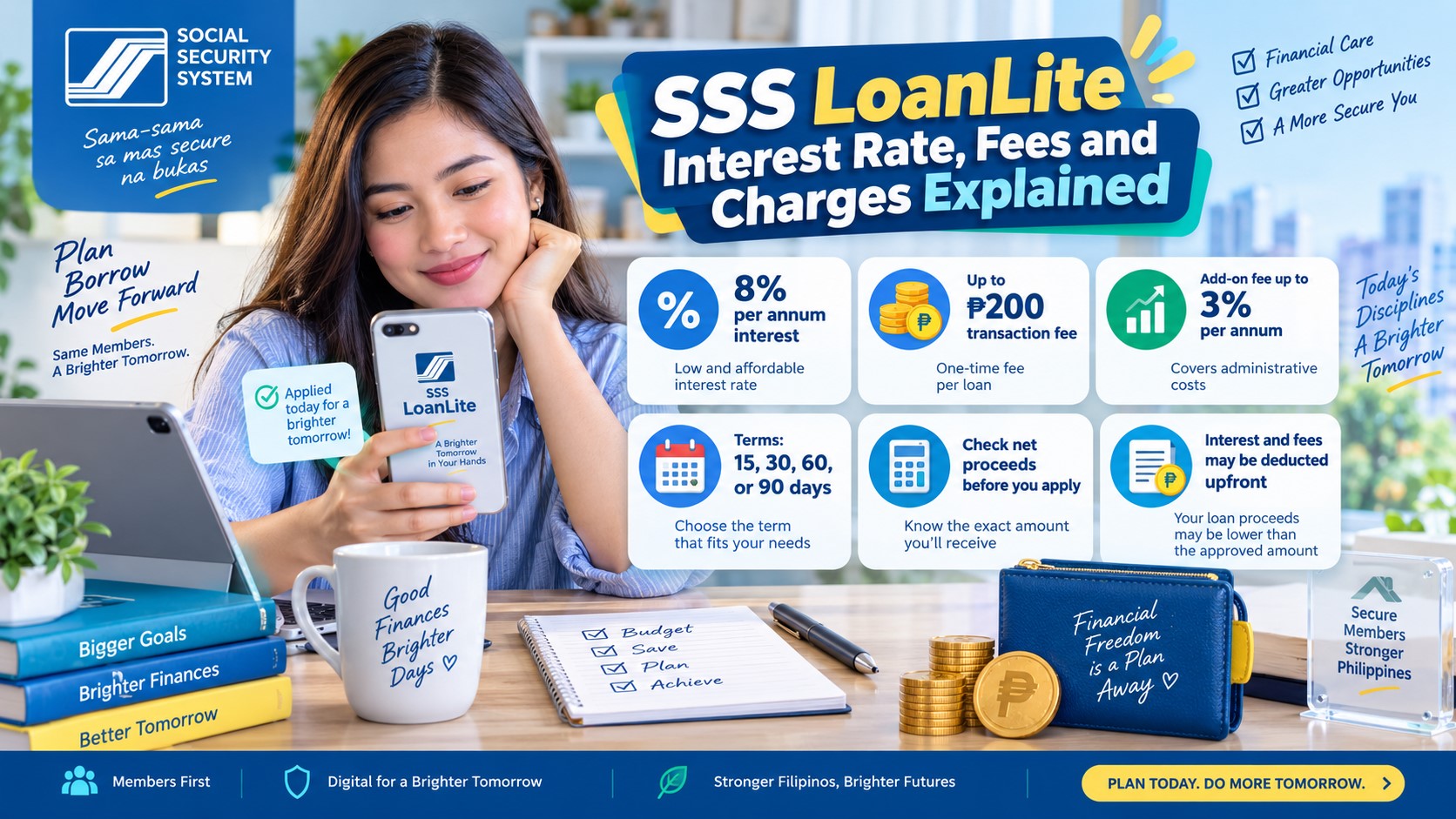
SSS LoanLite’s headline interest rate of 8% per annum—or approximately 0.67% per month—looks simple enough, but understanding the actual cost requires looking beyond that number.
There are really three potential deductions you should pay attention to before the money reaches your account:
the LoanLite interest,
the participating financial institution’s transaction fee of up to ₱200,
and an add-on fee that cannot exceed 3% per annum of the loan amount.
The most important thing is that these charges should be disclosed before you accept the loan.
So when your LoanLite offer appears in your bank’s app, don’t just look at the large number saying:
“Loan Amount: ₱20,000.”
Scroll down.
Check the interest.
Check the transaction fee.
Check the add-on fee.
Check the net proceeds.
And then check the repayment date.
LoanLite can be useful when you need a relatively small amount of money for a short-term expense. But because the repayment period can be as short as 15 days, borrowing responsibly matters just as much as getting approved quickly.
A ₱5,000 or ₱10,000 LoanLite that you can comfortably repay is far better than accepting the maximum ₱20,000 simply because the app offers it.
And whatever amount you choose, paying by the due date is especially important. Once a LoanLite becomes past due, the current rules allow continuing interest and monthly penalties to accumulate, while your SSS loan privileges can also be suspended until the account is settled.
Before tapping the final confirmation button, look at one question above everything else:
“How much money am I actually receiving, and how much will this loan cost me?”
If you know the answer to that, you’re in a much better position to decide whether SSS LoanLite is right for you.