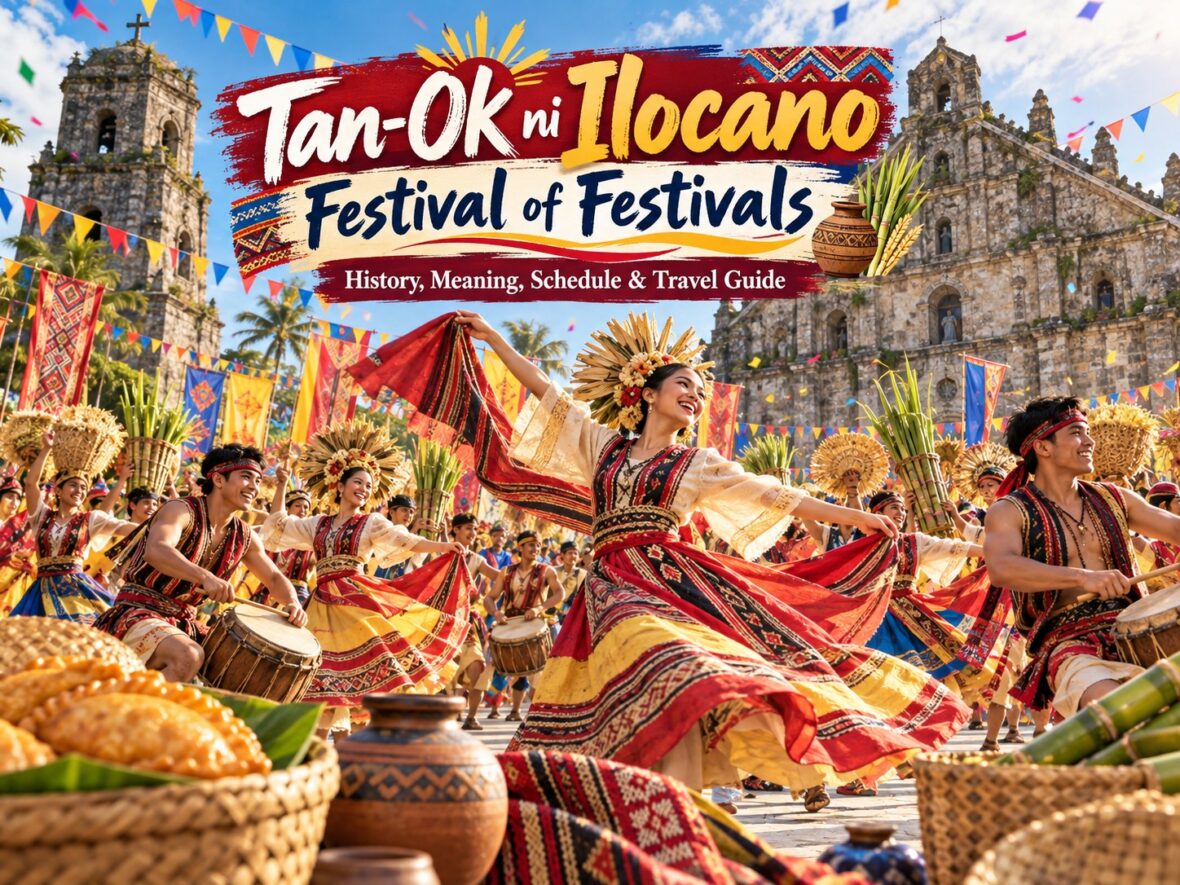
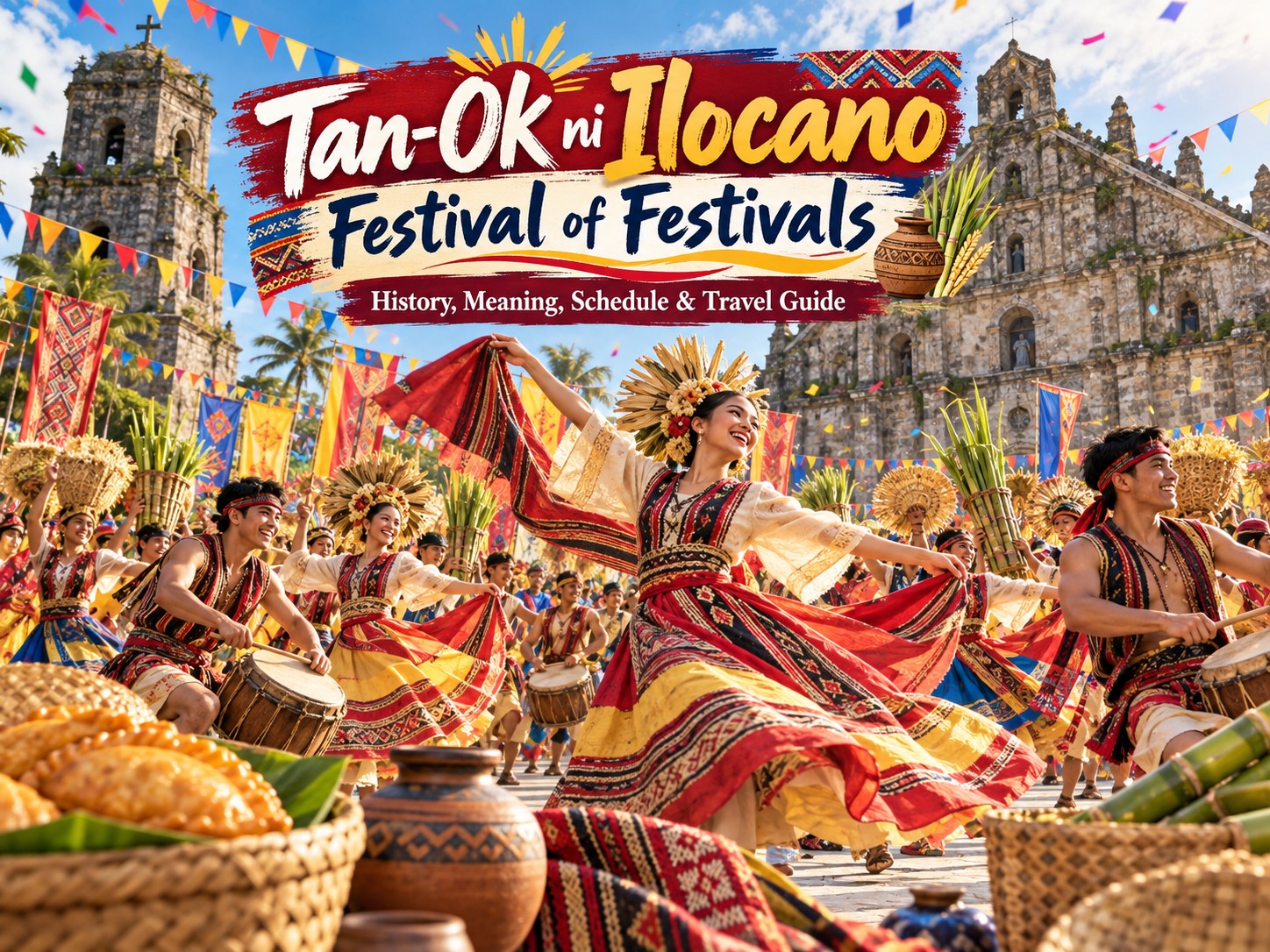
If there’s one festival that truly brings together the culture, creativity, and traditions of Ilocos Norte, it’s the Tan-Ok ni Ilocano Festival of Festivals.
Imagine watching hundreds of dancers in colorful traditional costumes, enormous stage props depicting rural life, and theatrical performances telling stories that have been passed down through generations.
Now imagine seeing different towns and cities of Ilocos Norte presenting their own cultural celebrations on one grand stage.
That’s what makes Tan-Ok ni Ilocano special.
Unlike most Philippine festivals that focus on the traditions of a single town, Tan-Ok brings together different local festivals in one spectacular event. Each participating community showcases its unique history, livelihood, culture, and identity through dance, music, and storytelling.
One performance might feature the centuries-old tradition of pottery making. Another might tell the story of farmers harvesting rice, while another celebrates the popular Ilocos empanada or an important historical event.
And while it’s technically a competition, the celebration is really about something much bigger: showcasing the greatness of the Ilocano people.
If you’re planning to visit Ilocos Norte or simply want to learn more about its cultural celebrations, here’s a complete guide to the Tan-Ok ni Ilocano Festival of Festivals, including its history, meaning, participating festivals, activities, location, and travel tips.
Content
What Is Tan-Ok ni Ilocano Festival of Festivals?
Tan-Ok ni Ilocano is a major cultural festival celebrated in Ilocos Norte, Philippines, where different municipalities and cities come together to showcase their respective festivals through grand dance and theatrical performances.
Organized by the Provincial Government of Ilocos Norte, the celebration brings the province’s diverse traditions into one major cultural event.
It’s often called the “mother of all cultural festivals” in Ilocos Norte, and for good reason.
The province has 21 municipalities and two component cities, each with its own history, traditions, local products, and cultural identity.
Rather than celebrating these traditions separately, Tan-Ok provides a common stage where participating communities can share their stories.
The performances typically incorporate traditional and contemporary choreography, elaborate costumes, original music, giant props, and theatrical storytelling.
Some presentations are inspired by agriculture and fishing, while others focus on indigenous traditions, historical struggles, religious beliefs, or the everyday lives of Ilocano families.
The result is a celebration that feels like a combination of a cultural festival, theatrical production, and dance competition.
And honestly, that’s one of the things that makes Tan-Ok different from many other festivals in the Philippines.
Tan-Ok ni Ilocano Festival: Quick Facts
| Details | Information |
|---|---|
| Festival Name | Tan-Ok ni Ilocano Festival of Festivals |
| Location | Laoag City, Ilocos Norte |
| Region | Ilocos Region (Region I) |
| First Celebration | November 2011 |
| Usual Festival Month | February in recent editions |
| Traditional Venue | Ferdinand E. Marcos Memorial Stadium |
| Organizer | Provincial Government of Ilocos Norte |
| Main Highlight | Cultural Festival Dance Competition |
| Participants | Contingents representing Ilocos Norte towns and cities |
| Main Purpose | Celebrating Ilocano culture, heritage, identity, and unity |
What Does Tan-Ok ni Ilocano Mean?
The name Tan-Ok ni Ilocano is commonly translated as “Greatness of the Ilocano.”
The word “Tan-Ok” is associated with greatness and excellence, reflecting the festival’s goal of presenting the best of Ilocano culture.
The celebration’s official presentation also describes Tan-Ok through ideas of awakening, illumination, unity, and cultural renewal.
These meanings help explain the spirit behind the celebration.
Tan-Ok is not simply an opportunity for communities to compete.
It’s a way of recognizing the cultural achievements, resilience, traditions, and creativity of the people of Ilocos Norte.
Throughout the province, communities have developed different identities based on their natural environment, occupations, local histories, and beliefs.
Coastal towns have traditions connected with fishing and the sea. Agricultural communities celebrate harvests, while other municipalities take pride in weaving, pottery, and traditional food.
Tan-Ok brings these different stories together.
And although each participating community has its own story to tell, they all contribute to a larger narrative about Ilocano identity.
History of Tan-Ok ni Ilocano Festival
The history of Tan-Ok ni Ilocano began in November 2011, when the Provincial Government of Ilocos Norte organized the first Festival of Festivals.
The celebration was introduced during the administration of then-Governor Imee Marcos as part of efforts to strengthen cultural pride and appreciation for Ilocano heritage.
At the time, the province already had numerous local festivals showcasing traditions associated with different communities.
However, the provincial government wanted to establish a larger event that could bring these individual celebrations together.
The idea was to give participating towns and cities a stage where they could present their cultural identities through dance, music, and creative storytelling.
From the beginning, Tan-Ok was intended to combine traditional and contemporary festival performances.
The First Tan-Ok ni Ilocano Celebration
The inaugural festival brought together representatives from communities across Ilocos Norte.
Each participating local government unit prepared a cultural performance inspired by its own traditions, products, history, religion, livelihood, or natural heritage.
Rather than simply dancing to festive music, contingents were encouraged to tell meaningful stories.
These presentations allowed spectators to discover the cultural differences and similarities among Ilocano communities.
The first celebration established the foundation for what would eventually become one of the province’s most anticipated cultural events.
How Tan-Ok Grew Over the Years
As the festival became more popular, the presentations grew increasingly elaborate.
What began as a showcase of local festival dances developed into a large-scale theatrical competition.
Participating contingents started incorporating more sophisticated production techniques, including custom-built stage props, detailed costumes, recorded narratives, original musical arrangements, and complex choreography.
Performances also became more focused on storytelling.
Some groups recreated important moments in local history, while others highlighted traditional livelihoods, folklore, and family relationships.
Over time, Tan-Ok became an opportunity for local performers, choreographers, musicians, designers, and other creative professionals to collaborate.
Why Is Tan-Ok Celebrated in February?
The festival was originally held during the latter part of the year.
In 2018, Tan-Ok was moved to February to coincide with the province’s bicentennial foundation anniversary and the agricultural harvest season.
Since then, February has become the usual festival period.
This also allows Tan-Ok to serve as one of the major highlights of Ilocos Norte’s foundation anniversary celebrations.
The festival experienced a temporary interruption during the COVID-19 pandemic before making its major comeback in February 2023.
Today, it continues to showcase the cultural traditions of Ilocos Norte while introducing new creative approaches to stage performances.
When Is Tan-Ok ni Ilocano Celebrated?
Tan-Ok ni Ilocano is generally celebrated in February as part of the foundation anniversary festivities of Ilocos Norte.
However, unlike festivals that are always celebrated on a fixed date, Tan-Ok’s exact schedule can change from year to year.
The Provincial Government of Ilocos Norte announces the official date, program, venue arrangements, and ticketing details for each edition.
The main event is usually an evening festival showdown featuring participating contingents from different towns and cities.
Depending on the year’s program, the celebration may also include special presentations, guest performers, and awards ceremonies.
For travelers, I recommend checking the official festival announcement before booking transportation and accommodations.
February is a good starting point when planning your trip, but don’t assume the festival will always fall on the same weekend.
Where Is Tan-Ok ni Ilocano Held?
The festival is traditionally held at the Ferdinand E. Marcos Memorial Stadium in Laoag City, the capital of Ilocos Norte.
The stadium provides a large venue for the elaborate performances and sizable audiences that the event attracts.
It’s also an important part of the Tan-Ok experience.
Unlike a typical street-dancing festival where performers move through city roads, the main Tan-Ok competition is staged inside a stadium.
This allows contingents to create more sophisticated presentations using enormous props, coordinated formations, lighting effects, and theatrical staging.
As evening approaches, the stadium transforms into a colorful performance venue filled with music, costumes, and spectators cheering for their favorite contingents.
The actual stage configuration and spectator arrangements may vary.
For example, some editions have used traditional stage layouts, while newer productions have explored different viewing arrangements to make performances more immersive.
What Happens During Tan-Ok ni Ilocano?
The highlight of the festival is the grand cultural dance competition.
Each participating town or city presents a choreographed performance inspired by a story connected to its community.
The preparations can begin months before the actual festival.
Performers rehearse their choreography, designers create costumes, musicians prepare soundtracks, and production teams construct props.
On festival night, these efforts come together in a series of theatrical presentations.
Here’s what makes the performances exciting.
1. Colorful Festival Dance Performances
Dance is at the heart of Tan-Ok ni Ilocano.
Each contingent performs a routine that reflects its local culture and traditions.
The choreography may incorporate traditional Ilocano dances, indigenous movements, contemporary dance, and theatrical expressions.
Some routines are fast-paced and energetic, while others use slower, more dramatic movements to tell emotional stories.
The performers typically work together in large formations that create impressive visual effects when viewed from the stadium.
2. Cultural Storytelling
One of Tan-Ok’s most distinctive features is its emphasis on storytelling.
Each performance is built around a particular concept or narrative.
For example, a contingent might portray the experiences of farmers during the harvest season.
Another might recreate a historical struggle or illustrate the importance of a traditional craft passed down through generations.
The presentation may also involve characters, dramatic conflicts, and emotional scenes.
This gives spectators something more meaningful than just a dance competition.
You get to learn about the community behind the performance.
3. Elaborate Costumes and Giant Props
Another reason Tan-Ok stands out is the creativity of its costumes and props.
Depending on the performance theme, dancers may wear traditional clothing inspired by indigenous communities, farmers, fishermen, or historical figures.
Others may wear brightly colored costumes representing agricultural products, animals, or symbols associated with their hometowns.
Large-scale props are also a major feature.
It’s not unusual for performances to incorporate structures representing houses, farm equipment, boats, traditional tools, or local landmarks.
These objects help bring the stories to life.
4. Music and Traditional Rhythms
Music plays an important role in creating the atmosphere of each presentation.
Some performances feature Ilocano folk melodies or musical arrangements inspired by traditional songs.
Others combine contemporary sounds with indigenous instruments, percussion, and recorded narration.
The music is designed to support the story, making the overall presentation feel more like a stage production.
5. Festival Competition and Awards
Although Tan-Ok is a celebration of cultural unity, it also includes a competitive component.
A panel of judges evaluates the participating contingents using the official criteria for that year’s competition.
These commonly involve elements such as storytelling, choreography, performance, production design, costumes, and originality.
The festival awards its highest recognition to the grand champion.
Special awards may also recognize outstanding choreography, musical arrangements, production design, direction, and individual performers.
The exact categories, prizes, and judging percentages can change between editions.
Famous Festivals Featured in Tan-Ok ni Ilocano
One of the best things about Tan-Ok is that you get to discover several local festivals during a single event.
Here are some of the notable celebrations represented in Tan-Ok performances over the years.
Pamulinawen Festival – Laoag City
The Pamulinawen Festival is one of the best-known cultural celebrations in Ilocos Norte.
Named after the famous Ilocano folk song, the festival reflects Laoag City’s cultural identity, traditions, and history.
The song “Pamulinawen” is closely associated with Ilocano music and courtship traditions.
During Tan-Ok, Laoag City’s presentations may draw inspiration from the city’s historical experiences, traditional occupations, folklore, and cultural heritage.
Its performances are often theatrical, combining music, dance, and storytelling.
Empanada Festival – Batac City
If you’ve traveled around Ilocos Norte, you’ve probably heard about the famous Batac empanada.
This popular local delicacy is made with a crispy rice-flour wrapper filled with ingredients that commonly include vegetables, egg, and longganisa.
Batac City’s Empanada Festival celebrates this important part of the city’s culinary identity.
At Tan-Ok, the contingent often transforms the familiar snack into a colorful cultural story.
The performances can highlight the people behind the local food industry, traditional preparation methods, and the significance of empanada to the community.
It’s a good example of how an everyday food can become the centerpiece of a cultural celebration.
Basi Festival – Piddig
Piddig is known for its connection to basi, a traditional fermented beverage made from sugarcane.
The town also has an important place in Philippine history because of the Basi Revolt of 1807.
The uprising was connected to Spanish colonial restrictions on the production and sale of basi.
Piddig’s Basi Festival commemorates this historical and cultural heritage.
During Tan-Ok, the contingent has presented theatrical interpretations of the revolt, highlighting the struggles, courage, and determination of local communities.
This is one of the festival’s most interesting examples of storytelling through dance.
Damili Festival – San Nicolas
San Nicolas is known for its traditional pottery-making industry.
The Damili Festival celebrates this local craft and the artisans who have preserved pottery-making techniques across generations.
In Ilocano, damili is associated with earthenware and pottery production.
During Tan-Ok, San Nicolas may showcase the process of creating clay pots and other traditional products.
Through dance and giant props, performers recreate the movements and daily activities associated with pottery making.
The celebration serves as a tribute to local craftsmanship and the families who depend on this traditional livelihood.
Guling-Guling Festival – Paoay
The Guling-Guling Festival is a cultural and religious celebration traditionally held in Paoay before the beginning of Lent.
Its history is closely connected with the town’s religious traditions dating back to the Spanish colonial period.
The word “guling” is associated with marking or smearing, referring to the traditional application of a white rice-flour mark on the forehead.
This custom is part of the community’s preparation for the Lenten season.
At Tan-Ok, Paoay’s cultural presentation may incorporate traditional dances, local beliefs, and practices associated with the festival.
Ani Festival – Dingras
Dingras is an important agricultural municipality in Ilocos Norte, and its Ani Festival celebrates farming and the harvest.
The word “ani” means harvest.
Naturally, the celebration highlights the role of agriculture in the lives of local communities.
Tan-Ok presentations inspired by the Ani Festival may portray farmers preparing their fields, cultivating crops, harvesting rice, and overcoming the challenges of agricultural life.
It’s a tribute to the people whose hard work helps sustain the province’s farming communities.
Tadek Festival – Nueva Era
Nueva Era is known for its indigenous cultural heritage, particularly traditions associated with the Tingguian or Itneg communities.
The Tadek Festival celebrates aspects of this cultural identity.
Tadek is associated with traditional dance, and festival performances have highlighted indigenous beliefs, ceremonies, community life, and relationships with nature.
During Tan-Ok, Nueva Era’s contingent has presented dramatic performances inspired by indigenous heritage.
These presentations provide spectators with an opportunity to appreciate cultural traditions that are sometimes less familiar to visitors.
Abel Festival – Pinili
Pinili is associated with traditional Ilocano weaving, particularly the production of abel textiles.
Abel weaving is an important part of the region’s craftsmanship and cultural heritage.
During Tan-Ok, presentations from Pinili may highlight local weaving traditions, the artistry involved in making textiles, and the dedication of the people who preserve these skills.
Some of the town’s festival presentations have also incorporated its agricultural products, including garlic.
Dinaklisan Festival – Currimao
Currimao is a coastal municipality, and fishing has long been an important part of local life.
The Dinaklisan Festival celebrates the traditions and livelihoods associated with the sea.
Its cultural presentations may feature fishermen, boats, nets, and other symbols of coastal community life.
The festival also highlights the relationship between residents and the natural environment that supports their livelihoods.
Abuos Festival – Banna
The Abuos Festival is one of the distinctive cultural celebrations associated with Banna.
The term “abuos” refers to ants, which are used as a cultural symbol associated with cooperation and industriousness.
In Tan-Ok performances, the theme can be interpreted through group choreography and storytelling that emphasize community unity, resourcefulness, and collective effort.
Other Participating Festivals
Additional celebrations represented in Tan-Ok have included Bangui’s Amian Festival, Burgos’ Saniata Festival, Solsona’s Gameng Festival, Vintar’s Siwawer Festival, and several others.
Each adds another dimension to the province’s cultural story.
The participating festivals, specific performance themes, and number of contingents can vary from one edition to another.
What Makes Tan-Ok ni Ilocano Unique?
The Philippines has many famous festivals, including Sinulog in Cebu, Ati-Atihan in Aklan, and Dinagyang in Iloilo.
So what makes Tan-Ok different?
For me, it’s the idea that you don’t just watch one community celebrate.
You get to see the diversity of an entire province in one event.
A performance can take you from a farming village to a fishing community, then to an indigenous settlement or a historical scene from the colonial period.
And because the festival emphasizes theatrical storytelling, you don’t need to know every local tradition beforehand to appreciate what’s happening.
The movements, music, costumes, and visual effects help communicate the story.
Another interesting aspect is how the festival combines tradition with modern creativity.
Although many performances are inspired by centuries-old practices, choreographers and designers are encouraged to present them in fresh and imaginative ways.
This helps introduce Ilocano traditions to younger generations while keeping the celebration relevant to modern audiences.
Why Is Tan-Ok Important to Ilocano Culture?
Beyond the excitement and competition, Tan-Ok plays an important role in cultural preservation.
Preserving Local History and Traditions
Each community has stories that deserve to be remembered.
Some are connected to historical events, while others reflect farming techniques, traditional crafts, or religious customs.
Through Tan-Ok, these stories are performed before a wider audience.
It also encourages participating communities to research and revisit the traditions that define their identities.
Supporting Local Artists and Performers
Tan-Ok requires the participation of dancers, musicians, choreographers, costume designers, stage builders, and production teams.
These creative professionals help transform traditional narratives into elaborate performances.
For many young performers, joining Tan-Ok can be a memorable opportunity to represent their hometown.
Promoting Ilocos Norte Tourism
The festival attracts audiences from different parts of Ilocos Norte and visitors from outside the province.
It also encourages travelers to explore the destinations and local products represented in the performances.
Someone who watches Batac City’s Empanada Festival might become interested in trying the famous local delicacy.
A presentation about traditional pottery could inspire visitors to learn more about San Nicolas’ artisans.
In that way, Tan-Ok helps introduce lesser-known cultural attractions to a wider audience.
Strengthening Community Pride
Another important part of the festival is the pride of representing one’s hometown.
Local residents often support their contingents enthusiastically.
The competition creates excitement, but the celebration also brings together communities with different histories and traditions.
At the end of the night, the entire province shares the spotlight.
Is Tan-Ok ni Ilocano Free to Watch?
Admission arrangements depend on the festival edition.
In recent years, organizers have offered free general-admission tickets through an advance registration system.
Some editions have also provided paid premium seating for spectators who prefer reserved areas or additional amenities.
However, free admission doesn’t necessarily mean you can arrive at any time and enter without a ticket.
The number of available seats may be limited, and organizers can require visitors to secure tickets in advance.
Before attending, check the Provincial Government of Ilocos Norte’s official announcements for the current ticketing system, admission requirements, gate opening times, and seating arrangements.
Don’t assume that ticket prices and admission procedures from previous years will remain the same.
How to Get to Tan-Ok ni Ilocano Festival
Since the festival is traditionally held in Laoag City, your first step is to travel to the capital of Ilocos Norte.
Laoag is accessible by land and air.
From Manila to Laoag by Bus
Traveling by provincial bus is one of the usual ways to reach Laoag from Metro Manila.
Several bus operators serve the Manila–Ilocos Norte corridor, although schedules, departure terminals, and route availability can change.
Long-distance buses generally travel through major highways in Central and Northern Luzon.
The journey takes several hours and may involve overnight travel.
If you’re attending Tan-Ok, consider booking your bus ticket in advance, especially if the event falls on a weekend.
From Manila to Laoag by Plane
Laoag International Airport serves Ilocos Norte and provides an alternative for travelers who prefer to fly.
Flight availability and schedules vary, so check airline operations when planning your visit.
From the airport, you can arrange local transportation to your hotel or the festival venue.
Getting Around Laoag City
Once you’re in Laoag, local transportation options include tricycles and other available transport services.
If you’re staying near the city center, reaching the festival venue may be relatively convenient.
However, expect heavier traffic and more passengers around the stadium on festival night.
It’s best to arrange your transportation ahead of time, especially if you plan to leave after the final performance.
Where to Stay During Tan-Ok ni Ilocano
Laoag City is generally the most convenient place to stay if you’re attending the festival.
The city offers a range of accommodations, including budget inns, hotels, and larger establishments.
Staying in Laoag means you’ll be closer to the main festival venue and have easier access to restaurants, shopping areas, and transportation services.
You can also consider accommodations in nearby municipalities if you’re planning a longer Ilocos Norte vacation.
However, remember that availability may become limited during major celebrations.
If your main purpose is to attend Tan-Ok, booking a hotel before the festival weekend is a good idea.
What to Eat During Your Ilocos Norte Trip
One of the best parts of visiting Ilocos Norte is enjoying the local food.
And because Tan-Ok celebrates the province’s cultural identity, trying Ilocano delicacies is a great way to continue the experience beyond the stadium.
Ilocos Empanada
You can’t visit Ilocos Norte without trying its famous empanada.
This crispy snack is usually made with a rice-flour wrapper and a savory filling.
Batac City is especially famous for its version, which is commonly served with vinegar.
Ilocos Bagnet
Bagnet is one of the best-known dishes associated with the Ilocos Region.
It’s made from pork that is cooked until the skin becomes crispy.
It’s often enjoyed with vegetables, rice, or a dipping sauce.
Ilocos Longganisa
Ilocano longganisa is known for its garlicky flavor.
It’s a popular breakfast food, usually served with rice and egg.
You can also find it as an ingredient in some versions of Ilocos empanada.
Pinakbet
Pinakbet is a traditional vegetable dish closely associated with Ilocano cuisine.
It commonly includes vegetables such as eggplant, bitter melon, okra, and squash, seasoned with bagoong.
Other Local Delicacies
You may also want to try traditional foods such as miki, dinardaraan, and dudol.
Exploring local food is one of the simplest ways to learn more about the communities represented in Tan-Ok.
Travel Tips for Watching Tan-Ok ni Ilocano
If you’re planning to experience the festival in person, here are a few practical tips.
Arrive Early
Tan-Ok attracts large audiences, especially residents supporting their local contingents.
Arriving ahead of the main program gives you time to find your entrance, follow ticketing procedures, and settle into your assigned or available viewing area.
Book Accommodations in Advance
Since the festival draws visitors from different parts of the province, hotels in Laoag can become busy.
Don’t leave your accommodation arrangements until the last minute.
Wear Comfortable Clothes
The event is usually held in an open-air stadium.
Wear comfortable clothes and footwear, especially if you’ll be walking or standing for long periods.
Depending on the weather, a light jacket may also be useful during the evening.
Bring Water and Essential Items
It’s a good idea to bring drinking water, personal medication, and other essentials, subject to the event’s security and venue rules.
If you’re planning to take photos or videos, make sure your phone is fully charged.
A power bank can also be useful if permitted.
Check the Festival Rules
Before heading to the stadium, verify which items are allowed inside.
Large bags, certain camera equipment, umbrellas, and other items may be subject to venue restrictions.
Always follow the latest instructions from the organizers.
Respect the Performers and Local Traditions
Remember that many performances represent real cultural traditions, historical experiences, or indigenous practices.
Enjoy the celebration, but also appreciate the meanings behind the performances.
Allow Time to Explore Ilocos Norte
If you’re traveling from Metro Manila or another province, consider extending your stay.
Ilocos Norte is known for its historic architecture, regional cuisine, coastal scenery, and natural attractions.
You can combine your festival visit with a broader cultural and sightseeing trip.
Frequently Asked Questions About Tan-Ok ni Ilocano
What Is Tan-Ok ni Ilocano?
Tan-Ok ni Ilocano is a cultural Festival of Festivals in Ilocos Norte, where participating towns and cities showcase their local traditions through choreographed performances, music, costumes, and theatrical storytelling.
Where Is Tan-Ok ni Ilocano Celebrated?
The festival is traditionally held at the Ferdinand E. Marcos Memorial Stadium in Laoag City, Ilocos Norte.
When Is Tan-Ok ni Ilocano Celebrated?
Tan-Ok is generally celebrated in February as part of Ilocos Norte’s foundation anniversary festivities.
The exact date varies and is announced by the provincial government.
What Does Tan-Ok ni Ilocano Mean?
Tan-Ok ni Ilocano is commonly translated as “Greatness of the Ilocano.”
The festival also emphasizes awakening, cultural renewal, unity, and the preservation of Ilocano heritage.
When Did Tan-Ok ni Ilocano Start?
The first Tan-Ok ni Ilocano Festival of Festivals was held in November 2011.
Who Organizes Tan-Ok ni Ilocano?
The festival is organized by the Provincial Government of Ilocos Norte in collaboration with participating local government units and cultural performers.
Is Tan-Ok a Religious Festival?
Tan-Ok is primarily a cultural festival rather than a religious celebration.
However, some participating community festivals incorporate religious traditions, beliefs, and historical practices.
Is Tan-Ok a Street-Dancing Festival?
The main Tan-Ok competition is a stadium-based cultural performance event.
Although it features festival dances, its grand presentations are traditionally performed onstage rather than through a single continuous street parade.
How Many Towns Participate in Tan-Ok?
Ilocos Norte has 21 municipalities and two component cities.
The festival provides a platform for their cultural celebrations, although the number of participating contingents can vary from year to year.
Is There an Entrance Fee?
Admission policies vary by edition.
Recent celebrations have offered free general-admission tickets, while certain premium seating arrangements required payment.
Always check the current ticket announcement before attending.
How Long Does the Festival Last?
The main Tan-Ok festival showdown is typically an evening event.
Because numerous contingents perform, the program can continue for several hours.
The overall duration depends on the number of participants and the official program.
What Is the Main Highlight of Tan-Ok ni Ilocano?
The biggest highlight is the Festival Dance Competition, where different communities present theatrical performances inspired by their local history, traditions, livelihoods, and cultural identities.
Latest Tan-Ok ni Ilocano Festival Update
For readers planning a future visit, here’s a brief look at the latest completed celebration.
The 13th Tan-Ok ni Ilocano Festival of Festivals was held on February 28, 2026, at the Ferdinand E. Marcos Memorial Stadium in Laoag City.
The event featured 22 competing contingents and introduced an in-the-round, 360-degree stage arrangement.
Laoag City’s Pamulinawen Festival emerged as grand champion, followed by Piddig’s Basi Festival in second place and Banna’s Abuos Festival in third.
The organizers offered free general-admission tickets through online registration and limited premium tickets priced at ₱1,000.
These arrangements were specific to that edition and should not be treated as the permanent festival schedule or admission policy.
As of October 18, 2026, the exact date and ticketing arrangements for the next edition have not yet been officially confirmed.
Visitors should monitor announcements from the Provincial Government of Ilocos Norte and its tourism office before finalizing travel plans.
Final Thoughts
The Tan-Ok ni Ilocano Festival of Festivals is more than just a colorful cultural celebration.
It’s an opportunity to discover the traditions, history, and stories that make Ilocos Norte unique.
What makes it particularly special is the way it brings different communities together.
Each town and city has its own identity, shaped by its environment, livelihood, beliefs, and historical experiences.
Yet during Tan-Ok, these different traditions become part of one larger celebration of Ilocano culture.
And whether you’re watching a dramatic historical presentation, a dance inspired by traditional farming, or a performance celebrating local food and craftsmanship, there’s always something interesting to discover.
If you’re someone who enjoys Philippine festivals, cultural performances, and learning about local traditions, Tan-Ok ni Ilocano is definitely worth including in your travel plans.
It’s a celebration that reminds us how rich and diverse Filipino culture really is.
And more importantly, it shows that our traditions continue to thrive when communities take pride in preserving and sharing them with future generations.
So the next time you’re planning a trip to Ilocos Norte, consider visiting during Tan-Ok season.
You might just discover a side of Ilocano culture that goes far beyond the province’s famous tourist attractions.
Naimbag nga panagbiyahe! Enjoy your trip to Ilocos Norte!