Bananas are among the most familiar fruits in the Philippines.
We eat them fresh, fry them with sugar, boil them as merienda and turn them into cakes, chips, preserves and other delicacies. Banana leaves are used for cooking and serving food, while other parts of the plant can become animal feed, compost, decorations and handicraft materials.
In Barangay Palocpoc, Mendez, Cavite, this humble crop became the inspiration for a colorful community celebration known as the Sinagingan Festival.
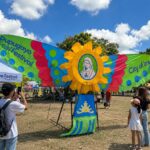
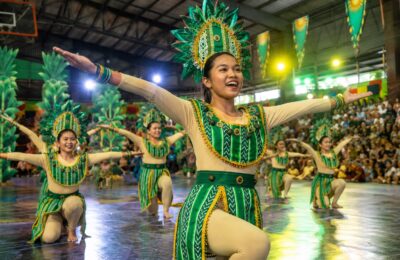
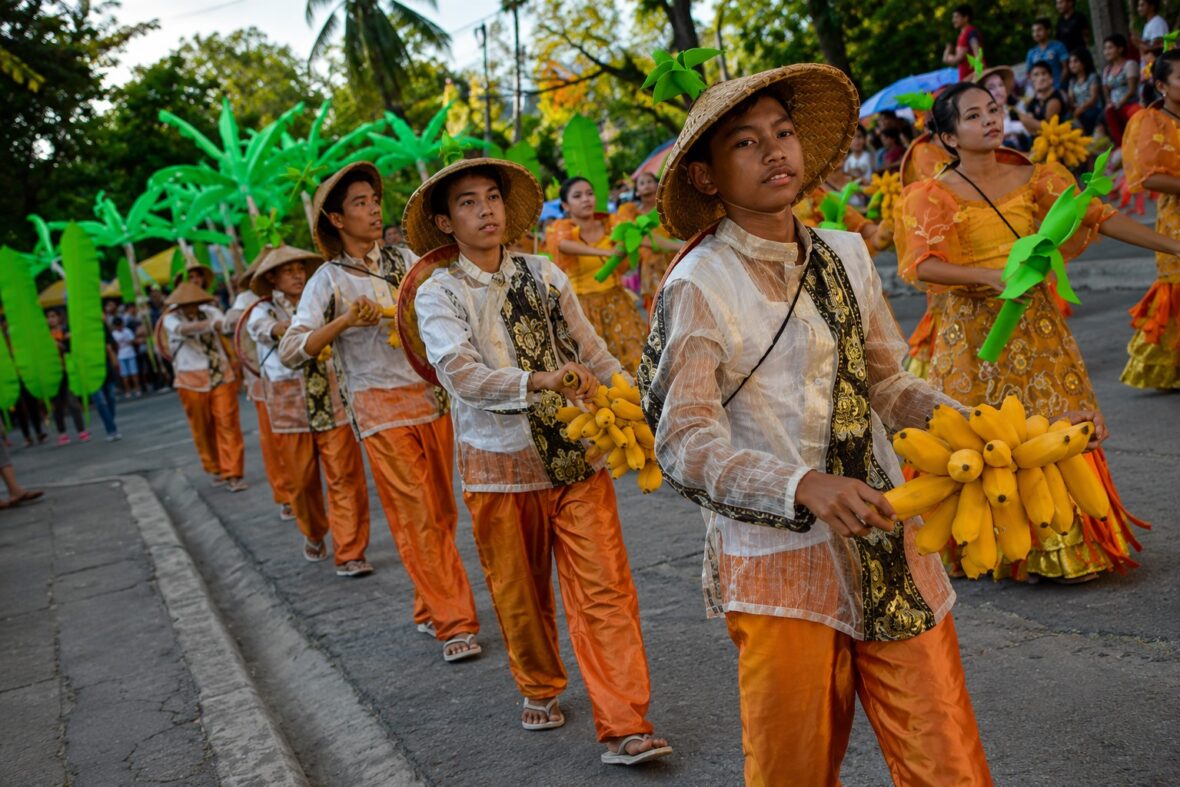
Every May, residents honor their farmers and give thanks for the local harvest through banana-themed decorations, cultural performances, religious activities and community gatherings. Houses may be decorated using leaves, fruit, stalks and other parts of the banana plant, while performers take to the streets in bright yellow and green costumes.
The celebration is held in connection with the May 15 feast of San Isidro Labrador, the patron saint traditionally associated with farmers and agricultural workers. Palocpoc’s religious community continued celebrating its San Isidro Labrador fiesta and related activities in May 2026.
For travelers, Sinagingan offers a quieter and more intimate alternative to Cavite’s large city festivals. It is not staged primarily for enormous crowds or commercial tourism. It remains closely connected with the farmers, families and religious traditions of one agricultural barangay.
Content
What Is the Sinagingan Festival?
The Sinagingan Festival is an agricultural and religious celebration traditionally held in Barangay Palocpoc, Mendez, Cavite, every May 15.
Its main purpose is to promote banana cultivation, recognize the crop’s importance to the local community and encourage the development of banana-based products. The festival also coincides with the barangay feast honoring San Isidro Labrador.
Traditional festival activities have included:
- Banana-themed street dancing
- Karakol or religious dance processions
- Decorated houses and community spaces
- Cultural presentations
- Banana-product exhibits
- Agricultural displays
- Religious services
- Fiesta meals
- Community contests
- Evening entertainment
The Department of Tourism has included Sinagingan among Cavite’s May festivals and identifies Mendez as its host municipality.
However, Sinagingan should be understood as a barangay-based festival, not necessarily the principal municipal festival of the entire town of Mendez.
Its celebrations are centered on Palocpoc and the local San Isidro Labrador community. Programs may be smaller and less formally advertised than festivals organized by a city or provincial government.
What Does “Sinagingan” Mean?
The festival name comes from the Filipino word saging, meaning banana.
Sinagingan may be understood as something made with, mixed with or characterized by banana. It describes a celebration in which the crop appears throughout the decorations, food, costumes and performances.
Some references call the event Sinagingan Festival, while old photographs and community posts sometimes use the shorter Saging Festival.
The spelling should also not be confused with Sagingan Festival in Tubod, Lanao del Norte, which is a separate event held in another part of the Philippines.
For the Cavite celebration, the important identifiers are:
- Barangay Palocpoc
- Mendez, Cavite
- May 15
- Bananas
- San Isidro Labrador
Where Is Barangay Palocpoc?
Palocpoc is part of the upland municipality of Mendez-Nuñez, located near Tagaytay, Alfonso and Indang.
Modern Mendez is divided into separate barangays that include Palocpoc I and Palocpoc II, although older festival descriptions often refer simply to Palocpoc. The local San Isidro Labrador chapel community is associated with the Palocpoc area.
Mendez belongs to Cavite’s productive upland agricultural zone. Provincial ecological profiles identify Mendez-Nuñez and neighboring municipalities as areas where fruits, vegetables and other crops are cultivated, alongside livestock and agritourism activities.
The climate is influenced by the municipality’s proximity to Tagaytay.
Visitors may notice cooler mornings and evenings than in Metro Manila or northern Cavite, although May afternoons can still be very warm.
Why Bananas Became Important in Palocpoc
Older festival accounts explain that bananas became one of Palocpoc’s important crops after local coffee production declined.
Farmers needed another crop that could grow under the area’s conditions, provide food and create dependable livelihood opportunities. Bananas became increasingly visible alongside coffee, coconut, pineapple, jackfruit and other upland produce.
A banana plant can produce more than one useful product.
The fruit may be eaten fresh or processed. Leaves are used as food wrappers and natural serving materials. The flower or puso ng saging can be cooked as a vegetable, while stems and agricultural waste may be composted or used in other farm applications.
This versatility made banana a fitting symbol for a farming community.
Unlike a purely decorative festival theme, the crop is connected with real household needs and livelihoods.
How the Festival Began
The first Sinagingan Festival is widely reported to have been held on May 15, 2003.
It was created to encourage banana cultivation, promote the use of different parts of the plant and help residents develop food and livelihood products from the crop.
The festival also gave Palocpoc a distinct identity.
Mendez may be a relatively small town, but its barangays have their own patronal feasts, agricultural products and traditions. Sinagingan allowed Palocpoc to present its local story rather than being known only as an area near Tagaytay.
Because accessible official archives for the earliest editions are limited, some details about its founding may rely on community histories and festival directories.
What remains consistent is the central idea: bananas, farming and thanksgiving are brought together on the feast of San Isidro Labrador.
The Connection with San Isidro Labrador
Sinagingan is not only an agricultural product festival.
Its May 15 schedule connects it directly with the feast of San Isidro Labrador, honored in Palocpoc and nearby Anuling. The local religious community continues to observe the feast with Masses, prayers, processions and related activities.
San Isidro Labrador is traditionally portrayed as a humble farmer.
Catholic farming communities pray through his intercession for good weather, successful crops, protection from agricultural disasters and blessings for workers who depend on the land.
His feast is celebrated in many Philippine farming towns on May 15.
This is why several harvest festivals around the country fall on the same date. Farmers give thanks for their produce while religious communities honor the saint associated with their livelihood.
In Palocpoc, the banana harvest gives the feast its distinctive local character.
Sinagingan and Karakol
One of the religious activities associated with the Palocpoc fiesta is karakol.
Karakol is a devotional dance procession widely practiced in Cavite. Participants move rhythmically behind or around the image of their patron while a marching band provides lively music.
Palocpoc continued holding a pre-fiesta karakol for San Isidro Labrador in May 2025, and community posts documented karakol activity again during the 2026 feast season.
The procession may appear joyful and informal to an outsider, but it remains a religious activity.
People dance as an expression of gratitude, fulfillment of a promise or petition for continued blessings.
Visitors should avoid blocking the image, pushing through the procession or treating participants merely as performers posing for photographs.
Banana-Themed Street Dancing
Street dancing is the festival’s most colorful attraction.
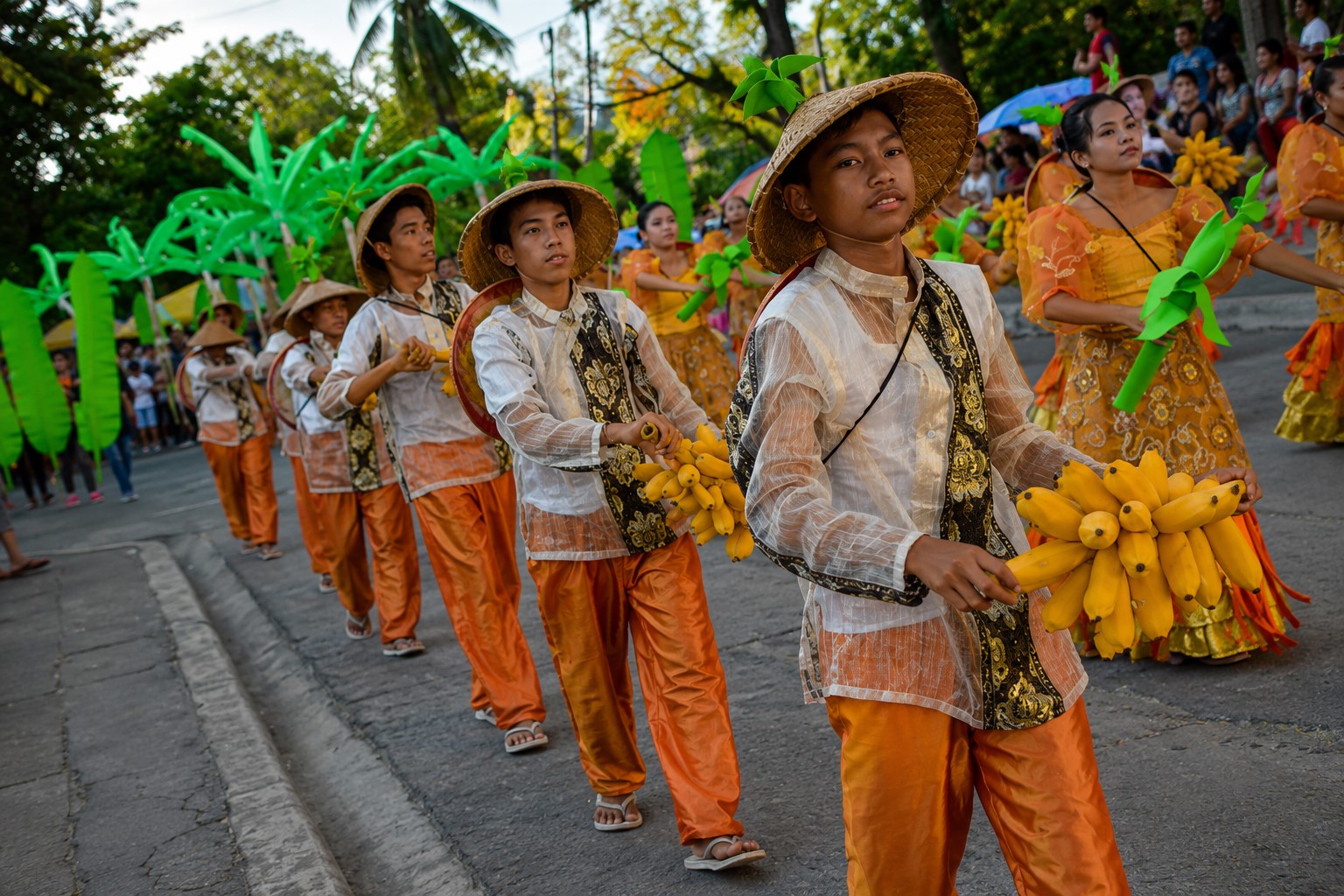
Performers wear costumes inspired by ripe bananas, green leaves, flowers, farmers and the surrounding agricultural landscape.
Yellow naturally dominates many costumes because it represents ripe fruit. Green symbolizes banana leaves and young plants, while brown suggests the soil, trunks and dried agricultural materials.
Some dancers carry:
- Artificial banana bunches
- Banana-leaf fans
- Baskets of fruit
- Farming tools
- Images of San Isidro Labrador
- Props shaped like banana flowers
- Decorations made from woven plant materials
The choreography may tell the story of banana production.
Dancers begin by portraying farmers clearing land or preparing the soil. Others represent planting, rain, sunlight and the gradual growth of the crop.
The final part usually becomes a thanksgiving celebration as performers carry harvested bananas and dance in honor of the community’s patron.
Costumes and Natural Materials
Festival costumes may incorporate materials inspired by the banana plant.
Actual dried leaves, fibers and stalk materials can create beautiful textures, but designers must consider comfort and safety.
Plant materials can become sharp, heavy or brittle. They should be cleaned, dried and attached securely before being placed on a performer’s costume.
Some groups use fabric, foam and recycled materials to imitate bananas and leaves instead.
This allows costumes to survive rehearsals and long parades while still representing the agricultural theme.
The most successful costume is not necessarily the one carrying the greatest amount of real banana material.
It should allow the dancer to move freely and communicate the festival story clearly.
Decorating Houses with Banana Plants
One of Sinagingan’s distinctive traditions is the decoration of homes and community areas using different parts of the banana plant.
Older accounts describe residents adorning their houses with leaves, fruit, trunks and other agricultural materials.
This is similar to other Philippine harvest festivals where families transform ordinary streets into agricultural exhibitions.
Banana leaves may be arranged into arches, fans and wall decorations. Bunches of fruit can be displayed beside other local produce, while trunks and flowers become parts of more elaborate designs.
The practice allows residents who are not joining the street-dancing competition to participate.
A family may contribute by decorating its house, preparing food, assisting performers or welcoming relatives returning for the fiesta.
Visitors should admire the decorations from public areas unless the household clearly invites people inside.
Agricultural and Product Displays
Sinagingan encourages residents to look beyond selling bananas only as raw fruit.
Processing can create additional income and reduce waste when farmers have more produce than the fresh market can absorb.
Festival exhibits may feature products such as:
- Banana chips
- Sweetened banana preserves
- Banana cue
- Turon
- Minatamis na saging
- Banana bread
- Banana cake
- Banana muffins
- Banana jam
- Banana ketchup
- Banana-based drinks
- Dried bananas
- Puso ng saging dishes
- Crafts made from banana fiber
Product development is important because bananas are highly perishable.
Once ripe, the fruit has a limited selling period. Processing can extend its usefulness and allow farmers or home-based businesses to earn more from a harvest.
Different Bananas, Different Uses
Not every banana variety is used in exactly the same way.
Some are best eaten fresh, while others become more enjoyable after cooking.
Saba
Saba is widely used for banana cue, turon, minatamis na saging and other cooked dishes.
Its firm flesh holds its shape better than many dessert bananas.
Lakatan
Lakatan is commonly eaten fresh and is known for its sweeter taste and fragrant yellow-orange flesh.
Latundan
Latundan is another familiar table banana with a soft texture and mild sweetness.
Cardaba
Cardaba is related to saba and is often used for chips and cooked products.
The varieties displayed during a festival depend on what local farmers grow and what is available during the season.
Visitors can ask sellers which variety they recommend for a specific recipe.
Food to Try During Sinagingan Festival
Banana Cue
Saba bananas are coated in caramelized brown sugar and fried on bamboo sticks.
The sugar creates a crisp outer coating while the banana becomes soft and warm inside.
It is one of the easiest festival snacks to eat while walking.
Turon
Slices of banana are wrapped in spring-roll pastry and fried.
Some versions include jackfruit, sweet potato, coconut or other fillings.
Freshly cooked turon should be crisp outside without being excessively oily.
Minatamis na Saging
Bananas are slowly cooked in sugar syrup until tender.
They may be served warm or chilled and are sometimes combined with shaved ice, milk or sago.
Banana Chips
Thin slices are fried or dried and then seasoned.
Some are sweet, while others use salt, cheese or spicy flavoring.
Check the ingredients and best-before date when purchasing packaged chips.
Banana Bread and Cake
Very ripe bananas work well in baked products because they provide sweetness, moisture and aroma.
Festival bakers may create breads, cupcakes, muffins and cakes from locally sourced fruit.
Puso ng Saging
The banana blossom can be cooked with coconut milk, meat, seafood or vinegar.
Its slightly fibrous texture works well in savory dishes and demonstrates that the festival is not limited to sweet banana products.
Banana Leaves in Filipino Cooking
Banana leaves are useful even when they are not eaten.
They can line trays, wrap rice meals and protect food during steaming or grilling. Their aroma may also add a subtle quality to dishes cooked inside them.
Festival food sellers may use banana leaves instead of disposable plates, although proper sanitation is still necessary.
Leaves should be cleaned and prepared safely before coming into contact with food.
Supporting Banana Farmers
The phrase “support local farmers” becomes meaningful only when it leads to real action.
Visitors can support Palocpoc’s agricultural community by:
- Buying directly from legitimate growers
- Purchasing locally processed products
- Paying fair prices
- Avoiding excessive bargaining
- Asking about the product’s origin
- Recommending good local sellers
- Returning outside festival season
- Preventing food waste
Buying one bundle of bananas may seem like a small contribution.
However, direct sales during a festival can provide farmers with better returns and introduce their products to customers from outside the barangay.
What the Festival Feels Like
Sinagingan feels more like a traditional barangay fiesta than a large commercial festival.
Early in the morning, families prepare food while loudspeakers announce the day’s programs. Religious groups gather around the San Isidro Labrador chapel, and participants make final adjustments to the patron’s image and decorations.
Street dancers arrive in yellow and green costumes.
Parents carry water and extra clothing, while teachers and choreographers review the routines.
Along the road, houses display banana leaves, fruit and other agricultural materials. Vendors sell snacks, drinks and local delicacies.
When the procession begins, marching-band music fills the community.
People dance during the karakol, greet neighbors and watch performers pass through familiar streets.
The atmosphere becomes busier in the afternoon and evening as relatives return home, food is shared and public entertainment begins.
The celebration may not have the enormous production scale of Cavite’s city festivals, but its smaller size creates a stronger sense of neighborhood participation.
When Is the Sinagingan Festival Celebrated?
The traditional festival date is May 15.
This is also the feast of San Isidro Labrador in Palocpoc and Anuling.
A tourism listing recorded the festival again for May 15, 2026, while local religious pages documented Palocpoc’s May 2026 fiesta season.
However, the principal activities may not all happen on the same date.
A karakol may take place several days earlier, while contests, pageants or entertainment programs may be spread throughout fiesta week.
Before traveling, check for the current schedule of:
- Novena Masses
- Karakol
- Street dancing
- Agricultural exhibits
- House-decoration contests
- Food fairs
- Evening concerts
- May 15 feast-day Mass
- Processions
- Flores de Mayo activities
The local chapel page, barangay announcements and Mendez tourism contacts are likely to provide more precise information than an old national festival calendar.
Where Is the Festival Held?
The festival is centered in Barangay Palocpoc, particularly around community roads, the San Isidro Labrador chapel and designated activity areas.
Because Palocpoc is divided administratively into Palocpoc I and Palocpoc II, confirm the exact venue rather than asking only for “Mendez.”
Local religious information places the San Isidro Labrador Palocpoc Chapel along Santa Cruz Street in Mendez.
The parade route and final performance area can change each year.
Roads may become narrow and congested during the fiesta, so buses or private vehicles may not reach the immediate chapel area.
Be prepared to transfer to a local tricycle or walk from an approved drop-off point.
How to Get to Mendez from Metro Manila
From PITX
PITX has buses serving the Tagaytay–Mendez route from Gate 2 on the second floor. The terminal also handles Tagaytay–Amadeo–Alfonso services that may provide useful connections depending on the current route.
Ask for a bus traveling to Mendez and tell the conductor that your final destination is Barangay Palocpoc.
Some buses may stop at Mendez Crossing or the town center rather than entering Palocpoc.
From the bus drop-off point, take a local jeepney or tricycle to the current festival venue.
Gate assignments and departure schedules can change, so verify the live schedule at PITX before boarding.
Via Tagaytay
Another option is to take a Tagaytay-bound bus and transfer at an appropriate point to a Mendez-bound jeepney or bus.
Tell the driver you are heading toward Palocpoc because different roads lead to the barangay and Mendez town proper.
Tagaytay traffic may become heavy during weekends and holidays.
From Dasmariñas or Silang
Buses traveling toward Tagaytay and Mendez use the Aguinaldo Highway corridor.
Commuters from Dasmariñas or Silang can board a suitable upland Cavite service and transfer locally when necessary. PITX’s current route guide confirms that Mendez-bound buses operate along this broader corridor.
By Private Vehicle
Drivers generally approach through Aguinaldo Highway toward Tagaytay and Mendez.
Use live navigation for Barangay Palocpoc, but follow local traffic personnel during the festival. Digital maps may not immediately reflect road closures or one-way systems.
Parking may be limited around the chapel and central community streets.
Use designated spaces and avoid blocking houses, farms, emergency routes and tricycle terminals.
Practical Tips for Visitors
Confirm That the Public Festival Is Taking Place
The San Isidro fiesta is an established annual religious celebration, but the scale of the Sinagingan street festival may vary.
Check current barangay and tourism announcements before making a special trip.
Arrive Early
Morning is usually the best time for religious activities, agricultural displays and cooler weather.
Early arrival also helps you avoid the heaviest fiesta traffic.
Bring Cash
Small vendors, farmers and tricycle drivers may not accept electronic payments.
Bring smaller bills to make transactions easier.
Wear Comfortable Shoes
You may need to walk through barangay roads or stand beside the parade route for several hours.
Prepare for May Heat
May is one of the warmest times of the year.
Bring water, sunscreen, a hat, a small towel and a compact umbrella.
Carry a Reusable Shopping Bag
Bananas, chips, baked products and other purchases are easier to carry inside a strong reusable bag.
Protect Fresh Produce
Avoid leaving ripe bananas and baked products inside a hot vehicle.
Use an insulated container when buying food that requires refrigeration.
Ask Before Entering Farms
Banana groves and agricultural properties are private working areas.
Do not enter, cut leaves or pick fruit without permission.
Respect Religious Activities
Keep voices low during Masses and prayers. Avoid blocking the patron’s image during the procession.
Bringing Children to the Festival
Sinagingan is a good way to teach children that bananas do not originate from supermarket shelves.
They can learn how the crop grows, how farmers harvest it and how different parts of the plant can be used.
Encourage them to observe:
- The size of banana leaves
- The way fruit grows in bunches
- The banana flower beneath the developing fruit
- The difference between ripe and unripe bananas
- The use of leaves in food preparation
- The products created from the harvest
Keep children away from moving floats, sharp agricultural tools and crowded procession areas.
Young visitors should not touch displayed produce without the seller’s permission.
Nearby Places to Visit in Mendez
St. Augustine Parish
St. Augustine Parish is the principal Catholic parish in Mendez town proper.
The Diocese of Imus lists St. Augustine as the parish patron, with a feast day on August 28. The parish traces its foundation to the late 19th century.
This should not be confused with Palocpoc’s May 15 celebration for San Isidro Labrador.
Visitors can stop at the parish when exploring central Mendez, but should observe proper church etiquette.
Yoki’s Farm
Yoki’s Farm is an agritourism attraction located in the Palocpoc area of Mendez.
Its official social-media information lists animal encounters, farm activities and daily operating hours, although schedules and admission policies should be confirmed before visiting.
The location can complement a Sinagingan trip by providing a broader look at Mendez’s agricultural tourism.
Paradizoo Theme Farm
Paradizoo is another farm-themed attraction in Mendez with gardens, animals and agricultural activities.
Current booking information lists it along Maglabe Drive, although ticket availability and operating arrangements can change.
Contact the property before including it in a fixed festival itinerary.
Tagaytay
Mendez is located beside Tagaytay, making it possible to combine the festival with restaurants, cafés and popular attractions in the ridge city.
However, weekend traffic can be heavy.
Attend the festival activity with a fixed time before proceeding to optional Tagaytay stops.
Why the Sinagingan Festival Matters
Small agricultural communities can easily disappear from public attention.
A barangay may continue producing crops, but visitors pass through without knowing what local farmers grow or how families earn their living.
Sinagingan gives Palocpoc a recognizable identity.
It allows farmers to display their harvests and encourages residents to transform bananas into food, crafts and commercial products.
The celebration also helps younger people understand the relationship between agriculture and faith.
The banana represents the livelihood, while San Isidro Labrador represents gratitude for the people, land and conditions that make the harvest possible.
Keeping a Small Festival Alive
Barangay festivals face different challenges from large city celebrations.
They may have smaller budgets, fewer tourism staff and less online publicity. Programs can depend heavily on volunteers, schools, chapel organizations and local families.
The celebration may also change when younger residents move away or farmland is converted for other uses.
Preserving Sinagingan therefore requires more than repeating the street dance.
The community must continue supporting:
- Banana growers
- Local food businesses
- Agricultural education
- Religious traditions
- Community artisans
- Youth participation
- Accurate documentation
- Responsible tourism
Visitors can help by treating the event as a living community tradition rather than an inexpensive background for photographs.
More Than a Common Fruit
Bananas are so widely available that people may take them for granted.
Yet every bunch represents agricultural work.
A farmer prepares the land, removes old growth, manages weeds and watches for pests and diseases. The plant must survive heat, rain and strong winds before producing fruit.
The bunch is harvested, transported and sold before it becomes overly ripe.
Processing adds another stage. Someone slices, cooks, bakes, dries or packages the fruit before it reaches a festival booth.
Sinagingan reminds visitors that ordinary food can carry an extraordinary amount of labor.
Final Thoughts
The Sinagingan Festival is one of Cavite’s smaller but most genuine agricultural celebrations.
It does not need an enormous parade or celebrity concert to communicate its meaning. Its identity comes from the banana farms, decorated houses, karakol dancers and families of Barangay Palocpoc.
The festival celebrates a crop that helped support the community after changes in its older agricultural economy.
It also honors San Isidro Labrador, connecting the work of farmers with prayer and thanksgiving.
Visit to see the banana-themed costumes, taste local products and experience a traditional barangay fiesta.
Buy directly from farmers and home-based businesses. Attend religious activities respectfully, and confirm the current program before making the trip.
Most importantly, look beyond the bright yellow decorations.
Every banana displayed during Sinagingan began as part of a plant cared for by someone. It grew through months of work, weather and uncertainty before becoming food, income and a symbol of community pride.
Through the Sinagingan Festival, Palocpoc shows that even the most familiar fruit can carry a meaningful local story.