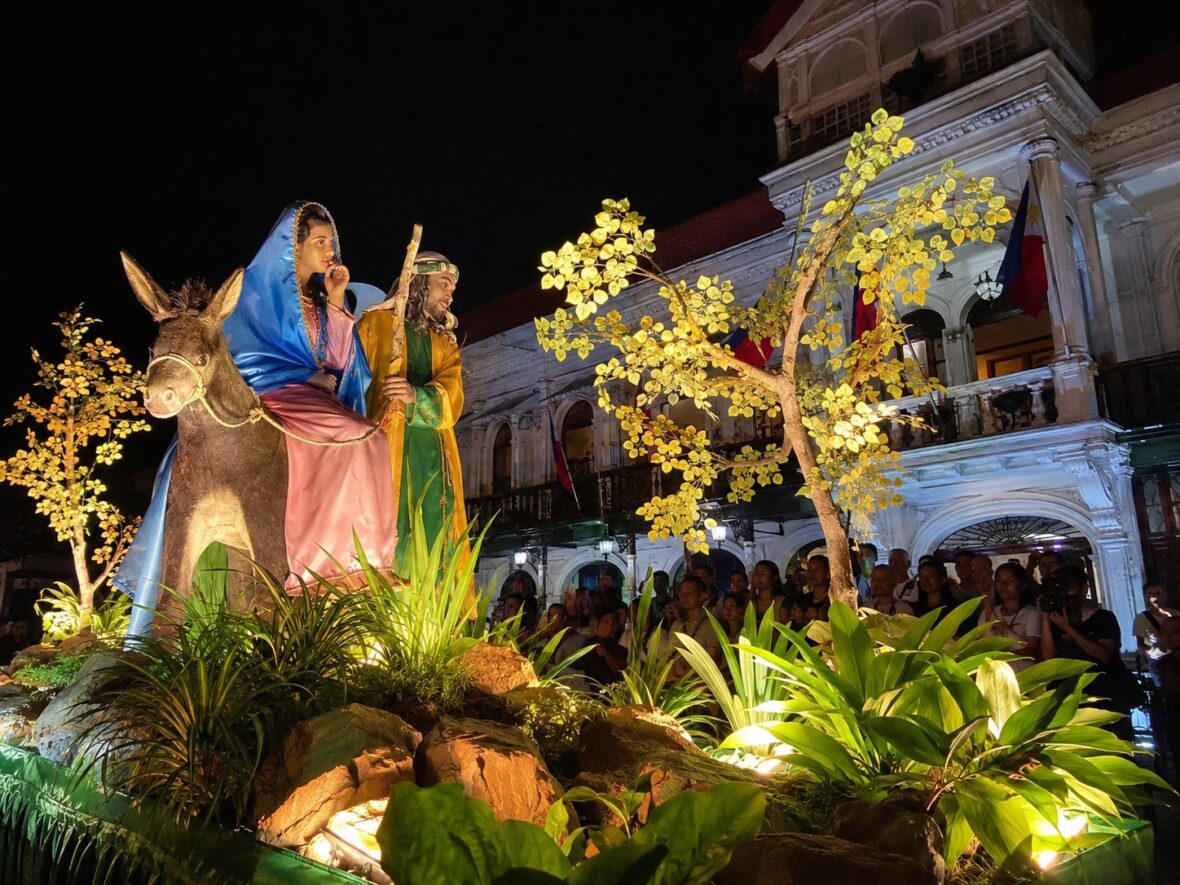
Christmas Eve in most Filipino homes is spent preparing food, exchanging gifts and waiting for the family’s Noche Buena. But in Kawit, Cavite, December 24 becomes something even more spectacular.
As darkness settles over the historic town, the streets begin to glow. Marching bands play familiar Christmas songs, crowds gather along the roads and enormous illuminated floats slowly make their way through the community. Each float presents a scene or personality from the Bible, transforming the town into a moving theatrical presentation of the Christian story of salvation.
At the center of everything is the Maytinis Festival, Kawit’s beloved Christmas Eve tradition.
The celebration retells the journey of Mary and Joseph as they search for a place to stay before the birth of Jesus. However, Kawit’s version of the familiar Panunuluyan is much grander than a simple parish play. It combines music, elaborate costumes, local artistry, religious devotion and beautifully constructed floats depicting stories from the Old and New Testaments.
For visitors, Maytinis offers a completely different way to welcome Christmas. It is festive without losing its spiritual meaning, theatrical without feeling disconnected from the community and deeply traditional while continuing to evolve with each new generation.
Content
What Is the Maytinis Festival?
The Maytinis Festival is an annual religious and cultural celebration held in Kawit, Cavite, every December 24.
Its main attraction is an evening procession of illuminated floats depicting biblical scenes and characters. The procession eventually leads into the Panunuluyan, the musical reenactment of Mary and Joseph searching for shelter in Bethlehem before the birth of Jesus.
The celebration is organized with the participation of the Confradia de Sagrada Familia, the local parish and the Kawiteño community. Residents from different barangays help construct floats, prepare costumes, portray biblical personalities and support the long procession through town.
Maytinis is both a public spectacle and an expression of prayer. Local organizers have explained that the tradition is intended to give honor and praise to God while reminding people of the religious meaning behind Christmas.
This combination is what makes the festival distinctive. You can admire the lights and artistry, but the celebration continually directs attention back to the Nativity story.
What Does “Maytinis” Mean?
The name Maytinis is commonly linked to maitines in Spanish or matins in Latin and English.
Matins refers to a traditional Christian service of prayer associated with the night or early morning. Over time, the term appears to have developed into the local word Maytinis used by Kawiteños for their Christmas Eve observance.
The exact linguistic history is not completely certain, just as the precise beginning of the festival remains difficult to establish. Nevertheless, the connection with prayer fits the character of the celebration.
Maytinis may look like a colorful parade, but its roots are devotional. It presents biblical stories not only for entertainment but also as a public expression of faith.
How Old Is the Maytinis Tradition?
Maytinis is frequently described as a centuries-old tradition, but there is no firmly documented date showing exactly when it began.
According to accounts from local organizers, even Emilio Aguinaldo reportedly could not identify its beginning because it was already an established tradition during his lifetime. The common explanation was simply nakagisnan na lang—something people had grown up seeing and practicing.
Some believe Spanish missionaries introduced an early version of the presentation to help local residents understand biblical stories. However, this remains a traditional explanation rather than a conclusively documented origin.
What can be verified is that Kawit has a long Catholic history. The National Historical Commission of the Philippines records that Jesuit priests began administering the community in 1624, while the first wooden church dedicated to Saint Mary Magdalene was built in 1638. The cornerstone of the present church was laid in 1737.
That historical setting helps explain how an elaborate Christmas tradition could take root and be passed from one generation to another.
More Than an Ordinary Panunuluyan
Different towns and parishes around the Philippines hold a Panunuluyan on Christmas Eve.
The presentation usually follows Mary and Joseph as they approach several houses asking for shelter. At each stop, they are turned away until they finally arrive at the place representing the manger where Jesus is born.
Kawit follows the same basic story, but Maytinis expands it into a much larger community production.
Before Mary and Joseph complete their journey, spectators watch a succession of floats presenting biblical stories from the creation of humanity to the coming of Christ. Recent descriptions of the celebration continue to characterize it as a retelling that begins with humanity’s creation and leads toward the Nativity.
Instead of seeing only the final moments before Jesus’ birth, visitors are presented with a broader story of salvation.
The procession may include scenes inspired by Adam and Eve, Cain and Abel, Noah, Moses, Ruth and Naomi, the prophets, the Annunciation and other events from Scripture. The exact selection and interpretation can change depending on the participating communities and the year’s program.
The Illuminated Biblical Floats
The floats are the most visually impressive part of Maytinis.
Each one functions like a moving stage. Biblical characters stand among artificial trees, clouds, animals, temples, palaces and carefully constructed landscapes. Lights outline the figures and decorations, allowing the scenes to remain visible as they travel through Kawit’s darkened streets.
Some floats are peaceful and elegant. A scene of the Annunciation may feature an angel surrounded by white clouds and glowing lights. A depiction of Mary may use blue and white fabric, stars and a crescent moon.
Other floats are dramatic. Scenes involving kings, armies, temptation or conflict may use darker lighting, elaborate armor and theatrical expressions.
Children frequently portray angels, while adults and young people take on the roles of prophets, rulers and other biblical personalities. Costumes may include flowing robes, crowns, wings, staffs, armor and handmade accessories.
The floats are not simply purchased as ready-made decorations. Barangays, families and community groups invest time, creativity and labor in bringing their assigned stories to life.
That community effort is one reason the festival remains meaningful. Every float carries not only a biblical scene but also the work of local designers, carpenters, electricians, seamstresses, performers and volunteers.
The Story Told by the Procession
The order of the floats gives Maytinis a narrative structure.
Rather than presenting unrelated Christmas decorations, the procession gradually moves through major biblical themes. Spectators are taken from creation and humanity’s fall toward God’s covenant, the prophets and the events leading to the birth of Jesus.
A visitor may see Adam and Eve in the Garden of Eden, followed by scenes from the lives of later biblical figures. As the procession continues, the stories move closer to the New Testament and the Nativity.
This structure makes Maytinis feel like an enormous outdoor religious play.
Even visitors who are unfamiliar with every character can still follow the general movement of the story. Light, costume, music and visual symbolism help communicate what is happening without requiring a long spoken explanation.
Parents often use the opportunity to explain the scenes to their children. In this way, the procession becomes both a festival attraction and a form of religious education.
The Panunuluyan of Mary and Joseph
The emotional heart of Maytinis is the Panunuluyan.
Mary and Joseph travel through the streets, stopping at selected homes or stations to ask for a place to stay. Their requests and the responses of the householders are traditionally delivered through song.
The repetition creates a sense of anticipation.
At every stop, Mary and Joseph are refused. Spectators follow their journey, knowing that the couple will eventually reach the manger but still feeling the sadness and difficulty of their search.
The presentation ends at or near the Diocesan Shrine and Parish of Saint Mary Magdalene, where the Nativity story reaches its conclusion. The church remains an active parish under the Diocese of Imus and serves as the religious center of the tradition.
Compared with the louder parade, the Panunuluyan can feel more solemn. The singing and repeated rejection encourage the audience to reflect on hospitality, compassion and the humble circumstances surrounding the birth of Jesus.
Marching Bands and Christmas Music
Music accompanies much of the Maytinis procession.
Marching bands travel with the floats, filling the streets with Christmas carols and processional music. The combination of brass instruments, drums and illuminated scenes gives the festival a distinctly traditional Filipino Christmas atmosphere.
The music also helps maintain the rhythm of the long procession.
People may begin gathering while there is still daylight, but the celebration continues well into the evening. The sound of an approaching band signals that another group of floats is about to appear, prompting spectators to move closer to the roadside.
Some songs are cheerful and familiar, while others create a more solemn mood. Together, they support the changing emotions of the biblical story.
The Payaso Tradition
One of the more unusual elements associated with Maytinis is the appearance of payaso, or clowns.
Although clowns may initially seem out of place in a religious Christmas procession, they have traditionally provided humor and social commentary. Past descriptions of the festival noted that the payaso used comedy and antics to satirize current issues while demonstrating the creativity of participating barangays.
Their presence gives spectators a lighter moment between the more serious biblical presentations.
The humor also reflects a familiar feature of Filipino community celebrations: the ability to combine solemnity and playfulness without allowing one to erase the other.
The exact role and appearance of the payaso may differ from year to year, but they remain an interesting part of Maytinis’ local character.
Saint Mary Magdalene Church
The Diocesan Shrine and Parish of Saint Mary Magdalene provides the historical and religious backdrop for Maytinis.
According to the NHCP marker, Jesuits began administering the area in 1624. A wooden church was built in 1638, while construction connected with the present church began in 1737. The church is also historically significant as the place where Emilio Aguinaldo was baptized in 1869.
Its age and architecture create an appropriate setting for a tradition centered on faith and local heritage.
When the procession approaches the church, the festival’s different elements finally come together. The floats, performers, music and crowds all move toward the town’s spiritual center.
Visitors should remember that the church is not merely a tourist backdrop. It is an active place of worship. Behave respectfully, particularly during prayers, Masses and the concluding parts of the Panunuluyan.
What Maytinis Feels Like
Maytinis has an atmosphere unlike an ordinary daytime festival.
The darkness makes every light appear brighter. You may first see only a faint glow at the end of the street. Then the sound of drums and brass instruments grows louder, and an enormous biblical scene slowly emerges from behind the crowd.
Children sit on their parents’ shoulders to see above the spectators. Families wait outside ancestral homes. Vendors sell snacks and drinks while residents greet friends and relatives who have returned to Kawit for Christmas.
Then another float appears.
For a few minutes, the road becomes the Garden of Eden, an ancient kingdom or a field filled with angels. When the float passes, the street becomes dark again until the next scene approaches.
The experience feels both communal and intimate. Thousands may be watching, yet the celebration still revolves around familiar barangays, families and parish traditions.
It is easy to understand why Kawiteños continue returning every Christmas Eve.
When Is Maytinis Celebrated?
Maytinis is traditionally held on December 24, with the main procession and Panunuluyan taking place during the afternoon and evening.
The exact starting time, float lineup, procession route and church program can change each year. Previous editions have required roads to be closed from around midday until late evening because the long procession passes through major sections of Kawit.
The tradition remained active in December 2025, when Kawit again staged the procession with biblical floats and musical performances.
A separate program will be announced for each future edition. Visitors should check updates from the Municipality of Kawit, Kawit Tourism, the parish and official Maytinis organizers before traveling.
Where Is the Festival Held?
The procession moves through the streets of Kawit and concludes around the town center and Saint Mary Magdalene Church.
Previous road closures have affected sections extending through communities such as Marulas, Gahak, Panamitan and the area approaching the Kawit fire station and town proper. However, the route can be adjusted, so these older arrangements should not be treated as the permanent festival map.
The Aguinaldo Shrine area has also served as an important gathering point and backdrop for past celebrations.
Before leaving home, look for the current route map and identify:
- The procession’s starting point
- The sections where the floats will pass
- The Panunuluyan stations
- The church entrance and designated spectator areas
- Road closures and public-transport drop-off points
- Authorized parking locations
Knowing these details will save you from wandering through blocked streets on one of Kawit’s busiest nights of the year.
How to Get to Kawit from Metro Manila
Via PITX
PITX is one of the most practical terminals for reaching Kawit from Metro Manila.
Its official route information lists Cavite City-bound buses serving Kawit and the Aguinaldo Shrine area.
At the terminal, ask for a bus heading toward Cavite City through Kawit. Tell the conductor that you are attending Maytinis and show the exact viewing location or drop-off point recommended in the current traffic advisory.
Because roads are usually closed before the procession, the bus may not follow its normal route or may drop passengers farther from the town center. Be prepared to walk.
Do not depend on a gate number from an older article. PITX assignments and operating arrangements can change, so check the live schedule or information counter on the day of travel.
By Private Vehicle
Drivers can approach Kawit through CAVITEX and connecting local roads.
However, bringing a private vehicle on December 24 requires patience. Road closures, Christmas traffic and limited parking can make movement difficult.
Leave early and use only official parking areas. Avoid trying to park close to the church or directly beside the procession route.
You may find it easier to park outside the busiest zone and walk toward your chosen viewing location.
Tips for Attending Maytinis
Arrive Before Sunset
Early arrival gives you time to find a good viewing area before the sidewalks become crowded. You can also eat, use the restroom and familiarize yourself with the route while there is still daylight.
Check the Weather
December is generally outside the peak rainy season, but unexpected rain is still possible. Bring a compact umbrella or light raincoat.
Wear Comfortable Shoes
You may need to walk a considerable distance because of road closures. Choose footwear suitable for standing and walking for several hours.
Bring Water and Snacks
Food vendors may be available, but lines can become long. Carry drinking water and a light snack, especially when attending with children.
Keep Your Belongings Secure
Crowded streets make it easier to lose a phone, wallet or bag. Carry only what you need and keep valuables close to your body.
Choose One Viewing Area
Trying to follow every float through the entire procession can be exhausting. Select a safe viewing point where you can see the floats clearly without blocking the route.
Avoid Using Flash at Close Range
Bright flashes can distract performers, drivers and participants positioned on illuminated floats. Night mode or available street lighting may produce better and more respectful photographs.
Respect the Religious Presentation
Remain quiet during prayers and the more solemn portions of the Panunuluyan. Do not interrupt performers for photographs while they are portraying Mary, Joseph or other sacred figures.
Keep Children Away from Moving Floats
Large floats may have limited visibility and require wide turning spaces. Hold young children’s hands and never allow them to run onto the road.
Plan Your Trip Home
Public transportation may be crowded after the procession. Identify your return route in advance and expect delays because December 24 is already a busy travel period.
Bringing Children to Maytinis
Maytinis can be a memorable Christmas experience for children.
The glowing angels, animals, kings and biblical scenes can make stories they have heard in church or school feel much more real. However, the late schedule and large crowd require preparation.
Choose a viewing spot that is not too close to the moving floats. Bring a jacket, water, snacks and any medicine your child may need.
Write your contact number on a card and place it securely in the child’s pocket. Older children should know the agreed meeting point in case the group becomes separated.
It may not be necessary to stay until the very end when attending with very young children. Watching the first several floats can already provide a satisfying experience without leaving them overtired before Noche Buena.
Food and Christmas Snacks
Street vendors and nearby establishments may offer familiar festival food, including grilled snacks, fried food, rice cakes, drinks and desserts.
Since the celebration happens on Christmas Eve, many local families are also busy preparing their own Noche Buena. Some businesses may close earlier than usual, while others may become crowded with visitors.
Eat a proper meal before entering the main viewing area. The procession can last several hours, and leaving your spot to search for food may be difficult once the road fills with spectators.
Bring cash in small denominations because temporary vendors may not accept digital payments.
Other Places to Visit in Kawit
A Maytinis trip can be combined with a daytime historical tour before the procession begins.
Emilio Aguinaldo Shrine
The Aguinaldo Shrine is the historic house where Philippine independence was proclaimed on June 12, 1898.
It is Kawit’s best-known landmark and an ideal first stop for visitors interested in Philippine history. Confirm its December 24 operating hours because museums may follow shortened holiday schedules or close for special events.
Saint Mary Magdalene Church
Visit the church before the evening crowd arrives so you can appreciate its architecture and historical marker more peacefully.
The NHCP records that the present structure traces its construction to 1737 and that Emilio Aguinaldo was baptized there.
Museo ni Baldomero Aguinaldo
This ancestral house is associated with Baldomero Aguinaldo, a revolutionary leader and cousin of Emilio Aguinaldo.
It offers another perspective on Kawit’s history beyond the better-known independence proclamation.
Kawit Town Proper
Walking around the older parts of Kawit allows you to see ancestral homes, churches and community spaces that provide the setting for the evening procession.
Allow enough time to return to your chosen viewing position before road closures become stricter.
Maytinis and the Filipino Christmas Spirit
Filipino Christmas celebrations are often associated with food, gifts, decorations and large family gatherings.
Maytinis brings attention back to the religious story at the center of the season.
Its most important characters are not wealthy or powerful. They are a tired couple searching for shelter. They are repeatedly turned away before finding a humble place where their child can be born.
That story raises questions that remain relevant today.
Would we recognize someone in need? Would we offer a place of safety? Would we make room for another person when doing so interrupts our own comfort?
Maytinis does not present these ideas through a lecture. It places them directly in the street, where the entire community can witness the search unfold.

Why the Tradition Matters to Kawit
Kawit is already nationally important because of its connection to Philippine independence.
Maytinis reveals another side of the town.
It shows Kawit not only as a place where history happened but also as a living community that preserves traditions through collective participation.
The celebration depends on people passing knowledge from one generation to the next. Older residents remember how floats were built in the past. Parents introduce children to the procession. Young performers eventually become organizers, designers and community leaders.
The materials and technology may change. New lighting systems may make floats brighter, and modern sound equipment may make music clearer. Yet the central story remains the same.
That continuity gives Maytinis its power.
Final Thoughts
The Maytinis Festival is one of Cavite’s most beautiful and meaningful Christmas traditions.
Its illuminated floats, marching bands and elaborate costumes create a spectacular evening for visitors. But behind the lights is a community prayer—a retelling of the events leading to the birth of Jesus and a reminder of what Christmas is supposed to represent.
Watching Maytinis feels like seeing the pages of the Bible move through the streets.
Adam and Eve pass before you. Prophets, kings and angels follow. Then Mary and Joseph appear, continuing their search for a place to stay as Christmas draws closer.
By the time the procession reaches Saint Mary Magdalene Church, the festival no longer feels like an ordinary parade. It becomes part of Kawit’s Christmas Eve—a tradition shared by families, barangays, performers, parishioners and visitors gathered beneath the December night sky.
Come for the glowing floats and beautiful photographs, but stay for the story.
Maytinis reminds us that the real spirit of Christmas is found not only in celebration, but also in faith, humility, hospitality and making room for others.


