Most festivals happen every year. Residents know exactly when the parade will return, when the street dancers will begin rehearsing and when the town plaza will once again fill with food stalls and music.
The Sorteo Festival of Carmona City is different.
It is traditionally celebrated only once every three years, making each edition feel like a long-awaited community reunion. More importantly, the festival is rooted in one of the most unusual local traditions in the Philippines: the distribution of communal agricultural land through a public lottery.
Yes, actual farmland was once raffled among qualified residents.
The winners did not simply receive trophies or small prizes. They were given the opportunity to cultivate portions of Carmona’s communal land, earn from the harvest and support their families for a specified period.
That centuries-old practice eventually became the inspiration for the modern Sorteo Festival—a colorful celebration combining history, agriculture, community pride, parades, cultural performances, beauty pageants and an enormous raffle for Carmona residents.
For visitors, Sorteo offers something beyond the usual street festival. It provides a glimpse into how one community used shared land, chance and local rules to distribute economic opportunities among its people.
Content
What Is the Sorteo Festival?
The Sorteo Festival is a triennial cultural and thanksgiving celebration held in Carmona City, Cavite.
The word sorteo is Spanish for a draw, lottery or raffle. The festival takes its name from Carmona’s historic practice of raffling communal agricultural lands among residents who could cultivate them.
The Tourism Promotions Board describes Sorteo as a thanksgiving celebration for abundant produce, held every three years and named after the raffle of communal farmland to local residents.
Although the historic land draw remains the foundation of the festival, the modern celebration has expanded into a much larger citywide event.
Depending on the edition, visitors may encounter float parades, cultural performances, community sports, traditional games, pageants, concerts, trade fairs and the highly anticipated grand raffle.
The festival celebrates several things at once: Carmona’s agricultural roots, the value of communal resources and the residents’ ability to preserve a tradition while adapting it to modern life.
What Does “Sorteo” Mean?
Sorteo generally refers to the act of drawing lots.
In Carmona, the term became associated with the process of choosing which residents would be allowed to cultivate parcels of communal agricultural land.
Rather than allowing powerful families or wealthy individuals to control all available farmland, the draw gave qualified residents an opportunity to participate. Names were selected publicly, and the winners received the right to use specific portions of land for farming.
The system was not exactly the same as permanently giving away private property. The communal land remained connected to the town, while the selected farmers received cultivation rights for a defined period.
Because the allocation was repeated every three years, other residents could eventually receive their own chance.
That three-year cycle explains why the full Sorteo Festival is not an ordinary annual celebration.
How the Sorteo Tradition Began
Carmona was originally known as Barrio Latag and formed part of Silang. It became a separate municipality in 1857.
The Sorteo tradition began in 1861, only a few years after Carmona became an independent town. The practice developed as a way of distributing opportunities to use communal agricultural land among local farmers.
Carmona was largely agricultural at the time. Land was essential not only for producing food but also for earning a living.
A family with the right to cultivate a productive parcel could plant crops, raise animals and benefit from the harvest. For residents without substantial private property, being selected in the draw could create an important economic opportunity.
However, communal land could also become a source of disagreement. Questions might arise over who had the right to use it, which family should receive a particular parcel and how long the land could remain under one farmer’s control.
The Sorteo offered a public method of making those decisions.
By drawing lots, Carmona created a system that was understood by the community and gave qualified residents a chance to participate.
How the Traditional Land Lottery Worked
The exact procedures changed over time, but the basic idea was straightforward.
Eligible residents or family names were entered into a public draw. Names were selected from a lottery drum, commonly called a tambiolo, and matched with available parcels of communal agricultural land.
A successful participant would receive the right to cultivate the assigned land for approximately three years. At the end of the period, the land could be included in another draw, giving a different resident the opportunity to farm it.
The three-year arrangement provided enough time for a farmer to prepare the land, plant crops and benefit from several growing seasons without turning the communal parcel into permanent private property.
The public nature of the draw was important. Residents could observe the selection process, hear the names being called and see who had received each parcel.
Over time, the event developed its own excitement and traditions. Families waited for familiar names, neighbors reacted to the results and the draw became a shared community occasion rather than a purely administrative procedure.
Why Is the Festival Held Every Three Years?
The triennial schedule reflects the original land-use arrangement.
Winners were traditionally given cultivation rights for a three-year period. When that period ended, another draw could be held.
The festival therefore followed the same rhythm as the agricultural allocation system.
Holding Sorteo every three years also makes the celebration feel different from an annual fiesta. Residents have more time to anticipate the next edition, while organizers can prepare a larger program.
The latest full festival was held in February 2025. It was the first Sorteo celebrated after Carmona became a component city. The 2025 festivities ran from February 14 to 23 and coincided with Carmona’s founding and cityhood celebrations.
Based on the traditional cycle, the next full edition would be expected in 2028, provided the city maintains the same schedule. Travelers should still wait for official announcements because dates, qualifications and programs may change.
From Agricultural Lots to Modern Cash Prizes
Carmona has changed considerably since the Sorteo tradition began.
Farmland has been affected by urbanization, industrial development and major infrastructure projects. The city is now part of a rapidly developing corridor near Laguna, Metro Manila and the eastern side of Cavite.
Because of these changes, the modern Sorteo draw no longer follows exactly the same format in every edition.
In preparation for the 2019 celebration, for example, the local government announced that 109 communal lots would be included in the lottery.
By 2022, however, the communal lands themselves were not the main prizes. Carmona conducted a computerized draw that awarded cash to bona fide residents. Local officials explained that portions of the communal land were being developed under a joint-venture arrangement, with expected benefits including employment and additional public revenue.
The 2022 draw also showed how the tradition had entered the digital age.
Residents registered electronically, names were selected through a computer system developed by the local government and the proceedings were streamed online. Participants could check whether their names had already been called through computer stations and a touchscreen kiosk.
In 2025, the city again awarded tax-free cash prizes to qualified residents. The prizes ranged from ₱50,000 to ₱300,000, continuing the spirit of distributing economic benefits even though the original agricultural system had evolved.
This change does not necessarily erase the meaning of Sorteo. Instead, it shows how Carmona has attempted to preserve the principle behind the tradition: communal resources should produce opportunities that benefit local people.
Carmona’s First Sorteo as a City
Carmona’s conversion from a municipality into a component city added another layer of significance to the 2025 festival.
Republic Act No. 11938, known as the Charter of the City of Carmona, was approved in February 2023. Carmona’s cityhood was later ratified through a plebiscite.
The 2025 Sorteo was therefore the first full edition held under Carmona’s new city status.
For residents, this created an interesting connection between the past and the present.
The celebration honored an agricultural practice that began in the 19th century, but it was now taking place in a young component city surrounded by industrial parks, residential communities and modern development.
That contrast is part of what makes Sorteo fascinating. It does not pretend that Carmona has remained unchanged. Instead, the festival asks how a growing city can carry an old communal tradition into a very different future.
What to Expect During the Sorteo Festival
The program changes with every edition, particularly because organizers have three years to develop new activities.
Some celebrations place more emphasis on the draw, while others expand the parades, sports competitions, pageants and cultural shows.
The 2025 festival included a broad program of public events held over more than a week.
The Grand Sorteo Draw
The raffle remains the heart of the celebration.
Qualified Carmona residents wait for their names to be called, knowing that a successful draw may result in a valuable cash prize or another benefit determined by the city government.
The atmosphere combines the excitement of a lottery with the familiarity of a community event.
People recognize surnames, barangays and families. Every announcement may bring cheering from one part of the crowd while everyone else continues waiting for another chance.
Visitors should understand that participation in the draw is generally restricted to qualified or bona fide Carmona residents who have completed the registration requirements.
A tourist cannot simply arrive, buy a ticket and join the raffle. The rules, eligibility criteria and registration process are announced by the local government for each edition.
Even without joining, visitors may still witness one of the country’s most unusual community traditions.
Parada ng Kaunlaran
The Parada ng Kaunlaran, or Parade of Progress, officially opened the 2025 festivities.
The parade presented Carmona’s development through participating organizations, community groups, businesses and decorated floats. It connected the city’s farming past with its current identity as a growing urban and economic center.
The word kaunlaran means progress or development.
That makes the parade particularly appropriate for Sorteo. The festival looks backward at Carmona’s communal farming system while also celebrating the schools, industries, businesses, infrastructure and public programs that shape the city today.
Spectators can expect music, banners, coordinated community groups and plenty of green-and-yellow decorations reflecting the visual identity of the festival.
Float Parade and Competition
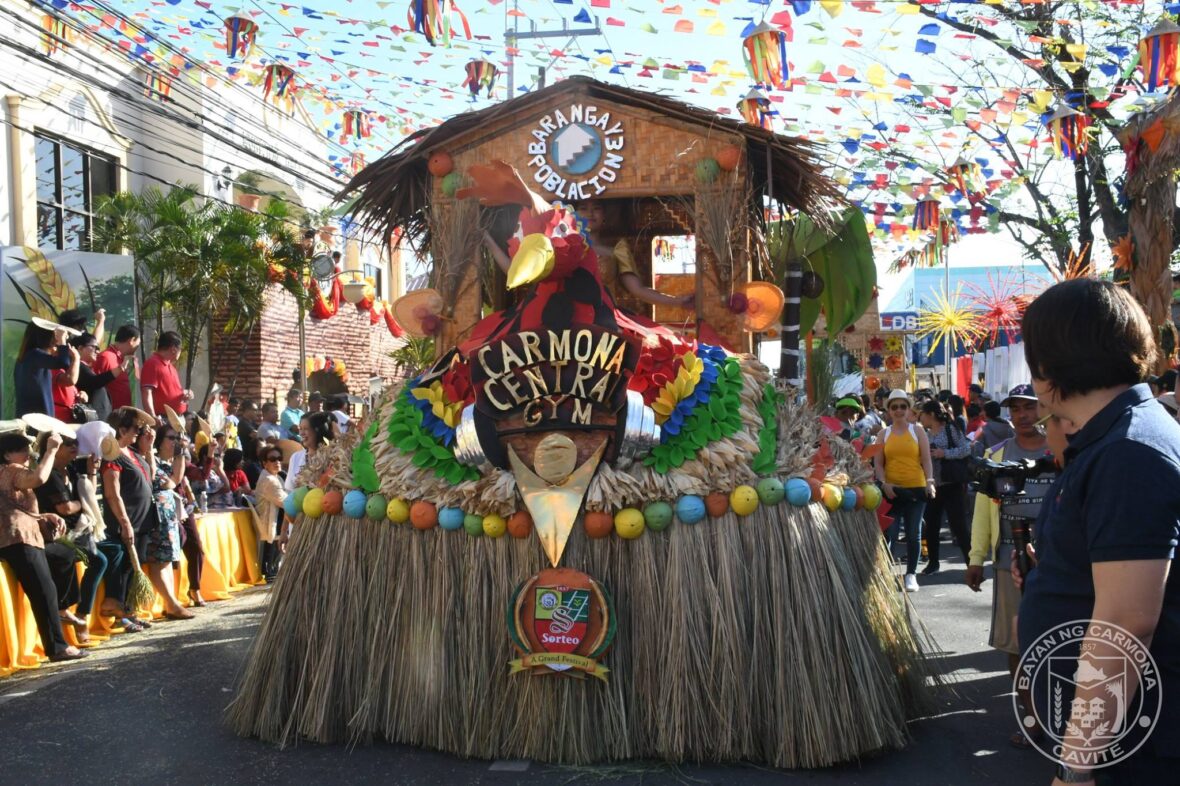
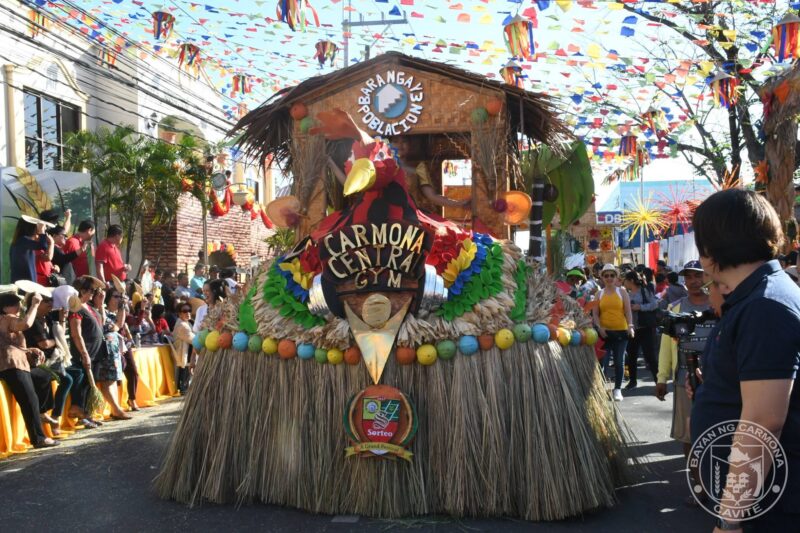
Decorated floats are among the most photographed features of the celebration.
Designs commonly incorporate farming scenes, crops, traditional houses, modern buildings and symbols associated with luck and prosperity.
Some floats present an idealized image of the old Carmona, with farmers carrying baskets and working in green fields. Others focus on the modern city, using factories, schools, roads and technology as symbols of progress.
The float competition allows barangays, organizations and businesses to tell their version of Carmona’s story.
One float may emphasize agriculture, while another celebrates employment, education or public service. Together, they create a moving timeline of the city.
Cultural and Street Performances
Music and dance help make the history behind Sorteo easier to appreciate.
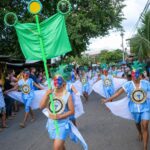
Performers may wear costumes inspired by farmers, crops, leaves and traditional rural clothing. Their choreography can portray planting, harvesting, thanksgiving and the suspense of the public draw.
The performances may also show Carmona’s transformation.
A presentation can begin with farmers working the soil before shifting into faster music, brighter costumes and formations representing factories, businesses and city life.
These performances are particularly valuable for younger residents who have grown up in an urbanized Carmona and may never have seen the agricultural landscape remembered by their grandparents.
Binibining Sorteo
The search for Binibining Sorteo adds pageantry and glamour to the festival.
Candidates representing different barangays or sectors take part in formal presentations, interviews and cultural segments. The coronation night was one of the major events included in the 2025 program.
Beyond appearance, contestants are generally expected to understand Carmona’s history and represent the city confidently.
The pageant gives candidates an opportunity to discuss local heritage, community concerns and the meaning of Sorteo for younger generations.
Festival-inspired costumes may feature agricultural elements such as rice stalks, leaves, flowers and farming tools. Other designs incorporate modern city symbols, showing again how the celebration joins Carmona’s past and present.
Sports and Community Competitions
Sorteo is not limited to parades and formal ceremonies.
The program may include basketball and volleyball tournaments, recreational activities, traditional Filipino games and contests for different age groups.
These events allow more residents to participate even when they are not performers or raffle winners.
Sports competitions build friendly rivalry among barangays, while Palaro ng Lahi activities preserve games that younger participants may rarely experience in everyday life.
The festival may also include youth programs, talent competitions and educational activities designed to make Sorteo relevant to a new generation.
Trade Fairs and Food Stalls
Trade fairs give Carmona businesses, entrepreneurs and community groups a place to showcase their products.
Visitors may find prepared food, drinks, clothing, crafts, agricultural goods and products made by local small businesses.
The fair also provides an opportunity to see how Carmona’s economy has diversified.
Agriculture remains central to the festival’s history, but the modern city is also connected with manufacturing, commerce and services. The variety of exhibitors reflects that broader economic identity.
Bring cash in small denominations. Temporary booths may accept digital payments, but mobile signals can slow down when the venue becomes crowded.
Concerts and Evening Entertainment
Major festival editions often include concerts, fireworks or evening cultural programs.
After the daytime parades and community activities, public plazas become gathering places where families can watch performers and enjoy the festive atmosphere.
The entertainment lineup is different every three years, so travelers should check the official program rather than relying on an old festival schedule.
Popular evening events can become crowded. Arrive early when a nationally known performer or major competition is included in the program.
What the Sorteo Festival Feels Like
Sorteo has the excitement of a raffle, the energy of a city festival and the familiarity of a neighborhood reunion.
Families gather knowing that the full celebration will not return the following year. Former residents come home, classmates meet again and barangays prepare presentations they may have been planning for months.
There is always a sense of anticipation.
During the draw, people listen closely for familiar names. During the parade, residents cheer when their barangay’s float appears. At night, crowds fill the plaza as music, lights and conversations carry across the city center.
Yet beneath the entertainment is a serious idea.
Sorteo began because land meant survival and opportunity. Being selected could change what a family was able to plant, harvest and earn.
The modern prizes may be different, but the emotion of waiting for one’s name—and the hope that comes with it—remains central to the experience.
When Is the Sorteo Festival Celebrated?
The Sorteo Festival is generally held in February once every three years.
The 2025 celebration ran from February 14 to 23 and was held alongside Carmona’s founding and cityhood commemorations.
This is important for travelers to remember: Sorteo is not an annual festival.
A visitor who arrives in Carmona every February will not necessarily find the full parade, grand draw and citywide program.
Assuming the traditional cycle continues, the next major celebration would be expected in 2028. However, visitors should confirm the date through the City Government of Carmona and the official Sorteo ng Carmona page before booking transportation or accommodation.
Smaller founding-anniversary or cityhood activities may still take place during non-Sorteo years.
Where Is the Festival Held?
Major activities are commonly staged around the Carmona Town Plaza, city government grounds, public parks and designated streets.
The parade may pass through several barangays before reaching the main program venue. Sports competitions, pageants and community events may be held in separate facilities.
Do not assume that every activity happens at the plaza.
Before traveling, identify the exact venue for the event you want to attend. The grand draw, float parade, pageant and concert may all take place at different locations or times.
Road closures and traffic rerouting are likely during major processions.
How to Get to Carmona
From Metro Manila via PITX
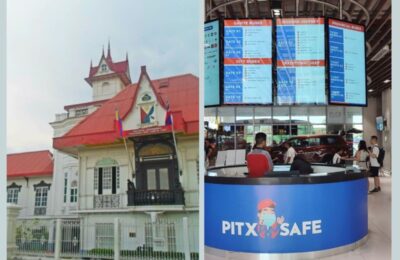
PITX serves numerous Cavite-bound routes and provides an online route finder and live bus schedule. Because routes, bays and operators change, check the current listing or ask at the information counter before boarding.
A common option is to take a bus toward General Mariano Alvarez, then transfer to a local jeepney or other public vehicle traveling to Carmona. Services between PITX and GMA operate through the Cavite corridor, although schedules should be verified on the day of travel.
Tell the driver that you are going to Carmona town proper or show the exact festival venue.
From Alabang or Southern Metro Manila
Travelers may use buses or jeepneys heading toward Biñan, Pacita or Carmona.
The correct transfer depends on the route and destination. Ask whether the vehicle passes Carmona proper or only the SLEX exit area before boarding.
From Other Parts of Cavite
Carmona is accessible from General Mariano Alvarez and Silang through local roads and public transportation.
Travelers coming from Imus, Dasmariñas or General Trias may first travel toward GMA or Governor’s Drive and transfer to a Carmona-bound vehicle.
By Private Vehicle
Drivers coming from Metro Manila can use the South Luzon Expressway and exit toward Carmona.
Those coming from central Cavite may approach through Governor’s Drive and connecting roads through GMA or Silang.
Festival traffic can become heavy near the plaza and city government area. Follow local traffic advisories and use only designated parking locations.
Practical Tips for Visitors
Confirm That It Is a Sorteo Year
Because the festival occurs only every three years, this should be the first thing you check.
Study the Schedule
The raffle, parade, pageant and evening performances may happen on separate days. Choose the activities that interest you most.
Arrive Early
Road closures may begin before the parade. Early arrival gives you time to find parking or walk from your drop-off point.
Bring Water and Sun Protection
February is part of the dry season, and daytime events can become hot. Carry drinking water, sunscreen, a hat and an umbrella.
Wear Comfortable Shoes
Expect to walk between venues or from a distant parking area.
Carry Cash
Food vendors, tricycles and temporary stalls may not all accept cards or digital payments.
Do Not Assume You Can Join the Draw
The grand raffle is intended for eligible Carmona residents who satisfy the official registration rules.
Keep Valuables Secure
Crowds can become dense during parades, concerts and the announcement of major winners.
Bringing Children to Sorteo
Sorteo can be educational for children because the festival tells a story that is rarely discussed outside Carmona.
Before attending, explain that the raffle was originally used to decide which families could farm community-owned land.
This simple background will help them understand why the tambiolo, farming imagery and three-year cycle are important.
Choose a viewing location away from moving floats and crowded intersections. Bring water, snacks and identification containing a parent or guardian’s contact number.
Children may especially enjoy the street performances, floats, traditional games and evening lights.
Why Sorteo Is Different from Other Cavite Festivals
Cavite has celebrations honoring coffee, smoked fish, independence, religious patrons and local delicacies.
Sorteo stands apart because it celebrates a system of distributing communal opportunity.
The festival is not only about a product grown in Carmona. It is about who received the chance to grow that product and how the community decided to share access to its land.
That distinction makes Sorteo historically important.
It reveals how local communities developed their own responses to questions of land, livelihood and fairness. The solution was imperfect and changed over time, but the public draw became important enough to survive in collective memory for more than a century.
Why the Sorteo Tradition Still Matters
Carmona is no longer the quiet agricultural town it was in 1861.
New businesses, industries, subdivisions and infrastructure have changed both the landscape and the way residents earn a living.
That makes preserving the memory of the communal lands even more important.
Without the festival, younger residents might see the word Sorteo only as the name of a monument, street or government program. Through the celebration, they learn that the term represents a real practice that affected the livelihoods of earlier Carmona families.
The festival also raises a question that remains relevant today: How should the benefits of community-owned resources be shared?
Modern Carmona answers that question differently from its agricultural ancestors. Land may be developed, employment may replace farming opportunities and cash prizes may take the place of cultivation rights.
However, the principle that public resources should create public benefits remains part of the festival’s message.
Final Thoughts
The Sorteo Festival is one of Cavite’s most distinctive cultural celebrations.
Its parades, floats, pageants, concerts and community competitions create the lively atmosphere people expect from a festival. But its true identity comes from something much older—the public drawing of names to determine who would receive the chance to cultivate Carmona’s communal land.
That tradition tells us a great deal about the city.
It speaks of farmers who depended on the soil, families who waited for their names to be called and a community that attempted to distribute opportunity through a shared system.
Modern Sorteo may involve computerized draws, cash prizes and celebrations held in a newly established city. Still, every name drawn connects the present generation with the residents who gathered around the tambiolo more than a century ago.
Because it happens only once every three years, attending the festival feels especially meaningful. You are not watching an ordinary annual parade. You are witnessing the latest chapter of a tradition that Carmona has carried from its agricultural past into its modern future.
At Sorteo, luck may decide whose name is called—but history is what gives the celebration its lasting value.