There is something naturally joyful about watching a kite rise into the sky.
At first, it struggles close to the ground. The person holding the line runs across the field, waiting for the wind to catch the sail. Then, almost suddenly, the kite lifts above the crowd.
The line becomes tight, the tail begins dancing and the kite climbs higher until it appears to float effortlessly against the blue sky.
During the Pupugayo Festival in Imus, Cavite, this familiar childhood activity becomes a colorful public celebration.
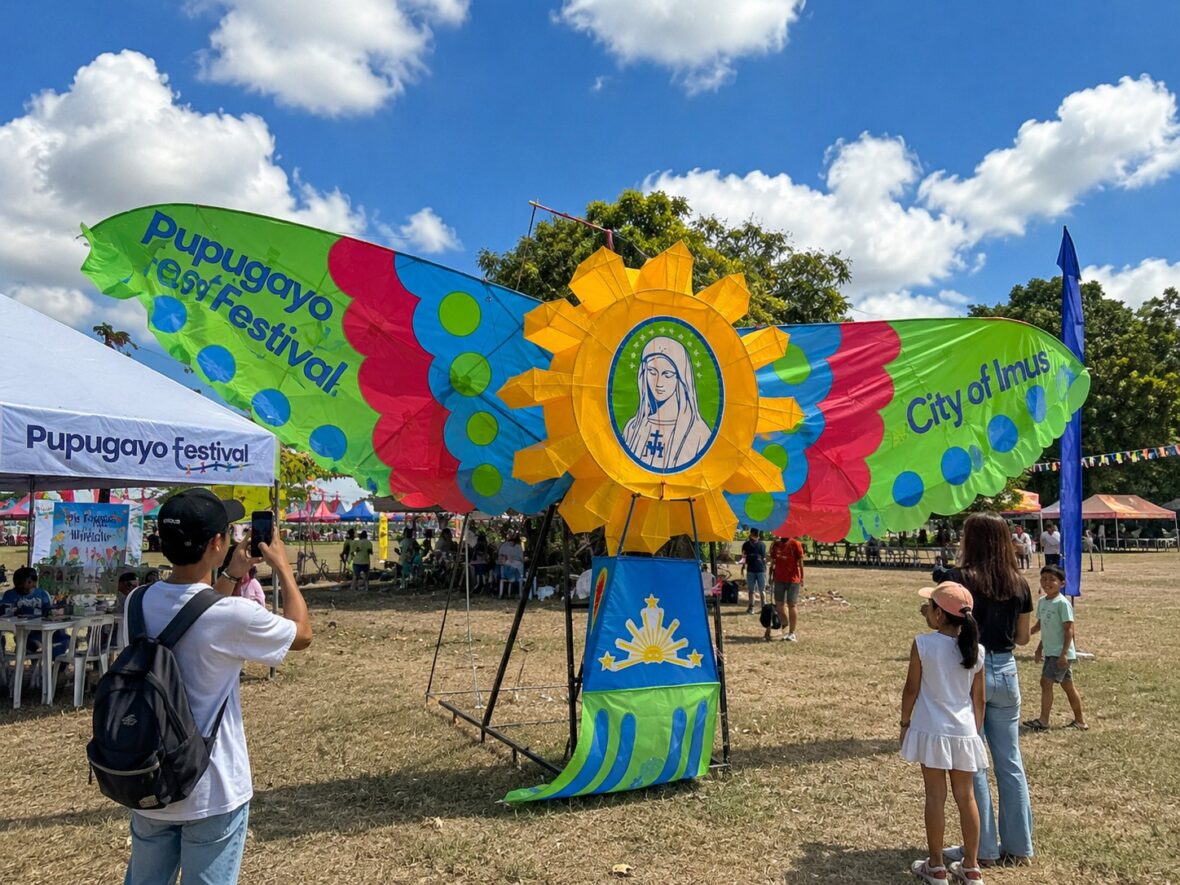
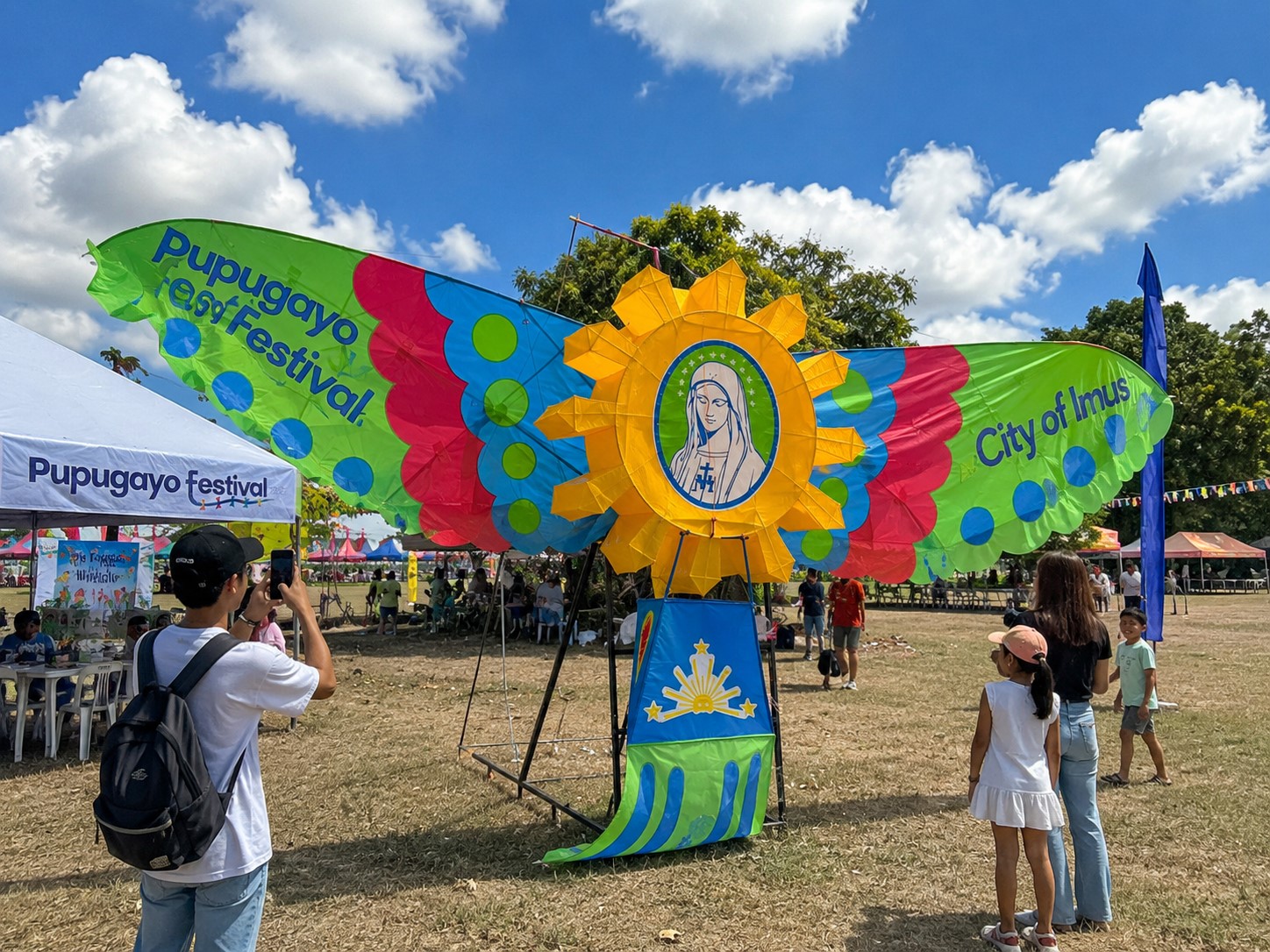
Traditional diamond-shaped kites fly beside enormous three-dimensional creations. Some resemble birds, butterflies, airplanes or imaginary creatures. Others feature the Philippine flag, historical symbols and designs representing Imus.
Families gather on open fields while competitors carefully control their lines. Children attend kite-making workshops, food sellers serve local snacks and photographers wait for the perfect moment when dozens of colors fill the sky.
Pupugayo is one of Cavite’s newest festivals, but it celebrates something deeply familiar to Filipinos: the simple pleasure of making a kite and seeing whether it can fly.
Content
What Is the Pupugayo Festival?
The Pupugayo Festival is an annual kite-making and kite-flying celebration organized by the City Government of Imus through its tourism and heritage office.
The festival was created to revive the Filipino tradition of kite flying while promoting tourism, art, culture, creativity and friendly competition among Imuseños.
The first Pupugayo Festival was held on April 27, 2024, at Heritage Park in Barangay Alapan II-B. Its theme was “Explore and Love Imus.” Participants competed in traditional flat-kite and three-dimensional-kite categories, while families joined workshops and explored a food bazaar featuring products and dishes from Imus.
The event returned on April 5, 2025, for its second edition at Vermosa. Kite makers again competed using traditional guryon designs and creative three-dimensional forms.
The third Pupugayo Festival was held on April 9, 2026, at Café 10/23 along Imus Boulevard in Barangay Malagasang II-C. Its theme, “Sining at Giting sa Paglipad: Pag-Angat ng Lahing Matatag,” connected the rising kites with the creativity, courage and resilience of the people of Imus.
Although the festival is still young, it has already established a clear identity. Pupugayo is not a conventional street festival built around dancers and floats. Its main stage is the sky.
What Does “Pupugayo” Mean?
In Imus, pupugayo is a traditional local term for a kite or saranggola.
Imus tourism materials connect the word with the Portuguese and Spanish terms papagaio or papagayo, which originally refer to a parrot. Similar words have also been used for colorful kites in parts of Cavite and Batangas.
The connection is easy to imagine.
Like a brightly colored bird, a kite appears to spread its wings and move freely through the air. Its tail sways behind it, while sudden changes in the wind make it climb, dive or turn.
The festival name also gives the celebration a distinctly Caviteño identity.
Organizers could have simply called it the Imus Kite Festival. Using Pupugayo preserves a local word and introduces it to younger residents who may be more familiar with the commonly used saranggola.
How the Pupugayo Festival Began
The City of Imus launched Pupugayo in 2024 to revive traditional kite flying and create a family-friendly tourism event centered on Filipino creativity.
The inaugural festival brought together kite makers, families, children and local-government departments at Heritage Park. Competitors created traditional and modern designs, while children learned the basics of kite construction and flying through workshops.
The concept was simple but effective.
Kite flying does not require an elaborate theater, expensive rides or a large concert stage. It needs an open space, steady wind and people willing to experiment.
The activity also appeals to different generations.
Older residents may remember making kites from bamboo strips, thin paper and paste. Parents can share those memories with their children, while modern builders introduce stronger fabrics, lightweight frames and more complicated geometric designs.
By turning kite flying into a festival, Imus created a space where childhood tradition, engineering, art and outdoor recreation could meet.
A New Festival with an Old Filipino Tradition
Pupugayo Festival began only in 2024, but kite flying has been part of Filipino childhood for generations.
Before smartphones, online games and streaming entertainment became widely available, children often created their own toys from materials found at home or around the neighborhood.
A simple kite might be made from:
- Thin bamboo sticks
- Old newspapers or colorful paper
- Rice paste or ordinary glue
- Thread or nylon line
- Strips of cloth or plastic for the tail
Making the kite was already part of the fun.
Children had to find bamboo that was light but strong. The sticks needed to be balanced, the paper stretched correctly and the bridle positioned carefully.
Then came the real test.
Would the kite rise—or spin uncontrollably and crash?
A failed attempt was not necessarily the end. The builder could shorten the tail, move the bridle, repair the paper and try again.
That process taught patience and problem-solving without feeling like a formal lesson.
Why Kite Flying Deserves a Festival
At first, a kite festival may sound less culturally important than a historical or religious celebration.
However, ordinary recreational traditions also deserve attention.
Kite flying brings together several valuable skills:
Creativity. Builders choose the colors, shape and visual story of their kite.
Craftsmanship. The frame and sail must be assembled carefully.
Basic engineering. Weight, balance, wind resistance and line placement affect whether the kite will fly.
Physical activity. Participants walk, run and move across open spaces.
Patience. Even a well-built kite may require several adjustments.
Community interaction. Families and enthusiasts share techniques, materials and advice.
The festival also encourages people to spend time outdoors.
In a rapidly urbanizing city such as Imus, public events that make use of safe open spaces are increasingly valuable.
The First Pupugayo Festival in 2024
The inaugural edition took place at Heritage Park in Alapan II-B on April 27, 2024.
The competition was divided into two main categories:
Pupugayo Flat Kite
This category featured traditional flat or guryon-style kites.
These designs rely on a relatively thin frame and a flat sail. Although they may look simpler than enormous three-dimensional creations, traditional kites still require careful balance and construction.
3D Figure Kite
This category featured three-dimensional and geometric-shaped kites.
Builders could experiment with box forms, animal figures, aircraft-inspired structures and other designs that occupied more space in the air.
Special awards recognized the most colorful, largest, longest, loudest, smallest and most unusual entries. Children between three and six years old could also join kite-making and kite-flying workshops, making the event accessible to families rather than only serious competitors.
The Second Festival in 2025
The second Pupugayo Festival was held at Vermosa on April 5, 2025.
Once again, competitors joined the traditional guryon and three-dimensional categories.
The city recognized not only the main winners but also kites that stood out for their size, color and uniqueness. City-government departments participated in a separate interdepartmental competition, showing that Pupugayo had developed into a wider community event rather than a contest limited to experienced hobbyists.
The large open spaces of Vermosa created a fitting environment for the festival.
Kites need enough distance from buildings, trees, road traffic and power lines. A spacious field also gives flyers room to run and prevents lines from becoming tangled too quickly.
Pupugayo Festival 2026
The third festival was held on April 9, 2026, at Café 10/23 along Imus Boulevard in Barangay Malagasang II-C.
The 2026 theme emphasized sining, or art, and giting, or courage.
Competitors again joined traditional and three-dimensional categories. Cash prizes were given to the first-, second- and third-place winners, while special awards recognized the largest, smallest, most colorful and most unique kites.
The continued staging of Pupugayo for a third year suggests that the city intends to develop it as an annual cultural and recreational tradition.
However, the venue has changed every year:
- Heritage Park in 2024
- Vermosa in 2025
- Imus Boulevard in 2026
Visitors should therefore confirm the current location before traveling.
Traditional Guryon or Flat Kite Competition
The traditional-kite category celebrates the familiar flat kite many Filipinos remember from childhood.
A basic guryon often has a diamond, shield or slightly elongated shape. A lightweight frame supports a paper, plastic or fabric sail, while a tail helps stabilize the kite.
The challenge is creating balance.
A beautiful kite will not remain airborne when one side is heavier than the other. The frame must also be strong enough to resist the wind without becoming unnecessarily heavy.
The bridle—the string connecting the frame with the main flying line—is especially important.
When the attachment point is too high or low, the kite may fail to catch enough air. It may also dive, spin or repeatedly stall.
Competition builders therefore do more than decorate their entries. They make small technical adjustments until the kite behaves properly in the wind.
Three-Dimensional Kite Competition
The three-dimensional category allows builders to become much more imaginative.
Instead of creating only a flat sail, participants construct forms with depth and volume.
These may include:
- Box kites
- Airplanes
- Birds
- Butterflies
- Fish
- Insects
- Buildings
- Geometric structures
- Cartoon-inspired figures
- Original fantasy creatures
A large 3D kite can look spectacular on the ground, but getting it airborne is another challenge.
The frame must remain light enough to lift. The surfaces need to catch the wind correctly, and the structure must distribute pressure without collapsing.
Some designs may require more than one person during launch.
One person holds the kite upright while another manages the line. The team waits for the right gust before releasing the structure.
When everything works, the result can appear almost impossible—a large figure floating above the field as though it has come alive.
Special Kite Awards
Pupugayo Festival does not judge entries only according to which kite flies highest.
Special awards encourage builders to explore different forms of creativity.
Previous festivals have recognized the:
- Biggest kite
- Smallest kite
- Most colorful kite
- Most unique kite
- Longest kite
- Loudest kite
These categories make the festival more entertaining for spectators.
A very small kite may require precision and light materials, while an enormous kite demands strong construction and teamwork.
A colorful design attracts photographers, but it must still remain visible and stable once it rises far above the ground.
The uniqueness award gives participants freedom to surprise the judges with a concept that may not fit a traditional shape.
Kite-Making Workshops for Children
The children’s workshops introduced during the first festival are among Pupugayo’s most meaningful activities.
A young child may see a completed kite and assume it is simply another toy purchased from a store. A workshop reveals that the object can be created by hand.
Children learn how simple materials work together:
- The frame provides structure.
- The sail catches the wind.
- The bridle connects the kite with the line.
- The tail improves stability.
- The flyer controls the direction and tension.
The activity also develops fine-motor skills.
Children measure, fold, attach and decorate. They learn that uneven construction can change the way the kite flies.
Parents should assist with cutting tools, pointed bamboo and strong adhesives. The goal is to make the experience enjoyable without exposing young participants to unnecessary risks.
Basic Parts of a Kite
Understanding the basic parts makes the festival more interesting.
Frame
The frame gives the kite its shape.
Traditional frames use thin bamboo because it is lightweight, flexible and widely available. Modern designs may use fiberglass, carbon-fiber rods, plastic or other light materials.
Sail
The sail is the broad surface that catches the wind.
Paper gives a traditional appearance but can tear easily. Plastic and synthetic fabrics are more resistant to moisture, while specialized kite cloth can provide strength without excessive weight.
Bridle
The bridle is the shorter arrangement of strings attached directly to the frame.
Its position determines the angle at which the kite meets the wind.
Flying Line
The main line allows the flyer to control the kite.
The line must be strong enough for the kite’s size but should never be made from dangerous conductive materials such as metal wire.
Tail
The tail helps stabilize some flat-kite designs.
When the kite spins or turns too sharply, adding or adjusting the tail may improve its behavior.
Not every kite requires one. Many box and professionally designed kites achieve stability through their shape.
How to Make a Simple Traditional Kite
A simple homemade kite can be created using lightweight bamboo, paper and string.
Prepare the Frame
Cut two thin bamboo sticks.
Place the shorter stick across the longer one to form a cross, then secure the center tightly with string.
Check whether the left and right sides are approximately equal.
Create the Outer Shape
Run string around the ends of the bamboo sticks to form the outline.
Keep the frame firm without bending the bamboo too severely.
Attach the Sail
Place the frame over lightweight paper or plastic.
Cut the material slightly larger than the outline, fold the edges over the string and glue or tape them securely.
Add the Bridle
Tie a short length of string to two points along the central frame.
The main flying line will connect to this bridle.
Add a Tail
Attach strips of cloth, paper or lightweight plastic to the lower end.
Begin with a moderate length. Adjust it after testing the kite.
Test the Balance
Hold the kite gently by the bridle.
It should appear balanced rather than leaning heavily to one side.
Fly only in a safe open area away from electrical lines, roads and buildings.
Choosing the Right Weather
A completely windless day will make launching difficult, while dangerously strong winds can break a kite or pull the flyer off balance.
Moderate, steady wind is generally easier for beginners.
Watch the movement of nearby trees, flags and grass before launching. Sudden dark clouds, lightning or strong gusts are signs that flying should stop.
Do not fly during a thunderstorm or when rain has soaked the kite and line.
Wet materials may become heavy, difficult to control and more hazardous near electricity.
Festival organizers may delay competition rounds when wind or weather conditions are unsafe. Such decisions protect participants and should be respected.
Essential Kite-Flying Safety
Kite flying may look harmless, but the location and materials matter.
Stay Far from Power Lines
Meralco has repeatedly warned the public not to fly kites near electrical lines because tangled lines can cause outages, electrocution and other serious accidents.
When a kite becomes trapped on electrical equipment, do not attempt to retrieve it. Report the situation to the utility provider or responsible authorities.
Never Use Metal Wire
A kite should never be flown using electrical wire, metal string or another conductive material.
Ordinary kite line is already capable of causing injuries when pulled tightly. Conductive wire creates a much greater danger near electricity.
Avoid Roads
A flyer looking upward may fail to notice approaching vehicles, bicycles or pedestrians.
Use a designated field rather than a roadside, parking lot or busy subdivision street.
Stay Away from Airports
Kites can interfere with aircraft when flown too close to an airport or at excessive height.
Use only approved festival grounds and follow any height limits imposed by organizers.
Wear Gloves for Large Kites
Strong wind can pull the line rapidly across the hands.
Gloves help reduce friction injuries when handling larger entries.
Give Other Flyers Space
Crossing lines can damage kites and create dangerous tension.
Launch one group at a time when the field is crowded.
Supervise Children
Young children should not fly powerful or oversized kites without adult assistance.
What the Festival Feels Like
Pupugayo has a relaxed and cheerful atmosphere.
Unlike a street parade where spectators remain beside the road, the crowd spreads across an open field.
Participants arrive carrying folded kites, long bamboo frames, reels of line and large fabric structures. Some spend an hour assembling their designs before attempting a launch.
Children run across the grass while parents hold small kites above their heads.
Competitors watch the wind carefully.
Then one kite rises.
Another follows, and soon the sky becomes filled with diamonds, birds, geometric shapes and long colorful tails.
Some launches receive immediate cheers. Others end with the kite turning sideways and falling into the grass.
Nobody needs to feel embarrassed.
Crashes are part of kite flying. Builders repair damaged frames, change the bridle and try again.
The atmosphere becomes especially beautiful when several large kites remain airborne together. Their colors appear brighter against the afternoon sky, and spectators stop talking for a moment simply to watch.
Food Bazaar and Family Activities
The inaugural festival included a food bazaar featuring food from Imus, together with activities designed for the entire family.
A food section is useful because participants may remain at the venue for several hours.
Offerings depend on the year and participating vendors, but visitors may encounter rice meals, grilled food, snacks, cold drinks, pastries and familiar Cavite delicacies.
Bring cash in small denominations because temporary sellers may not all accept electronic payment.
Dispose of packaging properly.
An open field filled with plastic cups, food containers and abandoned kite materials would go against the family-friendly atmosphere the festival is trying to create.
When Is the Pupugayo Festival Celebrated?
All three editions have been held in April:
- April 27, 2024
- April 5, 2025
- April 9, 2026
This places Pupugayo during the Philippine dry season, when outdoor activities are generally easier to organize.
However, the exact date changes every year.
The city may consider weather forecasts, venue availability, holidays and other public activities before finalizing the schedule.
Future visitors should monitor announcements from the City Government of Imus and the Office of the City Tourism and Heritage Officer.
Where Is the Festival Held?
Pupugayo does not yet have one permanent venue.
Its first three locations were:
Heritage Park, Alapan II-B
The inaugural event was held here in 2024.
The location connects the festival with the historical identity of Imus and the Alapan area.
Vermosa
The second event was held at Vermosa in 2025.
Its broad open grounds provided space for large kites and numerous participants.
Café 10/23, Imus Boulevard
The third festival was staged along Imus Boulevard in Barangay Malagasang II-C in 2026.
Because the location changes, always confirm the current venue before choosing your public-transport route.
Imus is a large city, and Alapan, Vermosa, Malagasang and the old poblacion are not within easy walking distance of one another.
How to Get to Imus from Metro Manila
From PITX
PITX accommodates several Cavite routes that pass through or connect with Imus.
Buses traveling toward Dasmariñas, Trece Martires, Tagaytay, Mendez, Alfonso and Nasugbu use the Aguinaldo Highway corridor and can serve northern or central sections of Imus.
PITX also has routes serving the Molino and General Mariano Alvarez corridor, which may be more practical for locations on the southern side of Imus.
Show the driver or conductor the exact festival venue.
Do not simply say “Imus,” because the correct drop-off could be:
- Aguinaldo Highway
- Alapan
- Vermosa
- Malagasang
- Imus Boulevard
- The poblacion
- Another designated festival site
A local jeepney, multicab or tricycle may be needed after the main bus trip.
From Bacoor
Jeepneys and buses travel along Aguinaldo Highway from Bacoor toward Imus and Dasmariñas.
For Vermosa or areas away from the highway, an additional transfer may be required.
From Alabang or Las Piñas
Travelers may use routes through Daang Hari, Molino or Alabang–Zapote Road, depending on the festival venue.
For a southern Imus location, this route may be more practical than traveling through the old poblacion.
By Private Vehicle
Imus can be reached through Aguinaldo Highway, Daang Hari, Open Canal Road, Molino Boulevard and other connecting roads.
Use live navigation and follow festival traffic advisories.
The kite field may have limited parking, so arrive early and use only areas approved by organizers.
What to Wear and Bring
Pupugayo is an outdoor festival, so dress for heat, wind and prolonged sun exposure.
Bring:
- Lightweight clothing
- Comfortable shoes
- Hat or cap
- Sunscreen
- Drinking water
- Small towel
- Umbrella
- Cash
- Power bank
- Reusable food container or bag
- Picnic mat when permitted
Avoid wearing loose scarves or accessories that could become tangled with kite lines.
Secure hats and lightweight belongings because sudden gusts may blow them across the field.
Tips for Festival Visitors
Arrive Early
Competitors may begin assembling and testing their kites before the formal program.
Early arrival also gives you better access to parking and shaded areas.
Bring Your Own Small Kite
Check the current rules first.
Some editions may have designated public-flying zones separate from competition areas.
Do Not Enter the Launching Area
Large kites and tight lines require considerable space.
Follow barriers and instructions from festival marshals.
Watch the Line, Not Only the Kite
A thin line can be difficult to see and may cross a walking area.
Avoid walking between a flyer and the kite.
Help Keep the Field Clean
Take broken bamboo, strings, paper and plastic home or place them in the proper waste containers.
Loose line is particularly hazardous to birds and other animals.
Prepare for Limited Shade
An open kite field may have few trees or covered areas.
Take breaks and drink water regularly.
Photographing the Pupugayo Festival
Pupugayo is one of the easiest Cavite festivals to photograph creatively.
The kites provide bright shapes against a simple sky, while the flyers’ expressions tell the human side of the event.
For stronger photographs:
- Use a low angle to place the kite against the sky.
- Include the flyer and line to show scale.
- Photograph groups during preparation.
- Capture unsuccessful launches as well as perfect flights.
- Use a faster shutter speed for moving tails and flags.
- Avoid standing directly in a launch path.
- Ask permission before taking close portraits of children.
A wide photograph showing dozens of kites can communicate the size of the celebration, while a close shot of hands tying bamboo reveals the craftsmanship behind it.
Bringing Children to Pupugayo
Pupugayo is especially suitable for families.
Children can watch the competition, decorate a small kite and learn how changes in balance affect flight.
Before entering the field, give them a few simple rules:
- Never run across kite lines.
- Stay away from power lines and roads.
- Do not touch another person’s kite without permission.
- Stop flying when an adult or marshal gives instructions.
- Do not leave strings or plastic on the ground.
- Wear sun protection and drink water.
A young child may become frustrated when a kite will not fly.
Treat the failure as part of the experience. Check the tail, frame and bridle together before trying again.
Nearby Places to Visit in Imus
A Pupugayo trip can be combined with several historical attractions.
Battle of Alapan Site and Heritage Park
The Battle of Alapan took place on May 28, 1898, and resulted in an important Filipino victory over Spanish forces.
The Philippine flag was first hoisted in battle following the victory, helping establish Imus’ identity as the Flag Capital of the Philippines. The site is commemorated through a historical marker and heritage area in Alapan.
The inaugural Pupugayo Festival’s location at Heritage Park created a natural link between the new cultural celebration and the city’s historical identity.
Imus Cathedral
Imus Cathedral is one of the city’s best-known landmarks and the seat of the Diocese of Imus.
Its red-brick architecture and central location make it a practical stop during a tour of the old city center. It remains an active place of worship, so visitors should dress respectfully and avoid disturbing Masses or religious activities.
Imus City Plaza
The plaza forms part of the traditional civic center of Imus.
It is located near the cathedral and other historical areas, making it convenient for a walking visit when roads and weather conditions permit.
Imus Historical Museum
The museum presents scenes from the city’s revolutionary history through displays, figures, murals and interpretive exhibits.
Its building is associated with the former arsenal and workshop where weapons were made and repaired for Filipino revolutionaries.
Check current opening hours before traveling because museum access can change during holidays or official activities.
Battle of Imus Site
The Battle of Imus was one of the important early Filipino victories during the Philippine Revolution.
The city commemorates it as a turning point that strengthened the revolutionary movement after earlier setbacks.
A visit helps place Imus’ modern festivals within the wider historical identity of the city.
Why the Pupugayo Festival Matters
Imus has become increasingly urbanized.
Open fields that once provided places for children to run and fly kites are gradually being replaced by roads, subdivisions and commercial developments.
The Pupugayo Festival temporarily restores that experience.
It creates a space where families can gather outdoors and participate in something simple, creative and affordable.
The festival also keeps a local word alive.
A child who learns the term pupugayo may become curious about the vocabulary, games and traditions remembered by older Imuseños.
Most importantly, the event allows creativity to rise above the city—literally.
Participants do not need expensive digital equipment to make something memorable. Bamboo, paper, cloth and imagination can still capture the attention of an entire crowd.
More Than a Childhood Game
Kite flying may begin as a game, but the festival reveals the knowledge behind it.
A kite maker works with balance, weight, tension and air movement. An artist considers color and visual impact. A competitor learns to read the wind and respond quickly when conditions change.
The flyer must also accept uncertainty.
You can prepare carefully, yet the wind may suddenly disappear. A beautiful kite may crash, while a simple design remains in the air.
That unpredictability is part of the joy.
The goal is not only to win. It is to build, adjust, launch and try again.
A Symbol of an Imus That Continues to Rise
The City of Imus has repeatedly connected Pupugayo with the idea of rising.
The 2025 celebration described the festival as part of the city’s continued ascent, while the 2026 theme linked flight with art, courage and a resilient people.
The symbolism works because a kite cannot rise by escaping resistance.
It rises because the wind pushes against it.
The frame must remain strong, the line must hold and the flyer must respond to changing conditions.
In that sense, Pupugayo represents more than recreation. It offers a simple image of resilience—remaining connected to the ground while continuing to climb.
Final Thoughts
The Pupugayo Festival is one of Cavite’s newest and most family-friendly celebrations.
It does not depend on complicated traditions or expensive attractions. Its beauty comes from colorful handmade objects, open skies and people sharing the excitement of flight.
Attend the festival to see traditional guryon, enormous three-dimensional kites and imaginative designs created by Imuseño builders.
Join a workshop, bring the children and explore the food stalls. Take photographs, but remain outside the launching zones and always watch for kite lines.
Most importantly, follow the safety rules.
Fly only in designated open spaces, stay far from electrical lines and never attempt to retrieve a kite caught on power equipment.
Pupugayo reminds us that some of the most enjoyable traditions are also the simplest.
A few bamboo sticks, a lightweight sail and a steady breeze can create something beautiful.
For a few hours each April, the people of Imus look upward together—and watch their creativity fill the sky.


