Long before the colorful street dancers take over Borongan City, Padul-ong begins somewhere much quieter.
In the early hours of September 7, devotees traditionally gather at Punta Maria, a coastal barangay outside the city proper. Prayers are said. Mass is celebrated. An image of the Blessed Virgin Mary is prepared for a journey that will take her from the coast, across the water, into Borongan and eventually toward the heart of the city.
Then the boats begin moving.
That journey is what makes Padul-ong Festival different.
Many Philippine festivals revolve around harvests, patron saints, local products or historical victories. Padul-ong is built around a journey—a local Marian tradition telling how the image of Our Lady of the Nativity came to Borongan.
Today, the festival combines a dawn fluvial procession, Catholic devotion, local folklore, drums, elaborate costumes, street dancing and theatrical performances. The Provincial Government of Eastern Samar officially describes Padul-ong as a “mythical presentation” of the arrival of the Marian image and its connection with the Lady in White of Hamorawon Spring.
And once you understand that story, the festival becomes much more interesting than a typical parade.
Content
Padul-ong Festival at a Glance
| Details | Information |
|---|---|
| Festival | Padul-ong Festival |
| Location | Borongan City, Eastern Samar |
| Region | Eastern Visayas |
| Main festival date | September 7 |
| Main fiesta date | September 8 |
| Patroness | Our Lady of the Nativity / Nativity of the Blessed Virgin Mary |
| Character | Religious, cultural and folkloric |
| Major tradition | Fluvial procession |
| Main cultural attraction | Street dancing and ritual presentation |
| Festival story | Journey and arrival of the Marian image in Borongan |
| Modern festival established | 1993 |
What Is the Padul-ong Festival?
Padul-ong Festival is Borongan City’s major cultural celebration connected with its annual fiesta honoring the Nativity of the Blessed Virgin Mary.
The festival is traditionally held on September 7, one day before the city’s principal religious feast on September 8.
Eastern Samar’s provincial government lists Padul-ong among the province’s major festivals and describes it as a dramatic presentation of the traditional story surrounding the arrival of the image of the Blessed Virgin Mary in Borongan.
But calling Padul-ong simply a street-dancing festival doesn’t really capture it.
There are essentially several celebrations happening at the same time.
There is the religious devotion to Mary.
There is the reenactment of a local oral tradition.
There is the journey across the sea.
There is the cultural competition involving performers, musicians, costume designers and choreographers.
And then there is the fiesta itself—the homecomings, food, gatherings and community celebrations that surround September 8.
All of those things eventually come together under the name Padul-ong.
What Does “Padul-ong” Mean?
The name itself tells you what the festival is about.
Padul-ong is derived from the local word dul-o, which carries the sense of bringing, accompanying or delivering someone or something to a destination.
In Filipino, the closest everyday idea would be hatid.
An in-depth account commissioned in connection with Borongan’s local cultural work explains that Padul-ong was deliberately framed around the continuing act of bringing or delivering Mary—not simply remembering something that happened in the distant past.
That makes the name perfect for the festival.
The entire celebration follows movement:
from Punta Maria,
to the water,
across Borongan Bay,
to Rawis,
through the streets,
and toward the city.
Mary is not simply displayed in one place.
She is brought home.
And every year, Borongan repeats that journey.
When Is Padul-ong Festival Celebrated?
September 7 is the traditional Padul-ong Festival date.
September 8 is the Feast of the Nativity of the Blessed Virgin Mary and the principal fiesta day of Borongan.
The Provincial Government of Eastern Samar officially lists Padul-ong on September 7. Meanwhile, the Cathedral Parish of the Nativity of Our Lady celebrates its feast on September 8.
For visitors, this means you shouldn’t think of September 7 and September 8 as interchangeable.
They are connected, but they have different emphasis.
September 7 is usually when the dramatic Padul-ong journey and cultural presentations take center stage.
September 8 is more firmly rooted in the Catholic patronal feast.
If you’re traveling specifically for the festival, experiencing both days gives you a much better understanding of Borongan’s fiesta.
The Story Behind Padul-ong Festival
Here is where Padul-ong becomes fascinating.
The festival is based partly on oral tradition rather than a fully documented historical event.
And that’s an important distinction.
According to the tradition commonly retold in Borongan, a mysterious woman boarded a vessel sailing from Portugal. One version places the voyage in 1718.
As the story goes, the woman remained secluded during the voyage.
When the ship entered Philippine waters, rough conditions supposedly prevented it from proceeding normally. The vessel eventually found calmer waters as it moved toward Samar.
It reached Guintaguican, the coastal community now known as Punta Maria.
When the crew looked for the mysterious woman, she had disappeared.
What remained was an image associated with Our Lady of the Nativity.
This became the central story reenacted in Padul-ong.
It is a beautiful story.
But it should be presented as exactly that: a long-standing local religious tradition and legend.
Legend or Verified History?
This is worth clarifying because many festival articles present the story of the Portuguese ship as if historians have definitively proven every detail.
That isn’t the case.
Eastern Samar’s own provincial government describes Padul-ong as a “mythical presentation.”
Religious historian Msgr. Lope Robredillo has also examined the tradition and described important parts of it as an etiological or explanatory legend—essentially, a story communities developed over time to explain things such as why the place became associated with Mary, why Hamorawon Spring was believed to possess special qualities and why the Virgin became Borongan’s patroness.
That doesn’t make the festival less meaningful.
Actually, I think it makes Padul-ong more interesting.
You are seeing the way history, folklore, geography and religious devotion can gradually blend together until a story becomes part of a community’s identity.
Padul-ong is not really asking visitors to prove whether every detail happened exactly as the legend says.
It is showing you the story Borongan has inherited.
Punta Maria: Where the Journey Begins
Punta Maria plays a central role in Padul-ong.
The small coastal community was historically known as Guintaguican and is identified in the tradition as the place where the Marian image arrived.
That is why the modern festival journey begins there.
Accounts of Padul-ong describe devotees gathering at the Punta Maria chapel before dawn on September 7.
Prayers and Mass precede the procession before the Marian image is carried toward the coast and placed aboard a boat for the journey to Borongan.
It is a very different atmosphere from what comes later.
There aren’t yet hundreds of dancers filling the road.
The festival begins with devotion.
And I think that’s one of the things first-time visitors should remember.
If you show up only for the big street-dancing competition, you’ll see Padul-ong’s most colorful side.
If you wake up early enough to experience the beginning of the journey, you’ll understand why the festival exists.
The Padul-ong Fluvial Procession
The fluvial procession is probably Padul-ong’s most distinctive tradition.
The Marian image is transported by boat while other vessels join the journey across the water.
One detailed account describes decorated fishing boats, bancas, devotees and visitors joining the flotilla as it moves toward Borongan. The journey eventually reaches the city’s port at Rawis before the celebration continues on land.
The Philippine Information Agency similarly described Padul-ong’s annual tradition as a dawn fluvial procession across Borongan Bay followed by a grand street parade and ritual dances dramatizing the arrival of the image.
It’s easy to see why this part is so visually powerful.
Picture the scene.
Morning light begins appearing over Eastern Samar.
Small boats gather offshore.
Banderitas and decorations move in the wind.
The Marian image rides above the water while devotees follow in other boats.
Then the procession approaches the city.
For a coastal community facing the Pacific, that imagery feels completely natural.
The sea isn’t simply a backdrop.
The sea is part of the story.
Why the Sea Matters in Padul-ong
This is another reason Padul-ong feels different from festivals where performers simply march along a highway.
Borongan’s relationship with the ocean is built into the celebration.
The legendary image arrived by sea.
The modern reenactment crosses the water.
Borongan itself is a Pacific-facing city whose everyday life has long been influenced by fishing, boats, storms and coastal travel.
So when the festival moves from Punta Maria onto the water and eventually back onto land, geography becomes part of the performance.
The city isn’t merely telling the story.
Borongan itself becomes the stage.
From Rawis to the Streets of Borongan
After the sea journey comes the transformation.
The quiet devotional atmosphere gradually becomes a full festival.
When the image reaches Rawis, the land procession and street presentations begin.
Historical accounts of the modern festival describe student contingents dressed in elaborate costumes inspired by flowers, marine life and other themes while drums and chants accompany the image through the city.
Today’s exact choreography, participating contingents and costume designs naturally change from year to year.
But the central story remains recognizable.
Someone is being welcomed.
Someone is arriving.
And the city is celebrating her journey.
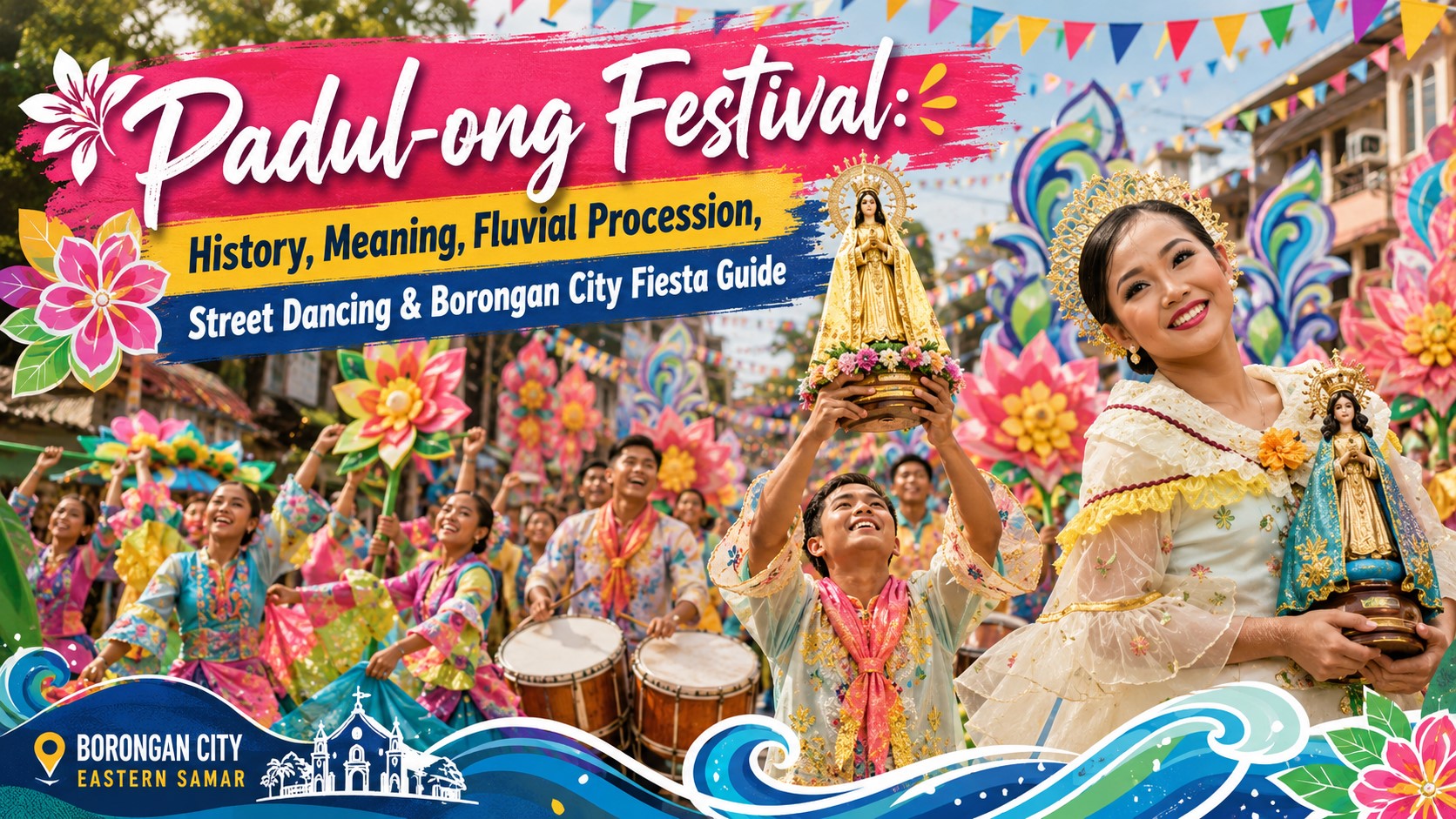
Padul-ong Street Dancing
This is the part most people see in photographs.
Dancers fill the streets in elaborate costumes.
Drummers move with the contingents.
Large props create dramatic scenes.
A performer may carry or raise an image of Mary while the rest of the group builds formations around that central figure.
The performance is often narrative rather than simply decorative.
The Philippine Information Agency describes the modern festival as combining devotion, tradition and artistry, with street performances dramatizing the image’s arrival at the parish church.
That storytelling component is what visitors should pay attention to.
Don’t just look at the costume colors.
Watch what the dancers are doing.
Some movements represent travel.
Others suggest the sea.
Some may portray hardship or danger.
Then the mood changes toward welcome, faith, celebration or thanksgiving.
The best Padul-ong performances turn a local legend into a short theatrical production performed in the middle of the street.
The Drums of Padul-ong
Like many major Philippine street festivals, percussion gives Padul-ong much of its energy.
You hear the contingents before you see them.
Drums establish the pace.
Chants carry through the streets.
Then dancers appear around the corner.
It’s a dramatic contrast with the quiet beginning at Punta Maria.
The festival starts with prayer before dawn.
Hours later, Borongan is filled with percussion and crowds.
That movement from solemnity to celebration mirrors the entire festival story.
The Modern Padul-ong Festival Began in the 1990s
Here’s another part of the festival’s history that often gets overlooked.
The oral traditions behind Padul-ong may be much older, but the organized festival itself is modern.
A detailed history of the celebration traces the idea to cultural worker and educator Neil Pinarok, who researched stories, folk practices, local legends and religious traditions around Borongan.
Working with other cultural advocates and consulting priests, religious sisters, elders and community members, he developed the concept that eventually became Padul-ong.
The first festival was staged in 1993.
That’s an important distinction.
Padul-ong isn’t an unchanged street festival that has been performed continuously since Spanish colonial times.
Instead, it is a modern cultural interpretation of much older stories.
And honestly, that makes sense.
Many festivals evolve this way.
Communities take oral history, religious traditions and local identity and translate them into a format younger generations can perform and understand.
In Padul-ong, that format became street theater, music, costumes and the fluvial reenactment.
Our Lady of the Nativity and the Borongan Fiesta
Padul-ong cannot be separated from Borongan’s devotion to the Blessed Virgin Mary.
Borongan Cathedral is officially the Cathedral Parish of the Nativity of Our Lady.
Available church records identify the parish as established in 1768 and list the Nativity of Our Lady as its titular devotion, with the feast celebrated on September 8.
September 8 commemorates the Nativity of the Blessed Virgin Mary—traditionally understood by Catholics as Mary’s birthday.
That explains the timing of Padul-ong.
The September 7 festival becomes a kind of arrival and welcome.
Then September 8 becomes the feast itself.
Is Padul-ong a Religious Festival?
Yes, although it also functions as a cultural festival.
That distinction can sometimes get blurry when you’re watching a highly competitive street-dancing performance.
There are trophies.
There are judges.
There are choreographers.
There are huge costumes.
But the Marian image being carried isn’t merely a festival prop.
For devotees, it represents their patroness.
The festival ultimately remains connected to faith and thanksgiving.
PIA has described Padul-ong as Borongan’s major expression of faith and heritage, with the Marian journey at the center of the celebration.
That’s why visitors should treat religious images and ritual moments respectfully even while enjoying the competition.
Hamorawon Spring and the Lady in White
Just when you think Padul-ong’s story is entirely about the sea, another piece of Borongan folklore appears.
Hamorawon Spring.
The natural spring near the center of Borongan became connected with another local story: the Lady in White.
According to the tradition, residents reported seeing a mysterious white-clad woman around the spring. Stories developed that she would disappear when spotted and that the spring’s water possessed healing properties.
Another version of the tradition connects the woman directly with the Virgin Mary.
Eastern Samar’s provincial tourism information explicitly links Padul-ong with the Lady in White who was believed to frequent Hamorawon Spring.
Again, this belongs to the realm of local religious folklore.
The claims of miraculous healing shouldn’t be treated as established medical fact.
But as cultural history, the story is extremely important.
It explains why the Padul-ong tradition isn’t centered on only one legend.
The sea journey, Punta Maria, the Marian image and Hamorawon Spring gradually became woven together into one larger Boronganon story.
Why Hamorawon Matters Even If You Don’t Believe the Legend
You don’t have to believe the miraculous claims to appreciate Hamorawon.
The spring was historically an important freshwater source around which community life developed.
That gives it significance even before the religious stories are considered.
A religious historian examining the Padul-ong tradition argued that these stories likely helped earlier Boronganons make sense of important places, religious devotion and community experiences.
That idea helps explain why old legends survive.
People attach stories to the places that matter to them.
Eventually, those places and stories become difficult to separate.
Padul-ong as Thanksgiving
There is one word that appears again and again when people talk about Padul-ong:
thanksgiving.
The festival isn’t only reenacting Mary’s arrival.
For many devotees, repeating the journey is a way of expressing gratitude.
A detailed account of the celebration describes Boronganons viewing the festival as thanksgiving to their patroness for protection and blessings.
That gives the festival a surprisingly personal dimension.
The big production may involve hundreds of performers.
But the devotion underneath it can be very individual.
Someone may be thankful for family.
Another person may be asking for protection.
Someone else may have returned home after years away.
For them, Padul-ong isn’t simply something tourists photograph.
It marks another year when Borongan gathers around the same story.
Padul-ong as a Boronganon Homecoming
Fiesta season in the Philippines has always been about more than official events.
It is also about coming home.
People who work elsewhere return to their hometowns.
Families prepare food.
Relatives visit.
Old classmates meet again.
Padul-ong fits naturally into that tradition.
Accounts of the festival describe residents returning from other parts of the Philippines and overseas specifically for the annual celebration.
And after the parade ends, the fiesta continues inside homes.
That’s a side of Philippine festivals travelers sometimes miss.
The competition might finish in the plaza.
But the fiesta doesn’t end there.
It moves to dining tables.
Why Padul-ong Festival Stands Out
The Philippines has no shortage of spectacular festivals.
So what makes Padul-ong different?
I think there are four things.
1. The festival moves from land to sea and back again
Few festivals have a structure this closely tied to geography.
You begin in a coastal barangay.
You travel by boat.
You arrive at the city.
Then the celebration continues through the streets.
2. The street dancing has a clear story
The dancers aren’t simply presenting generic festival choreography.
They’re interpreting a specific Boronganon narrative.
3. Faith and folklore exist side by side
Catholic Marian devotion sits alongside stories of a mysterious traveler, a Lady in White and a healing spring.
That combination gives Padul-ong a character that’s difficult to duplicate elsewhere.
4. It feels unmistakably Eastern Samar
The Pacific coast, fishing boats, local language, Borongan Bay, Punta Maria and Hamorawon aren’t interchangeable festival props.
They belong to this particular place.
That’s what good local festivals should do.
They should make sense only where they’re celebrated.
Visiting Padul-ong Festival
If you’re traveling to Borongan specifically for Padul-ong, don’t arrive on September 8 and assume you’ll see everything.
You’ll already have missed a lot.
September 7 is the date to prioritize for the major Padul-ong traditions.
Ideally, arrive at least one day earlier.
That gives you time to confirm the latest event route, understand transportation arrangements and prepare for an early start.
Wake Up Very Early
The traditional Padul-ong journey begins before normal tourist hours.
Past celebrations have started in the pre-dawn period at Punta Maria before the Marian image makes its way toward the coast.
Exact times can change each year.
But if you want the full experience, expect an early morning.
Very early.
Prepare for Rain
This is Eastern Samar.
And you’re visiting in September.
Weather along the Pacific side of the Philippines can change quickly.
Bring a light rain jacket or umbrella, quick-drying clothing and something waterproof for your phone.
This matters even more if you’re hoping to participate in or watch the fluvial activities.
Check the Official Program
Don’t assume last year’s parade route, competition venue or departure time will be used again.
Street-dancing routes change.
Tides can affect marine activities.
Weather can affect outdoor events.
The Borongan City Government, local tourism authorities and church organizers are the sources worth checking immediately before the festival.
Getting to Borongan City
Borongan is the capital of Eastern Samar and lies along the province’s Pacific coast.
The city has its own airport, and scheduled commercial flights have operated there in recent years. Philippine News Agency reporting also notes the role of air service in increasing visitor arrivals to events including Padul-ong.
However, airline schedules can change.
So check current services rather than assuming a particular route is operating.
For many travelers, Tacloban remains another practical gateway to Eastern Samar, followed by an overland trip toward Borongan.
If you’re traveling during fiesta week, allow extra time.
Festivals mean more passengers, more road activity and more people returning home.
What Else to See in Borongan
Padul-ong is reason enough to visit, but Borongan is also a destination worth exploring after the crowds settle.
The wider Eastern Samar area is known for Pacific beaches, surfing, islands, waterfalls and rugged coastal scenery. The Department of Tourism highlights the province’s combination of surfing destinations, islands and cultural heritage.
Within Borongan itself, several places connect naturally with the festival experience.
Borongan Cathedral
This is the religious center of the fiesta.
If you’re visiting during September 7–8, remember that the cathedral isn’t just a tourist attraction.
It is an active place of worship.
Hamorawon Spring
Visit this after learning the Padul-ong story and it becomes much more interesting.
You are standing in one of the places around which Borongan’s Marian folklore developed.
Borongan Bay
Seeing the coastline after watching the fluvial procession makes the connection between city and sea much clearer.
The ocean isn’t scenery added to the festival.
It is part of its identity.
Padul-ong Festival Frequently Asked Questions
Where is Padul-ong Festival celebrated?
Padul-ong Festival is celebrated in Borongan City, the capital of Eastern Samar in Eastern Visayas.
When is Padul-ong Festival?
Padul-ong is traditionally celebrated on September 7.
The following day, September 8, is Borongan’s patronal fiesta honoring the Nativity of the Blessed Virgin Mary.
What does Padul-ong mean?
Padul-ong comes from dul-o, a local term carrying the sense of bringing, accompanying or delivering someone to a destination. The name reflects the festival’s central story about bringing the Marian image to Borongan.
What is Padul-ong Festival famous for?
It is best known for its fluvial procession, Marian devotion, street dancing, ritual presentations and reenactment of the traditional story of Our Lady of the Nativity’s arrival in Borongan.
Is Padul-ong a religious festival?
Yes.
It is both religious and cultural.
The festival honors the Nativity of Our Lady while using dance, music and theatrical presentation to retell Borongan’s Marian tradition.
Who is the patroness of Borongan City?
Borongan Cathedral is dedicated to the Nativity of Our Lady, whose feast is celebrated on September 8.
Is the story about the Virgin Mary coming from Portugal historically proven?
It is better understood as local religious tradition and folklore rather than established historical fact.
The Provincial Government of Eastern Samar itself describes Padul-ong as a mythical presentation, while local historical scholarship has treated parts of the tradition as explanatory legend.
What is Punta Maria?
Punta Maria is the coastal community associated with the traditional story of the Marian image’s arrival and is traditionally the starting point of the annual Padul-ong journey.
What is Hamorawon Spring?
Hamorawon is a historic freshwater spring in Borongan connected with local stories about a mysterious Lady in White and reputed miraculous healing. Those healing accounts belong to local folklore and religious belief rather than established medical evidence.
Is there a boat procession during Padul-ong?
Yes.
The fluvial procession is one of the festival’s defining traditions, reenacting the arrival of the Marian image by sea before the celebration continues through Borongan’s streets.
When did the modern Padul-ong Festival begin?
The modern festival was first staged in 1993 after local cultural advocates researched and developed Borongan’s Marian oral traditions into a public cultural presentation.
Padul-ong Festival 2026
This article is designed to remain useful from year to year, but travelers planning specifically for 2026 should remember two dates.
| Date | Celebration |
|---|---|
| September 7, 2026 | Padul-ong Festival |
| September 8, 2026 | Feast of the Nativity of Our Lady / Borongan City Fiesta |
September 7 remains the established Padul-ong date according to the Provincial Government of Eastern Samar, while Borongan Cathedral observes its patronal feast on September 8.
As of early September 2026, the safest approach for anyone traveling specifically for the festival is to verify the final timetable for the fluvial procession, street dancing, competition venues and religious activities through Borongan’s official local-government and church announcements. The annual dates are well established, but event times and routes can change.
Final Thoughts
Some festivals are easiest to understand from the grandstand.
Padul-ong isn’t one of them.
To really understand this celebration, you have to follow the journey.
Start in Punta Maria before sunrise.
Watch the Marian image move toward the coast.
See the boats gather.
Follow the procession across the water.
Then wait as the quiet devotion of the morning becomes drums, costumes and street dancing in Borongan.
And finally, remember what everything is pointing toward: September 8 and the city’s devotion to Our Lady of the Nativity.
Padul-ong is colorful enough to work as a tourism festival. The costumes are dramatic. The street dancing produces beautiful photographs. The fluvial procession alone makes the celebration stand out among September festivals in the Philippines.
But the deeper reason it continues isn’t the spectacle.
It is because Borongan has taken an old collection of stories—about a ship, a mysterious woman, Punta Maria, Hamorawon Spring and the Virgin Mary—and turned them into something the community can experience together every year.
The historical details may live partly in legend.
The devotion, however, is very real.
And every September, Borongan takes that story back to the sea and brings it home again.