If you’ve ever seen photos of the Peñafrancia celebration in Naga City, you’ve probably encountered one unforgettable image: a sea of devotees surrounding the image of Our Lady of Peñafrancia, hands raised, bodies pressed together and voices shouting, “Viva la Virgen!”
Among the people closest to Ina are the voyadores.
These are the devotees traditionally entrusted with carrying and protecting the image during the famous Peñafrancia processions.
And from that deeply rooted religious tradition came one of Naga City’s most colorful cultural events—the Peñafrancia Voyadores Festival.
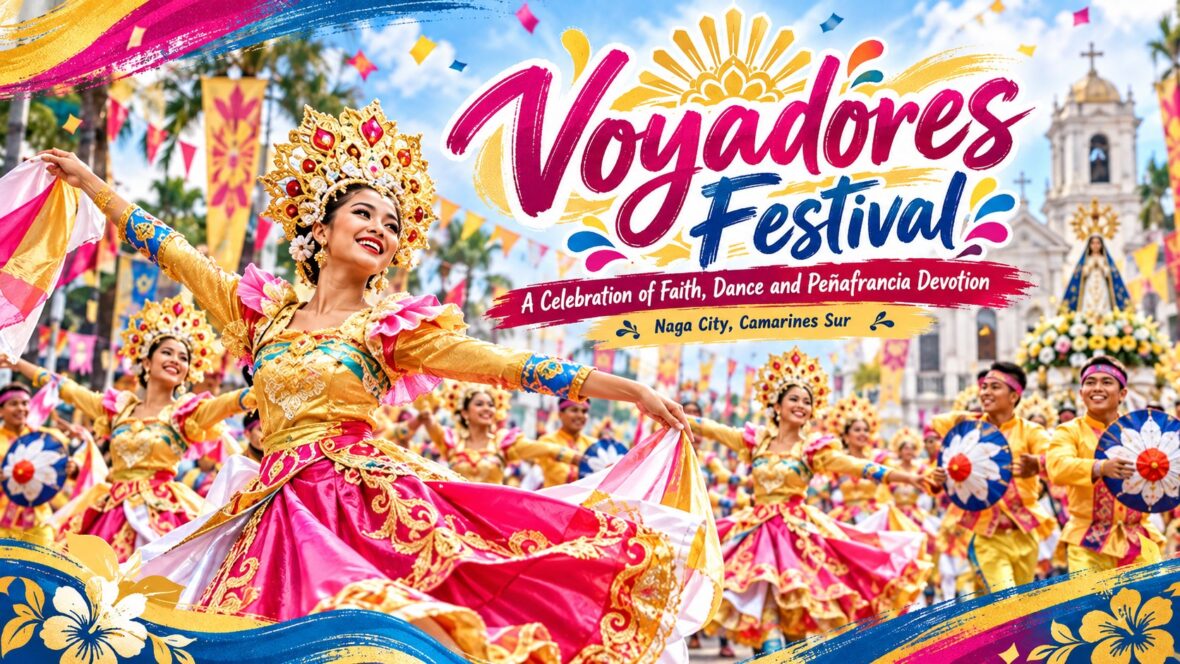
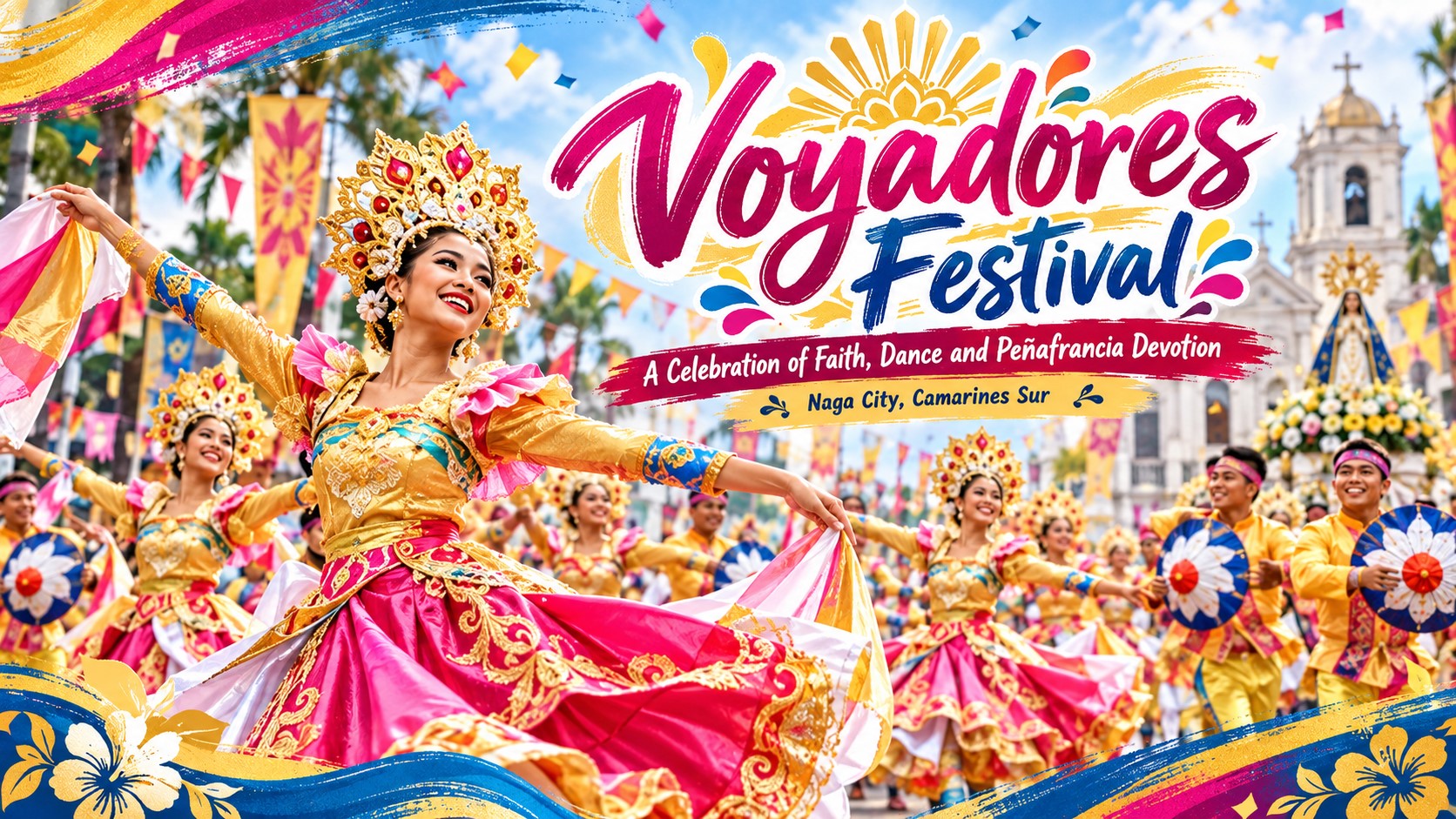
Held during the annual Peñafrancia festivities in September, the Voyadores Festival transforms devotion into movement, music and street performance. Dancers take over the streets in colorful costumes, interpreting through choreography the journey of Our Lady of Peñafrancia and the faith of the devotees who accompany her.
But this isn’t simply another street-dancing competition.
The festival exists because of a much older story—one that begins with Naga’s centuries-old devotion to a woman affectionately called Ina.
If you’re planning to experience the Voyadores Festival someday, here’s everything you need to know.
Content
Voyadores Festival at a Glance
| Festival | Peñafrancia Voyadores Festival |
|---|---|
| Location | Naga City, Camarines Sur |
| Province | Camarines Sur |
| Region | Bicol Region |
| Usual month | September |
| Celebration | Part of the Peñafrancia Fiesta |
| Honoree | Our Lady of Peñafrancia, lovingly called Ina |
| Main event | Street and Pilgrims Dance Competition |
| Festival began | 1996 |
| Main themes | Faith, devotion, pilgrimage and Bicolano culture |
| Related traditions | Traslacion and Peñafrancia Fluvial Procession |
The festival is officially staged as the Peñafrancia Voyadores Festival Street and Pilgrims Dance Competition and forms part of the wider Peñafrancia celebration organized in Naga City every September.
What is the Voyadores Festival?
The Voyadores Festival is a cultural and religious street-dancing celebration held in Naga City as part of the Peñafrancia Fiesta.
Its performances are inspired by the devotion to Our Lady of Peñafrancia and, in particular, by the men traditionally known as voyadores who carry and escort her image during the Traslacion and Fluvial Procession.
The competition translates these acts of devotion into dance.
Performers recreate the movement, emotion and energy of pilgrimage through choreographed street performances. The result is an event that can feel festive and competitive on the surface while remaining closely connected to a religious tradition underneath.
Official festival guidelines describe Voyadores as a cultural and religious homage to Our Lady of Peñafrancia, the Patroness of Bicol.
That’s what makes this festival different from many other street-dancing events around the Philippines.
The dancers aren’t just presenting a story from local folklore or celebrating a particular crop.
They’re interpreting a living devotion that continues around them every September.
What Does “Voyadores” Mean?
The term “voyadores” traditionally refers to the male devotees who accompany Our Lady of Peñafrancia and carry the andas—the platform bearing her image—on their shoulders.
In a broader sense, the term is also sometimes used when referring to the larger community of devotees accompanying Ina.
Festival guidelines make this distinction clearly: strictly speaking, voyadores are the male devotees carrying the andas, although the word may be used more loosely for devotees of different ages and genders.
During the actual Peñafrancia processions, the role of the voyadores is much more than ceremonial.
They walk among enormous crowds, helping protect the image while guiding it through the procession route.
The Archdiocese of Caceres describes organized voyadores as devotees who undergo spiritual preparation before the annual Traslacion and Fluvial Procession. Many traditionally walk barefoot during the processions.
So when dancers portray voyadores during the festival, they’re representing real people performing a real devotional responsibility.
Who is Our Lady of Peñafrancia?
To understand the Voyadores Festival, you really have to understand Ina first.
Our Lady of Peñafrancia is one of the most important Marian figures in the Philippines and is especially beloved throughout the Bicol Region.
Bicolanos affectionately call her “Ina,” which simply means “Mother.”
The devotion in Naga dates back to around 1710.
Rev. Fr. Miguel Robles de Covarrubias, who was devoted to Our Lady of Peña de Francia in Spain, brought that devotion to what was then Nueva Caceres, today’s Naga City.
He commissioned a local sculptor to create an image based on the Spanish devotion and built a chapel where the image could be enshrined.
More than three centuries later, the devotion remains central to the religious identity of Naga and much of Bicol.
Every September, pilgrims travel to the city to participate in novenas, Masses, processions and other events honoring Ina.
And somewhere within this massive celebration is the Voyadores Festival.
The History of the Voyadores Festival
Interestingly, the Peñafrancia devotion may be more than 300 years old, but the Voyadores Festival itself is relatively young.
The festival was conceptualized in the mid-1990s by the Diverse Initiative for Bikolano Artists, or DIBA, a group involving people from Naga’s performing arts, academic, religious and business communities.
The idea was eventually presented to the Naga City Government and incorporated into the official Peñafrancia Fiesta activities.
According to official festival guidelines from DepEd Naga, the inaugural Peñafrancia Voyadores Festival was held in 1996.
The concept was clever.
Naga already had one of the country’s most recognizable religious celebrations.
Instead of creating an unrelated street festival simply for entertainment, organizers developed something directly connected with Peñafrancia.
The voyadores became the inspiration.
Their movements, devotion and role in carrying Ina could now be interpreted through dance.
In that way, the festival developed its own identity without separating itself from the deeper religious tradition surrounding it.
Why the Voyadores Festival Was Created
During the 1990s, street-dancing festivals were becoming increasingly prominent around the Philippines.
Cebu had Sinulog.
Kalibo had Ati-Atihan.
Iloilo had Dinagyang.
Different cities were identifying themselves with festivals that combined tourism, performance and local heritage.
Research documenting the creation of the Voyadores Festival shows that Naga artists similarly wanted a distinctive cultural expression connected specifically with their city.
Rather than copying another festival, the resulting concept drew from something Naga already possessed: Peñafrancia devotion and the voyadores.
That connection is probably the most important reason the festival has endured.
Voyadores isn’t simply colorful because festivals are expected to be colorful.
Its imagery comes from traditions that are already part of Naga’s identity.
Street Dancing: The Heart of the Festival
This is the part most visitors come to see.
Groups of dancers move through the streets of Naga performing elaborate choreography accompanied by drums, music and chanting.
The performances can be energetic.
Very energetic.
But look carefully and you’ll notice that the movements aren’t random.
The dancers often interpret the journey of Ina, the devotion of pilgrims and the role played by the voyadores during the Peñafrancia processions.
Academic research on the festival describes participating groups as portraying aspects of both the Traslacion and Fluvial Procession through street dance and music.
Some choreography may suggest carrying the image.
Other sequences evoke the movement of crowds.
Props can reference processions, boats, the andas and other Peñafrancia symbols.
What you’re essentially watching is a religious procession retold through dance.
The Pilgrims Dance Competition
The official event isn’t simply called street dancing.
Today it is commonly presented as the Peñafrancia Voyadores Festival Street and Pilgrims Dance Competition.
That word “pilgrims” matters.
Peñafrancia is fundamentally a pilgrimage.
Every year, devotees from different parts of Bicol and elsewhere travel to Naga to fulfill a panata, attend Mass, pray to Ina or join the procession.
During Voyadores, those experiences become material for artistic interpretation.
Dance contingents aren’t limited to simply showing fast choreography.
The best performances have to communicate emotion.
Devotion.
Sacrifice.
Hope.
Thanksgiving.
And that makes Voyadores particularly interesting compared with festivals built mainly around spectacle.
It can still be spectacular.
But there is always something deeper underneath.
The Traslacion
One of the traditions most closely associated with the voyadores is the Traslacion.
The Traslacion marks the transfer of the images of Our Lady of Peñafrancia and the Divino Rostro from the old Peñafrancia Shrine toward the Naga Metropolitan Cathedral.
Thousands of devotees fill the streets as Ina begins her journey.
The official Voyadores Festival guidelines describe the Traslacion as the procession in which barefoot voyadores carry the andas of Ina toward the Metropolitan Cathedral at the beginning of the novena period.
This is one of the most intense moments of the entire Peñafrancia celebration.
The crowd can be enormous.
You’ll hear people shouting:
“Viva la Virgen!”
“Viva la Virgen de Peñafrancia!”
There are arms everywhere.
Devotees try to get close.
Voyadores work together around the image.
For a visitor watching for the first time, the atmosphere can be overwhelming.
And this is exactly the type of energy that Voyadores Festival dancers attempt to translate onto the streets.
The Fluvial Procession
If the Traslacion shows Ina being carried through Naga’s streets, the Fluvial Procession gives the Peñafrancia celebration its most iconic image.
After the novena period, Ina is brought from the Naga Metropolitan Cathedral toward the Naga River and placed aboard a decorated pagoda.
She then travels along the river toward the Basilica Minore.
Voyadores accompany and protect the image while enormous crowds line the riverbanks, bridges and nearby buildings.
The procession is one of the largest religious gatherings associated with the Peñafrancia devotion. Naga tourism officials reported around 1.8 million pilgrims, voyadores and visitors around the 2025 Fluvial Procession alone.
The journey along the water also inspires the Voyadores Festival.
Dancers may incorporate movements associated with rowing, waves, boats and the return journey of Ina.
So even if you’ve never experienced the actual Fluvial Procession, parts of its story can appear in the choreography.
Why You See Oars in Voyadores Performances
One prop that often makes perfect sense once you know the story is the paddle or oar.
The Fluvial Procession takes Ina along the Naga River aboard the pagoda.
Because the Voyadores Festival interprets the journey of the image, performers may use objects and movements that suggest boats, rowing and the river procession.
Research on Voyadores choreography has documented dancers raising and moving oar-like props while portraying the fluvial component of the devotion.
For someone unfamiliar with Peñafrancia, it can simply look like another colorful festival prop.
But once you know the meaning, you see something completely different.
The dancers aren’t just holding an oar.
They’re recreating the journey home.
Festival Costumes
Voyadores costumes can be incredibly colorful, but they generally work within the religious and Bicolano theme of the celebration.
You may see shades associated with Marian devotion, regional culture or the individual artistic concept of each competing group.
Costume design can incorporate flowing fabric, traditional-inspired details, headpieces, sashes and other elements chosen to make the dancers’ movements more visible.
Because this is a competition, groups naturally try to create strong visual identities.
But the most effective designs don’t overpower the subject.
Ina should still remain at the center of the story.
The festival isn’t really about who can wear the biggest costume.
It’s about how costume, dance, music and storytelling come together to express devotion.
Faith Meets Art
This is probably my favorite thing about Voyadores Festival.
There are clearly two sides to it.
One is religious.
The other is artistic.
You have a centuries-old Marian devotion on one side and contemporary competitive street dancing on the other.
Instead of treating those things as opposites, Voyadores brings them together.
Naga City itself has described the revived festival as an expression combining “faith and artistry.”
That phrase sums it up nicely.
Without the artistic side, you wouldn’t have the competition.
Without the faith behind it, Voyadores would lose the reason it exists.
Voyadores Festival vs. Peñafrancia Festival
This is an important distinction because the names sometimes get mixed together online.
Voyadores Festival and Peñafrancia Festival are not exactly the same thing.
The Peñafrancia Fiesta is the much larger annual religious and civic celebration honoring Our Lady of Peñafrancia.
Voyadores is one major event within that celebration.
Think of it this way:
Peñafrancia Fiesta is the entire celebration.
Voyadores Festival is the street and pilgrims dance competition held during it.
Other Peñafrancia activities include the Traslacion, novena Masses, the Civic and Float Parade, military parade, fairs, concerts, exhibitions and, of course, the Fluvial Procession.
If you’re planning a trip, I’d strongly recommend staying long enough to experience several of these events.
Watching Voyadores alone is fun.
Watching Voyadores after you’ve already experienced the Traslacion gives the dancing much more meaning.
The Religious Voyadores vs. Festival Dancers
Another distinction worth making is between actual voyadores and dancers performing in the Voyadores Festival.
They’re related, but they’re not necessarily the same people.
Actual voyadores have a devotional responsibility connected with accompanying Ina during the procession.
The Archdiocese of Caceres has developed organized spiritual formation for these devotees, particularly through the Cofradia de San Jose.
Festival dancers, meanwhile, participate in a choreographed artistic competition inspired by them.
That difference matters.
One is primarily devotional service.
The other is cultural performance portraying that devotion.
Both are connected to Peñafrancia, but they shouldn’t be treated as interchangeable.
Why Naga is Called the Pilgrim City
During ordinary months, Naga is one of the major urban centers of the Bicol Region.
September is different.
Peñafrancia changes the entire rhythm of the city.
Pilgrims arrive.
Hotels fill.
Streets close.
Religious images appear everywhere.
Businesses decorate their establishments.
Churches become packed.
And entire roads can suddenly transform into rivers of people.
The devotion to Our Lady of Peñafrancia has existed in Naga since around 1710 and has grown into one of the defining religious traditions of Bicol.
Voyadores is part of that larger transformation.
For one afternoon, dancers take the religious imagery surrounding the entire fiesta and turn it into performance.
When is Voyadores Festival Celebrated?
Voyadores Festival is held during the annual Peñafrancia celebration in September.
The exact date can change from year to year depending on the official Peñafrancia calendar.
Older references sometimes describe Voyadores as occurring around the third Friday of September, but modern schedules are set individually each year.
Because of that, don’t plan your trip based solely on an old festival calendar.
Always check the current Naga City or Peñafrancia schedule.
What remains consistent is its place within the wider September celebration.
Where is the Voyadores Festival Held?
The street-dancing route and performance areas may vary.
In recent editions, activities have centered around major roads and public spaces in central Naga, including areas near the Naga Metropolitan Cathedral and Plaza Quezon.
For 2026, for example, the official route runs from the Naga Metropolitan Cathedral toward Plaza Quezon.
Festival organizers can modify routes because of traffic, construction, security or crowd-control requirements.
So even if you’ve attended Voyadores before, it’s worth checking the latest route map.
What to Expect as a First-Time Visitor
Expect crowds.
September is not the time to visit central Naga expecting quiet streets and easy transportation.
But that’s also what makes Peñafrancia exciting.
People come from all over Bicol.
Families gather.
Pilgrims walk through the streets.
Musicians, performers and vendors fill public areas.
During Voyadores itself, spectators usually crowd around performance routes long before the first dancers arrive.
If photography is important to you, get there early.
A shaded viewing area is even better.
Bring water.
Wear comfortable shoes.
Use sunscreen.
Keep rain protection nearby because September weather can change quickly.
And travel light.
Moving through a festival crowd with a giant backpack is rarely fun.
Respect the Religious Side of the Celebration
This is especially important at Voyadores.
It may look like a street festival, but the event exists within a religious celebration.
For many people around you, Peñafrancia isn’t entertainment.
It’s panata.
It’s thanksgiving.
It’s prayer.
Some pilgrims have traveled considerable distances simply to see Ina.
So enjoy the dancing, take photos and cheer for the performers.
Just remember the environment you’re in.
The moment can be both joyful and sacred at the same time.
Food to Try While You’re in Naga
If you’re already traveling to Naga for Voyadores, don’t leave without exploring Bicolano food.
This is one of the easiest regions in the Philippines to get excited about eating.
Start with Bicol Express.
Then try laing.
Look for pinangat.
If you enjoy spicy food, you’re definitely in the right place.
And then there’s pili.
Pili nuts are everywhere in Naga—from candies and pastries to desserts and souvenir packs.
During Peñafrancia season you’ll also encounter food stalls, restaurants, fairs and temporary festival markets around the city.
My advice?
Don’t make every meal fast food just because you’re rushing between events.
Make time for at least one proper Bicolano meal.
You’ll remember it.
Places to Visit Around Naga During Peñafrancia
A festival trip becomes much more meaningful if you visit the places connected to the devotion.
Our Lady of Peñafrancia Shrine
The historic Peñafrancia Shrine is closely associated with the beginnings of the devotion in Naga and serves as the starting point of the Traslacion.
Naga Metropolitan Cathedral
The Metropolitan Cathedral becomes one of the central religious locations during the Peñafrancia novena.
Ina stays here during a major part of the festival period before the Fluvial Procession.
Basilica Minore de Nuestra Señora de Peñafrancia
The Basilica Minore is the present home of the image of Our Lady of Peñafrancia.
Construction began in 1976, the building was completed in 1981 and it received the title of Basilica Minore in 1985.
Plaza Quezon
Plaza Quezon sits in the heart of downtown Naga and frequently serves as a venue or destination for civic festival activities, including Voyadores events.
Visit these places and suddenly the street dancing feels like part of a much larger story.
How to Get to Naga City
Naga is accessible by both land and air.
From Metro Manila, long-distance buses travel directly to the city, generally arriving at Bicol Central Station. Naga’s tourism office estimates typical Manila-Naga bus travel at around eight to ten hours, although actual journey times depend on traffic and road conditions.
Air travelers can also use Naga Airport in nearby Pili. Flight availability and routes can change, so check airline schedules when planning. Another option is Bicol International Airport in Daraga, Albay, followed by a land trip to Naga.
Once you’re in the city, jeepneys, tricycles, e-trikes and other local transportation options are available.
During Peñafrancia, however, walking often becomes surprisingly practical because roads around major events can be closed or congested.
How Long Should You Stay?
If you’re traveling specifically for Voyadores, I’d recommend staying for more than one night.
Three or four days gives you a much better experience.
Ideally, try to see:
- the Traslacion,
- Voyadores Festival,
- some of the novena or civic activities,
- and the Fluvial Procession.
You don’t necessarily need to see everything.
But if Voyadores is your only exposure to Peñafrancia, you’re seeing just one chapter of the story.
The actual processions help explain everything the dancers are portraying.
Voyadores Festival 2026
For travelers planning specifically for 2026, there is already an official schedule.
The Peñafrancia Voyadores Festival Street and Pilgrims Dance Competition is scheduled for Thursday, September 17, 2026, beginning at 2:00 PM.
The official route is from the Naga Metropolitan Cathedral to Plaza Quezon.
Other major 2026 Peñafrancia dates include:
- September 11 – Peñafrancia Traslacion Procession
- September 16 – Scouts Parade and Drum, Xylophone and Majorettes Corps Competition
- September 17 – Civic and Float Parade
- September 17 – Voyadores Festival Street and Pilgrims Dance Competition
- September 18 – Bicol Regional Military Parade Exhibition
- September 19 – Peñafrancia Fluvial Procession
For 2026, the Fluvial Procession is scheduled to begin at 3:00 PM on September 19, traveling from the Naga Metropolitan Cathedral toward the Basilica Minore through the Naga River.
Travelers should still check Naga City’s official announcements shortly before visiting because traffic plans, route details and event logistics can be adjusted.
Why Voyadores Festival Matters
It would be easy to describe Voyadores Festival as another colorful Philippine street-dancing competition.
But that misses the point.
Voyadores exists because generations of people have carried Ina through Naga.
Literally.
Men have placed the andas on their shoulders.
Families have waited along procession routes.
Pilgrims have walked barefoot.
People have prayed.
Some have returned year after year because of promises they made decades ago.
And from that collective devotion came a festival.
That’s what makes Voyadores interesting.
The choreography may be modern.
The costumes may change.
The competition format can evolve.
But underneath all that movement is a tradition more than three centuries old.
Final Thoughts
Voyadores Festival is colorful, energetic and incredibly photogenic.
But the closer you look, the more you realize that the festival isn’t really about dancing.
It’s about carrying.
Carrying a religious image.
Carrying a promise.
Carrying a tradition from one generation to another.
The actual voyadores carry Ina through enormous crowds during the Peñafrancia processions.
Festival dancers carry that story through music and movement.
And every September, Naga City carries the devotion forward once again.
So yes, come for the costumes.
Come for the drums.
Come for the street dancing.
But if you really want to understand Voyadores Festival, stay long enough to witness Peñafrancia itself.
Stand somewhere in Naga while thousands of people around you begin shouting:
“Viva la Virgen!”
And suddenly, everything you saw in the dance will make sense.