In many farming communities across the Philippines, the carabao is much more than an animal working in the fields.
For generations, it has helped farmers plow rice paddies, transport crops, carry heavy loads and support families living in rural communities. Even as tractors and other machines have become more common, the carabao remains one of the most recognizable symbols of Philippine agriculture.
In the town of Gandara in Samar, this relationship between farmers and their dependable working animals is celebrated through the Karabaw Festival.
Held every September as part of Gandara’s town fiesta, the festival transforms the streets into a colorful celebration of rural Samareño life. Dancers dress as farmers, townspeople, birds and carabaos. Agricultural scenes become choreography. Traditional stories and local history find their way into elaborate performances.
And behind all those costumes and energetic street dances is a simple idea: honoring something that has quietly played an important role in the lives of Gandaranhons for generations.
Welcome to the Karabaw Festival.
Content
What is the Karabaw Festival?
Karabaw Festival is a cultural festival celebrated in Gandara, a municipality in the province of Samar in Eastern Visayas.
The festival pays tribute to the carabao and its contribution to farming and livelihood while also forming part of the town’s annual celebration in honor of St. Michael the Archangel.
September 29 is traditionally regarded as the festival’s main date because it coincides with the feast of St. Michael the Archangel, Gandara’s patron saint. Samar tourism listings also identify September 29 as the date of the Karabaw Festival.
But Karabaw Festival is not simply a parade of actual carabaos.
Its best-known feature is its street dancing.
Performers use elaborate costumes, props and choreography to portray the agricultural life of Samar. Some represent carabaos while others portray farmers, villagers and different characters connected with Gandara’s history and culture.
That gives the festival a theatrical quality.
Rather than simply displaying rural traditions, dancers recreate them in the streets.
Why Is It Called Karabaw Festival?
The name comes from the Visayan form of the Filipino word kalabaw.
The National Museum of the Philippines identifies “karabaw” as a Visayan local name for the swamp buffalo or water buffalo, the animal commonly known throughout the country as the carabao.
For anyone who grew up around Philippine farming communities, the importance of the carabao is easy to understand.
Before machines became widely available, farmers depended heavily on these animals.
Carabaos could pull plows through muddy rice fields, transport agricultural products and help families move goods between farms and villages.
Their strength made them especially useful in wet agricultural environments.
The National Museum describes them as important contributors to Philippine agriculture, noting their roles in farming, transportation and dairy production.
That agricultural connection is at the heart of Karabaw Festival.
The celebration takes an animal that people might otherwise see as ordinary and turns it into a symbol of hard work, patience and rural life.
Where Is Karabaw Festival Celebrated?
Karabaw Festival is celebrated in Gandara, Samar.
Gandara is an inland municipality located northwest of Catbalogan City and southeast of Calbayog City. The town is connected with the Gandara River, which has long played an important role in transportation, community life and local traditions.
Gandara was historically associated with the settlement of Bangahon before residents eventually established the present town. Historical accounts note that the community was relocated to its present location in the early 1900s.
That older Bangahon identity still appears in local cultural discussions today.
In fact, some contemporary cultural research refers to the celebration as the Bangahon-Karabaw Festival, linking the modern festival with Gandara’s older historical and cultural identity.
However, travelers will commonly encounter the simpler name Karabaw Festival when looking for information about Gandara’s fiesta.
When Is Karabaw Festival Celebrated?
Karabaw Festival is traditionally associated with September 29.
This is also the feast day of St. Michael the Archangel, the patron saint of Gandara.
The wider fiesta celebration may begin several days before the feast itself.
Depending on the year, Gandara may organize different religious, cultural, entertainment and community activities leading up to September 29.
That means visitors shouldn’t necessarily expect every major festival activity to happen on the same day.
Street dancing, competitions and other cultural presentations may be scheduled earlier during the fiesta period.
The safest approach for travelers is to treat late September as the main festival season and confirm the official program for the particular year they plan to visit.
Karabaw Festival and St. Michael the Archangel
One of the things that makes Philippine festivals fascinating is the way local culture and Catholic traditions often come together.
Karabaw Festival is a good example.
On one side, the celebration recognizes the agricultural identity of Gandara and the importance of carabaos to farmers.
On the other side, the town fiesta honors St. Michael the Archangel.
September 29 is observed in the Catholic calendar as the Feast of the Archangels Michael, Gabriel and Raphael, but St. Michael holds special importance in Gandara as the town’s patron.
The town’s religious heritage also stretches back to its older settlement.
The ruins of the old Bangahon church remain connected with Gandara’s history and devotion to St. Michael.
So during fiesta season, visitors may experience both lively cultural performances and religious activities.
These aren’t necessarily separate celebrations.
Together, they reflect the two sides of the fiesta: faith and community culture.
The Carabao as the Star of the Festival
It would be easy to think that celebrating a farm animal is mostly for fun.
But there is a deeper reason the carabao deserves such recognition.
Imagine farming in the Philippines decades ago.
There were no affordable tractors available to every farmer.
Roads in many rural areas were poor.
Fields became extremely muddy during planting season.
Moving sacks of rice, coconuts or other crops required considerable effort.
A strong carabao could make all of that easier.
Farmers used them to pull plows, haul carts and transport agricultural products.
For many households, owning a healthy carabao meant having an important productive asset.
And even today, carabaos continue to have economic value through dairy production and farming.
Karabaw Festival is essentially Gandara’s public thank-you to that long relationship.
Gandara’s Famous Keseo
There is another reason the carabao is particularly relevant to Gandara.
Milk.
Gandara is known for its traditional white cheese commonly called keseo or queseo.
The cheese is made from carabao’s milk and is one of the food products associated with the town.
Several descriptions of the Karabaw Festival specifically connect the celebration with keseo, explaining that the festival honors the animal not only for helping farmers cultivate their land but also for providing milk used in Gandara’s local cheese.
Keseo is generally a soft, salty white cheese.
If you’ve encountered kesong puti elsewhere in the Philippines, the idea is similar, although local preparation and flavor can vary.
It is the kind of food that makes the festival theme feel even more complete.
The carabao isn’t simply represented symbolically in a dance.
It contributes directly to a traditional product associated with the town.
Street Dancing: The Biggest Attraction
For visitors, the street dancing is often the most exciting part of Karabaw Festival.
This is where Gandara’s agricultural identity becomes a full-scale performance.
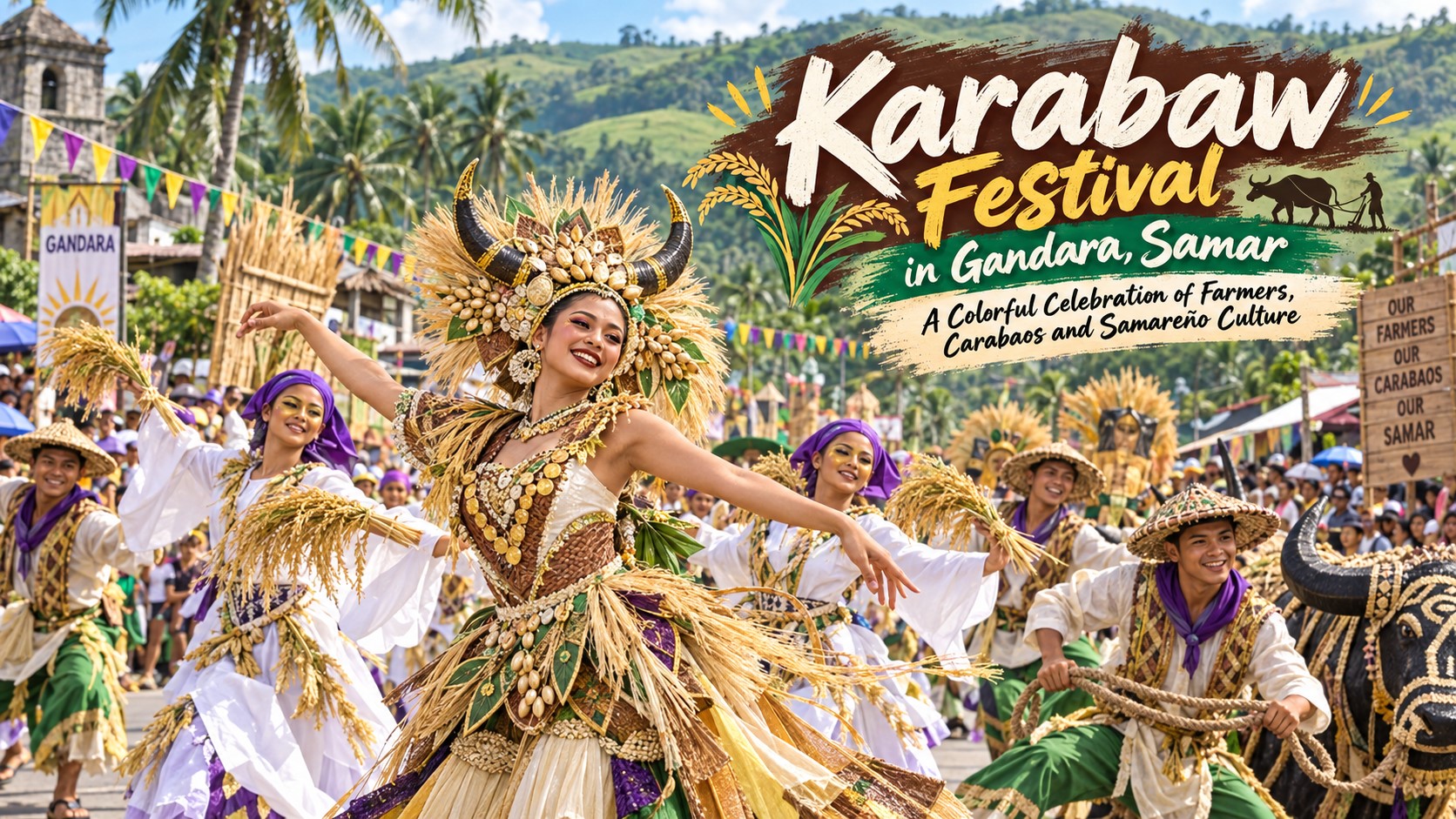
Groups of dancers move through the streets wearing colorful costumes inspired by rural life.
Some portray farmers.
Others represent townspeople.
And of course, there are performers portraying carabaos.
Historical descriptions of the festival say that the street dancing depicts rural life in Samar, with performers appearing as carabaos, farmers and other members of the community.
The result can be lively and theatrical.
Dancers recreate activities connected with farming and village life while musicians and festival rhythms keep the performance moving.
Instead of simply watching a parade, spectators are effectively watching a moving story about Gandara.
Costumes Inspired by Rural Samar
Costumes are an important part of almost every Philippine street-dancing festival, but they play a particularly interesting role in Karabaw Festival.
Imagine trying to represent a carabao through dance.
You need recognizable features.
Horns.
Dark earthy tones.
Large shapes.
Farm-related materials.
Designers can exaggerate these visual elements so audiences immediately understand what the performers represent.
Other dancers may wear costumes inspired by farmers, village residents, agricultural products, birds or characters from local stories.
The costumes don’t have to reproduce everyday clothing exactly.
Festival designers often turn ordinary rural elements into something much more theatrical.
A farmer becomes a character.
A farm animal becomes a giant costume.
A field becomes a backdrop.
Agriculture becomes art.
The Dance Tells a Story
One of the best ways to appreciate Karabaw Festival is to look beyond the steps.
Many festival routines work like short theatrical productions.
There is often a story.
Dancers may show farmers working.
Carabaos may appear to plow fields.
Communities gather.
Characters interact.
Celebration follows.
The movements can portray hardship, cooperation, harvest and thanksgiving.
Some versions of the festival have also included characters such as Ungaho, Menga, Hadang, Talabong, warriors and townspeople, showing how the performance has incorporated stories and symbols beyond the carabao itself.
This makes Karabaw more than an agricultural-themed dance competition.
Over time, it has become a platform for telling stories associated with Gandara.
The Talabong
One interesting character that has appeared in Karabaw Festival presentations is the talabong.
Talabong refers to a white bird, and dancers portraying these birds have appeared alongside the festival’s farmers, warriors, villagers and carabaos.
A firsthand account from a former Karabaw Festival performer recalls taking part as a talabong dancer beginning around 2000.
This detail gives you an idea of just how imaginative the festival can become.
It isn’t simply a line of performers wearing buffalo horns.
The performance creates an entire rural environment.
Animals, people and elements of the landscape can all become characters.
Farmers at the Center of the Celebration
Although the festival is named after the carabao, the farmer is equally important.
The two are connected.
For generations, farmers and carabaos worked side by side.
One guided the plow.
The other provided the strength.
So when Karabaw Festival celebrates the animal, it also recognizes the agricultural communities that relied on it.
This is why scenes of planting, plowing and rural livelihood fit naturally into the festival.
The celebration acknowledges not just what farmers produce but the work required to produce it.
And that is something worth remembering in an age when food usually appears neatly packaged in supermarkets, far removed from the fields where it originated.
A Festival Known Beyond Gandara
Karabaw Festival has not remained completely confined to Gandara.
Over the years, festival groups from the municipality have represented the town in competitions and cultural events elsewhere.
Local accounts report that Karabaw Festival won the Samar Day festival competition multiple times, helping build its reputation as one of the province’s recognizable cultural performances.
The festival was also brought to Manila during the WOW Philippines tourism campaign in the early 2000s, according to a former festival participant.
More recently, Karabaw Festival has continued to represent Gandara at Samar’s provincial festival competitions.
At the 2025 Tandaya Festival of Festivals, for example, a representative from Gandara’s Karabaw Festival won the Festival King title.
That continued participation shows that Karabaw remains an active cultural identity for Gandara rather than simply an old festival remembered from the past.
Samar Day and Festival Competitions
Samar is home to several town festivals representing different local industries and traditions.
During major provincial celebrations, these festivals can come together for competitions.
That creates an interesting environment because each town tries to communicate its own identity.
One municipality might highlight fishing.
Another might focus on crabs, agriculture or historical traditions.
For Gandara, the carabao becomes the central symbol.
This has helped make Karabaw Festival recognizable beyond the municipality.
The festival isn’t simply saying, “We have carabaos.”
It is saying, “This is part of how our community understands its history and way of life.”
Gandara’s Fluvial Tradition
September celebrations in Gandara aren’t limited to street dancing.
The town also has a traditional fluvial procession along the Gandara River, described as a longstanding part of the annual fiesta celebration.
Fluvial processions are common in many Philippine towns located beside rivers or the sea.
Religious images are placed aboard decorated boats while residents accompany them along the water.
In Gandara, the river provides a natural setting for this tradition.
This gives visitors another perspective on the town.
Karabaw Festival emphasizes agriculture and rural life on land.
The fluvial procession reminds you that the river has also shaped Gandara’s history and community.
Bangahon and the Historical Roots of Gandara
To understand Gandara more deeply, it helps to know the name Bangahon.
The present municipality developed from an older settlement connected with Bangahon.
Historical records say Gandara was formerly known as Bangahon, although spellings and historical accounts vary. The population later moved to the present town site.
Today, the Bangahon Church Ruins remain among the historical landmarks associated with Gandara.
The old site reflects a much earlier chapter of the community’s story.
That history has increasingly become connected with contemporary interpretations of the festival.
This is why you may sometimes see the celebration described as Bangahon-Karabaw Festival rather than simply Karabaw Festival.
The expanded name connects two ideas:
Bangahon represents the historical roots of the town.
Karabaw represents its agricultural identity.
Together, they create a festival that can tell a much broader story about Gandara.
A Celebration of Rural Samareño Life
What I find particularly interesting about Karabaw Festival is that its theme is incredibly ordinary.
Farmers.
Carabaos.
Fields.
Village life.
These are things people in rural Samar might see every day.
But that’s precisely what makes the festival meaningful.
Culture isn’t always found inside centuries-old buildings or museums.
Sometimes culture is the way people work.
The food they make.
The animals they depend on.
The stories grandparents tell.
The river running through town.
The routines repeated every planting season.
Karabaw Festival turns those everyday experiences into something worth celebrating.
Karabaw Festival Compared With Other Carabao Festivals
If you search for carabao festivals in the Philippines, you’ll quickly discover that Gandara isn’t the only place that celebrates the animal.
Pulilan, Bulacan has its famous Kneeling Carabao Festival.
Pavia, Iloilo celebrates the Carabao-Carroza Festival.
Nueva Ecija has events connected with carabao milk.
San Agustin, Isabela celebrates the Nuang Festival.
There are several others.
The National Museum and Philippine Carabao Center have documented how the animal appears in celebrations across the country because of its historical importance to agriculture.
But Gandara’s celebration has its own personality.
Karabaw Festival is particularly known for transforming Samareño rural life into elaborate street dancing.
The focus isn’t simply on displaying real animals.
It is on storytelling.
That distinction helps the festival stand on its own.
What to Expect During Karabaw Festival
If you’re visiting Gandara during fiesta season, expect the town to feel much busier than usual.
Families return home.
Visitors arrive from neighboring municipalities.
Food stalls appear.
Community activities take place.
Music fills public spaces.
Religious events accompany cultural celebrations.
And during the major festival performances, spectators gather along the streets to watch dancers pass.
Exact activities change from year to year, but visitors may encounter street dancing, cultural presentations, competitions, religious events, entertainment programs and the traditional fluvial procession.
The atmosphere tends to build as September 29 approaches.
Best Time to Visit
If Karabaw Festival is your main reason for traveling to Gandara, plan around the final part of September.
September 29 is the key date because it is both the feast of St. Michael the Archangel and the date traditionally associated with the festival.
However, arrive earlier if possible.
Major street-dancing events may occur before the actual feast day.
Staying for several days gives you a better chance of experiencing both the cultural and religious sides of the fiesta.
It also gives you time to explore Gandara beyond the festival itself.
Try Keseo While You’re There
If you’re already in Gandara, this is one local product you shouldn’t ignore.
Keseo is one of the strongest connections between the festival and the everyday economy behind it.
The cheese exists because of carabao milk.
That means eating keseo during Karabaw Festival is almost like experiencing the festival theme through food.
You’ll appreciate the celebration differently once you realize the same animal represented by dancers in the streets also contributes to a local product sold by residents.
Look for locally produced keseo and ask residents how they prefer to eat it.
Simple local foods often tell you as much about a destination as any tourist attraction.
Getting to Gandara
Gandara is located in Samar and can be reached by road from major transport centers in Eastern Visayas.
Travelers coming from outside the region will commonly enter Samar through areas such as Calbayog, Catbalogan or Tacloban before continuing by road.
Calbayog is particularly convenient for travelers coming from northern Samar routes, while Catbalogan provides another important transport hub within the province.
Because transportation schedules can change, especially around holidays and fiestas, check current bus and van services before traveling.
If you’re coming specifically for Karabaw Festival, book accommodations early.
Smaller municipalities have fewer lodging options than major cities, and fiesta season can increase demand.
Be Prepared for September Weather
September falls within a wetter part of the year in Eastern Visayas.
Rain is always possible.
And sometimes it arrives exactly when the street dancing begins.
That is simply part of attending outdoor festivals in the Philippines.
Bring something lightweight for rain, protect cameras and electronics, and wear footwear that can handle wet streets.
At the same time, don’t let cloudy weather discourage you.
Some of the most memorable Philippine festival scenes happen precisely because dancers keep performing despite the rain.
Respect the Religious Side of the Fiesta
Visitors sometimes focus entirely on street dancing and forget that Karabaw Festival happens within a town fiesta honoring St. Michael the Archangel.
If you’re entering churches or watching religious processions, behave accordingly.
Dress respectfully.
Avoid blocking worshippers.
Don’t interrupt prayers simply to take photos.
During the cultural events, however, expect a much louder and more festive atmosphere.
The contrast is part of the experience.
Morning prayers and evening concerts can happen within the same celebration.
That’s very Filipino.
Why Festivals Like Karabaw Still Matter
Modern farming is changing.
Machines are replacing some jobs once performed by draft animals.
Young people are moving away from agricultural communities.
Traditional lifestyles are evolving.
That makes festivals like Karabaw increasingly interesting.
They preserve memories of how communities developed.
A child watching the street dancers today might never personally use a carabao to plow a field.
But through the festival, that child can still understand why the animal mattered to previous generations.
This is how culture survives.
Not necessarily by keeping everything exactly the same.
But by finding new ways to tell old stories.
Karabaw as a Symbol of Hard Work
There is a reason the carabao became such a powerful symbol in Filipino culture.
Watch one working in a field and you’ll understand.
Slow.
Steady.
Strong.
Patient.
It doesn’t need to move quickly.
It simply keeps going.
Those qualities have often been associated with Filipino farmers themselves.
That symbolism gives Karabaw Festival an emotional dimension beyond agriculture.
The celebration can also be interpreted as honoring perseverance.
The farmer continues working despite unpredictable weather.
The carabao pulls through the mud.
Families continue building their lives.
The community keeps moving.
Karabaw Festival 2026
For travelers planning around the 2026 celebration, the traditional feast date remains September 29, 2026.
However, the exact dates for street dancing, competitions, concerts, the fluvial procession and other activities can vary from year to year.
As of September 15, I could not verify a complete official 2026 festival program from reliable publicly accessible sources.
So don’t assume that the main street-dancing event will automatically take place on September 29.
If you’re traveling specifically for Karabaw Festival 2026, check announcements from the Municipality of Gandara or its local tourism and information offices for the final schedule.
The safest travel window is generally the final days of September.
Final Thoughts
Karabaw Festival is one of those Philippine celebrations that becomes more meaningful once you understand what it represents.
At first, you see costumes.
You hear festival music.
You watch performers pretending to be farmers and carabaos.
But underneath the spectacle is a much older story.
It is the story of people working the land.
Of families depending on agriculture.
Of farmers walking behind carabaos through muddy fields.
Of milk becoming Gandara’s traditional keseo.
Of a town honoring St. Michael the Archangel every September.
Of old Bangahon and modern Gandara becoming part of the same community identity.
That is what makes Karabaw Festival special.
It isn’t celebrating something grand or luxurious.
It celebrates ordinary rural life—the kind of life that helped build towns across Samar and the rest of the Philippines.
And perhaps that is exactly why the festival deserves attention.
Karabaw Festival takes one of the most familiar images of the Philippine countryside and reminds everyone that behind every field, every harvest and every local tradition are generations of people—and animals—who quietly did the work.