Some Philippine festivals are built around harvests, flowers, religious devotion, or local products. Bathan Festival in San Miguel, Leyte is different.
At the center of this celebration is a story.
It is the local folktale of Bathan, a woman remembered in San Miguel tradition for surviving captivity and eventually finding her way home with the help of an unlikely companion—a crocodile named Bela.
That alone already makes Bathan Festival one of the more unusual cultural celebrations in Eastern Visayas.
Instead of simply using colorful costumes and street dancing for entertainment, the festival transforms a local legend into movement, music and community performance. Through the story of Bathan and Bela, residents preserve a piece of San Miguel’s oral heritage and pass it from one generation to another.
Today, Bathan Festival is officially recognized as the festival of the Municipality of San Miguel, Leyte and is celebrated every September.
But to really understand the festival, we have to begin with the woman whose name it carries.
Content
What is Bathan Festival?
Bathan Festival is the official cultural festival of San Miguel, Leyte.
The Municipality’s Tourism Code formally identifies Bathan Festival as San Miguel’s official festival and provides that it be celebrated every September.
Unlike many festivals centered on a particular crop or industry, Bathan Festival draws its identity from local folklore.
Its performances recreate or take inspiration from the story of Bathan, a young woman who, according to San Miguel tradition, was taken away from her community during a period of coastal raiding and eventually returned home with the help of a crocodile.
Because the story has been handed down as folklore, it is best understood as part of the town’s cultural memory rather than treated as a fully documented historical biography.
That distinction actually makes the festival even more interesting.
Bathan Festival shows how stories can become part of a community’s identity even generations after the events they are said to describe.
Where is Bathan Festival celebrated?
Bathan Festival is celebrated in San Miguel, a municipality in the province of Leyte in Eastern Visayas.
The celebration happens during September, the same month in which San Miguel honors its patron saint, St. Michael the Archangel.
September 29 is officially recognized as San Miguel Day. Republic Act No. 7791 declared September 29 of every year a special non-working public holiday in the municipality because it is the town’s annual fiesta honoring St. Michael the Archangel.
This means late September brings together two closely connected sides of local celebration.
There is the religious tradition surrounding St. Michael the Archangel.
And there is the cultural tradition represented by Bathan Festival.
Together, they help create the festive atmosphere that takes over San Miguel during fiesta season.
Who was Bathan?
The Bathan celebrated by the festival comes from a well-known local folktale.
According to versions of the story preserved in San Miguel, Bathan was a beautiful young woman from the community who was captured during a raid and taken to Jolo, where she was forced into servitude.
One surviving account says she was made to work as a laundrywoman and was given an impossible task: she was expected to wash clothing in such a way that white clothes would become black and black clothes would become white.
Like many old folktales, the story combines danger, hardship and supernatural or extraordinary elements.
And this is where Bela enters the story.
Bela, the crocodile
While Bathan was away from home, the story says she encountered a crocodile.
Instead of becoming her enemy, the animal became her ally.
The crocodile came to be known as Bela.
According to the local legend, Bathan developed a connection with Bela while washing clothes near the water. Eventually, the crocodile helped her escape and return to San Miguel.
It’s a remarkable image.
A woman separated from her home.
A seemingly impossible situation.
And a giant crocodile becoming the unexpected means of her return.
If you grew up hearing Philippine folklore, you’ll probably recognize the storytelling pattern. Animals frequently appear not simply as animals but as companions, protectors, warnings or supernatural forces.
In Bathan’s story, Bela becomes the protector.
And because of that, the crocodile became one of the most recognizable cultural symbols connected with Bathan Festival.
Bathan’s return home
The emotional center of the story is Bathan’s return.
After being taken far away from San Miguel, Bathan is eventually reunited with her community with Bela’s help.
Local tradition goes even further.
The story associated with the Kuratsa Binuaya says that after helping Bathan return, Bela joined the celebrations in her hometown.
According to accounts of the dance tradition, the crocodile supposedly danced the kuratsa with Bathan before eventually leaving.
It’s difficult not to imagine how memorable a story like that would have been when told from one generation to another.
A crocodile doesn’t simply rescue the heroine.
It celebrates with her.
And that unusual ending eventually became connected to one of San Miguel’s distinctive folk dances.
Kuratsa Binuaya
One of the most fascinating cultural traditions connected with the Bathan legend is Kuratsa Binuaya.
Kuratsa is a traditional dance widely associated with Leyte and Samar and appears in different local variations throughout Eastern Visayas.
San Miguel has its own particularly unusual version.
Kuratsa Binuaya is connected to the story of Bathan and Bela. Published research has cited the Municipal Government of San Miguel’s own heritage materials describing both the Bathan folktale and Kuratsa Binuaya as part of the town’s cultural heritage.
“Binuaya” comes from “buaya,” or crocodile.
The dance therefore incorporates movements associated with the crocodile.
According to the traditional story, Bela performed the kuratsa during the celebration of Bathan’s return, and a local observer later imitated the animal’s movements. This became associated with the crocodile-style dance passed down in the community.
Whether you approach that story literally or as folklore, the result is something culturally valuable.
The community created a dance based on its own local narrative.
And every time Kuratsa Binuaya is performed, part of the Bathan story survives.
The origins of Bathan Festival
The Bathan story itself is much older than the organized festival that carries its name.
One commonly cited account traces the modern presentation of the story to a playground demonstration held at San Miguel Central School during the town fiesta in 1967.
Students performed a dance-play based on the Bathan legend, helping turn the oral story into a staged cultural presentation.
That detail is significant.
Many traditions survive because somebody writes them down.
Others survive because people continue telling them.
Bathan survived partly because people performed the story.
A school performance gave the legend another way to reach younger generations.
From there, what had been a local story could increasingly be presented through choreography, music, costume and theatrical interpretation.
Eventually, Bathan became closely identified with San Miguel’s cultural celebrations.
The municipality later formally designated Bathan Festival as its official festival through its Tourism Code.
Bathan Festival as a dance-drama
Bathan Festival is particularly interesting because its central story naturally lends itself to dramatic performance.
There is a beginning.
Bathan lives in her community.
Then conflict arrives.
She is taken away.
She experiences hardship.
She encounters Bela.
She escapes.
She returns home.
And finally, the story ends in celebration.
That gives performers plenty of material to interpret.
Instead of street dancing built entirely around repetitive choreography, Bathan-inspired performances can function almost like outdoor theater.
Different scenes can represent the peaceful life of the community, the capture of Bathan, her captivity, her encounters near the water, Bela’s appearance, the journey home and the eventual reunion.
Costumes, props and music help make those scenes understandable even to spectators who have never heard the story before.
For visitors, this is probably the best way to experience Bathan Festival.
Don’t watch only for the dancing.
Watch the story being told.
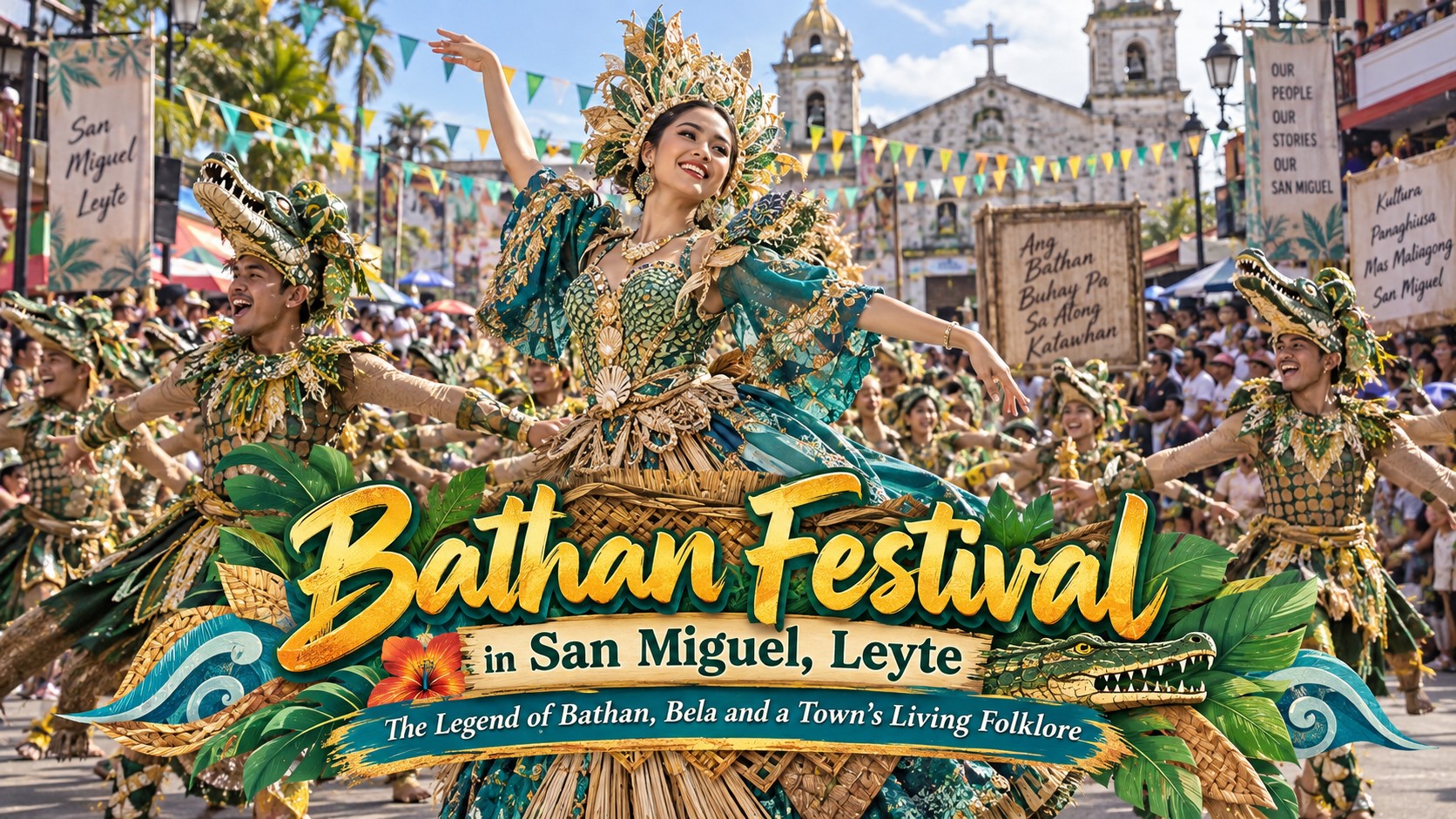
The crocodile in festival performances
Naturally, one of the most visually interesting parts of any Bathan-inspired performance is the crocodile.
Depending on the production, dancers can recreate crocodile-like movements through choreography or use props and costumes inspired by Bela.
This gives Bathan Festival a visual identity that is very different from festivals dominated by flowers, fruits or agricultural decorations.
And importantly, the crocodile isn’t presented simply as a frightening animal.
Within the Bathan story, Bela represents help.
The creature that people might normally fear becomes the heroine’s companion and protector.
That reversal makes the story memorable.
It is also one reason the Bathan legend works so well as festival material.
A story about resilience
Strip away the crocodile, costumes and festival music for a moment and Bathan’s story has a very human theme.
It is about somebody trying to get home.
Bathan is separated from her community and placed in circumstances beyond her control.
Yet the story does not end with her remaining a victim.
She survives.
She finds help.
She returns.
That makes resilience one of the strongest themes running through the Bathan tradition.
For residents of San Miguel, retelling the story can therefore mean more than simply preserving an old legend.
It celebrates courage, endurance and the idea of returning to one’s community after hardship.
Folklore versus documented history
This is worth explaining because Bathan Festival sometimes appears online with the story presented as straightforward historical fact.
The safer and more accurate approach is to describe Bathan as a figure from San Miguel’s local folklore.
The story reflects memories of an earlier period when coastal communities in the Visayas lived with the threat of raiding, but the specific adventures of Bathan and Bela belong to the town’s traditional narrative.
That doesn’t make the story unimportant.
Quite the opposite.
Folklore tells us what communities chose to remember.
Stories reveal fears, values, hopes and ideas about bravery, home, nature and survival.
So instead of asking only, “Did every detail happen exactly this way?”
A more useful question might be:
“Why has San Miguel continued telling this story for generations?”
Bathan Festival itself is part of the answer.
The community sees the story as worth preserving.
Bathan Festival and St. Michael the Archangel
Bathan Festival takes place within San Miguel’s wider September fiesta season.
The municipality’s patron saint is St. Michael the Archangel, whose feast falls on September 29.
The significance of this date is formally recognized under Republic Act No. 7791, which declared September 29 San Miguel Day and specifically identifies it as the municipality’s annual town fiesta honoring St. Michael the Archangel.
The local parish is likewise dedicated to St. Michael the Archangel.
As with many Philippine fiestas, religious and cultural activities can exist side by side.
Church celebrations focus on devotion to the patron saint.
Bathan Festival focuses on local heritage and folklore.
Together, they make September an important cultural and religious period for San Miguel.
Why September 29 is important in San Miguel
San Miguel Day isn’t simply an informal fiesta date.
It has legal recognition.
Republic Act No. 7791 states that September 29 is a special non-working public holiday in San Miguel and provides for meaningful civic, religious, sports and community activities during the celebration.
That helps explain why festival season can involve much more than the Bathan performances themselves.
Visitors may encounter community competitions, ceremonies, sports events, religious activities and other local programs surrounding the fiesta.
The exact lineup naturally changes from year to year.
But the September celebration remains deeply connected with the town’s identity.
What makes Bathan Festival unique?
There are hundreds of festivals across the Philippines.
What makes Bathan Festival memorable is that it doesn’t need a famous agricultural product or elaborate tourism slogan to explain itself.
It has a story that belongs specifically to San Miguel.
Take Bathan away and you no longer have the same festival.
Take Bela away and one of the most recognizable elements of the legend disappears.
Take away Kuratsa Binuaya and you lose one of the ways the community transformed that story into movement.
These elements are difficult to copy because they come from local tradition.
That gives Bathan Festival something many destinations spend years trying to create:
a distinct identity.
Keeping local stories alive
There is another reason Bathan Festival matters.
Without festivals, performances, school activities and cultural documentation, local folktales can disappear surprisingly quickly.
Grandparents remember them.
Parents remember pieces.
Children hear less.
Then eventually the story becomes little more than a name.
Turning Bathan into a festival makes forgetting more difficult.
Children see the costumes.
Students learn the dance.
Performers study the story.
Teachers explain the characters.
Families watch presentations.
Visitors ask why there’s a crocodile in the festival.
And every one of those moments gives somebody an excuse to tell the Bathan story again.
That’s how living heritage survives.
Community participation
Like many municipal festivals, Bathan Festival depends heavily on the participation of residents.
Students, dancers, teachers, musicians, choreographers, barangay representatives, local government workers and community organizations can all contribute to the celebration.
That involvement matters because cultural preservation works best when a tradition remains something people actually participate in.
A folktale locked inside an archive may survive academically.
A folktale danced in the streets survives socially.
Bathan Festival does the second.
Bathan Festival beyond entertainment
For travelers, festivals are fun.
There are performances to photograph, music to enjoy and colorful activities to watch.
But Bathan Festival becomes more meaningful once you understand the story underneath it.
The dancing represents narrative.
The crocodile represents Bela.
The heroine represents Bathan.
Kuratsa Binuaya connects the legend with a local dance tradition.
And the September celebration connects those traditions to the larger fiesta of San Miguel.
Suddenly, what looks like a street performance becomes something much richer.
You are watching a community retell one of its own stories.
What to expect at Bathan Festival
The exact festival program can change every year, but visitors attending San Miguel’s September celebrations may encounter cultural presentations connected to Bathan, community competitions and activities associated with the annual town fiesta.
If a Bathan dance presentation or street-dancing event is part of the year’s program, it is worth learning the basic story beforehand.
Watch for the major characters.
Look for Bathan.
Look for Bela.
Observe movements inspired by the crocodile.
And pay attention to how performers interpret the journey from danger to homecoming.
Understanding the story transforms the experience.
You stop seeing dancers in costumes and start seeing characters.
When is Bathan Festival celebrated?
Bathan Festival is celebrated every September in San Miguel, Leyte.
This timing is formally established in the municipality’s Tourism Code, which identifies Bathan Festival as San Miguel’s official festival and states that it is to be celebrated during September.
Festival calendars commonly associate Bathan Festival with the final days of September, while the town’s principal fiesta falls on September 29 in honor of St. Michael the Archangel.
Because performance dates and other activities can move from year to year, travelers should always check the current official schedule before planning a trip specifically around the street dancing or major cultural presentation.
Bathan Festival 2026 schedule
For 2026, Bathan Festival remains part of San Miguel’s September celebration season.
September 29, 2026 remains San Miguel Day and the feast of St. Michael the Archangel under the municipality’s established annual observance.
As of September 15, 2026, I could not verify a complete official day-by-day Bathan Festival 2026 program published online.
That means it would be better not to assume that the major cultural performance will occur on a particular date simply because older festival calendars list Bathan Festival around September 28 or 29.
If you’re planning to attend specifically for the Bathan presentation or street dancing, check the latest announcement from the Municipality of San Miguel before traveling.
Tips for visiting Bathan Festival
If Bathan Festival is your first provincial fiesta in Leyte, the best advice is to arrive with some flexibility.
Major performances can attract crowds around the town center, so arriving early gives you a better chance of finding a good viewing spot.
Wear comfortable clothing because you’ll probably spend a lot of time standing or walking.
September is also within the rainy season, so bring protection for both sun and sudden rain.
Most importantly, take time to understand what you’re watching.
Ask residents about Bathan.
Learn about Bela.
Listen for stories about Kuratsa Binuaya.
Local festivals become much more memorable when you experience them through the people who actually keep the tradition alive.
Why Bathan Festival matters
Bathan Festival represents something bigger than one annual celebration.
It shows how local identity can survive through storytelling.
Long before tourism campaigns, social media pages and official festival logos, communities remembered themselves through stories.
They told those stories at home.
They repeated them to children.
They turned them into songs and dances.
Bathan Festival continues that tradition.
A folktale about a woman, a crocodile and a journey home became a dance-play.
The dance-play became part of a fiesta.
The fiesta became an official municipal festival.
And now, every September, Bathan’s name becomes part of San Miguel’s public life once again.
Final thoughts
Bathan Festival probably won’t look like the giant tourism festivals most travelers already know.
That isn’t its strength.
Its strength is intimacy.
This celebration belongs to San Miguel.
The story belongs to San Miguel.
Bathan and Bela belong to the community’s folklore.
And Kuratsa Binuaya gives that story a form that can still be seen and experienced instead of merely read about.
So if you ever find yourself in Leyte during the final days of September, Bathan Festival offers something different.
Don’t go expecting only colorful street dancing.
Go for the story.
Watch how dancers turn an old legend into movement.
Look for the crocodile.
Remember Bathan’s journey.
And somewhere between the music, costumes and celebration, you’ll understand why San Miguel continues telling her story.
Because Bathan Festival isn’t simply about remembering the past.
It is about keeping a local story alive.