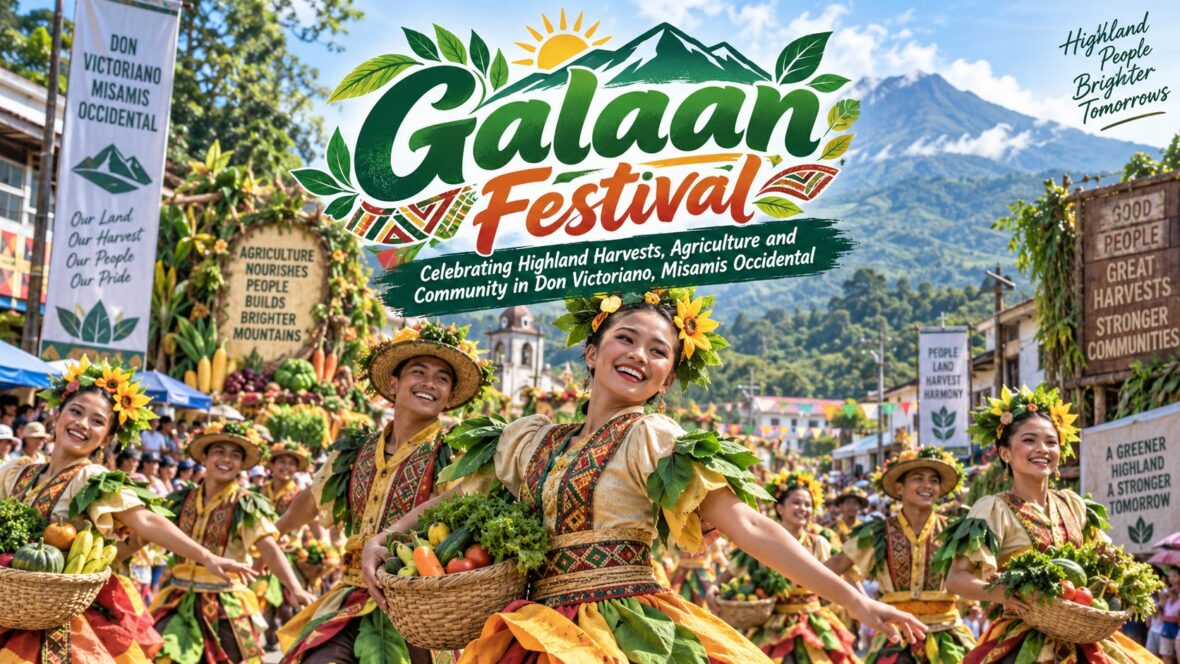
High in the mountains of Misamis Occidental, where cool air replaces the heat of the coastal lowlands and vegetable farms spread across the slopes of Mount Malindang, one community celebrates the products of its land every September.
This is Don Victoriano Chiongbian, often simply called Don Vic.
And its local celebration is the Galaan Festival.
Galaan may not have the nationwide recognition of Sinulog, MassKara or Panagbenga. You probably won’t find endless travel videos about it either.
But that’s exactly what makes festivals like Galaan interesting.
This is a celebration shaped by the place where it happens.
Don Victoriano is a highland farming municipality surrounded by the landscapes of the Mount Malindang Range. Agriculture remains important to its communities, while a large part of the town’s population belongs to the indigenous Subanen people.
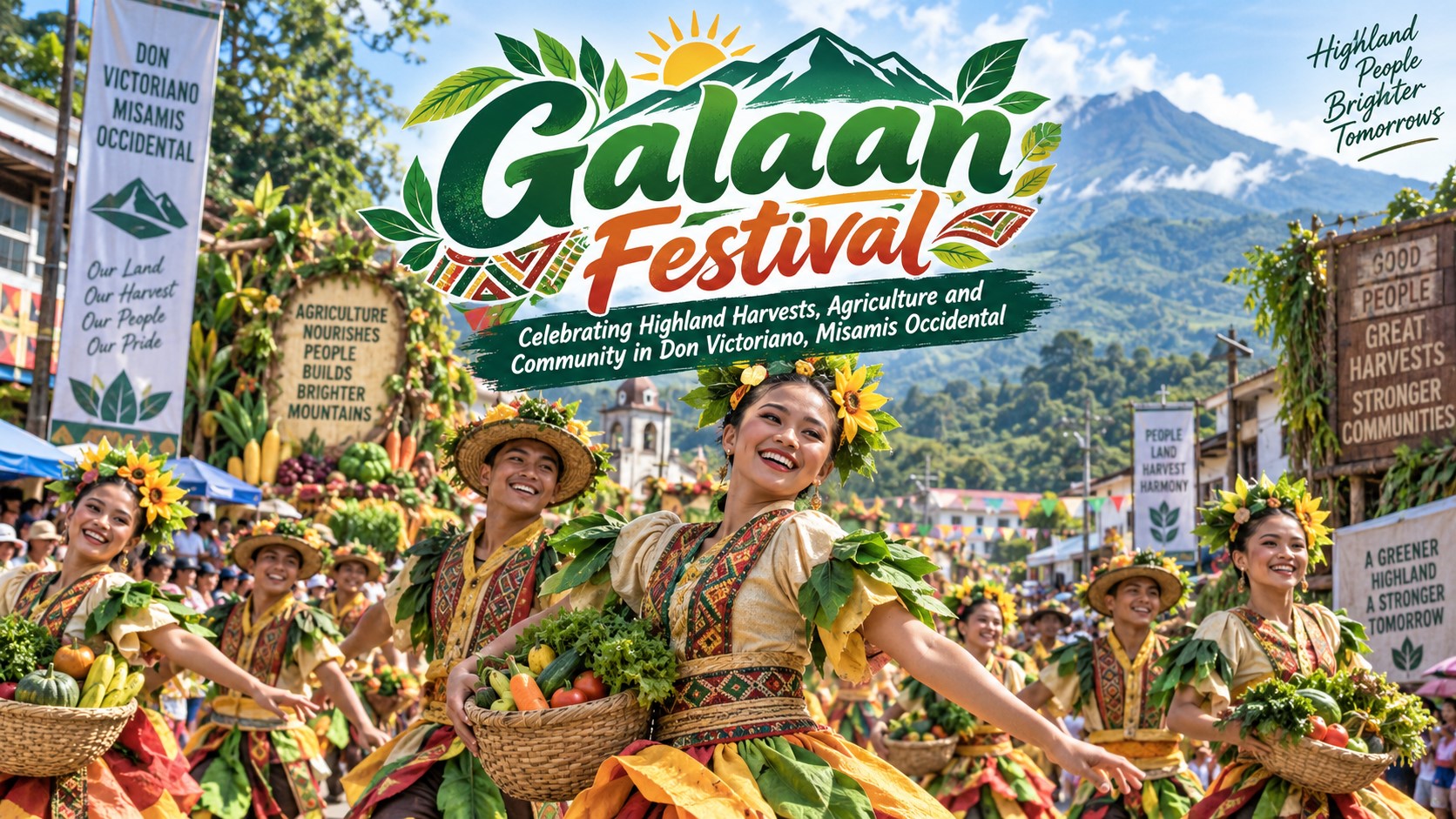
During Galaan Festival, those agricultural roots come to the foreground as local communities showcase the farm products grown in the mountains.
It’s a festival about harvest.
But it’s also about the people behind that harvest.
If you’re curious about Galaan Festival or thinking of visiting Don Victoriano someday, here’s a closer look at this lesser-known celebration in Misamis Occidental.
Content
Galaan Festival at a Glance
| Festival | Galaan Festival |
|---|---|
| Location | Don Victoriano Chiongbian, Misamis Occidental |
| Common local name of town | Don Vic |
| Traditional festival date | September 17 |
| Main theme | Agriculture and local farm products |
| Major feature | Showcase of agricultural produce |
| Other reported highlight | Colorful community parade |
| Setting | Highland communities around the Mount Malindang Range |
| Indigenous heritage | Strong Subanen presence |
| Nearby attractions | Lake Duminagat, Piduan Curtain Falls, Mount Malindang Range Natural Park |
Philippine festival calendars have traditionally listed Galaan Festival on September 17 in Don Victoriano, while older tourism listings describe its main purpose as showcasing the municipality’s variety of farm products.
That agricultural focus tells you almost everything you need to know about the celebration.
To understand Galaan, you first have to understand Don Victoriano.
Where is Don Victoriano?
Don Victoriano Chiongbian is a mountain municipality in Misamis Occidental in Northern Mindanao.
Unlike many towns in the province that face Panguil Bay or the surrounding coastal areas, Don Victoriano is tucked into the highlands surrounding the Mount Malindang Range.
And the elevation makes a noticeable difference.
Temperatures are generally cooler than in many nearby lowland communities, which is why Don Victoriano has increasingly been promoted as the “summer capital of Misamis Occidental.” Provincial tourism efforts have highlighted the municipality as one of the province’s major mountain destinations.
The landscape is green, mountainous and strongly agricultural.
Drive through parts of Don Vic and instead of beaches or fishing villages, you’ll encounter farms, mountain roads, vegetable plots, forest landscapes and communities sitting high above the surrounding plains.
This is the environment that gives Galaan Festival its identity.
What is Galaan Festival?
Galaan Festival is an agricultural and community celebration traditionally held every September 17 in Don Victoriano.
Older Department of Tourism-linked festival listings describe Galaan simply and clearly: it is a showcase of the town’s variety of farm products.
That description may sound simple, but it makes perfect sense when you see the municipality.
Agriculture isn’t something added to Galaan simply to create a festival theme.
It’s part of everyday life.
Farmers cultivate vegetables and other high-value crops in the cool mountain environment. Agricultural organizations operate in communities such as Gandawan, while government livelihood programs continue to support farming in the municipality.
In other words, the products displayed during Galaan represent actual livelihoods.
They’re what families grow.
They’re what farmers sell.
And they’re part of what makes Don Victoriano economically and culturally distinct from many other places in Misamis Occidental.
What Does “Galaan” Mean?
This is one area where it’s worth being careful.
Several festival directories identify the Galaan Festival and describe its agricultural purpose, but reliable public sources don’t consistently explain the exact linguistic origin or official meaning of the word “Galaan.”
Because of that, I wouldn’t confidently translate the festival name unless the municipal government itself provides an official explanation.
You’ll sometimes see Philippine festival articles assigning elaborate meanings to festival names without citing where those translations came from.
It’s better not to do that.
What we can say with confidence is that Galaan has long been associated with Don Victoriano’s September 17 celebration and the showcasing of local agricultural products.
And in many ways, that’s more important than forcing an uncertain translation.
Agriculture at the Heart of Galaan
If there is one theme that defines the Galaan Festival, it’s agriculture.
Don Victoriano’s upland environment allows farmers to grow crops suited to cooler mountain conditions.
Recent agricultural programs give us a good picture of what farming looks like in the municipality today.
In Barangay Gandawan, for example, the Gandawan Strawberry Growers’ Association has received support from the Department of Agriculture’s Special Area for Agricultural Development program for high-value crop production.
The group’s production has included cabbage, and farmers have more recently expanded into strawberries.
In September 2026 alone, the association reported harvesting more than four tons of cabbage from its communal garden.
Earlier in the year, the group also began expanding strawberry production and processing as part of efforts to diversify income.
That’s a useful reminder that when Galaan celebrates farm products, we’re not talking about some old agricultural identity that only survives in festival costumes.
Farming is still happening.
And it’s changing.
Farmers are experimenting with high-value crops, cooperatives are developing communal gardens, and mountain agriculture continues to support families.
The Farm Product Showcase
The agricultural showcase is the feature most consistently associated with Galaan Festival.
Depending on the year’s program and harvest availability, displays can provide local growers with an opportunity to present products cultivated across Don Victoriano.
You can think of it as a celebration of what the mountains can produce.
Vegetables are particularly relevant to the municipality’s modern agricultural economy.
Current agricultural development projects in Don Victoriano involve crops such as cabbage and strawberries, while local government high-value crop programs have included seeds and inputs for cabbage, Chinese cabbage, pechay, lettuce, carrots, peppers, eggplant, tomato, squash and other vegetables.
For visitors, an agricultural festival like this offers something street dancing alone can’t provide.
You get to see the actual reason behind the celebration.
The vegetables aren’t props.
They came from someone’s farm.
A Festival for Farmers
Agricultural festivals are sometimes marketed mostly around colorful costumes and parades.
But I think the more interesting way to experience Galaan is to pay attention to the people working behind all those displays.
Farming in the mountains isn’t easy.
Land conditions vary.
Weather can change quickly.
Transportation from remote communities to markets adds another challenge.
Farmers need buyers, roads, irrigation, seeds, training and access to capital.
That’s why festivals centered on agriculture can serve a purpose beyond entertainment.
They create a public space where farming becomes visible.
Instead of agricultural production happening quietly in the hills, the community brings the results into town and celebrates them.
For at least one part of the year, the harvest becomes the attraction.
The Colorful Festival Parade
Older descriptions of Galaan also identify a colorful parade as one of the celebration’s highlights.
Like many municipal celebrations in the Philippines, the exact parade format and participating groups can change depending on the year’s program.
That means travelers shouldn’t assume that every Galaan Festival has an identical street-dancing competition, costume theme or parade route.
The safest way to understand it is as a community celebration in which agricultural identity is displayed publicly.
When parades form part of the program, expect local organizations, barangays, schools or agricultural groups to become part of the festivities.
And because agriculture is central to Galaan, farm-inspired decorations and products naturally make sense within the celebration.
Don Victoriano and the Subanen
There’s another part of Don Vic’s identity that shouldn’t be ignored.
The municipality has a strong Subanen population.
The Philippine Information Agency reported in 2025 that around 80 percent of Don Victoriano’s population belongs to indigenous communities, according to the municipal mayor.
The Subanen have lived throughout the mountainous areas of the Zamboanga Peninsula and surrounding parts of western Mindanao for generations.
Mount Malindang is particularly significant.
The official Mount Malindang Range Natural Park information site describes the mountain as ancestral domain and sacred ground for the Subanen, who have traditionally maintained close relationships with its forests, rivers and natural resources.
This matters when talking about Galaan because the festival happens within a community where agriculture, indigenous heritage and the mountain environment overlap.
However, it’s important not to automatically label every Galaan performance or costume as “traditional Subanen culture.”
Festival performances can be modern interpretations.
Authentic indigenous rituals and cultural practices deserve to be distinguished from choreography designed for a civic celebration.
That’s an important distinction for both writers and visitors.
Mount Malindang Shapes the Town
You can’t really separate Don Victoriano from Mount Malindang.
The municipality contains communities within and around the Mount Malindang Range Natural Park, one of Mindanao’s most environmentally significant protected landscapes.
The park was declared an ASEAN Heritage Park in 2011 and encompasses more than 53,000 hectares when its protected area and buffer zone are considered together.
The range provides water, agricultural resources, biodiversity and livelihoods to communities across Misamis Occidental and nearby provinces.
That landscape also helps explain the character of Galaan.
This isn’t agriculture happening on broad lowland plains.
It’s mountain agriculture.
Cool temperatures.
Steep landscapes.
Forests.
Streams.
Vegetable-growing communities.
All of that becomes part of the backdrop to the festival.
Don Victoriano’s History
Don Victoriano is also one of Misamis Occidental’s younger municipalities.
It was originally created under the name Don Mariano Marcos through Batas Pambansa Blg. 171, approved on February 8, 1982.
The new municipality was formed from barangays and sitios that had previously belonged to several surrounding municipalities, with Tuno designated as the seat of government.
In 1990, Republic Act No. 6845 changed the municipality’s name from Don Mariano Marcos to Don Victoriano.
Today you’ll encounter several variations of the town’s name in official and informal use.
Don Victoriano.
Don Victoriano Chiongbian.
And, most commonly among locals and travelers:
Don Vic.
September 17 has also long been associated locally with “Don Vic Day.” A House bill filed in 2015 proposed formally declaring September 17 an annual special non-working holiday in the municipality under that name.
Galaan Festival is traditionally celebrated on the same date.
Galaan is Different From the Big Commercial Festivals
Don’t arrive expecting Sinulog.
That’s probably the best advice I can give.
Smaller municipal festivals have a different rhythm.
You won’t necessarily have massive sponsored stages, national celebrities on every corner or streets filled with hundreds of thousands of tourists.
And that’s not a disadvantage.
Galaan gives you the opportunity to experience a celebration that remains closely tied to the local community.
The people watching beside you may be relatives of the participants.
Farmers exhibiting produce may have grown those crops only a few kilometers away.
Students marching in a parade may come from the same mountain barangays you’re passing through.
The entire celebration feels closer to its source.
What to Expect During Galaan Festival
The exact program can vary from year to year.
But the agricultural identity is the part you should expect to remain consistent.
Visitors may encounter farm-product displays, civic activities, community programs and parade-related events surrounding September 17.
Additional activities can be added by the local government depending on the edition.
These might involve competitions, sports, performances, livelihood activities, agricultural programs or evening entertainment.
Because Galaan is not documented online as extensively as larger festivals, the best strategy is to check the latest municipal announcements shortly before your visit rather than relying on an old itinerary.
This is especially important if you’re traveling several hours specifically for one activity.
Don’t Just Visit for the Festival
One of the best things about traveling to Galaan is that Don Victoriano itself has become an increasingly interesting destination.
You can combine the festival with a highland nature trip.
And two attractions stand out.
Lake Duminagat
Lake Duminagat is one of the most culturally and environmentally significant destinations in Don Victoriano.
Located within Mount Malindang Range Natural Park, the crater lake is surrounded by forest and mountain terrain.
The Department of Tourism Northern Mindanao describes the lake as sacred to the Subanen, who regard its waters as having spiritual and healing significance.
Visiting isn’t simply a matter of pulling over beside the highway.
According to DOT Northern Mindanao, travelers can begin at the Don Victoriano municipal government area and continue by motorcycle toward the Lake Duminagat drop-off point, followed by an approximately 30-minute trek.
Because the place has indigenous cultural significance and lies within a protected landscape, visitors should follow local regulations and respect community guidance.
This isn’t the place for careless tourism.
Piduan Curtain Falls
Another attraction worth adding to a Don Vic trip is Piduan Curtain Falls.
The waterfall sits in Barangay Napangan within the Malindang mountain landscape.
DOT Northern Mindanao describes it as a roughly 60-meter curtain-like waterfall surrounded by lush vegetation.
More recent tourism coverage has helped bring national attention to Piduan as Misamis Occidental expands its tourism promotion.
The combination of cool mountain weather and broad, flowing cascades makes it an easy complement to a Galaan Festival trip.
Festival in town today.
Waterfall tomorrow.
That’s a pretty good weekend.
Why Don Victoriano is Called the Summer Capital of Misamis Occidental
One thing you’ll probably notice quickly is the temperature.
Don Victoriano sits at higher elevations than much of surrounding Misamis Occidental.
That cooler climate has helped earn it the nickname “Summer Capital of Misamis Occidental,” a description now being actively used in provincial tourism promotion.
And honestly, this is one of the reasons Galaan has travel potential beyond the festival itself.
You’re not simply going somewhere to watch a parade.
You’re entering a mountain destination.
Views open toward surrounding ranges.
Fog can move across the hills.
Vegetable farms appear beside the road.
Waterfalls hide in the landscape.
The trip becomes part of the festival experience.
How to Get to Don Victoriano
Don Victoriano sits inland in the mountainous western portion of Misamis Occidental, close to the borders with Zamboanga del Norte and Zamboanga del Sur.
For travelers arriving by air, Ozamiz Airport is one practical gateway.
DOT Northern Mindanao’s directions for Piduan Falls, for example, advise travelers arriving at Ozamiz Airport to proceed to the Ozamiz City Integrated Bus and Jeepney Terminal, take transportation toward Bonifacio, and continue into Don Victoriano by motorcycle for the mountain portion of the journey.
Private transportation can be particularly useful if you’re planning to combine the festival with attractions such as Lake Duminagat and Piduan Falls.
Distances on a map can also be deceptive here.
Mountain roads take time.
Build extra allowance into your itinerary.
What to Bring
Galaan happens in September, which is within the rainy part of the year in much of the Philippines.
So pack for both a festival and a mountain trip.
Bring comfortable footwear, light rain protection, water and a small bag that’s easy to carry through crowded community events.
If you’re going farther into the highlands, bring an extra layer.
The temperature can feel noticeably cooler than in Ozamiz or other lower-elevation communities.
Cash is also important.
Don’t assume every agricultural stall, sari-sari store or transportation provider accepts digital payments.
And if you’re heading to more remote communities, mobile reception may not always be dependable.
Supporting Local Farmers
If you attend Galaan and local agricultural products are available for sale, buy something.
Seriously.
You could attend the parade, take 500 photos, upload everything to Facebook and go home.
But buying directly from local farmers or community producers creates a much more meaningful connection with what the festival is celebrating.
Vegetables.
Processed farm products.
Local food.
Whatever is available that particular year.
Agricultural festivals exist because there is agriculture behind them.
Supporting that economy is one of the easiest ways visitors can participate.
Why Galaan Festival Matters
Galaan Festival may look modest beside the giant tourism festivals of the Philippines.
But festivals aren’t meaningful only when millions of people know their names.
Sometimes the opposite is true.
Galaan matters because it belongs so clearly to Don Victoriano.
The mountains shape the climate.
The climate shapes agriculture.
Agriculture supports families.
Farmers grow the crops.
Communities gather.
And once a year, those products become something to celebrate.
There’s a very direct line connecting the festival to everyday life.
That’s something worth preserving.
Galaan Festival and the Future of Highland Agriculture
Galaan also provides an interesting lens into how farming in Don Victoriano is changing.
Agriculture here isn’t frozen in time.
The current push toward strawberries is a perfect example.
The Gandawan Strawberry Growers’ Association began expanding strawberry production in 2026 after previous success with cabbage, with the Department of Agriculture supporting both production and potential processing activities.
That means future Galaan celebrations could increasingly showcase new products alongside established crops.
And that’s exactly how an agricultural festival should work.
It shouldn’t preserve agriculture as though it were a museum exhibit.
It should change alongside the farmers.
Galaan Festival 2026
For travelers looking specifically at 2026, September 17, 2026 falls on a Thursday.
Galaan Festival has traditionally been listed on September 17, the date also locally associated with Don Vic Day.
As of September 9, 2026, I could verify the traditional festival date but could not find a complete official 2026 Galaan program publicly accessible online covering the exact parade time, venues and individual activities.
So if you’re traveling specifically for Galaan Festival 2026, check the latest announcements from the Municipal Government of Don Victoriano or Misamis Occidental tourism authorities before leaving.
Don’t rely on an old festival schedule for exact event times.
What is already clear is that agriculture remains very much alive in Don Vic in 2026. Farmers in Gandawan harvested more than four tons of cabbage this year while continuing their expansion into strawberry production.
So the agricultural story behind Galaan remains as relevant as ever.
Final Thoughts
Some Philippine festivals announce themselves with giant drums, enormous floats and television coverage.
Galaan Festival tells a quieter story.
It’s the story of a mountain municipality.
Of farmers planting vegetables in cool highland soil.
Of indigenous communities whose relationship with Mount Malindang goes back generations.
Of harvests making their way from remote barangays to local markets.
And of a town taking one day in September to put those livelihoods on display.
Come for Galaan Festival and you’ll see farm products, community celebrations and the festive side of Don Victoriano.
But stay a little longer.
Drive into the mountains.
See Lake Duminagat.
Feel the cold water at Piduan Falls.
Look at the farms beside the road.
Talk to the people growing the crops.
Because once you’ve seen the landscape behind the festival, Galaan makes a lot more sense.
It’s not simply a festival about vegetables or agricultural displays.
It’s a celebration of what the mountains provide—and of the people who turn that abundance into a way of life.