Some festivals are remembered for giant floats.
Others are known for elaborate costumes, street dancers or food.
In Cardona, Rizal, one of the town’s most interesting traditions begins with something much simpler:
The ringing of church bells.
And not just the usual ringing you might hear before Mass.
During the La Torre Festival, the bells of Cardona’s church belfry come alive in a powerful chorus of sound, accompanied by brass bands and the excitement of a town preparing for one of its most important religious celebrations.
Known simply as La Torre, the tradition is held around October 6 in Cardona, traditionally on the eve of the October 7 feast of Our Lady of the Holy Rosary.
The celebration may not be as widely known as some of the Philippines’ huge festivals, but that’s exactly what makes it interesting.
La Torre feels unmistakably local.
It revolves around a church tower that generations of residents have looked up to, bells that have announced important moments in town life, and a tradition that connects faith, history and community.
For travelers who enjoy discovering the quieter cultural celebrations of the Philippines, La Torre Festival offers another reason to explore Rizal beyond the usual mountain resorts and overlooking cafés.
Content
What is the La Torre Festival?
La Torre Festival is a traditional celebration in Cardona, Rizal centered on the ringing of the bells housed in the town church’s belfry.
“La Torre” literally means “the tower” in Spanish.
In Cardona, the name refers specifically to the church bell tower where bells of different sizes have long served an important role in community life.
Historical tourism descriptions of La Torre explain that the bells weren’t used only for religious purposes. Over the years, their sound also announced cultural events and was used to warn residents during unforeseen calamities.
That gives the festival a deeper meaning.
These aren’t simply bells being rung for entertainment.
They once served almost like a community communication system.
Before smartphones, social media, text alerts and public-address systems, the sound of a church bell could tell people that something important was happening.
During La Torre, those bells become the center of attention once again.
Where is La Torre Festival Celebrated?
La Torre Festival is celebrated in Cardona, a municipality in Rizal Province.
Cardona sits along Laguna de Bay, with part of Talim Island also falling under the municipality’s jurisdiction.
The town has a strong religious heritage centered around what is now the Diocesan Shrine and Parish of Our Lady of the Holy Rosary in Barangay Real.
The parish itself was formally established in 1872. The feast of Our Lady of the Holy Rosary is celebrated on October 7.
And that date is important if you want to understand La Torre.
Traditionally, La Torre takes place on October 6—the day before the Marian feast.
It serves almost like a joyful announcement:
The fiesta is here.
Why Is It Called La Torre?
The name couldn’t be more straightforward.
“La Torre” is Spanish for “the tower.”
The tower refers to the church belfry where Cardona’s bells are housed.
Older descriptions of the festival even mention how residents, particularly children, would look up toward the tower in fascination because of the different sizes and sounds of the bells inside.
Think about that for a moment.
For people growing up in town, the tower isn’t simply part of the church’s architecture.
It is part of the town’s soundscape.
People hear those bells during religious occasions.
They hear them during important events.
Historically, they might even have heard them as a warning.
Eventually, the tower and its bells became important enough to inspire an entire local tradition.
That’s La Torre.
The Bells Are the Heart of the Festival
This is what separates La Torre from many other festivals in the Philippines.
There is no need for an enormous float or an elaborate festival queen to explain what La Torre is about.
You only need to listen.
The main tradition involves the strong and repeated ringing—or repique—of the church bells.
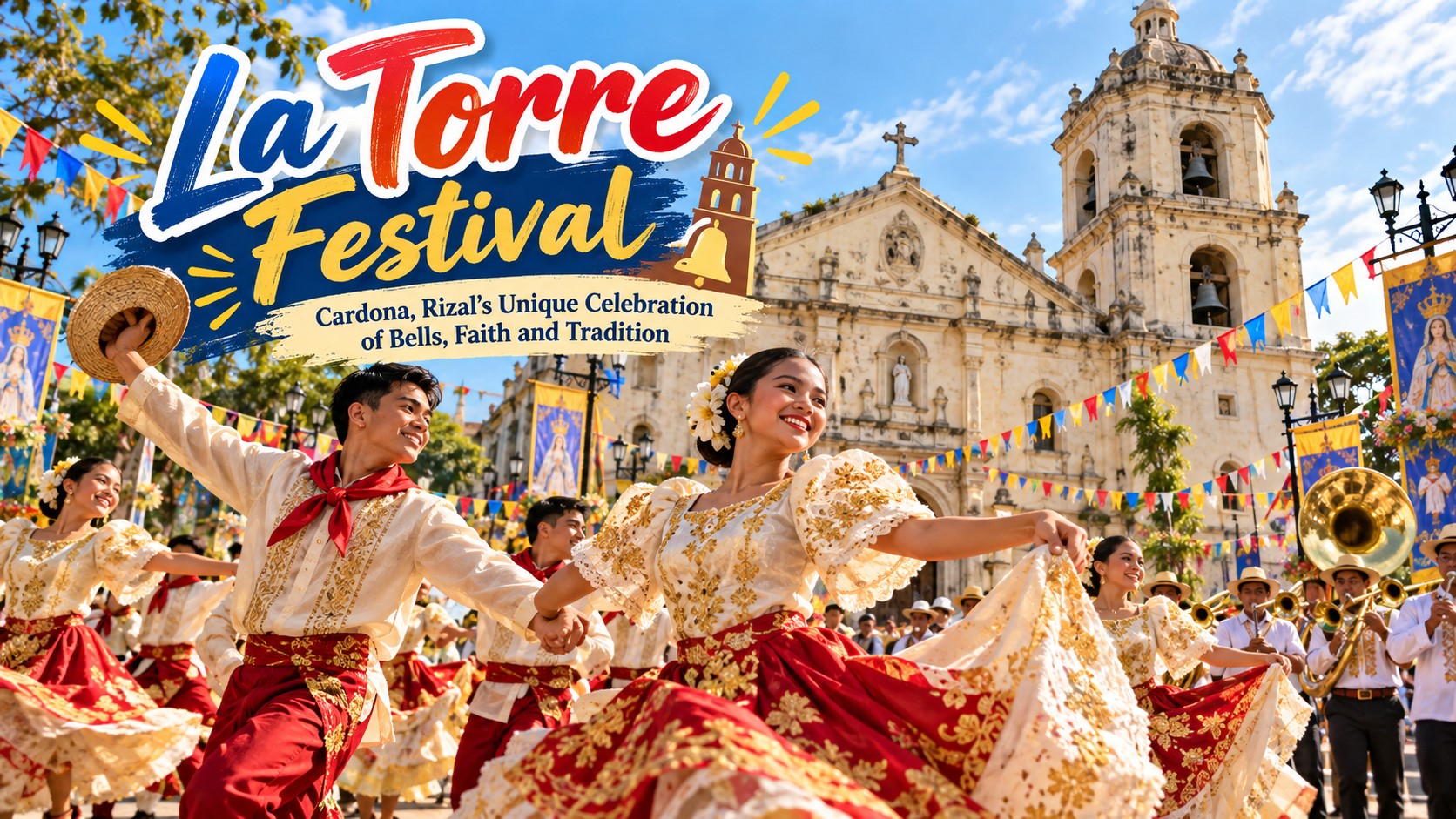
A historical account published by Balita described the October 6 celebration as beginning with a parade involving four brass bands around the town center. The parade eventually reached the area in front of the church and municipal hall, where the ringing of the church bells became the highlight of La Torre.
Imagine standing somewhere near the church.
The streets are already alive with music.
Brass bands are playing.
People are gathering.
Then the church bells begin.
The sound carries beyond the church plaza and into the surrounding community.
For several minutes, the bells and music become one big announcement that the town fiesta is about to begin.
It’s simple.
But that’s also what makes it memorable.
Church Bells as Part of Community Life
Today, we receive information instantly.
A storm warning appears on our phones.
An announcement gets posted on Facebook.
A text message tells us about an event.
That wasn’t always possible.
For generations, church bells played a much bigger role in Filipino towns.
Their sound could signal the beginning of Mass.
A particular pattern of ringing could announce a celebration.
Another could alert residents that something unusual was happening.
Sources describing La Torre specifically note that Cardona’s bells had been used to announce cultural events and could even serve as warnings during calamities.
So when Cardona celebrates La Torre, the town isn’t simply celebrating a physical bell tower.
In a way, it is also remembering an old form of community communication.
The bells once helped tell the story of daily life.
La Torre keeps their voice alive.
La Torre and the Feast of Our Lady of the Holy Rosary
You can’t separate La Torre from Cardona’s religious traditions.
The Diocesan Shrine and Parish of Our Lady of the Holy Rosary celebrates the feast of its titular patroness on October 7.
The parish was established in 1872, although Catholic missionary activity in the area goes back much further.
According to the Rizal Provincial Government, Franciscan missionaries established religious communities around Laguna de Bay, and devotion to Our Lady of the Holy Rosary eventually became closely associated with Cardona.
The Marian image is also known locally as Nuestra Señora del Santísimo Rosario de Cardona and La Virgen de Sapao.
In 2022, the image received a pontifical canonical coronation during the October 7 feast, which also coincided with the parish’s 150th anniversary.
La Torre traditionally happens immediately before this feast.
So the ringing of the bells is more than noise.
It announces a celebration of faith.
October 6: The Eve of the Fiesta
Traditionally, October 6 is La Torre day.
One of the most detailed historical accounts describes La Torre as being held on the morning of October 6, the eve of the feast of Our Lady of the Holy Rosary.
Brass bands parade through the town.
They converge near the church and municipal hall.
Then comes the powerful ringing of the bells.
The ringing serves as a signal that the community is entering the joyful celebration of the Marian feast.
There’s something beautiful about that idea.
Instead of simply looking at a calendar and saying, “Tomorrow is fiesta,” the whole town hears it.
The tower announces it.
Brass Bands and La Torre
Another important element of La Torre is the music of brass bands.
Philippine fiestas and marching bands have a long relationship.
Even today, you’ll encounter bands leading processions, marching through barangays or playing traditional music during town fiestas.
During La Torre, the band music works perfectly with the bells.
One sound comes from the streets.
The other comes from above.
Historical festival descriptions portray La Torre as a moment when the “joyful noise” of the church tower joins the music of brass bands.
And that is probably the best way to picture the celebration.
It’s a festival you don’t just watch.
It’s something you hear.
Thanksgiving and Hope
La Torre also carries two important ideas:
Thanksgiving and hope.
Traditional tourism descriptions specifically characterize the celebration as both an expression of thanks and a hope that Cardona will continue to receive God’s grace.
That makes sense when you consider how deeply religion is woven into traditional Filipino fiestas.
People don’t celebrate only because another year has passed.
They celebrate because the community has survived another year.
There have been challenges.
There have been storms.
There have been illnesses.
There have been personal struggles.
There have also been blessings.
La Torre turns that collective experience into sound.
The ringing of the bells becomes a way of saying:
We are still here.
We are thankful.
And we hope for another blessed year.
La Torre, Pagoda and Cardona’s October Traditions
This is where Cardona becomes particularly interesting.
La Torre isn’t the town’s only October tradition.
Several celebrations take place within a relatively short period, and online festival lists can sometimes make them look like completely separate events.
But they form part of a much broader religious and cultural season.
One is the Pagoda tradition associated with St. Francis of Assisi.
Another is La Torre on October 6.
Then comes the October 7 feast of Our Lady of the Holy Rosary.
Historical accounts also describe another fluvial procession on October 7, followed later by street dancing traditionally called Sapao-an.
So if you’re researching Cardona’s festivals, it’s important not to mix all of them together.
La Torre specifically refers to the tradition centered around the church tower, its bells and the musical celebration accompanying them.
What Is Sapao-an?
Travelers searching for photos of La Torre may sometimes encounter images of street dancing.
This can get confusing.
The street-dancing tradition associated with the October fiesta has historically been called Sapao-an.
According to an account of Cardona’s October celebrations, Sapao-an takes place during the feast of Our Lady of the Holy Rosary and has involved dancers representing the local government, barangays, schools and civic and religious organizations. A competitive showdown traditionally followed the street dancing.
That means La Torre and Sapao-an are connected through the same fiesta period, but they aren’t exactly the same tradition.
La Torre is about the tower and the bells.
Sapao-an brings dancing into the streets.
Together with processions and religious activities, they form different pieces of Cardona’s fiesta culture.
Why Bells Matter in a Filipino Town Fiesta
Anyone who grew up near a Catholic church in the Philippines probably recognizes the sound immediately.
You hear the bells early in the morning.
You hear them before Mass.
You hear them during fiestas.
Sometimes, especially in older communities, the bells feel almost like part of everyday life.
But La Torre takes something familiar and turns it into cultural heritage.
Instead of treating bell ringing simply as a practical part of church life, the people of Cardona give it a moment of its own.
For one day, everyone pays attention to the tower.
Everyone listens.
And a sound that residents may hear throughout the year becomes something worth celebrating.
That’s what makes small local festivals fascinating.
They often take something outsiders might overlook and reveal how meaningful it is to the community.
The Church Behind La Torre
A visit during La Torre naturally brings attention to the Diocesan Shrine and Parish of Our Lady of the Holy Rosary.
The church stands in Barangay Real in Cardona.
The parish was formally founded in 1872 and belongs today to the Diocese of Antipolo.
According to the Rizal Provincial Government, local tradition tells of an image of Our Lady of the Holy Rosary that was originally kept elsewhere but would mysteriously disappear. When the image returned, caretakers reportedly found amorseco—a type of grass associated with an area known as Sapao—which contributed to the belief that the Virgin had chosen where she wished to be enshrined.
Whether you visit primarily for culture, architecture or religious reasons, the church is essential to understanding La Torre.
Without the church tower, there would be no La Torre Festival.
What to Expect During La Torre Festival
La Torre isn’t necessarily the type of festival where you’ll spend an entire day watching dozens of competing street-dancing contingents.
Its identity is much more specific.
Traditionally, the experience revolves around:
The church and its bell tower.
The ringing of the bells.
Brass-band music.
Religious devotion.
Fiesta activities around the town center.
Community gatherings.
And the anticipation of the October 7 feast.
Depending on the year’s official fiesta program, additional cultural events, performances, processions and local celebrations may take place around the same period.
Programs can change from year to year, so visitors should always check announcements from the Cardona local government and the Diocesan Shrine and Parish of Our Lady of the Holy Rosary before traveling specifically for an event.
When Is La Torre Festival Celebrated?
La Torre has traditionally been observed on October 6 in Cardona, Rizal.
That date is significant because it comes immediately before the October 7 feast of Our Lady of the Holy Rosary. Long-standing festival references and historical accounts consistently identify October 6 with La Torre.
A simple guide would be:
Festival: La Torre Festival
Location: Cardona, Rizal
Traditional date: October 6
Main attraction: Ringing of the church bells
Religious connection: Feast of Our Lady of the Holy Rosary
Feast day: October 7
Important elements: Church belfry, bells, brass bands, thanksgiving and prayer
Travelers should still verify the official fiesta schedule each year because specific activities and times can change.
How Is La Torre Different From Other Philippine Festivals?
If you’re expecting something similar to Sinulog, Dinagyang or MassKara, La Torre will feel completely different.
And that’s a good thing.
Its identity isn’t based primarily on massive dance competitions.
It isn’t centered on elaborate costumes.
It doesn’t need giant floats.
The festival’s central symbol is something that’s been standing above the community all along.
A bell tower.
That’s what gives La Torre character.
The festival takes an ordinary part of a historic church and reminds everyone that it has witnessed generations of Cardona residents passing underneath it.
The bells have sounded during celebrations.
They have called people to church.
They have announced events.
They have warned the community.
And during La Torre, they ring simply to celebrate.
Why La Torre Festival Is Worth Preserving
Traditions like La Torre are easy to underestimate.
They’re quieter than major tourism festivals.
They don’t necessarily attract national television coverage.
There may not be enormous corporate sponsors or thousands of dancers.
But these are often the celebrations that tell us the most about a place.
La Torre tells us that a bell tower mattered to Cardona.
It tells us that bells once helped communicate with the entire community.
It tells us that brass bands remain part of Filipino fiesta culture.
It tells us that faith continues to shape local traditions.
And it shows how people can turn something as simple as the sound of a bell into something worth passing from one generation to another.
Visiting Cardona During Fiesta Season
If you’re planning to experience La Torre, arriving around the October fiesta period gives you a better chance of seeing several Cardona traditions rather than just one activity.
The town is connected with Laguna de Bay, and the eastern portion of Talim Island is also under Cardona’s jurisdiction.
Visitors interested in religious tourism can include the Diocesan Shrine and Parish of Our Lady of the Holy Rosary in their itinerary.
And if you’re already exploring Rizal Province, Cardona can easily become part of a broader trip around the lakeside towns.
But during La Torre itself, the best advice is simple:
Stay close to the church.
Listen.
That’s where the real festival happens.
La Torre Festival 2026
For travelers looking specifically at the 2026 celebration, it’s important to distinguish the festival’s traditional date from individual event schedules.
Long-established tourism references place La Torre on October 6, immediately before the October 7 feast of Our Lady of the Holy Rosary.
Because schedules for parades, religious activities and other fiesta events can change, visitors planning to attend should confirm the latest program released by the Municipality of Cardona or the Diocesan Shrine and Parish of Our Lady of the Holy Rosary.
That way, you won’t miss the actual bell-ringing tradition that makes La Torre special.
Final Thoughts
There are hundreds of festivals across the Philippines.
Some are enormous.
Some fill entire city streets with dancers.
Some bring together thousands of tourists.
And then there’s La Torre.
A town gathers.
Brass bands begin playing.
People look toward an old church tower.
And suddenly the bells start ringing.
That’s the festival.
Simple as it sounds, there is something powerful about it.
Those bells connect present-day Cardona with generations that came before. Long before social media announcements and emergency alerts, they helped tell people when something important was happening.
During La Torre, Cardona allows those bells to speak again.
They ring in thanksgiving.
They ring in celebration.
They ring in anticipation of the feast of Our Lady of the Holy Rosary.
And perhaps most beautifully, they ring with hope for whatever another year may bring.
That’s what makes La Torre Festival special.
It reminds us that Philippine festivals don’t always need to be grand to be meaningful.
Sometimes, all it takes is a tower, a community and the sound of bells carrying across town.