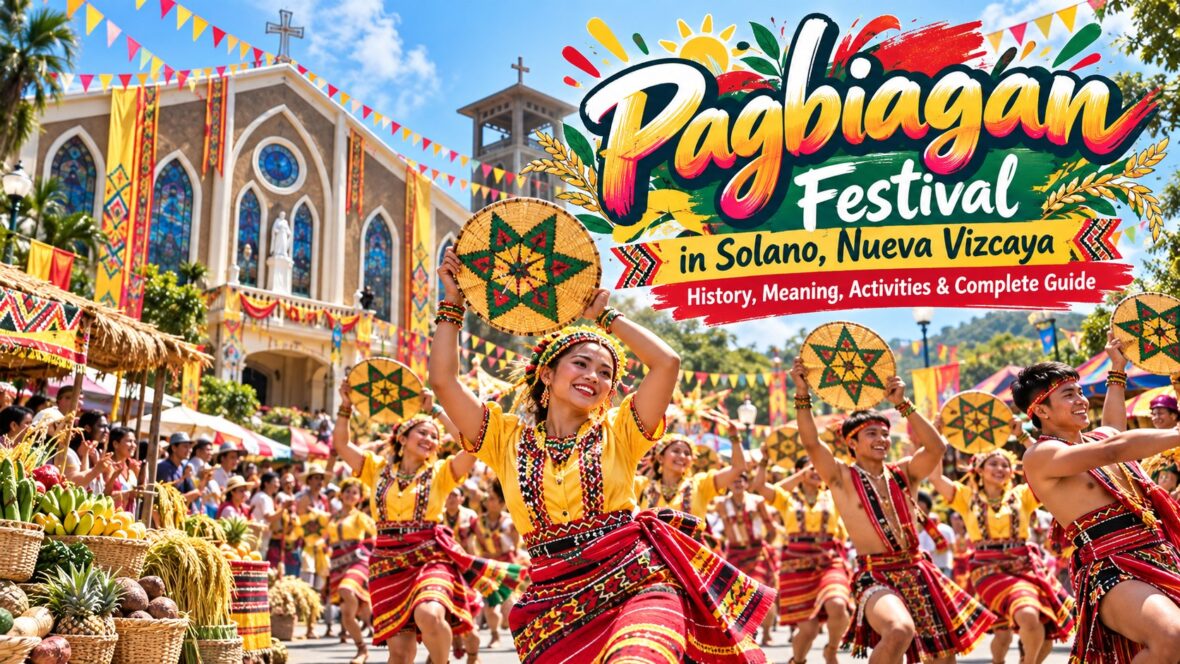
Every October, the busy town of Solano in Nueva Vizcaya becomes even livelier.
Streets fill with parades. Students march to the beat of drums and lyres. Barangays, businesses and community organizations join different activities. Local products take center stage, and residents come together to celebrate another year in the history of their town.
This is Pagbiagan Festival.
Compared with some Philippine festivals built around a single crop, religious image or legendary story, Pagbiagan has a much broader theme.
It celebrates the things that allow a community to live and prosper.
Farming. Business. Food. Trade. Skills. Local products. Employment. Culture. And most importantly, the people whose work keeps Solano moving.
The festival is also closely connected with Solano’s founding anniversary, making it both a thanksgiving celebration and an expression of hometown pride.
If you’re planning to experience festivals around Nueva Vizcaya, here’s a complete guide to Pagbiagan Festival.
Content
What is Pagbiagan Festival?
Pagbiagan Festival is an annual celebration held in the municipality of Solano, Nueva Vizcaya, usually during the first week of October.
According to Nueva Vizcaya provincial tourism material, the festival is held as an act of thanksgiving for God’s blessings and as a celebration of the abundant sources of livelihood enjoyed by the people of Solano.
It also gives the municipality’s 22 barangays an opportunity to showcase their produce, products and different forms of livelihood.
And that gives you the simplest way of understanding the festival.
Pagbiagan is essentially a celebration of how Solano lives.
It is not just about one industry or one product.
It recognizes farmers, entrepreneurs, workers, food producers, traders, professionals, small business owners and practically everyone who contributes to the local economy.
That makes Pagbiagan different from many festivals that revolve around a single agricultural product.
The festival celebrates the entire idea of livelihood.
What Does “Pagbiagan” Mean?
The name itself tells you what the festival is all about.
“Pagbiagan” is an Ilocano word connected with livelihood, a source of living or something that sustains life.
The term appears in Ilocano usage when referring to a person’s source of income or means of supporting a family.
That meaning fits Solano perfectly.
Rather than choosing only one product to represent the municipality, Pagbiagan recognizes the many ways residents earn a living.
Agriculture remains important in Nueva Vizcaya, but Solano has also developed into a major commercial center in the province.
Walk around town and you’ll quickly notice businesses, banks, shops, restaurants, markets and other establishments alongside communities still connected with farming and agricultural production.
Pagbiagan therefore becomes a celebration of both traditional livelihoods and the changing economy of Solano.
Where is Pagbiagan Festival Celebrated?
Pagbiagan Festival is celebrated in Solano, Nueva Vizcaya.
Solano sits close to Bayombong, the provincial capital, and is one of the busiest commercial areas in Nueva Vizcaya.
The municipality has 22 barangays, and their participation is an important part of Pagbiagan.
The festival is therefore not limited to the town center.
Different communities, organizations, schools, government offices, businesses and local groups participate in activities throughout the celebration.
During major events, however, much of the action naturally gathers around the poblacion, municipal government area and main streets of Solano.
When is Pagbiagan Festival Celebrated?
Pagbiagan Festival is generally celebrated during the first week of October.
Provincial tourism materials officially list Pagbiagan Festival as an October celebration, particularly during the first week of the month.
The celebration is closely linked with Solano’s founding anniversary.
This connection became even clearer when the municipality formally adopted October 2, 1860 as the official date of Solano’s establishment as a town.
Because the program changes from year to year, the entire festival should not be treated as having one fixed set of dates.
Some activities can begin before October 2 and continue afterward.
If you’re traveling specifically for the festival, always check the latest official program from the Solano local government before your trip.
The History of Solano
To appreciate Pagbiagan, it helps to know a little about Solano itself.
The town’s history stretches much farther back than the festival.
According to the Provincial Government of Nueva Vizcaya, the settlement was organized in 1767 under Spanish missionary Fr. Alejandro Vidal.
It was initially known as Lungabang, a Gaddang name that was later rendered as Lumabang by the Spaniards.
In 1851, Lumabang was made a barrio of neighboring Bayombong.
That changed in 1860 when Governor-General Ramon Solano y Llanderal authorized Lumabang’s separation from Bayombong and its restoration as a municipality.
The town was eventually renamed Solano in honor of the governor-general.
Today, the municipality officially commemorates October 2, 1860 as the date of its establishment as a town.
So when people celebrate Pagbiagan in October, they are not only celebrating local livelihoods.
They are also celebrating Solano itself.
A Thanksgiving Festival
At the heart of Pagbiagan is thanksgiving.
And I think this is one of the things that makes the festival easy to understand even if you are visiting Solano for the first time.
For many Filipino communities, fiestas are opportunities to look back at another year and say thank you.
Thank you for the harvest.
Thank you for jobs.
Thank you for businesses that survived.
Thank you for food on the table.
Thank you for opportunities.
Thank you for the community.
Nueva Vizcaya’s official description of Pagbiagan specifically connects the festival with gratitude for God’s blessings and appreciation for the sources of livelihood of Solano residents.
That gives the celebration a deeper meaning beyond concerts, competitions and parades.
It becomes a festival about the everyday work of ordinary people.
Celebrating the 22 Barangays of Solano
One of the strongest ideas behind Pagbiagan is participation.
Solano has 22 barangays, and the festival gives these communities an opportunity to present their products and livelihood activities.
That means Pagbiagan isn’t simply a show organized in the poblacion for spectators.
It represents communities from across the municipality.
Agricultural products, food, small businesses, crafts and different economic activities can all become part of the celebration.
Recent municipal records also show barangay governments participating actively in Pagbiagan festivities, reinforcing the festival’s community-wide character.
When you look at the festival this way, the name makes even more sense.
Every barangay has its own pagbiagan.
The festival brings those livelihoods together.
Pagbiagan and Baggat Dekat Festival
If you’ve searched for Pagbiagan online, you may have encountered another name: Baggat Dekat Festival.
Older Philippine festival listings sometimes refer to the celebration as the “Pagbiagan Festival/Baggat Dekat Festival and Solano Town Fiesta.”
Baggat Dekat has been described as a rice-and-native-cakes celebration intended to help preserve local culinary traditions involving rice cakes and delicacies.
This historical connection is worth mentioning because food and rice-based delicacies have long been part of the cultural identity of communities in the Cagayan Valley and Northern Luzon.
However, the modern official description of Pagbiagan is broader.
Instead of focusing only on rice cakes, it highlights the different produce, products and livelihood activities found throughout Solano’s 22 barangays.
So if you see the two names used together in older references, don’t be surprised.
Pagbiagan today is best understood as Solano’s wider celebration of livelihood, thanksgiving and community.
Grand Parade
Like many Philippine fiestas, one of the most enjoyable parts of Pagbiagan is seeing Solano’s streets come alive.
Grand parades have been part of recent editions of the festival, bringing together schools, organizations, barangays, government offices and other participants.
Expect colorful uniforms, banners, floats and groups marching through town.
A recent Pagbiagan celebration also featured a grand parade alongside a drum and lyre competition, showing how schools and young performers remain an important part of the festivities.
This is usually one of the best activities to watch if you’re visiting as a traveler.
You get to see different parts of the community represented in a single event.
Street Dancing and Cultural Performances
Pagbiagan has also been associated with street dancing and cultural presentations.
Dancers can transform the streets into performance spaces as groups use colorful costumes, choreography and music to interpret local culture and the festival theme.
Street dancing has been documented as part of Pagbiagan since its earlier years.
The exact format can vary.
Some years may emphasize competitive performances, while others may feature cultural presentations as part of a larger parade.
Either way, these activities provide the more visually colorful side of a festival whose central message is actually about work and livelihood.
Drum and Lyre Competitions
If there is one sound that instantly tells you a Philippine fiesta is happening, it is probably the sound of marching bands.
Drum and lyre competitions have become another feature associated with Pagbiagan.
Schools perform coordinated routines while musicians march through the streets in colorful uniforms.
These performances attract large crowds, especially families and students supporting their respective schools.
Recent Pagbiagan festivities have included both a grand parade and drum and lyre competition.
If you’re interested in local community festivals rather than massive commercial events, activities like these are part of the charm.
They feel genuinely local.
Local Products and Livelihood Showcases
This is where Pagbiagan really lives up to its name.
Because the festival is meant to celebrate livelihood, showcasing local products and economic activities is one of its most important purposes.
The idea is not simply to entertain visitors.
It is also to give local producers and entrepreneurs visibility.
Think of the festival as an opportunity for Solano residents to say:
“This is what we grow.”
“This is what we make.”
“This is what we sell.”
“And this is how our families earn a living.”
Provincial tourism material specifically identifies the showcasing of produce, products and livelihood engagements from the municipality’s barangays as a central purpose of the festival.
For visitors, this means festival season can be one of the best times to discover locally made products.
Food and Native Delicacies
Of course, you can’t have a Filipino festival without food.
And Pagbiagan has a particularly interesting connection with traditional rice delicacies because of its historical association with Baggat Dekat.
Older descriptions of the celebration highlighted the preparation and sharing of rice cakes and native delicacies.
While the modern Pagbiagan Festival has expanded far beyond this theme, local food remains part of the experience.
During festival activities, expect food stalls, local products and plenty of opportunities to eat.
If you see traditional kakanin and rice-based delicacies, try them.
Festivals are always more interesting when you taste the culture instead of just taking photos of it.
Community Events
One thing you’ll notice about Pagbiagan is the variety of activities.
The festival is not designed exclusively for tourists.
Many events are specifically created for residents.
Depending on the year, programs can include sports competitions, community activities, youth events, trade and livelihood programs, cycling events, pageants, concerts, government services and other public activities.
For example, recent editions have included Tour de Solano, a community cycling event held as part of Pagbiagan.
That variety is actually consistent with the festival’s theme.
Pagbiagan is about community life, so it makes sense that the program reaches many different sectors.
Job Fairs and Economic Opportunities
Here is another aspect of Pagbiagan that you won’t necessarily find in every festival.
Because the celebration revolves around livelihood, employment programs can become part of the activities.
Pagbiagan Festival 2026, for example, included a Serbisyo Caravan Job Fair where participating employers offered opportunities in sectors including retail, banking, education and food service.
And I think this gives Pagbiagan an interesting character.
A festival about livelihood isn’t limited to putting agricultural products on display.
It can also connect residents with actual opportunities to earn a living.
That keeps the festival’s theme relevant even as Solano becomes increasingly commercial and urbanized.
Solano as a Commercial Center
Pagbiagan also reflects what Solano has become.
Although the town remains surrounded by the agricultural landscapes that Nueva Vizcaya is known for, Solano itself has developed into an important commercial center.
Businesses, financial institutions, retail establishments and services attract people from different parts of the province.
That economic activity gives the concept of pagbiagan a wider meaning.
A farmer’s livelihood is pagbiagan.
A market vendor’s business is pagbiagan.
A restaurant is pagbiagan.
A bank employee’s job is pagbiagan.
A small family enterprise is pagbiagan.
A local artisan’s skill is pagbiagan.
The festival ultimately recognizes all of them.
Faith and the Solano Town Fiesta
Pagbiagan is also connected with the wider fiesta traditions of Solano.
The town’s Catholic life centers around Saint Louis Beltran Parish, which is also associated with the Shrine of Poong Hesus Nazareno.
Older references to the October celebrations sometimes group Pagbiagan together with the Solano Town Fiesta.
This creates a familiar Filipino combination of civic celebration, faith, culture and community life.
Visitors should therefore remember that some activities may have religious significance even when the overall festival program contains concerts, competitions and entertainment.
Places to Visit During Pagbiagan Festival
If you’re already traveling to Solano for Pagbiagan, don’t limit your visit to the parade route.
There are several places around the municipality worth seeing.
Saint Louis Beltran Parish Church
This is one of the most important religious landmarks in Solano.
Its location in the poblacion makes it easy to include in a walking tour during your festival visit.
Shrine of Poong Hesus Nazareno
Solano is also home to a shrine dedicated to the Black Nazarene or Poong Hesus Nazareno.
The shrine and church area are among the religious landmarks identified by the provincial government as attractions in Solano.
Giant Butaka
Another recognizable attraction is the Giant Butaka found near Saint Louis Beltran Church.
A butaka is the traditional large wooden lounging chair commonly associated with Northern Luzon.
It makes for an interesting quick photo stop while exploring the town center.
Hero’s Park
Hero’s Park is another landmark near the central area of Solano.
Visitors interested in local history can combine it with the church, municipal area and nearby attractions.
Solano Museum
For travelers who want to understand the town beyond the fiesta, the Solano Museum can add historical context to your visit.
Communal Falls
If you have more time and want to combine the festival with nature, Communal Falls is among the natural attractions listed for Solano by the Nueva Vizcaya provincial government.
How to Get to Solano, Nueva Vizcaya
Solano is located in the Cagayan Valley region of Northern Luzon.
From Metro Manila by Bus
One of the easiest ways to reach Solano without a private vehicle is by taking a northbound provincial bus traveling through Nueva Vizcaya or toward destinations farther north in the Cagayan Valley.
Because routes and terminals can change, check with bus companies before your trip and confirm that the service stops in Solano.
Travel time can be several hours depending on traffic, weather and road conditions.
For festival trips, traveling the night before can be more comfortable if you want to catch early morning events.
By Private Car
From Metro Manila, travelers heading to Nueva Vizcaya generally travel north through Central Luzon before continuing toward Nueva Ecija and the mountain roads leading into Nueva Vizcaya.
Allow plenty of time.
Road conditions, mountain sections, traffic and festival-related congestion can all affect the journey.
What to Expect During Pagbiagan Festival
If this is your first visit, expect Solano to be significantly busier than usual.
Festival season can mean road closures, rerouting, crowded streets and temporary changes in public transportation.
You may encounter:
- Grand parades
- Street dancing or cultural performances
- Drum and lyre competitions
- Local product exhibits
- Livelihood showcases
- Food stalls
- Sports events
- Cycling activities
- Community programs
- Job fairs and government services
- Pageants
- Concerts and evening entertainment
Not every activity happens every year, so always treat the official festival calendar as your final guide.
Travel Tips for Pagbiagan Festival
Arrive before the main parade
Roads can become crowded once major events begin.
If you’re driving, arriving early also gives you more options for parking.
Wear comfortable clothes
You’ll probably spend a lot of time walking outdoors.
Light clothing and comfortable shoes are your best friends during festival trips.
Bring rain protection
October can still bring unpredictable weather in Northern Luzon.
A small umbrella, rain jacket and waterproof pouch for your phone can save the day.
Bring cash
While digital payments are increasingly common, small stalls and vendors may still prefer cash.
Try local products
Pagbiagan is literally a livelihood festival.
Buying from local entrepreneurs and producers is one of the most appropriate ways to experience it.
Respect road closures
Traffic schemes may change during parades and large gatherings.
Follow local traffic personnel instead of relying entirely on navigation apps.
Stay for the evening
If concerts or nighttime events are included in the year’s schedule, the atmosphere can change completely after sunset.
Solano becomes particularly lively when crowds gather for evening entertainment.
Why Pagbiagan Festival Matters
What I like about the idea behind Pagbiagan is how ordinary it sounds at first.
Livelihood.
Work.
Products.
Jobs.
Businesses.
These aren’t necessarily things we associate with spectacular festivals.
But that’s exactly why the celebration makes sense.
Every community depends on people working every day.
Farmers plant.
Vendors sell.
Drivers transport passengers.
Teachers teach.
Shop owners open their businesses.
Workers report for their shifts.
Families prepare food.
Entrepreneurs take risks.
Pagbiagan turns those everyday activities into something worth celebrating.
It reminds us that local culture isn’t found only in dances, costumes and old traditions.
Culture also exists in how people make a living.
Pagbiagan Festival 2026
Pagbiagan Festival continued in Solano in 2026, with festival-related activities taking place around the traditional first-week-of-October period.
Among the confirmed activities was the Pagbiagan Festival 2026 Serbisyo Caravan Job Fair held on October 3 at the Tomas Dacayo Community Center. Preparations were also made for a music festival as part of the 2026 celebration.
Because individual events and schedules change every year, travelers should check announcements from the Municipality of Solano before planning specifically around a parade, competition or concert.
The important thing to remember for future visits is simple: Pagbiagan is traditionally an early-October celebration connected with Solano’s founding anniversary.
Frequently Asked Questions About Pagbiagan Festival
Where is Pagbiagan Festival celebrated?
Pagbiagan Festival is celebrated in Solano, Nueva Vizcaya.
When is Pagbiagan Festival celebrated?
It is generally celebrated during the first week of October, around the period of Solano’s founding anniversary.
What does Pagbiagan mean?
Pagbiagan is an Ilocano term associated with livelihood, source of income or a means of sustaining life.
What is Pagbiagan Festival about?
The festival is a thanksgiving celebration highlighting Solano’s different sources of livelihood, local products, produce and economic activities.
Why is Pagbiagan Festival important?
It recognizes the work of residents and gives the municipality’s barangays, producers, businesses and community groups an opportunity to showcase what they contribute to Solano.
Is Pagbiagan a harvest festival?
Agriculture is certainly part of it, but Pagbiagan is broader than a typical harvest festival.
It celebrates different forms of livelihood rather than focusing exclusively on one crop.
What is the connection between Pagbiagan and Baggat Dekat?
Older festival references sometimes combine Pagbiagan with Baggat Dekat, a celebration associated with rice and native rice cakes. Modern official descriptions of Pagbiagan emphasize a wider theme involving the products and livelihoods of all 22 Solano barangays.
What activities can I expect?
Programs vary each year, but previous celebrations have included grand parades, street performances, drum and lyre competitions, cultural activities, local product showcases, sports events, cycling activities, employment programs and entertainment.
Can tourists attend Pagbiagan Festival?
Yes.
Visitors can watch public events and explore Solano during festival season.
As with any local fiesta, respect road closures, religious activities and community rules.

Final Thoughts
Not every Filipino festival needs a giant flower, an enormous fruit or a legendary creature to give it an identity.
Sometimes, the most meaningful theme is something we deal with every single day.
Making a living.
That is what gives Pagbiagan Festival its character.
It celebrates Solano not only through dancing, music and parades but through the work of its people.
The farmer bringing produce from the field.
The vendor opening a stall.
The entrepreneur building a business.
The student dreaming of a future career.
The worker supporting a family.
The barangay proudly displaying what its community can produce.
All of these are part of Pagbiagan.
And when Solano gathers every October, the festival becomes a reminder that the real wealth of a town isn’t only found in its buildings, businesses or products.
It is found in the people whose work keeps the community alive.