When you think about Philippine festivals, the biggest names usually come to mind first—Sinulog, Ati-Atihan, Panagbenga, MassKara.
But travel around the provinces and you’ll discover smaller local celebrations that tell stories you probably won’t hear anywhere else.
Baggat Dekat Festival is one of them.
Found in Nueva Vizcaya, Baggat Dekat is closely connected with rice, traditional food, Indigenous culture, thanksgiving, and the kind of community gathering that has always been important in farming towns across northern Luzon.
It may not have the enormous crowds of the country’s major festivals, but that is also part of what makes it interesting.
This is the kind of celebration where food is not simply something sold beside the parade.
Food itself carries history.
Rice carries history.
Even the name of the festival brings you directly into the languages, agricultural traditions, and everyday lives of the people who have called Nueva Vizcaya home for generations.
So what exactly is Baggat Dekat Festival?
Let’s take a closer look.
Content
What Is Baggat Dekat Festival?
Baggat Dekat Festival is a cultural celebration in Nueva Vizcaya associated with rice, sticky-rice delicacies, local traditions, community gatherings, and the cultural heritage of groups such as the Gaddang.
One reason the festival is especially interesting is its name.
Research into traditional vocabulary in northern Luzon records “baggat” as a word referring to rice and “dekat” as glutinous or sticky rice in agricultural and ritual contexts. Another academic study of Gaddang vocabulary describes “dekat” as an important native delicacy that can also symbolize festivity, family gatherings, and social occasions.
So even before you see the festivities, the name already tells you something.
This is a celebration deeply connected with food and community.
And in a province where agriculture has shaped daily life for generations, that makes perfect sense.
What Does “Baggat Dekat” Mean?
The simplest way of understanding the name is through rice.
A study documenting agricultural beliefs among rice farmers in northern Luzon identifies “baggat” as rice and “dekat” as glutinous or sticky rice.
The same research discusses sticky rice preparations being used in thanksgiving and agricultural rituals, including offerings connected with hopes for a good harvest.
Meanwhile, research on Gaddang vocabulary gives “dekat” an even wider cultural meaning.
It is described not only as a traditional delicacy but also as something associated with festivities and social or family gatherings.
And honestly, that feels very Filipino.
Think about almost any important occasion in the Philippines.
There is food.
A birthday?
Food.
A fiesta?
More food.
A family reunion?
Definitely food.
For communities where rice farming has been central to everyday life, it makes sense that rice-based dishes would eventually become symbols of sharing, thanksgiving, and celebration.
That is the world behind Baggat Dekat.
A Festival Rooted in Rice Culture
Rice is so common in the Philippines that we sometimes forget how deeply it shapes Filipino culture.
We eat it practically every day.
But for farming communities, rice is more than something placed beside the ulam.
It represents months of work.
Preparing the land.
Planting.
Watching the weather.
Protecting the crop.
Waiting.
Harvesting.
Drying.
Milling.
And finally bringing the rice home.
For generations, harvest time has naturally become a reason to gather and give thanks.
Traditional rice cakes and sticky-rice dishes are especially important because they transform an everyday agricultural product into something prepared specifically for sharing.
That is why the rice connection in Baggat Dekat is so meaningful.
The festival is not simply saying, “We grow rice here.”
It is also saying:
This crop helped build our communities.
Gaddang Culture and Baggat Dekat
Another important layer of the festival is its relationship with Gaddang culture.
The Gaddang are one of the ethnolinguistic groups historically found across parts of Nueva Vizcaya and the Cagayan Valley.
Like many Indigenous and ethnolinguistic communities in northern Luzon, Gaddang culture developed around strong relationships among family, land, agriculture, language, traditional food, spirituality, music, and community gatherings.
A linguistic study of Gaddang vocabulary found that many traditional terms were connected with festivities, food and beverages, work, religious practices, values, and native customs.
That tells you something important about language.
Words preserve culture.
When an old food name disappears, you don’t just lose a word.
You can lose part of the story behind the food.
When the name of a ritual disappears, you can lose knowledge of why people once performed it.
Festivals like Baggat Dekat therefore have another purpose beyond entertainment.
They create a public space where traditions can remain visible.
Sticky Rice: More Than Just Food
One of my favorite things about Filipino food culture is how much meaning we attach to sticky rice.
We have suman.
Biko.
Bibingka.
Kalamay.
Puto.
Inutak.
And dozens of regional rice delicacies that most Filipinos outside their place of origin may never have even heard of.
Sticky rice appears constantly during fiestas, Christmas, weddings, gatherings, religious celebrations, and other special occasions.
There is something almost perfect about it as a festival food.
It is inexpensive enough to feed many people.
It can be prepared in large batches.
It can be sweet or savory.
And everybody gathers around it.
In traditional farming beliefs documented in northern Luzon, sticky rice has also appeared in agricultural offerings associated with good fortune and a successful harvest.
That gives “dekat” another dimension.
It connects the kitchen with the farm.
A Celebration of Thanksgiving
At its heart, Baggat Dekat can be understood as a celebration of thanksgiving.
For agricultural communities, thanksgiving does not have to mean one particular ritual.
It can mean thanking God.
Thanking the land.
Celebrating a successful harvest.
Sharing food.
Welcoming relatives.
Remembering ancestors.
Recognizing farmers.
Or simply being grateful that the community has reached another fiesta season together.
That spirit of thanksgiving is one of the most consistent themes among traditional Philippine harvest celebrations.
And Baggat Dekat fits naturally into that tradition.
Community Comes First
One thing I like about smaller provincial festivals is that they often feel less like performances created for tourists and more like actual community celebrations.
Barangays participate.
Schools participate.
Government employees participate.
Local organizations participate.
Families come home.
Vendors set up stalls.
People meet friends they haven’t seen in months.
Children perform.
Older residents watch from the roadside.
That community feeling is important to Baggat Dekat because the cultural meaning of “dekat” itself has been associated with social and family gatherings among Gaddang communities.
So the festival does not just celebrate a traditional food.
It recreates the kind of gathering the food represents.
Street Dancing and Cultural Presentations
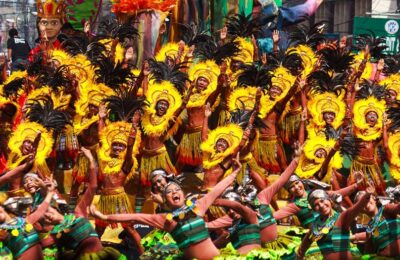
Like many municipal festivals in the Philippines, celebrations associated with Baggat Dekat can include street performances and cultural presentations.
This is where local history becomes visual.
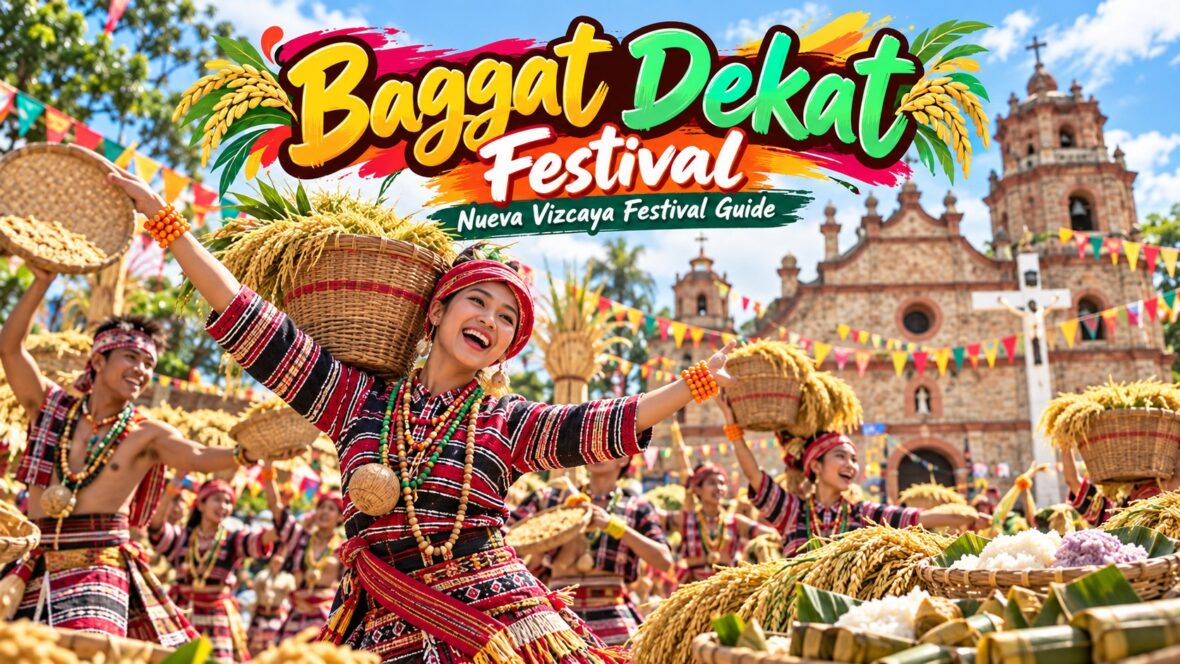
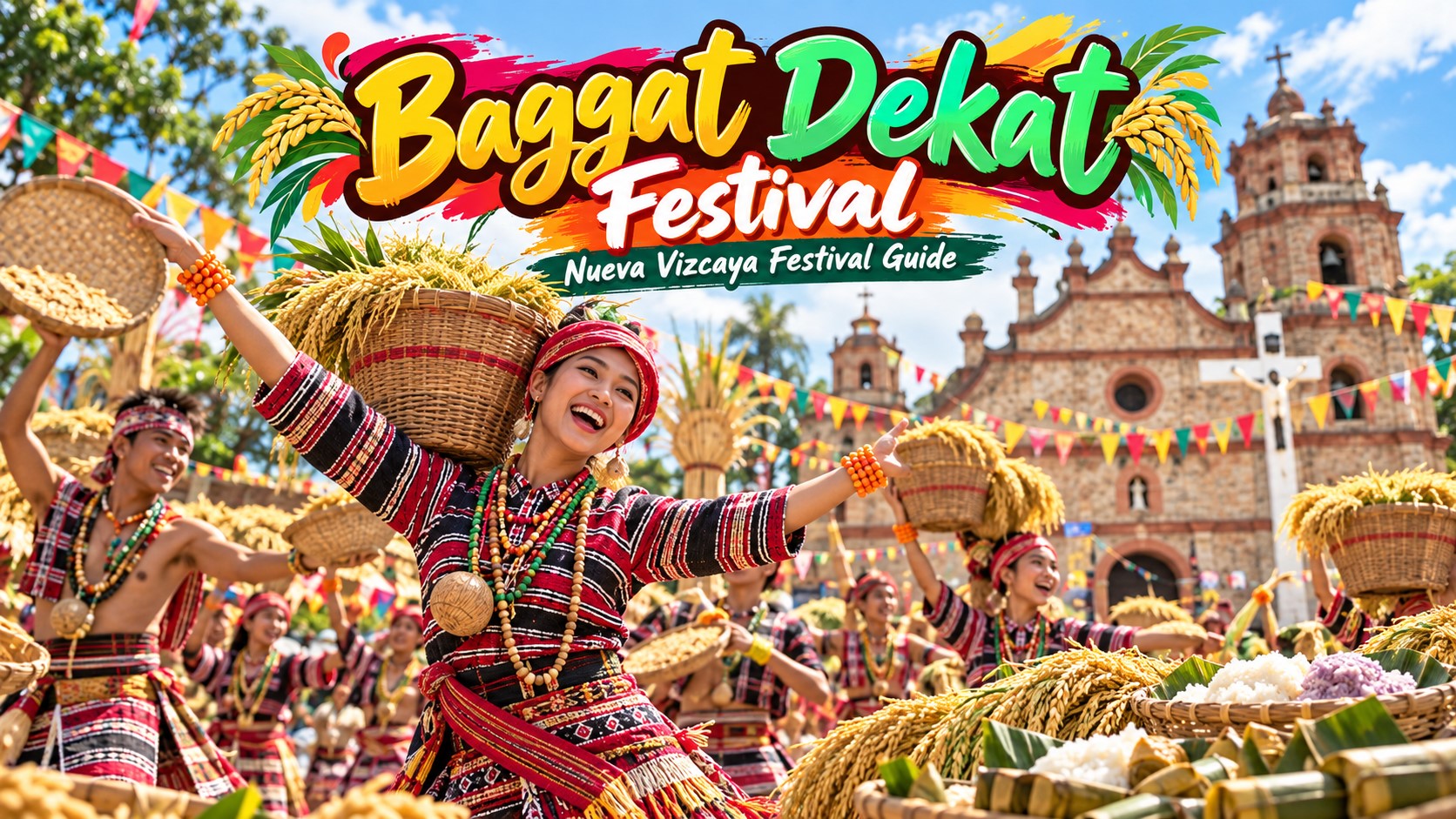
Costumes can draw inspiration from traditional textiles, agriculture, rice plants, native clothing, local products, and the identities of Nueva Vizcaya’s different communities.
Street dancing is always more interesting when you understand what the movements and costumes are trying to represent.
Some Philippine festival performances are essentially stories performed on the street.
Planting.
Harvesting.
Cooking.
Celebrating.
Giving thanks.
Working together.
Instead of simply watching which group has the most colorful costume, look for those little details.
They tell you what the festival values.
Rice-Inspired Festival Decorations
If you’re imagining a festival based around rice culture, don’t expect everything to be flashy in the same way as a huge urban celebration.
Agricultural festivals often turn ordinary farming materials into decoration.
Rice stalks.
Woven baskets.
Bilao.
Bamboo.
Native fabrics.
Palay.
Farm tools.
Traditional cooking utensils.
These materials immediately create a festival atmosphere connected to rural life.
And for photography, I actually prefer this.
There is something beautiful about a parade where the decorations clearly belong to the place instead of looking like they could have been used in any festival anywhere in the country.
Traditional Food During the Festival
If you’re visiting Baggat Dekat, come hungry.
Seriously.
A festival whose name is connected with rice and sticky rice is not a place where you should arrive immediately after a huge meal.
Rice-based delicacies are naturally among the foods worth looking for.
Depending on the celebration and the participating communities, visitors may encounter different forms of kakanin and other local specialties.
The exact food offerings can change from year to year, but look for dishes using glutinous rice, coconut milk, sugar, native ingredients, and traditional preparation methods.
And don’t just look for the most Instagrammable food.
Ask what it is called.
Ask how it’s made.
Ask whether it is usually prepared during fiestas.
Sometimes that five-minute conversation with a vendor becomes more memorable than the parade.
Why Kakanin Matters in Filipino Festivals
There is a reason kakanin keeps appearing in traditional celebrations.
Rice cakes are designed for sharing.
You make a tray.
You slice it.
Everybody gets some.
That simple act fits perfectly into the Filipino idea of a fiesta.
Nobody eats alone.
Someone always tells you:
“Kain ka muna.”
Even if you already ate.
And if you say no?
They ask again.
This is Philippine hospitality at its most predictable.
And I mean that in the best possible way.
Preserving Indigenous Languages
Baggat Dekat also highlights another issue that is becoming increasingly important: language preservation.
The Gaddang lexical study connected with Baggat-Dekat noted concerns that some traditional vocabulary was becoming unfamiliar among younger descendants as languages and cultures interact and change.
That makes festivals useful in ways we don’t always immediately see.
A child may hear the word “dekat” during a festival.
Then ask what it means.
Then learn the recipe.
Then hear a story about how a grandparent prepared it.
Suddenly one word has carried culture from one generation to another.
That is why keeping local festival names matters.
We don’t need to turn every festival name into generic English.
Sometimes the unfamiliar word is exactly what encourages us to learn something.
Nueva Vizcaya: A Province of Different Cultures
Another reason Baggat Dekat is fascinating is its setting.
Nueva Vizcaya sits in northern Luzon, surrounded by mountains and serving as an important gateway between Central Luzon, the Cordillera region, and the Cagayan Valley.
The province is home to communities with different cultural backgrounds, including Gaddang, Isinai, Bugkalot, Kalanguya, Ifugao and Ilocano influences, among others.
Over generations, these communities have interacted through agriculture, trade, marriage, migration, religion, and everyday life.
That diversity is reflected in the province’s festivals.
So when you attend a cultural event in Nueva Vizcaya, you are often seeing more than one historical influence operating at the same time.
Is Baggat Dekat Celebrated in Bayombong or Solano?
This is where things get a little confusing online.
And rather than pretending the confusion doesn’t exist, it is worth explaining.
A scholarly study on Gaddang vocabulary specifically refers to a “Bayombong Baggat-Dekat Festival” and says it was commemorated around the first or second week of August. Bayombong’s traditional town-fiesta period is also associated with early August and the feast of Santo Domingo de Guzman.
However, many widely circulated Philippine festival calendars list “Pagbiagan Festival/Baggat Dekat Festival and Solano Town Fiesta” together on October 7–8 in Solano, Nueva Vizcaya.
These references suggest that the name Baggat Dekat has been used within more than one local-fiesta context in Nueva Vizcaya, or that festival listings have combined traditions that developed or were promoted differently over time.
For travelers, the important lesson is simple:
Do not book a trip based solely on an old festival calendar.
Check the current program released by the relevant local government or tourism office.
Festival names, branding, schedules, and even host locations can evolve.
Baggat Dekat and Pagbiagan Festival
You may also encounter the name Pagbiagan Festival when searching for Baggat Dekat online.
Many festival directories combine the names as “Pagbiagan Festival/Baggat Dekat Festival” together with the Solano Town Fiesta.
This is one reason search results can look inconsistent.
For someone researching Philippine festivals, especially older or relatively small local celebrations, this happens more often than you might expect.
A festival may acquire a new official name.
A cultural component may become part of a larger town fiesta.
A previous festival branding may remain online for years.
Or two related celebrations may eventually be treated as one event in tourism calendars.
Rather than seeing this as a problem, I think it makes the history more interesting.
Festivals are living traditions.
They change along with the communities celebrating them.
What to Expect During a Town Fiesta in Nueva Vizcaya
Programs change each year, but a local celebration connected with Baggat Dekat may include activities such as:
- Cultural presentations
- Street dancing
- Community parades
- Agricultural exhibits
- Local food fairs
- Kakanin and cooking activities
- Trade fairs
- Sports competitions
- School performances
- Musical events
- Pageants
- Religious activities
- Barangay competitions
- Indigenous cultural showcases
- Evening entertainment
Not every activity appears every year.
That is normal.
The official program should always be your final reference before traveling.
When Is the Best Time to Visit?
Because historical and modern sources differ on the exact Baggat Dekat schedule, there is no single date I would recommend treating as permanently fixed.
Older cultural research connects the Baggat-Dekat name with Bayombong’s August celebrations, while current festival directories commonly associate it with Solano’s October town fiesta.
If you’re specifically traveling for Baggat Dekat, check official Nueva Vizcaya municipal announcements close to your trip.
The best day is usually the date featuring the main cultural parade, street dancing, food activity, or town-fiesta culmination.
How to Get to Nueva Vizcaya
Nueva Vizcaya is accessible by land from Metro Manila.
Major buses traveling north through the Cagayan Valley corridor pass through the province, making towns such as Solano and Bayombong relatively straightforward to reach without a private vehicle.
From Metro Manila, the trip generally follows the northbound route through Central Luzon and into Nueva Vizcaya.
Travel time can vary significantly depending on traffic, bus stops, weather, road conditions, and your exact destination.
If you’re visiting during a fiesta, leaving earlier than usual is a good idea.
Provincial town centers can get surprisingly busy once streets begin closing for parades and other activities.
Bayombong and Solano Are Close to Each Other
One advantage for travelers trying to understand the Baggat Dekat story is that Bayombong and Solano are neighboring municipalities.
Bayombong is the provincial capital, while Solano is one of Nueva Vizcaya’s main commercial centers.
That means you can easily include both in one trip.
You could explore the provincial capital, visit local churches and landmarks, try Nueva Vizcaya food, and continue toward Solano for shopping, dining, or festival activities depending on the year’s schedule.
What Else to See in Nueva Vizcaya
If you’re already traveling this far north, don’t make the festival your only stop.
Nueva Vizcaya is surrounded by mountain landscapes and has attractions connected with nature, history, Indigenous culture, agriculture, and local communities.
Dalton Pass is among the better-known historical and scenic stops in the province.
You can also explore local churches, markets, farms, mountain areas, and neighboring towns.
The province works especially well as part of a northern Luzon road trip.
You could continue toward Ifugao, Isabela, Quirino, or Cagayan depending on your itinerary.
Tips for Visiting Baggat Dekat Festival
First, check the official schedule.
I cannot stress this enough for this particular festival because historical sources use the Baggat Dekat name differently.
Second, arrive early for street events.
A good viewing position makes a huge difference, especially if you plan to take photos or videos.
Third, try the local food.
This is a rice-centered cultural celebration. Skipping the kakanin would almost defeat the purpose.
Fourth, bring cash.
Smaller vendors and temporary festival stalls may not accept cards or digital payments.
Fifth, ask questions.
If you see a traditional food, costume, dance, or object you don’t recognize, politely ask a local what it means.
That is how a festival becomes more than a photo opportunity.
Finally, respect Indigenous culture.
Traditional clothing, rituals, music, and dances are not costumes created purely for tourists. They can carry cultural and spiritual meanings that deserve respect.
Why Baggat Dekat Festival Matters
Some festivals become famous because they are huge.
Others matter because they preserve something small.
A word.
A recipe.
A dance.
A farming tradition.
A language.
A way of gathering.
Baggat Dekat belongs to that second category.
The idea behind the celebration takes something incredibly ordinary—rice—and reminds us that it is actually extraordinary.
Rice represents farmers.
Land.
Weather.
Labor.
Food.
Family.
Hospitality.
Thanksgiving.
And survival.
Sticky rice becomes a delicacy.
The delicacy becomes part of a gathering.
The gathering becomes a tradition.
And eventually, the tradition becomes something a whole community can celebrate.
Baggat Dekat Festival 2026
For travelers looking specifically at 2026, commonly circulated Philippine festival calendars list the Pagbiagan Festival/Baggat Dekat Festival and Solano Town Fiesta around October 7–8 in Solano, Nueva Vizcaya.
However, because historical academic sources also connect Baggat-Dekat with Bayombong’s August fiesta period, travelers should treat online calendar listings as a starting point rather than final confirmation.
Always check announcements from the concerned local government or tourism office before making the trip.
The cultural story of Baggat Dekat is much older and broader than one year’s program anyway.
Final Thoughts
Baggat Dekat Festival may not be one of those Philippine festivals everybody immediately recognizes.
And maybe that’s exactly why it is worth writing about.
It gives us a closer look at Nueva Vizcaya beyond highways and mountain scenery.
It introduces us to Gaddang language and culture.
It reminds us why rice means so much to farming communities.
And it shows how something as simple as sticky rice can become connected with thanksgiving, family, community, and identity.
Come for the festival.
Try the kakanin.
Watch the cultural performances.
Talk to the locals.
Learn what “baggat” and “dekat” mean.
Because sometimes the best festivals are not necessarily the loudest ones.
They’re the ones that help you understand the place a little better.
And Baggat Dekat does exactly that.
Suggested SEO title: Baggat Dekat Festival: Nueva Vizcaya Festival Guide, History & Activities
Suggested meta description: Discover Baggat Dekat Festival in Nueva Vizcaya, a celebration connected with rice, sticky-rice delicacies, Gaddang culture, thanksgiving, traditional food and community festivities.