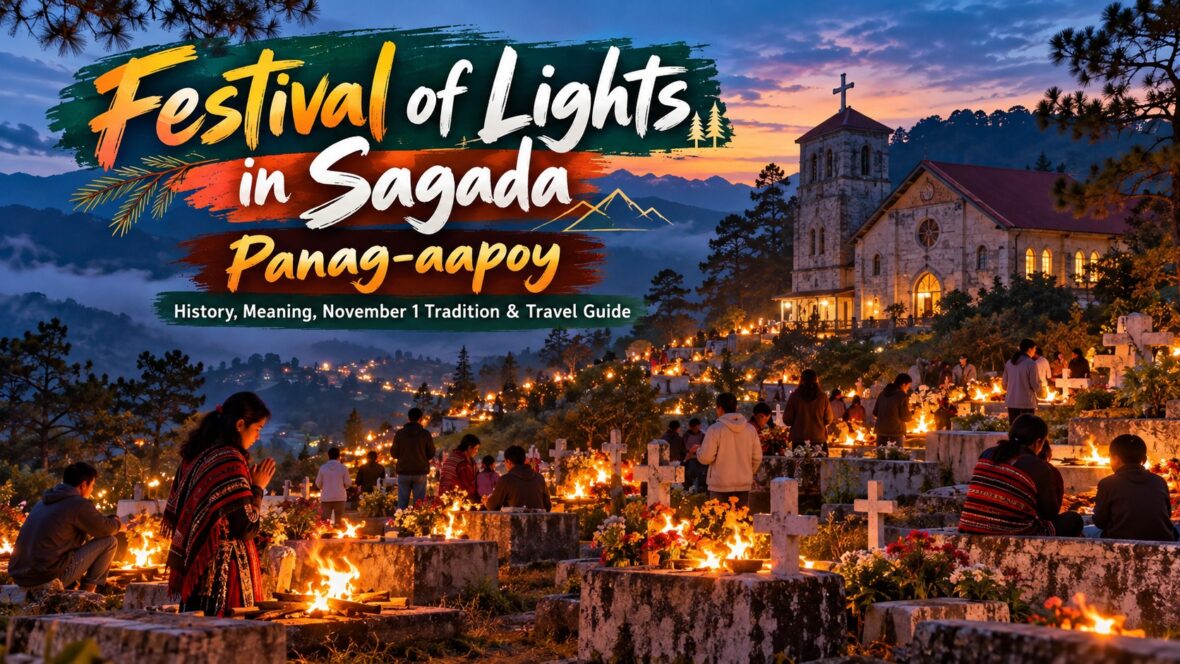
Every November 1, something extraordinary happens in the mountain town of Sagada in Mountain Province.
As the sun begins to disappear behind the Cordillera mountains, families make their way toward the cemetery carrying bundles of pinewood.
One by one, small fires begin to glow beside the graves of their departed loved ones.
And as darkness settles over the town, the cemetery gradually becomes illuminated by hundreds of flickering flames.
From a distance, it almost looks like the mountainside is covered in a sea of golden lights.
This is Panag-aapoy, a unique All Saints’ Day tradition in Sagada that many travelers have come to know as the Festival of Lights.
But there’s something important to understand about this beautiful sight.
Despite its popular nickname, Panag-aapoy isn’t actually a festival in the usual sense. There are no street dancing competitions, grand parades, or concerts.
Instead, it is a deeply personal and solemn tradition of remembrance.
For generations, families in Sagada have gathered to honor their departed loved ones by lighting pieces of resin-rich pinewood instead of ordinary candles.
It’s a practice that reflects the community’s Christian faith, local customs, and enduring relationship with the mountains.
And beyond the remarkable sight of glowing fires, Panag-aapoy offers a meaningful glimpse into how the people of Sagada remember those who have passed away.
If you’re curious about the Festival of Lights in Sagada, here’s everything you need to know about its history, meaning, traditional practices, celebration date, and cultural significance.
Content
What Is the Festival of Lights in Sagada?
The Festival of Lights in Sagada is the popular name used by some travelers and travel publications for Panag-aapoy, a traditional All Saints’ Day observance held every November 1 in Sagada, Mountain Province.
The local term is also written as Panag-apoy, while Panag-aapoy is a commonly used spelling.
During the observance, families gather at the cemetery near the Church of St. Mary the Virgin to remember their deceased relatives.
Instead of lighting ordinary candles, many residents burn small pieces of pinewood called saleng or saeng.
Because this wood contains naturally occurring resin, it burns with a bright flame.
When many families light their pinewood at approximately the same time, the cemetery becomes illuminated by numerous small bonfires.
It’s a remarkable sight, particularly as evening approaches and the surrounding mountains begin to fade into darkness.
However, the most important aspect of Panag-aapoy isn’t the appearance of the flames.
It’s the meaning behind them.
For the people participating, each fire represents an act of remembrance, prayer, and respect for a loved one.
Festival of Lights in Sagada at a Glance
| Details | Information |
|---|---|
| Local name | Panag-aapoy or Panag-apoy |
| Popular nickname | Festival of Lights |
| Location | Sagada, Mountain Province |
| Region | Cordillera Administrative Region |
| Traditional date | November 1 |
| Occasion | All Saints’ Day |
| Main location | Cemetery near the Church of St. Mary the Virgin |
| Main tradition | Lighting resin-rich pinewood beside graves |
| Material used | Saleng or saeng |
| Cultural significance | Remembrance of departed loved ones, faith, and family |
| Nature of observance | Solemn religious and community tradition, not a tourist festival |
Although the observance traditionally takes place on November 1, church arrangements, cemetery access, and visitor restrictions may change.
What Does Panag-aapoy Mean?
Panag-aapoy comes from the Kankanaey language and means “to light a fire.”
The name describes the most recognizable part of the tradition: lighting small fires beside the graves of deceased family members.
But its cultural meaning goes beyond the physical act of burning wood.
For the people of Sagada, the practice is a way of remembering their loved ones and keeping family connections alive.
The flames are associated with warmth, light, remembrance, and the continuing bond between the living and the dead.
Some local accounts describe the fires as a way of symbolically giving warmth to deceased family members.
Others emphasize prayer and the opportunity to reunite with relatives who return home for the observance.
At its heart, Panag-aapoy reflects a familiar Filipino value.
Remembering family members doesn’t end when they pass away.
Their lives continue to be honored through gatherings, prayers, and traditions passed down to younger generations.
History and Origins of Panag-aapoy
To understand the history of Panag-aapoy, we need to look at Sagada’s religious and cultural background.
Sagada is home to Kankanaey-speaking communities whose customs have been shaped by generations of life in the Cordillera mountains.
Traditional practices surrounding family, community, agriculture, and remembrance remain important parts of local identity.
However, Panag-aapoy should not be described as an exclusively precolonial indigenous ritual.
Historical accounts connect the observance strongly with the arrival of Anglican Christianity in Sagada during the early 20th century.
The Arrival of Anglican Christianity
During the American colonial period, Episcopal missionaries established a presence in Sagada.
The Church of St. Mary the Virgin became an important religious institution in the town.
As Christian practices became part of community life, residents began observing occasions such as All Saints’ Day through church services and cemetery visits.
In many Christian communities, families traditionally light candles at graves as expressions of prayer and remembrance.
But Sagada had a practical alternative.
Pinewood.
Why Pinewood Was Used Instead of Candles
Historical accounts from residents explain that candles were not always readily available in Sagada.
During earlier generations, families depended on local materials for lighting and other household needs.
Pine trees were abundant in the surrounding mountain environment, and resin-rich pinewood could burn brightly.
This material was useful not only for remembrance ceremonies but also for lighting paths and helping start fires.
Another explanation involves Sagada’s cool and windy mountain climate.
Ordinary candles could easily be extinguished by strong winds, while burning resinous pinewood provided a more substantial flame.
Over time, using pinewood during All Saints’ Day became an established local practice.
What may have begun partly as a practical solution developed into a deeply meaningful community tradition.
A Tradition Passed Down Through Generations
Older residents have described Panag-aapoy as something they experienced during childhood and continued practicing as adults.
Parents brought their children to the cemetery, families gathered around the graves of relatives, and younger generations learned how the observance was carried out.
Through these repeated family experiences, the tradition became part of Sagada’s cultural identity.
Today, Panag-aapoy is often described as a blending of Anglican Christian practices and the community’s local highland customs.
Its continuing significance comes from the families who observe it, rather than from tourism or organized entertainment.
Why Is Panag-aapoy Celebrated Every November 1?
Panag-aapoy takes place every November 1 because it is associated with All Saints’ Day.
In many parts of the Philippines, families visit cemeteries during the Undas period, which includes All Saints’ Day on November 1 and All Souls’ Day on November 2.
People clean graves, offer prayers, bring flowers, light candles, and spend time remembering relatives who have passed away.
In Sagada, the purpose is familiar, but the way it is expressed is different.
Instead of relying primarily on candles, families traditionally light pinewood fires.
November 1 is therefore not simply a date chosen for a cultural attraction.
It is connected to an established Christian observance and to the community’s way of remembering its dead.
Is Panag-aapoy Held on November 1 or November 2?
The traditional observance takes place on November 1.
This is an important distinction because many Filipinos associate cemetery visits with All Souls’ Day on November 2.
In Sagada, the characteristic pinewood-lighting practice is associated with the afternoon and evening of All Saints’ Day.
There may be other family or religious activities during the broader Undas period, but November 1 is the traditional date for Panag-aapoy.
How Is Panag-aapoy Observed?
One of the most meaningful things about Panag-aapoy is that it follows a relatively simple sequence.
There are no elaborate stage productions or competitions.
Instead, the observance brings together prayer, family gatherings, and the lighting of pinewood fires.
1. Families Prepare the Pinewood
Before November 1, families prepare pieces of resin-rich pinewood.
These pieces are called saleng or saeng.
They are generally cut into smaller sections that can be carried and burned beside graves.
The wood contains resin that helps it ignite and produce a bright flame.
Families prepare what they need for the observance, following their established customs.
This preparation is an important part of the tradition, although the exact practices may differ between households.
2. The Afternoon Church Service
Panag-aapoy traditionally begins with an afternoon religious service at the Church of St. Mary the Virgin.
The church is part of the Episcopal or Anglican tradition and has played a central role in the community’s religious life.
During the service, prayers are offered for the departed.
Historical accounts also describe the blessing of the saleng that families bring for the cemetery observance.
The religious service provides an opportunity for the community to gather in prayer before visiting the graves.
3. Families Proceed to the Cemetery
After the church service, families proceed to the nearby cemetery.
The cemetery is located on the hillside near the church.
Residents gather around the graves of their relatives, bringing their prepared pinewood.
Some offer personal prayers, while others spend time quietly remembering family members.
Church clergy have traditionally moved through the cemetery to bless the graves.
Unlike a festival parade, this movement from the church to the cemetery is part of the community’s religious observance.
4. The Lighting of the Saleng
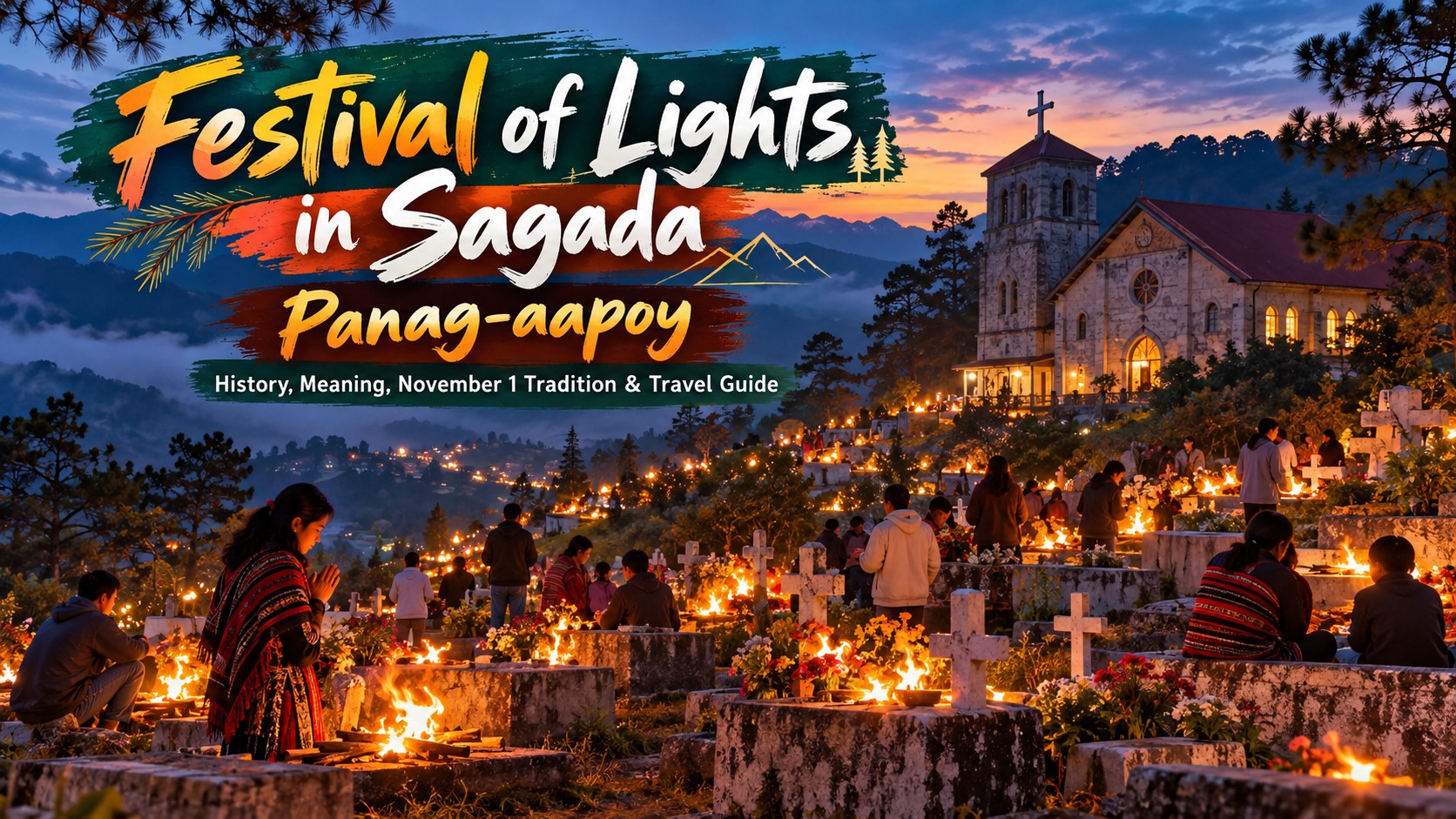
As the afternoon moves toward sunset, families begin lighting the pinewood beside the graves.
The fires are generally small, but they burn more brightly than ordinary candles.
At first, only a few flames may be visible.
Then more families light their saleng.
Gradually, the cemetery becomes filled with glowing orange and yellow fires.
As evening approaches, the flames stand out against the darkening mountain landscape.
This is the moment that has made Panag-aapoy widely recognizable in photographs and travel stories.
But for the families participating, the flames are not decorations.
They are expressions of remembrance.
5. Families Remember Their Loved Ones
While the fires burn, relatives spend time near the graves.
Some pray quietly.
Others greet family members, exchange stories, or remember people who are no longer with them.
For residents who have moved away from Sagada, November 1 can also be an opportunity to return home and reconnect with relatives.
This family-centered aspect is one of the most meaningful parts of Panag-aapoy.
The observance allows people to remember the past while strengthening connections with those who are still present.
6. The Fires Are Extinguished
Panag-aapoy is not an overnight festival.
The fires are usually allowed to burn for a limited period before families extinguish them and leave the cemetery.
Local authorities have emphasized the importance of fire safety, including ensuring that burning materials are completely put out.
This matters especially in Sagada, where forests and pine trees form an important part of the surrounding environment.
As the fires fade, families return home.
The cemetery gradually becomes quiet again.
What Is Saleng?
Saleng, also written as saeng, is the local name used for resin-rich pinewood that burns easily.
It is sometimes described as fatwood.
The material typically comes from portions of pinewood with a high concentration of resin.
Because of its resin content, it can produce a strong flame when ignited.
For generations, this type of wood has been useful in mountain communities.
Before electricity and modern lighting became widely available, resinous pinewood could be used as a source of light and for starting fires.
In the context of Panag-aapoy, saleng became an alternative to candles.
Its practical usefulness eventually became part of a continuing cultural tradition.
Why Does Saleng Burn So Brightly?
Pine resin is combustible.
When a piece of pinewood contains a high concentration of resin, it can ignite more readily and burn with a bright flame.
This explains why the small fires used during Panag-aapoy can produce a stronger glow than ordinary candles.
The burning wood also releases smoke and a characteristic pine scent.
However, the flames must be managed carefully.
The fact that saleng is traditionally used in the cemetery does not mean visitors should collect pinewood or start their own fires elsewhere in Sagada.
Fire safety and respect for local regulations are essential.
Why Panag-aapoy Is Not Actually a Festival
Here’s something that travelers should understand before visiting Sagada during the Undas season.
Although Panag-aapoy is widely called the Festival of Lights, residents and local officials have repeatedly explained that it is not a tourist festival.
The distinction is important.
A festival usually involves organized public entertainment, performances, competitions, or activities created for participants and spectators.
Panag-aapoy is different.
It is a solemn religious and community observance centered on remembering deceased loved ones.
In 2022, Sagada Mayor Felicito Dula publicly clarified that Panag-aapoy was not organized by the local government as a tourism event.
He explained that families simply follow their traditional practice of honoring relatives at the cemetery.
There is no official signal that starts the fires for spectators, and the observance is not designed as an entertainment program.
Local residents have also expressed concerns about visitors taking intrusive photographs or interfering with families during cemetery visits.
This is why the phrase “Festival of Lights” should be understood as a popular descriptive nickname rather than the official nature of the event.
The traditional name, Panag-aapoy, better reflects its meaning.
Where Does Panag-aapoy Take Place?
The best-known Panag-aapoy observance takes place at the cemetery associated with the Church of St. Mary the Virgin in Sagada, Mountain Province.
The church is located near the town center and is one of Sagada’s important religious landmarks.
The nearby cemetery lies along the hillside in an area surrounded by the town’s distinctive mountain landscape.
Many graves are relatively simple, with crosses or headstones marking burial places.
During November 1, families gather around these graves for the traditional remembrance.
The church and cemetery have a special significance for residents.
They are not simply tourist attractions.
Importantly, church-managed cemetery property may have its own access rules, including restrictions on visitors.
Travelers should never assume that cemetery access is automatically permitted just because photographs of Panag-aapoy are widely available online.
Can Tourists Watch the Festival of Lights in Sagada?
This is probably the most important question for travelers.
Panag-aapoy has attracted interest from photographers, travel bloggers, and visitors because of its unusual visual appearance.
However, being interested in the tradition doesn’t automatically give someone the right to enter the cemetery and observe families.
Local authorities and residents have emphasized that the occasion is primarily for the community.
Visitors should check with the church and the Sagada Tourism Office about any current guidelines or restrictions.
If visitors are not allowed in a particular area, respect that decision.
And even when observation is permitted, remember that you’re entering a space where families are remembering their dead.
It’s not an appropriate occasion for loud conversations, intrusive filming, or treating the ceremony as a performance.
A Few Important Rules for Respectful Visitors
If you happen to be in Sagada during the observance, keep these reminders in mind.
- Ask the appropriate church or community authorities whether visitors are permitted.
- Follow all cemetery access restrictions and instructions.
- Keep your voice low and avoid disturbing families.
- Don’t stand on graves or block pathways.
- Never move memorial objects or touch offerings.
- Ask permission before photographing recognizable individuals.
- Avoid flash photography, drones, and intrusive video recording.
- Don’t start your own bonfire or handle other families’ saleng.
- Leave immediately if organizers or residents ask visitors to do so.
The most respectful approach is to remember that Panag-aapoy belongs to the community.
Visitors are not its intended audience.
The Cultural Significance of Panag-aapoy
The longer you learn about Panag-aapoy, the more you realize that the tradition isn’t simply about lighting fires.
It represents several values that remain important in Sagada.
Remembering the Departed
At its heart, Panag-aapoy honors family members who have passed away.
The flames are visible reminders of the relationships that continue to matter after death.
The practice allows families to remember loved ones in a way that connects them with earlier generations.
Keeping Family Traditions Alive
Many residents learned about Panag-aapoy from their parents and grandparents.
Children grow up seeing how their families prepare the pinewood, attend the church service, and visit the cemetery.
Through these experiences, they learn the meaning behind the observance.
Community and Homecoming
November 1 can also bring family members back to Sagada.
Relatives who now live elsewhere may return to remember the departed and reconnect with their families.
These gatherings strengthen community relationships while preserving a shared tradition.
Faith and Local Identity
Panag-aapoy reflects the influence of Anglican Christianity alongside the customs and practical knowledge of the local community.
The use of pinewood, the mountain setting, and the shared religious observance all contribute to its distinctive character.
Respect and Responsibility
Another important part of the tradition is the value of behaving responsibly toward others and the environment.
In the Cordillera, the concept of inayan is often associated with ethical restraint and avoiding actions that may cause harm or disrespect.
This idea is particularly relevant when remembering the dead and protecting the natural environment surrounding the cemetery.
Panag-aapoy reminds both residents and visitors that cultural traditions carry responsibilities as well as meaning.
Is Panag-aapoy Unique to Sagada?
Sagada is the place most commonly associated with Panag-aapoy, largely because of its reputation as a popular mountain destination.
However, similar fire-lighting remembrance practices have also been documented in other parts of Mountain Province.
Accounts identify traditions in communities such as Besao, Bauko, and Sabangan.
In some places, the practice is also called panagdedenet.
The specific customs can differ between communities.
This means the use of fire during cemetery remembrance is not necessarily exclusive to Sagada.
Nevertheless, Sagada’s hillside cemetery, pinewood fires, and well-documented observance have made Panag-aapoy particularly recognizable.
How Is Panag-aapoy Different From the Usual Undas Traditions?
Throughout the Philippines, families visit cemeteries during the Undas season.
Common practices include cleaning graves, offering flowers, lighting candles, attending religious services, and gathering with relatives.
Panag-aapoy shares the same basic purpose of remembrance.
The main difference is the traditional use of resin-rich pinewood.
| Common Undas observances | Panag-aapoy in Sagada |
|---|---|
| Usually use candles | Traditionally use saleng or saeng |
| Cemetery visits often take place on November 1–2 | Main fire-lighting observance takes place November 1 |
| Prayers and family remembrance | Prayers and family remembrance |
| Flowers, candles, and other offerings | Pinewood fires and family prayers |
| Different practices depending on location | Closely associated with Sagada’s Anglican and local traditions |
The practices may look different, but the underlying reason is familiar to Filipino families across the country.
It’s about remembering those who are no longer with us.
How to Get to Sagada, Mountain Province
If you’re planning a trip to Sagada around November, it’s helpful to understand the available transportation options.
Sagada is located in the Cordillera Administrative Region of Northern Luzon.
The municipality is surrounded by mountains and is accessible by land.
From Manila to Sagada
One of the most convenient options for travelers from Metro Manila is a direct bus.
According to the official Sagada Tourism website, Coda Lines operates services from Cubao to Sagada.
The route travels through Nueva Vizcaya, Ifugao, and Mountain Province.
The journey generally takes approximately 12–14 hours, although actual travel time depends on weather, road conditions, and stops.
Bus schedules and fares can change, especially during holidays.
If you’re traveling during the Undas period, consider arranging transportation early.
From Baguio to Sagada
Another popular route is through Baguio City.
From Baguio, travelers can take a bus heading toward Sagada via the Halsema Highway.
The journey generally takes around five to six hours.
This route offers impressive views of the Cordillera mountains.
However, it also involves winding roads, steep sections, and areas where visibility can be affected by fog.
Traveling by Private Vehicle
Driving to Sagada gives you greater flexibility, particularly if you’re planning to visit other destinations in Mountain Province.
But mountain driving requires preparation.
Make sure your vehicle is in good condition and avoid unfamiliar mountain roads at night.
The official Sagada Tourism Office advises motorists to travel during daylight because of narrow roads, steep sections, fog, and possible landslides.
What Else Can You See in Sagada?
Even if your trip doesn’t coincide with Panag-aapoy, Sagada is worth visiting for its natural scenery, cultural heritage, and mountain atmosphere.
Here are some well-known attractions you can explore during an ordinary sightseeing visit.
Echo Valley and the Hanging Coffins
One of Sagada’s most recognizable attractions is Echo Valley, where visitors can see the famous hanging coffins.
The coffins are placed along rock faces as part of traditional burial practices associated with the community’s history.
The area offers a glimpse into beliefs and customs that differ from more familiar lowland burial traditions.
Tours typically involve walking through the surrounding landscape with a local guide.
Because these are burial sites, visitors should be respectful and avoid disturbing or touching the coffins.
Sumaguing Cave
Sumaguing Cave is another popular attraction in Sagada.
Known for its impressive rock formations and underground chambers, the cave attracts visitors interested in adventure tourism.
Exploring the cave can involve slippery rocks, uneven surfaces, and physically demanding sections.
For safety, follow local tourism regulations and use an accredited guide.
Bomod-ok Falls
If you enjoy trekking, Bomod-ok Falls is another natural attraction worth considering.
The waterfall is reached through a trail that passes mountain scenery and communities around northern Sagada.
The trek can be physically demanding, particularly on the return journey.
Check current trail conditions, weather, and community access arrangements before booking a guided visit.
Sagada’s Local Food
Beyond sightseeing, Sagada has a food culture worth exploring.
The town is known for mountain-grown vegetables, locally produced coffee, and traditional foods such as etag.
Etag is a preserved meat product associated with Cordillera food traditions.
You can also find local cafés, restaurants, and bakeries serving a combination of Filipino comfort food and regional specialties.
If you’re visiting during November, warm meals and hot coffee are particularly appealing in the town’s cool mountain atmosphere.
Where to Stay in Sagada
Sagada offers a range of guesthouses, inns, homestays, and small lodging establishments.
Many accommodations are concentrated around the town center, while others are located in quieter areas overlooking the surrounding mountains.
For first-time visitors, staying near the town center can be convenient because it provides easier access to restaurants, transportation, and the tourism office.
However, being close to the Church of St. Mary the Virgin does not mean that your accommodation includes permission to observe Panag-aapoy inside the cemetery.
Those arrangements are separate and remain subject to church and community rules.
November can also be a busy travel period because of holidays.
If you’re planning to visit Sagada around Undas, arrange your accommodation in advance and confirm your transportation.
Travel Tips for Visiting Sagada During November
Bring Warm Clothes
Sagada is located at a high elevation, and temperatures can become noticeably cooler than those in Metro Manila.
Bring a jacket, especially if you plan to be outdoors during the late afternoon or evening.
Prepare for Changing Weather
Mountain weather can change quickly.
You may experience sunshine, clouds, rain, and fog during the same trip.
Wear comfortable footwear and bring a rain jacket.
Register Through the Official Tourism System
Sagada has an organized local tourism system, including visitor registration and accredited guide services.
Check the latest requirements through the Sagada Tourism Office before exploring tourist sites.
Respect Sacred and Burial Sites
Sagada is known for its burial traditions and cultural heritage.
Avoid treating burial areas as ordinary photo spots.
Follow instructions from local guides, church authorities, and community representatives.
Practice Responsible Photography
The appearance of Panag-aapoy can be visually striking, but photographs should never come at the expense of people’s privacy or grief.
If access is permitted, prioritize respect over getting the perfect shot.
Don’t Start Fires
Only participating families and authorized community members should carry out the fire-lighting practice according to local rules.
Visitors should not attempt to recreate Panag-aapoy at other locations.
Support Local Businesses
Consider staying at locally operated accommodations, eating at community establishments, and hiring accredited local guides.
Responsible tourism can help support livelihoods while encouraging the preservation of Sagada’s cultural heritage.
Why the Festival of Lights in Sagada Matters
One of the reasons Panag-aapoy has attracted so much attention is its remarkable appearance.
Photographs of a mountainside cemetery glowing with dozens of small fires are undoubtedly memorable.
But if we focus only on the visual spectacle, we miss what makes the tradition important.
For the families of Sagada, Panag-aapoy is about memory.
It’s about parents remembering their children, children remembering their parents, and relatives gathering to honor people who helped shape their lives.
The pinewood flames may last only a short time, but the relationships being remembered endure.
The tradition also reflects how communities adapt practices to their surroundings.
What other places express through candlelight, Sagada has traditionally expressed through burning pinewood.
Over generations, that practice became part of the town’s cultural identity.
And in a world where tourism sometimes turns local traditions into attractions, Panag-aapoy is also a reminder that not everything meaningful is meant to become a performance.
Some traditions are meant primarily for the people who practice them.
Frequently Asked Questions About the Festival of Lights in Sagada
What is the Festival of Lights in Sagada?
The Festival of Lights is a popular nickname for Panag-aapoy, a traditional All Saints’ Day observance in Sagada where families light pinewood fires beside the graves of their deceased loved ones.
What does Panag-aapoy mean?
Panag-aapoy is a Kankanaey term meaning “to light a fire.”
When is Panag-aapoy celebrated?
The observance traditionally takes place every November 1, during All Saints’ Day.
Where is Panag-aapoy held?
The best-known observance takes place at the cemetery associated with the Church of St. Mary the Virgin in Sagada, Mountain Province.
Why do people in Sagada burn pinewood instead of candles?
Historical accounts explain that resin-rich pinewood was locally available when candles were less accessible. Burning pinewood is also more practical in windy conditions, although the tradition has since developed deeper cultural and religious significance.
What is saleng?
Saleng, or saeng, is resin-rich pinewood used to produce the small fires during Panag-aapoy.
Is Panag-aapoy a religious festival?
Panag-aapoy is connected to All Saints’ Day and the Anglican Christian traditions of Sagada.
However, local residents and officials emphasize that it is a solemn remembrance practice rather than a public festival or tourist celebration.
Can tourists join Panag-aapoy?
Visitor access is not guaranteed. The observance is primarily for local families, and the church or community may impose restrictions. Tourists should ask the appropriate authorities and respect any decision limiting access.
Is there street dancing during the Festival of Lights?
No. Panag-aapoy is not a street dancing festival. It is centered on prayer, cemetery visits, and remembrance.
Is Panag-aapoy the same as the Etag Festival?
No.
Panag-aapoy is an All Saints’ Day remembrance tradition held on November 1.
The Etag Festival is a separate cultural celebration held around late January and early February that highlights Sagada’s traditions, food heritage, and community life.
Do the fires burn all night?
No. The observance generally takes place from the afternoon into the early evening. Families extinguish their fires according to community safety practices before leaving the cemetery.
Is the Festival of Lights worth visiting Sagada for?
Panag-aapoy is culturally significant, but it should not be treated as a tourist attraction with guaranteed viewing access.
If you’re visiting Sagada during November, approach the tradition respectfully and follow the community’s guidance. The town’s natural attractions and cultural heritage can also be appreciated throughout the year.
Festival of Lights in Sagada 2026: Latest Schedule Information
For travelers researching the upcoming observance, Panag-aapoy traditionally takes place on November 1.
In 2026, November 1 falls on a Sunday.
Based on established practice, the observance would ordinarily involve an afternoon church service, prayers for the departed, and family visits to the cemetery, followed by the lighting of saleng around dusk.
However, as of October 18, 2026, a detailed official schedule or public visitor-access advisory for this year’s observance has not been independently verified.
Panag-aapoy also does not follow the format of a typical festival with a published program of performances.
The observance is carried out by families, and church or community authorities may determine who can enter particular cemetery areas.
Visitors should therefore avoid assuming that a November 1 trip automatically includes access to the ceremony.
For current guidance, consult the Sagada Tourism Office and the Church of St. Mary the Virgin.
Any restrictions concerning cemetery entry, photography, or visitor presence should be followed.
Final Thoughts
There are many beautiful traditions in the Philippines, but Panag-aapoy in Sagada stands out for its simplicity and meaning.
Every November 1, families gather to remember people who have passed away.
They attend prayers, visit graves, and light pinewood fires that glow against the cool mountain evening.
From a distance, the sight may resemble a festival of lights.
But for the people of Sagada, the tradition is much more personal than that.
It’s about family, faith, respect, and remembering those who remain part of their lives even after death.
And that’s what makes Panag-aapoy special.
It reminds us that traditions don’t always need grand celebrations or elaborate performances to be meaningful.
Sometimes, a small flame burning beside a grave can tell a story about love, memory, and the bonds that connect generations.
For travelers discovering Sagada, understanding Panag-aapoy offers another perspective on the town’s rich cultural heritage.
Beyond the hanging coffins, caves, waterfalls, and mountain views is a community with traditions that deserve to be understood and respected.
And perhaps that’s the most valuable lesson of Sagada’s so-called Festival of Lights.
The beauty isn’t simply in the flames.
It’s in the memories they represent.