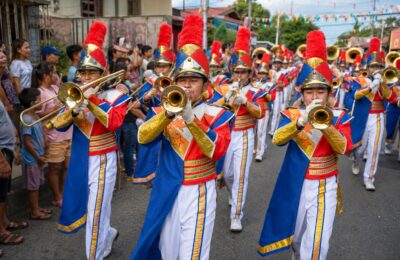
There are Philippine festivals built around patron saints, harvests, flowers, local delicacies and historic events. Then there are festivals like Busig-On, where an entire celebration grows out of a story.
Held in the municipality of Labo in Camarines Norte, the Busig-On Festival transforms a local epic into colorful street performances filled with warriors, courtship scenes, fishing traditions, flowing water and the story of a community overcoming hardship.
At the center of everything is Busig-On, a legendary hero whose story is closely connected with the waters of Labo. His name itself is usually interpreted as “plenty of water”—an appropriate symbol for a town where rivers have long played an important role in agriculture, livelihood and everyday life.
But Busig-On Festival isn’t simply a theatrical retelling of folklore. Over the years, it has become one of Labo’s biggest community celebrations, bringing together street dancers, schools, barangays, government offices, performers, athletes, pageant contestants and residents.
If you’re looking for a festival in Bicol that’s smaller and more intimate than the giant celebrations of Naga, Legazpi or the Visayas—but has a fascinating story of its own—Busig-On Festival is worth knowing.
Content
What Is the Busig-On Festival?
Busig-On Festival is an annual cultural festival celebrated in Labo, Camarines Norte, traditionally during the first part of September.
The Tourism Promotions Board of the Philippines describes Busig-On as a festival based on the epic of Labo’s hero Busig-On, emphasizing heroism, Bicolano values, the municipality’s history and its local places of interest.
Street dancing is among its most recognizable attractions, but the larger celebration has included parades, cultural presentations, competitions, pageants and community activities.
The festival is also closely connected with Labo’s foundation anniversary celebrations. For example, government records from 2012 describe the municipality celebrating both its 14th Busig-On Festival and its 212th Foundation Anniversary, while a 2015 celebration was billed as the 17th Busig-On Festival and Labo’s 215th anniversary.
So Busig-On isn’t just something staged for tourists. It has become part of how the people of Labo publicly celebrate their hometown.
Where Is Busig-On Festival Celebrated?
Busig-On Festival is held in Labo, Camarines Norte, one of the municipalities of the Bicol Region.
Labo sits inland from the provincial capital of Daet and is known for a landscape that includes mountains, forests, rivers and waterfalls.
That natural setting matters to the Busig-On story.
Water isn’t simply decorative imagery added to the festival. The story behind Busig-On revolves around a river and the idea that an abundant water supply can mean survival, food, irrigation and prosperity for a community.
That’s why you will often see water, fish, plants, farming and nature represented in festival choreography and costumes.
What Does “Busig-On” Mean?
One commonly repeated explanation divides the name into two parts:
“Busig” refers to water, while “on” conveys abundance or plenty.
Together, Busig-On is interpreted as “plenty of water” or “abundant water.”
The name is strongly associated with the river at the center of Labo’s local narrative.
And once you know that meaning, the festival starts making much more sense.
Performances involving fishing, flowing movements, blue and green decorations, river imagery and agricultural scenes aren’t random artistic choices. They’re connected to the life-giving water around which the Busig-On story revolves.
The Epic Story Behind Busig-On Festival
This is where Busig-On becomes particularly interesting.
Although it’s commonly referred to simply as the “Epic of Busig-On,” published accounts describe the work as a contemporary epic written by Dr. Carlos C. Galvez and inspired by the legends and landscape associated with Labo and its river.
So it is better understood as a locally written epic narrative rooted in Labo’s cultural memory rather than automatically assuming it is an ancient precolonial epic passed unchanged from generation to generation.
Its story revolves around three important characters:
Busig-On, Princess Maraya and their son Tarik-Kuduok.
Busig-On and Princess Maraya
According to the story, Busig-On and Princess Maraya belonged to two opposing tribes.
The two communities were enemies, but Busig-On and Maraya fell in love.
Eventually, they married.
Their union did something that fighting could not: it helped bring peace between their tribes.
Already, the story contains one of the festival’s most important themes.
Busig-On isn’t celebrated simply because he is portrayed as a powerful hero. His story represents reconciliation.
Two divided communities are brought together through love.
That’s why festival performances sometimes include courtship sequences alongside the more dramatic warrior choreography.
The Birth of Tarik-Kuduok
Busig-On and Maraya eventually had a son named Tarik-Kuduok.
After the death of his parents, Tarik-Kuduok became the leader of the people.
Then disaster came.
A severe drought or famine devastated the land. Water became scarce, crops suffered and the community struggled.
Faced with the suffering of his people, Tarik-Kuduok sought guidance from the spirit of his father.
What happened next provides the foundation for the festival’s connection with water.
How the Busig-On River Was Born in the Story
According to the epic narrative, water eventually emerged from the place associated with Busig-On.
The water grew into pools, streams and eventually a river.
The formerly dry landscape suddenly had the resource it desperately needed.
Fish returned or became plentiful.
Farms could be irrigated.
The people had water to sustain their lives.
The river came to be associated with Busig-On, whose name represented its abundance. Accounts identify the Busig-On River as a tributary connected with the larger Labo River system.
And that is essentially the heart of the festival story:
From conflict comes peace.
From drought comes water.
From hardship comes abundance.
And from Busig-On comes a symbol of resilience for Labo.
Why Water Is So Important to Busig-On Festival
It’s easy to look at Busig-On Festival photos and focus on the costumes.
But water is arguably the real protagonist of the celebration.
Rivers support agriculture.
They provide food.
They shape landscapes.
They sustain communities.
For earlier generations especially, a dependable source of water could mean the difference between a good harvest and hunger.
That’s what makes the Busig-On story so relatable.
The legendary spring or river isn’t simply a magical ending. It represents security.
When performers portray fishing, farming or flowing water, they are also illustrating the relationship between the people of Labo and their environment.
The Busig-On River and Labo River
The Busig-On narrative is connected with the waterways around Labo.
Sources describing the epic identify Busig-On River as a principal tributary of the Labo River, while accounts of local culture emphasize the importance of these waters to fishing and farming.
One educational reference from Camarines Norte even notes local fish associated with the river, including banak and palos.
So although Busig-On himself belongs to a narrative, the river environment celebrated by the festival is very real.
History of Busig-On Festival
Busig-On Festival is relatively young compared with religious fiestas that have been celebrated for centuries.
Available government records give us a useful clue about when it began.
In September 2012, the Department of the Interior and Local Government reported that Labo celebrated its 14th Busig-On Festival together with the municipality’s 212th Foundation Anniversary. Three years later, local coverage identified the 2015 celebration as the 17th Busig-On Festival.
Counting backward from those editions points to the festival emerging around 1999.
That makes Busig-On a good example of a modern Philippine festival that uses performance and storytelling to strengthen awareness of local identity.
And the festival has continued evolving.
What may have started primarily as a way of presenting Labo’s history and Busig-On narrative now works as a much broader town celebration involving tourism, community participation, entertainment and civic pride.
Street Dancing: The Highlight of Busig-On Festival
For most visitors, street dancing will probably be the most exciting part of Busig-On Festival.
This is where the epic moves from words to the streets.
Groups of dancers perform choreographed versions of the Busig-On story while spectators gather along the route.
Expect bright costumes.
Expect drums.
Expect warriors.
Expect fishing nets, baskets, bamboo props and nature-inspired designs.
And expect plenty of movement representing water.
Travel writer and photographer Marky Ramone Go, who documented the festival, described seeing performers interpret episodes involving courtship, fishing and homage to the Busig-On River.
That narrative element is important.
The street dance isn’t supposed to be merely a parade where groups try to wear the brightest costumes.
It is storytelling.
What the Street Dances Represent
Different contingents can interpret the story differently, but several themes naturally emerge from the Busig-On epic.
Tribal conflict
Some performances depict the two opposing communities from which Busig-On and Maraya came.
Warrior-inspired choreography, spears, shields and strong movements can represent this conflict.
Courtship and love
The relationship between Busig-On and Princess Maraya offers a softer contrast.
Dancers may use courtship scenes to portray how two people from opposing groups fall in love.
Reconciliation
Their marriage brings together the once-warring communities.
This makes unity another important theme of the festival.
Drought and hardship
Performers can portray famine through slower choreography, struggling movements or imagery of dry land.
The arrival of water
This is often one of the most visually interesting parts.
Costumes, fabric, formations and movement can represent springs or rivers suddenly flowing through the land.
Fishing and harvest
Once water returns, life follows.
Fishing baskets, nets and agricultural elements represent abundance and livelihood.
The complete performance becomes a simplified version of the Busig-On story told through music and dance.
The Costumes of Busig-On Festival
Busig-On Festival doesn’t have one single costume worn by everyone.
That actually makes the street dancing more visually interesting.
Different groups create costumes based on their interpretation of the festival theme.
Looking at documented performances over the years, you’ll see bright combinations of red, green, yellow, blue, purple and earth tones.
Some dancers wear clothing inspired by warriors.
Others carry large woven baskets.
Some use poles covered with fishing-net-like materials.
There are elaborate headdresses, shells, native materials, floral imagery and designs inspired by vegetation or water.
What ties everything together isn’t necessarily one color.
It’s the story.
Why Green and Blue Often Work So Well
Nature-inspired colors naturally fit Busig-On.
Green can represent the fertile land restored by water.
Blue or turquoise can evoke rivers.
Earth tones can represent farming and rural life.
Yellow can suggest harvest and abundance.
But festival designers are free to get creative, so contemporary costumes can become much more theatrical.
That’s part of the fun.
Drums, Music and Festival Energy
No Philippine street dancing festival would feel complete without percussion.
Busig-On is no exception.
Drummers accompany dancers as groups make their way through Labo.
The beat gives the routines their energy and helps transform storytelling into spectacle.
One firsthand account describes the festival as considerably smaller and more relaxed than massive celebrations such as Sinulog, Ati-Atihan or Dinagyang, but still filled with loud drums, colorful costumes and energetic choreography.
And that smaller scale can actually be an advantage.
At enormous festivals, spectators sometimes find themselves separated from performers by huge crowds.
Busig-On can feel much more local.
You aren’t necessarily watching from five rows behind thousands of tourists.
You feel like you’re in the middle of a town celebration.
More Than Street Dancing
Street dancing gets the photos, but Busig-On Festival has traditionally been much broader.
Programs change from year to year, but past celebrations have included civic parades, competitions, sports activities, community events and cultural programs.
The Tourism Promotions Board specifically describes the festival as showcasing talent and skills through competition while highlighting Labo’s history and places of interest.
Opening Parade
Parades have played an important role in past editions.
The 2015 opening celebration, for example, included a large parade involving municipal officials, schools, barangays, government agencies, NGOs and local organizations. Local reporting described it as one of the largest opening parades the town had staged at that point.
That’s a good example of how Busig-On functions as a genuine community festival.
It’s not only professional performers participating.
Much of Labo gets involved.
Competitions
Talent and skills competitions have long been incorporated into Busig-On celebrations.
Depending on the year, programs can include cultural contests, sports, performances and other competitions organized around different groups in the municipality.
These smaller events are part of what gives the festival its town-fiesta atmosphere.
Binibining Busig-On
Beauty pageants are another familiar part of many Philippine town celebrations, and Labo has its own festival-related pageant.
For 2026, for example, the Binibining Busig-On program was again part of the festival season, with contestants representing the town through pageant and community activities.
Pageant formats can change over time, but they add another popular component to the festivities.
Busig-On Festival and Labo’s Foundation Anniversary
Another important detail is that Busig-On has historically been celebrated together with the founding anniversary of Labo.
Government reporting from 2012 paired the 14th Busig-On Festival with Labo’s 212th Foundation Anniversary, while the 2015 edition accompanied the town’s 215th anniversary.
This places Labo’s traditional foundation date in 1800.
September 8 has also been associated locally with foundation-anniversary activities. A Marian exhibit and procession held on the Nativity of the Blessed Virgin Mary has historically formed part of celebrations around that date as well.
This makes early September an especially festive time to visit Labo.
Busig-On itself, however, is primarily a cultural and civic festival centered on the town’s epic and identity rather than being solely a religious feast.
The Bicolano Values Behind Busig-On
Official tourism descriptions specifically say Busig-On exemplifies heroism and Bicolano values.
But what does that actually mean?
The story gives us several themes.
Courage
Busig-On represents a heroic figure, while his son has the responsibility of leading a community through crisis.
Love over conflict
Busig-On and Maraya come from rival communities but choose one another.
Their relationship becomes a path toward reconciliation.
Unity
Two groups that once fought eventually come together.
That message remains relevant far beyond the original story.
Resilience
The people survive famine and drought.
The return of water symbolizes the ability to recover after hardship.
Respect for nature
The story makes it impossible to separate human survival from the environment.
Water sustains the community.
Rivers provide food.
Land produces crops.
People depend on nature rather than existing apart from it.
Those themes give Busig-On more depth than simply being another colorful September parade.
Why Busig-On Festival Is Unique
The Philippines has no shortage of street-dancing festivals.
So what makes Busig-On different?
It’s the narrative.
Many harvest festivals revolve around agricultural bounty. Religious festivals revolve around devotion. Product festivals promote a particular crop or industry.
Busig-On tells an entire story.
There are characters.
There is conflict.
There is romance.
There is tragedy.
There is drought.
There is a supernatural element.
And finally, there is water and abundance.
That makes the festival almost like street theater on a town-wide scale.
You don’t necessarily need to know the full story before watching the performances.
But once you do know it, the choreography makes much more sense.
A basket is no longer just a prop.
A fishing net represents livelihood.
A warrior represents conflict.
Flowing fabric becomes a river.
A pair of dancers can become Busig-On and Maraya.
And suddenly what looked like a colorful dance becomes a story about Labo.
When Is Busig-On Festival Celebrated?
Busig-On Festival is traditionally held during the first part of September in Labo.
Different historical sources sometimes list slightly different lengths for the celebration because full municipal programs can extend beyond the main festival days.
For planning purposes, however, the Tourism Promotions Board currently lists the festival on September 7 to 9.
The largest activities may not necessarily happen on every listed day, so travelers should always check the latest municipal program if street dancing or a specific competition is the main reason for visiting.
How to Get to Labo, Camarines Norte
For most travelers coming from Metro Manila, the usual route to Labo is by land through southern Luzon.
Buses traveling toward Camarines Norte and other Bicol destinations use the highway passing through the province. Depending on the service, traffic and route, an overnight bus can often be the most practical option.
Another strategy is to travel first to Daet, the provincial capital, and continue to Labo using local transport.
If you’re already exploring Bicol, Labo can also be combined with a wider Camarines Norte trip.
Because provincial transport schedules change, especially around holidays and festivals, check current bus departures before traveling rather than relying on an old timetable.
What to Expect If You’re Attending Busig-On
Busig-On has a different feel from the country’s giant festivals.
And that’s a good thing.
Don’t arrive expecting Sinulog-sized crowds or kilometers of corporate floats.
Busig-On’s appeal is that it still feels strongly connected to the community celebrating it.
You may find school groups preparing routines.
Barangays joining civic activities.
Families waiting on sidewalks.
Drummers walking beside performers.
Local residents greeting people they know along the parade route.
There’s an intimacy to smaller-town festivals that’s difficult to reproduce at massive tourism events.
Come Early for Street Dancing
If street dancing is your priority, arrive well before the scheduled starting time.
The best viewing areas can fill quickly.
Being early also gives photographers more freedom to move before the parade route becomes crowded.
Prepare for September Weather
September is within the rainy season.
Bring a light raincoat or umbrella.
At the same time, daytime heat can still be intense, especially when you’re standing along an open road.
Bring water, wear comfortable clothing and use sun protection.
Interestingly, one 2015 Busig-On street-dancing event drew such large crowds and intense heat that local reports mentioned some participants and spectators becoming faint.
So hydration isn’t just generic festival advice here.
Bring a Power Bank
If you’re photographing street dancers, your phone will work overtime.
Between videos, photos, navigation and messaging, battery life disappears quickly.
Respect the Performers
Remember that many dancers spend weeks or months preparing.
Give them room during performances and avoid suddenly walking into formations just to get a photo.
You’ll usually get better images by observing where the choreography is moving and waiting for the right moment.
Exploring Labo Beyond the Festival
If you’re traveling all the way to Camarines Norte, don’t immediately leave after the last drumbeat.
Labo’s identity is closely connected with nature, so the festival can serve as an introduction to a town worth exploring beyond its central streets.
The municipality is known for rivers, mountainous terrain, caves and waterfalls. Local tourism listings include places such as Saltahan Falls in Barangay Awitan and the Busig-On and Labo river systems themselves.
A slower visit lets you see why a story about water became such a natural symbol for this particular town.
Busig-On Festival vs. Other Camarines Norte Festivals
Camarines Norte has several distinct celebrations, and Busig-On represents Labo specifically.
What makes it different is its reliance on a local epic as the organizing theme.
Rather than simply showcasing a product, the festival combines folklore, history, environment and community identity.
For anyone trying to experience festivals beyond the most famous names in Philippine tourism, Busig-On offers exactly the kind of local discovery that makes festival-hopping interesting.
Is Busig-On Festival Worth Visiting?
Yes—especially if you enjoy cultural festivals and prefer events where you can still feel the character of the town behind the spectacle.
Busig-On isn’t trying to be Sinulog.
It doesn’t need to be.
The appeal comes from watching a community take a locally significant story and turn it into movement, music and celebration.
One moment you’re watching warriors.
The next you’re seeing a courtship.
Then dancers are carrying fishing baskets.
Suddenly the choreography shifts, the drums become louder and an entire group represents the arrival of water.
Once you understand the epic behind it, those scenes connect.
And that’s when Busig-On Festival becomes much more memorable.
Busig-On Festival 2026 Schedule
Although this article is designed as a timeless guide, travelers planning a visit this year should know that the Tourism Promotions Board currently lists Busig-On Festival 2026 for September 7–9 in Labo, Camarines Norte.
Current event listings also identify the same September 7–9 dates.
The municipality also organized Binibining Busig-On 2026 as part of this year’s festival season.
If you’re traveling specifically for the street-dancing competition, coronation night or another major event, check the latest announcement from the Municipality of Labo or its tourism office before leaving, because individual event times and venues can be announced separately from the general festival dates.
Frequently Asked Questions About Busig-On Festival
Where is Busig-On Festival celebrated?
Busig-On Festival is celebrated in Labo, Camarines Norte, in the Bicol Region.
When is Busig-On Festival?
It is traditionally celebrated in early September. The Tourism Promotions Board currently lists the main dates as September 7–9.
What does Busig-On mean?
The name is commonly interpreted as “plenty of water” or “abundant water,” referring to the river that plays a central role in the Busig-On narrative.
Who is Busig-On?
Busig-On is the central hero of the epic narrative celebrated by Labo. He falls in love with Princess Maraya, who belongs to an opposing tribe, and their relationship ultimately helps reconcile the two communities.
Who wrote the Epic of Busig-On?
Available accounts identify Dr. Carlos C. Galvez as the writer of the contemporary Epic of Busig-On.
Who are Princess Maraya and Tarik-Kuduok?
Princess Maraya is Busig-On’s wife. Tarik-Kuduok is their son, who later becomes a leader and seeks his father’s spiritual guidance when famine threatens the community.
What is the highlight of Busig-On Festival?
Street dancing is one of its best-known highlights. Performers interpret episodes from the Busig-On story using colorful costumes, props, music and choreography.
Is Busig-On a religious festival?
Busig-On is primarily described as a cultural festival built around Labo’s epic, history and Bicolano values. It takes place during a period that also includes Labo’s foundation-anniversary activities and other local observances.

Final Thoughts
Busig-On Festival is proof that a festival doesn’t need millions of spectators to have a story worth telling.
In Labo, that story begins with two people from opposing communities.
Busig-On and Princess Maraya choose love over conflict.
Their son inherits responsibility during a time of crisis.
The land becomes dry.
The people suffer.
Then water arrives.
The river brings fish, irrigation and life back to the community.
And generations later, the people of Labo continue turning those ideas into dance.
That’s what makes Busig-On different.
Behind the colorful costumes is a story of reconciliation. Behind the fishing baskets is a story of livelihood. Behind the flowing choreography is a river. And behind the hero Busig-On is a celebration of the resilience, history and identity of the people of Labo, Camarines Norte.
Come for the street dancing.
Stay for the story.
Because once you know what Busig-On means, every drumbeat, costume and flowing movement along the streets of Labo begins to tell you something about the town itself.