There are festivals where the main symbol is something you see only during the celebration.
That isn’t the case in Basey, Samar.
Here, one of the most important symbols of the festival is something families have been making with their own hands for generations:
the banig.
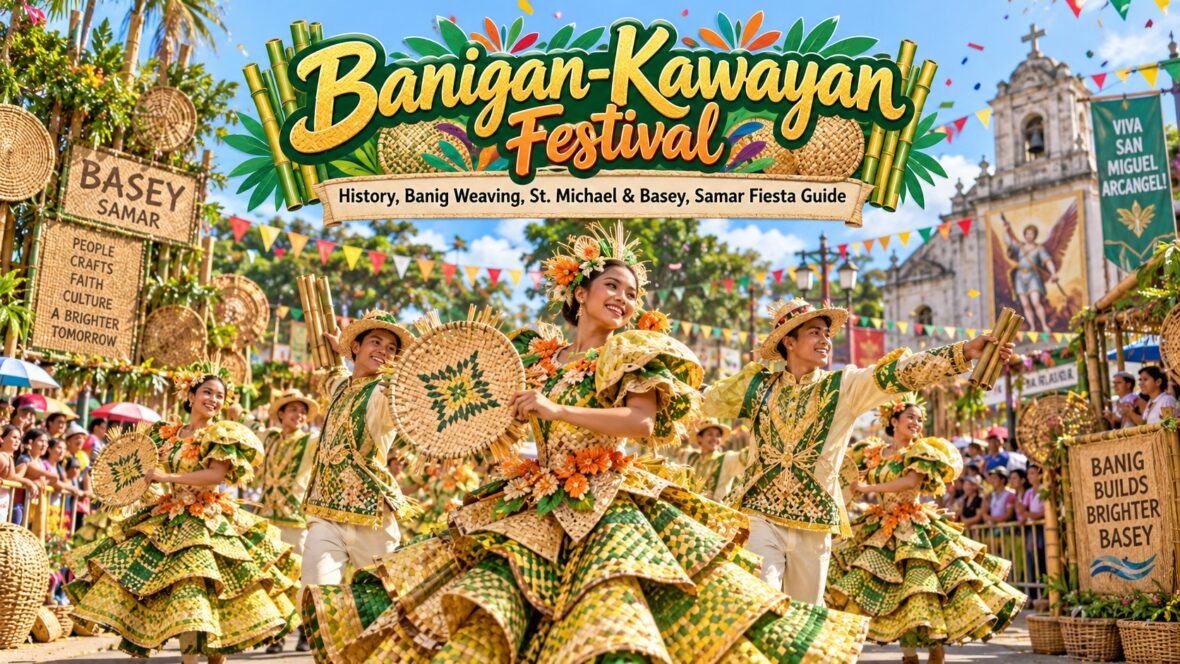
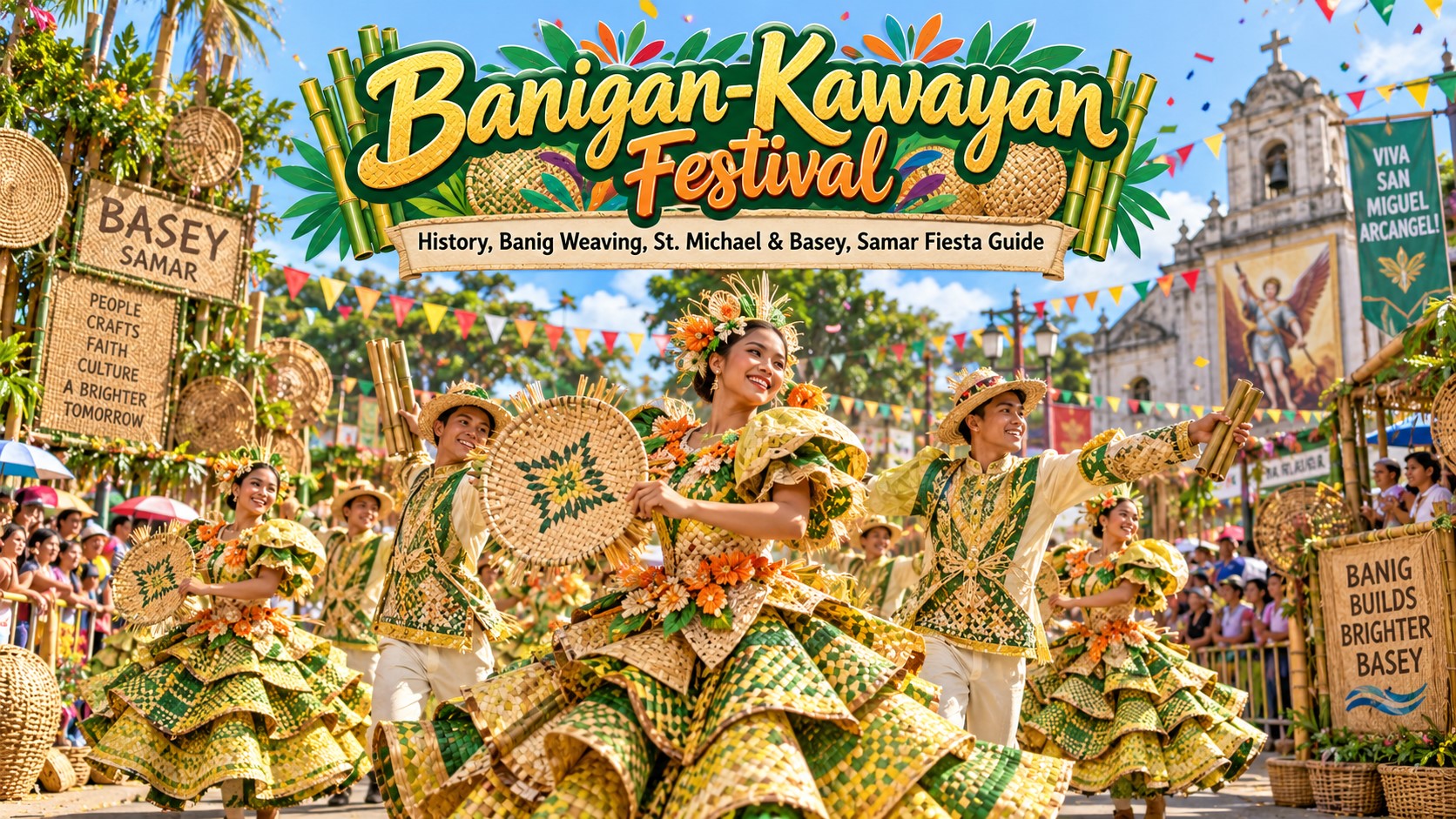
Every September, the colorful woven mats that Basey is famous for move out of homes and workshops and into the streets. They appear in costumes, decorations, props and cultural performances. Dancers parade through town while music and drama tell stories about weaving, livelihood and community life.
Beside the banig is another material that has long been important to local craftsmanship:
kawayan, or bamboo.
Put them together and you get the Banigan-Kawayan Festival, Basey’s annual celebration of craftsmanship, livelihood, faith and local identity.
The festival is closely connected with the September 29 fiesta of St. Michael the Archangel, Basey’s patron saint. The Tourism Promotions Board officially lists Banigan-Kawayan Festival on September 29 and describes it as a celebration of the town’s flourishing banig and bamboo crafts industries.
But the best way to understand this festival isn’t simply to watch the street dancing.
You have to look at the hands of the weavers.
Because long before anyone puts on a festival costume, somebody has to harvest the grass, dry it, color it, flatten it, arrange the pattern and slowly weave one strand over another.
That is where the real story of Banigan-Kawayan begins.
Content
Banigan-Kawayan Festival at a Glance
| Details | Information |
|---|---|
| Festival | Banigan-Kawayan Festival |
| Also called | Kawayan-Banigan Festival / Banigan Festival |
| Location | Basey, Samar |
| Region | Eastern Visayas / Region VIII |
| Main festival date | September 29 |
| Traditional fiesta period | Around September 28–29, with activities beginning earlier |
| Patron saint | St. Michael the Archangel |
| Feast day | September 29 |
| Festival character | Cultural, livelihood and religious |
| Main industries celebrated | Banig weaving and bamboo crafts |
| Signature attraction | Street-dancing parade |
| Main banig material | Tikog grass |
| Famous 2000 event | More-than-one-kilometer-long community-woven mat |
What Is the Banigan-Kawayan Festival?
Banigan-Kawayan Festival is Basey’s major cultural celebration showcasing the two traditional crafts that have become strongly associated with the town:
banig weaving and bamboo craftsmanship.
The Tourism Promotions Board’s description is short but very clear: the festival celebrates the banig and kawayan crafts industries flourishing in Basey.
Older accounts describe its signature event as a street-dancing parade winding through important roads in town, using music, dance and drama to depict the livelihoods of Baseynons.
So while spectators see costumes and choreography, what they’re really watching is a performance about work.
Growing and preparing raw materials.
Weaving.
Making handicrafts.
Passing skills from one generation to another.
And eventually turning those skills into products that support families.
That’s what gives Banigan-Kawayan a strong local identity.
You couldn’t simply pick up this festival and move it somewhere else.
It belongs in Basey because the craft belongs in Basey.
Why Is It Called Banigan-Kawayan?
The name is wonderfully straightforward.
Banigan comes from banig, the traditional woven mat.
Kawayan means bamboo.
The festival therefore places two local craft traditions side by side.
You’ll also encounter the reversed name Kawayan-Banigan Festival in older reports and tourism materials. Historical accounts of Basey’s fiesta used that version frequently, while today’s national tourism calendar uses Banigan-Kawayan Festival.
In more recent local announcements, you’ll sometimes see simply Banigan Festival.
Whichever version appears on the program, the cultural idea remains the same:
Basey celebrating the things its people know how to make.
Why Is Basey Famous for Banig?
This is where the festival becomes much more interesting.
Banig weaving isn’t simply an activity revived once a year for tourists.
It remains a living industry.
The Philippine Information Agency reported in 2026 that Basey’s tikog and buri mats have represented the town’s cultural heritage for centuries and supported generations of local weavers. Government science and livelihood programs are still actively helping the industry improve its drying, dyeing, product development and marketing methods.
The craft is particularly associated with women.
In 2025, a DOST-supported program involved around 1,200 women weavers from 24 Basey barangays, showing just how large the weaving community remains.
That’s why calling banig simply a “souvenir” doesn’t really do it justice.
For some families, this is livelihood.
For others, it’s a skill learned from a mother or grandmother.
For Basey itself, it has become part of the town’s cultural identity.
What Is a Basey Banig Made From?
One of the most important materials is tikog, a wild sedge grass traditionally used for mat weaving.
The National Commission for Culture and the Arts identifies Basey as one of the Philippines’ important mat-weaving communities and notes that the local mats are made from tikog grass. Basey mats are especially known for their borders and central motifs, often featuring stylized floral designs and striking color combinations.
The basic process requires patience.
Tikog has to be gathered.
Then dried.
Some of it is dyed.
The material is dried again and flattened before weaving can begin.
A Basey weaver interviewed by PIA explained that the traditional process could take several days just to prepare the grass properly, and completing a finished product could take more than a week depending on conditions and complexity.
So the next time you see a beautiful Basey bag or mat, don’t just look at the pattern.
Think about the hours inside it.
Basey Banig Is More Than a Sleeping Mat
Traditionally, banig makes most Filipinos think of a woven mat spread on the floor for sitting or sleeping.
But Basey’s weaving industry has evolved far beyond that.
Today’s artisans turn tikog, buri and related materials into:
bags,
purses,
placemats,
home décor,
accessories,
slippers,
laptop cases,
and even fashion pieces.
Recent government programs have deliberately helped Basey artisans develop new products and introduce more durable, consistent dyeing methods without abandoning the traditional character of the craft.
That evolution matters.
Traditions survive better when people can still make a living from them.
If banig remained useful only as an old-fashioned household mat, younger artisans might have less incentive to learn weaving.
But when the same skill can produce a modern bag or piece of home décor that people actually want to buy, the tradition finds another reason to continue.
A Craft Passed From Generation to Generation
This may be the most important part of Basey’s banig story.
You don’t learn weaving overnight.
Experienced weavers know how tightly to pull the material.
They understand color combinations.
They recognize patterns almost instinctively.
Their hands remember movements that can be difficult to explain in words.
That knowledge was traditionally transferred inside families and communities.
Today, Basey is trying to make sure the transfer continues.
In 2026, DepEd Samar announced plans to integrate banig weaving into the senior high school technical-vocational curriculum, partly because officials were concerned about declining interest among younger generations. Students would have opportunities for practical training using the town’s existing weaving resources.
That says something important about the festival too.
Banigan-Kawayan isn’t only celebrating a tradition that survived.
It’s helping remind people that the tradition still needs to be taught.
The Kawayan Side of the Festival
Banig gets most of the attention, but don’t forget the second half of the name.
Kawayan means bamboo.
Basey’s traditional craft economy has also included bamboo products, and the Tourism Promotions Board explicitly identifies the bamboo craft industry alongside banig weaving as one of the reasons for the festival.
Bamboo makes a natural partner for banig.
Both come from locally available plant materials.
Both require manual skill.
Both can become useful household objects.
And both demonstrate how rural communities can transform seemingly simple raw materials into something durable and beautiful.
Modern government product-development projects in Basey continue to include bamboo alongside tikog and buri, showing that the material remains part of the town’s wider handicraft tradition.
What Happens During Banigan-Kawayan Festival?
The exact program changes each year.
But several elements have become strongly associated with the celebration.
Street Dancing
This is the part most visitors want to photograph.
Groups of dancers move through Basey’s streets wearing bright costumes and elaborate headdresses.
Older festival accounts describe the parade as a combination of music, dance and drama depicting the lives and livelihoods of Baseynons involved in banig and bamboo crafts.

The costumes aren’t necessarily literal copies of what ordinary weavers wear.
This is festival theater.
Designers take the idea of weaving and exaggerate it.
Patterns become enormous.
Colors become brighter.
Banig textures may inspire headdresses, skirts and props.
Bamboo or weaving imagery can become part of the choreography.
When several dozen dancers move together, the entire street starts looking like a giant woven design.
Cultural Storytelling
The strongest festival routines don’t simply dance.
They tell a story.
A performance may begin with everyday community life.
Someone gathers raw material.
Workers begin weaving.
The rhythm changes.
The dancers show hardship or struggle.
Then the routine builds toward celebration and thanksgiving.
That’s why Banigan-Kawayan works particularly well as street theater.
Weaving itself already gives choreographers a visual vocabulary.
Crossing.
Interlacing.
Repeating.
Building patterns.
Separate strands becoming one finished object.
You can turn all of those ideas into dance formations.
The Famous Long Banig of Basey
No discussion of this festival is complete without mentioning the event that brought enormous attention to Basey’s weaving tradition.
In 2000, hundreds of Baseynons helped weave and parade a banig measuring more than a kilometer in length and about one meter wide as part of the festival celebration.
It became widely described as the world’s longest mat.
There is one important factual clarification, however:
the 2000 mat was not formally submitted to Guinness World Records.
Contemporary reporting later described it as an unpublished record rather than an officially certified Guinness title.
That doesn’t make the achievement any less impressive.
Think about what it takes to create a mat longer than a kilometer.
You need raw materials.
A lot of them.
You need weavers.
You need coordination across communities.
And then you have to transport and parade the thing through town without turning it into complete chaos.
Whether Guinness certified it or not, the giant banig became a powerful symbol of Basey.
One person could never have made it alone.
The entire achievement depended on people weaving together.
Which is really an excellent metaphor for a town fiesta.
St. Michael the Archangel and the Basey Fiesta
Banigan-Kawayan has a strong livelihood and cultural identity, but it also belongs to Basey’s annual religious fiesta.
The town honors St. Michael the Archangel, whose feast falls on September 29.
Basey’s historic St. Michael the Archangel Parish Church remains one of the municipality’s important heritage and religious landmarks. PIA includes the church among Basey’s major cultural attractions, while local fiesta accounts have long tied September 29 celebrations to devotion to St. Michael.
The religious side of fiesta season traditionally includes novena Masses and other church activities leading toward September 29.
That means Banigan-Kawayan isn’t simply an independent crafts festival coincidentally scheduled at the end of September.
It grew inside the wider town-fiesta tradition.
Why St. Michael Fits the Celebration
St. Michael the Archangel appears in Christian tradition as a defender against evil.
His imagery is dramatic:
armor,
sword or spear,
wings,
and the defeat of Satan.
You’ll find similarly strong devotion to St. Michael in many September fiestas around the Philippines, including communities elsewhere in Samar and the Visayas.
In Basey, however, the religious feast exists alongside something intensely local.
The church tells one part of the community’s story.
The weaving tells another.
Festival week brings both into the same space.
September 28 or September 29?
You may see both dates online.
Older descriptions commonly place the Kawayan-Banigan celebrations around September 28–29, while the Tourism Promotions Board currently lists Banigan-Kawayan Festival specifically on September 29.
The easiest way to understand the schedule is:
September 29 is the key established date, because it is St. Michael the Archangel’s feast day and the date currently carried by the national tourism calendar.
The days before it form part of the wider fiesta season.
And in practice, Basey’s celebration can begin much earlier.
Local programs historically included pageants, youth activities, musical events, religious observances and other community programs spread across September.
So don’t plan a trip assuming the entire festival lasts only a few hours on September 29.
Banigan Festival Today
The festival continues to evolve.
In August 2026, the Basey Municipal Tourism Development Office reported that organizers were already coordinating with school contingents and cultural teams on choreography, costumes, performance guidelines and other preparations for that year’s Banigan Festival.
The tourism office described the festival not simply as a competition, but as an effort to preserve, remember and continue Basey’s rich culture of banig weaving.
I think that description captures the festival better than almost anything else.
Competition attracts crowds.
But preservation is the bigger purpose.
Why Banigan-Kawayan Matters to Basey
Imagine what happens when a traditional industry disappears.
It’s not only a product that vanishes.
Vocabulary disappears.
Techniques disappear.
Patterns disappear.
Stories disappear.
And sometimes, livelihoods disappear with them.
Basey’s banig industry remains very much alive, but government efforts in recent years show that survival can’t be taken for granted.
Weavers face rising production costs.
Weather affects the drying of tikog.
Young people have more career choices.
Markets change.
Customers want modern designs.
Programs from DOST, DTI, DepEd and the provincial government are now addressing exactly those challenges through technology, training, education and new product development.
That makes Banigan-Kawayan more than a nostalgic celebration.
It gives the weaving industry visibility.
Every photograph of a festival dancer wearing banig-inspired designs tells somebody:
this craft still exists.
Supporting the Weavers
If you’re visiting Basey, one of the most useful things you can do is extremely simple.
Buy something.
Not a mass-produced imitation.
Buy from the people actually making Basey products.
The municipality’s own tourism guide recommends visiting weaving communities and cooperatives, observing the process and purchasing authentic handicrafts directly from artisans.
A small bag or placemat may seem like just a souvenir to you.
To the artisan, it’s another reason the craft remains economically worthwhile.
Basey Beyond the Festival
One of the strongest reasons to travel to Banigan-Kawayan is that the festival can easily become part of a larger Samar trip.
Basey has one of the most impressive natural attractions in Eastern Visayas:
Sohoton Natural Bridge and Caves.
The Department of Tourism describes Sohoton Natural Bridge National Park as a landscape of limestone formations, caves, forests and emerald waterways. Activities can include kayaking, river exploration, guided cave tours and nature photography.
That gives visitors two very different experiences in the same municipality.
One day:
dancers, drums and woven mats.
The next:
limestone cliffs, caves and a quiet river.
That’s a pretty good combination.
Saob Cave and the Banig Weavers
One of the most interesting places to connect tourism with Basey’s cultural tradition is Saob Cave.
PIA documented visitors meeting local women weavers around the cave area, where artisans demonstrated their craft and displayed woven products. The tourism activity there provides livelihood opportunities for members of a local banig-weavers association.
This is where the festival suddenly becomes real.
During Banigan-Kawayan, you may see a dancer carrying a beautifully designed mat.
At Saob, you see someone actually making one.
Those are two very different experiences.
I’d try to do both.
Visiting St. Michael the Archangel Parish Church
If you’re attending the festival, also spend some time at the church.
PIA describes St. Michael Parish Church as one of Basey’s historic cultural attractions.
Festival photos show you the public celebration.
The church gives you the religious context.
And during fiesta season, it helps explain why the final days of September matter so much even when no dancers are on the street.
Getting to Basey, Samar
Basey is particularly convenient for travelers using Tacloban City as their gateway to Eastern Visayas.
PIA places Basey roughly 29 kilometers by road from Tacloban, reached by crossing from Leyte to Samar via the San Juanico Bridge.
That makes it much easier to combine Basey with a Tacloban itinerary than many travelers might assume.
If you’re flying from Manila or Cebu, Tacloban is usually the logical major air gateway before continuing overland.
During fiesta days, however, allow extra time.
Crowds and road closures can make an otherwise straightforward trip slower.
Where to Stay
Basey has local accommodation options, but some travelers may prefer staying in Tacloban because of the larger selection of hotels and transportation.
If the festival is your main priority, staying closer to Basey has one major advantage:
you don’t have to worry as much about traveling back across the area after a long day of festivities.
If you’re also planning Sohoton, an overnight stay around Basey can make an early departure for the nature tour much easier.
Festival Tips for First-Time Visitors
Come early.
That advice applies to almost every Philippine festival, but especially when you want a good street-dancing view.
Bring water.
Wear comfortable shoes.
September can be wet in Eastern Visayas, so keep an umbrella or light rain jacket nearby and protect your electronics.
Don’t stand in the dancers’ route just to get a photo.
And if you visit weaving communities, ask permission before photographing artisans up close.
Most importantly, look beyond the finished products.
Ask how the banig is made.
That’s where the festival becomes much more memorable.
Banigan-Kawayan Festival Frequently Asked Questions
Where is Banigan-Kawayan Festival celebrated?
The festival is celebrated in Basey, Samar, in Eastern Visayas.
When is Banigan-Kawayan Festival?
The Tourism Promotions Board lists the festival on September 29. Older descriptions commonly place major celebrations around September 28–29 as part of the wider Basey town fiesta.
What is Banigan-Kawayan Festival famous for?
It is famous for colorful street dancing celebrating banig weaving and bamboo craftsmanship, two traditions strongly associated with Basey.
What does “Banigan-Kawayan” mean?
The name combines banig, the traditional woven mat, with kawayan, the Filipino word for bamboo.
What is a Basey banig made from?
Basey mats are especially associated with tikog grass, which is dried, dyed and prepared before being woven into decorative mats and other products.
Who is the patron saint of Basey?
Basey’s patron saint is St. Michael the Archangel, whose feast is celebrated on September 29.
Did Basey make the world’s longest banig?
In 2000, hundreds of residents helped weave and parade a mat more than a kilometer long.
It was widely described as a world-record attempt, but contemporary reporting confirms that the mat was not formally submitted to Guinness World Records, so it should not be presented as an officially certified Guinness title.
Is Banigan-Kawayan a religious festival?
It has both cultural and religious elements.
The festival celebrates Basey’s weaving and craft traditions while taking place in connection with the town fiesta honoring St. Michael the Archangel.
Is Banigan-Kawayan the same as Kawayan-Banigan Festival?
Yes. Both names have been used for Basey’s festival. The Tourism Promotions Board currently uses Banigan-Kawayan Festival, while many older sources use Kawayan-Banigan Festival.
What other attraction should I visit in Basey?
Sohoton Natural Bridge and Caves is the municipality’s standout natural attraction, offering caves, limestone formations, river trips and guided eco-adventures.
Banigan-Kawayan Festival 2026
This article is designed to stay useful beyond one particular year, but the 2026 celebration is already confirmed.
The Tourism Promotions Board lists:
September 29, 2026 — Banigan-Kawayan Festival, Basey, Samar.
Basey’s Municipal Tourism Development Office has also confirmed active preparations for Banigan Festival 2026, including coordination among school contingents, cultural teams and the municipal government involving choreography, costumes and competition mechanics.
The wider Basey Town Fiesta 2026 program is already underway as well. One early activity, Pasundayag, was held on August 29, while organizers have also been preparing a month-long Rayhakan Music Festival and other fiesta events.
For travelers, the most important date to keep in mind remains September 29, the feast of St. Michael the Archangel.
Anyone traveling specifically for the street-dancing competition should still check Basey Tourism’s final announcements for the exact time, parade route, venue and any road closures, because those details can change.
Final Thoughts
Banigan-Kawayan Festival is one of those celebrations that becomes much better once you understand what you’re looking at.
At first, you see dancers.
Bright costumes.
Mats.
Bamboo.
Drums.
A crowded Samar street.
But behind every woven pattern is somebody’s work.
Somebody gathered the tikog.
Somebody dried it.
Somebody chose the colors.
Somebody sat down and patiently moved one strand over another until a pattern appeared.
And somebody probably learned how to do that by watching an older member of the family.
That is why Banigan-Kawayan matters.
It isn’t simply celebrating a product Basey can sell.
It celebrates knowledge.
A skill.
A livelihood.
A community identity.
The more-than-kilometer-long banig paraded in 2000 may be the festival’s most famous story, but in some ways the smaller mats being woven every day are even more important.
Those are the ones keeping the tradition alive.
So if you’re in Basey during the final days of September, watch the street dancing.
Visit St. Michael.
Take the trip to Sohoton.
But before you leave, find a local weaving community.
Watch how the strands cross.
Look at the pattern slowly forming.
And buy something if you can.
Because the real Banigan-Kawayan Festival isn’t only what happens on September 29.
It’s what Basey’s weavers continue doing the rest of the year.