Every November, the province of Misamis Occidental in Northern Mindanao celebrates its history, culture, and the traditions of the communities that have shaped its identity.
One of the most meaningful celebrations associated with this occasion is the Pas’ungko s’g Mis Occ Festival, a colorful thanksgiving festival that highlights the heritage of the indigenous Subanen people.
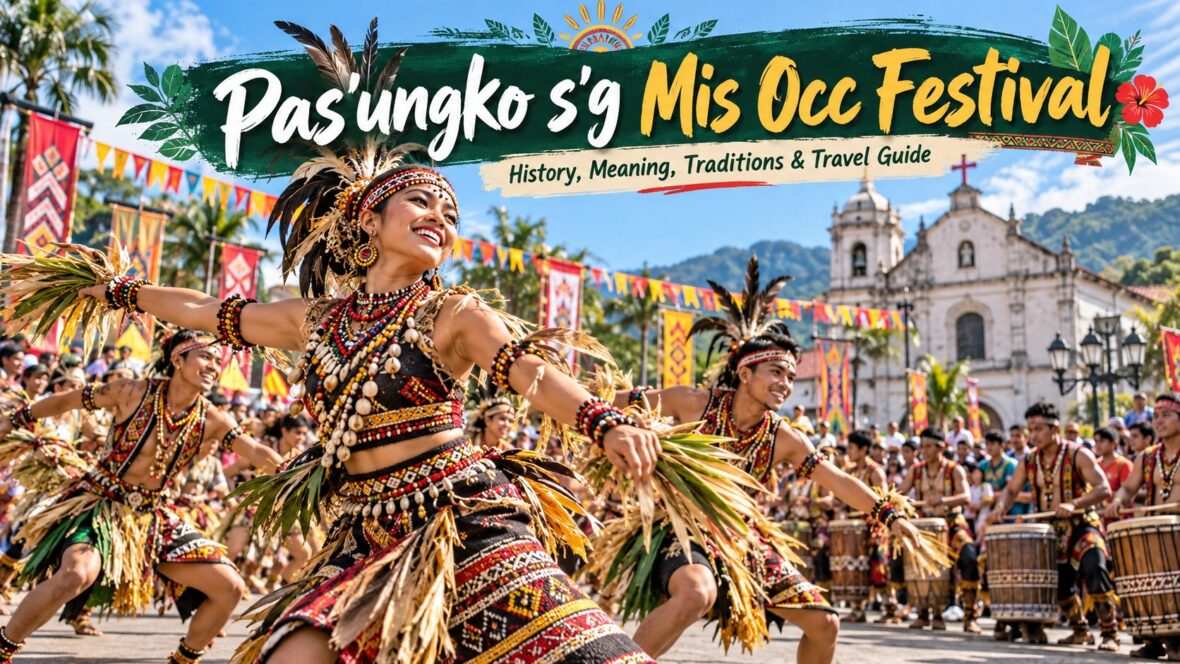
If you’ve seen photographs of the festival, you’ve probably noticed the dancers wearing elaborate traditional-inspired costumes, the colorful street performances, and the energetic atmosphere as different municipalities and cities gather for a province-wide celebration.
But Pas’ungko is much more than a street dancing competition.
It’s a celebration of gratitude, cultural preservation, community unity, and the rich indigenous heritage of Misamis Occidental.
The festival also tells an important story about the Subanen, one of Mindanao’s indigenous peoples whose traditions have influenced the cultural identity of the province for generations.
And while the celebration has evolved over the years, including its later development into what is now known as the Perangat Festival, the original spirit of Pas’ungko remains an important part of Misamis Occidental’s festival history.
If you’re interested in Philippine festivals or planning to explore Northern Mindanao, here’s everything you need to know about the Pas’ungko s’g Mis Occ Festival, including its meaning, history, cultural traditions, major activities, location, and travel tips.
Content
What Is the Pas’ungko s’g Mis Occ Festival?
The Pas’ungko s’g Mis Occ Festival is a cultural and thanksgiving celebration that originated in Misamis Occidental, Philippines.
It was established to commemorate the province’s founding anniversary while honoring the indigenous heritage, traditions, and achievements of its people.
The festival brings together representatives from the province’s cities and municipalities through street dancing, ritual-inspired performances, cultural presentations, and community activities.
Its main cultural inspiration comes from the Subanen people, an indigenous group whose ancestral communities are found in Misamis Occidental and other parts of western Mindanao.
Through music, dance, costumes, and storytelling, Pas’ungko presents different aspects of Subanen life, including thanksgiving traditions, relationships with nature, community cooperation, and cultural beliefs.
The festival also celebrates the agricultural and economic blessings received by the province.
For many years, Pas’ungko served as Misamis Occidental‘s major provincial cultural celebration.
In 2022, the provincial festival was relaunched under the name Perangat Festival, emphasizing progress and development while continuing to recognize the province’s cultural heritage.
Because of this, Pas’ungko and Perangat are closely connected through the history of Misamis Occidental’s provincial celebrations.
Pas’ungko s’g Mis Occ Festival at a Glance
| Details | Information |
|---|---|
| Festival Name | Pas’ungko s’g Mis Occ Festival |
| Other Spelling | Pasungko Festival |
| Location | Misamis Occidental, Philippines |
| Main Festival Center | Oroquieta City |
| Region | Northern Mindanao |
| Traditional Celebration Month | November |
| Provincial Founding Anniversary | November 2 |
| First Celebration | 2010 |
| Festival Type | Cultural and Thanksgiving Festival |
| Meaning of Pas’ungko | Thanksgiving or giving thanks |
| Main Cultural Inspiration | Subanen heritage and traditions |
| Major Highlights | Street Dancing, Ritual Dance Showdown, Cultural Activities |
| Later Festival Name | Perangat Festival, introduced in 2022 |
What Does Pas’ungko Mean?
The word “Pas’ungko” comes from the Subanen language and is commonly translated as “thanksgiving” or “giving thanks.”
This simple meaning explains the central message of the festival.
Pas’ungko celebrates gratitude for the blessings received by the people of Misamis Occidental.
These blessings may include agricultural harvests, natural resources, livelihood, community achievements, and the relationships that bind people together.
The concept of thanksgiving is particularly significant among the Subanen, whose cultural practices traditionally recognize the relationship between human communities, nature, and the spiritual world.
For the people of Misamis Occidental, Pas’ungko became a way to express these values through a larger provincial celebration.
Instead of limiting the event to one community, the festival brought together different municipalities and cities to celebrate their shared identity.
It also served as an opportunity for residents to appreciate the indigenous traditions that existed long before the establishment of the modern province.
That’s what makes the festival meaningful.
It’s not simply about celebrating another anniversary.
It’s about recognizing the past, expressing gratitude for the present, and preserving traditions for future generations.
History of the Pas’ungko Festival
The Pas’ungko Festival was first launched in November 2010 as part of the 81st founding anniversary celebration of Misamis Occidental.
At the time, the provincial government was under Governor Herminia “Hermie” Ramiro.
The festival was developed as a province-wide cultural event highlighting the heritage of the Subanen people while promoting local tourism, agriculture, business, and community participation.
The inaugural celebration took place from November 4 to 8, 2010, with major activities held in Oroquieta City, the provincial capital.
These included cultural presentations, street dancing, trade exhibitions, concerts, and community programs.
The First Pas’ungko Festival in 2010
One of the most important highlights of the inaugural celebration was the street dancing and ritual competition.
Participating contingents from Misamis Occidental presented performances inspired by Subanen culture.
The dancers wore traditional-inspired costumes and used music, choreography, and storytelling to portray different aspects of indigenous life.
Tangub City emerged as the champion of the first Pas’ungko s’g Mis Occ Festival.
The competition helped establish the celebration as an important cultural event for the province.
Aside from street dancing, the inaugural festival featured agricultural and trade exhibits showcasing products from local government units.
There were also concerts, community activities, a jobs fair, the Mutya ng Misamis Occidental pageant, and fireworks.
The combination of cultural performances, tourism promotion, and public activities helped establish Pas’ungko as more than a one-day celebration.
Pas’ungko Grows Into a Provincial Tradition
Following the inaugural celebration, Pas’ungko continued to develop as an annual event.
Different municipalities and cities participated in cultural competitions, representing their communities through music, costumes, and dance.
The festival became known for performances inspired by Subanen folklore, literature, traditional beliefs, and ways of life.
In the 2018 edition, which celebrated Misamis Occidental’s 89th founding anniversary, 11 competing contingents presented interpretations of Subanen heritage.
Their performances reflected traditional clothing, cultural stories, and symbolic rituals.
The festival also provided opportunities for local artists, choreographers, costume makers, performers, and students to showcase their talents.
Over time, Pas’ungko became an important part of the province’s cultural calendar.
From Pas’ungko to Perangat Festival
One important development in the festival’s history is its transition to the Perangat Festival.
In 2022, the provincial government introduced the Perangat Festival as the new identity of its major provincial cultural celebration.
The word “Perangat” comes from the Subanen language and is associated with progress, prosperity, and moving forward.
The name reflected the province’s development aspirations while continuing to celebrate its cultural heritage.
The first Perangat Festival was held in November 2022.
The celebration retained major elements associated with Pas’ungko, including street dancing, ritual dance performances, cultural presentations, and province-wide participation.
In later editions, the competition expanded to include contingents from other parts of Mindanao.
The festival therefore developed from a thanksgiving celebration focused primarily on Misamis Occidental’s communities into a larger cultural showcase.
Is Pas’ungko the Same as Perangat Festival?
The two names are historically connected, but they reflect different periods in the development of Misamis Occidental’s provincial festival.
Pas’ungko was the original festival name introduced in 2010, emphasizing thanksgiving and Subanen cultural heritage.
Perangat was introduced in 2022, emphasizing progress and prosperity while retaining the celebration’s cultural foundations.
Today, the provincial government’s more recent festival information identifies Perangat as its official provincial festival.
Understanding this history is useful because travelers searching for Pas’ungko may encounter newer announcements referring to Perangat instead.
The Subanen People: The Cultural Heart of Pas’ungko
To understand Pas’ungko, it’s important to learn about the Subanen people.
The Subanen, also referred to in different sources as Subanon or Subanun, are among the indigenous peoples of western Mindanao.
Their communities are found in Misamis Occidental, Zamboanga del Norte, Zamboanga del Sur, Zamboanga Sibugay, and surrounding areas.
The name Subanen is commonly associated with people who live near rivers or upstream areas.
Historically, Subanen communities developed ways of life closely connected with agriculture, forests, rivers, and the surrounding environment.
Traditional livelihoods have included farming, fishing, gathering forest products, weaving, and other crafts.
Their communities also developed distinctive customs, social structures, spiritual beliefs, oral traditions, and ceremonial practices.
Why Is Subanen Culture Important to the Festival?
The Subanen are part of the indigenous heritage of Misamis Occidental.
Their traditions existed long before the province acquired its modern political boundaries.
By highlighting Subanen culture, Pas’ungko recognizes a significant part of the region’s history.
Festival performances may portray traditional livelihoods, relationships with nature, community celebrations, or stories inspired by indigenous folklore.
The costumes and artistic presentations also create opportunities for residents to appreciate indigenous cultural expressions.
However, it’s important to remember that festival performances are creative interpretations.
They do not necessarily reproduce every traditional ceremony exactly as it is practiced by Subanen communities.
The most meaningful approach is to recognize the role of indigenous elders, cultural practitioners, and communities in preserving and sharing their own heritage.
Subanen Thanksgiving Traditions and the Buklog
One of the most significant traditional practices associated with Subanen culture is the Buklog.
Buklog is an elaborate thanksgiving ritual system practiced among Subanen communities.
It involves ceremonies expressing gratitude and strengthening relationships among families, communities, nature, and the spiritual world.
The practice is especially known for a large elevated wooden platform used during communal dancing.
When participants dance on the platform, its construction produces a distinctive resonating sound.
The ceremonies also involve traditional music, offerings, and community participation.
Why Is Buklog Significant?
Buklog has deep cultural and spiritual meaning.
It is not simply a dance performance.
The ceremonies help express gratitude, strengthen community relationships, and recognize the connection between human life and the natural environment.
In 2019, UNESCO inscribed Buklog on its List of Intangible Cultural Heritage in Need of Urgent Safeguarding.
This recognition highlighted both its cultural importance and the challenges involved in preserving the tradition.
These challenges include changing community conditions, economic pressures, and difficulties in transmitting traditional knowledge to younger generations.
Is Buklog Performed During Pas’ungko?
Pas’ungko’s thanksgiving theme is closely related to broader Subanen cultural values.
However, the Buklog ritual and the provincial festival are not the same thing.
The festival may feature ceremonial themes or performances inspired by Subanen traditions, but these should not automatically be described as authentic Buklog ceremonies.
A full Buklog follows community-specific customary practices and is organized by recognized cultural practitioners.
For visitors, understanding this distinction helps create a deeper appreciation of Subanen heritage.
Major Highlights and Activities of the Pas’ungko Festival
One of the best things about Pas’ungko is the variety of activities associated with the celebration.
Although annual programs vary, several events became especially recognizable during the festival’s original years.
1. Pas’ungko Street Dancing Competition
The street dancing competition was one of the festival’s biggest attractions.
Participating contingents performed along selected streets of Oroquieta City, wearing colorful costumes inspired by Subanen culture.
The performances involved coordinated choreography, rhythmic music, and creative storytelling.
Different groups developed presentations exploring cultural themes such as thanksgiving, livelihood, community life, and indigenous folklore.
One of the exciting aspects of the competition was the participation of representatives from different municipalities and cities.
Each contingent brought its own interpretation of the festival’s message.
For spectators, this created a lively atmosphere filled with music, cheering crowds, colorful costumes, and energetic performances.
2. Ritual Dance Showdown
Another important highlight was the ritual dance competition.
Unlike ordinary street dancing, these performances often involved more elaborate storytelling.
Participating groups presented theatrical interpretations inspired by Subanen traditions, beliefs, and historical experiences.
The performances could include ceremonial themes, symbolic movements, dramatic formations, and artistic props.
Music played an important role in creating the atmosphere.
The rhythmic sounds of drums and gong-like instruments helped accompany the dancers.
Costumes, choreography, and stage presentation were also important elements of the competition.
The ritual showdown allowed participating groups to demonstrate their creativity while introducing spectators to cultural themes associated with the Subanen people.
3. Colorful Traditional-Inspired Costumes
One of the most recognizable features of Pas’ungko was the elaborate clothing worn by festival performers.
Costumes frequently incorporated patterns, colors, and accessories inspired by indigenous cultural traditions.
Depending on the contingent’s theme, performers might wear woven-style fabrics, beaded accessories, headpieces, or decorative elements representing natural resources and community life.
However, not all festival costumes should be treated as exact reproductions of traditional Subanen clothing.
Many were artistic creations designed specifically for the competition.
This is part of what makes the festival interesting.
It combines cultural inspiration with modern choreography, costume design, and theatrical presentation.
4. Agricultural and Trade Fair
Agriculture has always been an important part of Misamis Occidental’s economy.
The province produces crops such as coconut, rice, corn, and bananas, while many coastal communities depend on fishing and aquaculture.
During the original Pas’ungko celebrations, agricultural and trade fairs gave participating municipalities opportunities to showcase their products.
Exhibits featured local agricultural produce, handicrafts, delicacies, and other products.
Some events also promoted the One Town, One Product program.
These fairs helped visitors discover products from different parts of the province while supporting local entrepreneurs and producers.
5. Mutya ng Misamis Occidental
Beauty pageants also formed part of earlier Pas’ungko celebrations.
One of the most recognizable events was the search for Mutya ng Misamis Occidental.
The competition provided a platform for candidates representing different communities.
Aside from celebrating beauty and personality, it helped promote local tourism and community pride.
The format and schedule changed across different editions.
6. Concerts and Entertainment Activities
Pas’ungko wasn’t limited to cultural competitions.
Earlier festival programs also included concerts, musical performances, entertainment shows, and other community activities.
These events created a festive atmosphere throughout the celebration.
Families and visitors could enjoy different activities even outside the main street dancing competitions.
7. Sports and Community Programs
Some Pas’ungko editions featured sports competitions, employment activities, public service programs, and other events organized for local residents.
These activities helped make the festival accessible to a wider audience.
They also reinforced the celebration’s central idea of bringing people together.
8. Fireworks and Festival Finale
Earlier Pas’ungko celebrations also included fireworks displays and evening entertainment.
These activities provided a colorful conclusion to some editions of the festival.
However, fireworks are not guaranteed in every annual program.
Visitors should confirm the current schedule rather than assuming that a fireworks show will always be included.
When Is the Pas’ungko Festival Celebrated?
Pas’ungko was traditionally celebrated in November, in connection with Misamis Occidental’s founding anniversary.
The province commemorates its anniversary every November 2.
However, festival events have not always been held exclusively on that date.
For example, the first Pas’ungko Festival was celebrated from November 4 to 8, 2010.
Later editions also featured activities extending across several days or weeks.
The modern Perangat Festival continues to be associated with the province’s November founding anniversary celebrations.
Why Is November 2 Important in Misamis Occidental?
November 2 marks the anniversary traditionally associated with the establishment of Misamis Occidental as a separate province.
On November 2, 1929, Act No. 3537 was approved, dividing the former Province of Misamis into Misamis Oriental and Misamis Occidental.
The law took effect on January 1, 1930.
Nevertheless, November 2 became the recognized provincial founding anniversary.
In 2018, Republic Act No. 11121 declared November 2 of every year a special non-working holiday in Misamis Occidental.
The holiday is known as Araw ng Misamis Occidental.
This anniversary provides the historical foundation for the province’s annual cultural celebrations.
Where Is the Pas’ungko Festival Held?
The Pas’ungko Festival was traditionally centered in Oroquieta City, the capital of Misamis Occidental.
Oroquieta serves as the seat of the provincial government and has hosted many of the province’s major cultural and public events.
During the inaugural Pas’ungko celebration, activities took place around the Provincial Capitol complex and other designated venues in the city.
Street dancing competitions were held along selected roads, while major performances took place in organized event areas.
In more recent years, the Misamis Occidental Provincial Athletic Complex, commonly known as MOPAC, has become an important venue for provincial festival competitions.
The complex has hosted major Perangat Festival street dancing and ritual showdown events.
Is Pas’ungko Celebrated in Ozamiz or Oroquieta?
The main provincial celebration has traditionally been associated with Oroquieta City.
However, the festival involves representatives of communities from across Misamis Occidental, including Ozamiz and Tangub.
Ozamiz has its own local festival traditions, while Oroquieta serves as the provincial capital.
If you’re planning to attend the province-wide festival, it’s best to confirm the official venue rather than assuming that all events will be held in the same city every year.
The Cities and Municipalities of Misamis Occidental
Pas’ungko was designed as a province-wide celebration.
Misamis Occidental has three cities and 14 municipalities.
These are:
Cities
- Oroquieta City
- Ozamiz City
- Tangub City
Municipalities
- Aloran
- Baliangao
- Bonifacio
- Calamba
- Clarin
- Concepcion
- Don Victoriano Chiongbian
- Jimenez
- Lopez Jaena
- Panaon
- Plaridel
- Sapang Dalaga
- Sinacaban
- Tudela
Over the years, participating communities have been represented through different contingents, exhibits, and cultural activities.
The actual lineup varies according to the annual festival program.
What Makes Pas’ungko Different From Other Philippine Festivals?
The Philippines has hundreds of festivals, but Pas’ungko developed a distinctive identity through its emphasis on thanksgiving and indigenous heritage.
Many Philippine festivals honor patron saints, celebrate agricultural harvests, or commemorate historical events.
Pas’ungko combines several of these broader themes into one provincial celebration.
First, it commemorates the founding anniversary of Misamis Occidental.
Second, it recognizes the cultural contributions of the Subanen people.
Third, it celebrates gratitude for the natural resources and blessings that support the province’s communities.
And finally, it provides a platform for local artists, performers, farmers, entrepreneurs, and residents to come together.
Another interesting characteristic is its connection to a festival tradition that continues to evolve.
The transition from Pas’ungko to Perangat reflects how the province’s annual celebration has changed while retaining important cultural themes.
The Cultural Importance of Pas’ungko
Pas’ungko is important because it helped bring indigenous heritage into a broader provincial cultural celebration.
For many visitors, the festival became an introduction to Subanen stories and traditions.
It also encouraged participating communities to explore their history and cultural identity.
Through performances, traditional-inspired costumes, and cultural storytelling, the celebration provided opportunities for younger generations to become more familiar with the province’s heritage.
The festival also supported tourism.
Visitors attending the events could discover local products, restaurants, historical landmarks, and attractions throughout Misamis Occidental.
This created opportunities for businesses and communities beyond the festival venue.
But perhaps the most meaningful contribution of Pas’ungko is the importance it placed on thanksgiving.
Its original name reminds people to recognize the blessings they receive and the communities that have helped shape their identity.
Local Food and Delicacies to Try in Misamis Occidental
One of the enjoyable parts of attending a Philippine festival is discovering the food of the destination.
Misamis Occidental has a diverse food culture influenced by its agricultural and coastal communities.
Here are some products and dishes worth exploring during a visit.
Suman
Suman is one of the popular rice-based delicacies associated with Misamis Occidental.
The municipality of Clarin is particularly known for its suman products.
Different varieties may be made with glutinous rice, coconut milk, and other ingredients.
These delicacies are commonly wrapped in leaves and served as snacks.
They’re also popular pasalubong choices.
Seafood
Misamis Occidental has coastal communities facing Panguil Bay, Iligan Bay, and the Mindanao Sea.
Fishing and aquaculture are important local industries.
Visitors can look for freshly prepared fish, shrimp, crabs, and other seafood dishes at local markets and restaurants.
Coconut-Based Products
Coconut is one of the province’s important agricultural products.
Locally produced coconut-based food, sweets, and other goods may be available in markets and trade fairs.
Local Kakanin
Aside from suman, visitors can discover different rice-based snacks and traditional delicacies sold in local markets.
The available products vary by municipality and vendor.
Trying these foods is another way to appreciate the province’s everyday culture beyond its festival performances.
How to Get to the Pas’ungko Festival in Misamis Occidental
If you’re planning to visit Misamis Occidental, Oroquieta City is generally the main destination for the provincial festival.
There are different ways to reach the province depending on where your journey begins.
From Manila to Misamis Occidental
One convenient option is to fly to Ozamiz City.
Ozamiz Airport serves as an important air gateway to Misamis Occidental.
From the airport, travelers can continue by road to Oroquieta City using available local transportation.
Because airline schedules change, it’s advisable to confirm current flights before booking your trip.
From Ozamiz City to Oroquieta City
Travelers can proceed from Ozamiz to Oroquieta using buses, vans, or other available road transportation.
The journey passes through several municipalities along the province’s highway network.
Travel time depends on traffic, weather, and the transportation service.
If you’re attending a major festival event, allow additional travel time because roads near the venue may become busy.
From Cagayan de Oro
Travelers coming from Cagayan de Oro may continue by road toward Misamis Occidental through the appropriate northern Mindanao highway connections.
Travel arrangements depend on the available route and transport operator.
Check the current bus services and road conditions before departure.
By Private Vehicle
Visitors traveling by private vehicle can reach Misamis Occidental through the regional road network.
If you plan to drive to Oroquieta City, check for any temporary road restrictions or parking arrangements during major festival competitions.
Where to Stay During the Festival
Visitors attending the provincial celebration can consider staying in Oroquieta City.
Staying in the provincial capital may be convenient if major events are scheduled around the Provincial Capitol or MOPAC.
Accommodation choices may include hotels, inns, guesthouses, and other lodging establishments.
Ozamiz City is another option for travelers who want access to a larger commercial center and airport facilities.
However, staying in Ozamiz means allowing additional travel time to reach the provincial festival venues in Oroquieta.
If you’re visiting during the major street dancing competition, it’s advisable to reserve your accommodation ahead of time.
Other Places to Visit in Misamis Occidental
If you’re traveling to the province for its cultural celebrations, consider spending extra time exploring its other attractions.
Misamis Occidental Provincial Capitol
Located in Oroquieta City, the Provincial Capitol is one of the province’s important government landmarks.
The complex is also associated with the history of provincial celebrations, including earlier Pas’ungko activities.
Fort Santiago and Cotta Shrine
Ozamiz City is home to Fort Santiago, also known as the Cotta Fort.
The historic fort dates to the Spanish colonial period and is associated with the defense of the surrounding coastal area.
It also contains a chapel honoring the Virgin of the Immaculate Conception.
For visitors interested in history and religious heritage, it’s an interesting destination.
Jimenez Heritage Church
The municipality of Jimenez is home to a historic church known for its architecture and religious heritage.
The church has been recognized as a National Cultural Treasure.
It’s an interesting stop for travelers who enjoy exploring historical buildings in the Philippines.
Mount Malindang
Nature lovers may also want to learn more about Mount Malindang.
The mountain and its protected landscape are known for rich biodiversity, forest ecosystems, and cultural significance to indigenous communities.
Outdoor activities should be arranged only through authorized routes and guides, with the necessary permits.
Exploring these destinations can make a festival trip more meaningful by introducing visitors to the province’s historical and natural attractions.
Tips for Attending Pas’ungko or Perangat Festival
If you’re attending Misamis Occidental’s provincial cultural festival for the first time, here are a few practical tips.
Check the Official Festival Name and Schedule
Older travel guides may refer to Pas’ungko, while newer programs use Perangat.
Make sure you’re looking at the correct year’s official announcements.
Arrive Early for Street Dancing
Major competitions can attract large crowds.
Arriving early gives you time to locate the venue and find an appropriate public viewing area.
Wear Comfortable Clothes
Misamis Occidental has a tropical climate.
Light, breathable clothing and comfortable shoes are useful when attending outdoor activities.
Bring Water and Sun Protection
Street dancing performances may take place under the afternoon sun.
Bring drinking water, sunscreen, and other appropriate sun protection.
Respect Indigenous Cultural Traditions
Since the festival draws inspiration from Subanen culture, it’s important to approach the performances respectfully.
Remember that traditional ceremonies can carry spiritual and cultural meanings beyond entertainment.
Support Local Businesses
Consider purchasing food, agricultural products, handicrafts, and souvenirs from local vendors.
Festival tourism can help support entrepreneurs, artists, farmers, and other community members.
Check Weather Conditions
November can still bring heavy rainfall to parts of Mindanao.
Monitor PAGASA forecasts before traveling, particularly if you’re planning long-distance road trips or outdoor activities.
Frequently Asked Questions About Pas’ungko s’g Mis Occ Festival
What is the Pas’ungko s’g Mis Occ Festival?
Pas’ungko is a cultural and thanksgiving festival established in Misamis Occidental to celebrate the province’s founding anniversary and honor Subanen cultural heritage.
Where is the Pas’ungko Festival celebrated?
The festival was traditionally centered in Oroquieta City, the capital of Misamis Occidental.
What does Pas’ungko mean?
Pas’ungko is a Subanen word commonly translated as thanksgiving or giving thanks.
When is the Pas’ungko Festival celebrated?
The original festival was traditionally celebrated in November in connection with the province’s founding anniversary on November 2.
When did Pas’ungko Festival start?
The first Pas’ungko s’g Mis Occ Festival took place in November 2010 during the province’s 81st founding anniversary celebration.
Why is the Pas’ungko Festival celebrated?
It was established to express thanksgiving, celebrate Misamis Occidental’s founding anniversary, preserve indigenous Subanen heritage, and promote provincial unity and tourism.
What are the main highlights of Pas’ungko?
Major activities have included street dancing, ritual-inspired dance competitions, agricultural and trade fairs, cultural performances, pageants, concerts, and community programs.
What is the connection between Pas’ungko and Subanen culture?
The festival draws inspiration from the traditions, beliefs, stories, and ways of life of the indigenous Subanen people.
Is Pas’ungko the same as Perangat Festival?
Perangat is the newer identity introduced in 2022 for Misamis Occidental’s major provincial cultural festival. It continues several traditions associated with the original Pas’ungko celebration.
What is the difference between Pas’ungko and Subayan Keg Subanen Festival?
Pas’ungko was a province-wide cultural festival associated with Misamis Occidental’s founding anniversary.
Subayan Keg Subanen was historically associated with Ozamiz City’s local cultural celebrations.
The two should not be confused, even though both highlight Subanen heritage.
Is November 2 a holiday in Misamis Occidental?
Yes. Republic Act No. 11121 declares November 2 of every year a special non-working holiday in Misamis Occidental, known as Araw ng Misamis Occidental.
Can tourists attend the festival?
Public street dancing performances and other cultural activities have traditionally attracted visitors. However, admission arrangements and event access depend on the official annual program.
Is Pas’ungko Festival worth learning about?
Yes, especially for travelers interested in Philippine festivals, indigenous heritage, Mindanao culture, and the history of Misamis Occidental.
Pas’ungko and Perangat Festival 2026: Latest Updates
For travelers planning to experience Misamis Occidental’s provincial cultural celebration in 2026, the province will commemorate its 97th founding anniversary.
The anniversary falls on Monday, November 2, 2026.
However, visitors should remember that the province’s current official festival identity is Perangat rather than the original Pas’ungko name.
The Perangat Festival has traditionally featured street dancing, ritual dance showdowns, and cultural performances celebrating Subanen heritage and the progress of Misamis Occidental.
As of October 18, 2026, a complete official program confirming all event dates, venues, routes, and activities for this year’s provincial festival has not been independently verified for this guide.
Travelers should check announcements from the Provincial Government of Misamis Occidental and its tourism office before making travel arrangements around a specific event.
This section can be updated once the final program becomes available.

Final Thoughts
The Pas’ungko s’g Mis Occ Festival is an important part of Misamis Occidental’s cultural history.
At first glance, it’s easy to be impressed by the colorful costumes, lively street dancing, music, and enthusiastic crowds.
But once you understand the meaning behind the celebration, it becomes much more interesting.
Pas’ungko is about thanksgiving.
It’s about recognizing the blessings received by the province, honoring the communities that have shaped its history, and celebrating the traditions of the indigenous Subanen people.
From its first celebration in 2010 to the development of the modern Perangat Festival, the provincial cultural celebration has continued to evolve.
But its connection to Misamis Occidental’s history and indigenous heritage remains an important part of its identity.
For travelers, learning about Pas’ungko offers another way to appreciate Northern Mindanao beyond its familiar attractions.
It introduces you to the stories of the people who call the province home, the cultural practices passed down through generations, and the importance of community cooperation.
And if you’re planning to explore Misamis Occidental, attending its provincial festival can be a meaningful addition to your itinerary.
You’ll discover local traditions, enjoy cultural performances, support community businesses, and experience the pride that residents have in their province.
After all, that’s what makes Philippine festivals so special.
Beyond the music, costumes, and celebrations, they tell the stories of the communities that created them.
And for Misamis Occidental, Pas’ungko will always be an important part of that story.