Some Philippine festivals immediately overwhelm you with giant floats, hundreds of dancers, booming sound systems and entire city streets covered in decorations.
Djanggo Festival is different.
This is a celebration where the mystery is part of the attraction.
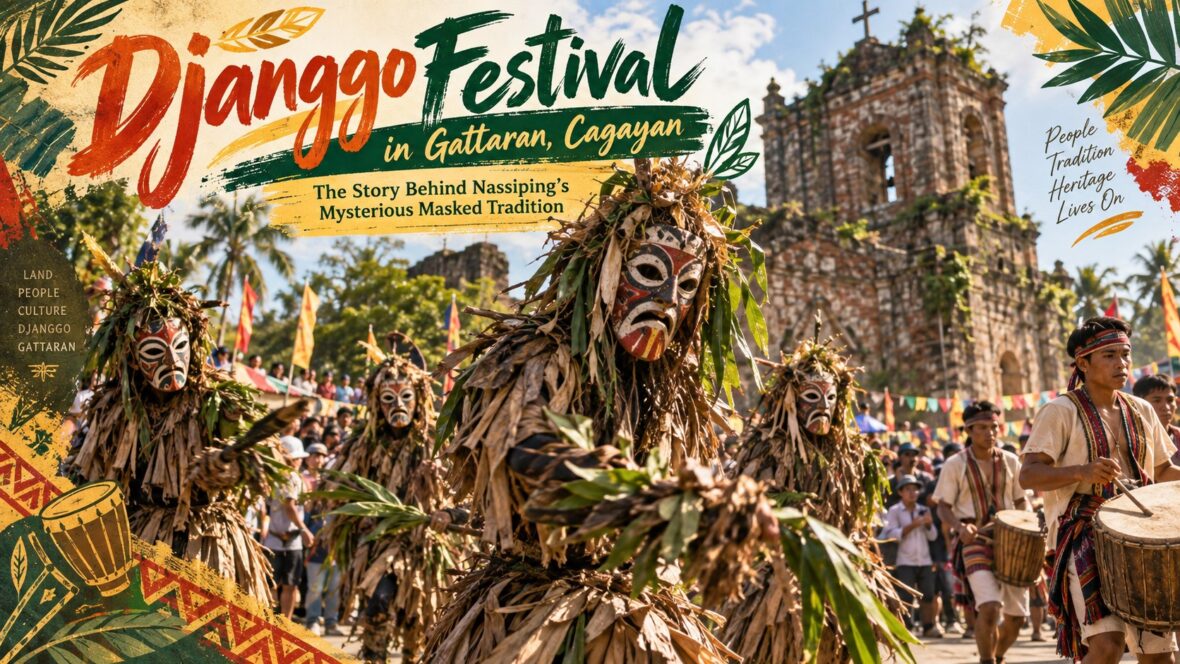
Every September, strange masked figures covered in leaves emerge in the community of Nassiping in Gattaran, Cagayan. Their faces can look frightening. Their costumes resemble creatures coming directly from the forest. Drums accompany their movements as they gather around an old Spanish-era church dedicated to St. Michael the Archangel.
These figures are known as the Djanggo.
And according to stories passed down through generations, they haven’t always been considered friendly.
What survives today is a fascinating mixture of Catholic devotion, local folklore, community memory and ritual performance—a tradition so closely connected with Nassiping that you won’t find another major Philippine festival quite like it.
The Tourism Promotions Board officially lists the Djanggo Festival in Nassiping, Gattaran, Cagayan, traditionally celebrated on September 28 and 29. It describes the event as a centuries-old religious and cultural tradition connected with the story of St. Michael.
But that short description barely captures what makes Djanggo Festival so interesting.
To really understand it, you need to know the story of Nassiping itself.
Content
Where Is Djanggo Festival Celebrated?
Djanggo Festival is celebrated in Barangay Nassiping in the municipality of Gattaran, Province of Cagayan.
Nassiping is not simply another modern barangay.
Historically, it was once an important settlement and ecclesiastical town in the Cagayan Valley.
Cagayan tourism records describe the history of present-day Gattaran as being connected with three earlier pueblos: Gattaran, Dummun and Nassiping. Nassiping is particularly notable because of its location near the meeting of major waterways.
The name itself is associated with the meeting of rivers. Historical explanations connect Nassiping with an Ibanag word referring to things joined or paired together, reflecting the area’s location near the confluence of the Cagayan River and the Chico River.
That riverside setting has shaped life in the community for centuries.
And standing there today is one of the most important landmarks connected with the festival: the ruins of the old San Miguel Arcangel Church.
The Old Nassiping Church
You can’t really separate the Djanggo Festival from the old church in Nassiping.
The surviving structure is one of the historic church ruins of Cagayan.
Records indicate that Nassiping became an ecclesiastical mission in 1596, initially under the patronage of Saint Catherine. By 1604, St. Michael the Archangel had become its patron. The exact construction date of the surviving brick church isn’t firmly established, although historical research places it before the later church of Gattaran.
Much of the church was eventually damaged, but portions of its walls and bell tower survived.
The National Commission for Culture and the Arts’ Talapamana cultural-property database identifies the Nassiping Church Ruins as a registered property of Cagayan and notes that the remaining structure continues to be used by the local community as a chapel.
Imagine the setting during the festival.
Centuries-old brick walls.
A weathered bell tower.
Trees growing around the ruins.
Then masked figures covered in dried leaves begin appearing.
Suddenly, the location doesn’t simply look historical.
It feels like the perfect stage for an old legend to return.
Who—or What—Are the Djanggo?
This is where the story becomes much more mysterious.
Local oral traditions portray the Djanggo as strange beings associated with the forest or jungle.
One account preserved in materials about Nassiping describes them as “jungle people” who were believed to emerge periodically and frighten residents.
More recent research and cultural documentation from Cagayan State University describes Djanggo figures as creatures or spirits that once inspired fear within the community.
They are portrayed wearing masks and coverings made from natural materials, particularly dried or banana leaves. Their painted faces and exaggerated expressions give them an intimidating appearance.
But just like many oral traditions, there isn’t one perfectly documented version of the legend.
Stories change as they pass from grandparents to parents to children.
Different families may remember certain details differently.
That is why it is better to understand Djanggo as part of Nassiping’s living folklore rather than trying to treat every part of the story as literal historical fact.
And that distinction actually makes the festival more fascinating.
The Legend of St. Michael and the Djanggo
The central story behind the festival connects the frightening Djanggo figures with St. Michael the Archangel.
According to a locally circulated version of the legend, missionaries introduced St. Michael as the community’s patron.
The Djanggo eventually encountered the image of the archangel.
They attempted to attack or challenge it but were unable to defeat St. Michael. Instead, they became weak and retreated.
After that encounter, the threatening figures were said to have disappeared.
This story provides the religious foundation of the festival.
St. Michael isn’t a random saint attached to an existing celebration.
He is central to its traditional narrative.
In Christian imagery, Michael the Archangel is commonly portrayed defeating evil, often holding a sword or spear while standing over a defeated dragon or demonic figure.
That visual symbolism fits naturally into Nassiping’s legend.
The masked Djanggo appear as threatening forces.
St. Michael represents protection.
Their confrontation becomes a story about fear being overcome.
From Frightening Creatures to Community Guardians
One particularly interesting thing about folklore is that characters don’t always remain exactly the same.
The modern interpretation of the Djanggo seems to have evolved.
Recent cultural documentation from Cagayan State University describes how oral traditions increasingly portray the beings not merely as frightening creatures but as protective figures associated with the community.
Stories collected around the tradition connect them with guarding Nassiping against dangers such as floods, storms and supernatural threats.
That evolution is important.
Something people once feared can eventually become something they celebrate.
The terrifying forest creature becomes a cultural symbol.
The mask that once frightened children becomes part of a festival costume.
The old story survives, but its meaning changes.
That is how living traditions work.
What Does a Djanggo Look Like?
If you’re expecting the usual glitter-covered Philippine festival costume, Djanggo may surprise you.
Natural materials are part of the visual identity.
Performers have traditionally appeared wearing coverings made from banana leaves or other dried plant materials.
Masks and painted faces transform the dancers into almost supernatural characters.
The colors can be earthy—brown, black, green and red—rather than the bright neon palette associated with many modern street-dancing competitions.
The result feels intentionally primitive and mysterious.
Instead of looking like performers dressed for a parade, the Djanggo can look as though they have walked out of the surrounding forest.
That visual effect is part of what makes the tradition memorable.
Why the Masks Matter
Masks have always played an interesting role in human culture.
The moment someone puts on a mask, they stop looking like an ordinary person.
They become a character.
An ancestor.
A spirit.
A monster.
A warrior.
Or something that sits somewhere between all of them.
That transformation is especially powerful during the Djanggo Festival.
You may know that the person underneath the leaves and painted face is someone’s neighbor, cousin or classmate.
But once the costume is complete, the performer represents something much older.
The individual disappears.
The Djanggo returns.
The Ritual Performance
Djanggo Festival isn’t best understood as a conventional street-dancing competition.
Its roots are closer to ritual reenactment.
Traditional accounts say that performances involving the Djanggo became part of the annual fiesta associated with St. Michael.
One locally preserved version even holds that residents believed misfortune might come to the village if the ritual were not performed.
Whether modern residents interpret that belief literally or symbolically can vary.
But the story demonstrates how seriously the tradition was once regarded.
This wasn’t simply entertainment scheduled because tourists needed something to photograph.
For the community, performance had meaning.
The ritual connected residents with their patron saint, their ancestors and the stories used to explain their past.
The Festival and St. Michael the Archangel
The timing of Djanggo Festival also reflects its religious character.
September 29 is traditionally observed in the Catholic Church as the feast of the Archangels Michael, Gabriel and Raphael.
In Nassiping, St. Michael occupies the central role.
The national Tourism Promotions Board lists Djanggo Festival on September 28 and 29 and identifies it specifically as a religious and cultural tradition based on St. Michael.
This explains why the celebration feels different from a festival built around agricultural harvests or municipal anniversaries.
The Djanggo characters may attract attention, but devotion is at the heart of the tradition.
The festival’s cultural and religious elements overlap.
The masks tell the legend.
The church provides the historical setting.
St. Michael gives the story its central figure.
And the community keeps everything alive.
A Festival Inside a Historic Landscape
One of the strongest reasons Djanggo Festival deserves more attention is the setting.
Nassiping itself is historical.
The area predates modern Gattaran as an organized colonial-era religious settlement.
Historical documentation traces the mission to 1596. Gattaran and Nassiping later underwent changes in ecclesiastical administration before Nassiping eventually became part of Gattaran.
So when residents perform an old ritual beside the ruins of a centuries-old church, the history isn’t something artificial created for tourists.
It is physically present.
You can see it in the bricks.
You can see it in the bell tower.
You can see it in the location of the settlement beside the river.
Few festival venues can offer that kind of atmosphere.
Why Djanggo Festival Is So Different
Think about some of the Philippines’ best-known festivals.
Sinulog has huge crowds and synchronized street dancing.
Ati-Atihan fills Kalibo with drums.
MassKara is defined by smiling masks and colorful costumes.
Panagbenga fills Baguio with flowers.
Pahiyas transforms homes with elaborate decorations.
Djanggo is much smaller and more local.
And that is precisely its strength.
It doesn’t need thousands of performers.
The festival’s appeal comes from folklore.
Mystery.
Masks.
History.
An old ruined church.
A saint defeating frightening beings.
Community stories surviving hundreds of years.
That combination gives Djanggo an identity completely different from the country’s commercialized mega-festivals.
More Than Something to Scare Children
One of the most fascinating details in the Djanggo tradition is the way frightening figures were historically used in community stories.
Folklore around the world often includes creatures adults use to warn children.
Don’t wander too far.
Don’t enter the forest.
Obey your parents.
Come home before dark.
Otherwise, something might get you.
Local descriptions of the Djanggo contain elements of this same pattern, portraying them as beings once associated with frightening or disciplining children.
But once those stories become part of a festival, their role changes.
Children don’t simply fear the character anymore.
They learn to portray it.
They make masks.
They perform the ritual.
They hear grandparents explain where the story came from.
Fear becomes heritage.
Oral Tradition Is Both the Festival’s Strength and Its Vulnerability
Much of Djanggo’s history has survived through oral tradition.
That sounds romantic, but it also creates a problem.
Stories can disappear.
Older residents pass away.
Young people move elsewhere.
Details get forgotten.
Different versions become mixed together.
One reason the festival received renewed academic attention was precisely because of this concern.
Students from Cagayan State University at Lal-lo documented the tradition through a research project titled “Trove Chronicles: A Comprehensive Written Account of the Original Djanggo Festival of Nassiping, Gattaran, Cagayan.” The project was recognized in the university’s research competition in 2025.
Their work reflects something increasingly important for small community festivals.
Celebrating culture isn’t enough.
Someone also has to document it.
Keeping the Tradition Alive
Community traditions survive only when younger generations understand why they matter.
A young performer might enjoy wearing a Djanggo mask.
But knowing the story behind that mask changes the experience.
Suddenly the costume isn’t simply dried leaves.
It’s connected with Nassiping.
The ruins.
The river.
St. Michael.
Stories told by older residents.
Generations of people who performed before them.
Recent cultural discussions surrounding the festival have emphasized education as one possible way to preserve the tradition—encouraging young residents to interview elders, study community history and understand the meaning behind festival practices.
That may eventually be more important than attracting huge numbers of visitors.
The Nassiping Church Ruins as Part of the Experience
For travelers interested in history, the church ruins alone make Nassiping worth understanding.
The surviving St. Michael the Archangel Church is constructed largely from brick and reflects Spanish colonial-era church architecture.
Research on historic Cagayan churches categorizes the structure as Spanish Baroque-inspired and places it among the province’s significant ruined colonial churches.
Its condition actually adds to its character.
This isn’t a perfectly restored tourist attraction polished until everything looks new.
The age is visible.
Vegetation surrounds parts of the structure.
Some walls are damaged.
The old bell tower still stands.
The local community continues using parts of the site.
During Djanggo Festival, that backdrop becomes inseparable from the performance.
Understanding the Festival Respectfully
Because Djanggo involves masks and frightening characters, it’s tempting to describe it simply as a “scary festival.”
That’s catchy.
But it’s incomplete.
The Djanggo shouldn’t be reduced to Halloween characters.
They belong to a specific community tradition involving religion, local folklore and collective memory.
Visitors should remember that residents aren’t simply dressing up to entertain outsiders.
They’re reenacting stories inherited from previous generations.
That means photography is fine when permitted, curiosity is welcome and asking locals about the tradition can be one of the best parts of the experience.
But treat the religious activities around St. Michael and the church with the same respect you would give any local fiesta.
When Is Djanggo Festival Celebrated?
Djanggo Festival is traditionally celebrated on September 28 and 29 in Nassiping, Gattaran, Cagayan.
The dates are consistently listed by the Tourism Promotions Board in its Philippine festival calendar.
September 29 is especially significant because it coincides with the feast associated with St. Michael the Archangel.
Individual programs and specific activity times can still change from year to year.
So if you are traveling specifically to see the ritual performance, confirm the schedule locally rather than assuming that every activity takes place at the same time annually.
How to Get to Gattaran and Nassiping
Gattaran is located in the northern part of Cagayan Province.
For travelers coming from Metro Manila, the usual overland route follows the Cagayan Valley corridor through Nueva Vizcaya and Isabela before continuing north into Cagayan.
Tuguegarao City is the principal transportation hub of the province and can serve as a practical starting point for travelers heading toward Gattaran.
From Gattaran, you’ll need to continue to Barangay Nassiping, where the old church and festival tradition are located.
Because this is a local community celebration rather than a massive tourism event, transportation arrangements and festival-day traffic may differ from what you’d experience in larger Philippine cities.
Allow extra time.
And when possible, ask locals for the latest directions once you reach Gattaran.
What Else Can You See Around Gattaran?
Djanggo Festival can also be an opportunity to explore this part of Cagayan.
Gattaran has natural attractions, rivers and historical sites that remain relatively unfamiliar to travelers outside Northern Luzon.
The province’s official tourism information highlights Gattaran’s combination of history, nature and adventure, with the old communities of Nassiping and Dummun forming part of the municipality’s deeper historical story.
For heritage travelers, the Nassiping church ruins are obviously the most natural companion attraction to the festival.
But simply spending time around the area also helps place Djanggo in context.
This isn’t a tradition that developed inside a modern convention center.
It grew in a riverside community surrounded by forests, farms and old settlements.
The environment matters.
Djanggo Festival vs. Panagsalukag Festival
One detail that can confuse people researching Gattaran festivals is that Djanggo isn’t the municipality’s only celebration.
Gattaran is also associated with Panagsalukag Festival, another municipal cultural celebration.
Djanggo, however, is specifically rooted in Barangay Nassiping and the community’s St. Michael tradition.
That distinction matters.
If you’re searching online for festivals in Gattaran, make sure you’re looking at the correct event.
Djanggo belongs to Nassiping’s story.
Is Djanggo Festival a Street-Dancing Festival?
Not in the same way as Sinulog, Dinagyang or MassKara.
You may see processional movement, dancing and public performance, but describing Djanggo solely as a street-dancing competition misses its character.
The core attraction is the ritual and its masked figures.
The performance derives its meaning from the legend.
That is why visitors should pay attention to more than choreography.
Look at the materials used for costumes.
Watch how performers interact.
Notice the relationship between the Djanggo and religious imagery.
Listen to local explanations.
The best festival experiences happen when you understand what you’re actually seeing.
Why the Djanggo Festival Matters
Small festivals like Djanggo sometimes struggle to compete for attention.
They don’t have massive advertising budgets.
They rarely dominate national television.
You won’t necessarily see celebrities performing on enormous concert stages.
But cultural importance isn’t measured by crowd size.
Sometimes the most valuable traditions survive inside one barangay.
One old church.
One group of elders.
One collection of stories.
And one annual ritual that residents refuse to let disappear.
That is Djanggo.
Djanggo Festival 2026
For 2026, national festival listings continue to place Djanggo Festival on September 28 to 29 in Nassiping, Gattaran, Cagayan. A current September 2026 festival listing also reflects Monday, September 28 through Tuesday, September 29.
However, travelers should treat those dates as the main festival period rather than a complete program.
Specific religious services, Djanggo performances and community activities may have their own schedules.
If you’re planning a trip specifically for the 2026 celebration, verify the final program with local organizers or tourism authorities closer to your visit.

Final Thoughts
There is something special about festivals that still feel connected to the stories of the place where they began.
Djanggo Festival is one of them.
It doesn’t need huge floats.
It doesn’t need thousands of dancers.
It doesn’t even need a perfectly restored venue.
Its power comes from something much simpler.
An old community remembers a story.
Once a year, residents put on masks and leaves.
The Djanggo appear again.
The centuries-old church of St. Michael stands behind them.
Drums break the quiet.
Children watch.
Older residents remember.
And for a brief moment, folklore becomes visible.
That’s what makes Djanggo Festival worth discovering.
It isn’t merely another fiesta on the Philippine calendar. It is a glimpse into the way communities preserve memory—through faith, fear, storytelling and performance.
And somewhere in Nassiping every September, when those mysterious masked figures emerge once again, an old story continues for another generation.