If you’ve ever driven along EDSA, C-5, Commonwealth Avenue, or other major roads in Metro Manila, you’ve probably noticed the cameras installed above intersections and busy thoroughfares.
And with the return of the No Contact Apprehension Policy (NCAP), many motorists are wondering whether these cameras are also being used to catch number coding violations.
Here’s a common situation.
Let’s say your car’s license plate ends in 5, which means your coding day is Wednesday.
You accidentally drive along EDSA at 8:30 in the morning.
There are no traffic enforcers nearby, and nobody stops you.
Does that mean you’re safe from a ticket?
Not necessarily.
Under NCAP, traffic violations can be recorded through cameras without requiring a traffic enforcer to physically stop the vehicle.
And yes, number coding violations are among the traffic offenses that have been monitored and recorded through MMDA’s no-contact apprehension system.
But there’s an important distinction.
Not every CCTV camera automatically issues number coding tickets, and the fact that your vehicle is recorded on your coding day doesn’t automatically mean you’ve committed a violation.
The applicable coding hours, road coverage, vehicle exemptions, and other enforcement rules still matter.
If you’re concerned about getting an NCAP ticket for number coding, here’s a comprehensive guide covering how the system works, which plate numbers are restricted, coding hours, penalties, exemptions, and how to check whether you’ve been issued a violation.
Content
Does NCAP Catch Number Coding Violations?
Yes. The No Contact Apprehension Policy can be used to detect and enforce number coding violations on roads covered by the relevant traffic authority.
In fact, number coding is not a new type of offense under NCAP.
The Metropolitan Manila Development Authority has previously identified number coding violations among the common traffic offenses recorded through its no-contact apprehension system.
In August 2022, before NCAP was suspended, MMDA reported that more than 107,000 apprehensions had been recorded from January through August 24 of that year.
Among the commonly recorded violations were disregarding traffic signs, violating the number coding scheme, and failing to follow designated loading and unloading rules.
When MMDA resumed NCAP operations on major roads in May 2025, number coding violations were again reported among the offenses detected during the initial implementation.
This means that motorists should not assume number coding is enforced only through physical apprehension.
A vehicle can potentially be recorded by a traffic camera even when there is no traffic enforcer nearby.
However, whether a valid citation can be issued depends on the applicable traffic restrictions and the evidence supporting the alleged violation.
NCAP and Number Coding: Quick Summary
| Question | Answer |
|---|---|
| Can NCAP catch number coding? | Yes, on covered roads under applicable enforcement rules |
| Does every CCTV camera issue tickets? | No |
| Is number coding enforced 24 hours? | No |
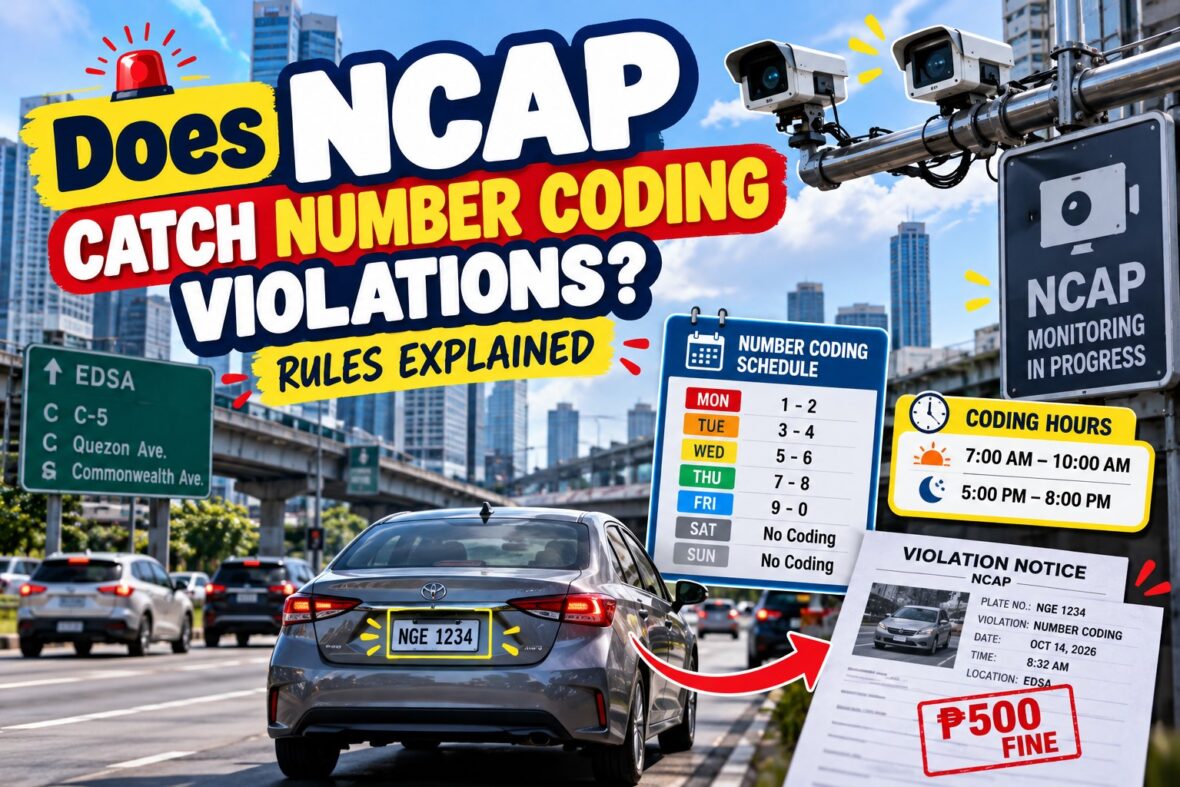
| Standard MMDA coding hours | 7 AM–10 AM and 5 PM–8 PM |
| Standard window hours | 10:01 AM–4:59 PM |
| Number coding on weekends | Generally suspended |
| MMDA coding violation fine | ₱500 under the reported standardized schedule |
| Do cameras automatically prove a violation? | No, evidence must be reviewed and validated |
| How to check MMDA tickets | May Huli Ka portal or supported eGovPH services |
| Can you contest a ticket? | Yes, through the issuing authority’s procedures |
How Does NCAP Detect Number Coding Violations?
NCAP uses traffic monitoring technology to record possible violations.
Depending on the system, this may involve closed-circuit television cameras, digital photography, video recording, automated vehicle identification, and software that helps traffic authorities review road activity.
Here’s how a number coding violation can be detected.
1. A Camera Records the Vehicle
When a vehicle passes through a monitored road or intersection, a traffic camera may record its image.
The footage can capture information such as the vehicle’s appearance, license plate, location, and time of travel.
This allows the traffic authority to review whether the vehicle was traveling in violation of an applicable rule.
2. The Plate Number Is Identified
Number coding is based on the last digit of a vehicle’s license plate.
If a camera records a vehicle whose plate ends in 5, for example, the relevant coding day is Wednesday.
The enforcement system can use the plate number together with the time and location of the recording to identify a possible violation.
However, identifying a license plate is not enough by itself.
The authority must also determine whether the vehicle was subject to number coding at that location and time.
3. The Date, Time, and Location Are Checked
This step is particularly important.
Let’s say the camera records a plate ending in 5 on a Wednesday.
If the recording occurred at 8:30 AM on an MMDA road where number coding is active, the vehicle may have committed a violation.
But what if the recording occurred at 2:00 PM?
Under the standard MMDA schedule, that falls within the window hours when coded vehicles are generally allowed to travel.
In that situation, the plate number alone would not establish a coding violation.
The applicable road rules, local exemptions, and any official coding suspension must also be considered.
4. The Evidence Is Reviewed
One important safeguard is that MMDA does not rely entirely on automated detection to finalize every citation.
When NCAP resumed in May 2025, MMDA explained that possible violations identified through its AI-assisted CCTV system are manually reviewed by personnel before a Notice of Violation is issued.
The purpose is to reduce incorrect apprehensions and verify the evidence.
This is significant because a camera can potentially misread a plate number or record a vehicle under circumstances that do not amount to an actual offense.
5. A Notice of Violation May Be Issued
If the reviewing authority determines that a violation occurred, a Notice of Violation may be issued to the vehicle’s registered owner.
The notice generally contains information about the alleged offense, supporting evidence, date and location, and the applicable fine.
It should also provide instructions for payment or contesting the citation.
The exact process depends on whether the violation was issued by MMDA or a local government operating its own NCAP program.
MMDA Number Coding Schedule: What Plate Numbers Are Restricted?
Before worrying about NCAP cameras, you should first understand the basic number coding schedule.
The official name of the program is the Unified Vehicular Volume Reduction Program, or UVVRP.
The system restricts certain vehicles from using covered Metro Manila roads during designated periods based on the last digit of their license plates.
Here’s the standard schedule.
| Day | Restricted plate endings |
|---|---|
| Monday | 1 and 2 |
| Tuesday | 3 and 4 |
| Wednesday | 5 and 6 |
| Thursday | 7 and 8 |
| Friday | 9 and 0 |
| Saturday | No regular MMDA coding |
| Sunday | No regular MMDA coding |
For example, if your license plate is ABC 1234, your coding day is Tuesday because the last digit is 4.
If your plate ends in 8, your coding day is Thursday.
The restriction is based on the last digit, not the letters or the sum of the numbers.
However, simply driving on your designated coding day does not automatically mean you’re violating the rule.
You must also consider the time, location, and applicable exemptions.
What Are the Number Coding Hours Under NCAP?
For roads covered by the standard MMDA UVVRP schedule, coding is generally enforced during two periods on weekdays.
Morning coding hours: 7:00 AM to 10:00 AM
Evening coding hours: 5:00 PM to 8:00 PM
Between those periods, motorists have what are commonly called window hours.
Number Coding Hours Explained
| Time | Standard MMDA coding status |
|---|---|
| Before 7:00 AM | No coding restriction |
| 7:00 AM–10:00 AM | Coding enforced |
| 10:01 AM–4:59 PM | Window hours |
| 5:00 PM–8:00 PM | Coding enforced |
| After 8:00 PM | No coding restriction |
Let’s use a simple example.
Your plate number ends in 2, meaning your coding day is Monday.
If you drive along an MMDA-covered road at 8:00 AM on Monday, you may be violating number coding.
But if you drive along that same road at 1:00 PM, you are generally within the allowed window period.
This assumes that the standard MMDA schedule applies and no different local rule or special restriction governs the road.
Can NCAP Catch You During Window Hours?
A camera can still record your vehicle during window hours.
However, recording a vehicle is not the same as establishing a number coding violation.
If you’re traveling during a valid window period, you should not receive a number coding citation solely because your license plate is coded that day.
Of course, you can still be cited for a different traffic offense.
For example, beating a red light or disregarding a traffic sign may still be a violation even when number coding is not in effect.
Does NCAP Enforce Coding at 10:01 AM or 5:01 PM?
Timing is extremely important when it comes to number coding.
Under the standard MMDA rules, window hours begin at 10:01 AM.
So, if your vehicle is recorded at 10:01 AM on a road following the usual MMDA schedule, you would generally no longer be violating the morning number coding restriction.
But if you’re recorded at 9:59 AM, you’re still within the restricted period.
The same principle applies in the afternoon.
At 4:59 PM, you’re still within the window hours.
At 5:01 PM, the evening coding restriction is already in effect.
This is why motorists should avoid planning their trips too close to the beginning or end of coding hours.
Traffic conditions can change unexpectedly, and a short delay may leave you on a covered road during the restricted period.
Does NCAP Catch Number Coding on EDSA?
Yes. EDSA is among the major Metro Manila thoroughfares monitored by MMDA’s NCAP system.
The agency resumed camera-based enforcement on major roads in May 2025 after the Supreme Court partially lifted restrictions on its implementation.
EDSA is one of the roads where NCAP monitoring has been used to detect traffic offenses.
This includes possible violations of the applicable number coding restrictions.
However, the important point is that NCAP operates as an enforcement system.
The actual offense still depends on the applicable UVVRP rules.
For example, a plate ending in 6 traveling along EDSA on Wednesday at 8:00 AM may be subject to number coding enforcement.
The same vehicle traveling during an applicable window period would not automatically be committing a coding offense.
Motorists should also remember that EDSA has other traffic rules, including restrictions on the EDSA Busway.
Even if you’re traveling outside your coding hours, you must still follow lane restrictions, traffic signs, and other regulations.
What Other Roads Have NCAP Cameras?
MMDA has identified several major thoroughfares within its NCAP enforcement coverage.
These have included EDSA, C-5, Commonwealth Avenue, Quezon Avenue, Roxas Boulevard, and Macapagal Boulevard.
Other monitored roads and intersections may also be included depending on the agency’s current implementation.
However, not every camera installed along these roads is necessarily dedicated to detecting number coding offenses.
Some equipment may be used for general traffic monitoring, incident detection, road safety, or other enforcement functions.
Likewise, the absence of a visible NCAP sign or camera directly above your vehicle should not be treated as permission to violate number coding.
Traffic enforcers can still apprehend motorists through traditional enforcement.
The best approach is to follow the applicable restrictions throughout your journey.
Does Makati Have Different Number Coding Hours?
Yes, and this is where some motorists get confused.
Makati City has historically enforced a stricter number coding schedule compared with the standard MMDA window-hour system.
Under Makati’s local scheme, the restriction generally applies from 7:00 AM to 7:00 PM on weekdays.
Unlike the standard MMDA schedule, Makati does not provide the usual midday window hours on roads subject to its city rules.
MMDA vs. Makati Number Coding Hours
| Details | Standard MMDA | Makati local rules |
|---|---|---|
| Morning start | 7:00 AM | 7:00 AM |
| Midday window | Yes | No |
| Restriction ends | 8:00 PM after evening coding | 7:00 PM |
| Coding days | Monday–Friday | Monday–Friday |
| Plate endings | Same standard schedule | Same standard schedule |
Let’s say your car’s plate ends in 3, meaning Tuesday is your coding day.
If you drive at 12:00 noon along a road following the MMDA window-hour schedule, that would generally be allowed.
However, if you enter a Makati road subject to the city’s continuous coding restriction at noon, you may still be violating its local rules.
It’s important to distinguish Makati’s coding restrictions from the question of whether an LGU-operated NCAP system is active at a particular location.
A city can enforce number coding through traffic personnel even where camera-based enforcement is not being used.
Before traveling through Makati, confirm the current road-specific rules and any exemptions.
Does NCAP Catch Number Coding in Quezon City, Manila, and Other Cities?
NCAP enforcement is not limited to MMDA.
Several Metro Manila local governments operate their own no-contact apprehension programs.
As of October 2026, city-run NCAP operations have resumed in Manila, Quezon City, Parañaque, Muntinlupa, and San Juan.
These systems are separate from MMDA’s own camera-based enforcement on major thoroughfares.
This matters because the coverage, types of violations monitored, and procedures for issuing citations may vary according to the implementing authority.
City-Run NCAP Enforcement
| Area | General NCAP situation as of October 2026 |
|---|---|
| MMDA-monitored roads | NCAP operational |
| Manila | City NCAP resumed |
| Quezon City | City NCAP resumed |
| Parañaque | City NCAP resumed |
| Muntinlupa | City NCAP resumed |
| San Juan | City NCAP resumed |
| Valenzuela | Planned resumption postponed |
Valenzuela initially planned to resume NCAP on October 5, 2026, but postponed implementation because of ongoing road construction.
It is important to distinguish the return of a city’s NCAP system from its number coding rules.
An operational NCAP program does not necessarily mean that every city road is covered by number coding or that every camera is configured to issue coding tickets.
The specific offense must be covered by the applicable regulations, and the vehicle must actually be violating the rule.
Before driving through a particular city, check its traffic management advisories and the current coverage of its enforcement program.
How Much Is the Fine for an NCAP Number Coding Violation?
Under the MMDA’s reported standardized traffic penalty schedule, the fine for violating number coding is ₱500.
This amount has been identified in government reporting concerning the MMDA’s single-ticketing system.
However, motorists should not assume that every number coding citation issued by every authority carries exactly the same amount under all circumstances.
The applicable fine may depend on the ordinance, implementing authority, and current traffic rules.
The amount stated in a valid official Notice of Violation should be checked against the issuing agency’s penalty schedule.
Can You Receive More Than One NCAP Ticket?
It is possible for separate traffic violations to be recorded during different incidents.
For example, a motorist may violate number coding and independently commit another traffic offense.
However, whether multiple citations can be issued for the same incident, how repeated violations are handled, and whether any restrictions apply depend on the governing rules and adjudication procedures.
Don’t assume that one NCAP ticket provides immunity from additional violations for the rest of the day.
Likewise, don’t assume that every camera you pass will automatically generate another fine.
How to Check Whether You Have an NCAP Number Coding Violation
If you suspect that you’ve been recorded while driving during number coding hours, you can check through the appropriate official portal.
For MMDA-issued violations, the main online service is May Huli Ka.
Step 1: Visit the May Huli Ka Website
Open the official MMDA portal at mayhulika.mmda.gov.ph.
Avoid clicking unfamiliar links from text messages or social media posts claiming that you have an unpaid violation.
Step 2: Enter Your Vehicle Information
The system supports vehicle searches using identifying information.
As of the August 2026 updates, motorists can check available NCAP records using their plate number and MV file number.
The MV file number can be found in the vehicle’s Certificate of Registration.
If you already have a Notice of Violation, another search method uses the plate number and ticket number.
Step 3: Review the Results
If the portal identifies a matching record, review its details.
Check the date, time, location, cited offense, and available evidence.
For a number coding ticket, compare the recorded date and time with your vehicle’s coding day and the rules applicable to that road.
Step 4: Check the Payment or Contest Status
The May Huli Ka platform allows motorists to access available payment and contest services.
If you believe the citation is correct, follow the official payment instructions.
If something appears inaccurate, review the procedure for contesting the violation.
What If the Portal Says “No Record Found”?
A “No Record Found” result means the particular search did not return a matching record.
It doesn’t necessarily guarantee that no violation exists anywhere.
Recently recorded incidents may still be undergoing processing.
City-issued citations may also be maintained in separate local government systems.
If you received a notice from a city traffic office, check that city’s official platform or contact the issuing authority.
Can You Check NCAP Violations Through the eGovPH App?
Yes. MMDA’s NCAP services have also been integrated into the eGovPH application.
The service provides motorists with another way to access supported NCAP information through their phones.
Depending on the available features, users may be able to review violation records, examine evidence, monitor transaction status, and access payment-related services.
However, the availability of MMDA services within eGovPH does not automatically mean every city-issued NCAP record is included.
If your ticket was issued by a local government, verify which platform that authority uses.
How to Contest an NCAP Number Coding Violation
What if you received a citation but you’re certain you weren’t violating number coding?
You have the right to use the applicable contest or adjudication procedure.
Here are the steps to consider.
1. Review the Official Notice
Check the violation date, location, and exact time.
For example, if your car’s plate ends in 8, Thursday is your regular coding day.
A ticket alleging a number coding violation on Tuesday may deserve further review.
However, make sure the notice doesn’t involve a different traffic offense.
2. Confirm the Applicable Coding Hours
Compare the alleged violation time against the restrictions governing that location.
If the road follows the MMDA window-hour schedule, a citation issued for an incident at 1:00 PM may have a factual problem.
But if the incident occurred on a road governed by a different local coding schedule, you must consider that rule.
3. Check for Official Suspensions
Number coding may be suspended during certain holidays or exceptional circumstances.
For example, MMDA suspended number coding on August 14, 2026, because of continuous heavy rain associated with the southwest monsoon.
If your alleged violation occurred during an officially announced suspension applicable to the road, preserve a copy of that advisory.
It may be relevant to your contest.
4. Verify the License Plate
Make sure the vehicle recorded in the evidence is actually yours.
An incorrectly read plate number or another vehicle using a similar or unauthorized plate could result in a disputed citation.
If you suspect plate misuse, coordinate with the appropriate authorities.
5. Submit Supporting Evidence
Relevant documents may include your vehicle registration, dashcam footage, timestamped records, an official coding suspension announcement, or evidence of an applicable exemption.
Submit the required documents through the issuing authority’s official process.
6. Follow the Contest Deadline
Don’t ignore the deadline indicated in your Notice of Violation.
The allowable period for filing a contest can differ depending on the issuing authority and applicable rules.
Submit your protest within the required period and keep your acknowledgment or case reference number.
Are Some Vehicles Exempt From Number Coding?
Yes. The standard MMDA number coding scheme includes exemptions for certain classes of vehicles.
These have included motorcycles, qualifying public utility vehicles, transport network vehicle services, ambulances, fire trucks, marked government vehicles, and certain vehicles carrying essential or perishable goods.
Electric vehicles also benefit from statutory incentives under Republic Act No. 11697, or the Electric Vehicle Industry Development Act.
The Department of Energy has clarified that the law’s number coding exemption applies to electric vehicles covered by its recognition framework, including applicable battery-electric and hybrid classifications.
However, not every vehicle advertised as a hybrid should automatically be assumed to qualify without verification of its official classification and documentation.
Does NCAP Automatically Recognize Exempt Vehicles?
A vehicle can still be captured by a camera even if it qualifies for an exemption.
This is why vehicle identification and evidence review matter.
If an exempt vehicle receives a number coding citation, the registered owner should follow the issuing authority’s instructions for presenting proof of exemption.
For example, a qualifying electric vehicle owner may need to demonstrate that the vehicle is covered by the applicable statutory exemption.
An exemption from number coding does not exempt the vehicle from other traffic laws.
Is Number Coding Suspended on Holidays?
Under the standard MMDA schedule, number coding is generally suspended on weekends and official holidays.
MMDA may also announce temporary suspensions because of severe weather, flooding, or other exceptional circumstances.
However, motorists should pay attention to which authority issued the suspension.
A general MMDA advisory may not automatically settle every question about separately administered local traffic restrictions.
Before driving on a holiday or during unusual conditions, check the current announcements from MMDA and the relevant city government.
Can an NCAP Camera Still Record You During a Holiday?
Yes.
Traffic cameras may continue operating even when number coding is suspended.
But if the relevant coding rule is not in effect, merely driving a vehicle with a normally restricted plate number would not establish a coding violation.
You can still be cited for other enforceable traffic offenses.
For example, disregarding a red light does not become legal simply because number coding has been suspended.
What If You Have No Plate Number Yet?
Newly purchased vehicles sometimes operate using a conduction sticker while awaiting their permanent license plates.
This can create confusion about number coding.
The MMDA has used conduction sticker numbers for coding purposes in circumstances where the permanent plate has not yet been issued.
However, the specific requirements depend on the vehicle’s registration and current implementing rules.
Don’t assume that having no physical plate automatically exempts you from number coding.
Check the applicable guidance and ensure that your vehicle complies with LTO registration and plate-display requirements.
Deliberately covering, altering, or obscuring your license plate to avoid detection can also lead to separate penalties.
Can You Avoid NCAP by Taking Another Road?
The most reliable way to avoid a number coding violation is to follow the applicable restrictions.
That generally means scheduling your trip outside restricted hours, using public transportation, or choosing a lawful route that is genuinely outside the area covered by the restriction.
However, motorists should be careful about assuming that side streets are always exempt.
Different cities may have their own traffic regulations.
And even on a road without NCAP cameras, traffic enforcers can still issue citations where the applicable restriction is in effect.
Some toll expressways have separate traffic arrangements from ordinary Metro Manila roads, but restrictions may apply once you exit onto a covered city street or major thoroughfare.
Plan your full route rather than focusing only on avoiding a particular camera.
Common Misconceptions About NCAP and Number Coding
“NCAP Only Catches Beating the Red Light”
False.
NCAP can be used to record different traffic offenses, including number coding, disregarding traffic signs, illegal lane movements, and other violations covered by the applicable rules.
“If There’s No Traffic Enforcer, I Won’t Get a Ticket”
False.
The purpose of NCAP is to allow traffic enforcement without requiring physical apprehension at the time of the offense.
“A Camera Automatically Means I’m Violating Coding”
Not necessarily.
A valid number coding offense depends on your plate number, the date, time, road, and applicable exemptions.
“Number Coding Applies for the Entire Day”
Not under the standard MMDA schedule.
The regular MMDA restriction operates during specified morning and evening periods.
However, certain local governments, particularly Makati, have different schedules.
“Window Hours Apply Everywhere”
False.
You need to check the rules of the road or city where you’re traveling.
“Every CCTV Camera Issues NCAP Tickets”
False.
Many cameras are used for traffic monitoring or other security purposes.
Camera-based enforcement depends on the authority operating the system and the applicable rules.
“No Record Found Means I’m Completely Cleared”
Not necessarily.
A portal may not yet display a recently recorded incident or citations from another authority.
Frequently Asked Questions
Does NCAP automatically catch number coding violations?
NCAP can detect number coding violations through camera-based monitoring, but not every camera automatically generates a ticket. The suspected violation must be supported by the applicable rules and evidence.
Can NCAP catch coding violations on EDSA?
Yes. MMDA uses NCAP on EDSA and other major monitored roads. Number coding violations are among the types of traffic offenses that can be enforced through the system.
Does NCAP catch number coding at 12 noon?
Under the standard MMDA schedule, 12 noon falls within the allowable window period. However, local restrictions may differ, particularly on roads governed by Makati’s continuous coding hours.
What is the fine for number coding under NCAP?
The reported MMDA standardized fine is ₱500. Verify the amount shown in the official notice against the current penalty schedule of the issuing authority.
Can NCAP catch number coding on weekends?
The standard MMDA number coding restriction is not enforced on Saturdays and Sundays. Cameras may still record other traffic violations.
Does NCAP operate 24 hours a day?
Traffic monitoring systems can operate around the clock, but the hours during which number coding is prohibited are determined by the applicable UVVRP or local traffic rules.
Can I receive an NCAP ticket after driving during window hours?
You may receive a ticket for another traffic offense, but a number coding citation should still be based on a valid restriction applicable to that location and time.
What if I entered EDSA before coding hours but was still there when coding started?
If your vehicle remains on a covered road after the restriction begins, you may be subject to apprehension. Starting the trip before coding hours does not automatically exempt the rest of the journey.
Can a provincial vehicle be caught for number coding in Metro Manila?
Yes. A vehicle registered in Cavite, Laguna, Bulacan, Rizal, or another province can still be subject to applicable Metro Manila number coding rules when traveling on covered roads.
Provincial registration alone does not provide an exemption.
Can an NCAP number coding ticket affect LTO registration?
An unresolved violation may lead to administrative consequences, including an alarm or restriction where authorized under the applicable procedures.
Not every unpaid citation automatically causes a registration hold. Check its actual status with the issuing authority and LTO.
How long does it take for an NCAP violation to appear online?
Processing time can vary by authority and the circumstances of the case. There is no universal guaranteed number of hours or days after which every recorded offense will appear online.
How do I check if I was caught by NCAP?
Use the MMDA May Huli Ka portal or supported eGovPH NCAP services. For city-issued citations, check the relevant local government’s official traffic enforcement platform.
NCAP and Number Coding: Latest October 2026 Update
As of October 19, 2026, NCAP continues to operate on major MMDA-monitored roads in Metro Manila.
The agency resumed its no-contact enforcement in May 2025 after the Supreme Court partially lifted the relevant temporary restraining order.
Meanwhile, city-run NCAP systems resumed in Manila, Quezon City, Parañaque, Muntinlupa, and San Juan on October 5, 2026.
Valenzuela postponed its planned NCAP return because of ongoing road construction.
This expansion means motorists may encounter camera-based enforcement from both MMDA and local governments, depending on the road and applicable traffic regulations.
For number coding, the standard MMDA restriction remains 7:00 AM to 10:00 AM and 5:00 PM to 8:00 PM on weekdays, with the usual midday window hours.
However, motorists should continue checking local advisories because separate city rules, exemptions, and temporary suspensions may apply.

Final Thoughts
So, does NCAP catch number coding violations?
Yes, it can.
And number coding has been among the traffic offenses monitored through MMDA’s no-contact apprehension system for years.
But here’s what motorists should remember.
Simply appearing on a camera during your coding day doesn’t automatically mean you’ve committed a violation.
The exact time, road, applicable coding regulations, and vehicle exemptions still matter.
If you’re driving along EDSA or other MMDA-monitored roads, make sure you follow the standard coding schedule.
And if your route passes through Makati or another city with different rules, don’t assume that the MMDA’s window hours apply everywhere.
It’s also a good idea to check the official NCAP portals occasionally, particularly if you suspect that you may have accidentally traveled during restricted hours.
If a violation appears, review the details carefully before paying or filing a contest.
At the end of the day, the best way to avoid NCAP fines isn’t by looking for cameras or figuring out which roads have enforcement equipment.
It’s by knowing the rules before leaving home.
A few minutes spent checking your plate number, coding hours, and planned route can help you avoid unexpected traffic tickets and the inconvenience of resolving them later.
And with NCAP now operating in more parts of Metro Manila, that’s a habit worth developing.
This article reflects publicly available MMDA, local government, and traffic enforcement information as of October 19, 2026. NCAP coverage, number coding hours, exemptions, penalties, and contest procedures may change through subsequent official advisories.