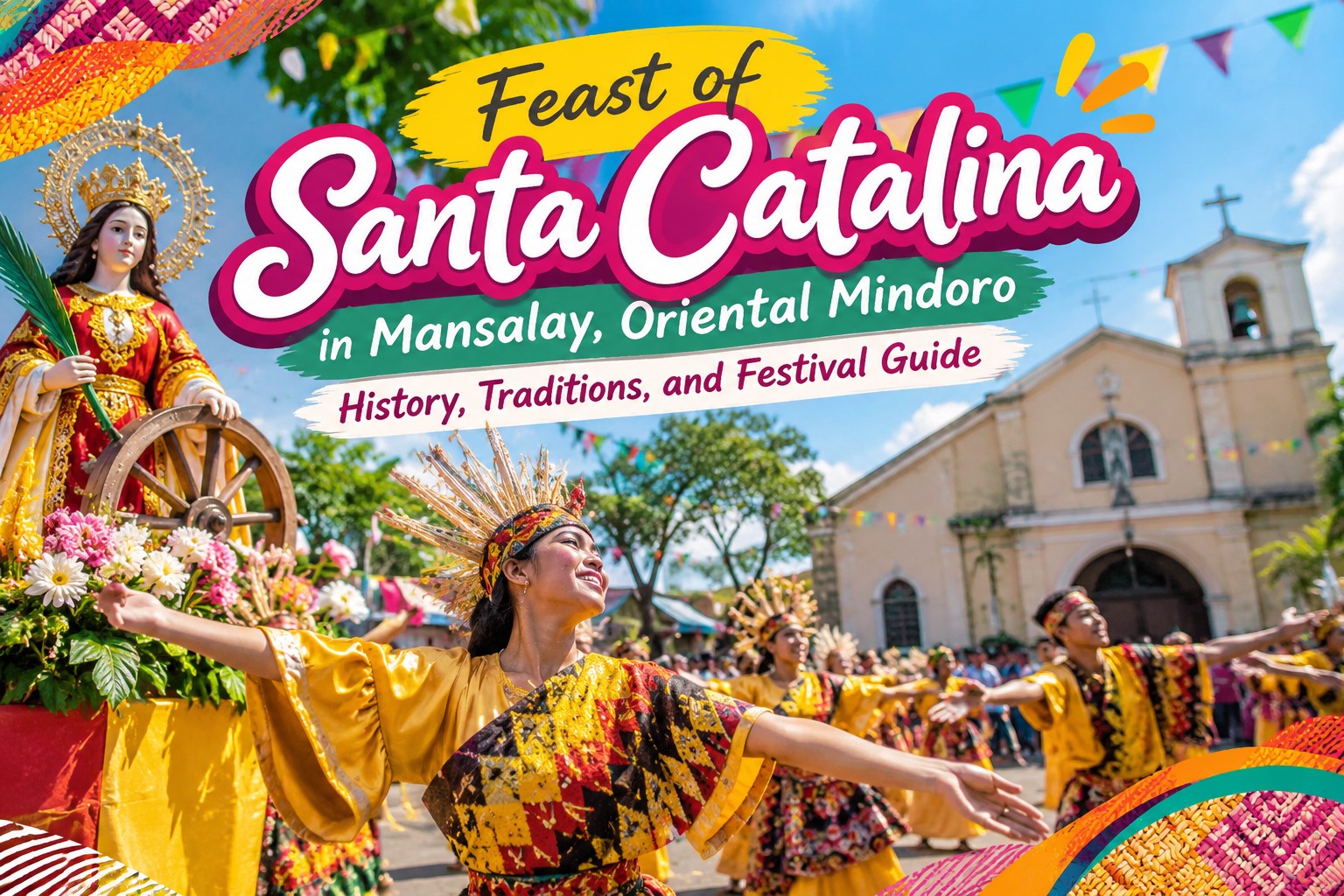
Every November, the municipality of Mansalay in Oriental Mindoro celebrates one of its most meaningful religious traditions—the Feast of Santa Catalina.
For the people of Mansalay, this annual celebration is more than just another town fiesta. It’s an occasion that brings families, neighbors, and devotees together to honor their patron saint, express gratitude, and keep local traditions alive.
Like many fiestas in the Philippines, the Feast of Santa Catalina combines religious devotion with the warmth and hospitality that Filipinos are known for. There’s the celebration at the parish church, the gathering of families, and the community activities that make a traditional provincial fiesta special.
One of the cultural highlights historically associated with the celebration is Palarong Lahi, where participants enjoy traditional Filipino games that have been passed down through generations.
But beyond the festivities, the Feast of Santa Catalina also tells a story about the history, faith, and identity of Mansalay.
If you’re curious about this celebration or planning to experience it yourself, here’s everything you need to know about the Feast of Santa Catalina in Oriental Mindoro.
Content
What Is the Feast of Santa Catalina?
The Feast of Santa Catalina is an annual religious and cultural celebration held in Mansalay, a municipality in the southern part of Oriental Mindoro.
It is dedicated to Santa Catalina de Alejandria, also known as Saint Catherine of Alexandria, the patron saint of the municipality.
The celebration is deeply connected to the town’s Catholic heritage. Every year, devotees honor their patron saint through religious observances, prayers, and community gatherings.
While the religious celebration remains at the heart of the occasion, the fiesta has also become a way for residents to celebrate their shared history and traditions.
It is a time when families gather, visitors return to their hometown, and the community comes together.
Unlike some of the Philippines’ larger festivals that are known primarily for elaborate performances and massive street parades, the Feast of Santa Catalina has traditionally emphasized religious devotion and local community activities.
This is part of what gives the celebration its distinct charm.
When Is the Feast of Santa Catalina Celebrated?
The Feast of Santa Catalina is celebrated annually in late November.
The Sta. Catalina Parish in Mansalay observes its patronal feast day on November 25, which is also the traditional Catholic feast day of Saint Catherine of Alexandria.
However, the Provincial Planning and Development Office of Oriental Mindoro lists November 26 as the town fiesta date.
For this reason, visitors may encounter references to both November 25 and November 26 when researching the celebration.
The distinction generally comes from the difference between the religious feast day and the town fiesta date appearing in provincial festival listings.
Some activities may also take place before the main celebration, depending on the schedule prepared by the parish and local government.
If you’re planning to visit, it’s best to check announcements from the Municipal Government of Mansalay and Sta. Catalina Parish for the confirmed program.
Who Is Santa Catalina de Alejandria?
Santa Catalina de Alejandria, or Saint Catherine of Alexandria, is one of the well-known female martyrs in Christian tradition.
According to traditional accounts, she lived in Alexandria, Egypt, during the early fourth century.
She is remembered as an intelligent and courageous young woman who remained faithful to Christianity despite persecution under Roman rule.
Religious tradition describes her as a highly educated woman who used her knowledge and reasoning to defend her faith.
She reportedly challenged the arguments of scholars who attempted to persuade her to abandon Christianity.
Because of her refusal to renounce her beliefs, she was sentenced to death.
One of the most recognizable symbols associated with Saint Catherine is a spiked wheel, which appears in traditional accounts of her martyrdom.
This is why she is sometimes called Saint Catherine of the Wheel.
She is also traditionally depicted holding a palm branch, symbolizing martyrdom, and sometimes a sword.
Over the centuries, Saint Catherine became associated with wisdom, education, and courage.
She is recognized as a patron saint of students, scholars, philosophers, and others involved in intellectual pursuits.
Although many details about her life come from Christian tradition rather than independently verified historical records, her story remains an important part of Catholic devotion.
In Mansalay, her patronage continues to inspire religious observances and community celebrations.
History of the Feast of Santa Catalina in Mansalay
To understand the importance of the Feast of Santa Catalina, it helps to know a little about the history of Mansalay itself.
Mansalay is one of the municipalities of Oriental Mindoro, a province known for its natural landscapes, agricultural communities, coastal areas, and rich cultural heritage.
The town’s history reaches back to the Spanish colonial period, when Catholicism became an important influence on many communities throughout the Philippines.
During that time, religious practices and devotion to patron saints gradually became part of local life.
Mansalay was once under the jurisdiction of Mangarin, a settlement associated with what is now Occidental Mindoro.
Over the years, Mansalay developed into a municipality with its own local institutions, cultural traditions, and community identity.
An important part of its religious history is the establishment of Sta. Catalina Parish in 1952.
Located in Barangay Poblacion, the parish belongs to the Apostolic Vicariate of Calapan.
The church became an important center of worship for Catholic residents and continues to play a central role in the celebration of the Feast of Santa Catalina.
Although the precise origins of every fiesta activity are not fully documented, the town’s continuing devotion to its patron saint reflects a religious tradition that has been maintained across generations.
For many residents, the celebration is not simply an annual event. It is part of the heritage of their hometown.
How Is the Feast of Santa Catalina Celebrated?
The Feast of Santa Catalina brings together religious practices and community traditions that are familiar to many Filipinos.
The exact program may vary from year to year, but the celebration is generally associated with prayer, thanksgiving, family gatherings, and local activities.
Here are some of the traditions connected with the occasion.
1. Holy Mass and Religious Observances
The religious celebration is the most important part of the Feast of Santa Catalina.
Catholic devotees gather at the Sta. Catalina Parish Church to honor their patron saint and participate in prayer and worship.
The feast-day Mass provides an opportunity for residents to express gratitude, seek spiritual guidance, and reflect on the example of Saint Catherine.
For many families, attending Mass is an important tradition during the fiesta.
The church also serves as a gathering place where residents reconnect with neighbors and relatives.
Even when other activities change from year to year, the religious meaning of the celebration remains central.
2. Novena Prayers
In the Philippines, patronal feasts are commonly preceded by a novena, or nine days of prayer.
The practice is a familiar part of Catholic celebrations throughout the country.
Devotees may use this period to reflect on their faith, offer petitions, and prepare spiritually for the feast day.
Those interested in joining novena prayers or special Masses in Mansalay should consult the parish’s official schedule, since arrangements may vary.
3. Palarong Lahi
One of the interesting traditions historically highlighted in descriptions of the Feast of Santa Catalina is Palarong Lahi.
Palarong Lahi refers to traditional Filipino games that promote teamwork, cooperation, friendly competition, and community participation.
These games are particularly meaningful because they help introduce younger generations to recreational activities enjoyed by Filipinos long before mobile phones and online games became part of everyday life.
Traditional Filipino games include patintero, tumbang preso, luksong tinik, and sack races, although the specific games featured in Mansalay depend on the organizers.
What’s special about Palarong Lahi is that it gives participants an opportunity to enjoy simple activities while celebrating Filipino culture.
Children, young people, and adults can participate, making it an enjoyable community experience.
Older festival descriptions specifically identify Palarong Lahi as a highlight of the Feast of Santa Catalina, although it should not be assumed that the same activities are organized every year.
4. Family Reunions and Fiesta Gatherings
For many Filipino families, a town fiesta is also a homecoming.
Relatives who live or work elsewhere may return to their hometown to spend time with loved ones.
Homes become gathering places, and visitors are welcomed with food and conversation.
In many Philippine communities, families prepare dishes such as pancit, adobo, grilled meats, and other local favorites during fiestas.
The exact food traditions naturally differ from one household to another.
But the spirit behind these gatherings is familiar across the country.
It’s about making time for family, welcoming guests, and celebrating together.
5. Community and Cultural Activities
Depending on the year’s official program, the town fiesta may also include activities organized by the local government, schools, community groups, and other organizations.
These may involve recreational events, cultural presentations, or other forms of community entertainment.
Such activities provide residents with opportunities to participate in celebrations beyond the religious observances.
However, not every activity is a permanent feature of the Feast of Santa Catalina.
Travelers hoping to watch a particular performance or attend a specific event should confirm that it is included in the current fiesta program.
The Feast of Santa Catalina and the Mangyan Festival
Another interesting aspect of visiting Mansalay is the municipality’s connection to the indigenous Mangyan communities of Mindoro.
Mansalay is especially associated with the Hanunuo Mangyan, one of the indigenous groups found on the island.
The municipality also celebrates the Mangyan Festival, which highlights the culture, traditions, and contributions of its indigenous communities.
The Mangyan Festival is known for cultural performances and presentations that showcase local heritage.
Traditional-inspired costumes, dances, and artistic expressions help bring attention to the identity of the Mangyan people.
Although the Mangyan Festival and the Feast of Santa Catalina are distinct celebrations, their activities may fall within the same general fiesta season.
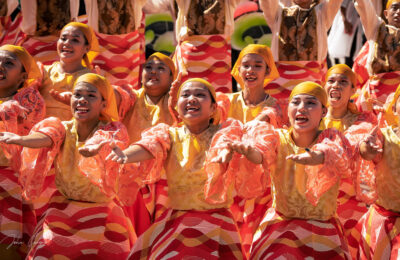
This is an important distinction for visitors, especially when looking at photographs of colorful street dancing performances from Mansalay.
Not every street dancing event in the municipality is necessarily part of the religious Feast of Santa Catalina.
Nevertheless, both celebrations contribute to the cultural identity of Mansalay.
The Feast of Santa Catalina highlights the town’s Catholic heritage, while the Mangyan Festival provides an opportunity to appreciate its indigenous cultural traditions.
Together, they reflect the diversity of the municipality.
Where Is the Feast of Santa Catalina Held?
The celebration takes place in Mansalay, Oriental Mindoro, Philippines.
The main religious venue is Sta. Catalina Parish Church in Barangay Poblacion.
Mansalay is situated in the southern portion of Oriental Mindoro and is part of the province’s network of coastal and agricultural communities.
The municipality is not as widely promoted as destinations such as Puerto Galera, but it has its own attractions and cultural experiences worth discovering.
Visitors who are interested in traditional Philippine festivals will find Mansalay particularly interesting because its celebrations offer a glimpse into local community life.
The experience is different from attending a large commercialized festival.
Instead, visitors can appreciate a provincial town where religious traditions, family relationships, and community activities remain important.
How to Get to Mansalay, Oriental Mindoro
If you’re planning to experience the Feast of Santa Catalina, you’ll first need to travel to Mansalay.
The municipality can be reached through Oriental Mindoro’s road network, with Calapan serving as a major gateway for travelers arriving from Luzon.
From Manila
One of the usual routes from Metro Manila involves traveling to Batangas Port and taking a ferry to Calapan.
From Calapan, travelers can continue to Mansalay by bus or van.
The journey involves several stages:
- Travel from Metro Manila to Batangas Port.
- Board a passenger ferry or RoRo vessel bound for Calapan.
- From Calapan, look for a southbound bus or van serving Mansalay or nearby municipalities.
- Alight in Mansalay and continue to Barangay Poblacion if you’re visiting the parish church.
Travel times and transportation fares depend on the operator, departure schedule, weather, and traffic conditions.
From Calapan
If you’re already in Oriental Mindoro, travel to Mansalay is generally more straightforward.
Southbound buses and vans connect Calapan with municipalities along the province’s main highway.
Before boarding, ask whether the vehicle passes through Mansalay.
It’s also a good idea to check the availability of return transportation, particularly if you’re planning to attend evening activities.
Other Things to See in Mansalay
A visit during the Feast of Santa Catalina can also be an opportunity to discover more of Mansalay.
Although the municipality is not among the country’s most heavily visited tourist destinations, it has natural attractions and cultural experiences worth exploring.
Mansalay’s Coastal Areas
Mansalay has coastal communities and beaches that provide opportunities to appreciate the quieter side of Oriental Mindoro.
The provincial government has identified areas such as Mansalay Beach, Del Mundo Beach, and Cagulong Beach among places with tourism potential.
Before visiting, check local access arrangements and available facilities, as not all locations operate as established tourist resorts.
Local Communities and Markets
One of the simplest ways to experience a new destination is to explore its local markets and small businesses.
Visitors can discover everyday life in Mansalay by trying locally available food, purchasing products from community vendors, and interacting respectfully with residents.
Mangyan Cultural Heritage
The indigenous communities of Mindoro have a rich cultural heritage that includes traditional weaving, artistic practices, and forms of indigenous knowledge.
For travelers interested in learning about these traditions, it is important to visit responsibly.
Cultural visits should be arranged with appropriate local guidance and the consent of the communities involved.
The goal should be to appreciate and understand local heritage rather than treat cultural practices as tourist performances.
Travel Tips for the Feast of Santa Catalina
Planning to attend the fiesta? Here are some practical tips that can help.
- Check the official schedule. Confirm the dates of religious activities and any community events before making travel arrangements.
- Arrive early for religious services. The parish church may receive additional visitors during important observances.
- Dress appropriately. Choose comfortable and modest clothing, especially when attending Mass.
- Bring cash. Small shops, transport providers, and local establishments may not always accept digital payments.
- Book accommodations early. If you’re planning to stay overnight, research lodging options in Mansalay or nearby municipalities.
- Respect local customs. Remember that religious activities are meaningful occasions for the community.
- Prepare for changing weather. November is still within the Philippines’ rainy season, so check weather and ferry advisories.
- Support local businesses. Buying food and other locally available products is one way to contribute to the community.
Most importantly, approach the celebration with an appreciation for its religious and cultural significance.
Why Is the Feast of Santa Catalina Important?
There are many reasons why the Feast of Santa Catalina remains meaningful to Mansalay.
First, it reflects the town’s long-standing Catholic faith.
For devotees, celebrating the feast is a way of honoring a patron saint whose story represents courage, knowledge, and commitment to religious beliefs.
Second, it strengthens community relationships.
Town fiestas provide opportunities for families, neighbors, and friends to reconnect. They also encourage participation in local activities and traditions.
Third, the celebration helps preserve a part of Mansalay’s heritage.
As communities grow and lifestyles change, traditional celebrations become reminders of the customs and values that helped shape local identity.
Finally, the feast contributes to the broader cultural landscape of Oriental Mindoro.
Each municipality in the province has its own celebrations and traditions, and the Feast of Santa Catalina is one of the occasions that makes Mansalay unique.
Frequently Asked Questions
What is the Feast of Santa Catalina?
The Feast of Santa Catalina is an annual religious celebration in Mansalay, Oriental Mindoro, honoring Saint Catherine of Alexandria, the town’s patron saint.
When is the Feast of Santa Catalina celebrated?
Sta. Catalina Parish observes its patronal feast on November 25. Some provincial and tourism references list the Mansalay town fiesta on November 26.
Where is the Feast of Santa Catalina celebrated?
The celebration takes place in Mansalay, Oriental Mindoro, with religious observances centered on Sta. Catalina Parish Church in Barangay Poblacion.
Who is Santa Catalina?
Santa Catalina is Saint Catherine of Alexandria, a Christian saint traditionally remembered for her intelligence, courage, and martyrdom.
What is the highlight of the Feast of Santa Catalina?
Older festival listings identify Palarong Lahi, featuring traditional Filipino games, as a highlight of the celebration. Religious activities, particularly the patronal feast Mass, are central to the occasion.
Is there street dancing during the Feast of Santa Catalina?
Mansalay is known for cultural dancing associated with its Mangyan Festival. However, street dancing should not automatically be considered part of the Feast of Santa Catalina’s program every year. Visitors should check the official event schedule.
Is the Feast of Santa Catalina a public holiday?
The celebration is not a nationwide Philippine public holiday. Any local holiday designation would depend on an applicable official declaration.
Can tourists attend the Feast of Santa Catalina?
Yes. Visitors may attend public religious activities and other community events, provided they follow local guidelines and respect the celebration’s traditions.
Feast of Santa Catalina 2026: Schedule and Important Advisory
The 2026 town fiesta in Mansalay was scheduled for November 24–25, with religious activities honoring Santa Catalina.
However, the Municipal Government of Mansalay announced the suspension of non-religious activities due to concerns about the potential effects of a strong El Niño event.
Under Memorandum Order No. 227, Series of 2026, the municipality suspended non-religious fiesta activities while allowing religious observances to continue.
The decision was made as part of precautionary measures related to possible water shortages, agricultural disruptions, and other community needs.
For confirmed religious schedules, residents and visitors are advised to follow announcements from Sta. Catalina Parish and the Municipal Government of Mansalay.
This advisory applies specifically to the 2026 celebration. Arrangements for future years may be different.
Final Thoughts
The Feast of Santa Catalina is one of the many local celebrations that make the Philippines’ cultural traditions so interesting.
It may not have the international recognition of festivals such as Sinulog or Ati-Atihan, but its significance to the people of Mansalay is just as meaningful.
At its heart, the celebration is about faith, gratitude, family, and community.
It’s about honoring a patron saint, continuing traditions, and gathering with the people who make a town feel like home.
The Feast of Santa Catalina also reminds us that not every memorable festival needs massive crowds or grand performances.
Sometimes, the most meaningful celebrations are the ones that bring communities together through simple traditions that have lasted for generations.
For travelers exploring Oriental Mindoro, experiencing the Feast of Santa Catalina offers another way to appreciate the province beyond its beaches and natural attractions.
And for the people of Mansalay, it remains an important reminder of their history, heritage, and shared devotion to Santa Catalina de Alejandria.