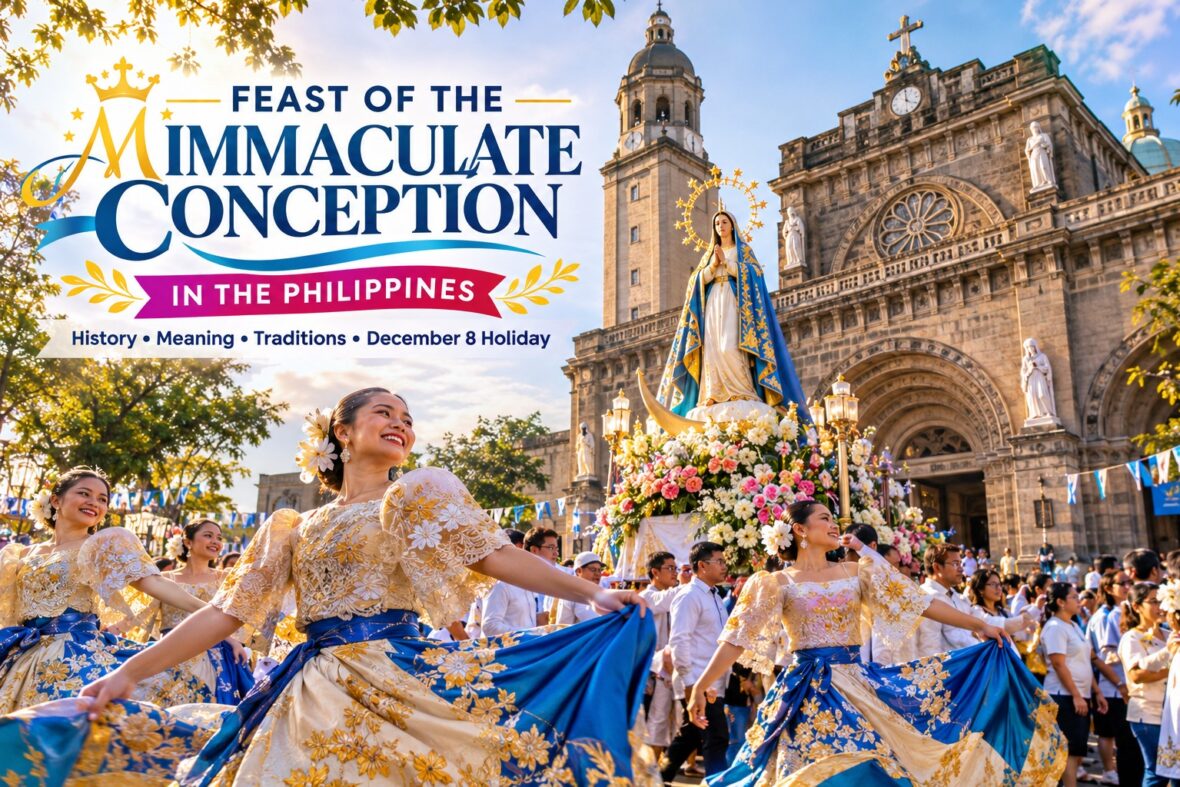
Every December 8, Catholics across the Philippines celebrate one of the most important Marian occasions of the year—the Feast of the Immaculate Conception of the Blessed Virgin Mary.
For many Filipinos, the occasion means attending Mass, joining religious processions, offering flowers to the Blessed Virgin Mary, and spending time in prayer. In some communities, the celebration becomes a full-fledged parish fiesta, complete with beautifully decorated churches, Marian images, and gatherings that bring families and neighbors together.
But beyond the celebrations, the Feast of the Immaculate Conception carries a deeper religious meaning. It honors a central Catholic belief about the Virgin Mary and her special role in the story of salvation.
The occasion is particularly significant in the Philippines, where the Blessed Virgin Mary, under the title of the Immaculate Conception, is recognized as the country’s principal patroness.
Here’s everything you need to know about the Feast of the Immaculate Conception, from its history and religious significance to the traditions that make it an important part of Filipino Catholic life.
Content
What Is the Feast of the Immaculate Conception?
The Feast of the Immaculate Conception, officially called the Solemnity of the Immaculate Conception of the Blessed Virgin Mary, is a Catholic celebration held every December 8.
It commemorates the Catholic belief that the Virgin Mary was preserved from original sin from the very first moment of her conception.
According to Catholic teaching, Mary received this special grace from God in preparation for her role as the mother of Jesus Christ.
One common misconception is that the Immaculate Conception refers to the conception of Jesus. However, the feast actually celebrates the conception of Mary herself.
The conception of Jesus is commemorated during the Feast of the Annunciation, celebrated on March 25.
The Immaculate Conception, on the other hand, concerns Mary and the Catholic belief that she was conceived without original sin.
For Catholics, this teaching highlights Mary’s unique place in the Christian faith and her willingness to accept God’s plan.
The celebration also takes place during Advent, the season of preparation leading to Christmas, making it an especially meaningful occasion for reflection and prayer.
When Is the Feast of the Immaculate Conception Celebrated?
The Feast of the Immaculate Conception is traditionally observed on December 8 every year.
The date remains the same, although the Church’s liturgical observance may occasionally be transferred when December 8 falls on a Sunday of Advent.
Interestingly, December 8 is exactly nine months before September 8, the date when the Catholic Church celebrates the Nativity or birthday of the Blessed Virgin Mary.
This connection reflects the traditional Catholic calendar surrounding Mary’s life.
In the Philippines, December 8 is also recognized as a nationwide special non-working holiday, allowing many Filipinos to participate in religious activities and celebrations.
History and Origin of the Feast of the Immaculate Conception
The devotion to Mary’s Immaculate Conception has a history that stretches back many centuries.
Long before the Catholic Church formally defined the doctrine, Christians had already expressed devotion to Mary and reflected on her unique holiness.
Over time, the belief became an important subject of theological discussion, especially concerning original sin and Mary’s role as the mother of Jesus.
The decisive moment came on December 8, 1854.
On that date, Pope Pius IX formally proclaimed the dogma of the Immaculate Conception through the apostolic constitution Ineffabilis Deus.
The declaration established as official Catholic doctrine that Mary, through a singular grace from God and in view of the merits of Jesus Christ, was preserved from original sin from the first moment of her existence.
Although the doctrine was formally proclaimed in the 19th century, devotion to the Immaculate Conception had already developed in many Catholic communities around the world.
The celebration eventually became one of the most important Marian solemnities in the Catholic liturgical calendar.
Today, it is observed by Catholics in numerous countries, including the Philippines, Spain, Italy, Portugal, and many parts of Latin America.
The Feast of the Immaculate Conception in the Philippines
The Philippines has a particularly strong devotion to the Blessed Virgin Mary.
This devotion can be seen in the country’s many Marian shrines, centuries-old churches, religious festivals, and processions.
From the popular devotion to Our Lady of Peñafrancia in Bicol to Our Lady of Manaoag in Pangasinan, Marian celebrations have become an important part of Filipino religious and cultural life.
The Immaculate Conception holds a special place among these devotions.
On September 12, 1942, Pope Pius XII, through the apostolic letter Impositi Nobis, declared the Blessed Virgin Mary under the title of the Immaculate Conception as the principal patroness of the Philippines.
This recognition strengthened the celebration’s significance for Filipino Catholics.
Today, December 8 is observed not only as an important Church celebration but also as a national holiday.
For many Filipinos, the feast provides an opportunity to express gratitude, strengthen their faith, and seek the Blessed Virgin Mary’s intercession.
The celebration is particularly meaningful in parishes and dioceses dedicated to the Immaculate Conception.
In these communities, December 8 may also serve as the principal parish fiesta, drawing devotees and visitors from surrounding towns and cities.
How Is the Feast of the Immaculate Conception Celebrated?
Although traditions vary from one community to another, several religious activities are commonly associated with the celebration.
1. Holy Mass and Religious Services
Attending Holy Mass is the central part of the Feast of the Immaculate Conception.
Catholic churches throughout the Philippines hold special Masses honoring the Blessed Virgin Mary.
In many parishes, additional Masses are scheduled to accommodate the large number of devotees who wish to attend.
The liturgical celebration focuses on Mary’s holiness, her role in God’s plan, and the importance of faith and obedience.
Churches dedicated to the Immaculate Conception may also hold more elaborate celebrations, particularly when the occasion coincides with their annual parish fiesta.
2. Novena Prayers
One of the most common preparations for the feast is the novena, a traditional Catholic devotion involving nine days of prayer.
Devotees gather in churches, chapels, or private homes to offer prayers honoring the Blessed Virgin Mary.
These novenas usually take place during the nine days leading up to December 8.
For some families, participating in the novena has become an annual tradition passed down from one generation to another.
It is also an opportunity to pray for personal intentions, family members, and the wider community.
3. Marian Processions
Religious processions are another important part of the celebration.
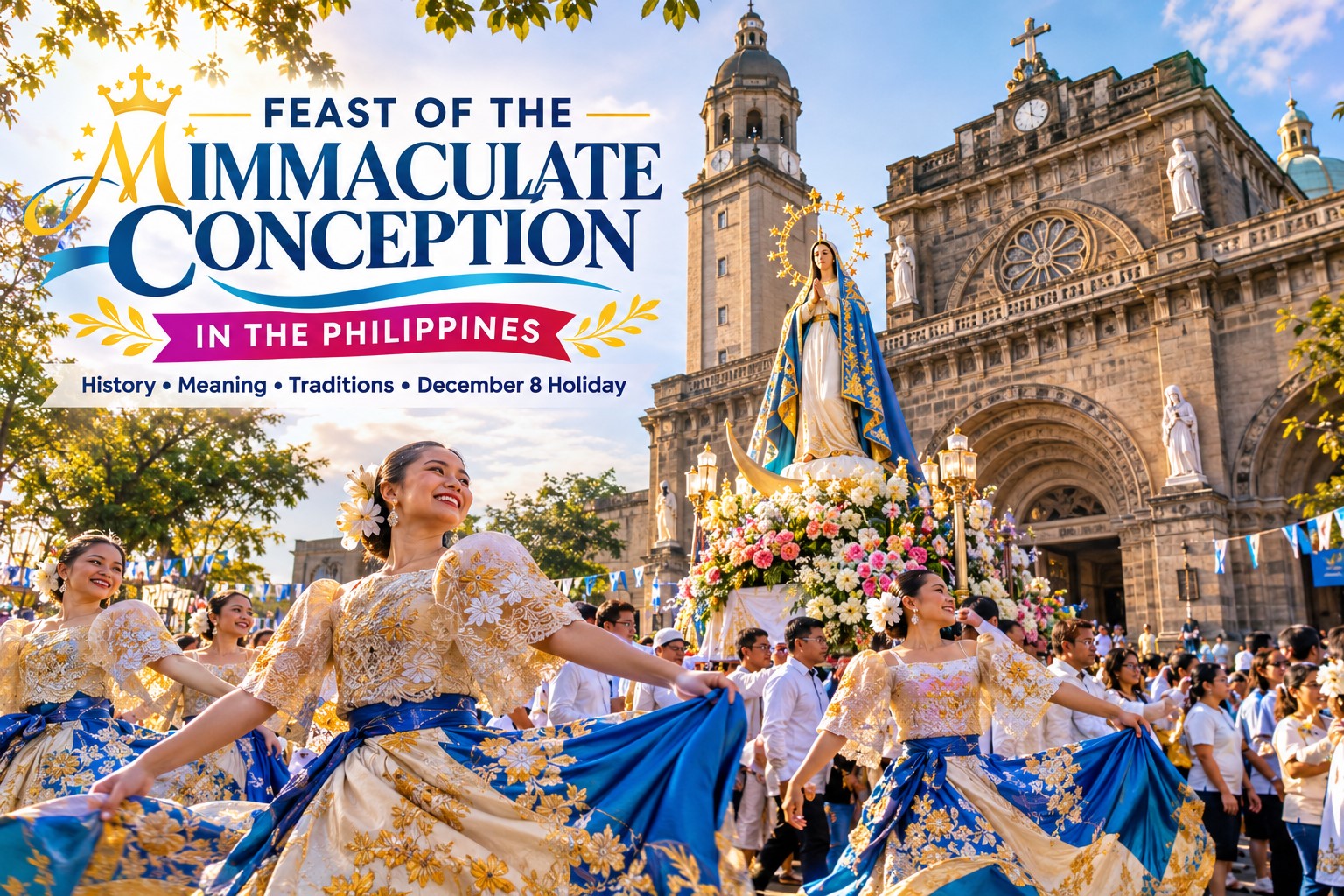
In many communities, an image of the Immaculate Conception is carried through the streets, accompanied by devotees, religious organizations, and parish representatives.
The image is often decorated with flowers and placed on an elaborate carriage or andas.
Some processions feature candles, traditional religious music, and prayers recited along the route.
For devotees, joining these processions is an act of faith and a way of publicly honoring the Blessed Virgin Mary.
4. Floral Offerings and Church Decorations
Flowers are a familiar sight during Marian celebrations in the Philippines.
During the Feast of the Immaculate Conception, churches and Marian images may be decorated with white flowers, blue ribbons, and other devotional ornaments.
White is commonly associated with purity, while blue has long been associated with the Virgin Mary in Christian art and devotion.
Some devotees bring bouquets to church as expressions of gratitude or personal prayer intentions.
These decorations also contribute to the festive atmosphere, particularly in parishes celebrating their patronal feast.
5. Community Gatherings and Parish Fiestas
In communities where the Immaculate Conception is the patroness, the feast often becomes an important local celebration.
Parish organizations may organize religious activities, community programs, and gatherings leading up to December 8.
Families sometimes prepare food and welcome relatives or visitors, especially in towns where the feast is also celebrated as a traditional fiesta.
While the religious observance remains the heart of the occasion, these gatherings reflect the Filipino tradition of bringing communities together through faith and celebration.
Places in the Philippines Known for Immaculate Conception Celebrations
Several churches and religious communities across the country have a particularly strong connection to the Immaculate Conception.
Manila Cathedral – Intramuros, Manila
One of the most important places associated with the feast is the Manila Cathedral, officially known as the Minor Basilica and Metropolitan Cathedral of the Immaculate Conception.
Located in the historic walled city of Intramuros, the cathedral is dedicated to the Blessed Virgin Mary under the title of the Immaculate Conception.
Every December, the cathedral traditionally holds special religious activities in honor of its patroness.
These include solemn Masses and other Marian devotions attended by Catholics from Metro Manila and nearby provinces.
The cathedral’s historical and religious importance makes it one of the most recognizable destinations for devotees during the celebration.
Intramuros Grand Marian Procession
Another significant Marian tradition in Manila is the Intramuros Grand Marian Procession.
Usually held on a Sunday close to the Feast of the Immaculate Conception, the event brings together beautifully decorated images of the Blessed Virgin Mary under her various titles.
The procession passes through the historic streets of Intramuros, attracting devotees, photographers, and visitors.
Organized through the efforts of Marian devotees and participating institutions, the modern procession is connected to a tradition whose roots in Intramuros date back to 1619.
It has become one of the country’s most recognizable public expressions of Marian devotion.
Visitors who enjoy Philippine religious festivals will find the procession particularly interesting because of its combination of faith, history, religious art, and traditional craftsmanship.
The exact schedule and procession route may change from year to year.
Malolos Cathedral – Malolos City, Bulacan
The Malolos Cathedral, also known as the Minor Basilica of Our Lady of Immaculate Conception, is another important destination associated with the feast.
The Immaculate Conception is the patroness of the Diocese of Malolos, making December 8 especially significant to the local Catholic community.
The occasion is marked by religious services and patronal celebrations.
For devotees in Bulacan and nearby provinces, the cathedral serves as an important center of Marian devotion.
Other Immaculate Conception Parishes
Beyond Manila and Bulacan, numerous churches throughout Luzon, Visayas, and Mindanao are dedicated to the Immaculate Conception.
Many of these parishes hold their own patronal celebrations on December 8.
The activities may differ depending on local customs, parish traditions, and community participation.
Some emphasize solemn religious observances, while others combine church activities with the familiar atmosphere of a Filipino town fiesta.
Is December 8 a Holiday in the Philippines?
Yes. December 8 is a nationwide special non-working holiday in the Philippines in observance of the Feast of the Immaculate Conception of Mary.
The holiday is established under Republic Act No. 10966, which was signed into law on December 28, 2017.
The law declares December 8 of every year a special non-working holiday throughout the country to commemorate the feast of the principal patroness of the Philippines.
This means the observance is not limited to particular provinces, cities, or municipalities.
However, it is important to remember that a special non-working holiday is different from a regular holiday under Philippine labor regulations.
What Happens If You Work on December 8?
For private-sector employees, the usual special non-working holiday pay rules apply.
Under the general guidelines issued by the Department of Labor and Employment (DOLE):
- Employees who do not work are generally subject to the “no work, no pay” principle, unless a favorable company policy, practice, or collective bargaining agreement provides otherwise.
- Employees who work during the special non-working holiday are generally entitled to 130% of their basic wage for the first eight hours.
- Employees who work on the holiday when it also falls on their scheduled rest day are generally entitled to 150% of their basic wage for the first eight hours.
- Additional pay rules apply to overtime work.
Employees should still check the applicable DOLE advisory and their employer’s policies for the specific holiday.
Is the Feast of the Immaculate Conception a Holy Day of Obligation?
Yes. In the Philippines, the Solemnity of the Immaculate Conception is a holy day of obligation for Catholics.
This means Catholics are expected to participate in Holy Mass, subject to the usual exceptions recognized by the Church.
The Catholic Bishops’ Conference of the Philippines (CBCP) includes December 8 among the country’s holy days of obligation.
The occasion is particularly important because Mary, under the title of the Immaculate Conception, is the country’s principal patroness.
For Catholic families, attending Mass together on December 8 is a meaningful way to observe the feast.
Religious Significance of the Immaculate Conception
At its heart, the Feast of the Immaculate Conception is a celebration of grace, faith, and God’s love.
Catholic teaching presents Mary as someone who received a unique gift from God, preparing her for her role as the mother of Jesus.
Her life is also viewed as an example of humility, trust, and willingness to follow God’s will.
For devotees, the celebration is more than simply remembering an important religious doctrine.
It is an invitation to reflect on their own relationship with God and the values they practice in everyday life.
The feast encourages Catholics to recognize the importance of kindness, compassion, humility, and faithfulness.
It also reminds believers that Advent is not only about preparing for Christmas celebrations but also about spiritual renewal.
The Immaculate Conception and Filipino Marian Devotion
One reason the Feast of the Immaculate Conception remains meaningful in the Philippines is the country’s long tradition of devotion to the Virgin Mary.
In many Filipino households, images of the Blessed Virgin Mary are displayed in prayer corners or family altars.
The Rosary continues to be an important devotional practice for many Catholic families.
During difficult times, devotees often turn to Mary in prayer, asking for her intercession and guidance.
This devotion is also visible in religious traditions such as Flores de Mayo, Santacruzan, Marian pilgrimages, and local patronal fiestas.
Although these celebrations have different histories and meanings, they reflect the important place of the Virgin Mary in Filipino Catholic culture.
The Feast of the Immaculate Conception is especially significant because it honors Mary under the title recognized as the principal patroness of the nation.
Tips for Attending the Feast of the Immaculate Conception
If you are planning to visit a church or participate in a celebration on December 8, a little preparation can make your experience more meaningful.
Check the church’s Mass schedule. Popular churches such as Manila Cathedral may schedule additional Masses or special activities. Checking official parish announcements beforehand is recommended.
Arrive early. Churches may attract more devotees than usual, particularly during solemn Masses and major processions.
Dress appropriately. Remember that the occasion is primarily religious, even when it includes community festivities.
Respect processions and religious activities. Visitors are welcome to observe many traditions, but it is important to avoid disrupting prayers and ceremonies.
Check transportation arrangements. Roads surrounding popular churches may experience heavier traffic or temporary restrictions when major processions are held.
Explore the local community. If the feast coincides with a parish fiesta, you may also have an opportunity to experience local food, traditions, and community activities.
Whether you are attending as a devotee or visiting to learn more about Filipino religious culture, respecting the spiritual significance of the celebration is always important.
Frequently Asked Questions About the Feast of the Immaculate Conception
What is the Feast of the Immaculate Conception?
It is a Catholic celebration honoring the belief that the Blessed Virgin Mary was preserved from original sin from the first moment of her conception.
When is the Feast of the Immaculate Conception celebrated?
The feast is traditionally observed every December 8, although the Church’s liturgical celebration may sometimes be transferred when the date conflicts with an Advent Sunday.
Is December 8 a regular holiday in the Philippines?
No. December 8 is a special non-working holiday nationwide under Republic Act No. 10966, not a regular holiday.
Is the Immaculate Conception about the birth of Jesus?
No. The Immaculate Conception refers to Mary’s conception, not the conception or birth of Jesus Christ.
Why is the Immaculate Conception important in the Philippines?
The Blessed Virgin Mary, under the title of the Immaculate Conception, is recognized as the principal patroness of the Philippines.
Do Catholics need to attend Mass on December 8?
Yes. In the Philippines, the Solemnity of the Immaculate Conception is a holy day of obligation for Catholics, subject to the usual exceptions.
Where can I celebrate the Feast of the Immaculate Conception?
You can attend Mass at Catholic churches throughout the Philippines. Churches dedicated to the Immaculate Conception, including Manila Cathedral and Malolos Cathedral, are particularly associated with the occasion.
Feast of the Immaculate Conception 2026 Schedule
For those planning to observe the celebration in 2026, here are the important details:
| Details | Information |
|---|---|
| Celebration | Feast of the Immaculate Conception |
| Date | December 8, 2026 |
| Day | Tuesday |
| Holiday classification | Special Non-Working Holiday |
| Coverage | Nationwide, Philippines |
| Main observances | Holy Mass, novenas, Marian processions, and parish celebrations |
December 8, 2026, is included in the official Philippine holiday calendar under Proclamation No. 1006.
Specific Mass schedules, novena activities, and procession details will depend on individual parishes and dioceses.
Devotees planning to attend celebrations at Manila Cathedral, Malolos Cathedral, or other churches are encouraged to check official parish announcements for confirmed schedules.
Final Thoughts
The Feast of the Immaculate Conception is one of those religious celebrations that reminds us how closely faith and Filipino culture are connected.
For some people, December 8 is a day to attend Mass and offer prayers of thanksgiving. For others, it is an opportunity to return to their hometown, participate in a parish fiesta, or continue a family tradition that has been observed for generations.
What makes the occasion meaningful is not necessarily the size of the procession or how elaborate the celebration becomes.
It is the devotion behind it.
From the historic churches of Intramuros to small chapels in provincial communities, the Feast of the Immaculate Conception continues to bring Filipino Catholics together in prayer and celebration.
And beyond the holiday itself, the occasion serves as a reminder of the values associated with Mary’s life—faith, humility, compassion, and trust in God.
As the Christmas season approaches, December 8 offers a meaningful opportunity to reflect, give thanks, and remember an important part of the Philippines’ religious heritage.