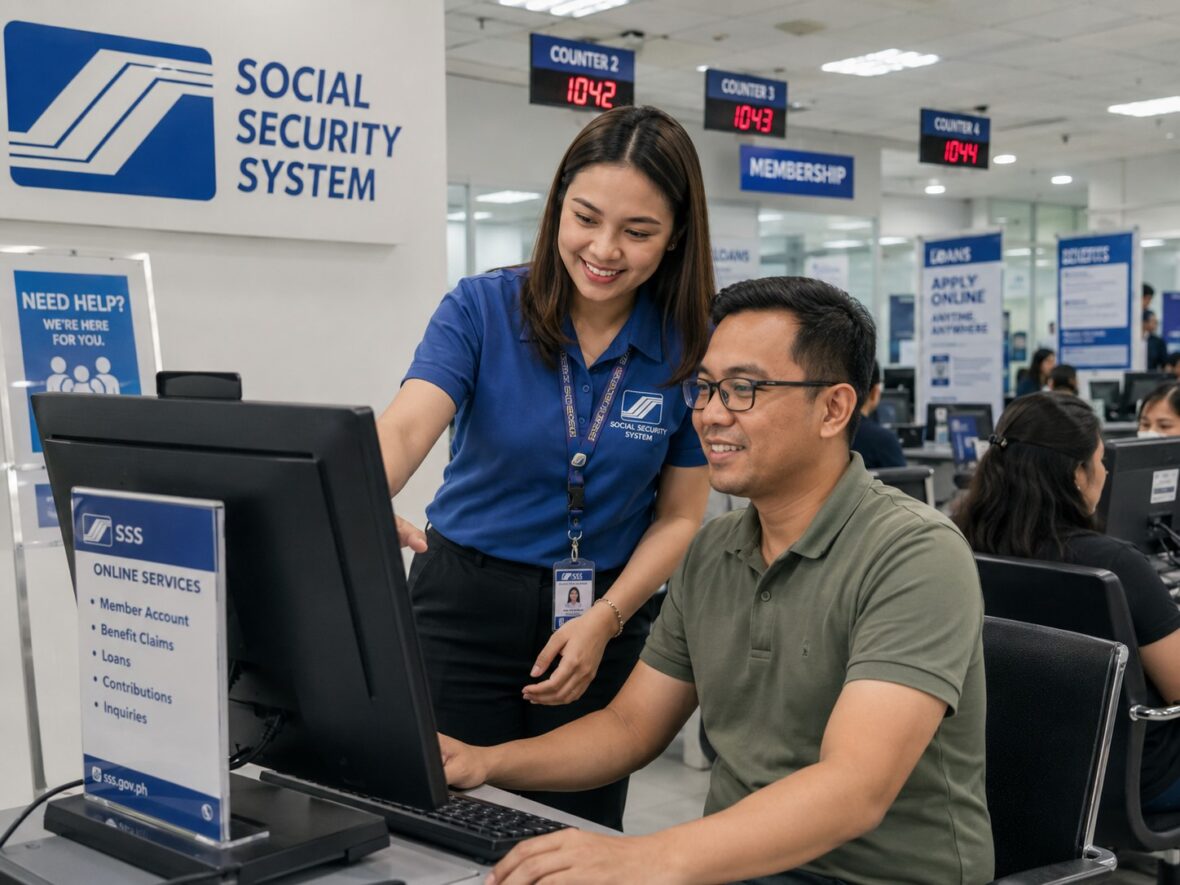
There are times when you need additional cash but do not necessarily want to borrow from an online lending app, use your credit card, or ask a relative for help.
This is where the SSS Salary Loan may be useful.
Despite its name, the program is not limited to company employees who receive a fixed salary. Qualified self-employed members, voluntary members, non-working spouses, kasambahays, and land-based OFWs may also apply.
The application is completed online through the My.SSS Member Portal or the MySSS mobile app. However, being an SSS member does not automatically mean that your application will be approved. You must have enough posted contributions, an active disbursement account, updated contact information, and no disqualifying unpaid loans.
There were also important changes to the program in 2025 that continue to apply in 2026. In particular, the standard interest rate for an initial salary loan was reduced from 10% to 8% per year, subject to the specific rules discussed below. (Social Security System)
Here is everything you need to know before applying.
Content
What Is an SSS Salary Loan?
An SSS Salary Loan is a short-term loan available to qualified SSS members who need help covering immediate financial needs.
You may use the proceeds for purposes such as:
- Emergency household expenses
- School expenses
- Medical costs
- Home repairs
- Utility bills
- Debt consolidation
- Work-related expenses
- Other short-term financial needs
SSS describes it as a privilege loan rather than an automatic benefit. This means that even when you have been contributing for years, you must still meet all current eligibility and application requirements. (Social Security System)
Unlike many online lending applications, the loan amount is not primarily based on your credit score or the amount you type into an application form. It is based mainly on your posted SSS contributions and your latest Monthly Salary Credits, or MSCs.
Who Can Apply for an SSS Salary Loan?
The salary-loan program is available to eligible members under the following categories:
- Employed members
- Kasambahays or household employees
- Self-employed members
- Voluntary members
- Non-working spouses
- Land-based OFWs
However, each applicant must satisfy the qualifying conditions set by SSS. (Social Security System)
Sea-based OFWs generally have contributions processed under an employer-based arrangement, while the specific eligibility listed for individually paying OFWs refers to land-based OFW members.
SSS Salary Loan Requirements in 2026
Before opening the application page, check whether you meet the following requirements.
1. You must have enough posted contributions
The required number depends on whether you are applying for a one-month or two-month loan.
| Type of loan | Total posted contributions required | Recent contribution requirement |
|---|---|---|
| One-month salary loan | At least 36 monthly contributions | At least 6 within the 12 months before the application month |
| Two-month salary loan | At least 72 monthly contributions | At least 6 within the 12 months before the application month |
The word posted is important.
It is not enough that contributions were deducted from your salary or that you recently made a payment. The required contributions must already appear in your official SSS record when the system evaluates your application. (Social Security System)
Example
Suppose you apply in July 2026.
For the recent-contribution requirement, SSS will examine the applicable 12-month period before July 2026. You must have at least six posted contributions within that period, in addition to meeting the total 36- or 72-contribution requirement.
Having 100 lifetime contributions will not be enough when you do not also meet the recent six-contribution requirement.
2. Individually paying members need contributions under their current membership type
Self-employed, voluntary, non-working-spouse, and land-based OFW members must have at least six posted monthly contributions under their current coverage or membership type before the month of application. (Social Security System)
This matters when you recently changed your status.
For example, you may have accumulated many employee contributions before resigning. However, after changing to voluntary membership, you must still satisfy the requirement for posted contributions under your current voluntary classification.
3. Your employer must be updated with SSS
For employed applicants, the employer must be updated in the payment of required SSS contributions and loan remittances.
The employer must also electronically certify the application through its My.SSS account. (Social Security System)
An employee may satisfy the personal contribution requirement but still experience a problem when the employer:
- Has unpaid contribution obligations
- Has unposted remittances
- Has not submitted required loan payments
- Does not certify the application
- Is not shown as the applicant’s current employer
It is a good idea to notify your HR or payroll department after submitting the application.
4. You must be of legal age and younger than 65
The applicant must be legally of age and under 65 years old at the time of the loan application. (Social Security System)
5. You must not have received an active final SSS benefit
You must not have been granted a final benefit such as:
- Retirement
- Permanent total disability
An exception may apply when a previously granted final benefit has already been canceled because of re-employment, resumption of self-employment, or recovery from total disability before the loan application. (Social Security System)
6. You must not have disqualifying past-due loans
You must have no past-due obligation under programs that SSS includes in its eligibility review, such as:
- Salary Loan
- Salary Loan Early Renewal Program
- Educational Assistance Loan Program
- Other short-term or long-term member loans identified by SSS
An old unpaid SSS loan can therefore prevent you from applying for a new salary loan. (Social Security System)
7. You must not be disqualified because of fraud
A person disqualified for committing fraud against SSS cannot qualify while the disqualification remains effective. (Social Security System)
8. Your contact information must be updated
Your email address and mobile number should be current in the SSS database.
These details may be used for:
- Account verification
- Application notices
- Employer-certification updates
- Loan approval notifications
- Disbursement messages
- Payment reminders
Outdated information can make it difficult to monitor or secure your account.
9. You need an active disbursement account
You must have an eligible account through which SSS can release your loan proceeds.
SSS currently allows salary-loan proceeds to be released through:
- An active MySSS Card
- An active UMID ATM Pay Card
- An active single account with a PESONet-participating bank, enrolled through DAEM
The bank account must be in the member’s name. (Social Security System)
Members with a MySSS Card do not need to enroll that card separately through DAEM because its partner-bank account is automatically linked to SSS as the principal disbursement account. (Social Security System)
How Much Can You Borrow?
The SSS Salary Loan has two main loan levels.
One-month salary loan
A one-month loan is based on the average of your 12 latest posted MSCs under the Regular Social Security Program.
The average is rounded to the next higher available MSC. However, when you apply for an amount lower than that computed figure, the lower amount becomes the basis of the approved loan. (Social Security System)
Two-month salary loan
A two-month salary loan is equal to twice the average of your 12 latest posted Regular SS MSCs, rounded to the next higher MSC—or the lower amount you choose to apply for. (Social Security System)
You need at least 72 posted monthly contributions to qualify for the two-month option.
Sample salary-loan computations
Example 1: One-month loan
Suppose your 12 latest Regular SS MSCs average ₱15,000.
Your potential one-month loan amount would be:
₱15,000
That is the gross approved amount before deductions.
Example 2: Two-month loan
Using the same ₱15,000 average MSC:
₱15,000 × 2 = ₱30,000
Your potential two-month loan would be ₱30,000 before applicable deductions.
Example 3: Average falls between MSC brackets
Suppose the average of your latest 12 MSCs is ₱14,625.
Because the amount is rounded to the next higher available MSC, the loan computation may use the next applicable bracket, such as ₱15,000.
The online system will display the actual amount you are eligible to borrow.
Example 4: You apply for less than the maximum
Suppose your computed one-month loan eligibility is ₱15,000, but you request only ₱10,000.
Because SSS uses the computed amount or the amount applied for—whichever is lower—the approved gross loan may be ₱10,000.
This can be useful when you do not need the full available amount and want a smaller monthly obligation.
Does Your Entire ₱35,000 MSC Count Toward the Loan?
Not necessarily.
The salary-loan formula refers specifically to MSCs under the Regular Social Security Program. Under the current contribution structure, the portion of an MSC above the Regular SS limit may be allocated to the mandatory provident-fund or MySSS Pension Booster component.
This means your total contribution-based MSC and the Regular SS MSC used for the salary-loan calculation may not always be identical. The SSS online application will determine the official loanable amount based on your posted records. (Social Security System)
Do not assume that having a ₱35,000 total MSC automatically gives you a one-month salary loan of ₱35,000.
Why Is the Amount You Receive Lower Than the Approved Loan?
The approved loan amount is the gross amount.
The actual amount credited to your account is the net proceeds, which may be lower because SSS deducts:
- The 1% service fee
- Pro-rated interest
- An outstanding balance from a previous applicable short-term loan
- Other applicable charges shown in the disclosure statement
SSS deducts pro-rated interest covering the period from the loan-granting date through the end of the month before the first amortization month. (Social Security System)
Simple illustration
Suppose your gross approved loan is ₱20,000.
The 1% service fee alone would be:
₱20,000 × 1% = ₱200
Your initial net amount would already be below ₱20,000 after the service fee. Pro-rated interest and any existing deductible loan balance would reduce it further.
Always review the Disclosure Statement before submitting. It shows the loan amount, deductions, net proceeds, monthly amortization, effective interest rate, and repayment schedule applicable to your application.
SSS Salary Loan Interest Rate in 2026
The current interest rate depends on your type of application and recent loan-condonation history.
| Type of salary-loan application | Interest rate |
|---|---|
| Initial salary loan | 8% per year |
| Renewal without penalty-condonation availment during the previous five years | 8% per year |
| Renewal after using penalty condonation within the previous five years | 10% per year |
Interest is computed on a diminishing principal balance, which means interest is applied to the remaining unpaid principal rather than continually being charged against the original amount throughout the entire term. (Social Security System)
SSS notes that the rate may be adjusted in response to market conditions. A future adjustment would apply to new or renewed loans from its effective date rather than automatically changing every existing loan. (Social Security System)
Nominal rate vs. effective interest rate
The quoted rate may be 8% or 10%, but your Annual Effective Interest Rate can be slightly different.
The effective rate considers factors such as:
- Loan amount
- Release date
- Start of amortization
- Service fee
- Pro-rated interest
- Other applicable charges
Your individual EIR should appear in the Disclosure Statement during the online application. (Social Security System)
SSS Salary Loan Service Fee and Late-Payment Penalty
Service fee
SSS deducts a service fee equal to 1% of the approved loan amount from the proceeds.
| Gross loan | 1% service fee |
|---|---|
| ₱10,000 | ₱100 |
| ₱15,000 | ₱150 |
| ₱20,000 | ₱200 |
| ₱30,000 | ₱300 |
| ₱40,000 | ₱400 |
These figures show only the service fee. Pro-rated interest and prior loan balances may also be deducted.
Late-payment penalty
An amortization paid after its deadline is subject to a penalty of 1% per month, computed for the period of delay.
When the loan remains unpaid after its term ends, SSS applies:
- 10% annual interest
- 1% monthly penalty
These charges continue until the obligation is fully paid. (Social Security System)
What You Need Before Applying Online
Prepare or complete the following:
- An active My.SSS account
- A correct user ID and password
- Access to your registered mobile number
- Updated contact information
- Enough posted contributions
- An active MySSS Card, qualified UMID ATM Pay Card, or approved DAEM bank account
- Current employer information, when employed
- No unresolved past-due SSS loan
- A stable internet connection
- Time to read the loan disclosure carefully
You normally do not need to upload a payslip or personally visit a branch for the standard online application. However, SSS may require further action when your membership, employer, contribution, loan-payment, identity, or disbursement records need correction.
How to Enroll a Bank Account Before Applying
When you do not have an active MySSS Card or qualifying UMID ATM Pay Card, you will generally need an approved bank account under the Disbursement Account Enrollment Module, or DAEM.
Basic DAEM process
- Log in to your My.SSS member account.
- Open the Services or Disbursement Account Enrollment Module section.
- Read the enrollment reminders.
- Choose the appropriate account type.
- Enter your bank and account information.
- Upload the required proof of account.
- Review the details.
- Submit the enrollment.
- Wait until the account is approved or activated before applying for the loan.
Your bank account should be:
- Active
- In your name
- A single account rather than an account belonging solely to another person
- With a participating PESONet bank
- Entered using the correct account number
Do not confuse your bank-account number with:
- Your ATM card number
- The number printed across the front of a debit card
- Your mobile number
- Your bank customer number
- A transaction reference number
A wrong account number can delay or prevent disbursement.
Using the MySSS Card
The MySSS Card combines an SSS functional ID with a partner-bank debit and savings account. Once successfully issued and linked, it serves as the primary SSS disbursement account without a separate DAEM enrollment. (Social Security System)
How to Apply for an SSS Salary Loan Through My.SSS
The exact menu names may change when SSS updates the portal, but the usual process follows these steps.
Step 1: Sign in to My.SSS
Open the official SSS website and access the My.SSS Member Portal.
Enter your:
- User ID
- Password
- Required OTP or authenticator code
Use only the official portal. Do not sign in through a link sent by an unknown text message, social-media account, or supposed loan agent.
Step 2: Check your records first
Before applying, review:
- Posted contributions
- Current employer
- Membership type
- Existing loan balance
- Contact information
- Approved disbursement account
This can help you identify a problem before reaching the final application screen.
Step 3: Open the salary-loan application
Go to the Loans or E-Services section and select the option to apply for a salary loan.
The system will evaluate your records.
When you are not qualified, it may display a reason such as:
- Insufficient contributions
- Missing recent contributions
- No approved disbursement account
- Past-due loan
- Employer-related issue
- Outdated or incomplete information
Step 4: Review your eligible loan amount
When qualified, the system should display:
- Whether you qualify for a one-month or two-month loan
- Maximum loanable amount
- Available amount you may select
- Existing loan balance to be deducted, when applicable
Do not automatically choose the maximum. Consider how much you actually need and whether the monthly amortization fits your budget.
Step 5: Choose your disbursement account
Select the active account where you want the loan proceeds credited.
Check:
- Bank name
- Account number
- Account status
- Name of account holder
When no eligible account is available, you may need to complete DAEM enrollment or activate another approved disbursement method before proceeding.
Step 6: Confirm your employer when employed
An employed applicant must identify or confirm the current employer that will certify the application.
Make sure the employer shown is correct.
Do not choose a previous employer just because it still appears in your records. The certifying employer must be your present employer. (Social Security System)
Step 7: Review the Disclosure Statement
Take time to read the disclosure before accepting it.
Look for:
- Gross loan amount
- Service fee
- Pro-rated interest
- Existing loan deduction
- Net loan proceeds
- Interest rate
- Effective interest rate
- Monthly amortization
- Repayment term
- First applicable payment month
- Payment deadlines
Do not focus only on the amount you will receive. Check how much you must repay and when payments begin.
Step 8: Read the terms and conditions
The terms generally include authorizations involving:
- Payroll deduction
- Employer certification
- Collection of amortizations
- Deduction of the balance from separation benefits
- Collection from future SSS benefits when the loan remains unpaid
- Recovery of an erroneous or duplicate disbursement
Read these terms before ticking the agreement box.
Step 9: Submit the application
Confirm the information and submit the online application.
Save or screenshot the:
- Application reference
- Submission confirmation
- Loan amount
- Disbursement account
- Date of application
Do not share a screenshot containing your SS number, bank details, address, or other private account information.
Step 10: Wait for employer certification when applicable
For employed members, submission by the employee is not necessarily the final step.
The employer must log in to its My.SSS account and electronically certify that:
- You are currently employed by the company
- Your net take-home pay can cover the amortization
- The employer will deduct and remit the monthly payments
The application may remain pending until the employer completes this step. (Social Security System)
Contact HR or payroll when certification is taking unusually long.
Step 11: Monitor your My.SSS account
Check your:
- Loan application status
- My.SSS inbox
- Registered email
- Registered mobile number
- Bank account
Keep all confirmation messages until the proceeds have been credited and the loan details appear in your account.
How to Apply Through the MySSS Mobile App
SSS also allows salary-loan applications through its official mobile application. (Social Security System)
The general process is:
- Open the official MySSS app.
- Sign in to your member account.
- Complete security verification.
- Open the loan section.
- Select Salary Loan.
- Review your eligibility.
- Choose the amount.
- Select an approved disbursement account.
- Confirm your employer when applicable.
- Read the Disclosure Statement.
- Accept the terms.
- Submit the application.
- Monitor the application status.
App menus can move after an update, but the eligibility and loan rules remain the same.
What Happens After You Apply?
For employed members
The application is routed for employer certification.
After certification and successful processing, the proceeds are sent to your selected disbursement account.
Your employer then deducts the monthly amortization from your salary and remits it to SSS.
For voluntary, self-employed, non-working-spouse, and land-based OFW members
There is no current employer to deduct and remit your payment.
You are personally responsible for:
- Generating the correct loan PRN
- Paying the monthly amortization
- Paying before the deadline
- Confirming that payments were posted
- Following up on missing payments
Do not wait for SSS to automatically debit an ordinary bank account unless a specific payment arrangement expressly provides for it.
How Long Does SSS Salary Loan Approval Take?
SSS does not guarantee one universal processing time for every salary-loan application.
The actual timeline can depend on:
- Employer certification
- Eligibility verification
- Status of the disbursement account
- Correctness of member records
- Banking and PESONet processing
- Weekends and holidays
- System maintenance
- Additional review when a discrepancy exists
For an employed member, a common source of delay is pending employer certification.
For individually paying members, a common issue is an inactive or unapproved disbursement account.
Monitor the official My.SSS application status rather than relying only on an estimated number of days shared on social media.
Why Is Your SSS Salary Loan Application Pending?
Possible reasons include:
Employer certification is still pending
Ask your HR or payroll department whether the application has appeared in the employer’s My.SSS account.
Your DAEM account is not active
Submitting a bank-account enrollment does not always mean it is already approved for disbursement.
Contributions were paid but not posted
The online system evaluates posted records. Recently remitted contributions may not yet be reflected.
Your employer has an SSS compliance issue
An employed applicant’s employer must be updated with contribution and loan remittances.
Your records require verification
A discrepancy involving your employer, membership type, contact information, identity, or prior loan may require correction.
The application is undergoing normal processing
Allow reasonable time and check for messages in your My.SSS inbox.

Why Was Your Salary Loan Application Rejected?
Common reasons include the following.
Insufficient total contributions
You need at least 36 posted contributions for a one-month loan and 72 for a two-month loan.
Fewer than six recent contributions
Even with enough lifetime contributions, you still need at least six posted contributions within the required recent 12-month period.
Not enough contributions under your current status
This can affect self-employed, voluntary, non-working-spouse, and land-based OFW applicants.
Past-due SSS loan
An unpaid or delinquent loan can disqualify you.
No active disbursement account
The loan cannot be released without an approved account.
Employer is not updated
The employer may have unremitted contributions or loan payments.
Incorrect current employer
A former employer cannot certify that you are currently employed there.
Age or final-benefit restriction
You may not meet the age requirement or may have an active final SSS benefit.
Fraud-related disqualification
The account may be under a formal restriction imposed by SSS.
How Is the SSS Salary Loan Repaid?
The loan is payable in 24 equal monthly amortizations.
Payments begin in the second month following the month of approval. The deadline for each applicable amortization is the last day of the following month. (Social Security System)
Example repayment schedule
Suppose your loan is approved in July 2026.
- Second month following July: September 2026
- First applicable amortization month: September 2026
- Payment deadline: October 31, 2026
When a deadline falls on a Saturday, Sunday, or holiday, payment may be made on the next working day. (Social Security System)
Always follow the dates appearing in your actual Disclosure Statement and My.SSS loan records.
How Employed Members Pay the Loan
For employed borrowers, the employer deducts the monthly amortization from payroll and remits it to SSS.
However, you should still check your My.SSS account regularly.
A deduction shown on your payslip does not always prove that the payment was posted correctly to your SSS loan.
Compare:
- Payroll deductions
- Loan payment history
- Outstanding balance
- Applicable payment months
Report missing postings promptly to payroll and SSS.
How Voluntary, Self-Employed, and OFW Members Pay
Individually paying borrowers must pay their amortizations using a loan Payment Reference Number, or PRN.
Payment may be made through:
- An SSS branch with a tellering facility
- SSS-accredited collecting agents
- Supported bank or electronic payment channels
The PRN helps ensure that the payment is credited to the correct loan and applicable month. (Social Security System)
Keep every receipt until the payment appears in your online loan record.
How SSS Applies Your Loan Payments
Payments are applied in the following order:
- Penalties
- Interest
- Principal
This means that when your loan already has penalties and unpaid interest, part of your payment will cover those charges before reducing the principal balance. (Social Security System)
Paying late repeatedly can therefore make the balance decrease more slowly.
What Happens If You Miss Payments?
A late amortization may incur a monthly penalty.
The situation becomes more serious when the obligation reaches default.
SSS considers a loan in default when:
- The total unpaid obligation is equivalent to more than six monthly amortizations, or
- A balance remains after the loan term
Once in default, the entire balance becomes due and demandable. (Social Security System)
The unpaid amount can include:
- Principal
- Interest
- Penalties
Ignoring the loan does not make it disappear.
Can an Unpaid Salary Loan Be Deducted from Your SSS Benefits?
Yes.
When the loan remains wholly or partly unpaid, SSS may collect the outstanding principal, interest, and penalties from benefits payable to the member or beneficiaries.
For a final claim such as retirement, permanent total disability, or death, the unpaid loan balance may be deducted from the benefit proceeds. (Social Security System)
This is why members should not treat an SSS loan as free money.
You may not receive collection calls in the same manner as with a private lender, but the debt remains connected to your SSS record.
What Happens to Your Salary Loan When You Resign?
When an employed borrower resigns, retires, is terminated, or is otherwise separated from the company, the employer is required to deduct the remaining loan balance from compensation or benefits due to the employee when sufficient funds are available.
This may include applicable final-pay amounts, subject to the governing SSS rules and available compensation.
When those amounts are insufficient, the employer reports the separation and remaining balance to SSS. The member then remains responsible for paying the unpaid obligation. (Social Security System)
Do not assume that payroll deductions will continue after your last salary.
After resignation:
- Check the amount deducted from your final pay.
- Ask for proof of remittance.
- Review your My.SSS loan balance.
- Generate loan PRNs for any remaining amortizations.
- Continue paying before the deadlines.
What If You Transfer to a New Employer?
Inform the new employer that you have an existing SSS Salary Loan.
Under the program rules, the member authorizes a new employer to deduct and remit the corresponding amortization, including applicable interest or penalties, when the member becomes employed or re-employed. (Social Security System)
Do not assume that the loan information automatically appears in your new company’s first payroll cycle without any coordination.
Provide the records requested by HR or payroll.
Can You Renew an SSS Salary Loan?
Yes, but renewal is subject to current conditions.
Renewal while the existing loan is active
You may renew after at least six months from the date of the existing loan’s approval when:
- The loan is not past due
- Your last three monthly amortizations before the renewal month were paid on time
The outstanding balance of the existing loan will be deducted from the proceeds of the new loan. (Social Security System)
Renewal after fully paying the loan
A fully paid loan may be renewed immediately when the final three amortizations were paid within their due dates.
When any of the last three amortizations was late, renewal is allowed after three months from the date of full payment. (Social Security System)
Minimum net proceeds for renewal
After deducting the prior balance and applicable charges, the new loan must provide net proceeds of at least:
- ₱2,000 for most members
- ₱100 for kasambahays or household employees
When the remaining proceeds fall below the applicable minimum, the renewal will not qualify. (Social Security System)
Can You Cancel an SSS Salary Loan After Applying?
Once the salary loan has been granted, cancellation is not allowed under the current program rules.
When you want to end the loan early, you may fully settle the outstanding principal, interest, and any applicable penalties. (Social Security System)
This is another reason to review everything before confirming the online application.
Check the:
- Amount
- Bank account
- Employer
- Interest rate
- Monthly amortization
- Net proceeds
- Repayment schedule
What If the Loan Was Credited by Mistake?
SSS may recover or recall an amount disbursed because of:
- Error
- Duplicate release
- Unauthorized credit
- A similar incorrect transaction
When you have already withdrawn or used the mistakenly credited money, SSS may send official instructions for returning it.
Until the amount is returned and confirmed, you may be temporarily disqualified from obtaining another SSS loan. An unreturned amount can also become due with applicable interest and penalties and may be deducted from future benefits. (Social Security System)
Do not spend an unexpected duplicate credit without first verifying it.
Common Mistakes to Avoid
Applying before checking your contributions
Review your posted record first. A payroll deduction that has not yet been remitted or posted does not count during the online evaluation.
Assuming the approved amount is what you will receive
The net proceeds are lower after service fees, pro-rated interest, and existing loan deductions.
Entering the wrong bank-account number
Use the actual deposit-account number, not the debit-card number.
Selecting a previous employer
An employed member must identify the current employer for electronic certification.
Forgetting to inform HR
Your application can remain pending when the employer does not know that certification is required.
Not reading the Disclosure Statement
The disclosure contains the real cost, amortization, deductions, and repayment dates.
Borrowing the maximum without checking your budget
The amount offered is based on your SSS record, not necessarily on what is comfortable for your household budget.
Ignoring the loan after resignation
You remain responsible for the balance even after payroll deductions stop.
Assuming SSS will automatically collect from your bank account
Individually paying members generally need to generate a PRN and actively pay the amortization.
Sharing your My.SSS password or OTP
A fixer, supposed loan agent, employer, or customer-service representative should not need your personal password or one-time code.
Is an SSS Salary Loan a Good Option?
It can be a practical option when:
- You qualify under the contribution rules
- You need funds for a legitimate short-term expense
- The amortization fits your budget
- You have a clear repayment plan
- You understand the charges and deductions
- You are comparing it with more expensive forms of borrowing
However, it may not be the best choice when:
- The expense is unnecessary
- Your budget is already struggling
- You expect to resign soon without a repayment plan
- You have other unpaid obligations
- You are borrowing only because the amount is available
- You have not reviewed the effective interest rate
An affordable interest rate does not make borrowing risk-free.
The loan still reduces your future monthly income and can affect benefits when left unpaid.
Frequently Asked Questions
Can I apply for an SSS Salary Loan without visiting a branch?
Yes. Standard applications are filed online through the My.SSS Member Portal or the official MySSS mobile app. (Social Security System)
A branch visit may still be necessary when your records, payments, identity, employer information, or disbursement account require correction.
How many SSS contributions do I need?
You need:
- 36 posted contributions for a one-month loan
- 72 posted contributions for a two-month loan
In either case, at least six contributions must be within the required recent 12-month period. (Social Security System)
Can a voluntary member apply?
Yes, when all eligibility requirements are met.
The voluntary member must also have at least six posted contributions under the current voluntary membership type before the application month. (Social Security System)
Can a self-employed member apply?
Yes.
The member must satisfy the total and recent contribution requirements, including at least six posted contributions under the current self-employed coverage before applying.
Can an OFW apply?
A qualified land-based OFW member may apply online.
The member must have the required contributions, an active disbursement account, and no disqualifying past-due obligation.
Can a kasambahay apply?
Yes. Qualified kasambahays are included in the salary-loan program.
The household employer must perform the required electronic certification and payroll-related responsibilities.
Can I apply immediately after resigning?
Your eligibility depends on your current membership status and posted contributions.
When you are no longer employed, your previous employer cannot certify that you are still working there. You may need to update your coverage through valid contributions under the appropriate current membership type and satisfy the six-contribution requirement that applies to individually paying members.
What is the SSS Salary Loan interest rate?
The standard rate is currently:
- 8% annually for an initial loan
- 8% for an eligible renewal without penalty-condonation availment in the past five years
- 10% for a renewal when penalty condonation was used within the previous five years
Interest is computed on a diminishing principal balance. (Social Security System)
Is there a service fee?
Yes. SSS deducts 1% of the approved loan amount as a service fee.
How long is the repayment period?
The loan is payable in 24 equal monthly amortizations. (Social Security System)
When does the first amortization start?
It starts in the second month following the month in which the loan was approved.
The payment deadline is the last day of the month after the applicable amortization month. (Social Security System)
Can I choose a loan amount lower than my maximum?
Yes. The approved loan is based on the computed loanable amount or the lower amount you apply for.
Can I receive the loan through GCash?
The official salary-loan rules specify an active MySSS Card or UMID ATM Pay Card, or an active single account with a PESONet-participating bank enrolled through DAEM. Check the options displayed in your My.SSS account rather than assuming that every e-wallet is accepted. (Social Security System)
Why is my net loan lower than expected?
SSS deducts the:
- 1% service fee
- Pro-rated interest
- Outstanding balance from applicable previous loans
- Other charges shown in your disclosure
Can I apply when I have an existing salary loan?
You may qualify for renewal after six months from approval when the existing loan is not past due and your latest three amortizations were paid within their due dates.
The existing balance will be deducted from the new proceeds. (Social Security System)
Can I pay the loan early?
Yes. You may fully settle the outstanding balance, including applicable interest and penalties.
The granted loan itself cannot simply be canceled.
What happens if my employer deducts the payment but does not remit it?
Compare your payslip with your My.SSS loan-payment history and raise the discrepancy with payroll immediately.
Keep copies of payslips showing the deduction. When the employer does not resolve the issue, contact SSS through its official channels.
Can SSS deduct an unpaid loan from my pension?
Yes. An outstanding loan, including interest and penalties, may be deducted from a final benefit such as retirement, permanent total disability, or death proceeds. (Social Security System)
SSS Salary Loan Application Checklist
Before applying, confirm that:
- You have an active My.SSS account
- Your contact details are updated
- Your SS number and records are correct
- You have at least 36 or 72 posted contributions
- You have at least six recent contributions
- Your current membership type meets the applicable requirement
- Your employer is updated, when employed
- You have no disqualifying past-due loan
- Your disbursement account is active
- Your current employer is correctly displayed
- You understand the interest rate
- You have checked the service fee
- You have reviewed the estimated net proceeds
- You can afford the monthly amortization
- You know when repayment begins
After submission:
- Save the confirmation
- Notify HR when employer certification is required
- Monitor the application status
- Check the receiving account
- Save the Disclosure Statement
- Review your loan-payment schedule
- Confirm every monthly payment in My.SSS
Final Thoughts
Applying for an SSS Salary Loan online is relatively convenient, but the decision to borrow should not be rushed.
Start by checking your posted contributions, existing loan balance, current membership type, employer information, and disbursement account. These are the areas that commonly cause applications to become pending or rejected.
When the system offers you a loan amount, look beyond the headline figure. Review the service fee, pro-rated interest, net proceeds, effective interest rate, and monthly amortization.
Most importantly, create a plan for repayment before the money reaches your account.
An SSS Salary Loan can help you handle a short-term financial need at a more manageable cost than many high-interest lending options. But like any loan, it works best when you borrow only what you need, pay each amortization on time, and regularly check that every payment is posted to your SSS record.