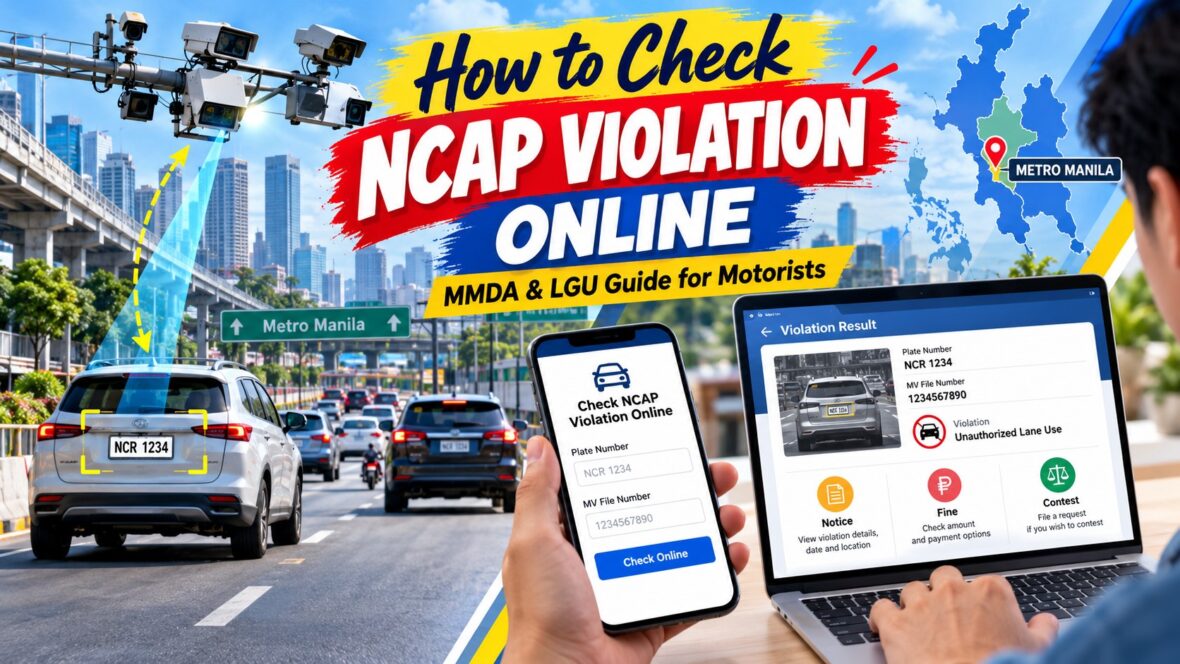
With the No Contact Apprehension Policy back in the news—and camera-based traffic enforcement operating again on several Metro Manila roads—one question many motorists are asking is simple:
How do I know if I have an NCAP violation?
The good news is that you don’t necessarily have to wait for a physical Notice of Violation to arrive at your house.
For violations handled by the Metropolitan Manila Development Authority or MMDA, motorists can check online through the official “May Huli Ka” portal using their vehicle information.
Some local governments also operate their own NCAP portals for violations recorded by city-operated cameras.
And this distinction is important.
An MMDA NCAP violation and an LGU-issued NCAP violation may be handled through different online systems.
Here’s a complete step-by-step guide to checking your NCAP violations online, understanding the results, paying your fine and contesting a citation if you believe it was issued incorrectly.
Content
Is NCAP Active Again in 2026?
Yes, although implementation differs depending on the road and local government.
The Supreme Court announced on July 9, 2026 that it had dismissed the consolidated petitions challenging the previous NCAP ordinances and lifted the temporary restraining order issued in August 2022.
The Court explained that the cases had been overtaken by the adoption of the Metro Manila Traffic Code of 2023, which established a newer and more uniform framework for traffic enforcement, penalties, adjudication and NCAP implementation.
Several Metro Manila cities subsequently announced that they would resume NCAP beginning October 5, 2026.
However, the situation changed shortly before and after implementation.
As of October 6, 2026:
- Manila has resumed NCAP.
- Quezon City has resumed NCAP.
- Muntinlupa has resumed NCAP.
- San Juan has resumed NCAP.
- Valenzuela postponed its restart because of ongoing road construction.
- Parañaque also deferred implementation until further notice.
So don’t assume that every city originally announced for the October 5 rollout is currently enforcing NCAP.
Quezon City’s official government website confirms that its NCAP reimplementation began October 5.
Valenzuela and Parañaque, meanwhile, have postponed their respective rollouts for now.
MMDA also has its own NCAP enforcement system covering applicable roads under its jurisdiction.
What Is NCAP?
NCAP stands for No Contact Apprehension Policy or Program.
Instead of a traffic enforcer physically stopping a vehicle, cameras and other monitoring equipment can record an alleged traffic violation.
The footage or images are then reviewed.
If authorities determine that a violation occurred, a Notice of Violation can be issued based on the vehicle information on record.
Examples of technology used can include:
- CCTV cameras
- High-resolution traffic cameras
- Digital cameras
- Automated monitoring systems
- Other traffic-enforcement technology
The main difference from traditional apprehension is that you may not know immediately that you’ve been cited.
That’s exactly why checking your record online can be useful.
The Fastest Way to Check an MMDA NCAP Violation
For an MMDA-issued NCAP violation, use the official May Huli Ka website.
The MMDA’s current portal allows motorists to search using:
Option 1
Plate Number + MV File Number
or
Option 2
Plate Number + Ticket Number
The site also provides an alternative search using the MV File Number.
The safest way to reach the checker is through the official MMDA website or directly through the official government May Huli Ka portal.
Do not use random websites claiming they can check your NCAP violation for a fee.
What Is the MV File Number?
Your MV File Number is your Motor Vehicle File Number.
You’ll find it on your vehicle’s LTO Certificate of Registration or CR.
This is different from your:
- Plate number
- Engine number
- Chassis number
- Driver’s license number
For the basic May Huli Ka search, you’ll generally need the vehicle plate number and MV File Number.
The MV File Number provides another layer of verification so someone can’t simply type random plate numbers into the portal and freely access private violation records.
How to Check NCAP Violation Online Through May Huli Ka
Here’s the step-by-step process.
Step 1: Prepare your Certificate of Registration
Get your vehicle’s LTO Certificate of Registration.
You’ll need the information printed on the document, particularly your:
- Plate number
- MV File Number
If you already received a ticket or Notice of Violation, keep its reference or ticket number nearby as well.
Step 2: Go to the official MMDA May Huli Ka portal
Open the official May Huli Ka website.
You should see a section asking for vehicle information.
The current portal prominently displays:
“Plate + MV File No.”
and
“Plate + Ticket No.”
as its search methods.
Step 3: Enter your plate number
Type the vehicle plate number carefully.
Double-check letters and numbers.
Something as simple as entering an “O” instead of a zero can prevent the system from finding the correct record.
Step 4: Enter your MV File Number
Copy the MV File Number exactly as shown on your Certificate of Registration.
Make sure you aren’t accidentally entering another identification number from the CR.
Step 5: Select Check / Pay My Fine
Submit the information.
The portal will search its database for a matching violation record.
If a valid violation is found, the system can display information related to the citation and provide the appropriate next steps.
Can You Check Using a Ticket Number?
Yes.
If you already have a ticket number, May Huli Ka provides another search option using:
Plate Number + Ticket Number.
This can be useful when you’ve already received an NCAP notice and simply want to verify it online.
Never rely only on the text or email that supposedly informed you of the violation.
Verify the citation independently through the official portal.
Can Vehicles Without a Permanent Plate Check NCAP?
MMDA’s enhanced system has supported searches involving vehicle identifiers including plate or conduction-sticker information together with the vehicle’s MV File Number.
If your vehicle still does not have a regular plate, follow the identification format accepted by the current portal or the instructions shown on your Notice of Violation.
If the system cannot locate your vehicle, contact MMDA rather than repeatedly entering different combinations of personal information on unofficial websites.
What Information Can You See After Finding a Violation?
Depending on the record and system, you may be able to see information such as:
- Violation reference
- Vehicle details
- Type of traffic violation
- Location
- Date or time
- Evidence associated with the citation
- Fine
- Payment status
- Case or contest status
MMDA’s newer Vehicle Portal is designed to let registered users securely view traffic violations, receive ticket updates and monitor case status.
The system can also support multiple vehicles under one account, which can be particularly useful for businesses managing a fleet.
What If May Huli Ka Says “No Record Found”?
This is an important part.
“No Record Found” should not automatically be interpreted as:
“I definitely have zero traffic violations anywhere.”
MMDA has previously explained that its May Huli Ka service is specifically designed around violations within its NCAP system.
Other violations or citations may be handled by:
- A local government
- LTO
- Another traffic enforcement authority
- A different ticketing system
MMDA has specifically reminded motorists that a “No Record Found” result does not necessarily mean the vehicle has no other traffic violations.
So if you received a legitimate Notice of Violation from a city government, check that city’s official system instead.
MMDA NCAP vs. LGU NCAP: Know Who Issued the Violation
This is probably the most useful thing to understand.
Not every NCAP camera belongs to MMDA.
Some are operated by local governments.
If your alleged violation was recorded by an LGU’s NCAP system, the appropriate city portal may be the place where you need to:
- Verify the violation
- View evidence
- Pay
- Contest the citation
Meanwhile, MMDA-issued NCAP cases can be checked through May Huli Ka.
Look at the Notice of Violation and identify the issuing authority.
Don’t assume MMDA issued it simply because it happened somewhere in Metro Manila.
How to Check a Quezon City NCAP Violation
Quezon City operates its own NCAP service.
The Quezon City Government directs motorists to its official NCAP portal to check their plate number or verify a Notice of Violation.
Quezon City officially resumed its NCAP program on October 5, 2026.
If the citation was issued by Quezon City rather than MMDA, use the official Quezon City NCAP platform.
Again, don’t confuse that with the MMDA May Huli Ka portal.
They serve different enforcement authorities.
How to Check a Valenzuela NCAP Violation
Valenzuela also maintains an official NCAP website.
The city’s portal includes a “Check for Violations” function specifically for verifying NCAP records.
However, Valenzuela postponed the planned October 5, 2026 resumption of NCAP because of ongoing road works and changing traffic conditions.
The postponement is until further notice.
The portal can still be relevant if you’re dealing with an existing Valenzuela record or earlier NCAP case.
What About Manila, Muntinlupa and San Juan?
These cities have also been part of the renewed Metro Manila NCAP rollout.
As of October 6, Manila, Muntinlupa, Quezon City and San Juan are the four cities reported to have resumed city-level NCAP following the latest postponements by Valenzuela and Parañaque.
Because each LGU can maintain its own digital services, start from the official city government website if the Notice of Violation was issued by one of these LGUs.
Avoid Google ads or sponsored results that mimic government pages.
Government traffic portals should be reached through official government websites whenever possible.
Can You Check NCAP Through the eGovPH App?
Yes.
NCAP-related MMDA services have also been integrated into the eGovPH Super App.
Current guidance says motorists can access the MMDA NCAP service through eGovPH on their phones.
This gives motorists another official option if they prefer using a mobile app instead of a browser.
For direct checking on a computer or phone browser, May Huli Ka remains particularly straightforward.
Can You Check NCAP Through the LTO LTMS Portal?
This is where there’s a lot of confusion online.
Your LTO LTMS account is important because LTO vehicle and owner information can be used in the notification and enforcement process.
However, for checking an MMDA NCAP record directly, MMDA tells motorists to use May Huli Ka.
LTMS is especially important for making sure your:
- Vehicle ownership information
- Contact number
- Email address
- Other LTO records
are up to date.
MMDA uses contact information associated with LTO records to send electronic NCAP notifications.
So don’t treat May Huli Ka and LTMS as interchangeable services.
Update Your LTO Contact Information
This has become increasingly important under NCAP.
MMDA can send real-time notifications using the contact details associated with LTO records.
If your phone number or email address is outdated, you could miss an alert.
That matters even more if you’ve:
- Changed mobile numbers
- Changed email addresses
- Moved house
- Bought a second-hand vehicle
- Sold a vehicle
- Failed to complete transfer of ownership
Keeping your records current can save you a lot of trouble later.
What Happens After an NCAP Violation Is Confirmed?
Once an alleged violation has been verified and processed, a Notice of Violation can be issued.
For MMDA cases, the current May Huli Ka process says motorists can request a copy of their Notice of Violation through email.
A physical copy can also be sent through registered mail.
The notice is important because it formally tells you:
- What violation was recorded
- Where it allegedly happened
- When it happened
- The corresponding fine
- How to pay
- How to contest it
Don’t immediately pay if you genuinely believe the citation is incorrect.
Review the evidence and your options first.
How to Pay an MMDA NCAP Fine Online
If you verify the violation and decide not to contest it, May Huli Ka provides a payment option after a valid violation is found.
According to the MMDA portal, available digital channels include:
- GCash
- Maya
- Bayad App
- iCash
- Landbank Link.BizPortal
The portal also lists physical payment options at designated MMDA facilities.
Always initiate the payment from the official portal.
Don’t pay through an account number sent to you in a random text message.
Can You Contest an NCAP Violation?
Yes.
NCAP isn’t supposed to mean that whatever the camera system records can never be questioned.
Motorists have the right to use the applicable adjudication process.
For an MMDA-issued citation, the May Huli Ka portal says a motorist who disagrees with the citation can file a contest with MMDA’s Traffic Adjudication Division within ten working days from receiving the Notice of Violation.
MMDA allows filing through its adjudication process, including online means.
For LGU-issued violations, follow the contest instructions stated by the issuing city and on the Notice of Violation.
When Might You Contest an NCAP Citation?
Possible situations include cases where:
- You believe your vehicle was misidentified.
- The plate number is incorrect.
- The vehicle wasn’t at the location.
- The alleged violation didn’t happen.
- Road markings or signs created an issue that affected the situation.
- The vehicle had already been sold.
- Another person was lawfully using the vehicle.
- There are circumstances specifically recognized under the applicable adjudication rules.
Simply disagreeing with traffic rules is not, by itself, a reason for cancellation.
Your appeal should address why the specific citation is incorrect or why the applicable enforcement rules provide a defense.
What If Someone Else Was Driving My Car?
This is one of the biggest issues surrounding camera-based enforcement.
NCAP cameras identify the vehicle rather than stopping the actual driver on the spot.
The system therefore initially works from vehicle registration information.
This is also one reason why motorists should not ignore a Notice of Violation just because someone else borrowed the vehicle.
Check the issuing authority’s adjudication procedure and submit the appropriate documents if the rules allow you to identify or establish another responsible driver or circumstance.
What If You’ve Already Sold the Vehicle?
Take this seriously.
If LTO’s records still show you as the registered owner, notices could continue to be associated with your information.
That’s why formal transfer of ownership is so important.
A deed of sale sitting inside a drawer doesn’t necessarily mean every government database has automatically updated.
Complete the proper LTO transfer process when selling or buying a second-hand vehicle.
MMDA has specifically encouraged motorists to keep vehicle ownership records updated.
What If the Car Is Company-Owned?
Businesses operating several vehicles may find MMDA’s Vehicle Portal particularly useful.
The service allows users to register multiple vehicles under one dashboard and is specifically designed to make fleet management easier.
That means companies can monitor:
- Violations
- Ticket updates
- Case statuses
- Multiple registered vehicles
from one system.
Watch Out for Fake NCAP Text Messages
This is extremely important.
Scammers have taken advantage of motorists’ fear of unpaid NCAP violations.
Fake texts can claim:
“You have an unpaid traffic violation.”
“Your vehicle will be tagged.”
“Pay within 24 hours.”
“Click here to avoid an LTO alarm.”
Do not panic and click the link.
MMDA has warned motorists about fake NCAP messages.
The official sender ID for MMDA NCAP text notifications is:
MMDA_NCAP
And legitimate MMDA NCAP SMS notifications do not contain:
- Payment links
- Reply instructions
- SMS contact numbers
- The registered vehicle owner’s name
The safest response to any suspicious message is to close it and manually go to the official May Huli Ka portal yourself.
Never Pay an NCAP Fine Through a Random Link
Even if the message knows your plate number, don’t automatically trust it.
Go directly to the official portal.
Search your vehicle details there.
Only proceed with payment once you have independently verified the violation through an authorized government system.
Never send money to:
- Personal GCash accounts
- Unknown bank accounts
- Crypto wallets
- Payment pages using strange domains
- Links shortened through unknown URL services
A legitimate government violation should be verifiable through the proper government portal.
Do NCAP Fines Have Daily Interest?
Be careful with scam messages threatening rapidly increasing “interest.”
MMDA has publicly warned against fake messages using these tactics and has stated that NCAP fines are fixed rather than carrying the kind of interest or late-payment charges claimed in these scam texts.
Always rely on the actual amount shown on your official citation and government payment system.
Why It’s Better to Check NCAP Regularly
You don’t necessarily need to check your vehicle every morning.
But there are situations where doing a quick search makes sense.
For example:
After driving regularly on NCAP-monitored roads
If you think you may have accidentally violated a traffic rule, checking provides peace of mind.
Before selling a vehicle
Resolving outstanding issues before transferring ownership can help avoid complications.
After buying a used vehicle
Make sure the ownership transfer is completed and verify any outstanding issues associated with the vehicle.
If you receive an NCAP text or email
Don’t click the message.
Open the official checker independently.
Before important vehicle transactions
Unresolved traffic issues can create unnecessary complications later, so it’s better to address them promptly.
Common Traffic Violations NCAP May Detect
The exact violations enforced depend on the applicable traffic rules, road and jurisdiction.
Camera-based systems may detect moving violations such as:
- Beating the red light
- Disregarding traffic signs
- Illegal turns
- Lane violations
- Obstruction-related violations
- Number coding violations where applicable
- Other traffic offenses covered by the enforcing authority
Under the newer Metro Manila framework, traffic penalties and enforcement procedures are being standardized through the Metro Manila Traffic Code of 2023.
The Supreme Court specifically noted that the newer framework covers uniform fines and penalties, adjudication procedures, payment mechanisms and rules for tagging violations in LTO’s LTMS.
Why NCAP Changed in 2026
The NCAP issue has a long history.
In August 2022, the Supreme Court issued a temporary restraining order stopping several Metro Manila LGUs from implementing their NCAP ordinances.
That remained a major legal issue for years.
But the traffic-enforcement framework changed after the Metro Manila Traffic Code of 2023 was adopted.
The Supreme Court eventually ruled in 2026 that the petitions challenging the older ordinances had effectively become moot because the system being challenged had been replaced by a newer framework.
The Court consequently lifted the old TRO.
One important detail, though:
The Supreme Court specifically clarified that dismissing the petitions did not amount to a blanket declaration that every previous NCAP issuance was constitutionally valid.
The decision centered on procedural issues and the fact that the old framework had been superseded.
That’s an important distinction when discussing the legal history of NCAP.
Quick Guide: How to Check NCAP Online
For MMDA-issued NCAP:
- Prepare your LTO Certificate of Registration.
- Get your plate number.
- Find your MV File Number.
- Open the official MMDA May Huli Ka portal.
- Enter your plate number.
- Enter the MV File Number.
- Select “Check / Pay My Fine.”
- Review any violation found.
- Verify the Notice of Violation and evidence.
- Pay through an official channel or contest the citation if appropriate.
For an LGU-issued violation:
- Identify which city issued the citation.
- Go to the official city government website.
- Open its official NCAP portal.
- Enter the information requested by the LGU.
- Review the violation and evidence.
- Follow the city’s official payment or contest procedure.
Frequently Asked Questions
How can I check if my plate number has an NCAP violation?
For MMDA NCAP records, use the official May Huli Ka portal and enter your plate number together with your MV File Number.
The MV File Number can be found on your LTO Certificate of Registration.
Can I check NCAP using only my plate number?
The current MMDA portal uses additional verification information rather than relying only on the plate number.
Its primary search method uses the plate number together with the MV File Number.
Another option uses the plate number and ticket number.
Where can I find my MV File Number?
Check your LTO Certificate of Registration or CR.
Do not confuse it with the engine number, chassis number or plate number.
What is the official MMDA NCAP checker?
The official MMDA service is called “May Huli Ka.”
It allows motorists to check a violation and proceed to official payment options when a valid citation is found.
Can I check NCAP through eGovPH?
Yes.
MMDA NCAP services are also available through the eGovPH Super App.
Does “No Record Found” mean I have no violations anywhere?
Not necessarily.
May Huli Ka is an MMDA NCAP service.
You could potentially have a violation handled through another system or enforcement authority.
Can I pay an NCAP fine online?
Yes.
For MMDA citations, the official portal currently lists digital payment options including GCash, Maya, Bayad App, iCash and Landbank Link.BizPortal.
LGUs may provide their own authorized online payment channels.
Can I contest my NCAP violation online?
Yes.
MMDA’s system provides a contest process through the Traffic Adjudication Division.
For MMDA citations, the portal states that a contest may be filed within ten working days after receiving the Notice of Violation.
City-issued NCAP notices should be contested using that LGU’s official adjudication procedure.
Is NCAP active in Quezon City?
Yes.
Quezon City officially announced the reimplementation of its NCAP beginning October 5, 2026.
Is NCAP active in Valenzuela?
Not currently under the planned October 2026 restart.
Valenzuela postponed implementation until further notice because of ongoing road construction and changing traffic conditions.
Is NCAP active in Parañaque?
Parañaque initially planned to restart NCAP on October 5 but subsequently deferred the program until further notice.
Which Metro Manila cities currently have NCAP?
As of October 6, 2026, Manila, Quezon City, Muntinlupa and San Juan have resumed their city-level NCAP programs.
Valenzuela and Parañaque have deferred their planned restarts.
MMDA separately operates its own NCAP system on applicable major roads.
Are NCAP text messages with payment links legitimate?
Do not trust them.
MMDA says legitimate NCAP SMS notifications do not contain payment links.
Its official NCAP SMS sender ID is “MMDA_NCAP.”

Final Thoughts
Checking an NCAP violation online is actually pretty straightforward once you know which agency issued it.
For an MMDA violation, start with May Huli Ka.
Have your Certificate of Registration ready, enter your plate number and MV File Number, and let the portal check for a matching NCAP record.
If the violation came from a local government such as Quezon City, use that city’s official NCAP portal instead.
The biggest mistake I’d avoid is clicking whatever link arrives through text.
NCAP scams are real, and fake messages deliberately create urgency by telling motorists that their fines are about to increase or their LTO account will be blocked.
Don’t let the message decide where you go.
Open the official government portal yourself.
Check the violation.
Review the evidence.
Then either pay using an authorized channel or file a contest if you genuinely believe the citation is wrong.
And finally, make sure your LTO vehicle ownership, mobile number and email information are updated.
With NCAP becoming increasingly digital, accurate government records may be the difference between knowing about a violation promptly and finding out about it much later.