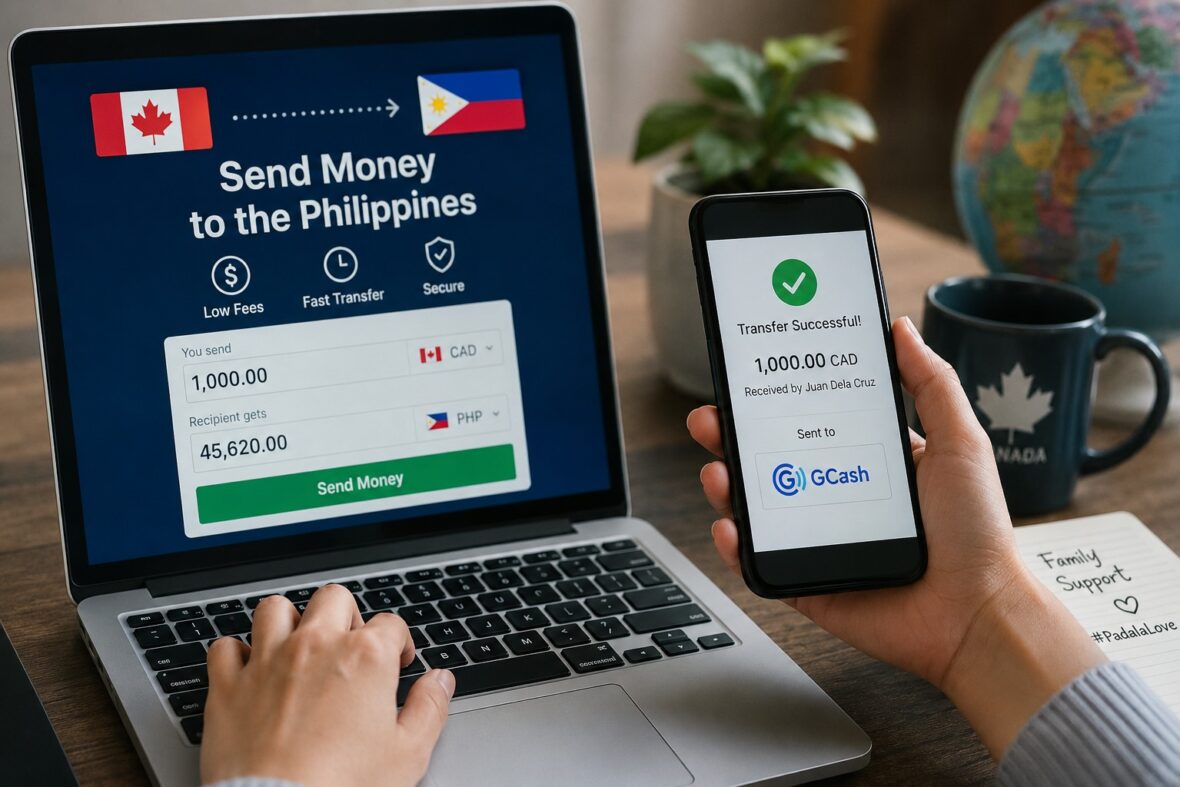
Sending money from Canada to the Philippines has become much easier over the years. You no longer have to rely only on traditional bank wire transfers or visit a remittance center every time you want to send money home.
Today, Canadians can send Philippine pesos directly to a BDO, BPI, Metrobank, PNB, Landbank or other Philippine bank account. You can also send money directly to GCash or Maya, arrange cash pickup, and in some cases have the money available to your recipient within minutes.
But there is one question that almost everyone asks:
What is the cheapest way to send money from Canada to the Philippines?
The answer depends on several things — how much you’re sending, how you’re paying, how your recipient wants to receive the money, and most importantly, the CAD-to-PHP exchange rate offered by the provider.
A service advertising a “$0 transfer fee” isn’t automatically the cheapest. Sometimes another company charges a small transfer fee but gives you a much better exchange rate, leaving your family with more pesos in the Philippines.
In this guide, I’ll walk you through some of the best ways to send money from Canada to the Philippines, including Wise, Remitly, RemitBee, WorldRemit, Western Union and MoneyGram.
We’ll also look at GCash transfers, bank deposits, cash pickup, Interac e-Transfer funding, transfer speeds and the things you should compare before pressing that Send button.
Content
Quick Answer: What Is the Best Way to Send Money From Canada to the Philippines?
There isn’t one service that wins in every situation.
Here’s the simple version:
| What you need | Options worth checking |
|---|---|
| Low-cost bank deposit | Wise, RemitBee |
| Send directly to GCash | Remitly, WorldRemit, Western Union, MoneyGram |
| Fast transfer | Remitly Express, WorldRemit mobile wallet, Wise, Western Union |
| Cash pickup | Western Union, MoneyGram, Remitly |
| Pay using Interac e-Transfer | Remitly, RemitBee, Wise |
| Send to BDO/BPI and other banks | Wise, Remitly, RemitBee, Western Union, MoneyGram |
| Multiple delivery options | Remitly, Western Union |
| Canada-focused remittance service | RemitBee |
My recommendation is to compare at least two or three services before sending, especially for larger transfers.
Don’t compare only the transfer fee.
Compare the final number that matters:
How many Philippine pesos will actually arrive?
That is the real cost of your remittance.
1. Wise
Wise is one of the first services I would check if your recipient has a Philippine bank account.
Wise is particularly known for showing its transfer fee separately while converting money using the mid-market exchange rate rather than hiding an additional markup inside the exchange rate.
For Canada-to-Philippines transfers, Wise allows Canadians to send CAD that is converted to PHP and deposited into the recipient’s local bank account. Your recipient doesn’t necessarily need a Wise account to receive the money.
How much does Wise cost?
Fees depend on the amount and payment method.
As one example, when I checked Wise’s Canada-to-Philippines calculator, a CAD 1,000 transfer funded through a bank transfer showed a fee of about CAD 8.33.
The same example showed different costs depending on funding method, including higher fees for debit cards, credit cards, Apple Pay and Google Pay. Wise also supported Interac e-Transfer as a payment option.
These prices can change, so don’t treat that CAD 8.33 figure as permanent.
How fast is Wise?
Some Wise transfers can arrive extremely quickly.
Wise says that globally, 74% of transfers arrive in under 20 seconds and 95% arrive in less than a day, although actual Canada-to-Philippines delivery depends on the payment method and transfer details.
For the CAD 1,000 example I checked, certain payment options showed delivery within seconds, while Interac e-Transfer funding showed approximately five minutes. Bank-funded transfers could take longer.
Can Wise send directly to GCash?
Here’s one limitation worth knowing.
Wise currently says that it does not send directly to a GCash wallet from Canada. Instead, you can use Wise to deposit money into a Philippine bank account.
So if your mother, father, sibling or other recipient wants the money directly inside GCash, one of the next options may be more convenient.
Wise is best for:
- Philippine bank-account deposits
- Transparent exchange-rate comparisons
- People who want to see the transfer fee clearly
- Larger bank transfers
- Canadians who already use Wise
2. Remitly
Remitly is another major option for Canadians sending money to the Philippines, especially when you want more ways for your recipient to receive the funds.
Unlike Wise, Remitly supports several Philippine delivery methods, including:
- Bank deposit
- Cash pickup
- Mobile wallet
- Home delivery in available areas
Its Philippine network includes BDO, BPI, PNB, Security Bank, RCBC, GCash, Maya, Cebuana Lhuillier, M. Lhuillier, LBC and other providers.
That’s one reason Remitly is particularly convenient for Filipinos.
You’re not limited to sending to a bank account.
Can you send from Canada to GCash using Remitly?
Yes.
GCash currently lists Remitly among its official remittance partners available from Canada.
This makes Remitly one of the services I would compare first if your recipient specifically says:
“Just send it to my GCash.”
How fast is Remitly Canada to Philippines?
Remitly has different transfer speeds depending on how you pay and which delivery method you select.
According to Remitly, its Express transfers funded by debit or credit card have historically delivered 90% of transfers within seven minutes or less.
Its Economy option using a bank account can typically take around five to seven business days.
So if the money is urgently needed, paying slightly more for a faster method may sometimes make sense.
But if you’re sending regular monthly support and aren’t in a hurry, the cheaper option may be better.
Can you use Interac e-Transfer with Remitly?
Yes.
Remitly specifically supports Interac e-Transfer as a Canadian funding option.
That’s useful because many Canadians already use Interac regularly through their bank.
Remitly is best for:
- GCash transfers
- Maya transfers
- Philippine bank deposits
- Cash pickup
- Families who want several receiving options
- Urgent transfers using Express
- Canadians who prefer Interac e-Transfer
3. RemitBee
RemitBee is particularly interesting because it is a Canadian money-transfer company built around international remittances.
For the Philippines, RemitBee advertises transfers to major banks and mobile wallets including:
- BDO
- BPI
- Metrobank
- PNB
- Landbank
- RCBC
- UnionBank
- Security Bank
- GCash
- Maya
It also supports cash pickup.
RemitBee fees for Philippines transfers
This is where RemitBee can become particularly competitive.
When checked, RemitBee said transfers funded using e-Transfer, EFT or bill payment were:
- CAD 2.99 for transfers below CAD 500
- No transfer fee for transfers of CAD 500 or more
Debit-card funding had separate, generally higher fees.
Again, remember the golden rule:
A zero transfer fee doesn’t automatically mean the transfer is cheaper.
You still need to compare the CAD/PHP exchange rate.
For example, imagine:
Provider A charges CAD 0 but offers a weaker exchange rate.
Provider B charges CAD 7 but offers a stronger exchange rate.
Your family could still receive more pesos through Provider B.
Always look at the final PHP amount.
How fast is RemitBee?
RemitBee lists different processing speeds depending on how you fund the transfer:
- Debit card — processed instantly
- Interac e-Transfer — around 15 minutes
- Bill payment — approximately one business day
- EFT — approximately one to two business days
Actual delivery to the Philippines may still depend on the recipient method and processing requirements.
RemitBee is best for:
- Canadians who frequently send CAD 500 or more
- Interac e-Transfer users
- Bank deposits
- People comparing low transfer fees
- Filipino-Canadian families making regular remittances
4. WorldRemit
WorldRemit is another established service with particularly strong mobile-wallet support in the Philippines.
It allows Canadian customers to send money through its website or app and pay by methods such as bank transfer, debit card or credit card depending on availability.
WorldRemit to GCash
For many Filipinos, this is probably the feature that matters most.
WorldRemit supports direct mobile-money transfers to several Philippine wallets, including:
- GCash
- Maya
- GrabPay
- ShopeePay
WorldRemit says eligible mobile-wallet transfers can arrive within minutes.
GCash also lists WorldRemit among its official Canadian remittance partners.
WorldRemit GCash limits
WorldRemit’s current Philippines mobile-wallet page lists a maximum of PHP 50,000 per transfer for supported wallets.
However, the receiving wallet itself can also impose limits.
GCash now has different wallet and incoming-transaction limits depending on the user’s verification and account status, so don’t assume every GCash account can accept the same amount.
Before sending a large amount to GCash, ask your recipient to check whether their wallet has enough available incoming capacity.
WorldRemit is best for:
- GCash
- Maya
- Mobile-wallet transfers
- Smaller urgent transfers
- Recipients who don’t want to visit a cash-pickup branch
5. Western Union
Western Union remains one of the most familiar names in Philippine remittances.
And although apps have changed the remittance industry significantly, Western Union still has one major advantage:
Flexibility.
You can send from Canada through:
- Western Union’s website
- Western Union’s mobile app
- A physical agent location
Your recipient in the Philippines can potentially receive the money through:
- Bank deposit
- Cash pickup
- Mobile wallet
Western Union says it has more than 2,700 Canadian agent locations and more than 21,000 cash-pickup locations available in the Philippines.
Western Union to GCash
Western Union supports mobile-wallet transfers to the Philippines, including GCash. GCash also lists Western Union among its official remittance partners for Canada.
Western Union cash pickup
Cash pickup is where Western Union remains particularly useful.
Your recipient may be able to collect money within minutes, depending on the transaction, agent availability, verification and other conditions.
For relatives who live in areas where bank or e-wallet access isn’t convenient, cash pickup can still make a lot of sense.
Be careful when paying by credit card
Western Union specifically warns Canadian customers that a credit-card issuer may treat a money transfer as a cash advance.
That could mean:
- Cash-advance fees
- Interest charges
- Interest beginning immediately rather than after a normal grace period
Western Union suggests using a debit card or another payment method if you want to avoid potential card-issuer cash-advance charges.
I would keep this in mind with any money-transfer service that lets you use a credit card.
Western Union is best for:
- Cash pickup
- GCash
- Bank transfers
- People who prefer physical locations
- Recipients without a traditional bank account
- Families already comfortable using Western Union
6. MoneyGram
MoneyGram is another traditional remittance company that has expanded heavily into app-based and online transfers.
From Canada, customers can send money to the Philippines through:
- The MoneyGram app
- MoneyGram online
- Physical locations
Receiving options can include:
- Cash pickup
- Bank deposit
- Mobile wallet
- Other digital methods depending on the transaction
MoneyGram allows you to see the exchange rate, transfer fee, delivery estimate and amount the recipient should receive before completing the transaction.
GCash also lists MoneyGram among its official Canadian remittance partners.
MoneyGram is best for:
- Cash pickup
- Mobile-wallet transfers
- Customers who want physical-agent options
- People already using MoneyGram
Cheapest Way to Send Money From Canada to the Philippines
So which provider is actually the cheapest?
Unfortunately, I can’t give you one permanent winner.
Exchange rates constantly move, and remittance companies frequently change:
- Fees
- Promotional exchange rates
- New-customer offers
- Funding costs
- Delivery charges
The cheapest provider today may not be the cheapest provider next month.
Here’s how I would compare them.
Suppose you’re sending CAD 1,000.
Don’t ask:
“How much is the fee?”
Instead ask:
“If CAD 1,000 leaves my pocket, how many pesos will my recipient actually receive?”
Imagine these three offers:
| Provider | Fee | Recipient receives |
|---|---|---|
| Provider A | CAD 0 | PHP 44,000 |
| Provider B | CAD 8 | PHP 44,550 |
| Provider C | CAD 4 | PHP 44,300 |
Provider A advertises “zero fees.”
But Provider B still gives your family PHP 550 more.
That’s why the exchange rate matters just as much as the fee.
The Hidden Cost: Exchange-Rate Markups
One of the biggest mistakes people make when comparing remittance companies is ignoring the exchange rate.
There are usually two ways a company can make money from a transfer:
- Charge a visible transfer fee.
- Give you an exchange rate that is slightly worse than the market rate.
Some companies do both.
For example, if the real market exchange rate were around:
CAD 1 = PHP 45
A provider could offer:
CAD 1 = PHP 44.20
The difference may seem tiny.
But on CAD 2,000, it becomes much more noticeable.
This is why I always recommend checking the recipient amount rather than looking for the biggest “$0 fee” banner.
Fastest Way to Send Money From Canada to the Philippines
If speed is your priority, mobile-wallet transfers are often among the quickest options.
Depending on the provider and transaction, options worth comparing include:
Remitly Express
Remitly says 90% of Express debit- or credit-card-funded transfers have historically arrived within seven minutes or less.
WorldRemit to GCash
WorldRemit says supported Philippine mobile-wallet transfers can arrive within minutes.
Wise
Some Wise-funded transfers can arrive within seconds, although timing varies considerably depending on the funding and receiving method.
Western Union
Cash-pickup transfers can sometimes be available within minutes.
But remember that “instant” or “minutes” isn’t guaranteed for every transaction.
Transfers may be delayed because of:
- First-time customer verification
- Incorrect recipient details
- Large transfer amounts
- Bank processing
- Fraud or security checks
- Weekends or holidays
- Wallet limits
- Recipient-bank issues
If somebody urgently needs money, don’t wait until the last minute if you can avoid it.
How to Send Money From Canada to GCash Philippines
GCash has changed how many Filipino families receive money from overseas.
Instead of travelling to a remittance center, your recipient can potentially receive the funds directly on their phone.
GCash’s official list currently includes several remittance partners serving Canada, including Remitly, WorldRemit, MoneyGram and Western Union, among others.
The general process looks like this:
Step 1: Choose a remittance service
For example:
- Remitly
- WorldRemit
- Western Union
- MoneyGram
Step 2: Select Philippines
Set the destination country to the Philippines.
Step 3: Enter your amount
Choose how much CAD you want to send.
Step 4: Select GCash or mobile wallet
Look for GCash under the receiving options.
Step 5: Enter your recipient’s details carefully
You’ll normally need information such as:
- Recipient’s full name
- Philippine mobile number registered with GCash
The information should match the recipient’s GCash account.
GCash specifically advises users to make sure the receiver’s name and number are correct.
Step 6: Review the exchange rate and final PHP amount
Don’t press Send yet.
Compare the actual amount of pesos your recipient will get.
Step 7: Pay for the transfer
Depending on the provider, available methods may include:
- Interac e-Transfer
- Bank account
- Debit card
- Credit card
Step 8: Track the transfer
Most major providers now provide tracking or status notifications.
How to Send Money From Canada Directly to a Philippine Bank
Bank deposit is one of the easiest choices when the recipient already has a bank account.
Common supported banks can include:
- BDO
- BPI
- Metrobank
- Philippine National Bank
- Landbank
- RCBC
- Security Bank
- UnionBank
- EastWest Bank
- China Bank
The exact list varies by transfer provider.
You’ll normally need:
- Recipient’s full legal name
- Bank name
- Account number
- Sometimes recipient address or other identifying information
Double-check the account number.
A single wrong digit can create a major headache.
Sending Money for Cash Pickup
Cash pickup still has an important place in the Philippines.
It may be useful if your recipient:
- Doesn’t have a bank account
- Doesn’t use GCash
- Lives in an area where cash remains heavily used
- Needs physical cash immediately
Popular cash-pickup providers include Western Union, MoneyGram and Remitly.
Depending on the network selected, Philippine pickup locations may include remittance centers and partner outlets.
Recipients will generally need valid identification, and the name on the transfer should match the name on their ID.
Never use nicknames.
If your mother’s government ID says “Maria Teresa Santos,” don’t simply enter “Tess Santos” because that’s what everyone calls her.
Use the legal name required by the provider.
Can I Use Interac e-Transfer to Send Money to the Philippines?
You generally can’t send a normal Interac e-Transfer straight from your Canadian bank account to someone’s Philippine bank account.
But you can use Interac e-Transfer to fund transfers through certain remittance companies.
For example, Remitly supports Interac e-Transfer funding, while RemitBee also allows customers to fund transfers using e-Transfer. Wise likewise lists Interac e-Transfer among its available Canadian funding methods.
The money-transfer provider handles the international conversion and delivery to the Philippines.
What Information Do You Need to Send Money to the Philippines?
Requirements vary depending on the provider and receiving method, but prepare the following.
Your information
You may need:
- Full legal name
- Canadian address
- Phone number
- Email address
- Date of birth
- Government-issued identification
Recipient information
You may need:
- Full legal name
- Philippine address
- Phone number
For bank deposits:
- Bank name
- Account number
For GCash or Maya:
- Registered mobile number
- Account holder’s exact name
For cash pickup:
- Recipient’s legal name exactly matching their ID
Why Am I Being Asked for ID?
Don’t automatically panic if a legitimate remittance company asks you to verify your identity.
Money-services businesses operating in or serving Canada are subject to Canada’s anti-money-laundering requirements.
FINTRAC says money-services businesses and foreign money-services businesses serving Canadians must register and comply with requirements that can include record keeping, client identification and transaction reporting.
Verification requirements can become especially relevant for certain larger transactions.
For example, FINTRAC rules require identity verification in several circumstances involving transfers of CAD 1,000 or more.
That doesn’t necessarily mean there’s anything wrong with your transaction.
It’s part of the compliance rules money-transfer providers operating in Canada have to follow.
How to Check Whether a Money-Transfer Company Is Legitimate in Canada
Before sending your hard-earned money through an unfamiliar company, do some research.
FINTRAC maintains a public Money Services Business Registry that lets consumers check the registration status of money-services businesses operating in or serving Canada.
One important clarification:
Being registered with FINTRAC does not mean FINTRAC endorses the company.
FINTRAC itself makes that clear.
Registration means the business has satisfied the legal requirement to register; it should not be interpreted as a government recommendation of that company.
Still, checking the registry is one useful step when evaluating a remittance provider you’ve never heard of.
Tips for Getting More Pesos for Your Canadian Dollars
A few small habits can make a surprisingly big difference if you send money regularly.
1. Compare the recipient amount
This is the most important tip in this entire guide.
Open two or three apps.
Enter the same amount.
Then compare:
Recipient gets: PHP ______
Choose based on the overall value, not simply the transfer fee.
2. Avoid automatically using your credit card
Debit cards and bank-based payments are often cheaper.
Credit cards can involve additional costs, and certain issuers may treat money transfers as cash advances.
Western Union, for example, specifically warns Canadians about potential credit-card cash-advance fees and interest.
3. Use slower transfers when you aren’t in a hurry
Instant transfers are convenient.
But convenience can sometimes cost more.
If you send money to your family every month, schedule the transfer a little earlier and compare slower bank-funded options.
4. Watch the CAD-to-PHP rate
If you’re sending a large amount and the transfer isn’t urgent, even a small improvement in the CAD/PHP exchange rate can make a noticeable difference.
5. Look beyond promotional rates
New-customer offers can be excellent.
But don’t assume that the same rate applies forever.
For example, Remitly currently advertises a promotional welcome exchange rate for eligible new customers, subject to its terms and limits.
Compare the regular service once your introductory offer is over.
6. Send larger amounts less frequently — when appropriate
Some services give better pricing at higher transfer amounts.
RemitBee, for example, currently waives its transfer fee on certain CAD 500+ transfers funded by methods including e-Transfer, EFT and bill payment.
Of course, only do this when it makes sense for your budget and your family’s needs.
Which Is Better: GCash, Bank Deposit or Cash Pickup?
It depends on your recipient.
Choose GCash if:
- They already use GCash regularly
- They want money quickly
- They need to pay bills digitally
- They don’t want to travel to a remittance branch
Choose bank deposit if:
- They have a Philippine bank account
- You’re sending a larger amount
- The money is intended for savings, tuition, rent or regular household expenses
Choose cash pickup if:
- They don’t have a bank account
- They don’t use digital wallets
- Cash access is more convenient where they live
There’s no universal winner.
The best receiving method is the one that’s easiest and safest for the person actually receiving the money.
Is It Safe to Send Money From Canada to the Philippines Online?
Using a reputable transfer company can be a convenient way to send money internationally.
But remittance scams are real.
Be suspicious if someone asks you to send money because:
- You supposedly won a prize
- You need to pay an unexpected government fee
- A stranger online claims to be in an emergency
- Someone you’ve never met asks you for financial help
- You’re being pressured to act immediately
- You’re told not to discuss the payment with anyone
Money transfers can be difficult or impossible to reverse once paid out.
Send money only to people you know and trust.
Frequently Asked Questions
What is the cheapest way to send money from Canada to the Philippines?
There isn’t one service that is always cheapest. Wise and RemitBee are worth comparing for bank transfers, while other providers can become cheaper depending on promotional exchange rates and transfer amounts. Compare the final Philippine peso amount your recipient will receive.
What is the fastest way to send money from Canada to the Philippines?
Mobile-wallet and expedited transfers can sometimes arrive within minutes. Remitly Express, WorldRemit mobile-wallet transfers, Wise and Western Union are among the options worth comparing when speed matters.
Can I send money from Canada directly to GCash?
Yes. GCash officially lists several Canadian remittance partners, including Remitly, WorldRemit, MoneyGram and Western Union.
Can I send money from Canada to BDO?
Yes. Several providers support deposits into BDO accounts, including Wise, Remitly, Western Union and RemitBee, depending on current availability.
Can I send money from Canada to BPI?
Yes. BPI is supported by several Canada-to-Philippines remittance services, including Remitly, Western Union and RemitBee.
Can I send money using Interac e-Transfer?
You can use Interac e-Transfer to fund transfers with certain remittance services, including Remitly, RemitBee and Wise. The provider then handles the international transfer to the Philippines.
Does the recipient need a bank account?
No.
Depending on the service you choose, your recipient may receive money through GCash, Maya or cash pickup instead.
Does my recipient need a GCash account?
Only if you’re sending directly to GCash. The GCash account should be active and the recipient details you enter should match the account information.
How long does Canada-to-Philippines money transfer take?
It can range from seconds or minutes to several business days. The timing depends on the provider, payment method, receiving method, amount and verification requirements.
Is a zero-fee transfer always cheaper?
No.
Always compare the exchange rate and the final amount of Philippine pesos received.
A provider charging a small fee can still give your family more pesos than a provider advertising a zero transfer fee.

Final Thoughts: What’s the Best Way to Send Money to the Philippines From Canada?
Sending money from Canada to the Philippines is much easier today than it was even a decade ago.
For bank deposits, I would start by comparing Wise and RemitBee.
For GCash, I would check Remitly, WorldRemit, Western Union and MoneyGram.
For cash pickup, Western Union, MoneyGram and Remitly are among the strongest options to compare.
But I wouldn’t stay loyal to one remittance company without checking the numbers.
Before every reasonably large transfer, take two minutes and compare:
- How much CAD you’re paying
- Transfer fee
- CAD-to-PHP exchange rate
- Delivery time
- Final amount your recipient gets
Then choose the service that puts the most pesos where they belong — with your family in the Philippines.
Because when you’re regularly sending money home, even a few hundred pesos saved on each transfer can add up over the course of a year.