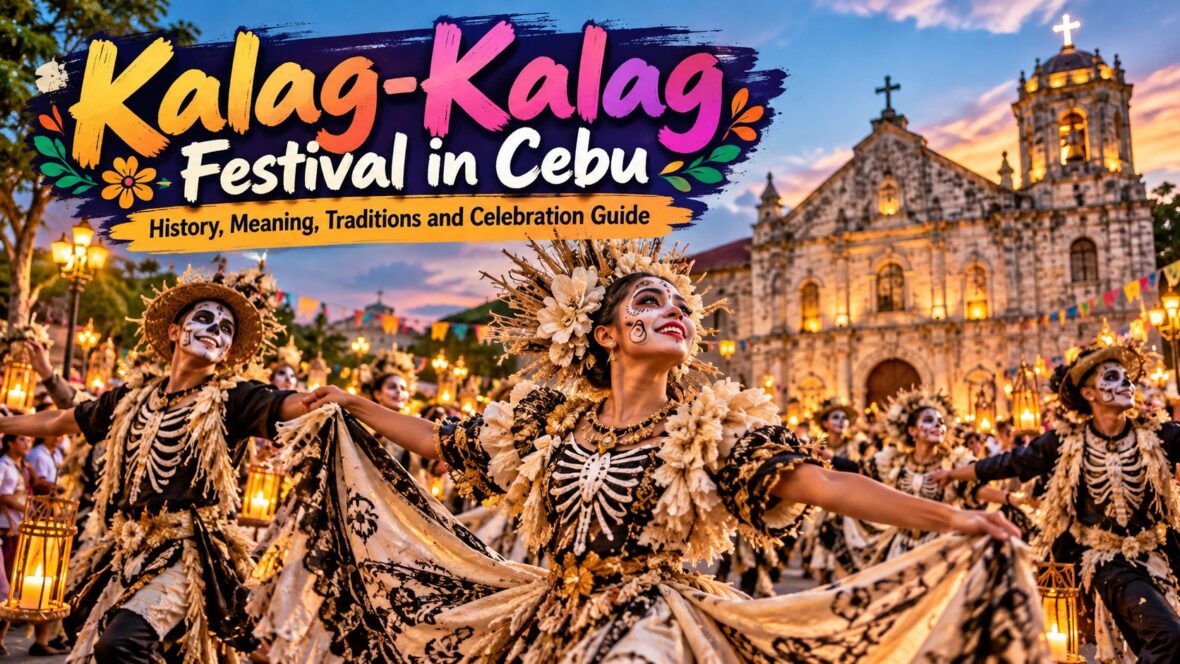
When we think about festivals in the Philippines, we usually imagine colorful street dancing, lively music, elaborate costumes, and communities coming together to celebrate their culture. However, not every Filipino festival revolves around grand parades and competitions.
Some celebrations are deeply connected to family, faith, and the traditions passed down from one generation to another.
One of these is the Kalag-Kalag Festival, a cultural and religious observance closely associated with Cebu and other Cebuano-speaking communities in the Philippines.
Unlike the usual festivals that celebrate a patron saint, a successful harvest, or a historical event, Kalag-Kalag is about remembering those who have passed away. It brings families together to honor departed relatives through prayers, cemetery visits, candle lighting, and gatherings that celebrate the enduring connection between the living and the dead.
Interestingly, Kalag-Kalag also has a festive side. In some communities, remembering deceased loved ones is not simply a solemn occasion. It is also an opportunity for families to reconnect, share meals, and continue traditions that have existed for generations.
Let’s explore the meaning, history, traditions, and cultural significance of Kalag-Kalag, including where and when it is celebrated in the Philippines.
Content
What Is the Kalag-Kalag Festival?
The Kalag-Kalag Festival is a Filipino cultural and religious celebration associated with honoring departed loved ones, particularly during All Saints’ Day and All Souls’ Day.
It is closely associated with Cebu, where the term Kalag-Kalag is commonly used to describe the annual observance of Undas.
The celebration centers on the Filipino tradition of remembering deceased family members, visiting their graves, offering prayers, and gathering with relatives.
In its Philippine festival calendar, the Tourism Promotions Board also identifies Kalag-Kalag Festival as a cultural event in Cebu City that highlights the tradition of visiting relatives and remembering loved ones who have passed away.
However, Kalag-Kalag is more than a single organized event.
For many families, it is a deeply personal tradition that takes place every year, whether at cemeteries, churches, family homes, or ancestral properties.
The observance combines Catholic practices with local customs surrounding remembrance, hospitality, and family relationships.
While some communities observe Kalag-Kalag quietly, others celebrate it with family gatherings, shared meals, and activities that resemble a traditional Filipino fiesta.
This combination of solemn remembrance and communal celebration makes Kalag-Kalag an interesting part of Philippine culture.
What Does Kalag-Kalag Mean?
The name Kalag-Kalag comes from the Cebuano word “kalag,” which means soul or spirit. Depending on the context, the word can also refer to a ghost.
In Cebuano usage, Kalag-Kalag refers to All Souls’ Day or the customary gatherings involving prayers and food held in remembrance of the dead.
The term is particularly familiar in Cebu and other Cebuano-speaking communities in the Visayas and Mindanao.
It reflects the central idea behind the celebration: remembering the souls of people who are no longer physically present but remain important to their families.
In many parts of the Philippines, this annual observance is more commonly called Undas.
Whether people use the term Undas, Kalag-Kalag, or Adlaw sa mga Kalag, the tradition generally revolves around remembrance, prayer, and honoring departed loved ones.
Where Is Kalag-Kalag Festival Celebrated?
Kalag-Kalag is particularly associated with Cebu City and other parts of Cebu province.
The Tourism Promotions Board includes Cebu City as the location of the Kalag-Kalag Festival in its national calendar of Philippine festivals.
However, the actual Kalag-Kalag tradition extends beyond Cebu City.
Across Cebuano-speaking communities, families observe the occasion through cemetery visits, prayer gatherings, candle lighting, and family reunions.
The traditions may vary depending on the community.
In urban areas, such as Cebu City, much of the observance takes place at cemeteries and memorial parks.
In some rural and mountain barangays, the celebration can also involve gatherings at family homes, where relatives prepare food and welcome visitors.
There is also a related celebration in the municipality of Isabela, Negros Occidental, known as the Tigkalalag Festival, sometimes described as the Kalag-Kalag Festival.
Unlike Cebu’s primarily family-centered observance, Isabela’s festival is known for elaborate costumes, street dancing, folklore-inspired performances, and theatrical presentations.
Although both celebrations are connected to remembrance and beliefs surrounding departed souls, they should not be confused as one identical event.
When Is Kalag-Kalag Festival Celebrated?
The traditional Kalag-Kalag observance takes place during the annual All Saints’ Day and All Souls’ Day commemorations.
The important dates are:
- November 1 – All Saints’ Day
- November 2 – All Souls’ Day
Preparations usually begin during the final days of October, when families clean graves, buy flowers and candles, and arrange their visits to cemeteries.
November 1 is traditionally dedicated to remembering all saints in the Catholic calendar.
November 2, meanwhile, is All Souls’ Day, specifically associated with prayers for the faithful departed.
In the Philippines, however, families commonly visit cemeteries on either or both dates, depending on their schedules and local customs.
An interesting detail is that the Tourism Promotions Board’s general festival calendar lists November 13 for Kalag-Kalag Festival in Cebu City.
This should not be confused with the established November 1–2 dates of the religious and cultural observance. A separate annual November 13 program is not consistently documented, so visitors should verify whether a special event is actually being organized.
For travelers hoping to experience the traditional Kalag-Kalag atmosphere, the All Saints’ Day and All Souls’ Day period remains the most relevant time.
History and Origins of Kalag-Kalag Festival
Understanding Kalag-Kalag means looking at the combination of religious beliefs and family traditions that have shaped the Philippine observance of death and remembrance.
Catholic Influence and All Souls’ Day
The Catholic observances of All Saints’ Day and All Souls’ Day became established in the Philippines during the Spanish colonial period.
As Catholicism spread across the islands, Filipinos adopted religious practices such as attending Mass, praying for departed relatives, and commemorating the dead.
These observances eventually became important dates in the Filipino calendar.
However, the Philippine celebration developed characteristics beyond formal religious ceremonies.
Families began treating the occasion as a time to gather, return to their hometowns, and maintain their connections with relatives who had passed away.
In many communities, cemeteries became places where several generations of a family could gather in remembrance.
Traditional Beliefs About Spirits
The concept of spirits and the continued connection between the living and the dead also appears in Filipino indigenous beliefs and local folklore.
In Cebuano culture, the word kalag itself reflects the familiarity of the concept of the soul.
Some traditional beliefs hold that the spirits of deceased family members may return to visit their loved ones during the remembrance period.
These beliefs have influenced customs involving food offerings, candles, and prayers.
However, not every family practices these traditions in the same way.
For some, Kalag-Kalag is primarily a Catholic religious observance. For others, it also includes customs inherited from parents, grandparents, and earlier generations.
This combination of religious and local traditions helped give Kalag-Kalag its distinctive character.
How Kalag-Kalag Became a Community Celebration
Over time, the annual observance developed into an important occasion for family reunions.
Relatives who live in different towns or cities return home to visit ancestral graves.
Households prepare meals, relatives exchange stories, and families spend time remembering those who have died.
In some Cebu mountain communities, Kalag-Kalag gatherings have traditionally resembled a fiesta.
Food is prepared not only for household members but also for visiting relatives and neighbors.
Meanwhile, in urban areas, the observance is more visibly centered on cemeteries.
These local variations demonstrate how the tradition has adapted to different communities while retaining its central purpose of remembrance.
Kalag-Kalag Festival Traditions and Activities
One of the most interesting aspects of Kalag-Kalag is that it combines religious practices with distinctly Filipino expressions of family togetherness.
Here are some of the traditions commonly associated with the celebration.
1. Visiting the Graves of Departed Loved Ones
Cemetery visits are among the most recognizable Kalag-Kalag traditions.
Families travel to cemeteries and memorial parks to visit the burial places of deceased relatives.
Many clean the graves and surrounding areas before the main observance.
This can involve removing weeds, sweeping pathways, washing tombstones, and arranging flowers.
For relatives who live far away, visiting the cemetery during Kalag-Kalag may be one of their few opportunities each year to personally honor their deceased family members.
2. Lighting Candles and Offering Flowers
Candles are an important part of the celebration.
Families light candles at graves, memorial markers, and designated prayer areas.
For many Catholics, candle lighting is a symbolic expression of prayer, faith, and remembrance.
Flowers are also offered as a sign of love and respect.
As Kalag-Kalag approaches, flower and candle vendors become a familiar sight near cemeteries.
At night, the rows of illuminated graves create one of the most recognizable scenes associated with the Philippine observance of Undas.
3. Prayers and Memorial Masses
Religious activities remain central to Kalag-Kalag.
Catholic families often attend Mass, recite the Rosary, and offer personal prayers for deceased relatives.
Some families gather beside the graves of loved ones to pray together.
Others participate in cemetery Masses or religious services organized by local parishes.
These activities reinforce the religious meaning of All Souls’ Day, which emphasizes prayer for those who have died.
4. Family Reunions and Shared Meals
Kalag-Kalag is also an occasion for family members to reconnect.
Since many Filipinos return to their hometowns during the observance, relatives who rarely see one another have an opportunity to gather.
In some communities, families prepare meals and welcome visiting relatives into their homes.
This is particularly notable in accounts of Kalag-Kalag traditions in Cebu’s mountain barangays, where the celebration has sometimes taken on the atmosphere of a neighborhood fiesta.
The gathering may include storytelling, conversations about family history, and meals shared across generations.
These activities make Kalag-Kalag both a remembrance occasion and a celebration of family relationships.
5. Traditional Food Offerings
In some Cebuano households, families prepare food that is associated with departed relatives.
Traditional beliefs may involve setting aside portions of food as offerings, sometimes called halad.
These customs are based on the belief that deceased loved ones remain spiritually connected to the household.
Such practices vary across communities and families.
They are not required Catholic rituals, and they should not be interpreted as universal features of Kalag-Kalag.
Nevertheless, they provide an interesting glimpse into the cultural traditions that exist alongside the religious observance.
6. Remembering Family Stories
Beyond candles, flowers, and prayers, Kalag-Kalag gives families an opportunity to share memories.
Parents and grandparents may talk about relatives who passed away before younger family members were born.
Stories about their personalities, achievements, and family experiences become a way of keeping their memories alive.
This tradition helps younger generations understand their family history and maintain a connection to their ancestors.
Kalag-Kalag and Filipino Folklore
Another interesting part of the Kalag-Kalag tradition is its connection to Filipino folklore.
Across the Philippines, stories about spirits, ghosts, and supernatural creatures have long been part of local storytelling.
In Cebuano and other Visayan communities, these stories often feature supernatural beings associated with traditional beliefs.
The word kalag itself can refer to a ghost or spirit.
However, Kalag-Kalag should not automatically be interpreted as a festival of frightening supernatural creatures.
For most families observing Undas, the occasion is about honoring loved ones rather than celebrating fear or horror.
That said, some communities have developed cultural presentations inspired by folklore.
One of the clearest examples can be found in Isabela, Negros Occidental.
The Tigkalalag Festival in Isabela, Negros Occidental
Although Cebu is associated with the Kalag-Kalag tradition, another notable celebration connected to the same theme is the Tigkalalag Festival in Isabela, Negros Occidental.
This festival presents a more theatrical interpretation of remembrance.
It is known for performances featuring characters inspired by traditional ghost stories, supernatural folklore, skeletons, and other imagery associated with death.
Instead of presenting these characters purely as frightening figures, the festival transforms them into elements of dance, storytelling, and entertainment.
History of Tigkalalag Festival
The modern Tigkalalag Festival in Isabela was launched on November 2, 2008, during the administration of the late Mayor Renato Malabor Sr.
Its main celebration coincides with All Souls’ Day, which was also the former mayor’s birthday.
The festival became known for turning the imagery of death and spirits into organized cultural performances.
It later gained recognition through its participation in provincial festival competitions.
After a lengthy interruption, the Tigkalalag Festival returned in 2025 with street dancing and an arena showdown featuring participating barangay groups.
The municipality has also pursued efforts to establish the celebration as a permanent part of Isabela’s cultural identity.
Street Dancing and Performances
Among the major attractions of Isabela’s Tigkalalag Festival are its street dancing and choreographed presentations.
Participants may wear costumes inspired by folklore, supernatural beings, and imagery associated with the afterlife.
The performances combine music, storytelling, movement, and theatrical elements.
What makes the celebration different from many other Philippine festivals is its unusual theme.
While most cultural festivals highlight agriculture, patron saints, or historical victories, Tigkalalag explores the relationship between life, death, memory, and local folklore.
Visitors should remember that these performances are features of Isabela’s organized festival, not standard activities at Cebu’s cemeteries during Kalag-Kalag.
Kalag-Kalag Festival vs. Halloween: What’s the Difference?
Because Kalag-Kalag takes place around the same time as Halloween, the two celebrations are sometimes compared.
However, their origins and primary purposes are different.
Halloween, observed on October 31, is widely associated today with costumes, trick-or-treating, decorated houses, and spooky entertainment.
Kalag-Kalag, on the other hand, is primarily associated with All Saints’ Day and All Souls’ Day.
Its main purpose is to remember and pray for deceased loved ones.
The tradition places greater emphasis on families, cemeteries, religious activities, and remembrance.
There are some similarities, particularly in celebrations like the Tigkalalag Festival of Isabela, where ghostly costumes and folklore-inspired performances are major attractions.
Still, these similarities should not overshadow their different cultural meanings.
Kalag-Kalag is rooted in remembrance, while modern Halloween celebrations are more commonly associated with entertainment.
Why Kalag-Kalag Is Important to Filipino Culture
Kalag-Kalag reflects several values that remain important in Filipino society.
Respect for Departed Family Members
The celebration emphasizes the importance of remembering relatives even after their death.
By visiting graves, offering prayers, and sharing memories, families continue to express their love and respect.
Strong Family Connections
Kalag-Kalag also demonstrates the significance of extended family relationships.
Relatives gather from different places to participate in an annual tradition that connects generations.
For many families, the observance is one of the occasions when everyone has an opportunity to reunite.
Preservation of Local Customs
The celebration also helps preserve regional traditions.
Practices such as food offerings, family gatherings, and local storytelling reflect the diversity of Filipino customs.
Although the religious observance is widespread, the way it is celebrated can vary from one province or community to another.
Community Participation
Kalag-Kalag is not limited to individual families.
Churches, barangays, cemetery administrators, vendors, local government offices, and community organizations also participate in preparations.
Their involvement helps accommodate the many families who gather for the annual observance.
What to Expect During Kalag-Kalag in Cebu
If you’re planning to visit Cebu during the Kalag-Kalag period, expect a different atmosphere from the city’s usual tourist celebrations.
Rather than large festival stages and organized street dancing, the most visible activities usually take place around churches, cemeteries, and family homes.
Many families visit the graves of relatives throughout the day.
Flowers and candles are common sights, while crowds become particularly noticeable at larger cemeteries.
It is also common for relatives to spend several hours together, talking and sharing memories while visiting family burial sites.
In some neighborhoods, the occasion includes meals and visits to relatives.
Transportation can become busier, particularly along roads serving cemeteries and memorial parks.
Local authorities may introduce traffic rerouting, parking restrictions, security measures, and cemetery visiting guidelines.
These arrangements can change every year, so visitors should check official local announcements before traveling.
Tips for Visitors During Kalag-Kalag
Kalag-Kalag is a meaningful cultural experience, but it is important to remember that the occasion remains deeply personal for participating families.
If you plan to observe the tradition, here are some helpful tips.
Respect Religious and Family Activities
Remember that cemeteries are places of remembrance.
Avoid interrupting families while they are praying or spending time beside the graves of loved ones.
Ask Permission Before Taking Photos
While illuminated candles and memorial decorations can be interesting to photograph, visitors should avoid taking close-up photos of grieving families without permission.
Plan for Crowds
November 1 and 2 are among the busiest periods for cemetery visits in the Philippines.
Travel early whenever possible, and prepare for traffic near major burial grounds.
Follow Cemetery Rules
Cemetery administrators and local government units may regulate parking, operating hours, vendors, candles, large gatherings, and prohibited items.
Always follow the applicable rules.
Keep the Area Clean
Dispose of waste properly and avoid leaving plastic packaging or food containers around graves.
Understand the Cultural Context
Kalag-Kalag is not simply a tourist attraction.
It is a living tradition that continues to hold emotional and religious significance for Filipino families.
Visitors who approach the occasion respectfully can gain a better understanding of local culture.
Frequently Asked Questions About Kalag-Kalag Festival
What is Kalag-Kalag Festival known for?
Kalag-Kalag is known for the Filipino tradition of honoring deceased loved ones through prayers, candle lighting, cemetery visits, and family gatherings. In some communities, especially Isabela in Negros Occidental, related celebrations also feature folklore-inspired street dancing and cultural performances.
Where is Kalag-Kalag Festival held?
The Philippine Tourism Promotions Board lists Cebu City as the location of Kalag-Kalag Festival. However, Kalag-Kalag is also a broader remembrance tradition observed in Cebuano-speaking communities. A related organized festival called Tigkalalag is held in Isabela, Negros Occidental.
What is the meaning of Kalag-Kalag?
Kalag is a Cebuano word meaning soul or spirit. Kalag-Kalag refers to the observance of All Souls’ Day and related customs of remembering the dead.
Is Kalag-Kalag a religious festival?
Kalag-Kalag has strong religious connections because it coincides with the Catholic observances of All Saints’ Day and All Souls’ Day. It also incorporates family and community customs that vary across different locations.
When is Kalag-Kalag celebrated every year?
The traditional observance takes place on November 1 and 2, with preparations often beginning during the final days of October. The Tourism Promotions Board separately lists November 13 for a Cebu City festival entry, although this should not be treated as a confirmed annual program without local verification.
Is Kalag-Kalag the same as Halloween?
No. Kalag-Kalag primarily focuses on remembering deceased loved ones, while modern Halloween celebrations commonly involve costumes, games, and spooky entertainment. Certain local festivals inspired by Kalag-Kalag may incorporate similar visual themes.
Does Kalag-Kalag Festival have street dancing?
Street dancing is a major feature of the Tigkalalag Festival in Isabela, Negros Occidental. However, it is not a standard feature of Cebu’s broader Kalag-Kalag observance.
Is there an entrance fee?
The traditional observance does not require a festival admission ticket. However, cemetery access rules, parking fees, and any charges for separately organized activities depend on the venue and local organizers.
Kalag-Kalag Festival 2026 Schedule and Updates
For those planning to experience the celebration in 2026, the main dates of the traditional Kalag-Kalag observance are:
- October 31, 2026 (Saturday) – Halloween and the period of preparations for Undas
- November 1, 2026 (Sunday) – All Saints’ Day
- November 2, 2026 (Monday) – All Souls’ Day
In Cebu City, local authorities have been preparing security, traffic management, and cemetery operations for the November 1–2 observance.
The Tourism Promotions Board continues to carry a November 13 listing for Kalag-Kalag Festival in Cebu City, but a separate official 2026 event program for that date has not been verified.
Meanwhile, Isabela, Negros Occidental, traditionally holds its Tigkalalag Festival activities around October 31 to November 2, with November 2 as the central celebration.
Specific performance schedules, routes, participating groups, and venue arrangements should be confirmed through local government announcements.
Final Thoughts
Kalag-Kalag is one of those Filipino traditions that reminds us that festivals do not always have to be about grand performances, loud music, and colorful parades.
Sometimes, a celebration can be as simple as lighting a candle, offering a prayer, preparing a meal, or spending time with relatives while remembering someone who is no longer around.
What makes Kalag-Kalag meaningful is its connection to family, faith, and the Filipino tradition of honoring departed loved ones.
In Cebu, the observance continues through cemetery visits, religious practices, and reunions that bring generations together.
In Isabela, Negros Occidental, the related Tigkalalag Festival has developed its own distinctive identity through folklore-inspired performances and street dancing.
Although these celebrations take different forms, they share an important theme: the connection between the living and those who came before them.
And perhaps that is what makes Kalag-Kalag such a special part of Philippine culture.
It reminds us that even after people are gone, their memories continue to have a place in the lives of the families and communities they leave behind.