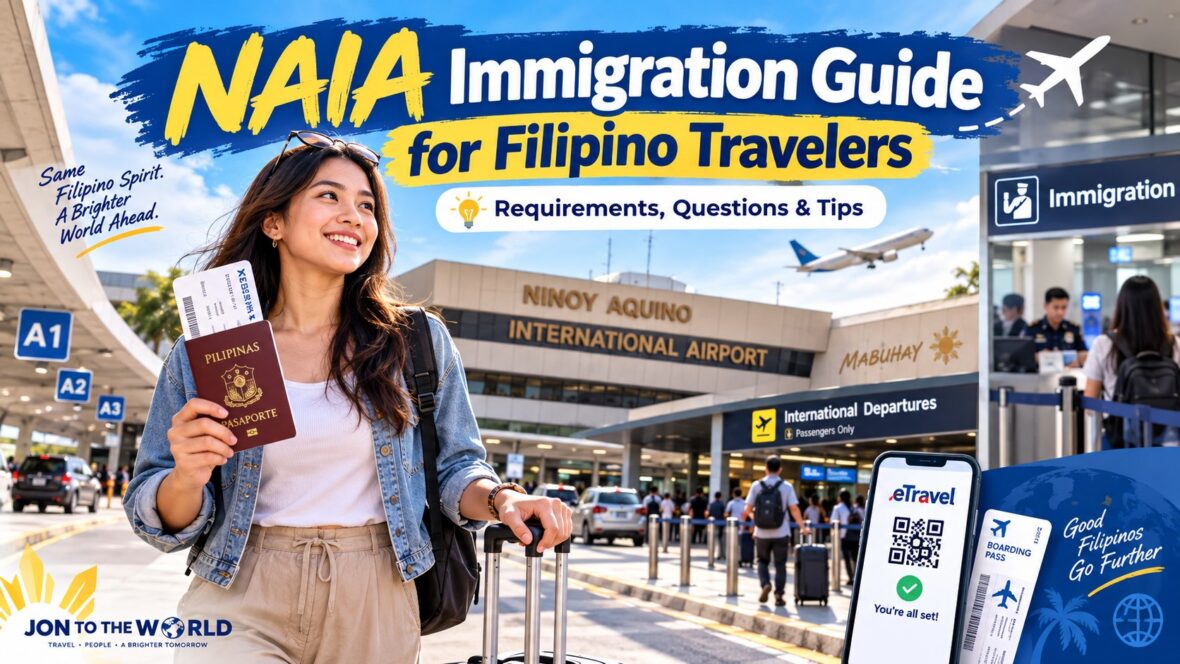
For many Filipino travelers, the most stressful part of an international trip isn’t the flight, the hotel booking or even the visa application.
It’s Philippine immigration.
You can have your passport ready, your boarding pass on your phone and your luggage already checked in—and still feel a little nervous while waiting for your turn at the immigration counter.
What are they going to ask?
Do I need to show my hotel booking?
What if it’s my first international trip?
Do I need a bank statement?
What if somebody else is paying for my vacation?
And of course, there’s the question almost every first-time Filipino traveler eventually searches online:
“How do I avoid getting offloaded?”
The good news is that the process is usually much simpler than social media makes it look.
For an ordinary Filipino traveling abroad as a tourist, the Bureau of Immigration has said that the basic requirements are a valid passport, visa when required by the destination, boarding pass, confirmed round-trip ticket and eTravel registration. The stricter 2023 revised departure guidelines were suspended, with the previous departure procedures remaining in effect.
Additional documents may become relevant if there are inconsistencies or other concerns that result in secondary inspection.
So you don’t necessarily need to arrive at NAIA carrying an entire folder containing your diploma, graduation pictures, birth certificate, bank history and every payslip you’ve received since college.
But you should understand your trip and be able to support what you’re telling immigration.
Here’s how the process works.
Content
What Does Philippine Immigration Check Before You Leave?
The Bureau of Immigration isn’t deciding whether you deserve to take a vacation.
The officer’s job includes confirming that you’re properly documented for your stated trip and identifying cases involving illegal recruitment, human trafficking or travelers misrepresenting their real reason for leaving the Philippines.
The long-standing departure guidelines list a passport, visa when required and round-trip ticket among the basic documents for tourist travelers. The BI has separately clarified that regular departing tourists should also have their boarding pass and eTravel registration.
For most legitimate tourists with straightforward itineraries, immigration inspection can be very quick.
You present your documents.
The officer asks a few questions.
You answer.
Your departure is cleared.
And you continue toward the boarding gate.
Basic Immigration Requirements for Filipino Tourists
Before heading to NAIA, I would make sure these are ready:
- Philippine passport with sufficient validity for your destination, valid visa if the country requires one, confirmed return or onward flight, boarding pass, completed eTravel registration, accommodation and itinerary details that you can quickly access if asked, and supporting financial or sponsorship documents when they are genuinely relevant to your trip.
BI has previously described a passport valid for at least six months as part of the standard documentation expected from regular Filipino tourists. You should also check your destination country’s own passport-validity requirement because immigration rules vary from country to country.
Don’t Forget eTravel
eTravel is now part of the Philippine international travel process.
The official eTravel system currently states that travelers can register only within 72 hours before their arrival in or departure from the Philippines. Travelers are also advised to present their eTravel QR code during the travel process.
Registration is free.
That’s worth emphasizing because fake websites have previously charged travelers thousands of pesos for something that costs absolutely nothing. The Bureau of Immigration specifically warns travelers to use only the official Philippine eTravel system.
The electronic system replaced the old paper-based arrival and departure cards.
My practical advice is simple:
Complete eTravel before heading to NAIA and save a screenshot of the QR code.
That way you aren’t standing inside the airport trying to fill it out while your mobile signal decides to disappear.
What Happens Before You Reach Immigration?
Immigration isn’t usually your first stop.
For most international departures, you’ll first go through your airline’s check-in process.
The airline may verify your passport, destination visa and other entry requirements before issuing or validating your boarding pass.
After checking in and dropping your baggage, you’ll proceed toward Philippine immigration.
Have your passport and boarding pass ready.
Don’t bury them at the bottom of your backpack underneath your power bank, jacket and three packs of dried mangoes.
What Happens at the Immigration Counter?
When it’s your turn, you’ll present your passport and boarding pass.
The immigration officer may look at your travel records and ask questions about your trip.
There is no single script that every traveler receives.
Sometimes you’ll barely be asked anything.
Other times the officer may ask several questions.
The key isn’t memorizing the “correct answer.”
The key is knowing your actual trip.
Common Immigration Questions for Filipino Travelers
Typical questions can revolve around where you’re going, why you’re traveling, how long you’ll stay, where you’re staying, who you’re traveling with, who is paying for the trip and what you do in the Philippines.
For example, if you’re flying to Bangkok for four days, the conversation might be as simple as explaining that you’re going on vacation, giving the dates and naming your hotel.
If you’re visiting your sister in Dubai, say you’re visiting your sister.
If your parents paid for your trip, say your parents paid for your trip.
If you’re traveling alone, say you’re traveling alone.
Straightforward answers are usually much easier than trying to sound like you’re answering a job interview.
Keep Your Answers Short and Truthful
This is probably the best immigration advice I can give.
Answer what was asked.
You don’t need to tell your entire life story when the officer asks how many days you’ll be in Singapore.
If the question is:
“How long are you staying?”
A perfectly normal answer would be:
“Four days.”
You don’t need to continue with a 10-minute explanation of why you’ve wanted to visit Singapore since Grade 6.
But never invent information just because you think it’s what the officer wants to hear.
Immigration issues often begin when the passenger’s documents and answers don’t match.
What Is Secondary Inspection?
Some passengers are referred for additional questioning called secondary inspection.
That doesn’t automatically mean you’ve done anything wrong.
The purpose is to examine the travel circumstances more closely where immigration officers believe further verification is necessary.
The longstanding departure guidelines allow secondary inspection as part of measures against trafficking and illegal recruitment. Those guidelines specifically identify factors such as financial capability and inconsistencies surrounding a passenger’s travel purpose.
BI’s more recent cases show how this works in practice.
In March 2026, for example, the agency said a departing traveler was referred for additional assessment after officers identified inconsistencies in her statements. BI said concerns included an unclear travel purpose, lack of a concrete itinerary and insufficient apparent means to sustain the overseas stay.
In other recent cases, travelers who initially presented themselves as tourists later admitted that their actual reason for traveling was overseas employment arranged through unofficial recruiters.
That’s an important distinction.
Going on vacation and going abroad to work are two completely different travel categories.
Is Everyone Asked for Bank Statements?
No.
Bank statements aren’t listed among the basic documents required from every ordinary tourist.
That doesn’t mean financial capability can never come up.
The departure guidelines allow immigration officers to consider financial capacity when conducting secondary inspection.
So if your circumstances make financial sponsorship relevant, having supporting documentation accessible can help explain the trip.
But I wouldn’t interpret that as meaning every Filipino tourist needs to print six months of bank statements just to spend a weekend in Hong Kong.
Context matters.
Do You Need a Certificate of Employment?
Not automatically if you’re simply traveling as a tourist.
A Certificate of Employment can be useful supporting evidence if questions arise about your employment or your ability to finance your trip.
But again, this is different from saying every tourist must present one during primary immigration inspection.
The BI’s published basic documentation for regular tourists does not include a Certificate of Employment as a universal requirement.
What About Hotel Bookings?
I always recommend keeping your hotel reservation available on your phone.
Immigration may ask where you’re staying.
More importantly, your destination country’s immigration authorities may ask the same question when you arrive.
You don’t necessarily need to print 14 pages from Booking.com.
A screenshot or accessible reservation containing the hotel’s name, address and booking details is much more practical.
If you’re staying with relatives or friends instead of a hotel, know their address and contact information.
First-Time International Travelers
First-time travelers tend to worry the most about immigration.
Maybe you’ve read stories online claiming that being a first-time traveler automatically makes you suspicious.
It doesn’t mean you’re prohibited from traveling.
There is no separate basic tourist-document checklist simply because you’ve never left the Philippines before.
Your job is still the same:
Know your trip.
Have the proper documents.
Answer truthfully.
If you’re traveling to Bangkok for five days, know your hotel, return date and basic itinerary.
You don’t need to memorize every BTS station in Bangkok to prove you’re a tourist.
But saying you have no idea where you’re staying, who bought your ticket or how long you’re traveling naturally creates more questions.
Solo Travelers
Traveling alone is completely normal.
Millions of people do it.
I’ve traveled solo myself, and one thing I’ve learned is that having a simple, logical itinerary makes everything easier—not just immigration, but the entire trip.
If asked why you’re alone, you can simply explain that you’re taking a solo vacation.
Know your accommodation.
Know your travel dates.
Know what you’re planning to do.
There’s no need to invent a companion.
What If Someone Else Is Paying for Your Trip?
Sponsored trips can require a little more explanation.
Maybe your parents are paying.
Maybe your sibling who lives abroad invited you.
Maybe your partner purchased your flights.
There’s nothing automatically wrong with that.
But the immigration officer may want to understand who the sponsor is and why that person is paying.
The departure guidelines provide for supporting documentation such as an authenticated affidavit of support or an undertaking/guaranty in certain circumstances involving travelers without independent financial capacity.
That doesn’t mean every sponsored tourist automatically needs one specific document.
Requirements can depend on the circumstances and destination.
If you’re being sponsored, however, I would make sure you can clearly explain the relationship and keep legitimate supporting information available.
Visiting a Boyfriend, Girlfriend or Partner Abroad
This is another situation where honesty matters.
Don’t say you’re traveling alone for sightseeing if you’re actually visiting a partner simply because somebody online told you immigration officers don’t like hearing the word “boyfriend.”
If your real purpose is visiting your partner, say so.
Trying to hide something harmless can create inconsistencies that look much more suspicious than the truth.
Separate requirements may apply to Filipinos leaving permanently, emigrating, marrying abroad or traveling under certain spouse, fiancé or partner visa categories.
The Commission on Filipinos Overseas currently operates different registration programs for immigrant visa holders, Filipino spouses or partners of foreign nationals, fiancé visa holders, certain J-1 visa holders and au pairs.
So the appropriate documentation depends on your actual travel status.
Tourist Travel Is Not the Same as Overseas Employment
This is one of the most important parts of this entire guide.
If you’re leaving the Philippines specifically to work abroad, don’t pretend you’re traveling as a tourist.
OFWs have separate documentation requirements.
Longstanding departure rules require properly documented OFWs to present employment-related documents such as their passport, applicable work visa and Overseas Employment Certificate or the appropriate exemption/clearance.
The Department of Migrant Workers also maintains systems for processing OECs and overseas employment documentation.
BI continues to intercept travelers recruited online who were instructed to pose as tourists before proceeding to unverified overseas jobs. Recent cases have involved fake documents, indirect travel routes and employment offers arranged through Facebook, Telegram and similar platforms.
If the purpose of your trip is employment, use the proper DMW process.
Returning OFWs
Returning workers may have different departure procedures depending on their employment situation and OEC status.
Some qualified returning workers can receive OEC exemptions.
DMW guidance says an exempt worker proceeding through airport departure formalities should still have a passport and valid work visa or permit, with employment proof potentially needed when the employer isn’t identified on the visa.
Check your current DMW record well before your flight rather than trying to resolve an employment-document problem at NAIA.
Filipino Immigrants and Permanent Residents
If you’re leaving the Philippines to settle permanently overseas, you’re not traveling under the same category as an ordinary tourist.
The Commission on Filipinos Overseas currently provides registration and pre-departure programs for permanent-resident and immigrant visa holders.
Depending on your visa category, you may need CFO registration or the appropriate pre-departure program before leaving the Philippines.
Don’t assume that simply having an immigrant visa means you’ve completed all Philippine departure requirements.
Filipino Minors Traveling Abroad
Families traveling with children should check DSWD requirements before the trip.
A Filipino minor traveling abroad alone or with someone other than a parent or another authorized person may require a DSWD travel clearance.
The rules depend on the child’s circumstances, including who is accompanying the minor and who has legal parental authority.
This is something I would verify long before arriving at NAIA.
A missing child travel clearance isn’t the kind of document you can conveniently fix while your plane is boarding.
What Filipinos Usually Call “Offloading”
You’ll hear Filipinos say:
“Na-offload siya.”
The Bureau of Immigration commonly uses the term “deferred departure.”
Its FAQ defines deferred departure as a situation in which a traveler is not allowed to depart for reasons determined during immigration processing.
It’s important to understand that being referred for secondary inspection and having your departure deferred are not necessarily the same thing.
Secondary inspection means additional assessment.
A traveler can complete that assessment and still be cleared to fly.
What Can Cause a Departure to Be Deferred?
One obvious problem is insufficient documentation.
Another is misrepresentation.
The longstanding departure guidelines state that a traveler found to be misrepresenting the purpose of travel as tourism should not be cleared for departure.
Recent BI cases illustrate exactly what that can mean.
Travelers have been intercepted after claiming to be tourists while actually heading abroad for work, using fake employment documents or following instructions from unlicensed recruiters.
This is why consistency matters so much.
Your ticket, visa, answers and supporting documents should tell the same story—because they should all reflect the truth.
Don’t Use Fake Documents
This should go without saying, but fake supporting documents make a difficult situation significantly worse.
BI has reported cases involving fabricated travel authorities, fake employment-related certificates and falsified relationship documents provided by recruiters or purchased online.
If someone tells you:
“Just show this document if immigration asks.”
and you know that document isn’t genuine, don’t use it.
A legitimate tourist trip shouldn’t require you to pretend you’re someone you’re not.
Don’t Memorize Fake Answers From TikTok
There’s a lot of immigration advice online.
Some of it is useful.
Some of it is basically a tutorial on how to look suspicious.
You’ll see advice like:
“Never say you’re visiting your boyfriend.”
“Always say you’re paying for yourself.”
“Tell immigration you’re traveling with friends.”
“Don’t mention you’re unemployed.”
That advice creates bigger problems if it isn’t true.
Immigration officers deal with travelers every day.
You aren’t going to improve your situation by memorizing a fictional backstory.
Know your real itinerary instead.
How Much Money Should You Have?
There isn’t one universal peso amount that automatically qualifies someone to travel internationally.
A four-day trip to Kuala Lumpur and a three-week vacation in Switzerland clearly don’t have the same budget.
Your financial situation should make reasonable sense in the context of the trip.
If someone else is sponsoring you, explain that honestly.
Don’t suddenly transfer hundreds of thousands of pesos into an account just so you can show a dramatic bank balance.
Actual financial circumstances and genuine supporting documents are more useful than trying to manufacture an image of wealth.
Should You Print Everything?
Personally, I wouldn’t carry a giant binder for a routine vacation.
I would keep important documents organized digitally and have crucial items available offline.
My phone would contain my return ticket, hotel reservation, travel insurance if applicable, itinerary, relevant visa, invitation or sponsorship documents when needed and basic employment information if useful.
For important documents, screenshots can be a lifesaver.
Airport Wi-Fi has an amazing ability to stop cooperating precisely when you need it.
How Early Should You Go Through Immigration?
Don’t treat immigration as something you can squeeze into the final 20 minutes before boarding.
Most passengers clear quickly.
But queues can become long, especially during holiday travel periods.
Secondary inspection can also take additional time.
For an international departure from NAIA, I’d rather be inside the terminal early with time to eat than be running toward immigration while hearing my name announced over the airport speakers.
If you’re a first-time traveler or have a more complicated travel situation involving sponsorship, a minor, immigration status or employment documentation, give yourself an even larger buffer.
What If You’re Sent to Secondary Inspection?
Stay calm.
Listen carefully to the questions.
Answer honestly.
Provide the documents requested if you have them.
If you don’t understand the question, ask for clarification instead of guessing what the officer means.
Don’t become argumentative simply because you’ve been referred.
At the same time, you can reasonably ask what document or issue needs clarification.
The objective should be to establish your actual travel purpose and demonstrate that your trip matches your documentation.
What If Your Departure Is Deferred?
If you’re not cleared to depart, ask exactly why.
Find out which document or issue needs to be resolved before your next travel attempt.
The BI Citizen’s Charter says that where departure is deferred because of misrepresentation or insufficient documents, the traveler may be provided information about documents that need to be secured for a subsequent attempt.
Keep any written documentation given to you.
Don’t immediately book another flight without first fixing the underlying issue.
Interestingly, BI’s list of 2026 issuances includes Memorandum Circular No. 2026-001 dated July 13, titled “Guidelines for Reimbursing the Travel Expense of Filipino Passengers Whose Travel Was Deferred by the Bureau of Immigration.” Eligibility and procedures depend on the circular, so passengers with a qualifying case should check directly with BI rather than assuming every deferred traveler is automatically entitled to reimbursement.
Immigration Myths Filipino Travelers Should Stop Believing
One common myth is that immigration requires every tourist to provide a graduation yearbook.
No.
Another is that being unemployed automatically means you can’t leave the country.
No.
Another is that solo travel automatically results in secondary inspection.
Again, no.
And being a first-time international traveler does not automatically mean your trip will be denied.
What matters is whether your travel purpose is legitimate, your required documents are complete and your circumstances make sense.
A Simple Example
Imagine you’re taking your first international trip:
Manila → Bangkok
Five days.
You’re paying for the trip yourself.
You’re staying in a hotel near Sukhumvit.
Your return ticket is already booked.
You work in Manila.
Your basic story is already complete.
If asked:
“Purpose of travel?”
Vacation.
“How many days?”
Five days.
“Where are you staying?”
Your hotel.
“Who paid for the trip?”
You did.
“When are you coming back?”
The date on your return ticket.
That’s it.
You don’t need to make a five-day Bangkok vacation sound like a Supreme Court hearing.
Frequently Asked Questions
What documents do Filipino tourists need at Philippine immigration?
For an ordinary tourist, BI has identified the core documents as a valid passport, visa when required, boarding pass, confirmed round-trip ticket and eTravel registration. Additional supporting documents may be requested when further inspection is necessary.
Is eTravel required when leaving the Philippines?
Yes. The official system accepts departure registration within 72 hours before departure.
Does eTravel cost money?
No. Registration is free. BI has warned against fraudulent websites charging fees.
Do Filipino tourists need bank statements?
Not as a universal basic requirement. Financial capability may, however, become relevant during secondary inspection depending on the travel circumstances.
Do I need a Certificate of Employment?
It isn’t one of the universal basic tourist requirements listed by BI. It can nevertheless be useful supporting evidence if your employment or ability to finance the trip needs clarification.
Can first-time travelers be allowed through immigration?
Yes. Being a first-time traveler isn’t itself a prohibition on international travel. You should simply have the proper travel documents and be prepared to explain your genuine itinerary.
What is secondary inspection?
It’s an additional immigration assessment used when further verification is considered necessary, including cases involving possible trafficking, illegal recruitment, financial-capacity concerns or inconsistencies in the stated travel purpose.
What does “offloaded” mean?
The commonly used Filipino term generally refers to what BI calls a deferred departure—when a passenger isn’t allowed to depart following immigration processing.
Can I travel abroad if someone else pays for the trip?
Yes, but be ready to honestly explain who is sponsoring you and your relationship to that person. Depending on your circumstances, supporting sponsorship documentation may become relevant.
Can I leave as a tourist if I’m really going abroad to work?
You should not. Overseas employment has separate DMW and immigration documentation requirements. BI continues to intercept illegally recruited workers instructed to pose as tourists.

Final Thoughts
Philippine immigration can feel intimidating, especially if it’s your first time traveling abroad.
But don’t let all the horror stories online convince you that every Filipino traveler needs to arrive at NAIA carrying a suitcase filled with supporting documents.
For a normal tourist trip, start with the basics:
A valid passport.
The correct visa when required.
A return ticket.
Your boarding pass.
Your eTravel registration.
Then know your trip.
Know where you’re going, where you’re staying, how long you’re traveling and who is paying.
Keep legitimate supporting documents accessible when they genuinely apply to your circumstances.
And most importantly, tell the truth.
You don’t need a perfect immigration script.
You just need your answers and documents to reflect the trip you’re actually taking.
That’s a much better way to approach NAIA immigration than spending the night before your flight memorizing answers from strangers on TikTok.