Palawan is usually associated with beaches, limestone cliffs and island-hopping. But travel farther away from the province’s famous tourist destinations and you’ll find another side of Palawan—one shaped by old island communities, local languages, patron saints, traditional dances and fiestas that have been celebrated for generations.
One of these celebrations is the Pangalipay Festival of Magsaysay, Palawan.
Held toward the end of September, Pangalipay Festival is the town’s socio-cultural and religious celebration honoring St. Michael the Archangel, or San Miguel, the patron saint of Magsaysay. The name itself already tells you what kind of celebration it is. “Pangalipay” is a Cuyonon word associated with merrymaking, joy and celebration. Magsaysay’s tourism office describes the festival as a gathering of the community dedicated to St. Michael the Archangel.
And this is what makes Pangalipay interesting.
It isn’t simply a tourism event created around performances. At its core, it is a town fiesta where faith, Cuyonon identity and community celebration come together.
If you’re planning to discover the lesser-known festivals of Palawan, here’s a closer look at Pangalipay Festival—what it means, where it is celebrated, its connection to Cuyonon culture, what you can expect and why September 29 is an important date in Magsaysay.
Content
What is Pangalipay Festival?
Pangalipay Festival is an annual festival celebrated in the municipality of Magsaysay in Palawan.
The celebration is closely connected with the town fiesta honoring St. Michael the Archangel. Festival references traditionally place its culmination on September 29, the feast associated with San Miguel, while current Palawan festival calendars generally list Pangalipay during the last week of September.
The Municipal Tourism Office of Magsaysay explains that the word “Pangalipay” comes from Cuyonon and means “merrymaking.”
That name fits the festival perfectly.
Pangalipay is essentially a period when the people of Magsaysay come together—not only for religious observances but also for cultural performances, dancing and community activities.
Think of it as a traditional Filipino town fiesta with a very distinct Cuyonon identity.
Where is Pangalipay Festival celebrated?
Pangalipay Festival is celebrated in Magsaysay, Palawan, a municipality located in the Cuyo Archipelago.
This is important because there are several places named Magsaysay in the Philippines. The Pangalipay Festival discussed here is specifically the festival of Magsaysay, Palawan—not Magsaysay in Davao del Sur or another municipality with the same name.
Magsaysay occupies part of Cuyo Island and several surrounding islands. Historically, the area was once part of the municipality of Cuyo.
Republic Act No. 3426, enacted in 1961, separated the barrios of Los Angeles, Rizal, Lucbuan, Igabas, Imilod, Balaguen, Danawan, Cocoro, Patonga, Tagawayan Island, Siparay Island and Canipo from Cuyo to form the Municipality of Magsaysay. The law designated Danawan as the seat of the new municipal government.
That history helps explain why Magsaysay’s culture remains strongly connected with Cuyo and the Cuyonon people.
What does “Pangalipay” mean?
This is probably the best place to start understanding the festival.
Pangalipay means merrymaking or rejoicing.
Magsaysay’s tourism office specifically identifies it as a Cuyonon term for merrymaking.
And the name isn’t accidental.
Rather than naming the celebration after a crop, animal or local product, the festival is named after an emotion and an activity—the act of celebrating together.
There’s something very Filipino about that.
A fiesta is not only about watching a performance. It means people returning home, families preparing food, neighbors seeing each other, church activities, music, dancing and gathering in public spaces.
Pangalipay captures that spirit.
Pangalipay Festival and Cuyonon Culture
You really can’t talk about Pangalipay Festival without talking about the Cuyonon culture of the Cuyo Islands.
Cuyonon is an island language spoken primarily in the Cuyo Islands, and the language contains an extensive vocabulary connected with the sea, tides and everyday island life. Researchers from the University of the Philippines have continued documenting the Cuyonon language and its relationship with coastal life in the Cuyo Islands.
Historically, Cuyo was also one of Palawan’s major cultural centers.
Magsaysay developed from communities that were originally part of Cuyo, so the cultural connection is understandable.
The festival’s Cuyonon name itself is already one expression of that heritage.
And during the festivities, culture becomes more visible through music, costumes, dancing and public performances.
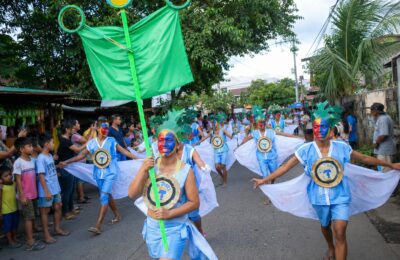
Festival guides describe Pangalipay as featuring colorful street dancing and folk dancing, with performers wearing costumes inspired by local traditions.
So while visitors may initially come for the colorful celebration, Pangalipay is also an opportunity to encounter a living Cuyonon community.
Why is Pangalipay Festival celebrated?
At the center of the celebration is St. Michael the Archangel.
The Municipal Tourism Office describes Pangalipay Festival as a celebration dedicated to St. Michael, the town’s patron saint.
This means Pangalipay has two sides that naturally blend together.
There is the religious side—the town fiesta and devotion to San Miguel.
Then there is the socio-cultural side—the music, dancing, gatherings and community programs surrounding the fiesta.
This combination is common in Philippine festivals.
You attend Mass in the morning, watch a cultural presentation later in the day and then suddenly find yourself surrounded by music and people celebrating in the plaza at night.
The sacred and festive sides aren’t necessarily separate.
They are both part of the same fiesta tradition.
When is Pangalipay Festival?
Pangalipay Festival is traditionally associated with the latter part of September.
Several Philippine festival calendars identify September 29 as the main date of the celebration, corresponding with the feast of the town’s patron, San Miguel. A more recent Palawan festival calendar lists Pangalipay Festival in the last week of September.
Some references describe a longer socio-cultural celebration leading up to September 29.
The important thing to remember if you’re traveling for the festival is that the exact schedule of activities can change from year to year.
September 29 is the traditional anchor date.
If your goal is to see the major festival activities, plan around the final days of September—but always check the official announcement from the Municipality of Magsaysay or its tourism office before booking transportation.
The Feast of St. Michael the Archangel
San Miguel is more than simply the name attached to the fiesta.
St. Michael the Archangel is the patron honored by the community during Pangalipay Festival, and the religious celebration gives the festival its central purpose.
The San Miguel Arkanghel Church is located in Lucbuan, within the municipality of Magsaysay.
This part of Magsaysay also carries considerable history. Historical church records cited by Recollect sources identify Lucbuan among the Palawan parishes established in 1894.
So when you see the religious dimension of Pangalipay, you’re also seeing part of a much older Catholic tradition in the Cuyo Islands.
Street Dancing and Cultural Performances
For visitors, one of the most visually exciting parts of Pangalipay is the dancing.
Published Palawan festival guides describe the celebration as featuring colorful street dancing and folk dancing with indigenous or tradition-inspired costumes.
This is usually where the festival becomes most photogenic.
Imagine groups of performers moving through town in bright costumes, accompanied by music and surrounded by residents watching from the roadside.
But these performances are more than entertainment.
Festival dancing allows younger generations to participate in local traditions and gives communities a public space to present their identity.
And in a place like the Cuyo Archipelago, where distinct Cuyonon dances, songs and performing traditions have developed over generations, that cultural element matters.
Cuyonon traditions include a variety of dances influenced by both indigenous practices and centuries of outside contact. Recorded dances include the Pastores, Lanceros de Cuyo, Paraguanen, La Jota Paragua, Mazurka de Cuyo and Pinundo-pundo. Cuyonon performing arts also include the Sayaw, which combines music, dance and narrative.
That broader cultural background gives festival performances in the Cuyo Islands a character you won’t necessarily find elsewhere in Palawan.
A Celebration of Community
This may actually be the most important part of Pangalipay.
Large festivals are often marketed around spectacular street-dancing competitions or celebrity concerts.
Pangalipay has a different scale.
Magsaysay remains an island municipality, and the festival functions very much as a community celebration.
Families participate.
Students participate.
Barangays participate.
Religious groups participate.
Local officials participate.
And residents who live elsewhere may also use fiesta season as an opportunity to return home.
This is why festivals in smaller Philippine towns can sometimes feel more personal than the massive celebrations in major cities.
You’re not simply watching a tourist attraction.
You’re entering a town during one of its most important periods of the year.
What to Expect During Pangalipay Festival
The exact program changes, so it would be misleading to say that the same event happens on the same day every year.
But visitors can generally expect the celebration to revolve around a few major themes: the patronal fiesta honoring St. Michael, cultural and folk-dance presentations, community gatherings, public programs and festive activities leading toward the September 29 feast.
Some editions may include competitions, evening programs, youth activities, sports or entertainment events depending on what the municipal government and festival organizers prepare for that year.
For travelers, the best strategy is simple:
Don’t expect Pangalipay to operate like a commercial festival with one permanent program.
Treat it as a living town fiesta.
That means the details may change, but the central themes of San Miguel, Cuyonon culture and communal merrymaking remain.
Pangalipay Festival Is Not Pangalipay sa Baybay
Here’s something worth clarifying because online searches can become confusing.
Pangalipay Festival in Magsaysay, Palawan is not the same event as Pangalipay sa Baybay in Puerto Princesa City.
They share the word “Pangalipay,” but they are separate celebrations.
Pangalipay Festival:
Magsaysay, Palawan
Usually celebrated in the last week of September
Connected with the feast of St. Michael the Archangel
Pangalipay sa Baybay:
Puerto Princesa City
Traditionally held in April
A summer celebration centered around the Puerto Princesa Baywalk
Puerto Princesa’s tourism office says Pangalipay sa Baybay began in April 2005 and developed as a multi-day summer event at the Baywalk featuring activities such as parades and fireworks.
So if you search for “Pangalipay Festival Palawan” and suddenly see photos of Puerto Princesa Baywalk, you’re probably looking at a different festival.
This article is about Pangalipay Festival of Magsaysay.
Why Magsaysay’s Location Makes the Festival Interesting
Magsaysay isn’t on mainland Palawan.
It is part of the Cuyo Archipelago in the Sulu Sea.
That geographic isolation is actually part of what makes visiting the festival interesting.
You’re experiencing a fiesta within an island community whose identity developed somewhat separately from the major tourism centers of Puerto Princesa, El Nido and Coron.
Magsaysay occupies the eastern portion of Cuyo Island and also encompasses several surrounding islands.
Cuyo Airport is actually located in Magsaysay, around the Lucbuan area. The Civil Aviation Authority of the Philippines lists Cuyo Airport in Lucbuan, Magsaysay, Palawan.
However, travelers shouldn’t assume there will always be regular commercial flights.
As of 2026, current travel information indicates that Cuyo Airport does not have regular scheduled airline service, while passenger ships connect Cuyo Island with routes involving Puerto Princesa and Iloilo. Sailing schedules can change depending on weather and operations.
If you’re planning specifically for Pangalipay, confirm transportation well in advance.
Island travel has a way of reminding you that schedules are sometimes more like suggestions than guarantees.
Visiting Pangalipay Festival
If you decide to experience Pangalipay personally, give yourself some flexibility.
Don’t arrive on September 29 expecting to travel back out immediately after the celebration.
Cuyo is not Metro Manila where you can simply book another Grab and go home.
Transportation options are more limited, and weather conditions can affect sea travel.
Ideally, arrive several days before the main fiesta.
That gives you time to settle in, learn your way around Magsaysay and experience some of the activities leading up to the celebration.
It also gives you a better chance of seeing the festival beyond just the big public program.
Because sometimes the most memorable part of a provincial fiesta isn’t the event onstage.
It’s what happens around it.
Families preparing food.
Kids walking to performances wearing their costumes.
Neighbors setting up decorations.
Music coming from somewhere in the distance.
People who haven’t seen each other for months—or even years—meeting again.
That is also Pangalipay.
Respecting the Religious Side of the Festival
It’s easy to focus on street dancing because that’s what looks best in photos and videos.
But remember that Pangalipay is also connected with a Catholic patronal feast.
Visitors attending church activities should dress appropriately and follow local customs.
If a religious procession or ceremony is taking place, give participants enough space.
And if you’re photographing religious events, try not to block the procession just because you want the perfect angle.
This is still someone else’s place of worship.
Festival photography is always better when you can get the shot without becoming part of the obstacle course.
Food During the Festival
One of the joys of visiting any Philippine town fiesta is food.
Cuyo Island has a strong island and coastal food culture, so seafood naturally plays an important part in local life. Academic and cultural studies of Cuyo describe fishing alongside agriculture as an important livelihood, with local waters providing fish, crab, shrimp, octopus, shellfish, sea urchins, sea cucumbers and seaweed.
Festival programs vary, so don’t expect a specific official food festival unless it appears on that year’s schedule.
Instead, this is a good opportunity to look for locally prepared Cuyonon dishes, seafood and home-style food offered around town during fiesta season.
And if someone invites you to eat during a Filipino fiesta, there’s a good chance the answer to “Kumain ka na?” is expected to be followed by another plate anyway.
Why Pangalipay Festival Matters
Pangalipay may not have the international recognition of Sinulog, Ati-Atihan or MassKara.
But festivals don’t have to attract millions of visitors to be culturally significant.
For Magsaysay, Pangalipay provides a space where several parts of local identity come together.
Faith.
Language.
Music.
Dance.
Family.
Community.
And Cuyonon heritage.
There is also something important about the festival retaining a Cuyonon name.
Every time residents say “Pangalipay,” they are using a local word to describe the celebration.
In an era when smaller Philippine languages constantly compete with Filipino, English and other dominant languages, simply keeping those local words visible matters.
Pangalipay as Part of Palawan’s Festival Calendar
Palawan has far more festivals than many travelers realize.
The province’s calendar includes municipal and barangay celebrations spread throughout the year—from Pasinggatan in Taytay and Purongitan in Cuyo to Manunggul in Quezon, Panalaminan in Roxas and many smaller community fiestas.
A 2026 province-wide festival guide places Pangalipay Festival in Magsaysay during the last week of September.
This makes late September an interesting period for travelers interested in cultural tourism rather than the usual beach itinerary.
You’re seeing Palawan beyond the postcards.
Pangalipay Festival 2026 Update
For 2026, Pangalipay Festival remains scheduled around its traditional late-September celebration in Magsaysay.
The Banuang Magsaysay Turismo page began promoting Pangalipay Festival in August 2026, again describing “Pangalipay” as the Cuyonon word for merrymaking and confirming that the celebration honors St. Michael the Archangel.
Current Palawan festival listings place Pangalipay in the last week of September, with September 29 remaining the traditional feast date associated with the festival.
As of September 18, 2026, I could verify promotion of the festival but not a complete official day-by-day 2026 program in publicly indexed sources.
So if you’re attending this year’s celebration, check the latest announcements from Banuang Magsaysay Turismo and the Municipal Government of Magsaysay before traveling.
Once the complete schedule is published, that’s the source you’ll want to follow for exact times, venues and individual activities.
Frequently Asked Questions About Pangalipay Festival
Where is Pangalipay Festival celebrated?
Pangalipay Festival is celebrated in Magsaysay, Palawan, part of the Cuyo Archipelago.
When is Pangalipay Festival?
The festival is generally celebrated during the last week of September and culminates around September 29, the feast associated with St. Michael the Archangel.
What does Pangalipay mean?
“Pangalipay” is a Cuyonon word meaning merrymaking or rejoicing.
Who is the patron saint of Pangalipay Festival?
The festival honors St. Michael the Archangel, locally referred to as San Miguel.
What are the highlights of Pangalipay Festival?
The festival combines the religious town fiesta with cultural activities. Published festival guides particularly mention colorful street dancing and folk dancing in traditional or indigenous-inspired costumes.
Is Pangalipay Festival held in Puerto Princesa?
No. Pangalipay Festival is held in Magsaysay, Palawan. Puerto Princesa has a different celebration called Pangalipay sa Baybay, traditionally held around April at the City Baywalk.
Is Magsaysay on mainland Palawan?
No. Magsaysay is part of the Cuyo Archipelago and occupies the eastern portion of Cuyo Island together with surrounding islands.

Final Thoughts
There are festivals you travel to because they’re famous.
And then there are festivals you discover because you want to understand a place a little better.
Pangalipay Festival belongs to the second group.
It may be smaller than Palawan’s major provincial celebrations, but that is also part of its charm.
This is Magsaysay celebrating as Magsaysay.
The language is Cuyonon.
The patron is San Miguel.
The community comes together.
And the name says everything you really need to know.
Pangalipay.
Merrymaking.
A celebration of faith, culture and the simple joy of gathering together.
For travelers willing to venture beyond Palawan’s usual tourism route, Pangalipay Festival offers something different: not another beach attraction, but a chance to experience the living culture of the Cuyo Islands and the people who continue to call them home.