Long before Argao became known for celebrating its famous torta through the La Torta Festival, the southern Cebu town had another festival carrying a very different name.
Pitlagong.
It wasn’t named after a saint, a flower or even a finished local product.
It was named after a humble tool used by people who gathered tuba—the traditional coconut wine that has been part of Cebuano rural life for generations.
That alone tells you something about the Pitlagong Festival.
This was a celebration deeply connected with everyday life.
Coconut trees. Tuba gatherers climbing high above the ground. Bamboo containers collecting sap. Farmers and artisans going about their livelihoods. Friends sharing a drink after a long day. And, above all, the people of Argao gathering to honor their patron, St. Michael the Archangel.
Pitlagong Festival eventually disappeared from Argao’s official fiesta calendar when the municipality introduced La Torta Festival in 2011. Historical and academic accounts confirm that La Torta directly replaced Pitlagong while retaining the broader goal of celebrating Argao’s culture and heritage.
But that doesn’t mean Pitlagong should simply be forgotten.
The festival tells an important part of Argao’s cultural story.
And interestingly, the tradition represented by Pitlagong didn’t completely disappear. Tuba remains connected with Argao’s food culture today because it is also an important ingredient in the town’s famous torta.
So let’s go back to the beginning.
Content
What Was the Pitlagong Festival?
Pitlagong Festival was a cultural and religious festival celebrated in Argao, Cebu as part of the festivities honoring the town’s patron saint, St. Michael the Archangel.
Like many Cebu festivals, it combined several elements of community identity into one celebration.
There was faith.
There was livelihood.
There was local food and drink.
There were traditional occupations.
There was street dancing.
And there was a ritual showdown in which performers presented Argao’s culture through music, costumes, movements and props.
Historical descriptions of the celebration identify the parade, street-dancing competition and ritual showdown as major components of Pitlagong Festival.
But the most important thing to understand is the name itself.
Once you know what a pitlagong is, the entire festival begins to make sense.
What Does Pitlagong Mean?
A pitlagong is a tool associated with traditional tuba gathering.
More specifically, it is used to clean the sugong, the bamboo container placed on a coconut tree to collect its sap.
That might sound like an incredibly small detail around which to build an entire festival.
But think about what the object represents.
Without the tools of the trade, there is no traditional tuba gathering.
Without the person climbing the coconut tree, there is no sap.
Without the sap, there is no tuba.
And without tuba, one important part of Argao’s traditional culinary culture—including its torta—wouldn’t be quite the same.
Descriptions of the old festival specifically identify the pitlagong as the implement used to clean the sugong used by tuba gatherers.
So the festival wasn’t really about one bamboo tool.
The pitlagong represented an entire livelihood.
Understanding Tuba
If you grew up in the Visayas, the word tuba probably needs little introduction.
For everyone else, tuba is a traditional drink produced from the sap of coconut blossoms.
The process begins high up a coconut tree.
A tuba gatherer carefully prepares the flower stalk so that its sap drips into a container attached to the tree.
Freshly collected coconut sap can be consumed before significant fermentation takes place. As fermentation progresses, it develops into coconut toddy or wine.
Different stages and preparations can produce drinks known by terms such as bahal and bahalina.
In the traditional process described in connection with Argao, the person harvesting the sap uses several specialized tools. The sugong is positioned to collect the dripping sap, while the pitlagong helps clean that container. Other implements are used for cutting, collecting and carrying the liquid.
It’s skilled work.
Imagine climbing coconut trees every day—sometimes more than once—while carrying sharp tools and containers.
Suddenly that glass of tuba at ground level represents a lot more effort than you might initially think.
The Manunuba
At the center of the tradition is the manunuba, the person who gathers tuba.
In parts of Cebu, you may also encounter related terms for coconut-sap gatherers.
The job requires experience, balance and familiarity with the coconut tree.
The gatherer climbs the tree and works with the flower stalk to encourage sap production. A bamboo receptacle collects the liquid over several hours.
The sap then has to be gathered regularly.
Accounts of traditional tuba production explain that the manunuba may collect sap in the morning and again later in the day.
For generations, occupations like this formed part of the everyday rural landscape of Cebu.
And that’s really what Pitlagong Festival was celebrating.
Not something invented for tourists.
A real occupation.
A real product.
And a real tradition.
Why Build a Festival Around a Small Tool?
This is perhaps the most interesting question.
Why not simply call it the Tuba Festival?
Why name an entire celebration after the cleaning implement?
There is something wonderfully local about choosing pitlagong.
Almost anyone can understand the idea of coconut wine.
But a pitlagong belongs to the vocabulary of people who actually know the process.
It takes you behind the finished product.
The name points toward the worker and the craft rather than simply the drink.
And that makes the festival feel more specific to the community.
It’s similar to festivals elsewhere in the Philippines that celebrate fishing nets, weaving tools, agricultural techniques or traditional implements.
The object becomes a shortcut to a larger cultural story.
Pitlagong and Argao’s Agricultural Life
Argao’s history extends far beyond tuba.
The municipality developed strong agricultural, food-production and handicraft traditions over generations.
Coconut trees formed part of that landscape.
So did cacao.
Weaving became another important craft.
Then there was torta, which would ultimately become one of the foods most strongly associated with the municipality.
Cebu’s provincial government today describes Argao as a place with a particularly rich combination of heritage architecture, foodways, artisan traditions and local products.
Pitlagong Festival emerged from that environment.
The tuba gatherer therefore wasn’t an isolated character.
He represented one part of a larger rural economy involving farmers, food makers, craftsmen and families.
Pitlagong Festival and St. Michael the Archangel
Like many Philippine festivals, Pitlagong had a religious foundation alongside its cultural theme.
Argao’s patron is St. Michael the Archangel.
The Archdiocese of Cebu lists September 29 as the feast day of the Archdiocesan Shrine of St. Michael the Archangel in Argao.
This is important because the festival didn’t exist separately from Argao’s town fiesta.
The cultural celebration took place within a larger period of religious devotion and community festivities surrounding San Miguel.
That combination is very familiar throughout the Philippines.
Mass in the morning.
A procession.
Street dancing.
Family reunions.
Food.
Music.
Competitions.
Visitors coming home.
One town fiesta can contain all of those things at once.
Pitlagong Festival gave Argao’s celebration its own distinctive cultural identity.
Street Dancing at Pitlagong Festival
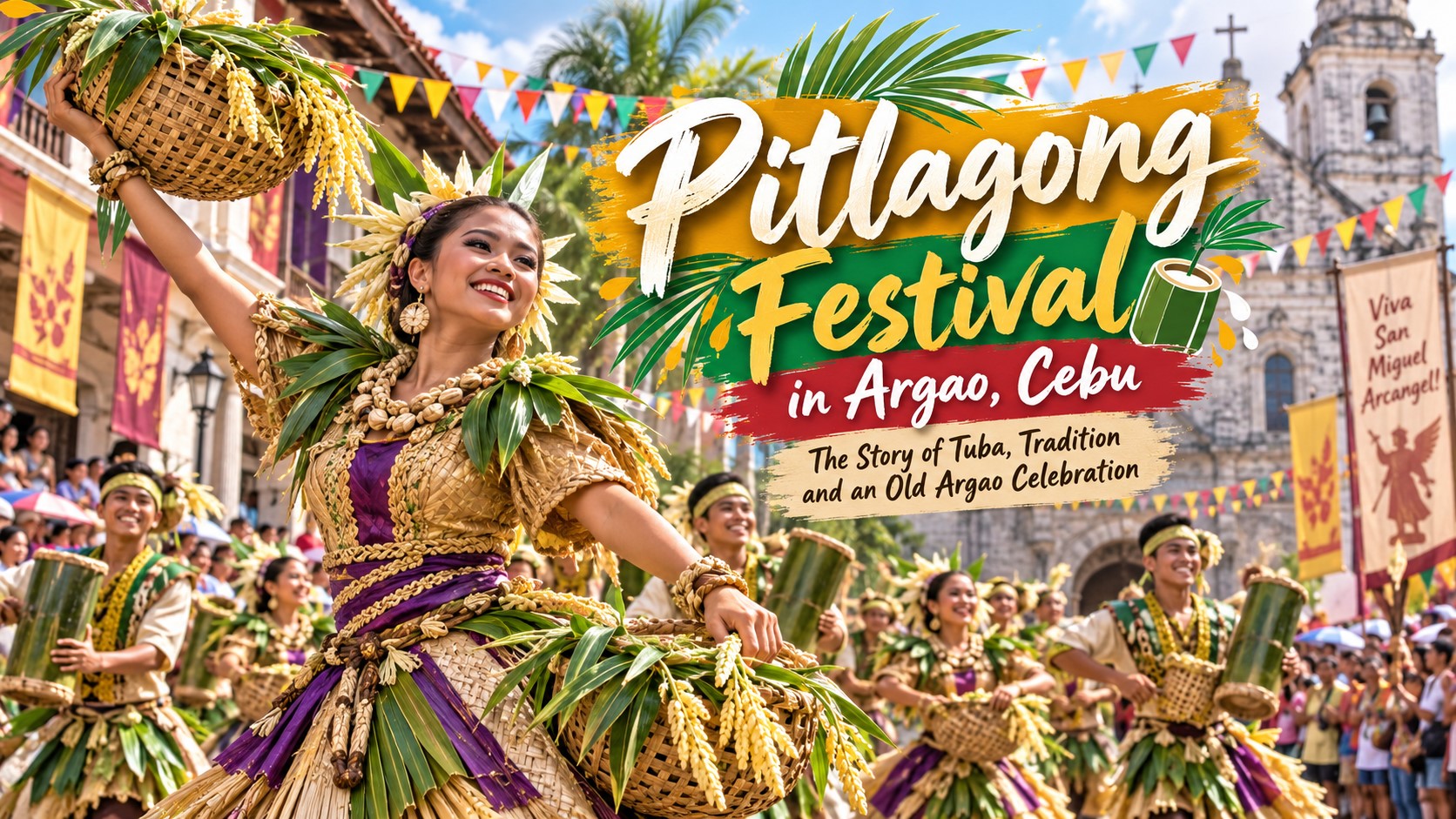
One of the festival’s most visible attractions was street dancing.
Participating groups moved through the streets of Argao performing routines inspired by the festival theme.
This allowed ordinary activities surrounding tuba gathering and local livelihood to become choreography.
Think about the possibilities.
A performer imitates someone climbing a coconut tree.
Another portrays the preparation of the flower stalk.
Dancers carry containers representing sugong.
Others show the collection of sap.
Groups celebrate after the day’s work.
A simple livelihood suddenly becomes a moving theatrical production.
Historical festival descriptions consistently identify street dancing as part of Pitlagong celebrations.
The Ritual Showdown
The ritual showdown was another major element.
Instead of simply passing spectators along a parade route, contingents could perform a longer presentation in a designated area.
This allowed performers to tell a more complete story.
The routines could combine religion and livelihood.
St. Michael might become part of the narrative.
Tuba gathering could provide the main theme.
Argao’s traditions could be incorporated through costumes, props and music.
This format remains familiar in Cebu festivals today.
The street-dancing portion brings the festival through the community, while the showdown gives contingents an opportunity to present their full choreographed piece.
Faith, Work and Merrymaking
The old Pitlagong Festival represented three sides of traditional fiesta culture remarkably well.
First was faith.
The celebration formed part of Argao’s devotion to San Miguel.
Second was work.
The pitlagong symbolized the livelihood of tuba gatherers and the broader agricultural life of the community.
Third was merrymaking.
Tuba is also a social drink.
Friends and neighbors traditionally shared it during gatherings.
Accounts surrounding the festival describe the tagay culture associated with tuba, where a drink can be passed among companions as part of social interaction.
Those three things—faith, livelihood and fellowship—came together naturally during fiesta season.
The Social Side of Tuba
Tuba has never been purely an agricultural product.
It has a social role too.
In many Filipino communities, sharing a drink becomes a way of spending time together.
People talk.
Stories come out.
Neighbors catch up.
Friends joke.
A simple drinking session can become part of community bonding.
Traditional Cebuano drinking customs often involve tagay, where people share drinks in turns rather than everyone keeping a separate glass.
Older accounts of Pitlagong Festival connect this communal drinking culture with the symbolism of the festival.
That social association eventually became one reason Argao reconsidered the Pitlagong theme.
But before getting to that transition, there is another important connection to explain.
Tuba and Argao’s Famous Torta
Here’s where the story comes full circle.
Pitlagong Festival was replaced by a festival devoted to torta.
At first, those two themes might seem completely unrelated.
One represents coconut wine.
The other represents a pastry.
But they’re actually connected.
Traditional Argao torta uses tuba in the baking process.
Instead of relying exclusively on ordinary commercial yeast, traditional recipes use fresh coconut toddy as a leavening or rising ingredient.
That gives the pastry part of its distinct identity.
Modern provincial tourism material continues to highlight Argao’s torta as one of the municipality’s defining foods.
So when Argao transitioned from Pitlagong Festival to La Torta Festival, the town didn’t completely abandon the cultural world represented by Pitlagong.
Tuba followed it into the new celebration through the torta itself.
Argao’s Torta Tradition
Torta in Argao is not the Spanish omelet that international travelers might imagine when they hear the word.
This is a Cebuano pastry.
It is rich, soft and traditionally associated with special occasions.
Recipes vary between families and bakeries, but common ingredients can include flour, eggs, sugar and fat, along with tuba as part of the traditional preparation.
The pastry has become one of the best-known food souvenirs from Argao.
Families serve it during fiestas.
Visitors bring boxes home.
It appears at celebrations.
Bakeries produce their own versions.
Its cultural value is precisely why Argao eventually decided that torta could represent the town more clearly than Pitlagong.
Why Was Pitlagong Festival Replaced?
This is the most important part of the festival’s modern history.
In 2011, Argao replaced Pitlagong Festival with La Torta Festival.
This wasn’t simply a random renaming.
Academic research on the transition explains that the municipality wanted a festival theme that could represent Argao’s identity more effectively while moving away from the strong association between Pitlagong and alcoholic drinking.
Another account links the shift with efforts to highlight distinctive local products and the broader one-town-one-product approach to tourism and economic promotion.
Community representatives considered several possible themes.
These reportedly included retaining Pitlagong as well as celebrations built around torta, tableya and hablon.
La Torta eventually emerged as the choice.
It made sense.
Argao’s torta could be marketed.
Visitors could buy it.
Bakeries benefited.
The product had historical and culinary connections to the town.
And unlike a festival centered around an implement associated with alcoholic beverage production, torta could be promoted easily to families and travelers of all ages.
The End of Pitlagong—or Its Evolution?
It would be easy to say that Pitlagong Festival simply ended in 2011.
Technically, as the official Argao festival name, that’s essentially what happened.
But culturally, the story is more complicated.
A lot of what Pitlagong represented survived.
Tuba remained.
The workers and traditions surrounding coconut sap remained.
The feast of St. Michael remained.
Street dancing remained.
Argao’s cultural heritage remained.
And tuba became part of the story told through torta.
So perhaps the transition is better understood as an evolution.
Argao changed the symbol at the center of its festival.
The pitlagong gave way to the torta.
But both belonged to the same cultural landscape.
La Torta Festival Arrives
La Torta Festival debuted as Argao’s new cultural festival in 2011.
It quickly gained recognition.
That same year, Argao’s La Torta contingent won the street-dancing competition at Pasigarbo sa Sugbo and also took the festival-jingle award while placing in other categories.
The festival retained many characteristics familiar from Pitlagong.
There was street dancing.
There was a showdown.
There was devotion to St. Michael.
There was storytelling about Argao’s culture.
But the town’s famous pastry now occupied center stage.
In that sense, anyone studying La Torta Festival today is also looking at the continuation of a festival tradition that passed through Pitlagong.
What Pitlagong Tells Us About Argao
The most interesting festivals are usually the ones that tell you something specific about their hometown.
Pitlagong certainly did.
It told visitors that coconut farming mattered.
It showed that specialized traditional occupations existed around coconut sap.
It introduced words like pitlagong and sugong that outsiders probably wouldn’t otherwise hear.
It connected livelihood with fiesta.
It celebrated St. Michael.
And it reflected a time when tuba occupied an even more visible place in community social life.
Those details are valuable precisely because they’re so local.
You could move Pitlagong Festival somewhere else, but it wouldn’t carry exactly the same meaning.
It belonged to Argao.
The Heritage Town Behind the Festival
Argao itself makes the festival story even more interesting.
The town is one of southern Cebu’s notable heritage destinations.
Its historic center retains structures and spaces reflecting its long Spanish colonial history.
At the heart of the town stands the large St. Michael the Archangel church complex.
Nearby heritage buildings reinforce the atmosphere of an old Cebu settlement.
Today’s provincial tourism promotion continues to highlight Argao for its historic church, heritage character, local crafts and food traditions.
So when Pitlagong’s performers once danced through Argao, they were performing inside a setting that already contained centuries of history.
San Miguel Arcangel and Argao Identity
For visitors concentrating on colorful festival performances, it’s easy to overlook the patron saint.
But San Miguel is central to Argao’s fiesta identity.
St. Michael the Archangel is traditionally portrayed as the heavenly warrior defeating evil.
Churches dedicated to him commonly show the archangel carrying a sword or spear.
Argao’s devotion continues through the present day, with September 29 recognized by the Archdiocese of Cebu as the shrine’s feast day.
Pitlagong Festival therefore had two intertwined stories.
One came from Catholic devotion.
The other came from local livelihood.
That combination is a recurring pattern in Cebuano festivals.
Pitlagong as Cultural Vocabulary
There’s another reason I think the festival remains worth writing about even though it no longer exists officially.
It preserves a word.
Pitlagong.
Languages change.
Traditional tools disappear.
Younger generations grow up using modern equipment.
Occupations decline.
Eventually, a word once understood by almost everyone in a community might mean very little to younger residents.
A festival can prevent that from happening.
Even after Pitlagong Festival was replaced, the old name invites people to ask the same question:
“What is a pitlagong?”
Then someone explains the sugong.
Then someone explains tuba.
Then someone talks about the manunuba.
Then someone explains how tuba goes into Argao torta.
And suddenly one forgotten-looking word has opened an entire conversation about heritage.
Other Argao Traditions
Pitlagong also belongs to a much larger collection of Argao traditions.
The municipality is known for torta.
It has a strong tableya or cacao tradition.
Hablon weaving is another important craft, and Cebu’s current tourism portal specifically highlights Hinablon sa Argao as a celebrated local weaving tradition.
Agriculture remains part of the local identity.
Then there are heritage structures, religious traditions and local stories.
All of these elements help explain why finding a single symbol for an Argao festival was never easy.
There was simply too much culture to choose from.
Visiting Argao During Fiesta Season
Travelers hoping to experience the spirit of the old Pitlagong celebration should now plan for La Torta Festival instead.
Argao’s patronal feast falls on September 29.
The current festival season brings cultural programs, street dancing and religious activities associated with St. Michael and La Torta.
Even without Pitlagong on the official program, visitors can still explore the cultural connections behind it.
Try local torta.
Ask about tuba.
Visit the church.
Look for locally produced tableya.
Learn about hablon.
Walk around the heritage district.
Once you know the Pitlagong story, many of those experiences become connected.
How to Get to Argao
Argao is located in southern Cebu, along the island’s southeastern side.
From Cebu City, travelers generally head south by bus or private vehicle.
The town center is accessible along the main highway and makes a convenient destination for travelers exploring southern Cebu.
Unlike destinations where attractions are scattered far from the poblacion, several of Argao’s most important heritage landmarks can be experienced around the historic center.
If you’re traveling during fiesta season, expect more people than usual.
Argawanons living elsewhere often return home, religious celebrations bring additional visitors, and cultural events can make the town center much busier.
Don’t Leave Without Trying Torta
If you’re researching Pitlagong Festival, eating Argao torta might seem like jumping forward to a completely different festival.
It isn’t.
Remember the connection.
Tuba.
The same coconut sap tradition represented by Pitlagong also contributes to the distinctive character of traditional Argao torta.
That makes the pastry almost a bridge between Argao’s old and new festival identities.
Pitlagong told the story of tuba production.
La Torta tells the story of one thing Argawanons make with it.
Seen that way, the transition starts to feel surprisingly logical.
Pitlagong Festival vs. La Torta Festival
The two festival names are sometimes treated online as though they’re interchangeable.
They’re not exactly the same.
Pitlagong Festival was Argao’s earlier cultural festival.
Its central image came from the traditional tool associated with collecting tuba.
La Torta Festival replaced it in 2011 and shifted the emphasis toward Argao’s signature pastry and broader heritage.
Both honored the cultural identity of Argao.
Both were associated with the town fiesta of St. Michael.
Both used street dancing and ritual performance.
And both were connected, directly or indirectly, with tuba.
But since 2011, La Torta has been the official festival identity.
That distinction matters, especially for travelers searching for current schedules.
Is Pitlagong Festival Still Celebrated?
As a separate official municipal festival, no.
Pitlagong Festival was replaced by La Torta Festival in 2011. This is documented both in academic research on Argao’s festival culture and in current descriptions of La Torta.
You may still encounter Pitlagong in older festival directories, blog posts and lists of Philippine celebrations.
Some of those pages continue to give it a September date.
But those listings shouldn’t be interpreted as evidence that Argao currently holds a separate Pitlagong Festival every year.
The active festival is La Torta.
Pitlagong Festival 2026
This is where travelers need to be especially careful.
There is no separate official Pitlagong Festival 2026 schedule because Pitlagong is no longer Argao’s current municipal festival.
In 2026, Argao continues to be represented by La Torta Festival. The Cebu Provincial Government’s current festival material specifically identifies La Torta Festival as Argao’s celebration, highlighting the town’s torta, heritage and devotion to St. Michael the Archangel.
St. Michael’s feast day remains September 29.
So if you’re planning to visit Argao in September 2026 after finding an old online listing for “Pitlagong Festival,” look for the La Torta Festival and Argao fiesta program instead.
Pitlagong belongs to the history behind today’s celebration.
Why Pitlagong Festival Is Still Worth Remembering
Festivals change.
That’s normal.
Communities change.
Tourism changes.
Local economies change.
The symbols towns choose to represent themselves change too.
But when an old festival disappears, it’s easy to lose the stories attached to it.
Pitlagong Festival deserves to be remembered because it recorded an ordinary piece of life in Argao.
A small tool.
A bamboo container.
A coconut tree.
A worker climbing its trunk.
Sap dripping slowly.
Tuba being collected.
Friends sharing a drink.
Families celebrating a fiesta.
Dancers carrying those scenes into the street.
None of those things sound spectacular by themselves.
Together, they tell the story of a community.
Final Thoughts
Pitlagong Festival may no longer appear on Argao’s modern festival calendar, but its story is far from irrelevant.
In fact, understanding Pitlagong makes today’s La Torta Festival more meaningful.
Before the torta became the star, Argao celebrated one of the tools behind another important local tradition: tuba making.
The pitlagong represented the people who climbed coconut trees, maintained the containers and collected the sap.
Tuba represented livelihood and social life.
St. Michael represented faith.
Street dancing transformed all of it into a celebration.
Then, in 2011, Argao chose a new symbol.
The festival became La Torta.
But the cultural thread wasn’t cut.
Tuba went from the center of the festival story into the pastry at the center of the new one.
And that’s what makes Pitlagong Festival such an interesting chapter in Argao’s history.
It reminds us that festivals aren’t frozen traditions.
They evolve with the communities celebrating them.
The names may change.
The costumes may change.
The symbols may change.
But underneath all of that, the same story remains: a town finding creative ways to celebrate its faith, its livelihood and the traditions that make it distinctly its own.