There are Philippine festivals named after saints, flowers, fruits and historical events.
Then there is D’Dalaylay Festival.
At first glance, the name doesn’t immediately tell you what the celebration is about. But once you break it down, you begin to understand Jalajala itself.
Dairy.
Isda.
Gulay.
Palay.
Milk, fish, vegetables and rice.
These aren’t just ingredients you might find in a Filipino kitchen. In Jalajala, Rizal, they represent livelihoods—the farmers, fishermen, livestock raisers and agricultural communities that have helped sustain the town for generations.
And every time performers take to the streets during D’Dalaylay Festival, these everyday sources of livelihood become something much bigger.
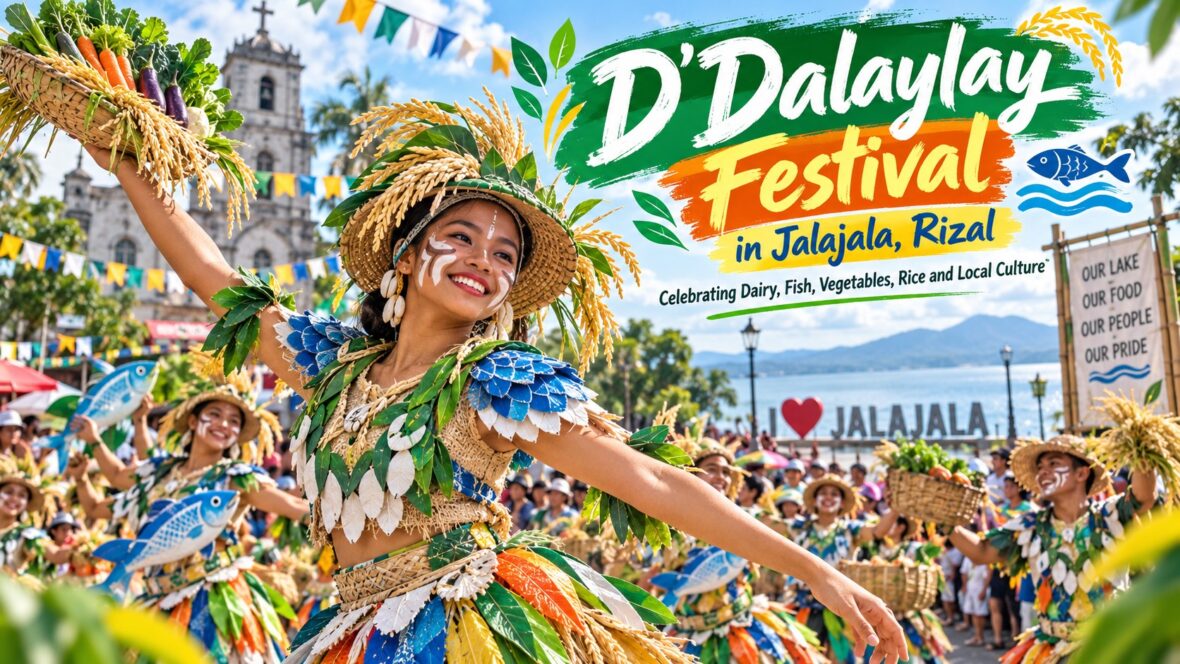
Rice fields become costumes.
Fish become colorful props.
Vegetables become decorations.
Farm life turns into choreography.
And the entire celebration becomes a way for Jalaleños to tell visitors what their town is all about.
Welcome to D’Dalaylay Festival.
Content
What Is D’Dalaylay Festival?
D’Dalaylay Festival is the cultural festival of Jalajala, a municipality in the eastern part of Rizal Province.
It showcases the town’s agricultural and fishing livelihoods through colorful street dancing, elaborate costumes, music and choreographed performances.
The celebration has also been closely associated with St. Michael the Archangel, Jalajala’s patron saint.
The Rizal Provincial Government describes D’Dalaylay as a festival featuring street dances performed by representatives from Jalajala’s barangays and schools, with participants wearing colorful and creative costumes.
Historically, festival descriptions often placed D’Dalaylay on September 29, the feast of St. Michael.
More recent celebrations, however, have also connected the festival with Jalajala’s municipal founding anniversary in March.
That evolution is important, and we’ll come back to it later.
First, let’s talk about the unusual name.
What Does D’Dalaylay Mean?
This is one of the most interesting things about the festival.
The name is constructed from products associated with Jalajala’s economy.
Local accounts explain D’Dalaylay through the words:
D – Dairy
Da – Isda
Lay – Gulay
Lay – Palay
Another published explanation simplifies “Dalaylay” itself as an acronym built from isDA, guLAY and paLAY. A 2018 Manila Bulletin report used precisely that explanation when describing Jalajala’s Dalaylay Dance Competition.
Older local documentation also describes D’Dalaylay as representing dairy, isda, gulay and palay, while a video of the 2014 festival identifies its theme as “Dairy, Gulay, Palay, Isda.”
Whichever ordering you encounter, the basic idea remains the same.
The festival name represents Jalajala’s livelihood.
And that’s what makes it such an effective local festival.
It isn’t named after something arbitrary.
It is built from what people grow, raise and harvest.
Why Dairy?
Dairy might be the most unexpected part of the festival name.
Many travelers don’t immediately associate Rizal Province with milk production.
But Jalajala has an established carabao-based dairy industry.
The Rizal Provincial Government highlights Dairy Delights in Barangay Bayugo, produced by the Llano Farmers Multi-Purpose Cooperative. Provincial tourism information notes that cooperative members raise carabaos and produce fresh milk that is processed and marketed locally and beyond the municipality.
That helps explain why dairy deserves a place in D’Dalaylay.
Carabaos aren’t simply farm animals here.
They provide another source of livelihood.
Milk can become fresh dairy products.
Farmers can diversify their income.
And a product that might seem ordinary becomes part of the town’s identity.
During festival presentations, this agricultural side of Jalajala gives dancers plenty of material to work with.
Carabaos.
Milk containers.
Farm scenes.
Pastures.
Farmers.
All of them can become part of the storytelling.
Why Isda?
Then there is isda.
You only need to look at a map to understand why fishing matters to Jalajala.
The municipality sits beside Laguna de Bay.
For generations, the lake has supported fishing communities around Rizal and Laguna.
The Rizal Provincial Government identifies Laguna de Bay as the province’s major aquaculture resource. Bangus, tilapia and bighead carp are among the species raised commercially, while other freshwater species are also found throughout the lake.
In Jalajala, the lake is impossible to separate from the landscape.
Drive through parts of the municipality and you’ll see water on one side and agricultural land on the other.
That combination explains D’Dalaylay perfectly.
Land provides one source of livelihood.
The lake provides another.
Fish appearing in festival props and costumes aren’t merely decorations.
They represent real families whose income is connected with Laguna de Bay.
Why Gulay?
Vegetables form another important part of the festival’s agricultural theme.
Jalajala’s rural areas contain farms where residents grow crops for local consumption and sale.
Current municipal agricultural programs continue to support vegetable production. Jalajala’s municipal Citizen’s Charter, for example, includes the distribution of seeds and seedlings for vegetable cultivation and fruit trees.
That makes gulay another natural choice for D’Dalaylay.
During street dancing, vegetables allow costume designers to become incredibly creative.
Imagine giant eggplants.
Bright green leaves.
Tomatoes.
Squash.
Beans.
Baskets of produce.
A farm harvest can become one of the most colorful themes you could possibly bring into a parade.
And behind all that color is something very practical.
Food production.
Why Palay?
Palay completes the picture.
Rice remains one of the foundations of Philippine agriculture, and Jalajala is no exception.
The municipality maintains agricultural programs supporting rice farmers, including seed distribution intended to improve palay production.
The imagery of rice is especially suited to festival performance.
Young green plants can represent planting season.
Golden stalks symbolize maturity and harvest.
Farmers carrying bundles of rice can become choreographed characters.
Large woven baskets and native hats complete the scene.
And once dancers begin moving together, an entire rice field can appear to come alive on the street.
D’Dalaylay Is Really a Livelihood Festival
This is probably the easiest way to understand the celebration.
D’Dalaylay is a livelihood festival.
Yes, there is street dancing.
Yes, there are colorful costumes.
Yes, competition can become intense.
But underneath the spectacle are actual economic activities.
People raise carabaos.
People produce milk.
People fish.
People plant vegetables.
People cultivate rice.
When dancers recreate those activities, they’re performing stories their own families may recognize.
That makes D’Dalaylay different from a festival theme invented purely for entertainment.
The source material already exists in everyday Jalajala.
The festival simply puts it onstage.
Where Is D’Dalaylay Festival Celebrated?
D’Dalaylay Festival is celebrated in Jalajala, Rizal.
The town occupies a peninsula-like area along Laguna de Bay and is among the more rural municipalities of Rizal Province.
Coming from the heavily urbanized parts of Metro Manila and western Rizal, the change can be surprising.
Buildings become less dense.
Fields appear.
Livestock becomes more common.
Mountain views open up.
And Laguna de Bay dominates sections of the landscape.
This setting explains why agriculture and fishing remain so visible in the festival.
D’Dalaylay belongs to the geography of Jalajala.
Move the festival into the middle of a dense city and the theme wouldn’t carry the same meaning.
Why Is the Town Called Jalajala?
Even the town’s name is associated with its relationship with water.
One widely repeated local explanation traces Jalajala to halaan, referring to shellfish once abundant along the lakeshore.
Historical accounts also record Jalajala’s long development through the Spanish colonial period before it was finally re-established as an independent municipality in 1907. The present municipal anniversary traces to March 27, 1907.
This history eventually became important to D’Dalaylay itself because the festival developed not only as a patronal celebration but also as part of activities surrounding Jalajala’s founding anniversary.
St. Michael the Archangel
You can’t tell the story of D’Dalaylay without San Miguel Arcangel.
St. Michael the Archangel is Jalajala’s patron saint.
The devotion has deep roots.
According to the Rizal Provincial Government, a bamboo church was constructed in Jalajala by a Franciscan priest in 1676. A stone church replaced it in 1733, around the period when St. Michael became identified as patron of the church and community.
The provincial tourism office describes devotion to St. Michael as so strong that Jalajala has become closely identified with the archangel.
That relationship is important when you watch D’Dalaylay.
The festival’s agricultural theme represents livelihood.
St. Michael represents faith.
Together they create the kind of celebration you’ll find in many Philippine towns—one where religious devotion and everyday community life aren’t treated as completely separate things.
September 29 and the Traditional Fiesta
Historically, September 29 has been the date most commonly associated with D’Dalaylay Festival.
That is the feast of St. Michael the Archangel.
Rizal tourism references describe the festival as a September 29 celebration featuring street dances from different barangays and schools.
Documentation from 2009 and 2010 also shows D’Dalaylay street dancing taking place on September 29.
In 2010, for example, contingents representing Jalajala barangays paraded through town before performing in a dance competition. Barangay Bagumbong was reported as that year’s winner.
That gives us a useful snapshot of what the traditional festival looked like.
Barangays prepare.
Dancers rehearse.
Costumes are created.
The contingents parade through town.
Then everything builds toward a final showdown.
The Street Dancing Competition
Street dancing is the heart of D’Dalaylay’s public spectacle.
Barangays, schools or organized contingents perform along designated routes while spectators line the streets.
The performers aren’t simply walking in costumes.
They’re telling a story.
You might see movements inspired by planting.
Fishing.
Harvesting.
Milking.
Carabao raising.
Carrying baskets.
Working in fields.
The details depend on the contingent’s chosen interpretation.
And because the theme is so broad, every group has room to be creative.
One might focus on palay.
Another might emphasize fishing.
Another might combine all four livelihood components into one production.
That’s where competition becomes interesting.
Everyone is telling the story of Jalajala.
But each group tells it differently.
The Final Showdown
After the parade comes the part many festival fans wait for—the final showdown.
Instead of performing while continuously moving along a street, contingents are given a larger performance area where they can present their full routine.
This allows more complicated choreography.
Dancers can form patterns.
Large props can enter.
Characters can interact.
A small farm can appear.
A fishing scene can unfold.
Costumes can change.
The music can build toward a dramatic ending.
Historical accounts describe packed local venues for these showdown-style competitions, demonstrating how important the event has become to residents.
And the tradition continues.
Footage from the 2026 D’Dalaylay Festival shows barangay contingents performing final-showdown presentations as part of the contemporary celebration.
The Costumes
If there is one place where D’Dalaylay’s agricultural identity becomes immediately visible, it’s the costumes.
Festival designers have four strong themes to work with:
Dairy.
Fish.
Vegetables.
Rice.
That opens up almost endless possibilities.
Yellow and gold can represent palay.
Green works naturally for vegetables and farmland.
Blue represents the lake and fishing.
White can suggest milk and dairy products.
Then designers can add fish scales, leaves, rice stalks, baskets, fishing nets, farm tools and other recognizable symbols.
The best costumes don’t simply look colorful.
They communicate something.
Even if you knew nothing about Jalajala before arriving, the costumes should give you clues about how people make a living.
Schools and Barangays Keep the Festival Alive
One of D’Dalaylay’s strongest characteristics is local participation.
This isn’t simply a professional dance production brought into town.
Historical accounts document participation from Jalajala barangays as well as local schools.
In the 2009 celebration, groups from different barangays and schools performed in the festival.
That community structure matters.
Students learn the dances.
Parents help prepare costumes.
Local choreographers create routines.
Barangay officials support contingents.
Residents watch relatives perform.
What begins as a competition becomes a community project.
And that’s often how festivals survive.
Not because tourists keep coming.
Because residents continue caring.
D’Dalaylay and Typhoon Ondoy
There is an important piece of festival history that sometimes gets misunderstood online.
Typhoon Ondoy struck Luzon in September 2009 and caused devastating flooding throughout Metro Manila and parts of Rizal.
Jalajala still proceeded with its September 29 fiesta and D’Dalaylay Festival.
A local account written immediately after the storm described the 2009 celebration as an expression of thanksgiving through St. Michael because Jalajala had escaped some of the catastrophic flooding experienced in neighboring areas.
That story became strongly associated with the festival.
But it is safer not to say that Typhoon Ondoy created D’Dalaylay unless stronger historical documentation emerges.
What we can say confidently is that the 2009 D’Dalaylay took on a particularly powerful meaning.
After a disaster affecting much of the province, the festival became an act of gratitude.
The dances weren’t simply entertainment that year.
They were thanksgiving.
A Festival of Gratitude
That idea actually fits D’Dalaylay very well.
Farmers depend on weather.
Fishermen depend on the lake.
Crops depend on rain.
Livelihood can disappear after one typhoon.
Agricultural communities understand uncertainty better than most.
So a festival celebrating harvest, livelihood and faith naturally becomes a festival of gratitude too.
Thanksgiving for food.
For work.
For surviving another season.
For community.
For protection.
For another harvest.
The festival doesn’t need to announce all of those things directly.
They’re already built into what D’Dalaylay represents.
Jalajala as a Farming Community
Spend enough time in Jalajala and you’ll understand why D’Dalaylay doesn’t feel artificial.
Agriculture isn’t simply part of the municipality’s past.
It remains visible.
The local government continues programs supporting rice farmers and vegetable growers.
Livestock and dairy production remain part of the local economy.
Laguna de Bay continues supporting fishing and aquaculture.
This is why D’Dalaylay works.
It takes the real economy of the town and translates it into a cultural performance.
That’s festival storytelling at its best.
Dairy Culture in Barangay Bayugo
If you want to explore one of the less obvious parts of the D’Dalaylay theme, learn about Jalajala’s dairy production.
Barangay Bayugo has been associated with organized carabao dairy farming.
The Llano Farmers Multi-Purpose Cooperative has produced and marketed milk through Dairy Delights, according to Rizal provincial tourism information.
This gives visitors another way to understand Jalajala.
The festival doesn’t merely tell you “D is for dairy.”
There are actual farmers behind that letter.
Actual carabaos.
Actual milk production.
Actual livelihoods.
Once you’ve seen that, the acronym becomes much more meaningful.
Fishing Along Laguna de Bay
The same thing happens with isda.
When you look across Laguna de Bay from Jalajala, you’re looking at one of the largest livelihood systems in the region.
Fish cages and fishing communities are part of life around the lake.
Bangus and tilapia are among the most familiar species.
At the festival, a giant fish-shaped prop can look playful.
On the lake, that same fish represents someone’s income.
Festivals have a way of turning economic realities into symbols.
D’Dalaylay does that particularly well.
Palay and Gulay in the Countryside
Travel beyond the town center and Jalajala’s agricultural character becomes even clearer.
Fields stretch across parts of the municipality.
Small farms appear between communities.
Vegetables grow on plots of land.
Rice farming follows seasonal cycles.
The scenery gives D’Dalaylay its visual language.
Green plants.
Golden rice.
Farmers.
Native baskets.
Harvest.
These images aren’t borrowed from somewhere else.
They’re already there.
The Festival and Jalajala’s Foundation Anniversary
Here’s where D’Dalaylay’s schedule becomes particularly interesting.
Older festival directories and Rizal tourism references strongly associate D’Dalaylay with September 29 and the feast of St. Michael.
But over time, the festival also became part of Jalajala’s March founding anniversary celebrations.
A 2014 D’Dalaylay competition, for example, was documented on March 27.
In 2018, Manila Bulletin reported a Dalaylay Dance Competition during the municipality’s 111th founding anniversary in March.
That means D’Dalaylay has grown beyond a single patronal-fiesta date.
It has also become a broader cultural identity for the municipality.
So When Is D’Dalaylay Festival Celebrated?
This is where older online festival lists can become confusing.
If you’re researching the festival historically, September 29 is absolutely important.
That is St. Michael’s feast day, and D’Dalaylay street dancing was documented on that date in earlier years.
But if you’re planning an actual trip, don’t assume the current main competition will always happen on September 29.
Recent versions have been staged in March in connection with Jalajala’s founding anniversary.
The safest approach is to check that year’s official municipal or tourism program.
D’Dalaylay Festival 2026
The 2026 edition provides a perfect example of why travelers should verify the current schedule.
Jalajala Tourism launched a D’DaLayLay Festival 2026 campaign in February.
Municipal procurement records described the celebration as part of the “119th Founding Anniversary of D’Dalaylay Festival 2026,” confirming its connection with Jalajala’s municipal anniversary celebrations.
The town traces its modern municipal re-establishment to March 27, 1907, making 2026 its 119th anniversary.
Festival footage shows the D’Dalaylay 2026 final showdown taking place on March 28, with barangay contingents competing in the cultural presentation.
So for 2026 specifically, the major D’Dalaylay competition belonged to the March founding-anniversary celebration rather than waiting until September.
September 29 nevertheless remains important as the traditional feast day of St. Michael the Archangel.
Visiting Jalajala for the Festival
One of the advantages of D’Dalaylay is its location.
Jalajala is still close enough to Metro Manila for an overland trip, but the atmosphere feels much more rural.
The journey through eastern Rizal offers views of mountains, agricultural areas and Laguna de Bay.
Once you reach town, festival days naturally bring heavier traffic and larger crowds than usual.
If you’re coming specifically for the street-dancing competition, arrive early.
Local festivals rarely have the enormous grandstands of events like Sinulog or Dinagyang.
Finding a good viewing spot can make a huge difference.
Bring water.
Prepare for heat.
And because both March and September events are outdoors, bring protection from sudden rain as well.
Visit St. Michael the Archangel Church
If you’re attending D’Dalaylay, make time for the church at the heart of Jalajala’s patronal tradition.
St. Michael the Archangel Church represents centuries of Catholic history in the municipality.
The parish’s roots stretch back to the Spanish colonial period, with early bamboo and later stone churches forming part of Jalajala’s religious development.
Seeing the church helps put the festival in context.
D’Dalaylay isn’t simply agricultural.
Faith remains part of Jalajala’s identity.
Explore the Lakeside Landscape
Laguna de Bay is another essential part of the experience.
You don’t need a festival prop to understand why “isda” appears in D’Dalaylay.
Just look at the lake.
Fishing has shaped settlements around Laguna de Bay for generations.
Even a quiet drive through Jalajala allows visitors to see the relationship between the town and the water.
That contrast—lake on one side, farmland on another—is perhaps the best visual explanation of D’Dalaylay you’ll ever get.
Try Local Dairy Products
If available during your visit, try products made from local carabao milk.
Milk.
Cheese.
Other dairy products.
They give you a literal taste of the first part of D’Dalaylay.
Food always makes cultural explanations easier.
You can read that dairy is important.
But drinking locally produced milk or tasting a product made by the farmers turns an abstract festival theme into something real.
Why D’Dalaylay Festival Is Special
Rizal Province has several famous festivals.
Angono has Higantes.
Cainta has SumBingTik.
Tanay has Hane and other celebrations.
Different municipalities use festivals to present their own identities.
Jalajala’s identity is unusually grounded in livelihood.
That’s what gives D’Dalaylay its charm.
You don’t need an elaborate legend to explain the festival.
You need a rice field.
A vegetable farm.
A carabao.
A bottle of milk.
A fisherman.
Laguna de Bay.
That’s Jalajala.
And that becomes the festival.
More Than an Acronym
It’s easy to remember D’Dalaylay simply because of the clever name.
Dairy.
Isda.
Gulay.
Palay.
But behind each word is a person.
A dairy farmer wakes up early.
A fisherman heads onto the lake.
A vegetable farmer checks the crops.
A rice farmer prepares for planting or harvest.
Those are the people the festival ultimately represents.
Street dancing gives them color.
Music gives them rhythm.
Choreography turns their work into spectacle.
But the livelihood itself came first.
Why the Festival Matters
Agricultural communities are changing quickly.
Younger generations have more career options.
Technology is changing farming.
Fishing faces environmental pressures.
Urban development continues spreading outward from Metro Manila.
In that environment, a festival like D’Dalaylay serves another purpose.
It records identity.
Even if someday fewer Jalaleños personally work in rice fields or raise dairy carabaos, the festival tells future generations:
This is part of how our town developed.
This is what sustained families here.
This is why the lake matters.
This is why the land matters.
This is where we came from.

Final Thoughts
D’Dalaylay Festival might not be as famous as some of the giant festivals elsewhere in the Philippines.
But sometimes smaller local festivals tell you more about a place.
Jalajala doesn’t need to invent an exotic symbol.
It already has everything it needs.
Dairy from its carabao farmers.
Fish from Laguna de Bay.
Vegetables from its farms.
Palay from its fields.
Faith centered on St. Michael the Archangel.
And communities willing to transform those things into music, costumes and dance.
That is D’Dalaylay.
A festival built from food.
From work.
From faith.
From the lake.
From the land.
And from the people who continue to call this quiet corner of Rizal home.
Once you understand that, the unusual name becomes surprisingly easy to remember.
Dairy. Isda. Gulay. Palay.
D’Dalaylay.
Jalajala telling its story through dance.