General Trias today is easy to associate with subdivisions, new townships, industrial estates, cafés, shopping centers and rapidly expanding roads.
But if you want to understand what GenTri was before all of that, you need to go back to its old town center.
At the heart of that older General Trias is Plaza Rizal.
This isn’t the kind of tourist attraction where you buy a ticket, follow a fixed route and spend three hours going from exhibit to exhibit. Plaza Rizal is much simpler than that. It is a public space surrounded by the everyday life of the city.
And that’s exactly what makes it interesting.
Around this part of GenTri, you begin to see traces of the old San Francisco de Malabon—the community that existed long before the city was renamed General Trias. Nearby stands the centuries-old San Francisco de Malabon Parish Church. Streets carry the names of revolutionary personalities. Historical markers remind visitors that this town played an important role during the Philippine Revolution. And the layout of the old plaza, church, government buildings and commercial streets still reflects the traditional center of a Philippine town.
The General Trias city government itself continues to feature Plaza Rizal as one of the recognizable places associated with the city. Even more interestingly, an older General Trias zoning ordinance specifically described the old plaza, municipal hall, church, public market and surrounding residential area as the Poblacion-Central Business District and envisioned it as both a civic and cultural district.
So if you’ve been exploring General Trias only through its newer developments, Plaza Rizal offers a completely different side of GenTri.
It’s quieter.
Older.
More historical.
And in many ways, closer to the city’s original identity.
Content
Plaza Rizal and Old General Trias at a Glance
| Detail | Information |
|---|---|
| Place | Plaza Rizal |
| City | General Trias, Cavite |
| Historic town name | San Francisco de Malabon |
| Area | Old poblacion / traditional town center |
| Nearby landmark | San Francisco de Malabon Parish Church |
| Historical significance | Part of the civic core of a major Revolutionary-era Cavite town |
| Best for | Heritage walks, history, photography, church visits, local culture |
| Entrance fee | None for the public plaza |
| Recommended visit | Around 30 minutes to 2 hours depending on your heritage itinerary |
| Best time | Morning or late afternoon |
Why Plaza Rizal Matters
At first, Plaza Rizal can seem like an ordinary city plaza.
There are open spaces, trees, benches, government buildings, roads and people going about their day.
But plazas were incredibly important in the way Philippine towns developed during the Spanish colonial period.
The traditional poblacion usually revolved around a central open space, with the church, government offices, market and homes of prominent families nearby.
General Trias followed that pattern.
A 1999 municipal zoning ordinance described the Poblacion-Central Business District as the area containing the old plaza, municipal hall, municipal church, public market, central business district and old prime residential area of General Trias. The same ordinance viewed the plaza and surrounding area as a civic and cultural district rather than simply another commercial zone.
There’s even a fascinating detail in that ordinance.
Building heights in the old Poblacion-CBD were intended to remain lower than the church belfry so that the historic church would retain its visual prominence.
I love that detail because it tells you how important the old church-and-plaza relationship was to the identity of GenTri.
Before tall commercial buildings, before huge subdivisions and before today’s townships, the church tower was one of the defining features of the town skyline.
Before It Was General Trias: San Francisco de Malabon
To understand the plaza, you have to understand the old town.
General Trias was once known as San Francisco de Malabon.
According to the official history published by the City of General Trias, San Francisco de Malabon was established as a municipality on December 13, 1748 and was named after its patron saint, St. Francis of Assisi.
The origin of the word Malabon is less certain.
The city government explains that it may have come from labong, meaning bamboo shoot, or mayabong, referring to abundant or luxuriant vegetation. The city considers the labong explanation more likely because Mariano Trias himself reportedly used “Labong” in his writings and conversations.
San Francisco de Malabon was also once much larger than today’s General Trias.
The old municipality included areas that eventually became Tanza and Rosario.
So when you’re walking around Plaza Rizal today, you’re standing in what was once the center of a much larger historic Cavite town.
A Town at the Center of the Philippine Revolution
This is where the story becomes much more interesting.
San Francisco de Malabon wasn’t simply an old agricultural town.
It became one of Cavite’s important revolutionary centers.
The General Trias city government’s Comprehensive Development Plan records that the First Cry of Cavite occurred in San Francisco de Malabon on August 31, 1896, when Filipino revolutionaries captured the town tribunal. The local account names Mariano Trias, Diego Mojica and Nicolas Portilla among the leaders involved.
The National Historical Commission of the Philippines also maintains a historical marker for General Trias commemorating the town’s revolutionary role. The marker recalls fighting against Spanish forces in August 1896 and notes that Andres Bonifacio stayed in the area before the Tejeros Convention of March 22, 1897.
That’s why walking around old GenTri is more meaningful if you know the history first.
You’re not simply walking through an old commercial district.
You’re moving through a town that became part of the Revolutionary landscape of Cavite.
The Mariano Trias Connection
Of course, the name General Trias comes from Heneral Mariano Trias.
He was one of the major revolutionary figures from San Francisco de Malabon and later became an important official in the Revolutionary Government and First Philippine Republic.
An NHCP marker identifies Mariano Trias as a Katipunan member, a leader of the revolutionary movement in San Francisco de Malabon, a general of the Revolutionary Army, vice president of the Revolutionary Government in 1897, secretary of finance of the First Philippine Republic and later the first civil governor of Cavite.
In 1920, Act No. 2889 changed the name of the town from Malabon to General Trias in his honor.
So the name on modern signs, schools, subdivisions and businesses across GenTri ultimately comes from a revolutionary leader whose life was deeply connected to this old town.
That gives the poblacion a completely different weight.
San Francisco de Malabon Parish Church
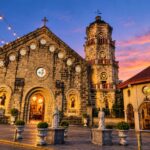
The most important landmark to combine with Plaza Rizal is San Francisco de Malabon Parish Church, also known as St. Francis of Assisi Parish Church or simply GenTri Church.
This church is much older than the modern city surrounding it.
According to the NHCP historical marker, Franciscan missionaries established the first chapel here in 1611, when the area was still a visita of Kawit. San Francisco de Malabon became its own parish in 1753, and construction of the stone church began in 1769.
The church went through several periods of renovation and rebuilding, including repairs following the earthquake of 1880.
But its most famous historical connection came in 1898.
The Plaza, Church and Lupang Hinirang Story
One of the best reasons to include this old part of General Trias in a Cavite heritage trip is its connection to the Philippine National Anthem.
The NHCP church marker states that the Banda Matanda rehearsed the Marcha Filipina inside General Trias Church before performing the music during the proclamation of Philippine independence in Kawit on June 12, 1898.
The NHCP’s General Trias historical marker also commemorates the town’s band for playing Julian Felipe’s composition during the proclamation.
The music eventually became the melody of Lupang Hinirang.
That makes the plaza and church area a natural companion to Aguinaldo Shrine in Kawit.
One site tells you where independence was proclaimed.
The other tells you something about the people who helped provide its soundtrack.
It’s one of those historical connections that makes Cavite much more interesting once you stop viewing its attractions individually.
What Is Plaza Rizal Like Today?
Don’t expect Plaza Rizal to feel like a preserved historical park sealed off from modern life.
This is still part of a working city center.
Vehicles pass nearby.
People conduct business.
Students, residents, government workers and churchgoers move through the area.
Public events can change the atmosphere dramatically.
And that’s part of the experience.
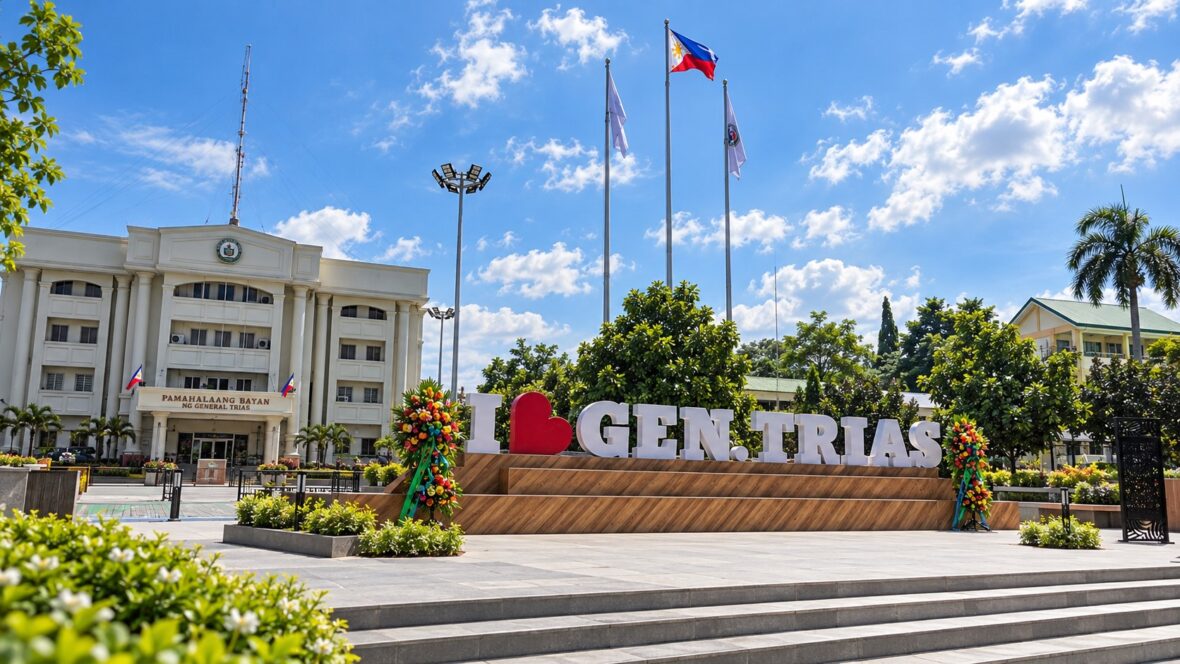
Older photographs of the plaza show a landscaped civic space with palm trees, paved sections, benches and government buildings surrounding the open area. The city continues to use Plaza Rizal prominently in its own public presentation of General Trias.
What I find interesting is that the plaza hasn’t been separated from everyday GenTri.
History sits right beside normal life.
That’s often how Philippine heritage works.
Take Your Time Walking Around
Plaza Rizal isn’t a place where you need a strict checklist.
Instead, walk slowly.
Look toward the church.
Notice the streets leading out from the center.
Pay attention to older buildings mixed among newer ones.
Check for historical markers.
Watch the way residents actually use the space.
You begin to understand why the city government once described this zone not only as a commercial center but also as a cultural district.
Sometimes the value of visiting an old town isn’t that every building is spectacular.
It’s seeing how the town still functions around a layout established generations ago.
Look for Historical Markers
General Trias has several NHCP markers connected to its history.
One commemorates the town’s Revolutionary role.
Another marks General Mariano Trias himself along Governor Ferrer Drive.
There is also a biographical marker associated with his birthplace on Bagumbayan Street.
And, of course, General Trias Church has its own marker describing the church’s development and connection to the Marcha Filipina.
If you’re doing a heritage walk, these markers turn the visit into something more than photography.
Stop and read them.
They’re short enough that it only takes a few minutes, but they give context to what you’re seeing.
Walk Through the Streets of the Old Center
One of my favorite things about old town centers is simply walking the surrounding streets.
Modern GenTri is geographically huge, and many neighborhoods feel very different from one another.
The old center is more compact.
City ordinances identify streets around the historic core such as Sotto, Mendoza, Mabini, San Gabriel, Diego Mojica, Arnaldo, Asercion, 1896th Street, General Trias Street, Juan Luna Street and Plaza Rizal itself.
Even the street names tell a story.
You encounter names tied to history, national figures and local personalities.
This is one of the best places in General Trias to put the car aside for a while and explore on foot.
Visit the Church Even If You’re Not Religious
You don’t need to be Catholic to appreciate San Francisco de Malabon Parish Church.
Approach it as a heritage landmark.
Look at the old stone façade.
Notice the bell tower.
Read the historical marker.
Then step inside quietly if the church is open and no private religious event prevents entry.
Just remember that this is still an active parish.
People may be attending Mass, praying, preparing for a wedding or participating in other religious activities.
Respect that.
The fact that the church is still alive rather than operating purely as a museum is actually one of the most interesting things about the old town.
See the Contrast Between Old and New GenTri
This might be my favorite reason to visit Plaza Rizal now.
General Trias is changing incredibly quickly.
In other parts of the city, you have Maple Grove, Riverpark, large subdivisions, industrial parks and major commercial developments.
Then you return to the old center and find a centuries-old church, traditional streets and a plaza that still acts as a civic gathering place.
The contrast tells you more about General Trias than either side alone.
The new developments show where the city is going.
Plaza Rizal shows where it came from.
Visit During the Town Fiesta
If you want to experience the old town center at its liveliest, visit during the annual General Trias fiesta in honor of St. Francis of Assisi.
The fiesta is celebrated around October 4 and brings religious and community activities into the streets surrounding the parish.
During this period, the area becomes much more than a quiet heritage stop.
The church becomes a center of devotion.
Streets fill with people.
Processions and community events change the normal rhythm of the poblacion.
If your goal is photography and culture, this can be a fantastic time to visit.
If your goal is peaceful sightseeing, choose another day.
Plaza Rizal During December
December is another interesting season because General Trias celebrates its city anniversary and Valenciana Festival around this period.
Public spaces across the city become more active with events, decorations and community celebrations.
Depending on the year’s official program, areas around the traditional civic center can become part of the wider festive atmosphere.
It’s also simply more comfortable to walk around Cavite during cooler December evenings compared with the hottest months of the year.
Best Time of Day to Visit
For photography and walking, I’d recommend early morning or late afternoon.
Midday heat can make a heritage walk unnecessarily tiring.
Morning is good if you want a quieter experience.
Late afternoon works beautifully because you can see the old town in daylight and then watch the atmosphere change as evening arrives.
If you’re also visiting the church, check the current Mass schedule so you can either attend Mass or avoid disrupting a service while you’re photographing the interior.
Is There an Entrance Fee?
No typical admission fee is required to visit Plaza Rizal.
It is a public civic space rather than a commercial tourist attraction.
Likewise, San Francisco de Malabon Parish Church does not operate like a museum with an entrance ticket.
That means you can enjoy a simple heritage trip around this part of General Trias without spending much at all.
Your main expenses will probably be transportation, food and perhaps coffee or merienda afterward.
How Long Should You Spend Here?
If you’re simply stopping by Plaza Rizal, 20 to 30 minutes can be enough.
But I wouldn’t recommend visiting it that way.
Give yourself at least an hour.
That lets you walk around the plaza, visit the church, read the historical markers and explore some of the surrounding streets.
If you’re genuinely interested in Philippine history and photography, two hours can pass surprisingly quickly.
The old center makes more sense when you experience it as one connected heritage area rather than treating Plaza Rizal as a single attraction.
A Simple General Trias Heritage Walk
Start at Plaza Rizal and spend a few minutes taking in the civic center. From there, walk toward San Francisco de Malabon Parish Church and examine the old stone façade before going inside quietly. Look for the NHCP marker describing the church and the Banda Matanda rehearsal.
Afterward, continue through the surrounding poblacion streets and look for markers connected with General Mariano Trias and the Revolutionary history of the town. Finish with lunch, merienda or coffee somewhere in the old center.
It’s not a complicated itinerary.
That’s the point.
A heritage walk doesn’t need ten attractions packed into three hours.
Sometimes slowing down makes you notice more.
How to Get to Plaza Rizal
Plaza Rizal is in the traditional town center of General Trias.
For visitors coming by private vehicle, the historic center can be approached through General Trias Drive and Governor Ferrer Drive depending on your starting point.
City transportation ordinances identify General Trias Drive as the section connecting Tejero Crossing to Prinza Crossing and Governor Ferrer Drive as continuing from Prinza toward Manggahan.
From Metro Manila, many commuters enter Cavite through PITX and then use buses, modern jeepneys or other Cavite-bound services depending on their destination.
The important thing is to specify that you’re going to the old General Trias town proper, Plaza Rizal or San Francisco de Malabon Parish Church.
Simply saying “General Trias” isn’t specific enough.
GenTri covers a large area.
Someone headed to Manggahan, Tejero, Lancaster, Riverpark or Javalera could be going nowhere near your destination.
Parking and Getting Around
Parking conditions around old town centers can vary considerably depending on the day and whether there is a church service or public event.
During normal weekdays, you may find parking in surrounding areas, but don’t assume you’ll be able to leave your vehicle directly beside the plaza.
Fiestas, weddings, Holy Week and major city activities can make the area substantially busier.
Once you’re in the old center, walking is the best way to explore.
Distances within the core are much more manageable than trying to explore the wider city on foot.
What to Wear and Bring
You don’t need special travel gear for Plaza Rizal.
Comfortable walking shoes are the most useful thing.
An umbrella is helpful because Cavite weather can switch between intense sunshine and sudden rain.
Bring water if you’re visiting during the warmer part of the day.
If you plan to enter the church, wear clothing appropriate for an active religious space.
And keep your phone or camera ready because the interesting details aren’t always the obvious ones.
Photography at Plaza Rizal
For travel photography, try to capture more than just the plaza itself.
Include the church tower in wider compositions when possible.
Photograph streets leading away from the center.
Look for old details against newer structures.
Include people when appropriate because the everyday use of the plaza is part of its story.
Historic places can sometimes look lifeless when photographed as empty monuments.
Plaza Rizal works better when you show that it remains part of a functioning city.
Combine Plaza Rizal With Other GenTri Attractions
After exploring the old town, you can build the rest of your day around another part of General Trias.
History lovers can continue to the Geronimo Berenguer de los Reyes Jr. Museum.
Families can spend the afternoon at Kaway’an EcoPark.
You can head toward General Trias City Park later in the day.
Or you can visit Maple Grove to experience the sharp contrast between historic GenTri and the city’s emerging modern districts.
That old-versus-new combination actually makes a great General Trias itinerary.
Start with the past.
End with the future.
Combine It With Aguinaldo Shrine
For a more serious Cavite history trip, combine Plaza Rizal and GenTri Church with Aguinaldo Shrine in Kawit.
This route works especially well because of the Marcha Filipina story.
At General Trias Church, the Banda Matanda rehearsed the composition. At Kawit, the band performed it during the June 12, 1898 proclamation of independence.
Visiting the two places on the same day helps connect the historical events in a way that reading about them separately doesn’t.
Is Plaza Rizal Worth Visiting?
Yes—but you need to approach it with the right expectations.
If you’re looking for rides, attractions, cafés built specifically for tourists or elaborate photo installations, Plaza Rizal isn’t that kind of place.
It’s a heritage stop.
You visit because the plaza helps tell the story of old General Trias.
You visit because San Francisco de Malabon once revolved around this kind of civic center.
You visit because the nearby church has stood here in various forms for centuries.
You visit because the Revolution passed through this town.
And you visit because it gives you a glimpse of GenTri before the highways, subdivisions and modern townships changed its landscape.
For history lovers, that’s enough.
Frequently Asked Questions About Plaza Rizal General Trias
Where is Plaza Rizal in General Trias?
Plaza Rizal is located in the old civic and poblacion area of General Trias, Cavite, close to the city’s historic church-and-government center. The city government continues to feature Plaza Rizal as one of General Trias’ recognizable landmarks.
What can you see near Plaza Rizal?
The most important nearby heritage attraction is San Francisco de Malabon Parish Church. The broader old center also contains historical markers and streets associated with General Mariano Trias and the Revolutionary history of the city.
Is Plaza Rizal free?
Yes. It is a public plaza rather than a ticketed attraction.
How much time do you need?
Allow around one to two hours if you’re combining the plaza with the historic church, markers and a walk around the poblacion.
What was General Trias called before?
General Trias was formerly known as San Francisco de Malabon. The city government dates the establishment of the municipality to December 13, 1748. It was renamed General Trias in 1920 in honor of Mariano Trias.
Why is the old town historically important?
San Francisco de Malabon became an important center of Revolutionary activity in Cavite. Official city records place the First Cry of Cavite here on August 31, 1896, while NHCP markers also commemorate the town’s role in the Revolution.
What is the connection with Lupang Hinirang?
The Banda Matanda rehearsed Julian Felipe’s Marcha Filipina at San Francisco de Malabon Parish Church before performing it during the proclamation of Philippine independence in Kawit on June 12, 1898.
The Old GenTri Is Still Here
General Trias has become one of those cities where development seems to move incredibly fast.
New roads appear.
Subdivisions expand.
Commercial districts rise.
Townships reshape former agricultural land.
And sometimes when a city changes that quickly, it’s easy to forget what was there before.
That’s why Plaza Rizal matters.
It doesn’t need to be the grandest plaza in the Philippines.
Its value comes from context.
The old plaza.
The church.
The government center.
The nearby market.
The surrounding streets.
Together, they show how General Trias once worked as a traditional Cavite town.
A 1999 zoning ordinance even tried to protect this identity by treating the Poblacion-CBD as a cultural district and keeping building heights below the historic church belfry.
That tells you something.
Even while GenTri was modernizing, there was already recognition that the old center deserved to remain visually and culturally important.
Final Thoughts
Plaza Rizal isn’t the kind of place that shouts for attention.
And maybe that’s why I like it.
There’s no dramatic mountain view.
No theme park.
No huge entrance gate telling you that you’ve reached a tourist attraction.
Instead, you arrive in the middle of ordinary General Trias life.
Then you look closer.
You see the old church.
You read the historical markers.
You learn that this place was once San Francisco de Malabon.
You discover how deeply the town was involved in the Philippine Revolution.
You learn about Mariano Trias.
And you find out that musicians once rehearsed inside the nearby church before traveling to Kawit and playing the music that would eventually become Lupang Hinirang.
Suddenly the plaza doesn’t feel ordinary anymore.
For anyone exploring General Trias, I think that’s the best way to experience the old town center.
Don’t rush through it.
Walk.
Look around.
Read the markers.
Visit the church.
And try to imagine GenTri before it became the sprawling modern city we know today.
Because underneath all the new development, old San Francisco de Malabon is still there—you just have to know where to look.