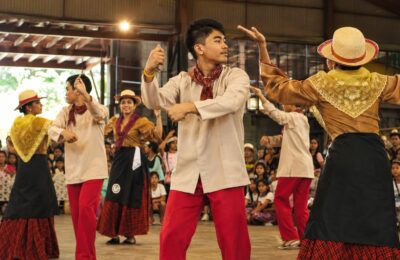
Some traditional Filipino dances are graceful. Some are romantic. Some are playful. But Sayaw sa Bangko is exciting in a different way because it makes you wonder: How do they dance on top of that narrow bench without falling?
This folk dance is exactly what its name says. Sayaw sa Bangko means “dance on a bench.” Instead of performing on a wide stage or open floor, the dancers move, step, hop, and sometimes switch places while standing on top of a narrow wooden bench.
It looks fun and simple at first, but once you see the dancers moving confidently on such a small space, you realize how much balance, coordination, timing, and trust are needed. It is one of those dances that can easily make an audience clap, smile, and hold their breath at the same time.
Content
What Is Sayaw sa Bangko?
Sayaw sa Bangko is a traditional Filipino folk dance commonly associated with Pangasinan. The National Commission for Culture and the Arts’ Talapamana inventory lists Sayaw Ed Tapew Na Bangko as an intangible cultural property connected with Lingayen, Pangasinan.
The dance is usually performed by a couple on top of a narrow bench. The dancers move from one end of the bench to the other, sometimes exchanging places, turning, hopping, or performing graceful steps without falling. Some descriptions note that the bench used in performances is often very narrow, making the dance a real test of balance and skill.
That is what makes Sayaw sa Bangko so entertaining. The audience is not only watching the beauty of the movement. They are also watching the challenge.
The Meaning of the Name
The name is very direct. Sayaw means dance, and bangko means bench. So, Sayaw sa Bangko simply means dance on a bench.
In Pangasinan, the dance is also known as Sayaw ed Tapew na Bangko, which means dance on top of a bench. This local name gives the dance a stronger connection to its regional identity. It is not just a general folk dance; it is part of the cultural heritage of Pangasinan.
Sometimes the simplest names are the most memorable. Once you hear “Sayaw sa Bangko,” you already know what makes the dance special.
Why the Dance Is So Impressive
The main attraction of Sayaw sa Bangko is the bench itself.
Dancing on the floor is already challenging when the steps are fast or complicated. But dancing on top of a narrow bench? That adds a whole new level of difficulty. The dancers need to be aware of every step. One careless movement can lead to losing balance.
But the best performers make it look easy. They move lightly, confidently, and gracefully. They may hop, turn, change places, and interact with each other without looking nervous. That confidence is part of the charm.
The dance is impressive because it combines two things: skill and playfulness. It is not stiff or overly serious. It feels lively and entertaining, but it also quietly shows the discipline and practice behind the performance.
A Dance of Balance and Coordination
Balance is the heart of Sayaw sa Bangko.
The dancers must control their bodies carefully while keeping in rhythm with the music. Their feet must land safely on the bench, their posture must stay steady, and their timing must match their partner’s movement.
Coordination is just as important. Since the dance is often performed by a pair, both dancers must be aware of each other. If one dancer moves too early or too late, the other can be affected. This is especially true when they exchange places or move closely together on the bench.
That is why Sayaw sa Bangko is not only about individual skill. It is also about partnership.
The Role of Trust in Sayaw sa Bangko
One of the most beautiful things about Sayaw sa Bangko is the trust between the dancers.
When two people are moving on a narrow bench, they cannot just think about themselves. They need to move as a team. They must know when to step forward, when to give space, when to turn, and when to support the flow of the dance.
This gives Sayaw sa Bangko a deeper meaning. It is not just about showing off balance. It also reflects cooperation. The dancers need to complement each other so the performance stays smooth and safe.
In a way, the bench becomes a small stage where teamwork is tested. The dance works only when both performers trust each other.
How Sayaw sa Bangko Is Performed
Sayaw sa Bangko is usually performed by a male and female pair, although group versions are also common in schools and cultural programs.
The dance begins with the performers stepping onto the bench. From there, they move along the narrow surface using graceful but careful footwork. They may hop from one section to another, turn around, move past each other, or switch positions.
In some versions, the movements become more daring as the performance continues. Dancers may add playful gestures, faster steps, or more challenging transitions. For staged performances, some groups may even use multiple benches or creative formations to make the dance more exciting.
Even with these variations, the main idea remains the same: dancers must perform beautifully while staying balanced on the bench.
The Music of Sayaw sa Bangko
The music for Sayaw sa Bangko is usually lively and cheerful. It gives the dance its festive energy and helps guide the dancers’ steps.
The rhythm should be bright enough to make the performance fun, but not so uncontrolled that the dancers lose timing. Since balance is very important, the music must support steady movement. The dancers need to feel the beat clearly so they can move with confidence.
In traditional and school performances, the music may be played through recordings or live instruments. What matters most is that the rhythm keeps the dance lively and supports the playful character of the performance.
Costumes Used in Sayaw sa Bangko
Costumes for Sayaw sa Bangko usually follow traditional Filipino folk dance attire.
Female dancers may wear a balintawak, patadyong-inspired dress, or other colorful rural-style Filipino costume. Male dancers may wear a barong Tagalog, camisa de chino, or simple folk-inspired clothing. The costumes are usually bright, festive, and easy to move in.
Since the dancers need to balance on a bench, the costumes should not be too heavy or restrictive. The performers need freedom of movement, especially in the legs and feet.
The clothing adds visual charm, but the real focus remains on the dancers’ skill. The audience’s attention naturally goes to the footwork and the careful movement on top of the bench.
Sayaw sa Bangko in Schools and Cultural Programs
Many Filipinos encounter Sayaw sa Bangko in school. It is often included in Physical Education or MAPEH lessons, especially when students study Philippine folk dances.
It is also performed during Buwan ng Wika, foundation day programs, cultural presentations, folk dance competitions, and town fiestas. Because it is visually interesting and easy for audiences to understand, it is a favorite choice for stage performances.
Students often enjoy watching it because it has an element of suspense. Even if the steps are simple, dancing on a bench makes everything more exciting. The audience naturally waits to see if the dancers can complete the routine without slipping or losing balance.
That is what makes Sayaw sa Bangko such a strong performance piece. It catches attention right away.
Sayaw sa Bangko and Pangasinan Culture
Sayaw sa Bangko is closely connected to Pangasinan, and that connection gives the dance its cultural value. Pangasinan has a rich heritage of songs, dances, festivals, food traditions, and community celebrations. Sayaw sa Bangko is one of the folk dances that helps represent the province’s creativity and local identity.
The NCCA Talapamana listing recognizes Sayaw Ed Tapew Na Bangko as part of the cultural inventory for Lingayen, Pangasinan, which shows its importance as a local intangible heritage item.
This matters because folk dances are not just entertainment. They are also markers of place. They tell us where a tradition comes from, who practiced it, and how a community expressed joy, skill, and celebration through movement.
Why Sayaw sa Bangko Is Popular
Sayaw sa Bangko is popular because it is simple to understand but exciting to watch.
You do not need to know a long story to appreciate it. Once you see dancers performing on top of a narrow bench, the challenge is clear. The audience immediately understands the skill involved.
It is also popular because it feels playful. Unlike some dances that are more formal or dramatic, Sayaw sa Bangko has a cheerful and entertaining quality. It feels like a celebration of talent, balance, and confidence.
The dance also has a bit of suspense, which makes it audience-friendly. People naturally react when dancers step close to the edge, switch places, or perform quick movements on the bench.
What Sayaw sa Bangko Teaches Us
Sayaw sa Bangko teaches several simple but meaningful lessons.
First, it teaches balance. The dancers must stay steady even when the space is small.
Second, it teaches focus. Every step matters.
Third, it teaches teamwork. The dancers must move together and trust each other.
And lastly, it teaches confidence. To perform this dance well, the dancers must believe in their training and stay calm even when the audience is watching closely.
These are the same qualities that make many Filipino folk dances meaningful. They are not only about movement. They also reflect values like discipline, cooperation, grace, and community pride.
Why Sayaw sa Bangko Still Matters Today
Sayaw sa Bangko still matters because it keeps a unique part of Filipino culture alive.
In a time when many young people are more familiar with modern dances and online trends, folk dances like Sayaw sa Bangko remind us of the creativity of earlier generations. They show that Filipino communities could create beautiful and entertaining performances using simple everyday objects.
A wooden bench may seem ordinary. But in this dance, it becomes a stage, a challenge, and a symbol of skill.
That is the beauty of folk culture. It turns simple things into something meaningful.

Final Thoughts
Sayaw sa Bangko is one of the most impressive traditional dances in the Philippines because it combines balance, rhythm, teamwork, and entertainment.
It may not have the bamboo poles of Tinikling or the glowing lamps of Pandanggo sa Ilaw, but it has its own unforgettable charm. Watching dancers move gracefully on top of a narrow bench is exciting because you can clearly see the skill required.
More than anything, Sayaw sa Bangko reminds us that Filipino folk dance is full of creativity. It can be graceful, playful, challenging, and deeply rooted in local culture all at once.
From Pangasinan to school stages and cultural programs across the country, Sayaw sa Bangko continues to show the beauty of Filipino balance, trust, and tradition.