Among the many traditional dances in the Philippines, Singkil stands out because of its elegance, drama, and royal feel. It is the kind of dance that immediately captures your attention—not just because of the bamboo poles, but because of the way the dancers move with such grace and confidence.
At first glance, some people may compare Singkil to Tinikling because both dances use bamboo poles. But once you watch Singkil closely, you will quickly see that it has a very different personality. Tinikling is playful and energetic, while Singkil feels more regal, refined, and theatrical.
With its graceful fan movements, dramatic entrance, rhythmic bamboo clapping, and royal-inspired costumes, Singkil is one of the most beautiful cultural performances in the Philippines.
Content
What Is Singkil?
Singkil is a traditional dance associated with the Maranao people of Mindanao, particularly the culture around Lake Lanao. It is often described as a royal or courtly dance and is commonly performed with bamboo poles, elegant fan movements, and traditional Maranao-inspired attire.
The dance is also strongly connected to the Darangen, the ancient epic of the Maranao people. The Darangen is recognized by UNESCO as part of the Representative List of the Intangible Cultural Heritage of Humanity, and it contains a rich collection of stories, values, customs, and traditions from the Maranao people of Lake Lanao.
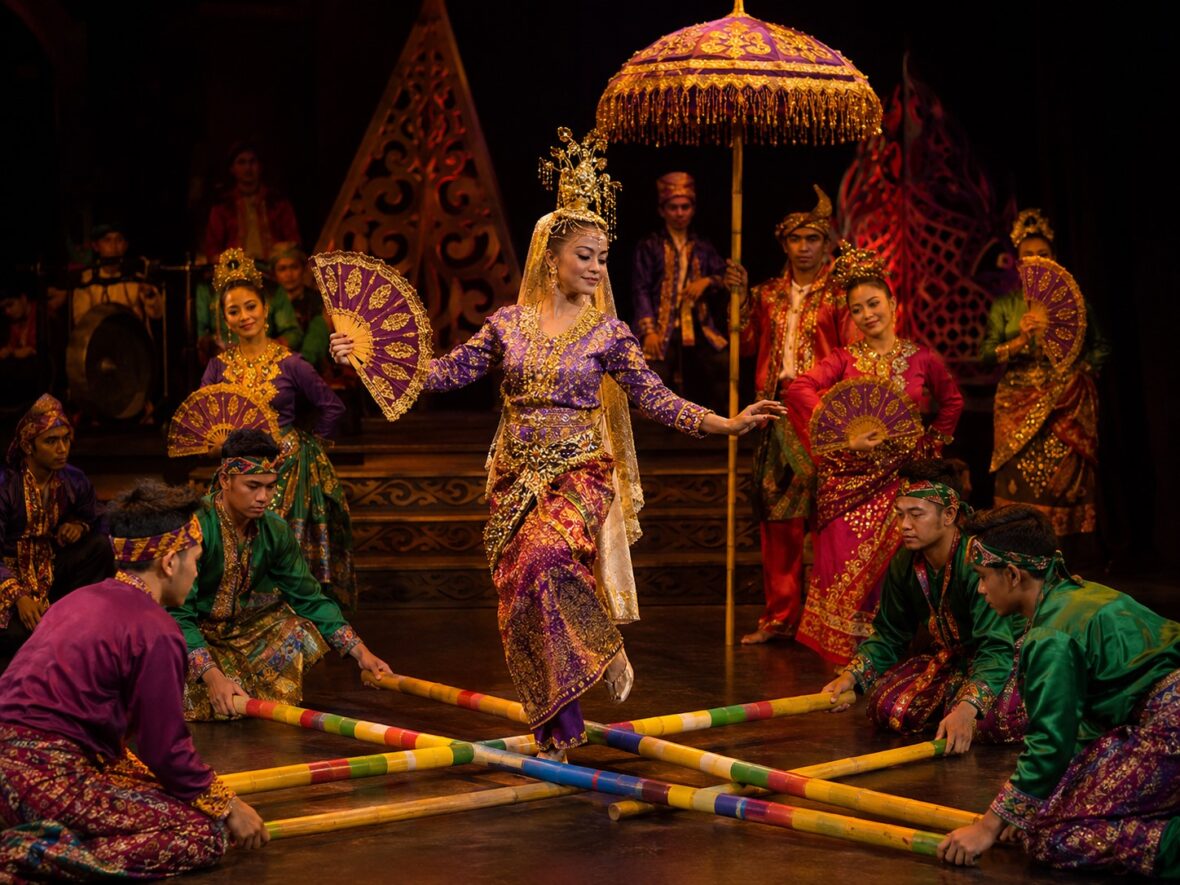
In many staged versions of Singkil, the dance tells a dramatic story involving a princess moving gracefully through a forest during an earthquake, while bamboo poles represent falling trees and obstacles. The lead female dancer steps in and out of the bamboo poles with calm elegance, often holding fans in both hands.
It is graceful, but also intense. Every step must be perfectly timed.
The Meaning of the Name Singkil
The name Singkil is often connected to the anklets or foot ornaments worn by the lead female dancer. These ornaments add a delicate sound and visual beauty to the performance, emphasizing the graceful movement of the feet.
In the dance, the feet are very important. The dancer must carefully step between the bamboo poles while maintaining poise, posture, and expression. Unlike Tinikling, where the movement can feel lively and playful, Singkil requires a more controlled and majestic style.
The dancer is not just avoiding bamboo poles. She is portraying dignity, calmness, and royal grace even while surrounded by danger and movement.
The Story Behind Singkil
One of the most familiar stage interpretations of Singkil is inspired by an episode from the Darangen epic. In this version, a princess is caught in the forest during an earthquake. The bamboo poles represent the falling trees, and the dancer moves through them gracefully, showing courage and composure.
This is part of what makes Singkil so powerful. It is not just a dance of skill. It is also a dance of storytelling.
The lead female dancer is often portrayed as a princess, while other dancers may appear as attendants, fan dancers, warriors, or a prince, depending on the version being performed. Some modern stage presentations include a male dancer carrying a sword and shield, adding a dramatic and heroic element to the performance.
It is important to remember, though, that folk dances often change over time. Some of the Singkil performances we commonly see today are theatrical stage adaptations, especially those popularized by cultural dance groups. The Bayanihan Philippine Dance Company, founded in the 1950s, played an important role in bringing many Philippine folk dances to wider national and international audiences.
Because of this, Singkil today is both a cultural tradition and a staged performance. It carries Maranao inspiration and identity, while also reflecting how Philippine folk dances have been presented to modern audiences.
How Singkil Is Performed
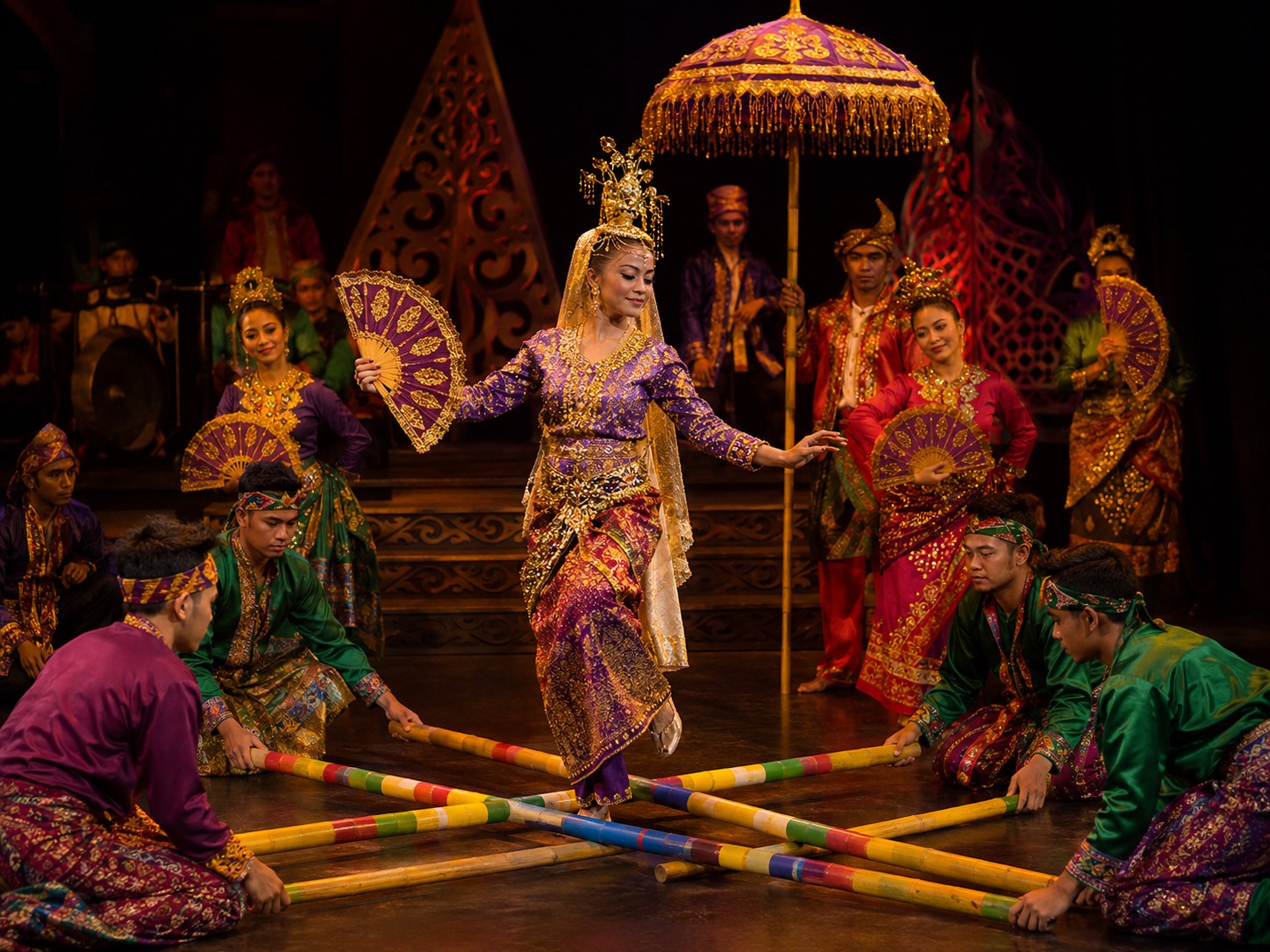
Singkil is usually performed with bamboo poles arranged in a crisscross pattern. The pole handlers tap and clap the bamboo in rhythm while the dancers move through the spaces.
The lead female dancer often carries fans and moves slowly and gracefully at first. As the dance continues, the rhythm may become faster and more complex. She steps in and out of the bamboo poles while keeping her upper body elegant and composed.
That is what makes Singkil so impressive. The dancer has to think about many things at the same time:
She must follow the rhythm.
She must avoid the bamboo poles.
She must keep her arms graceful.
She must use the fans beautifully.
She must stay calm and regal.
It is a dance that demands both discipline and artistry.
In some versions, other dancers join the performance. Attendants may hold umbrellas or fans, while male dancers may perform warrior-like movements. The full stage version can feel almost like a royal scene from an epic story.
The Bamboo Poles in Singkil
The bamboo poles are one of the most exciting parts of the dance. They create the rhythm, the challenge, and the visual drama.
In Singkil, the poles are often arranged differently from Tinikling. Instead of just two parallel poles, some versions use crisscrossed bamboo poles, making the footwork even more complicated. This creates a maze-like pattern that the dancer must navigate.
The sound of the bamboo poles also adds to the atmosphere. The clapping rhythm creates suspense. Each time the poles close, the audience can feel the danger and precision of the dance.
But the dancer must not look afraid. That is the beauty of Singkil. Even with the bamboo poles moving around her, she remains graceful and composed.
The Music of Singkil
Singkil is commonly accompanied by traditional music associated with Mindanao, especially instruments such as the kulintang and agung. These instruments create a rich, gong-based sound that gives the dance its royal and ceremonial feel.
The music is very different from the Spanish-influenced melodies used in dances like Cariñosa or Pandanggo sa Ilaw. Singkil’s music has a deeper, more majestic quality. It gives the performance a sense of ceremony and grandeur.
The rhythm guides the bamboo pole handlers and the dancers. Everyone must listen carefully. If the rhythm is lost, the performance can easily fall apart.
That teamwork between musicians, pole handlers, and dancers is one of the reasons Singkil feels so powerful on stage.
The Costumes of Singkil
The costumes used in Singkil are among the most striking in Philippine folk dance.
The lead female dancer often wears a colorful and elegant Maranao-inspired outfit, usually with rich fabric, beautiful patterns, and royal-looking accessories. She may also wear a decorative headpiece and carry fans. The costume helps create the image of nobility and grace.
Male dancers, when included, may wear traditional-inspired attire and carry props such as a sword and shield. Attendants may also appear in coordinated costumes that add to the royal atmosphere of the performance.
The colors are usually bold and beautiful—gold, red, green, purple, and other rich tones that give the dance a grand visual appeal. When combined with the bamboo poles, fans, and music, the costume makes Singkil look truly majestic.
Singkil and Maranao Culture
Singkil is closely associated with Maranao culture, and that connection is very important.
The Maranao people are one of the major Muslim ethnolinguistic groups in the Philippines, with deep cultural roots around Lake Lanao in Mindanao. Their traditions include music, weaving, metalwork, oral literature, and rich artistic expressions.
The Darangen epic, which is connected to many Maranao cultural performances, is not just a story. UNESCO describes it as an ancient epic song that contains knowledge, values, customary law, and artistic traditions of the Maranao people.
The National Commission for Culture and the Arts also includes Singkil ng Maranao in its Philippine Intangible Cultural Heritage Inventory, showing its importance as part of the country’s cultural heritage.
Because of this, Singkil should be appreciated not only as a beautiful stage performance, but also as part of a living cultural tradition.
Singkil in Schools and Cultural Shows
Many Filipinos encounter Singkil through school programs, cultural presentations, folk dance competitions, and tourism events. It is often one of the highlights of a cultural show because it looks grand and dramatic.
Compared to other folk dances, Singkil can feel more difficult to perform because of the bamboo pole pattern and the level of grace required. It is not enough to simply avoid the poles. The dancer must look elegant while doing it.
That is why Singkil is often performed by dancers who have practiced carefully. The timing must be exact, the formations must be clean, and the overall performance must feel polished.
When done well, Singkil can easily become the most memorable number in a cultural program.
Why Singkil Is So Beautiful to Watch
Singkil is beautiful because it combines several powerful elements at once.
There is music.
There is rhythm.
There is storytelling.
There is danger.
There is elegance.
There is cultural identity.
The bamboo poles create excitement, but the dancer’s grace gives the performance its soul. The audience watches not only to see if the dancer can avoid the poles, but also to admire how calmly and beautifully she moves through them.
It is this contrast that makes Singkil special. The environment around the dancer feels chaotic, but her movement remains controlled. The poles clap loudly, but her gestures stay soft. The rhythm becomes intense, but she remains poised.
That image is unforgettable.
Why Singkil Still Matters Today
Singkil still matters because it helps preserve and celebrate the cultural richness of Mindanao.
Many people outside Mindanao may only know a few things about Maranao culture. Through dances like Singkil, audiences get a glimpse of its beauty, artistry, and deep storytelling tradition.
It also reminds us that Philippine culture is not one single thing. The Philippines is made up of many regions, languages, histories, and communities. Folk dances like Singkil help show that diversity.
Tinikling may represent one familiar image of Filipino dance, but Singkil shows another side of the country—one that is royal, dramatic, and deeply connected to Mindanao’s cultural heritage.
In that sense, Singkil is not just entertainment. It is cultural education.
Final Thoughts
Singkil is one of the most majestic traditional dances in the Philippines. With its bamboo poles, graceful fan movements, royal-inspired costumes, and connection to the Darangen epic, it offers a beautiful glimpse into Maranao culture and artistry.
It is a dance that requires skill, discipline, and confidence. But more than that, it requires grace. The lead dancer must move through danger without losing her composure, turning a challenging performance into something elegant and meaningful.
Whether performed in a school, a cultural show, a festival, or an international stage, Singkil continues to impress audiences because it is more than just a dance. It is a story of beauty, courage, tradition, and cultural pride.
And that is why Singkil remains one of the most unforgettable traditional dances of the Philippines.