You will probably smell the festival before you see it.
As you enter Rosario, Cavite, the familiar aroma of smoked fish begins drifting through the air. Vendors arrange golden-brown tinapa on their tables, families gather beside the streets and young performers prepare costumes inspired by fishing, the sea and the town’s most famous local product.
Then the drums begin.
Colorful dancers carrying baskets, fishing nets and giant fish-shaped props enter the parade route. Floats decorated with scenes of coastal life slowly pass through town, while spectators cheer for participating schools and barangays.
This is the Tinapang Salinas Festival, Rosario’s annual celebration of the smoked-fish industry that has provided food, livelihood and a distinct identity to the community.
The festival is enjoyable even when you are not a huge fan of tinapa. Beyond the food, it tells the story of a coastal town shaped by fishing, fish processing, family businesses and generations of residents who turned a simple local product into something recognized throughout Cavite and beyond.
Content
What Is the Tinapang Salinas Festival?
The Tinapang Salinas Festival is a cultural and culinary celebration held every October in Rosario, Cavite.
The festival promotes Rosario as the place associated with the original Tinapang Salinas, the town’s well-known smoked fish. According to the Provincial Government of Cavite, the product has created tourism opportunities and stable jobs for local residents, making it far more than an ordinary delicacy.
Festival activities vary each year, but recent editions have featured:
- Street-dancing competitions
- Grand parades and decorated floats
- Performances by local schools and barangays
- Community programs and competitions
- Food booths and local-product displays
- Concerts and evening entertainment
- Activities commemorating Rosario’s founding anniversary
In 2024, Rosario celebrated the 18th edition of the festival on October 18 and 19. Fourteen elementary and secondary school teams joined the street-dancing competition, followed by a free concert featuring nationally known performers.
The 2025 celebration marked the 19th Tinapang Salinas Festival alongside Rosario’s 180th founding anniversary. Its parade included floats, traditional costumes and performances by schools, barangays and civic organizations.
What Is Tinapang Salinas?
Tinapa is fish preserved and flavored through smoking.
The fish is normally cleaned, salted or soaked in brine and arranged on racks before being exposed to heat and smoke. The process cooks the fish, reduces its moisture and gives it a distinct smoky aroma, golden color and savory flavor.
Tinapang Salinas refers specifically to the smoked-fish tradition associated with Rosario.
The name helps distinguish the product from generic tinapa made in other parts of the Philippines. For Rosarinos, it represents a local method, industry and culinary identity developed and sustained by families in the community.
Different processors may use different kinds of fish depending on availability, season and market demand. Small fish suitable for smoking are cleaned and prepared in large batches before being placed inside traditional or modern smoking equipment.
Once finished, the fish develops the familiar qualities that tinapa lovers look for:
- A rich smoky aroma
- Salty and savory flesh
- A golden or deep-brown exterior
- Firm meat that flakes easily
- A flavor that pairs perfectly with rice
A simple plate of Tinapang Salinas, hot rice, tomatoes and vinegar can already feel like a complete Filipino breakfast.
Why Is It Called “Salinas”?
Rosario was historically associated with the name Salinas, a word connected with salt and the salt-making activities once found in the area.
Even though the municipality is now called Rosario, the older name survived through its most famous food product. The phrase Tinapang Salinas therefore carries both geographical and historical meaning.
It is not merely smoked fish sold in Rosario. It is a product associated with the community’s older identity and its long relationship with the coast.
That connection makes the festival name especially meaningful. Every time people say “Tinapang Salinas,” they are preserving a piece of the town’s past.
Rosario as a Coastal Community
Rosario sits along the coastal side of Cavite, where fishing has long influenced daily life.
Before modern commercial developments expanded across the municipality, many families depended directly or indirectly on the sea. Some residents caught fish, while others repaired nets, transported the catch, sold seafood or processed fish into tinapa, daing, bagoong and other products.
Fish processing offered an important advantage.
Fresh fish spoils quickly, particularly in a tropical climate. Smoking extended its usefulness while creating a product that could be transported, stored and sold to customers outside the immediate fishing community.
As demand for Tinapang Salinas grew, smoked-fish production generated work for more people.
The industry needed cleaners, processors, smokers, packers, vendors, delivery workers and suppliers. Some businesses remained small family operations, while others expanded their production and customer base.
This is why the festival is not simply about eating fish. It celebrates an entire chain of local livelihoods.
How Tinapang Salinas Is Made
The precise method differs among producers, and many families develop their own preferred techniques. However, the traditional process generally follows several basic stages.
Choosing and Cleaning the Fish
Fresh fish must first be sorted and cleaned.
Scales, internal organs and unwanted parts are removed as necessary. The fish is then washed carefully to eliminate blood and debris.
Freshness is important because smoking adds flavor and helps preserve the product, but it cannot turn poor-quality fish into good-quality tinapa.
Salting or Brining
The cleaned fish is salted or soaked in a brine solution.
This step seasons the flesh and helps prepare it for smoking. The length of time depends on the fish’s size, the strength of the brine and the producer’s preferred level of saltiness.
Too little salt may result in a bland product, while excessive salting can overpower the fish’s natural flavor.
Drying Before Smoking
The fish may be allowed to drain or dry briefly before entering the smoker.
Removing excess surface moisture helps the smoke adhere more evenly and contributes to the desired texture and appearance.
Arranging the Fish
The fish is arranged on trays, racks or screens.
Processors must leave enough space for heat and smoke to circulate. If the fish is packed too tightly, it may cook unevenly or fail to develop a consistent smoky flavor.
Smoking
The fish is placed inside the smoking chamber, where controlled heat and smoke gradually cook and flavor it.
This is the stage that gives tinapa its identity.
The type of fuel, temperature, smoking time and airflow can affect the final product. Experienced processors learn how to judge readiness through color, aroma, texture and appearance.
Cooling and Packing
After smoking, the fish must cool before being packed.
Proper handling is essential because the product is already cooked and should be protected from contamination. Some Tinapang Salinas is sold loose in markets, while other producers use sealed or vacuum-packed packaging for convenience and longer storage.
Watching this process helps you appreciate how much labor goes into something that many people finish eating in only a few minutes.
A Festival for Local Workers and Producers
The people behind Tinapang Salinas are at the heart of the festival.
When customers buy smoked fish, they normally see only the finished product. They may not see the early mornings, repetitive preparation, heat from the smoking area or physical work required to produce batch after batch.
Processing fish can be demanding.
Workers spend hours cleaning and arranging the catch. They must manage smoke and heat while ensuring that the fish cooks properly. Producers also face rising costs, unpredictable fish supplies and competition from inexpensive products made elsewhere.
The festival makes their work visible.
Food displays, cultural performances and public programs remind visitors that Tinapang Salinas exists because local families continued practicing and improving their craft.
Buying directly from Rosario producers is one practical way of supporting that heritage.
Street-Dancing Competition
Street dancing is one of the most exciting parts of the Tinapang Salinas Festival.
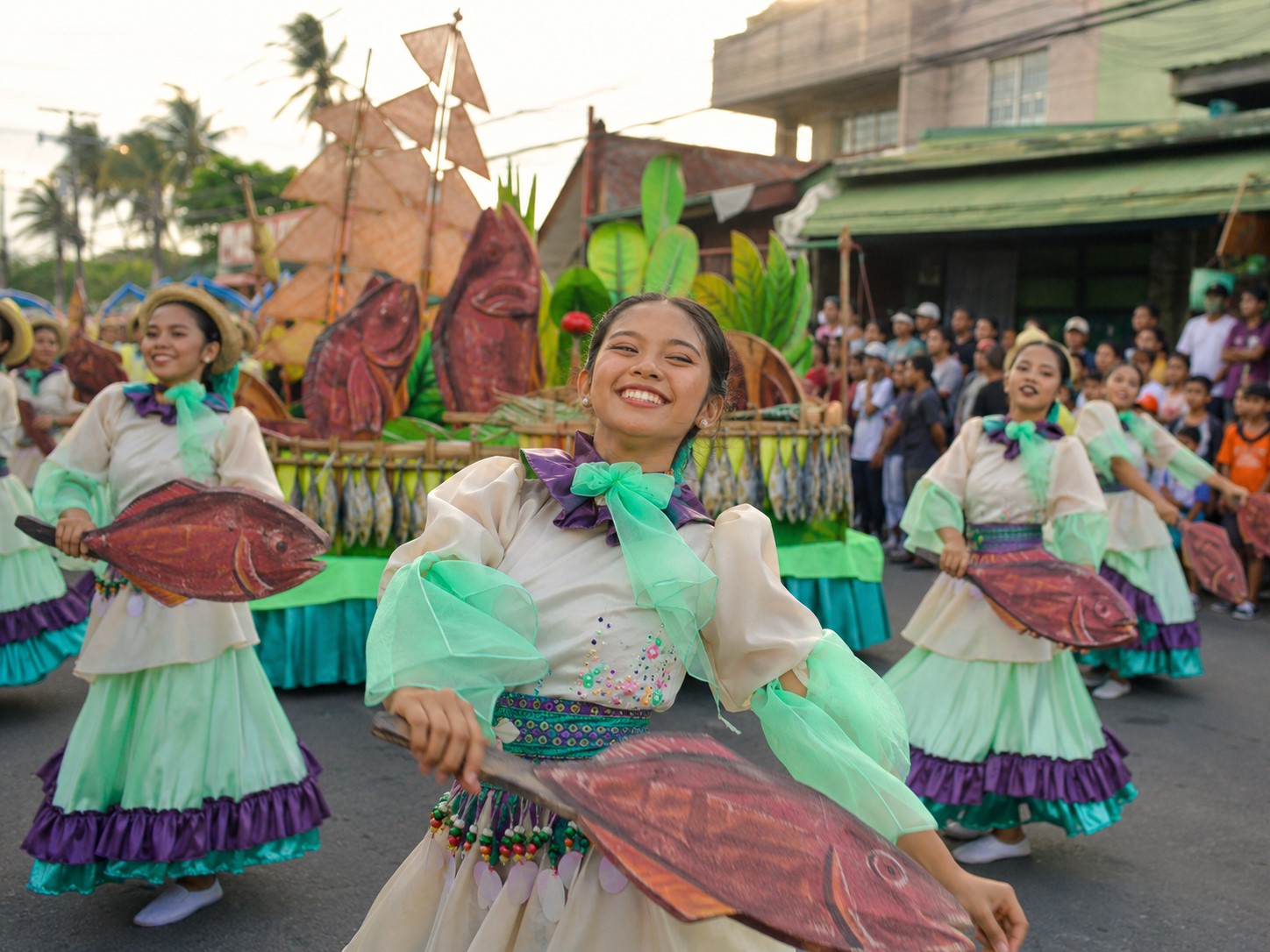
School contingents perform choreographed routines inspired by fishing, fish smoking, coastal life and the history of Rosario. Costumes commonly use shades of blue, green, silver, brown and gold to represent the sea, fresh fish, smoke and the finished product.
Props help tell the story.
You may see dancers carrying:
- Baskets filled with imitation fish
- Fishing nets and paddles
- Oversized plates of tinapa
- Circular props resembling fish trays
- Boats and market baskets
- Representations of smoke, fire and waves
Some routines begin with performers acting as fishermen preparing their boats. Others portray workers sorting, salting and smoking the catch.
The music becomes livelier as the dancers present the finished Tinapang Salinas and celebrate the livelihood it provides.
During the 2024 festival, 14 teams from Rosario’s elementary and secondary schools joined the competition. Mayor Calixto D. Enriquez Elementary School and Bagbag National High School won their respective divisions.
The competition continued in 2025 as one of the main attractions of Rosario’s festival and founding-anniversary celebration.
The Costumes and Props
Festival costumes transform an ordinary fishing product into something theatrical.
A designer may take the silver scales of a fish and recreate them using reflective fabric. Another group may incorporate fishing nets into skirts, sleeves or headpieces. Brown and orange materials can represent the smoke and fire used during processing.
Some dancers wear hats inspired by traditional fish vendors. Others carry trays similar to those used for arranging fish before smoking.
The best designs are not necessarily the most expensive.
A simple prop can be effective when the audience immediately understands what it represents. A basket carried above the head may symbolize the daily catch. Long blue fabric moving across the road can create the illusion of waves.
When an entire contingent combines these elements, the street becomes a moving story about Rosario’s coastal life.
Grand Parade and Festival Floats
The grand parade brings together schools, barangays, civic organizations, government offices and local businesses.
Decorated floats may feature giant fish, fishing boats, coastal scenes and representations of traditional smoking areas. Some show the journey from sea to market, while others highlight Rosario’s development as a modern municipality.
The 2025 parade featured floats and performances paying tribute to the town’s smoked-fish industry. Organizers combined the Tinapang Salinas Festival with Rosario’s 180th founding anniversary, giving participants an opportunity to celebrate both the local product and the wider history of the municipality.
The parade can become crowded, particularly near the town plaza and final performance area.
Arrive early when you want a clear view of the floats. Stay behind designated barriers because large decorations can extend beyond the sides of the vehicle and require extra space when turning.
Food Booths and Local Products
Naturally, one of the best parts of attending the festival is trying the food.
Some booths sell traditional Tinapang Salinas by the piece, bundle or package. Others may offer prepared meals or products using smoked-fish flakes.
You may encounter dishes such as:
- Tinapa with rice, tomatoes and salted egg
- Tinapa fried rice
- Pasta or noodles topped with tinapa flakes
- Tinapa omelet
- Smoked-fish lumpia
- Tinapa spread
- Bottled tinapa flakes
- Rice meals with vinegar or pickled vegetables
Offerings depend on the participating vendors, so not every dish will appear in every edition.
The festival is a good opportunity to compare products from several sellers. You may notice differences in saltiness, smokiness, texture and fish variety.
Ask vendors how they recommend storing and reheating their product. Locally produced Tinapang Salinas makes a practical souvenir, provided you pack it carefully and keep it at an appropriate temperature.
How to Eat Tinapang Salinas
There is no need to make things complicated.
Tinapang Salinas is already flavorful, so it works beautifully with simple side dishes.
The classic combination is:
Hot rice + Tinapang Salinas + sliced tomatoes + vinegar
Salted egg, onions and cucumber can also be added.
For breakfast, the fish works well with garlic rice and fried egg. You can flake the meat and remove the bones before mixing it into rice.
Tinapa flakes can also add depth to noodle dishes, salads, pasta and savory spreads. A small amount goes a long way because of the product’s concentrated smoky and salty flavor.
When reheating whole tinapa, use gentle heat. Overcooking can make the flesh dry and cause the smoky aroma to become too intense.
Concerts and Evening Entertainment
The festival does not end when the street dancers finish performing.
Recent celebrations have included concerts and evening programs that attract younger residents and visitors. The 2024 festival concluded with a free concert featuring TJ Monterde, Flow G and Skusta Clee.
The performers change every year, and a major artist is never guaranteed.
Check the official calendar before traveling when the concert is your main reason for attending. Popular shows can draw large crowds, so arrive early and identify the authorized entrances and exits.
Bring only essential belongings. Concert areas may enforce bag inspections and restrict certain objects for safety.
Religious Significance of October
Rosario’s festival season also has a religious dimension.
The municipality’s principal Catholic church is the Diocesan Shrine and Parish of the Most Holy Rosary. Its patroness is Our Lady of the Most Holy Rosary, whose feast day is celebrated on October 7.
This places the culinary festival within a wider October season of faith, thanksgiving and community celebrations.
Religious activities and the Tinapang Salinas Festival may follow separate schedules, but together they reflect two important parts of Rosario’s identity: devotion to its patroness and pride in the livelihood associated with the sea.
Visitors who enter the shrine should dress respectfully and avoid disrupting Masses, prayers or parish activities.
When Is the Tinapang Salinas Festival Celebrated?
The festival is celebrated every October, although its exact dates change annually. The Provincial Government of Cavite identifies October as the traditional month of celebration.
Recent schedules demonstrate that the major activities do not necessarily happen on the same weekend each year:
- The 2024 festival highlights were held on October 18 and 19.
- The 2025 festival was celebrated alongside Rosario’s 180th founding anniversary, with major parade and street-dancing activities taking place later in October.
As of July 2026, a complete public schedule for the 2026 edition was not readily available from reliable official sources.
Wait for announcements from the Municipality of Rosario before finalizing your trip. The street-dancing competition, parade, concert and religious activities may all take place on different dates.
Where Is the Festival Held?
Major activities are generally held around Rosario town proper, including the public plaza, municipal areas and streets designated for the parade.
Some programs may also be staged at schools, covered courts, commercial centers or other municipal venues.
Do not assume every activity takes place in one location.
Before leaving home, check the official poster for:
- The parade’s assembly point
- The street-dancing route
- The final judging venue
- Concert location
- Road-closure times
- Public-transport drop-off points
- Authorized parking areas
Showing a driver the specific venue is more useful than simply saying you are attending the Tinapang Salinas Festival.
How to Get to Rosario from Metro Manila
From PITX
PITX is a convenient starting point for commuters traveling from Metro Manila to the coastal and western side of Cavite.
The terminal serves buses and modern jeepneys going toward Tanza and Tejero, as well as buses bound for Naic and Ternate. PITX’s current route directory lists these west-Cavite services, although bay assignments and schedules may change.
Ask terminal staff for a vehicle that passes through Rosario or Tejero.
Tell the conductor that you are going to Rosario town proper or show the exact festival venue. Depending on traffic restrictions, you may need to get off before the central parade zone and continue on foot or by local transportation.
From Cavite City, Kawit or Noveleta
Jeepneys and other local vehicles travel along the coastal corridor toward Rosario, Tanza and nearby communities.
During the festival, routes may be shortened or diverted because of road closures. Ask the driver for the nearest available drop-off point.
From General Trias
Rosario is accessible from General Trias through roads leading toward Tejero and the coastal side of Cavite.
Local jeepneys and multicabs serve parts of this corridor. Confirm whether the vehicle continues to Rosario town proper rather than ending at a nearby commercial area.
By Private Vehicle
Drivers from Metro Manila can use CAVITEX and continue through Kawit and Noveleta toward Rosario.
Those coming from central Cavite may approach through General Trias and Tejero.
Expect congestion during parades and evening concerts. Parking near the town plaza may be limited, so arrive early and follow local traffic instructions.
Helpful Tips for Festival Visitors
Check the Exact Date
The festival is held in October, but the main events move from year to year.
Arrive Early
Road closures may begin well before the parade. Early arrival gives you time to find your viewing area and explore the food booths.
Prepare for Heat and Rain
October can still be humid and rainy. Carry water, sunscreen and a compact umbrella or raincoat.
Wear Comfortable Shoes
You may need to walk from a distant drop-off point or parking area.
Bring Cash
Some food sellers and local transport providers may not accept cards or digital payments.
Pack Tinapa Properly
Use sealed containers or insulated bags, especially when traveling for several hours. The smoky aroma can easily transfer to clothes and other belongings.
Ask Before Photographing Workers
Public parades are naturally photographed, but fish-processing areas may be private workplaces. Request permission before entering or taking close photographs.
Keep the Streets Clean
Dispose of food packaging properly. A festival celebrating the sea should not leave plastic and litter that may eventually return to the coastline.
Bringing Children to the Festival
The Tinapang Salinas Festival can be educational for children.
Street dancing makes it easier for them to understand the stages between catching a fish and seeing it served at the dining table. Props, costumes and floats turn a local livelihood into a story they can follow.
Explain that many people contribute to the product:
- Fisherfolk catch the fish.
- Workers clean and prepare it.
- Processors smoke it.
- Vendors bring it to customers.
- Families and businesses keep the tradition alive.
Choose a viewing location away from moving floats and crowded intersections. Bring water, snacks, sun protection and identification containing a parent or guardian’s contact details.
Other Places to Visit in Rosario
Diocesan Shrine and Parish of the Most Holy Rosary
The shrine is the spiritual center of Rosario and honors the municipality’s patroness.
Its feast day is October 7, making it especially relevant during the town’s festival month. Confirm current Mass and visitor schedules before going because parish programs may affect access.
Rosario Town Plaza
The plaza is a practical starting point for exploring the town center and is often close to major community activities.
During the festival, expect stages, booths, spectators and temporary traffic arrangements around this area.
Tejeros Convention Site
The historically important Tejeros Convention took place in the area now associated with General Trias and Rosario’s Tejeros community.
A side trip gives visitors another reason to explore this part of Cavite beyond its food traditions. Confirm museum or site hours before traveling.
SM City Rosario
The mall provides restaurants, restrooms, parking and a convenient meeting point for travelers.
It may also hold festival-related displays or activities, although these depend on the current year’s program.
Why the Tinapang Salinas Festival Matters
A local food tradition can disappear surprisingly quickly.
If fish becomes more expensive, processors may stop operating. Younger family members may choose different careers. Traditional smoking spaces may be replaced by residential or commercial development.
Once enough producers leave the industry, the knowledge behind the product begins to disappear as well.
The Tinapang Salinas Festival helps prevent that heritage from becoming invisible.
It reminds young Rosarinos that the smoked fish sold in markets represents generations of skill and labor. It gives producers a public platform and encourages visitors to buy locally made products.
The festival also allows Rosario to define itself through something genuinely connected to the community.
Many towns have parades, pageants and concerts. Tinapang Salinas gives Rosario a story that belongs specifically to its people.
More Than Just Smoked Fish
At first, the idea of building an entire festival around tinapa may sound simple.
But that simplicity is exactly what makes the celebration meaningful.
Tinapa is everyday Filipino food. It is served at breakfast tables, packed into rice meals and sold in neighborhood markets. It is rarely treated as luxurious or glamorous.
The festival asks people to look at it differently.
A piece of Tinapang Salinas represents the sea, a fisherman’s catch, a processor’s experience and a vendor’s livelihood. It connects older methods of preserving food with the needs of a modern community.
The product may be humble, but the story behind it is rich.
Final Thoughts
The Tinapang Salinas Festival is one of Cavite’s most flavorful cultural celebrations.
Its street dancers, floats and concerts create the lively atmosphere expected from a town festival. However, its true character comes from the smoky delicacy that has supported generations of Rosario families.
When you taste Tinapang Salinas, you are not simply eating preserved fish.
You are tasting part of the town’s coastal history.
Visit the festival to watch the colorful performances, explore the food stalls and experience the excitement of Rosario’s streets. Bring home a package of locally produced tinapa, but also remember the workers and families behind it.
The smoke may disappear once the festival is over, but the tradition it represents continues throughout the year—in processing areas, local markets and Rosarino homes where Tinapang Salinas remains proudly served.