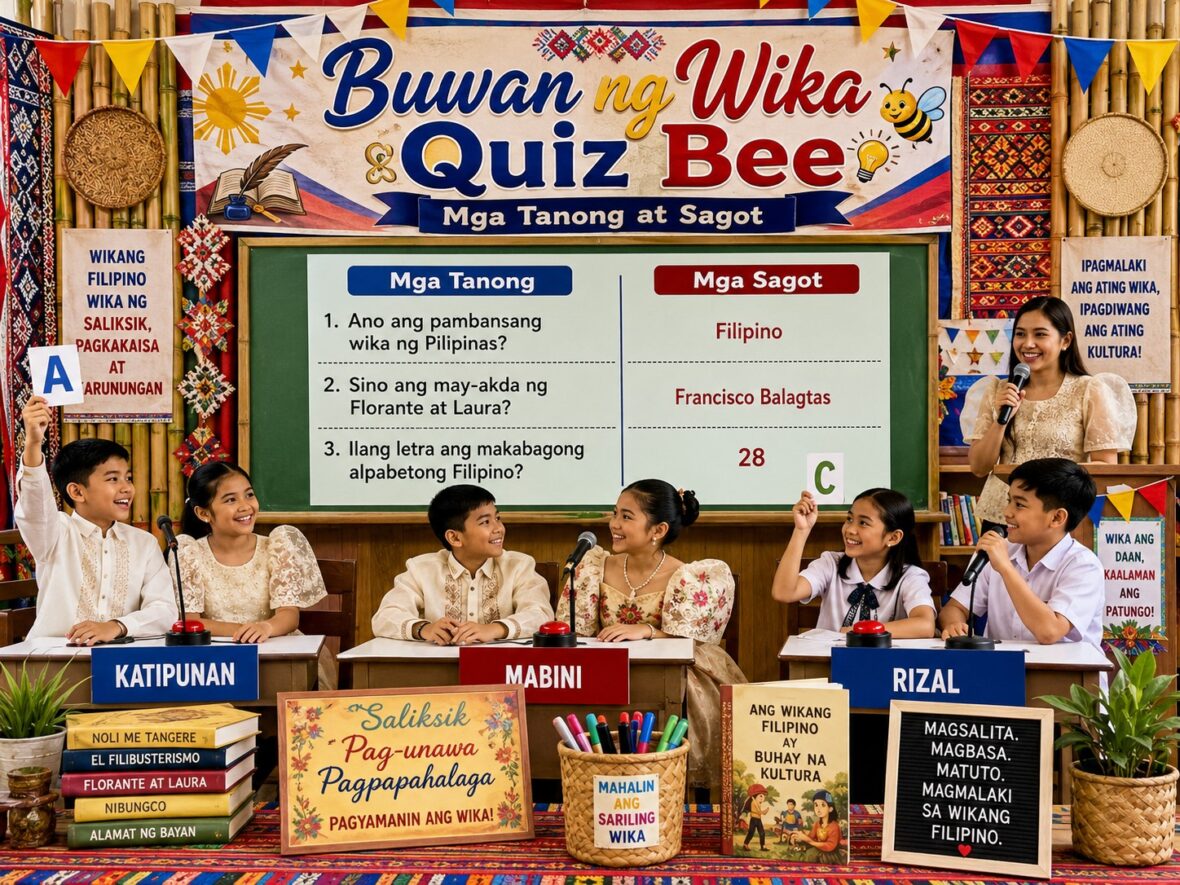
Quiz Bee is one of those Buwan ng Wika activities that never really goes out of style.
You have contestants sitting nervously in front.
Teachers holding answer sheets.
Classmates whispering answers from the audience even though they’re definitely not supposed to.
Then comes the dreaded announcement:
“For the difficult round…”
Suddenly, everyone becomes serious.
If you’re organizing a Buwan ng Wika Quiz Bee for 2026, this guide gives you more than 100 questions that you can use for elementary students, high school students, classroom games, Filipino clubs, or a school-wide competition.
The questions cover topics such as:
- Buwan ng Wikang Pambansa
- Wikang Filipino
- History of the national language
- Filipino grammar
- Vocabulary
- Philippine literature
- Filipino culture
- Philippine languages
- The 1987 Constitution and Filipino
- Komisyon sa Wikang Filipino
- The official Buwan ng Wika 2026 theme
- Filipino and Artificial Intelligence
The official Buwan ng Wikang Pambansa 2026 theme is:
“Wikang Filipino at AI: Kasangkapan sa Pananaliksik at Tulay sa Yaman ng Impormasyon.”
The 2026 celebration highlights the relationship between Filipino and artificial intelligence, particularly the use of AI as a research tool while emphasizing responsible and ethical technology use.
So for this year’s Quiz Bee, I’ve also included a special round about Filipino, AI, research, and information.
Let’s start with the easy questions.
Content
Easy Buwan ng Wika Quiz Bee Questions
These questions are suitable for elementary students or the easy round of a larger competition.
Questions 1–30
1. What is the national language of the Philippines?
Answer: Filipino
The 1987 Constitution identifies Filipino as the country’s national language.
2. What month is Buwan ng Wikang Pambansa celebrated?
Answer: August
3. From what date to what date is Buwan ng Wikang Pambansa officially observed?
Answer: August 1 to August 31
Proclamation No. 1041 declares August 1–31 of every year as Buwan ng Wikang Pambansa.
4. Who is known as the “Ama ng Wikang Pambansa”?
Answer: Manuel L. Quezon
Proclamation No. 1041 itself identifies former President Manuel Luis Quezon as the Ama ng Wikang Pambansa.
5. When is Manuel L. Quezon’s birthday?
Answer: August 19
6. What two languages are identified by the 1987 Constitution as the official languages of the Philippines for communication and instruction?
Answer: Filipino and English
7. What government commission is responsible for promoting the development and preservation of Filipino and other Philippine languages?
Answer: Komisyon sa Wikang Filipino or Commission on the Filipino Language
8. What does KWF stand for?
Answer: Komisyon sa Wikang Filipino
9. What is the Filipino word for “language”?
Answer: Wika
10. What is the Filipino word for “country” or “nation” in the common phrase ating bayan?
Answer: Bayan
11. What is the Filipino word for “school”?
Answer: Paaralan
12. What is the Filipino word for “teacher”?
Answer: Guro
13. What is the Filipino word for “student”?
Answer: Mag-aaral
14. What is the Filipino word for “knowledge”?
Answer: Kaalaman
15. What is the Filipino word commonly used for “research”?
Answer: Pananaliksik
16. What is the Filipino word for “culture”?
Answer: Kultura
17. What part of speech names a person, place, thing, animal, event, or idea?
Answer: Pangngalan
18. What part of speech replaces a noun?
Answer: Panghalip
19. What part of speech expresses an action or state?
Answer: Pandiwa
20. What part of speech describes a noun or pronoun?
Answer: Pang-uri
These grammatical categories are among the topics covered in Filipino learning materials available through DepEd’s Learning Resources Management and Development System.
21. What is the opposite or kasalungat of malaki?
Answer: Maliit
22. What is the opposite of mataas?
Answer: Mababa
23. What is the opposite of mabilis?
Answer: Mabagal
24. What is the opposite of masaya?
Answer: Malungkot
25. What is the opposite of mainit?
Answer: Malamig
26. Complete the Filipino proverb: “Kung may tiyaga, may _____.”
Answer: Nilaga
27. Complete the proverb: “Nasa Diyos ang awa, nasa tao ang _____.”
Answer: Gawa
28. What Filipino literary form presents a riddle that the listener must solve?
Answer: Bugtong
29. What do we call a traditional Filipino proverb containing wisdom or advice?
Answer: Salawikain
30. What is a traditional Filipino poetic debate called?
Answer: Balagtasan
Average Buwan ng Wika Quiz Bee Questions
Now let’s make things a little more challenging.
These questions are suitable for upper elementary, junior high school, or the average round of a competition.
Questions 31–65
31. Which Philippine president signed Proclamation No. 1041 declaring August 1–31 as Buwan ng Wikang Pambansa?
Answer: President Fidel V. Ramos
32. In what year was Proclamation No. 1041 signed?
Answer: 1997
33. On what exact date was Proclamation No. 1041 signed?
Answer: July 15, 1997
34. What celebration preceded the month-long Buwan ng Wikang Pambansa?
Answer: Linggo ng Wika
35. Before it became a month-long celebration, what dates were associated with Linggo ng Wika?
Answer: August 13–19
36. Why is August 19 especially significant in the history of the national language celebration?
Answer: It is the birthday of Manuel L. Quezon, who is regarded as the Ama ng Wikang Pambansa.
37. What language was selected as the basis for the development of the national language in 1937?
Answer: Tagalog
Executive Order No. 134 approved Tagalog as the basis of the national language.
38. Which president approved Tagalog as the basis of the national language?
Answer: President Manuel L. Quezon
39. What executive order proclaimed the national language based on Tagalog?
Answer: Executive Order No. 134
40. In what year was Executive Order No. 134 issued?
Answer: 1937
41. What law established the National Language Institute?
Answer: Commonwealth Act No. 184
42. In what year was Commonwealth Act No. 184 approved?
Answer: 1936
43. What was one of the primary tasks of the National Language Institute?
Answer: To study Philippine languages and choose a native language that would serve as the basis for the national language.
44. Under Commonwealth Act No. 184, what two major language references was the Institute tasked to prepare after the national language was proclaimed?
Answer: A dictionary and a grammar
45. What law created the Commission on the Filipino Language?
Answer: Republic Act No. 7104
46. In what year was Republic Act No. 7104 enacted?
Answer: 1991
47. On what date was Republic Act No. 7104 approved?
Answer: August 14, 1991
48. How many commissioners does Republic Act No. 7104 provide for in the Commission on the Filipino Language?
Answer: Eleven commissioners
49. According to Republic Act No. 7104, what does the term Filipino refer to?
Answer: The national language of the Philippines
50. According to the 1987 Constitution, Filipino should continue to develop and become enriched based on what?
Answer: Existing Philippine and other languages
51. Under the Constitution, regional languages serve as what in their respective regions?
Answer: Auxiliary official languages and auxiliary media of instruction
52. Which two languages does the Constitution say should be promoted on a voluntary and optional basis?
Answer: Spanish and Arabic
53. What article of the 1987 Constitution contains provisions concerning language, education, science, arts, and culture?
Answer: Article XIV
54. What is the subject in the sentence: “Ang mga bata ay nagbabasa ng aklat.”
Answer: Ang mga bata
55. What is the predicate or panaguri in the same sentence?
Answer: Ay nagbabasa ng aklat
56. Identify the verb in this sentence: “Sumulat si Maria ng tula.”
Answer: Sumulat
57. Identify the adjective in this sentence: “Maganda ang kanyang poster.”
Answer: Maganda
58. Identify the pronoun in this sentence: “Siya ay mahusay umawit.”
Answer: Siya
59. Identify the noun in this sentence: “Masipag mag-aral ang estudyante.”
Answer: Estudyante
60. What is the kasingkahulugan of masaya?
Possible answers include:
Maligaya or matuwa, depending on usage.
For Quiz Bee purposes, the recommended answer is:
Maligaya
61. What is the kasingkahulugan of maganda?
Answer: Marikit
62. What is the kasalungat of matapang?
Answer: Duwag
63. What is the kasalungat of maingay?
Answer: Tahimik
64. What do you call words having the same or similar meanings?
Answer: Magkasingkahulugan
65. What do you call words having opposite meanings?
Answer: Magkasalungat
DepEd learning resources include exercises involving pangngalan, panghalip, pandiwa, pang-uri, pang-abay, sentence structure, and words with opposite meanings, making these useful areas for school-level Filipino quiz competitions.
Difficult Buwan ng Wika Quiz Bee Questions
Now we’re entering the part where contestants start staring at the ceiling hoping the answer magically appears.
These questions are best suited for junior high, senior high school, or difficult rounds.
Questions 66–95
66. What section of Article XIV of the 1987 Constitution states that the national language of the Philippines is Filipino?
Answer: Section 6
67. What section of Article XIV identifies Filipino and English as the country’s official languages for communication and instruction?
Answer: Section 7
68. What section of Article XIV directs Congress to establish a national language commission?
Answer: Section 9
69. What does the Constitution direct the national language commission to promote research for?
Answer: The development, propagation, and preservation of Filipino and other languages
70. What law eventually established the Commission on the Filipino Language envisioned by the Constitution?
Answer: Republic Act No. 7104
71. According to RA 7104, the Commission must promote not only Filipino but also what broader group of languages?
Answer: Other Philippine languages
72. Under RA 7104, what is a “regional language”?
Answer: The lingua franca or commonly spoken language of a region
73. According to RA 7104, what is an “auxiliary language”?
Answer: A language used in certain places that supports the national and/or official languages in their functions.
74. What major Philippine language is explicitly named together with Cebuano, Ilocano, and Hiligaynon among the languages represented under RA 7104?
Answer: Tagalog
75. What government office is the Commission on the Filipino Language directly under according to RA 7104?
Answer: Office of the President
76. How old must a person be at minimum to qualify as a commissioner under RA 7104?
Answer: 30 years old
77. What citizenship qualification is required of a commissioner under RA 7104?
Answer: The commissioner must be a natural-born Filipino citizen.
78. What did Commonwealth Act No. 184 establish in 1936?
Answer: The National Language Institute
79. How many members including its president did Commonwealth Act No. 184 originally provide for in the National Language Institute?
Answer: Seven — one president and six members.
80. What kinds of Philippine speech forms was the National Language Institute instructed to study?
Answer: The Philippine languages or native tongues spoken in the country
81. What linguistic areas was the Institute instructed to study besides vocabulary?
Possible answers include:
Philippine phonetics, orthography, prefixes, infixes, and suffixes.
82. What executive order formally approved the adoption of Tagalog as the basis of the national language?
Answer: Executive Order No. 134
83. On what date was Executive Order No. 134 issued?
Answer: December 30, 1937
84. Who chaired the Institute of National Language mentioned in Executive Order No. 134?
Answer: Jaime C. de Veyra
85. On what date did the Institute adopt its resolution selecting Tagalog as the basis of the national language?
Answer: November 9, 1937
86. What President’s birthday was specifically mentioned in Proclamation No. 1041 as one reason connected with the August celebration?
Answer: Manuel L. Quezon’s birthday
87. In what year was Manuel L. Quezon born?
Answer: 1878
88. What is the complete title of Proclamation No. 1041 in relation to the celebration?
Answer: It declares the annual celebration of August 1–31 as Buwan ng Wikang Pambansa.
89. According to the Constitution, what role should Filipino increasingly serve within government?
Answer: A medium of official communication
90. According to the Constitution, Filipino should also be sustained as a language of what major social institution?
Answer: Education or the educational system
91. Who wrote Noli Me Tangere?
Answer: Jose Rizal
92. Who wrote El Filibusterismo?
Answer: Jose Rizal
93. Which was published first: Noli Me Tangere or El Filibusterismo?
Answer: Noli Me Tangere
94. In what year was Noli Me Tangere published?
Answer: 1887
95. In what year was El Filibusterismo published?
Answer: 1891
National Historical Commission markers identify Jose Rizal as the author of Noli Me Tangere (1887) and El Filibusterismo (1891).
Buwan ng Wika 2026 Theme Quiz Questions
Here’s the round I would definitely include this year.
Since the official theme specifically involves artificial intelligence, having a few questions about the year’s theme makes the Quiz Bee feel current rather than simply recycling last year’s question bank.
Questions 96–110
96. What is the official theme of Buwan ng Wikang Pambansa 2026?
Answer: “Wikang Filipino at AI: Kasangkapan sa Pananaliksik at Tulay sa Yaman ng Impormasyon.”
97. What does “AI” stand for?
Answer: Artificial Intelligence
98. What is the commonly used Filipino term for Artificial Intelligence?
Answer: Artipisyal na Intelihensiya or Artipisyal na Katalinuhan
99. According to the 2026 theme, AI should serve as a kasangkapan in what activity?
Answer: Pananaliksik or research
100. According to the theme, Filipino and AI should become a tulay toward what?
Answer: Yaman ng impormasyon
101. True or False: The official 2026 theme suggests that AI should completely replace human thinking in research.
Answer: False
KWF officials have emphasized that AI should be treated as a tool rather than a replacement for Filipino intelligence, culture, and humanity.
102. True or False: Responsible use of artificial intelligence is part of the message surrounding Buwan ng Wika 2026.
Answer: True
103. Aside from Filipino, what other languages does the 2026 celebration continue to recognize as important in the Philippines?
Answer: Katutubong wika or Indigenous/Philippine languages
104. What should a student do before accepting an AI-generated research answer as fact?
Answer: Verify or fact-check the information using credible sources.
105. If an AI gives two conflicting answers about Philippine history, what should a researcher do?
Answer: Consult reliable sources and verify which information is supported by evidence.
106. What is the Filipino word used in the theme for “information”?
Answer: Impormasyon
107. What is the Filipino word used in the theme for “research”?
Answer: Pananaliksik
108. What role should Filipino have in discussions involving emerging technology according to explanations of the 2026 theme?
Answer: Filipino should continue to have a meaningful place in discussions, research, and communication involving new technologies.
109. True or False: Using AI responsibly means believing every answer it generates.
Answer: False
110. Complete the official theme:
“Wikang Filipino at AI: Kasangkapan sa ______ at Tulay sa Yaman ng Impormasyon.”
Answer: Pananaliksik
Bonus Tie-Breaker Questions
Never organize a Quiz Bee without preparing tie-breakers.
Seriously.
You may think:
“Surely one contestant will win after the difficult round.”
Then suddenly three students all have 24 points.
Now everyone is looking at the Quiz Master.
So prepare these questions beforehand.
Questions 111–120
111. What is the number of the proclamation that established the annual August 1–31 celebration of Buwan ng Wikang Pambansa?
Answer: Proclamation No. 1041
112. Who signed Proclamation No. 1041?
Answer: Fidel V. Ramos
113. Give the exact date on which Proclamation No. 1041 was signed.
Answer: July 15, 1997
114. What is the number of the Republic Act that created the Commission on the Filipino Language?
Answer: Republic Act No. 7104
115. Give the exact date RA 7104 was approved.
Answer: August 14, 1991
116. What Commonwealth Act established the National Language Institute?
Answer: Commonwealth Act No. 184
117. Give the exact date Commonwealth Act No. 184 was approved.
Answer: November 13, 1936
118. What executive order approved Tagalog as the basis of the Philippine national language?
Answer: Executive Order No. 134
119. Give the date of Executive Order No. 134.
Answer: December 30, 1937
120. Recite the complete official Buwan ng Wikang Pambansa 2026 theme.
Answer:
“Wikang Filipino at AI: Kasangkapan sa Pananaliksik at Tulay sa Yaman ng Impormasyon.”
Multiple-Choice Buwan ng Wika Questions
If you’re organizing a Quiz Bee for younger students, multiple-choice questions may be easier.
Here are a few additional examples.
121. Sino ang tinatawag na Ama ng Wikang Pambansa?
A. Jose Rizal
B. Andres Bonifacio
C. Manuel L. Quezon
D. Emilio Aguinaldo
Answer: C. Manuel L. Quezon
122. Kailan ipinagdiriwang ang Buwan ng Wikang Pambansa?
A. January
B. June
C. August
D. December
Answer: C. August
123. Ano ang pambansang wika ng Pilipinas?
A. Spanish
B. Filipino
C. Latin
D. French
Answer: B. Filipino
124. Alin sa mga sumusunod ang pandiwa?
A. Maganda
B. Bahay
C. Tumakbo
D. Siya
Answer: C. Tumakbo
125. Alin ang pang-uri?
A. Masaya
B. Tumalon
C. Mesa
D. Kami
Answer: A. Masaya
126. Alin ang panghalip?
A. Paaralan
B. Sila
C. Kumain
D. Matamis
Answer: B. Sila
127. Ano ang kasalungat ng “malawak”?
A. Makitid
B. Mataas
C. Mahaba
D. Malalim
Answer: A. Makitid
128. Ano ang kasingkahulugan ng “maligaya”?
A. Malungkot
B. Masaya
C. Galit
D. Takot
Answer: B. Masaya
129. Anong batas ang lumikha sa Commission on the Filipino Language?
A. RA 7104
B. RA 9003
C. RA 9165
D. RA 10175
Answer: A. Republic Act No. 7104
130. Ano ang tema ng Buwan ng Wika 2026?
A. Filipino at Turismo
B. Filipino at Kalikasan
C. Wikang Filipino at AI: Kasangkapan sa Pananaliksik at Tulay sa Yaman ng Impormasyon
D. Wika Para sa Palakasan
Answer: C. Wikang Filipino at AI: Kasangkapan sa Pananaliksik at Tulay sa Yaman ng Impormasyon
True or False Buwan ng Wika Questions
These are useful for quick classroom games.
131. Filipino is the national language of the Philippines.
Answer: True
132. Buwan ng Wikang Pambansa is officially celebrated only for one week.
Answer: False
It is observed from August 1–31.
133. Manuel L. Quezon is regarded as the Ama ng Wikang Pambansa.
Answer: True
134. President Fidel V. Ramos signed Proclamation No. 1041.
Answer: True
135. Tagalog was selected as the basis for the national language in 1937.
Answer: True
136. English is the only official language of the Philippines.
Answer: False
For purposes of communication and instruction, the Constitution names Filipino and English as official languages.
137. Regional Philippine languages have no recognized role under the Constitution.
Answer: False
The Constitution recognizes regional languages as auxiliary official languages in their regions and auxiliary media of instruction.
138. Republic Act No. 7104 created the Commission on the Filipino Language.
Answer: True
139. The official Buwan ng Wika 2026 theme includes Artificial Intelligence.
Answer: True
140. AI should replace human judgment in research according to the message of the 2026 celebration.
Answer: False
KWF has described AI as a research tool rather than a replacement for Filipino intelligence, culture, and humanity.
Buwan ng Wika Quiz Bee Questions for Elementary Students
If you’re preparing a Quiz Bee specifically for elementary students, don’t make every question about laws and presidential proclamations.
Imagine asking a Grade 2 student:
“Under what section of Article XIV of the Constitution…”
Poor kid.
For younger students, focus more on:
- Basic Filipino vocabulary
- Opposites
- Synonyms
- Bugtong
- Salawikain
- Filipino grammar
- Common cultural terms
- National language
- Buwan ng Wika
- Manuel L. Quezon
A good elementary Quiz Bee should challenge students without making the questions feel like a law-school entrance exam.
You can structure it like this:
Easy Round
10 questions
1 point each
Average Round
10 questions
2 points each
Difficult Round
5 questions
3 points each
Tie-Breaker
Sudden death
That already gives you a fun and manageable contest.
Buwan ng Wika Quiz Bee Questions for High School
For high school students, you can go much deeper.
Include questions about:
- History of the national language
- Philippine language policy
- 1987 Constitution
- Republic Act No. 7104
- Proclamation No. 1041
- Philippine literature
- Filipino grammar
- Regional languages
- Filipino vocabulary
- Research
- Media literacy
- AI and language
This year’s theme also gives you an opportunity to ask application questions rather than purely memorization-based ones.
For example:
Question:
An AI tool gives a student a historical claim but does not provide a source. What should the student do?
Answer: Verify the claim using credible and reliable sources before using it.
That’s a much more useful question than asking students to memorize a random number.
Suggested Buwan ng Wika Quiz Bee Mechanics
If you’re a teacher or organizer, here’s a simple format you can use.
Number of Contestants
You could have:
- One representative per section
- Two representatives per grade level
- Teams of two or three students
Individual competitions are easier to score, while team competitions can be more exciting.
Easy Round
10 questions
Suggested time:
10 seconds per question
Correct answer:
1 point
Average Round
10 questions
Suggested time:
15 seconds per question
Correct answer:
2 points
Difficult Round
10 questions
Suggested time:
20–30 seconds per question
Correct answer:
3 points
Tie-Breaker Round
Use sudden death.
Ask one question at a time.
If only one contestant gets the answer correct, that contestant wins.
If everyone gets it correct, continue.
If everyone gets it wrong, continue.
This can become surprisingly dramatic.
Sample Scoring System
You can use:
Easy – 1 point
Average – 2 points
Difficult – 3 points
For example, a contestant who gets:
8 easy questions = 8 points
7 average questions = 14 points
6 difficult questions = 18 points
would receive a total of:
40 points
Keeping the scoring simple also makes life easier for your judges.
Should You Use Identification or Multiple Choice?
It depends on the age group.
For younger students, multiple choice works well.
For older students, identification makes the competition more challenging.
You can also combine formats.
For example:
Easy
Multiple choice
Average
Identification
Difficult
Identification with no choices
Tie-Breaker
Identification or open-ended questions
That creates a natural increase in difficulty.
How to Make the Quiz Bee More Exciting
A Quiz Bee doesn’t have to be 40 students watching three contestants silently write answers on whiteboards for an hour.
Add variety.
You could have a:
Picture Round
Show photos related to Filipino culture, literature, historical personalities, or traditional objects.
Audio Round
Play Filipino words or short audio clips and ask students to identify something.
Complete the Salawikain Round
Give half of a Filipino proverb.
Vocabulary Round
Ask for meanings, synonyms, or antonyms.
2026 Theme Round
Focus on Filipino, AI, research, and information literacy.
Rapid-Fire Round
Give contestants 60 seconds to answer as many questions as possible.
Now you have an actual event rather than just another written test.
Sample Rapid-Fire Questions
Here are some quick ones:
National language of the Philippines?
Filipino.
Ama ng Wikang Pambansa?
Manuel L. Quezon.
Month of Buwan ng Wika?
August.
Filipino for teacher?
Guro.
Filipino for language?
Wika.
Filipino for knowledge?
Kaalaman.
Filipino for research?
Pananaliksik.
Opposite of malaki?
Maliit.
Opposite of mabilis?
Mabagal.
Part of speech expressing action?
Pandiwa.
Part of speech naming a person, place, or thing?
Pangngalan.
Traditional Filipino riddle?
Bugtong.
Traditional proverb?
Salawikain.
Traditional poetic debate?
Balagtasan.
Law that created KWF?
RA 7104.
Proclamation declaring August as Buwan ng Wikang Pambansa?
Proclamation No. 1041.
Basis of the national language selected in 1937?
Tagalog.
AI stands for?
Artificial Intelligence.
That’s already enough for a fast and energetic final round.
Questions Teachers Should Double-Check Before the Contest
This is important.
If you’re creating your own Quiz Bee questions, always verify:
Dates
Names
Law numbers
Historical claims
Quotations
Official themes
And particularly:
anything generated using AI.
That’s actually very appropriate for Buwan ng Wika 2026.
AI can help you brainstorm questions.
But the final responsibility belongs to the organizer.
If a contestant challenges a question during the competition, you should be able to point to a reliable source.
For historical and legal questions about Buwan ng Wikang Pambansa, useful primary references include the 1987 Constitution, Proclamation No. 1041, Commonwealth Act No. 184, Executive Order No. 134, and Republic Act No. 7104.
That can save you from the awkward situation where a Grade 8 student proves the Quiz Master wrong.

Frequently Asked Questions
What are good topics for a Buwan ng Wika Quiz Bee?
Good categories include:
- Filipino language
- Filipino grammar
- Vocabulary
- Philippine literature
- National language history
- Philippine languages
- Buwan ng Wikang Pambansa
- Filipino culture
- Salawikain
- Bugtong
- Historical personalities
- KWF
- Constitution and language
- Current Buwan ng Wika theme
For 2026, questions about Filipino, AI, pananaliksik, responsible technology use, and information literacy are also very timely because these ideas are central to the official theme.
What is the theme of Buwan ng Wika 2026?
The theme is:
“Wikang Filipino at AI: Kasangkapan sa Pananaliksik at Tulay sa Yaman ng Impormasyon.”
Who is the Ama ng Wikang Pambansa?
Manuel L. Quezon is recognized as the Ama ng Wikang Pambansa.
Why is Buwan ng Wika celebrated in August?
The month-long observance was established through Proclamation No. 1041, signed by President Fidel V. Ramos in 1997, which declared August 1–31 as Buwan ng Wikang Pambansa. The proclamation also notes that Manuel L. Quezon, regarded as the Ama ng Wikang Pambansa, was born on August 19, 1878.
What is the national language of the Philippines?
The national language is Filipino, as stated in Article XIV, Section 6 of the 1987 Constitution.
What are the official languages of the Philippines?
For purposes of communication and instruction, the 1987 Constitution identifies Filipino and English as the official languages, while recognizing regional languages as auxiliary official languages in their respective regions.
What is KWF?
KWF stands for Komisyon sa Wikang Filipino, or Commission on the Filipino Language.
Republic Act No. 7104 created the Commission and assigned it responsibilities involving the development, propagation, preservation, and research of Filipino and other Philippine languages.
Final Thoughts
A Buwan ng Wika Quiz Bee can be much more than a contest about memorizing difficult Filipino words.
Done well, it can introduce students to the history of our national language.
It can help them discover Filipino literature.
It can strengthen vocabulary.
It can teach grammar.
It can introduce them to Philippine linguistic diversity.
And in 2026, it can even encourage students to think critically about artificial intelligence, research, and information.
That’s what makes this year’s celebration particularly interesting.
The world in which students communicate is changing quickly.
They have books.
They have Google.
They have social media.
They have smartphones.
And now they have AI systems capable of answering questions within seconds.
But having easy access to information doesn’t automatically mean understanding it.
Students still need to ask:
Tama ba ito?
Saan galing ang impormasyon?
Mapagkakatiwalaan ba ang source?
May ebidensiya ba?
Naiintindihan ko ba talaga ang sagot?
Those questions are just as important as knowing the correct answer in a Quiz Bee.
So use these 100+ Buwan ng Wika Quiz Bee questions and answers for 2026 as a starting point.
Choose the easiest ones for younger students.
Use the historical and constitutional questions for high school.
Add the AI questions for a special 2026 round.
Prepare your tie-breakers.
Check your sources.
Then get the whiteboards ready.
Because eventually, after all the easy and average questions, the Quiz Master will say those four words every contestant has been waiting for:
“For the difficult round…”
And that’s when things really get interesting.