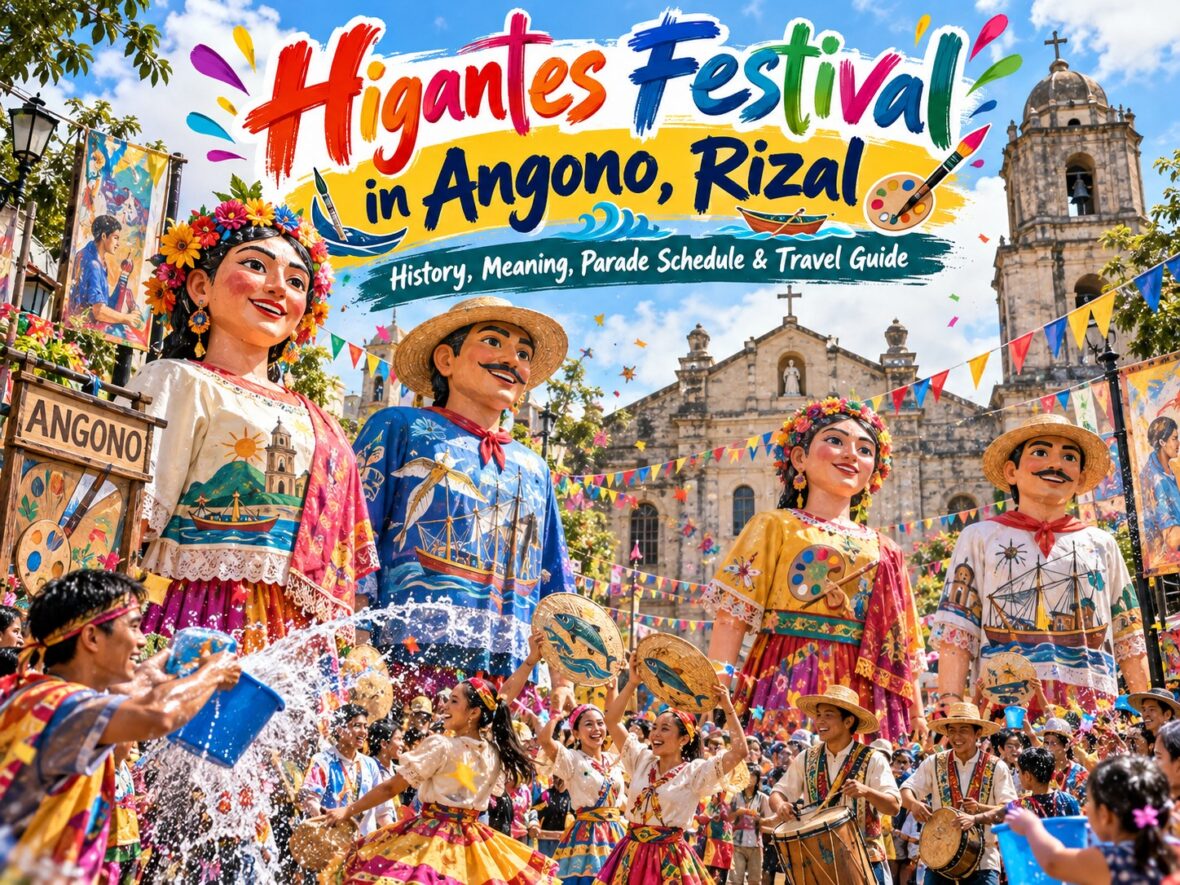
Imagine walking through the streets of a small town in Rizal when suddenly, you see giant human figures towering above the crowd.
Some have enormous smiling faces. Others have exaggerated noses, colorful clothing, and funny expressions. And as music fills the streets, these massive figures begin swaying, turning, and dancing alongside hundreds of spectators.
Welcome to the Higantes Festival in Angono, Rizal!
It’s one of the most unique and visually impressive festivals in the Philippines, famous for its enormous papier-mâché puppets, locally known as higantes.
And the best part? You don’t need to travel to a distant province to experience it. Angono is just east of Metro Manila, making the festival a popular cultural attraction for visitors looking for an exciting day trip.
But Higantes Festival is more than just a parade of giant puppets.
Behind its colorful celebrations is a fascinating story involving Spanish colonial history, local artists, religious devotion, and the creative traditions of a town known as the Art Capital of the Philippines.
The festival also honors San Clemente, the patron saint of fishermen, whose feast day is celebrated every November 23.
From the famous Higantes Grand Parade to the traditional water-splashing celebration and religious processions along Laguna de Bay, there’s plenty to discover.
In this guide, we’ll explore the history and meaning of Higantes Festival, how the giant figures are made, when and where the festival is celebrated, its major activities, and practical travel tips for anyone planning to visit Angono.
Content
What Is Higantes Festival?
Higantes Festival is an annual cultural celebration held in Angono, Rizal, featuring a grand parade of enormous papier-mâché figures carried through the town’s streets.
The word “higantes” comes from the Spanish word “gigantes,” meaning giants.
And that’s exactly what you’ll see during the celebration.
These colorful figures commonly stand around 10 to 12 feet tall, although their actual sizes can vary depending on the design.
Each giant has an oversized head, a lightweight body frame, and colorful clothing. A person standing inside the figure carries and controls its movements, creating the appearance of a giant walking or dancing.
The festival is closely associated with the feast of San Clemente, or Saint Clement, the patron saint of Angono and its fishing community.
While the Higantes Grand Parade is a cultural celebration organized by the municipality, the town fiesta also includes religious traditions such as Masses and processions.
Together, these activities showcase the artistic creativity, cultural heritage, and religious traditions of Angono.
Higantes Festival: Quick Facts
| Details | Information |
|---|---|
| Festival Name | Higantes Festival |
| Also Known As | Gigantes Festival, Higantes and Arts Festival |
| Location | Angono, Rizal, Philippines |
| Region | CALABARZON (Region IV-A) |
| Festival Month | November |
| Patron Saint | San Clemente (Saint Clement) |
| Patron Saint’s Feast Day | November 23 |
| Main Attraction | Giant papier-mâché puppet parade |
| Other Activities | Cultural performances, art exhibits, religious processions, water-splashing traditions |
| Festival Organizer | Municipal Government of Angono and participating organizations |
| Known For | Giant puppets, local artistry, cultural heritage, and religious traditions |
What Does Higantes Mean?
The word “higantes” simply means “giants.”
It refers to the towering human-like figures that have become the most recognizable symbols of Angono’s cultural identity.
Traditionally, these figures were designed with exaggerated human features, including large heads, expressive faces, and oversized bodies.
Some have serious expressions, while others look cheerful or comical.
Their clothing may resemble traditional Filipino attire, everyday outfits, uniforms, or costumes inspired by different characters.
But the meaning of Higantes Festival goes deeper than its name.
According to local folklore, the giant figures were originally associated with the residents’ resistance against abusive landowners during the Spanish colonial period.
Over time, what was once regarded as a symbol of protest evolved into a celebration of creativity, community pride, and artistic achievement.
Today, the higantes represent not only the town’s historical traditions but also the aspirations of its people.
For the residents of Angono, these giants have become symbols of a community that takes pride in its talent, imagination, and cultural identity.
History of Higantes Festival
The history of Higantes Festival is one of the most interesting aspects of the celebration.
There are different accounts of how the tradition began, although the most popular story dates back to the Spanish colonial period.
The Spanish Colonial Origin of Higantes
According to Angono folklore, the area was once part of a large hacienda controlled by wealthy landowners.
During this period, ordinary residents and agricultural workers reportedly experienced strict restrictions imposed by the people who controlled the land.
One version of the story says that residents were allowed to hold only one major celebration each year.
Rather than openly confronting their landlords, the townspeople supposedly found a creative way to express their dissatisfaction.
They made enormous human figures resembling the wealthy hacienda owners.
The giants had exaggerated facial features and expressions, making them appear intimidating, arrogant, or ridiculous.
The residents then paraded these figures through the streets, turning the celebration into a subtle form of mockery and protest.
It was an imaginative way of expressing criticism through art.
And that’s why the traditional higantes are sometimes depicted with their hands placed on their hips and their faces showing exaggerated expressions.
Were Higantes Really Created During Spanish Times?
While the Spanish-era story is widely repeated, it’s important to recognize that it belongs to local oral tradition.
The Municipality of Angono has also documented an alternative historical interpretation.
According to research attributed to Far Eastern University professor James Owen Saguinsin, the story may have originally referred to a tall hacienda caretaker named Karias Tangkad, rather than actual giant puppets.
The researcher also proposed that the familiar papier-mâché figures may have become part of Angono’s fiesta only after World War II.
Under this interpretation, National Artist Carlos “Botong” Francisco encouraged local craftsman Artemio Tajan to develop giant figures that could help bring excitement and happiness to the community after the war.
This means the exact beginnings of the Higantes tradition are not completely settled.
However, both interpretations reveal something important about Angono.
Whether the tradition emerged as an expression of resistance or developed into a postwar artistic celebration, the higantes have become a powerful part of the town’s identity.
The Evolution of Higantes Festival
Over the years, the celebration became increasingly elaborate.
Originally, the giant figures were commonly associated with exaggerated human characters, including representations of a father, mother, and child.
Eventually, local artists began experimenting with different designs.
Today, higantes can represent fishermen, farmers, local personalities, public figures, workers, imaginary characters, and other subjects inspired by the community.
Some even depict vegetables and other playful themes.
The municipality has also introduced smaller versions called higantitos.
As the tradition expanded, schools, barangays, artists, businesses, and community organizations became involved in making and displaying the giant puppets.
What began as a local artistic tradition has grown into a major cultural attraction that draws visitors from different parts of Rizal, Metro Manila, and beyond.
Why Is Higantes Festival Celebrated?
Higantes Festival is celebrated for several interconnected reasons.
First, it serves as a showcase of Angono’s artistic heritage.
The town has a long history of producing talented painters, sculptors, musicians, and other creative professionals.
Creating giant papier-mâché figures provides an opportunity for local artists and residents to express their imagination.
Second, the festival helps preserve an important cultural tradition.
The knowledge involved in constructing, painting, and carrying higantes can be passed down from older artisans to younger generations.
Third, the celebration is associated with Angono’s devotion to San Clemente.
The town has historical ties to fishing and Laguna de Bay, making the patron saint’s feast day particularly meaningful.
Finally, Higantes Festival brings the community together.
Residents from different barangays participate in preparing and presenting the giant figures, while visitors gather to enjoy the celebration.
In many ways, the festival reflects the creativity, resilience, faith, and community spirit of the people of Angono.
Why Is Angono Called the Art Capital of the Philippines?
To fully appreciate Higantes Festival, it helps to understand the artistic identity of Angono.
The municipality is widely known as the Art Capital of the Philippines because of its long-standing contributions to visual arts, music, and other creative fields.
Angono is the hometown of two important Filipino National Artists.
The first is Carlos “Botong” Francisco, who received the National Artist recognition for Visual Arts.
Francisco was known for his remarkable murals and paintings depicting Philippine history, culture, and everyday life.
The second is Lucio San Pedro, a National Artist for Music.
San Pedro was a respected composer and music educator whose compositions helped shape Philippine musical heritage.
One of his best-known works is “Sa Ugoy ng Duyan,” composed with lyrics by Levi Celerio.
But Angono’s artistic culture extends beyond these two remarkable figures.
The town is home to painters, sculptors, musicians, galleries, family museums, and community arts organizations.
It’s also known for public artworks and cultural activities that reflect the creativity of its residents.
During Higantes Festival, this artistic identity becomes particularly visible.
Instead of displaying artwork only inside galleries, the town transforms its streets into a giant open-air exhibition.
And the artworks themselves actually move!
How Are the Higantes Made?
One of the most fascinating things about Higantes Festival is the craftsmanship behind the giant figures.
Although they look massive, the puppets are designed to be lightweight enough for a person to carry.
The traditional construction process combines papier-mâché, bamboo or similar framing materials, paint, and colorful fabric.
Step 1: Creating the Giant Head
The most recognizable part of a higante is its oversized head.
Artisans begin by preparing a mold or framework to establish the face’s shape.
Layers of paper are applied using an adhesive mixture, following the papier-mâché technique.
Once the material dries and hardens, it forms a relatively lightweight shell.
The head is then removed from its mold or finished according to the maker’s construction method.
Step 2: Painting the Facial Features
After the head is prepared, artists begin painting its features.
This is where individual creativity really comes into play.
Some giants have large eyes, exaggerated noses, thick eyebrows, and enormous smiles.
Others are designed to resemble familiar personalities or imaginative characters.
The expressions are often intentionally dramatic because the figures must remain recognizable even from a distance.
Step 3: Building the Body Frame
The body of a higante is usually made using lightweight framing materials such as bamboo.
The structure must be sturdy enough to support the head while remaining manageable for the person carrying it.
The artist also has to consider balance, visibility, and movement.
Remember, the figure will eventually be carried through crowded streets, sometimes for several hours.
Step 4: Adding the Costume
The frame is covered with colorful fabric to create the giant’s clothing.
Depending on the character, this might include a dress, barong-inspired attire, a uniform, a traditional costume, or an imaginative outfit.
Some figures also have oversized sleeves that create the appearance of giant arms.
The costume helps hide the person carrying the puppet inside.
Step 5: Bringing the Higante to Life
Once the figure is completed, a participant enters or positions themselves within the structure.
By walking, turning, and shifting their body, the carrier makes the giant appear to move.
During the parade, the higantes sway and dance as their operators respond to the music and cheering spectators.
It’s a fun and impressive sight, especially when dozens of giants are moving together.
And when you consider the amount of work that goes into each creation, it’s easy to understand why Higantes Festival is such an important celebration of local craftsmanship.
When Is Higantes Festival Celebrated?
Higantes Festival is celebrated every November in Angono, Rizal.
The celebration is associated with the feast of San Clemente on November 23.
However, here’s something important to remember if you’re planning to visit.
The Higantes Grand Parade and the religious feast day do not necessarily take place on the same date.
Historically, the Municipality of Angono has scheduled the parade of giants on the Sunday before the November 23 fiesta.
But actual festival schedules can change depending on the organizers’ plans.
Some editions also feature a broader Higantes and Arts Festival program throughout November.
Typical Higantes Festival Activities
| Festival Activity | Usual Period |
|---|---|
| Cultural and arts activities | Throughout selected dates in November |
| Higantes Grand Parade | Announced separately, traditionally before November 23 |
| Parish novena and religious activities | Days leading to November 23 |
| Feast of San Clemente | November 23 |
| Religious and fluvial processions | Around the patron saint’s feast day |
| Other community celebrations | Dates vary by edition |
The most reliable approach is to check the official festival calendar for the year you plan to attend.
If your goal is to see the giant puppets, confirm the date of the actual grand parade.
If you’re interested in the religious traditions, November 23 is the key date to remember.
Where Is Higantes Festival Held?
Higantes Festival takes place in Angono, a municipality in the province of Rizal, east of Metro Manila.
The main attraction is the street parade, which moves through designated roads in the municipality.
The exact assembly points, parade route, and finishing location can change from year to year.
Festival activities may also take place around the town center, municipal facilities, and other designated venues.
Meanwhile, the religious celebrations are centered on the Diocesan Shrine and Parish of Saint Clement.
The feast day also includes traditions connected with Laguna de Bay, which has played an important role in Angono’s history as a fishing community.
If you’re visiting for the first time, it’s best to identify the official parade route and plan where you’ll watch before traveling to Angono.
Main Activities During Higantes Festival
The festival offers much more than the giant puppet parade.
Depending on the year’s program, visitors can experience a combination of cultural performances, traditional ceremonies, art exhibitions, and community activities.
Here are some of the highlights.
1. Higantes Grand Parade
This is the most famous attraction of the festival.
During the grand parade, dozens or even hundreds of enormous papier-mâché figures move through Angono’s streets.
The giants are accompanied by their carriers, community groups, performers, and spectators.
Some higantes feature traditional human faces, while others represent modern characters or creative interpretations of local culture.
What makes the parade interesting is that every giant has its own personality.
Some appear serious, others look funny, and a few are intentionally exaggerated.
As the carriers move, the figures sway from side to side, creating the illusion that the giants themselves are dancing.
For photographers and festival enthusiasts, this is the activity you definitely shouldn’t miss.
2. Street Dancing and Musical Performances
Music plays an important role in creating the festive atmosphere.
Marching bands, drummers, and other performers may accompany the celebrations.
Depending on the program, participants can also perform choreographed dances while moving along the parade route.
The music adds energy to the procession, while the performers’ colorful costumes make the streets even more vibrant.
Unlike competitions focused primarily on synchronized choreography, Higantes Festival is especially memorable for its moving works of art.
The giant figures themselves remain the center of attention.
3. Parehadoras and the Traditional Fishing Heritage
Another important tradition associated with Angono’s fiesta is the participation of the parehadoras.
These are traditionally groups of young women dressed in colorful costumes, often wearing wooden slippers called bakya.
They carry wooden boat paddles, known as sagwan, while marching or dancing during the procession.
The paddles symbolize Angono’s long-standing connection to fishing and Laguna de Bay.
As the band plays, participants may shout “Viva San Clemente!” in honor of the town’s patron saint.
It’s a tradition that reflects the history of Angono as a community whose livelihood was closely connected to the lake.
4. Basaan or Water-Splashing Tradition
Now, here’s something you should know before attending the religious fiesta activities.
You might get wet!
One of Angono’s most recognizable traditions is the basaan, where water is splashed or poured on people during the celebration.
For many residents, this is a joyful expression of thanksgiving and devotion connected to San Clemente.
The water also reflects the importance of the lake and fishing to the community’s history.
During some celebrations, people use buckets, hoses, or other containers to splash water as the procession moves through the streets.
The atmosphere can be lively, with residents cheering and participating enthusiastically.
However, visitors should remember that basaan is a local cultural and religious tradition, not simply an excuse to splash strangers without consideration.
If you’re planning to watch the procession, bring waterproof protection for your phone, camera, wallet, and other important belongings.
5. Fluvial Procession on Laguna de Bay
Another meaningful highlight is the fluvial procession honoring San Clemente.
A fluvial procession is a religious procession conducted on water.
During Angono’s traditional celebration, the image of San Clemente is brought aboard a decorated boat or floating platform.
Other boats carrying devotees may accompany the procession along Laguna de Bay.
The tradition reflects the town’s historical connection to fishing and its devotion to the patron saint.
For local families whose livelihoods were traditionally connected to the lake, the procession carries a particularly important meaning.
It’s a way of expressing gratitude and asking for continued protection and blessings.
The exact route, boarding arrangements, and public viewing areas depend on the parish and local organizers.
6. Art Exhibits and Cultural Activities
Because Angono is known as the Art Capital of the Philippines, arts-related activities are often part of the broader festival celebration.
Depending on the edition, visitors may encounter painting exhibitions, cultural presentations, competitions, workshops, concerts, or displays featuring local artists.
These events provide additional opportunities to appreciate the town’s creative traditions.
Some activities highlight established artists, while others give younger participants an opportunity to develop and showcase their talents.
7. Community Celebrations and Local Food
Like many Philippine fiestas, Higantes Festival is also a time for families and friends to gather.
Local businesses and food vendors may experience increased activity as residents and visitors come together for the celebration.
You can expect the town to have a festive atmosphere, especially around the parade route and central activity areas.
For many local families, the celebration is an opportunity to reconnect with relatives and welcome visitors.
Is Higantes Festival a Religious Festival?
Higantes Festival has both cultural and religious connections.
The giant puppet parade itself is primarily a cultural celebration highlighting Angono’s artistic traditions.
However, it takes place in connection with the town’s annual fiesta honoring San Clemente.
The religious celebration includes Catholic traditions such as Masses, devotional activities, and processions.
This distinction is important because the grand parade and the religious activities may be scheduled on different days.
In simple terms, Higantes Festival celebrates the creativity and cultural heritage of Angono, while the feast of San Clemente honors the town’s patron saint.
Together, they create a celebration that combines art, history, religion, and community traditions.
Who Is San Clemente?
San Clemente, also known as Saint Clement I or Pope Clement I, is an early leader of the Catholic Church traditionally recognized as one of its earliest popes.
He is also venerated as a martyr.
According to Christian tradition, Saint Clement was martyred by being thrown into the sea with an anchor attached to him.
This association with water contributed to his recognition as a patron of sailors and fishermen.
For Angono, a municipality with historical ties to fishing on Laguna de Bay, devotion to San Clemente became an important part of its religious identity.
His feast day is observed every November 23.
During the celebration, devotees honor him through prayers, Masses, processions, and other traditional activities.
The fluvial procession is particularly meaningful because it reflects both the saint’s association with water and the community’s fishing heritage.
Why Is Higantes Festival Important?
Beyond the entertainment and colorful giant figures, Higantes Festival plays an important role in preserving Angono’s cultural identity.
Preserving Local History
The festival keeps alive stories associated with the town’s past.
Whether visitors are learning about the Spanish-era hacienda tradition or the development of papier-mâché artistry after World War II, Higantes provides an opportunity to explore Angono’s history.
Promoting Filipino Creativity
The giant figures demonstrate how ordinary materials can be transformed into impressive works of art.
Through papier-mâché, bamboo, fabric, and paint, local artists create figures that are both visually entertaining and culturally meaningful.
Supporting Local Artists
The celebration also provides opportunities for artisans, painters, designers, and other creative professionals to showcase their work.
For younger artists, participating in the festival can be an opportunity to learn traditional techniques and gain experience.
Strengthening Community Pride
The involvement of barangays, families, schools, artists, and other local groups helps strengthen community participation.
Residents take pride in representing their town and maintaining a tradition that has become recognized throughout the Philippines.
Promoting Rizal Tourism
Higantes Festival is also an important attraction for visitors exploring Rizal Province.
Its proximity to Metro Manila makes it relatively accessible to travelers interested in experiencing a traditional Filipino fiesta.
The celebration also introduces visitors to Angono’s art galleries, local cuisine, and cultural heritage.
How to Get to Higantes Festival in Angono
One of the advantages of Higantes Festival is that you can experience it without taking a flight or traveling overnight.
Angono is located east of Metro Manila and is accessible through several major roads connecting Rizal Province with the capital region.
From Metro Manila by Public Transportation
Travelers can reach Angono using buses, jeepneys, UV Express services, or other available public transportation routes toward eastern Rizal.
Depending on where you’re coming from, common transport corridors include Ortigas Avenue and the roads connecting Taytay and Angono.
Some services travel directly toward Angono, while others may require a transfer.
Because routes and terminals can change, check current transport arrangements before leaving.
If you’re attending the parade, remember that some roads may be temporarily closed.
This means your vehicle might not be able to drop you off directly near the event area.
Be prepared to walk.
From Manila by Private Vehicle
If you’re driving, Angono can be reached through the road network connecting Metro Manila to eastern Rizal.
However, traffic can become particularly heavy during the festival.
Road closures and parking restrictions may also be implemented around the parade route.
If you’re bringing a private vehicle, identify an authorized parking area before the event and avoid relying on street parking close to the procession.
Is Angono Far From Manila?
Angono is close enough to Metro Manila for a day trip, although actual travel time depends heavily on your starting point and traffic conditions.
On ordinary days, the journey may be manageable within a few hours.
During Higantes Festival, however, allow extra time.
It’s better to arrive early than spend most of the morning stuck in traffic while the parade is already taking place.
Where to Stay During Higantes Festival
Since Angono is relatively close to Metro Manila, many visitors choose to attend the festival as a day trip.
However, staying overnight can be convenient if you want to attend multiple activities or avoid rushing back after the celebrations.
Accommodation options are available in Angono and nearby areas of Rizal.
You can look for small hotels, inns, guesthouses, or other lodging establishments depending on your budget and preferences.
For visitors planning to attend early-morning activities, staying close to the town center may be helpful.
Just remember to book ahead once the official dates are announced.
What to Eat in Angono During the Festival
Aside from its art and cultural heritage, Angono is also known for its local food.
One traditional delicacy associated with the town is fried itik, or duck.
Visitors can also explore restaurants offering Filipino dishes and regional specialties.
Another well-known part of Angono’s food culture is balaw-balaw, a fermented condiment associated with the area.
Local restaurants and eateries may offer dishes featuring this ingredient.
During fiesta season, food stalls and small establishments may also provide convenient options for visitors watching the parade.
If you’re spending a whole day in Angono, consider trying a local restaurant rather than relying entirely on snacks.
It’s another way to support small businesses while exploring the town.
Travel Tips for Watching Higantes Festival
If you’re planning to attend the celebration, here are a few reminders that can make your experience more enjoyable.
Arrive Early
The grand parade is one of the festival’s most anticipated activities.
Popular viewing areas can become crowded, so arriving ahead of the announced start time gives you more flexibility.
Check the Parade Schedule
Don’t assume the giant puppet parade will always take place on November 23.
The religious feast and grand parade may fall on different dates.
Always confirm the current festival calendar.
Wear Comfortable Clothes and Shoes
Expect to spend a considerable amount of time walking or standing.
Light clothing and comfortable footwear are ideal for navigating busy streets.
Prepare for Water-Splashing Activities
If you’re attending the basaan celebration, use a waterproof pouch to protect your phone and money.
You may also want to bring an extra shirt or towel.
Protect Your Camera
Higantes Festival is an excellent event for photography.
However, large crowds, moving puppets, and water-splashing traditions can make photography challenging.
Keep your equipment protected and avoid standing directly in the path of the giant figures.
Keep a Safe Distance From the Giants
Although the higantes are designed to be carried, they are still large structures.
Their operators may have limited visibility while moving.
Avoid grabbing the figures, pulling their costumes, or blocking their path.
Respect Religious Activities
If you’re watching the San Clemente procession, remember that it is also a religious observance.
Be considerate of devotees and avoid interrupting prayers or ceremonies.
Bring Cash
Local food vendors and small establishments may prefer cash payments.
Having small bills can make purchasing food, drinks, or souvenirs easier.
Check Weather Announcements
November can still bring rain or changing weather conditions to parts of Luzon.
Check the forecast before your trip and follow official announcements if activities are adjusted because of bad weather.
Frequently Asked Questions About Higantes Festival
What Is Higantes Festival?
Higantes Festival is an annual cultural celebration held in Angono, Rizal, featuring giant papier-mâché puppets paraded through the town’s streets.
It showcases Angono’s artistic heritage and is associated with the feast of San Clemente.
Where Is Higantes Festival Celebrated?
The festival is celebrated in the municipality of Angono, Rizal, in the CALABARZON Region of the Philippines.
When Is Higantes Festival Celebrated?
Higantes Festival takes place every November.
The town celebrates the feast of San Clemente on November 23, while the grand parade may be scheduled on a separate date.
What Does Higantes Mean?
Higantes means “giants.”
The name refers to the enormous papier-mâché figures that serve as the main attraction of the celebration.
Why Do People Celebrate Higantes Festival?
The festival celebrates Angono’s artistic traditions, local history, community identity, and cultural heritage.
It is also connected to the town’s devotion to San Clemente.
Who Is the Patron Saint of Higantes Festival?
San Clemente, or Saint Clement I, is the patron saint of Angono and its traditional fishing community.
His feast day is celebrated every November 23.
How Tall Are the Higantes?
Many traditional higantes stand approximately 10 to 12 feet tall.
However, their actual dimensions vary depending on the design and construction.
What Are the Higantes Made Of?
The giant figures are commonly made using papier-mâché heads, lightweight bamboo or similar body frames, painted details, and colorful fabric costumes.
Who Carries the Higantes?
A person positioned inside the structure carries and controls the figure.
By walking, turning, and shifting their body, the operator makes the giant appear to move or dance.
What Is Basaan During Higantes Festival?
Basaan is a water-splashing tradition associated with Angono’s religious fiesta.
It is commonly interpreted as an expression of blessings, thanksgiving, and the community’s connection with water and fishing.
What Are Parehadoras?
Parehadoras are traditional procession participants, historically young women, who wear colorful clothing and wooden slippers while carrying boat paddles.
They represent Angono’s fishing heritage and devotion to San Clemente.
Is Higantes Festival Free?
The street parade is generally a public event that spectators can watch without purchasing an admission ticket.
However, certain organized activities, workshops, or special events may have separate requirements or fees.
Is Higantes Festival Good for Families?
Yes. The giant puppets are especially entertaining for children.
However, families should prepare for crowds, warm weather, walking, and possible water-splashing activities.
Can I Visit Higantes Festival in One Day?
Yes. Angono is close enough to Metro Manila for a day trip.
If your main goal is to watch the grand parade, one day may be sufficient.
However, staying longer allows you to attend more activities and explore the town’s artistic attractions.
Higantes Festival 2026: Latest Schedule and Updates
Although this guide focuses on the festival as a whole, here’s a quick look at the announced schedule for the upcoming 2026 celebration.
The Municipality of Angono has introduced the theme “Higante at Sining: Ugat ng Kalinangan, Sagisag ng Pagkakaisa.”
The celebration will include a series of cultural and artistic activities throughout November.
Higantes Festival 2026 Important Dates
| Date | Activity |
|---|---|
| October 31, 2026 | Official festival launch at Angono Gymnasium |
| November 15, 2026 | Higantes Festival Grand Parade |
| November 23, 2026 | Feast of San Clemente and traditional religious celebrations |
Angono Tourism has announced November 15, 2026, as the date of the grand parade.
The November 23 feast day is also associated with the traditional fluvial procession honoring San Clemente.
The official festival calendar is scheduled to be unveiled during the October 31 launch.
As of October 18, the complete activity schedule, exact parade route, and detailed start times have not all been confirmed in the information reviewed.
Visitors should check the Municipality of Angono and Angono Tourism’s official announcements for further updates.
Final Thoughts
Higantes Festival is one of those celebrations that perfectly shows how creative and unique Philippine festivals can be.
At first glance, it’s easy to be fascinated by the enormous puppets, colorful costumes, and lively parade.
And honestly, seeing those giant figures moving through the streets is already an experience worth traveling for.
But when you learn about the festival’s history, you realize there’s much more to it.
The higantes are connected to stories of resistance, artistic expression, community pride, and the cultural traditions of Angono.
They also represent the creativity of local artisans who continue to transform simple materials into remarkable moving works of art.
Add the town’s devotion to San Clemente, its fishing heritage, and its long tradition of producing talented artists, and you have a celebration that truly reflects the identity of the community.
For travelers coming from Metro Manila, Higantes Festival is also one of the more accessible cultural celebrations worth experiencing.
You don’t need to take a flight or plan an expensive vacation.
Sometimes, all it takes is a trip to Rizal to discover something extraordinary.
So if you’re looking for a Philippine festival that’s colorful, interesting, and deeply connected to local culture, consider adding Higantes Festival in Angono to your travel plans.
It’s a wonderful reminder that Filipino creativity comes in all shapes and sizes.
And in Angono, it just happens to come in the form of giants.
See you in Angono, the Art Capital of the Philippines and Home of the Higantes Festival!