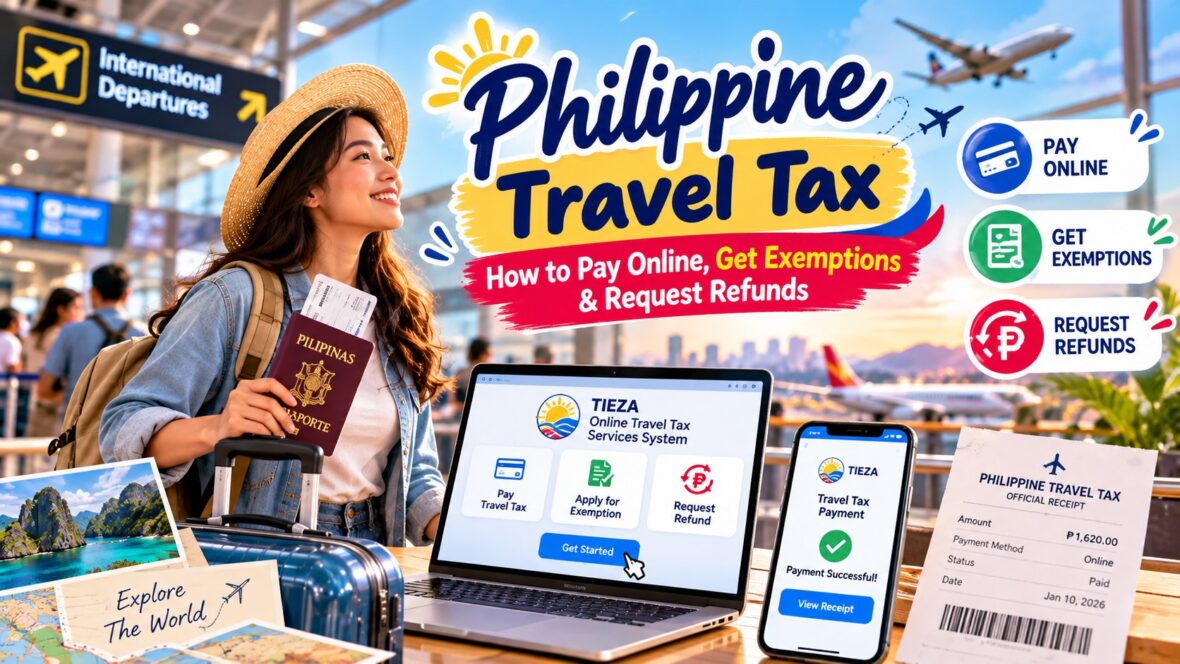
Planning an international trip from the Philippines? Whether you’re flying to Japan, South Korea, Thailand, Singapore, or another destination, there’s one expense you shouldn’t forget when preparing your travel budget: the Philippine travel tax.
If you’ve traveled abroad before, you’re probably familiar with this additional charge.
For most Filipino tourists flying in economy class, the Philippine travel tax is ₱1,620 per person.
It might not seem like a huge amount compared with the cost of an international flight, but when you’re traveling with your family, those additional expenses can quickly add up.
For example, a family of four paying the full economy-class rate would spend ₱6,480 on travel tax alone.
And here’s something many travelers don’t realize: not everyone needs to pay the full amount.
Certain passengers are completely exempt from paying Philippine travel tax, while others qualify for reduced rates.
You might also be entitled to a refund if you accidentally paid twice, canceled your trip, or paid the full amount even though you qualified for an exemption.
The good news is that the Tourism Infrastructure and Enterprise Zone Authority (TIEZA) has made several improvements to its online services, making it easier for travelers to pay travel tax and apply for exemptions or reduced rates.
In this comprehensive guide, I’ll explain everything you need to know about the Philippine travel tax, including the latest rates, how to pay online, who qualifies for exemptions, how to get discounted rates, and how to request a refund.
Let’s get started!
Content
What Is the Philippine Travel Tax?
The Philippine travel tax is a government levy imposed on certain passengers departing the Philippines for international travel.
It is administered by the Tourism Infrastructure and Enterprise Zone Authority, commonly known as TIEZA.
The tax is established under Presidential Decree No. 1183, as amended, and applies to covered travelers regardless of where they purchased their airline tickets.
This means that even if you booked your flight through an international airline or an overseas travel agency, you may still be required to pay Philippine travel tax when departing the country.
The amount depends on your passenger category, class of travel, and eligibility for special exemptions or reduced rates.
Travel tax applies to covered international departures, not ordinary domestic trips within the Philippines.
Where Does the Travel Tax Money Go?
You might be wondering why the Philippine government collects this tax in the first place.
Under Republic Act No. 9593, also known as the Tourism Act of 2009, travel tax collections are allocated as follows:
- 50% goes to TIEZA for tourism infrastructure and related purposes.
- 40% goes to the Commission on Higher Education (CHED) for tourism-related educational programs.
- 10% goes to the National Commission for Culture and the Arts (NCCA).
Essentially, the money helps support tourism development, tourism education, and cultural programs.
Although travelers may see it as an additional expense, the tax has a specific purpose under Philippine law.
How Much Is the Philippine Travel Tax in 2026?
As of October 2026, the regular Philippine travel tax is ₱1,620 for economy or business-class travel and ₱2,700 for first-class travel.
However, passengers who qualify for reduced travel tax may pay significantly less.
Here’s the official rate comparison.
| Travel Tax Category | Economy / Business Class | First Class |
|---|---|---|
| Full Travel Tax | ₱1,620 | ₱2,700 |
| Standard Reduced Travel Tax | ₱810 | ₱1,350 |
| Privileged Reduced Travel Tax | ₱300 | ₱400 |
| Qualified Exempt Passengers | ₱0 | ₱0 |
The standard reduced rate is available to certain passengers, including qualifying children.
The privileged reduced rate applies to eligible dependents of Overseas Filipino Workers (OFWs), subject to specific conditions.
Meanwhile, qualified exempt passengers do not need to pay Philippine travel tax.
Remember that online payment service providers may charge additional convenience or transaction fees.
Who Is Required to Pay Philippine Travel Tax?
Not everyone leaving the Philippines is automatically required to pay the tax.
Under the applicable rules, the following categories are generally covered.
1. Filipino Citizens Traveling Abroad
Most Filipino citizens traveling overseas for tourism, business, family visits, or other personal reasons must pay Philippine travel tax unless they qualify for an exemption.
For example, if you’re a Filipino tourist flying from Manila to Bangkok for a five-day vacation, you’ll normally be required to pay travel tax.
The same generally applies if you’re flying to Tokyo, Seoul, Singapore, Hong Kong, or another international destination.
2. Foreign Passport Holders With Taxable Immigration Status
Some foreign passport holders residing in the Philippines are also subject to travel tax.
This includes certain permanent resident aliens and foreign nationals holding immigration statuses covered by Philippine travel tax regulations.
3. Non-Immigrant Foreign Nationals Staying More Than One Year
Foreign passport holders who have stayed in the Philippines for more than one year may become subject to Philippine travel tax, depending on their immigration status and applicable exemptions.
This is why travel tax obligations should not be determined by passport nationality alone.
A foreign tourist visiting the Philippines for a short holiday generally has a different tax status from a foreign national who has been residing in the country for an extended period.
Who Is Exempted From Philippine Travel Tax?
Here’s one of the most important parts of this guide.
Certain travelers qualify for a complete exemption, meaning they don’t have to pay the regular Philippine travel tax.
However, exemption eligibility must be supported by the required documents.
Let’s discuss the most common categories.
1. Overseas Filipino Workers (OFWs)
Qualified Overseas Filipino Workers are exempt from paying Philippine travel tax when traveling in connection with their overseas employment.
For example, an OFW returning to their overseas worksite after a vacation in the Philippines may qualify for an exemption.
An Overseas Employment Certificate (OEC), or the applicable documentation recognized under current OFW procedures, can serve as evidence of eligibility.
TIEZA’s published rules specify that the OEC serves as a travel tax exemption certificate when used for travel to the OFW’s worksite.
If you’re an OFW, check that your documentation is valid for your particular journey.
Don’t assume that every international trip you take automatically qualifies for exemption simply because you have worked overseas.
2. Filipino Permanent Residents Abroad
Filipino citizens who are permanent residents of another country may be exempt if they stay in the Philippines for less than one year.
For example, consider a Filipino who is a permanent resident of Canada.
If that person visits the Philippines for a short vacation and then returns overseas, they may qualify for travel tax exemption.
Typical supporting documents include:
- Philippine passport
- Proof of foreign permanent residence
- Passport records showing the latest arrival in the Philippines
- Other documents required by TIEZA
Examples of proof of foreign permanent residence include a valid permanent resident card or equivalent documentation.
However, holding an ordinary tourist visa or temporary work permit in another country is not necessarily the same as having permanent resident status.
3. Infants Up to Two Years Old
Infants up to their second birthday on the date of travel are exempt from Philippine travel tax.
This is helpful for families traveling overseas with babies.
You may need to present the child’s original passport or, in applicable circumstances, their birth certificate and passport identification details.
Keep in mind that the child’s eligibility is based on their age on the date of travel.
4. Qualified Balikbayans
Certain balikbayans who have stayed in the Philippines for less than one year may qualify for travel tax exemption under Republic Act No. 6768.
This includes eligible returning Filipinos and former Filipino citizens who meet the applicable requirements.
TIEZA may require passport records, proof of previous residence or departure, and other documents establishing eligibility.
Eligible accompanying family members of former Filipino citizens may also qualify under the relevant rules.
However, not everyone who casually uses the term “balikbayan” automatically qualifies.
The specific legal definition and requirements still apply.
5. Government Officials Traveling on Official Business
Certain Philippine government officials and employees traveling abroad on authorized official business may be exempt from paying travel tax.
They generally need appropriate documentation, such as a certified travel authority or travel order.
The applicable category excludes employees of government-owned and controlled corporations under the published exemption rules.
Personal vacations are not automatically covered simply because someone works for the government.
6. Qualified Students With Government-Approved Scholarships
Some students are eligible for travel tax exemption when traveling under scholarships approved by the appropriate government agency.
However, being a student alone does not automatically mean you’re exempt.
For example, an ordinary college student traveling abroad for a family vacation generally cannot claim exemption simply by presenting a school ID.
The student must meet the relevant scholarship and documentary requirements.
7. Other Qualified Passengers
Additional exemption categories include certain foreign diplomatic and consular personnel, UN personnel, qualified international flight crew members, Philippine foreign service personnel, and other individuals specifically covered by law.
The requirements vary depending on the exemption category.
If you’re unsure whether you qualify, it’s best to confirm your status with TIEZA before paying.
How to Apply for Philippine Travel Tax Exemption Online
The good news is that eligible travelers can now apply for a Travel Tax Exemption Certificate online.
TIEZA expanded its Online Travel Tax Services System to support electronic applications for exemption certificates.
This means qualified travelers don’t necessarily have to visit a TIEZA office simply to begin their application.
Here’s how the process works.
Step 1: Visit the Official TIEZA Website
Open your browser and visit:
tieza.gov.ph
Navigate to the Online Travel Tax Services System.
You can also access TIEZA’s current online services through onlinettax.tieza.gov.ph.
Step 2: Select Travel Tax Exemption
Choose the option for a Travel Tax Exemption Certificate, commonly called TEC.
Step 3: Enter Your Travel Information
Provide the information requested by the system, including your intended departure date and relevant passenger details.
Make sure your name and passport information match your official travel documents.
Step 4: Upload the Required Documents
Prepare clear digital copies of the documents needed for your exemption category.
TIEZA lists the following among its standard online application requirements:
- Recent 2×2 ID photograph
- Passport identification page
- Airline ticket or flight booking
- Additional proof establishing exemption eligibility
For example, an eligible permanent resident abroad may need to provide proof of residency and Philippine arrival details.
Other categories require different supporting records.
Step 5: Submit Your Application
Review your information and uploaded documents.
Once everything is correct, submit your application through the portal.
Step 6: Wait for TIEZA’s Evaluation
TIEZA’s current exemption application guidance states that complete online TEC applications are processed within three working days.
Your departure date must be at least three days after the date of your online application.
Applications submitted after 5:00 PM or during weekends are considered received on the next working day under TIEZA’s stated processing rules.
For trips departing sooner than the online application window allows, applicants are directed to process their request onsite at a TIEZA office or airport counter.
Step 7: Keep Your Approved Certificate
After approval, follow the instructions provided by TIEZA and keep your exemption certificate available for airline verification.
Save a copy on your phone and consider bringing a printed copy.
It’s also a good idea to carry the original supporting documents used to establish your exemption.
What Is Reduced Philippine Travel Tax?
Not everyone who is ineligible for full exemption needs to pay the regular ₱1,620 rate.
Some passengers qualify for reduced travel tax.
TIEZA recognizes two main reduced-rate categories:
- Standard Reduced Travel Tax
- Privileged Reduced Travel Tax
Let’s look at the difference.
Standard Reduced Travel Tax: Who Qualifies?
The standard reduced travel tax is 50% of the full rate.
For economy-class travel, this reduces the amount from ₱1,620 to ₱810.
For first-class travel, the amount is reduced from ₱2,700 to ₱1,350.
Eligible passengers include the following.
Children Above Two Years Old Through Their 12th Birthday
Children from two years and one day old through their 12th birthday on the date of travel qualify for the standard reduced rate under TIEZA’s published age rule.
For example, if you’re traveling with an eight-year-old child, the child’s economy-class travel tax would generally be ₱810 rather than ₱1,620.
You may need to present the child’s passport or other documents confirming their age.
Accredited Filipino Journalists
Filipino journalists traveling abroad for qualifying journalistic assignments may also be eligible for reduced travel tax.
They need to satisfy the accreditation and documentation requirements.
Ordinary leisure travel does not automatically qualify.
Travelers Authorized by the President
Certain passengers specifically authorized by the President of the Philippines for reasons of national interest may qualify for reduced travel tax.
Written authorization is required.
Privileged Reduced Travel Tax for OFW Dependents
This is another benefit that some Filipino families may not be familiar with.
Qualified dependents of Overseas Filipino Workers may pay a privileged reduced travel tax rate when traveling to the OFW’s worksite.
The privileged rates are:
| Class of Travel | Privileged Rate |
|---|---|
| Economy / Business Class | ₱300 |
| First Class | ₱400 |
Eligible dependents include:
- Legitimate spouses of OFWs
- Unmarried children of OFWs below 21 years old
- Children of OFWs with disabilities, even when over 21 years old, subject to the applicable requirements
However, an important condition applies.
TIEZA states that this privilege is granted when the dependent is traveling to the OFW’s worksite.
For example, if an eligible spouse is traveling to join an OFW at their overseas place of employment, the spouse may qualify for the privileged rate.
A family member going on an unrelated vacation abroad should not automatically assume that the same discount applies.
Required documents may include the OFW’s OEC or recognized employment documentation, marriage or birth certificate, and other relevant proof.
How to Apply for Reduced Travel Tax Online
TIEZA’s updated online system also supports Reduced Travel Tax applications.
Here’s the general procedure.
Step 1: Open the Online Travel Tax Services System
Visit TIEZA’s official website and open the online travel tax services page.
Step 2: Select Reduced Travel Tax
Choose the reduced travel tax option.
Step 3: Choose Your Eligibility Category
Indicate whether you’re applying for the standard or privileged reduced rate.
Step 4: Enter Your Information
Complete the form with your passenger and travel details.
Step 5: Upload Supporting Documents
Depending on your category, these may include your passport, proof of age, family relationship documents, or the OFW’s employment documents.
The online system accepts supported digital document formats.
Step 6: Submit Your Application
Review your details, agree to the terms, and submit the application.
TIEZA’s online guidance states that complete RTT applications are processed within one day.
Your flight must be at least one day after the online application date. Otherwise, the application should be processed onsite.
Step 7: Follow the Instructions for Payment
Once your eligibility is verified, follow TIEZA’s instructions for paying the applicable reduced rate and securing your documentation.
If you’ve already paid the full travel tax but qualify for a reduced rate, TIEZA advises applying for a refund of the excess amount through its onsite process.
How to Pay Philippine Travel Tax Online
Now, let’s talk about the process most Filipino tourists will probably use.
If you’re traveling abroad and required to pay the regular full travel tax, you can make the payment online before arriving at the airport.
TIEZA’s official Online Travel Tax Services System makes this possible.
And thankfully, you don’t need to create a permanent account just to make a full-rate payment through the current system.
Here’s how.
Step 1: Check Whether Your Airline Ticket Already Includes Travel Tax
Before paying anything, review your airline booking confirmation or e-ticket.
Look for an item labeled Philippine Travel Tax, PH Travel Tax, or a similar description.
This is extremely important because some airlines allow passengers to pay travel tax during the booking process.
If you’ve already paid it through the airline, making another payment directly to TIEZA could result in a duplicate charge.
Step 2: Visit the Official TIEZA Online Travel Tax Portal
Go to:
onlinettax.tieza.gov.ph
Alternatively, open tieza.gov.ph and select the Online Travel Tax Services System.
Use only the official government website or an authorized payment channel.
Step 3: Select Full Travel Tax Payment
Choose the full travel tax payment option.
The system will display the required passenger information fields.
Step 4: Enter Your Personal Information
Provide your details, including:
- First name
- Last name
- Middle name, if applicable
- Passport number
- Ticket number or booking reference
- Mobile number
- Email address
Double-check that your name and passport number match your travel documents.
Step 5: Enter Your Flight Information
Provide the requested trip details.
These generally include your airline, destination country, departure date, and class of travel.
The system distinguishes first-class travel from economy, business, and other applicable travel categories.
Step 6: Add Other Passengers, If Necessary
Here’s a useful feature for families and groups.
The current full-payment portal allows a maximum of 10 passengers in one transaction.
Passengers may have different flight dates and destinations, according to the portal’s instructions.
However, the system issues one acknowledgment receipt to the primary passenger for the transaction.
Make sure all passenger details are correct before proceeding.
Step 7: Review Your Travel Tax Assessment
The system will calculate or display the applicable travel tax.
For a regular economy-class Filipino tourist, the government tax itself is ₱1,620.
Check whether the payment provider adds a convenience fee or other processing charge.
Step 8: Choose Your Payment Method
Select one of the available payment options.
TIEZA’s online payment arrangements through MYEG have supported e-wallets, online bank transfers, credit and debit cards, and participating over-the-counter payment partners.
Examples of channels historically offered include GCash, Maya, GrabPay, selected banks, and major card networks.
Actual payment options and convenience fees can change, so follow the choices displayed by the live portal.
Step 9: Complete Your Payment
Follow the instructions provided by your selected payment provider.
Once successful, wait for the official confirmation.
Don’t close the payment page while the transaction is still processing.
Step 10: Save Your Official Acknowledgment Receipt
After successful payment, save the acknowledgment receipt or other official payment confirmation issued through the system.
I recommend keeping both a digital copy and a printed copy.
You may be asked to present proof of payment during airline check-in or departure processing.
And that’s it! You’ve completed your Philippine travel tax payment without having to line up at the airport’s travel tax counter.
Can You Pay Philippine Travel Tax Through GCash?
Yes. GCash has been one of the payment methods supported through TIEZA’s online payment arrangements.
The important thing is to initiate the transaction using an official TIEZA or authorized government payment channel.
For example, if GCash is available in the payment options displayed by the portal, you can select it and follow the instructions.
The payment provider may charge a convenience fee.
Always check the total amount before confirming.
Don’t send money to a personal GCash account claiming to process travel tax payments.
Can You Pay Philippine Travel Tax Through Maya?
Maya has also been among the supported e-wallet payment options under TIEZA’s online payment arrangements.
As with GCash, availability depends on the payment gateway currently offered.
Begin your transaction through the official portal and select Maya only when the system presents it as an available payment method.
Can You Pay Travel Tax Through the eGovPH App?
Yes.
TIEZA has integrated full travel tax payment services with the eGovPH Super App and the eTravel ecosystem.
This gives travelers another official way to complete the payment.
The general process involves opening the eGovPH app, accessing the TIEZA travel tax service, providing the required passenger and trip details, and following the payment instructions.
One advantage is that the integrated system may retrieve relevant traveler information from connected government services.
The exact app interface can change with updates, so follow the options displayed in the current version.
Can You Pay Philippine Travel Tax at the Airport?
Yes. If you haven’t paid online, you can generally settle the travel tax at an authorized TIEZA counter before international departure.
TIEZA maintains travel tax counters at major Philippine international airports.
These include NAIA Terminals 1, 2, and 3, Clark International Airport, and other airports with authorized travel tax collection facilities.
However, I recommend paying in advance whenever possible.
Airports can become extremely crowded during holidays, long weekends, summer vacation, and other peak travel seasons.
If you still need to pay travel tax on your departure day, it means another stop before airline check-in or immigration.
It’s much more convenient to settle the payment beforehand and keep your receipt ready.
How to Check Whether Travel Tax Is Included in Your Airline Ticket
This is something every international traveler should do.
Travel tax is not automatically included in every airline’s advertised ticket price.
Some airlines collect it during booking, while others direct passengers to pay separately.
Here’s how to check.
For Cebu Pacific Passengers
Review your itinerary receipt and booking payment breakdown.
Cebu Pacific offers passengers options to settle the Philippine travel tax through its booking or associated digital payment channels.
If you paid during booking, check whether the amount appears in your confirmation.
For Philippine Airlines Passengers
Philippine Airlines has offered the option to pay Philippine travel tax separately through the booking confirmation process.
Its published booking guidance states that travel tax is not automatically included in the online quoted ticket price.
Review your actual ticket and payment confirmation to determine whether you’ve already paid.
For Other Airlines
Check the taxes and fees section of your e-ticket.
If you’re unsure whether the Philippine travel tax has been collected, contact the airline or booking agency.
It’s better to verify before departure than to pay twice and request a refund later.
Philippine Travel Tax vs. Terminal Fee: What’s the Difference?
This is another common source of confusion.
Travel tax and airport terminal fees are not the same thing.
| Philippine Travel Tax | Airport Terminal Fee |
|---|---|
| Administered by TIEZA | Collected under airport passenger service arrangements |
| Applies to covered international travelers | Applies according to airport and passenger service rules |
| Regular economy rate is ₱1,620 | Amount varies by airport and applicable rules |
| Certain passengers qualify for exemptions or reductions | Different exemptions or collection arrangements may apply |
| Can be paid through TIEZA and authorized channels | Often incorporated into airline ticket charges |
The Philippine travel tax is a separate government levy.
The terminal fee, also known as the Passenger Service Charge, is associated with the use of airport facilities and services.
So if your airline ticket already includes a terminal fee, that doesn’t automatically mean your Philippine travel tax has been paid.
Always check both.
How to Request a Philippine Travel Tax Refund
What if you’ve already paid Philippine travel tax but later discover that you’re eligible for a refund?
Fortunately, TIEZA has established procedures for qualified refund claims.
A refund may be available when a traveler paid tax that wasn’t due, made a duplicate payment, qualified for an exemption or reduced rate, or meets certain other grounds recognized by TIEZA.
However, refunds are subject to documentary requirements and evaluation.
Let’s discuss the common situations.
When Can You Get a Philippine Travel Tax Refund?
1. You Paid Travel Tax Twice
Imagine booking a flight and paying travel tax through the airline.
Later, you forget that you’ve already paid and make another payment through TIEZA.
You may qualify for a refund of the duplicate payment.
You’ll need evidence of both transactions.
2. You Qualified for an Exemption but Already Paid
For example, you may be an eligible OFW or permanent resident abroad who paid the regular travel tax without realizing that an exemption applied.
In this situation, you may request a refund after presenting the required proof of eligibility.
3. You Paid the Full Amount but Qualified for a Reduced Rate
Suppose you paid ₱1,620 for a child’s economy-class ticket, but the child qualified for the ₱810 standard reduced rate.
The excess amount may be refundable upon approval.
The same principle applies to eligible OFW dependents who mistakenly paid the full amount.
4. Your Ticket Was Unused
Travelers with unused airline tickets may qualify for a travel tax refund under TIEZA’s rules.
However, this doesn’t mean every canceled booking automatically results in an immediate refund.
The applicable requirements depend on the ticket, the way travel tax was collected, and the circumstances of the cancellation.
TIEZA may require documentation from the airline confirming the ticket’s status.
5. You Were Charged Even Though You Were Not Covered
Some foreign travelers who were not subject to Philippine travel tax may be eligible for a refund if the tax was mistakenly collected.
They must establish that they were not taxable under the applicable rules.
6. Your Ticket Was Downgraded
If you paid the first-class travel tax but your ticket was subsequently downgraded to a lower class, you may qualify for a refund of the difference.
Supporting documents from the airline are required.
How to Apply for a Philippine Travel Tax Refund Online
TIEZA’s current online portal includes a Travel Tax Refund application feature.
Here’s the general process.
Step 1: Visit the Official Online Travel Tax Services System
Open:
onlinettax.tieza.gov.ph
Select the Refund option.
Step 2: Indicate How You Paid the Travel Tax
The online refund portal allows applicants to distinguish between travel tax paid through TIEZA and travel tax collected with an airline ticket.
Choose the applicable option.
This matters because the procedure may differ depending on who originally collected the payment.
Step 3: Enter Your Passenger Information
Provide the requested personal information and transaction details.
Make sure the information matches your passport and travel tax records.
Step 4: Identify the Reason for Your Refund
Select the applicable refund category.
Examples include duplicate payment, tax exemption entitlement, reduced-rate entitlement, or another qualifying reason.
Step 5: Prepare Your Supporting Documents
The documents you need depend on the reason for your claim.
These may include:
- Original passport or required identification
- Airline ticket showing travel tax collection
- TIEZA official receipt or acknowledgment receipt
- Proof of exemption or reduced-rate eligibility
- Airline certification for an unused or downgraded ticket
- Additional documents required for your particular claim
Step 6: Submit the Application
Review your information and follow the portal’s submission instructions.
Keep any acknowledgment or tracking information provided.
Step 7: Wait for Evaluation
TIEZA will evaluate whether your refund claim qualifies under the applicable rules.
Additional documentation or clarification may be required.
Step 8: Follow the Approved Refund Release Procedure
Once approved, follow TIEZA’s instructions for receiving the refund.
TIEZA’s published refund policies describe payment by check, while the agency has also announced a partnership with GCash to modernize approved refund disbursements.
The actual release method depends on the refund process available for your claim.
Don’t assume that every approved refund is automatically credited to your original payment card or e-wallet.
What Documents Are Required for a Travel Tax Refund?
Here’s a practical overview of common documentary requirements.
| Reason for Refund | Important Supporting Documents |
|---|---|
| Duplicate payment | Passport, ticket, receipts proving both payments |
| Exempt passenger paid tax | Passport, tax receipt, proof of exemption |
| Qualified for reduced tax | Passport, tax receipt, reduced-rate supporting documents |
| Unused ticket | Ticket, receipt, airline certification or required fare refund records |
| Downgraded ticket | Ticket, receipt, airline certification confirming downgrade |
| Tax collected in error | Ticket, receipt, proof that the traveler was not taxable |
The table is a summary. TIEZA may require original documents, airline-certified records, or other information depending on the claim.
For unused tickets involving Philippine Airlines or Cebu Pacific, TIEZA’s published guidance specifically directs certain airline-ticket refund transactions to the respective airline.
Contact the airline first if the travel tax was included in your booking payment.
How Long Do You Have to Request a Travel Tax Refund?
This is very important.
Under TIEZA’s published policy, regular travel tax refund claims must be made within two years from the date of payment.
For example, if you paid Philippine travel tax on August 10, 2026, you should submit any qualifying refund claim within the applicable two-year period.
Don’t leave the request until the last minute.
The earlier you prepare your documents, the easier it may be to retrieve payment records and airline certifications.
Is There a Same-Day Philippine Travel Tax Refund?
Yes. TIEZA also provides a same-day refund procedure for eligible circumstances involving travel tax paid directly at certain airport counters.
The published procedure covers qualifying claims made within 24 hours from the time of payment.
Possible grounds include:
- Canceled flights or offloaded passengers
- Eligible exemptions or reduced rates
- Duplicate travel tax payments
- Travel tax collected when it was not due
The passenger must present the original passport, the applicable same-day refund form, and the required original TIEZA receipts.
Additional documents depend on the reason for the refund.
This procedure is different from the regular refund process and has specific conditions.
If your flight is canceled while you’re still at the airport and you’ve just paid travel tax at a TIEZA counter, ask the staff immediately whether the same-day refund procedure applies.
Can You Receive a Philippine Travel Tax Refund Through GCash?
TIEZA announced a partnership with GCash operator G-Xchange to improve its travel tax refund services.
The arrangement involves the use of GCash’s Funds Disbursement Service for approved refunds.
This is intended to make refund releases faster and reduce the need for physical claims.
However, the availability of GCash disbursement for a particular claim should be confirmed with TIEZA.
For some cases, the agency’s published refund instructions still refer to check-based processing.
The important thing is to follow the official instructions provided after your refund application has been evaluated.
How to Contact TIEZA for Travel Tax Concerns
If you’re having trouble with your payment, exemption application, or refund, you can contact TIEZA through its official customer service channels.
The published TIEZA Travel Tax Department telephone number is:
(02) 8249-5987
TIEZA also provides contact options through its official website.
For assistance with the Online Travel Tax Services System, the payment platform operator MYEG has published the following contact numbers:
- (02) 8935-4036
- 0968-621-1441
- 0936-148-2679
Contact details and operating hours may change, so verify them through TIEZA’s official website before calling.
If your concern involves a specific payment, prepare your passport information, booking reference, payment receipt, and transaction details.
However, only share sensitive personal information through verified official support channels.
Common Philippine Travel Tax Payment Problems
Although online payment is convenient, problems can still happen.
Here are some situations travelers may encounter.
1. I Paid Online but Didn’t Receive a Receipt
First, check your email inbox, including the Spam and Junk folders.
Next, verify whether your payment was actually completed.
If the money was deducted but no official acknowledgment was issued, contact the authorized payment provider or TIEZA.
Avoid paying again before checking the original transaction.
2. I Accidentally Paid Twice
Keep both payment confirmations.
Then follow TIEZA’s travel tax refund procedure for duplicate payments.
3. I Entered the Wrong Passport Number
Contact the payment service or TIEZA as soon as possible.
The information on your receipt should match your travel documents.
Don’t assume that an incorrect passport number will be accepted without verification.
4. The System Says My Travel Tax Payment Cannot Be Found
First, confirm whether your payment was successfully processed.
Then check whether the issue involves the travel tax system or an integrated travel declaration service.
TIEZA previously advised that payments made through the older Online Travel Tax Payment System might not be validated automatically within eTravel.
The agency instructed affected travelers to keep their acknowledgment receipts as proof.
If you’ve paid through the current system and encounter the same problem, contact TIEZA for guidance.
5. I Paid the Full Rate but Qualified for an Exemption
You may be able to request a refund, provided you meet the exemption requirements and submit the proper documents.
6. My Flight Was Canceled
Check whether your ticket remains valid for rebooking or has been refunded.
The travel tax refund procedure depends on the ticket status and how the tax was collected.
Contact the airline or TIEZA, as appropriate.
Important Tips Before Paying Philippine Travel Tax
If you’re preparing for an international trip, here are some reminders that can save you time, money, and stress.
Check Your Ticket Before Paying
This is probably the most important tip in this entire guide.
Always confirm whether the airline already collected your travel tax.
There’s no reason to pay twice.
Apply for Exemptions in Advance
If you’re an OFW, qualified permanent resident abroad, or another eligible passenger, prepare the required documents before your flight.
For online exemption applications, remember TIEZA’s three-working-day processing guidance and the requirement that the flight must be at least three days after the online application date.
Apply for Reduced Travel Tax Before Departure
If you’re traveling with children or you’re an eligible OFW dependent, check whether you qualify for a reduced rate.
This can make a noticeable difference in your overall travel budget.
Use Only Official Payment Channels
Avoid suspicious websites or people offering discounted travel tax payments through unofficial means.
Use the TIEZA website, authorized payment providers, or recognized collection counters.
Keep Both Digital and Printed Receipts
Even with digital systems, carrying a printed copy is a useful precaution.
It can be helpful if you encounter connectivity problems or if airline personnel request documentation.
Don’t Confuse Travel Tax With eTravel Registration
Philippine travel tax and eTravel registration are separate requirements.
Travel tax involves payment of the applicable government levy.
eTravel involves submitting required travel information through the government’s electronic travel declaration system.
Completing one doesn’t automatically eliminate the need to comply with the other.
Allow Extra Time When Paying at the Airport
If you’re unable to pay online, settle the tax early enough to complete airline check-in and other departure procedures.
Don’t wait until the final minutes before boarding.
Frequently Asked Questions About Philippine Travel Tax
How much is Philippine travel tax in 2026?
The regular travel tax is ₱1,620 for economy and business-class travelers and ₱2,700 for first-class travelers. Reduced rates and exemptions apply to eligible passengers.
Is Philippine travel tax mandatory?
Yes, for passengers covered by Philippine travel tax laws. However, certain travelers are exempt or eligible for reduced rates.
Can I pay Philippine travel tax online?
Yes. You can pay through TIEZA’s official Online Travel Tax Services System.
What is the official website for Philippine travel tax payment?
The current online travel tax service is accessible through onlinettax.tieza.gov.ph or the official TIEZA website at tieza.gov.ph.
Can I pay Philippine travel tax through GCash?
GCash has been supported through TIEZA’s authorized online payment arrangements. Check the payment options currently displayed by the official portal.
Can I pay travel tax at the airport?
Yes. TIEZA maintains authorized travel tax collection counters at major international airports.
Can I pay travel tax through the eGovPH app?
Yes. TIEZA’s full travel tax payment service has been integrated with eGovPH and the eTravel ecosystem.
Is Philippine travel tax already included in my airline ticket?
Not necessarily. It depends on the airline and whether you selected travel tax payment during booking. Always check your itinerary receipt.
Do children pay Philippine travel tax?
Children above two years old through their 12th birthday may qualify for the standard reduced rate. Infants up to their second birthday are exempt under TIEZA’s published rules.
How much is travel tax for children?
For qualifying children traveling in economy or business class, the standard reduced rate is ₱810.
Are OFWs exempt from Philippine travel tax?
Qualified OFWs traveling in connection with their overseas employment are exempt, subject to the required documentation and applicable conditions.
Are OFW dependents exempt from travel tax?
Not automatically. Certain OFW dependents traveling to the OFW’s worksite qualify for a privileged reduced rate instead of a complete exemption.
How much is the travel tax for OFW dependents?
The privileged reduced rate is ₱300 for economy or business-class travel and ₱400 for first-class travel, subject to eligibility requirements.
Are permanent residents abroad exempt from travel tax?
Eligible Filipino permanent residents abroad whose stay in the Philippines is less than one year may qualify for exemption.
Are foreign tourists required to pay Philippine travel tax?
Ordinary foreign tourists generally are not required to pay if they are not in a taxable immigration category and have stayed in the Philippines for less than one year.
Other foreign residents may be subject to the tax.
Are students exempt from Philippine travel tax?
Not automatically. Certain students traveling under approved government scholarships may qualify, but an ordinary student ID alone does not establish exemption.
Can I get a refund if my flight is canceled?
Possibly. Refund eligibility depends on the ticket status, how the tax was collected, and TIEZA’s applicable requirements.
Can I get a refund if I accidentally paid twice?
Yes. Duplicate payment is one of the grounds recognized by TIEZA for a travel tax refund, provided the claim is supported by the necessary documents.
How long do I have to request a travel tax refund?
Regular refund claims must be submitted within two years from the date of payment.
Can I apply for a travel tax refund online?
Yes. The Online Travel Tax Services System provides a refund application feature.
Can I receive my travel tax refund through GCash?
TIEZA has announced a partnership to facilitate approved refunds through GCash. Confirm the actual disbursement arrangements for your specific claim.
Is Philippine travel tax the same as the terminal fee?
No. Travel tax is a separate government levy administered by TIEZA, while airport terminal fees are passenger service charges.
Do I need to pay travel tax for domestic flights?
No. Philippine travel tax applies to covered departures from the Philippines for international travel, not ordinary domestic flights.

Final Thoughts
When you’re excited about an upcoming international trip, it’s easy to focus on the fun parts—booking affordable flights, choosing hotels, planning your itinerary, and researching the best attractions.
But travel requirements like the Philippine travel tax are just as important.
For most Filipino tourists, paying ₱1,620 before departure is part of the international travel process.
Fortunately, you now have more convenient options.
Instead of lining up at a travel tax counter at the airport, you can settle the payment online through TIEZA’s official system or other authorized channels.
And if you qualify for an exemption or reduced rate, you may be able to save a considerable amount.
This is particularly useful for families traveling with children, OFWs returning to their workplaces, Filipino permanent residents living abroad, and other eligible passengers.
Just make sure you understand the requirements before making any payment.
Check whether your ticket already includes travel tax, confirm your eligibility for any exemption or discount, and keep your payment receipts.
If you’ve already paid but later discover that you’re entitled to a refund, TIEZA also provides an official claims process.
My recommendation is simple: settle your travel tax requirements before your departure day whenever possible.
That way, you’ll have one less thing to worry about at the airport.
After all, your international trip should be about enjoying the journey—not rushing between counters to complete last-minute payments.
Safe travels!
Last updated: October 19, 2026. This guide is based on TIEZA’s published travel tax rates, exemption and reduced-rate requirements, online service announcements, and refund procedures. Eligibility, document requirements, payment options, and processing arrangements may change. Always follow the latest instructions from TIEZA and your airline.